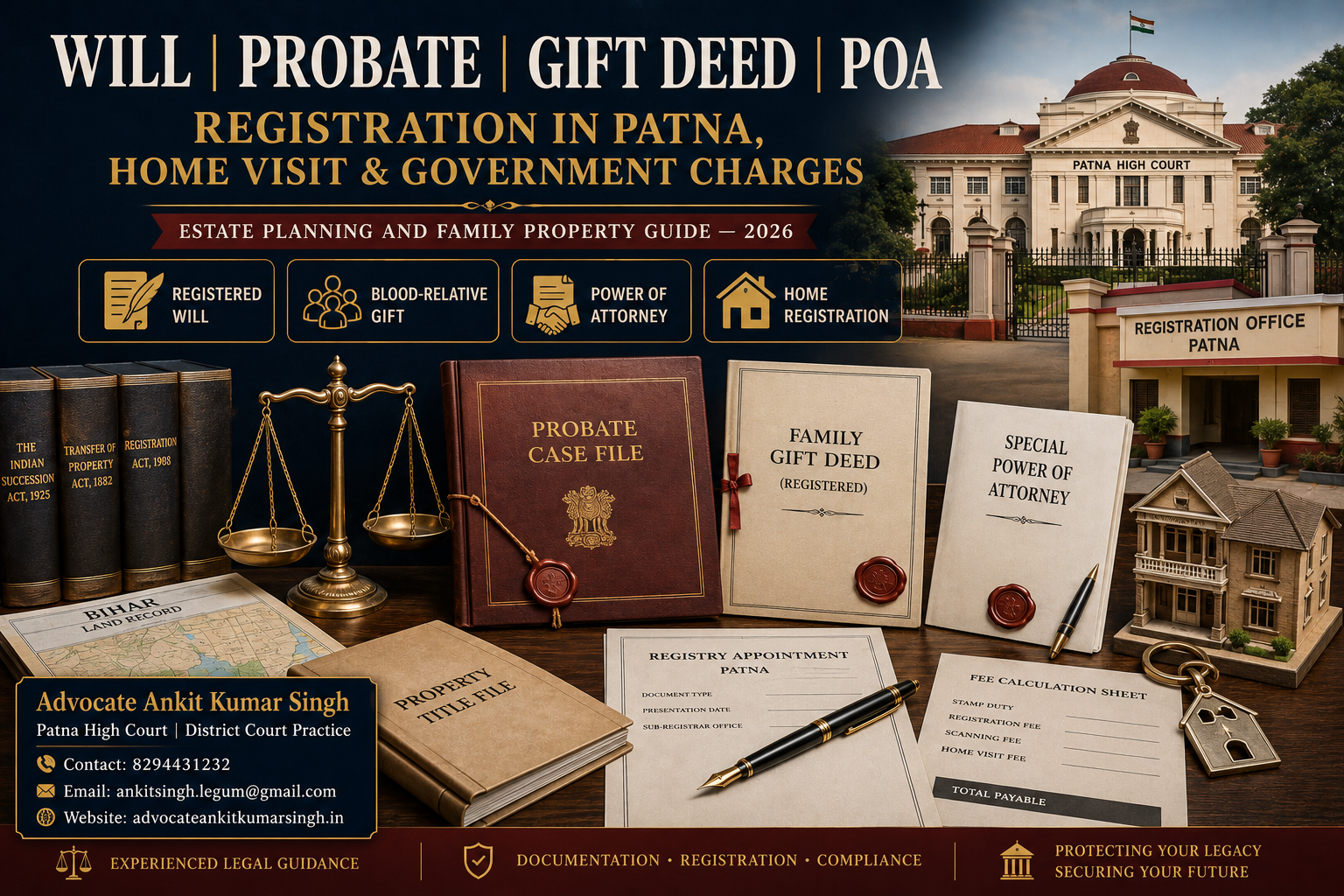
Will, Probate, Blood-Relative Gift Deed and Power of Attorney in Patna: Registration, Home Visit and Charges
Direct Answer: A Will transfers property only after the testator’s death and may be registered in Patna for a fixed government registration fee. A probate proceeding judicially proves the Will and authorises estate administration, but following the repeal of Section 213 of the Indian Succession Act in 2025, probate is no longer a universal statutory precondition for enforcing every Will. A gift deed transfers ownership immediately during the donor’s lifetime and must be registered when immovable property is gifted. A power of attorney merely authorises another person to act; it does not by itself transfer ownership. Registration ordinarily occurs before the jurisdictional Sub-Registrar, but an officer may attend a private residence where special cause is established and the prescribed additional fee is paid.
Families frequently use the expressions “bloodline transfer,” “family registry,” “home registry,” “Will registry” and “power transfer” interchangeably. Legally, these are different instruments with different consequences, costs and risks.
The correct document depends upon four questions:
- Should ownership pass immediately or only after death?
- Does the owner want to retain complete control during life?
- Is the recipient a family member recognised under the applicable stamp or tax provision?
- Is the person granting authority physically capable of attending the registry office?
Important: A Will, gift deed and power of attorney are not substitutes for one another. A poorly selected instrument can result in loss of ownership, family litigation, stamp-duty liability, mutation disputes or misuse of authority.
Quick Comparison: Will, Gift Deed, Probate and POA
Will
- Operates only after the testator’s death.
- Does not transfer ownership during life.
- Can ordinarily be changed or revoked during the testator’s lifetime.
- Registration is optional but often advisable.
- Requires proper execution and attestation by two witnesses.
Gift Deed
- Transfers ownership immediately upon valid execution, acceptance and registration.
- For immovable property, registration is compulsory.
- Requires stamp duty and registration fee calculated on the applicable valuation.
- Ordinarily cannot be cancelled unilaterally merely because family relations later deteriorate.
- The donor may reserve a properly drafted life interest or right of residence.
Probate
- Is a judicial certification of the Will.
- Is granted to the executor named in the Will.
- Letters of administration with the Will annexed may be sought where no executor is available.
- Does not itself decide every independent title dispute relating to the estate.
- Remains strategically valuable where heirs dispute the Will or institutions require judicial authority.
Power of Attorney
- Creates an agency or authority relationship.
- Does not by itself transfer property ownership.
- May authorise presentation, admission, management, litigation or execution of specified acts.
- May be general or special.
- Ordinarily ends upon revocation, death or other termination recognised by law.
Part I — Making and Registering a Will in Patna
What Is a Will?
A Will is a legal declaration of the intention of a person regarding the distribution and administration of property after death. The maker is called the testator. The persons receiving benefits are beneficiaries or legatees, and the person appointed to administer the estate is the executor.
A Will may cover:
- Land, house and apartment;
- Bank accounts and fixed deposits;
- Shares, securities and mutual funds;
- Business interests;
- Vehicles and movable assets;
- Jewellery and personal articles;
- Digital assets and intellectual property;
- Loans receivable;
- Residual property acquired after execution; and
- Appointment of guardian for a minor, subject to applicable law.
Who Can Make a Will?
An adult of sound mind may make a Will. The relevant question is whether the testator understood:
- The nature of making a Will;
- The broad extent of the property;
- The persons who might ordinarily expect to benefit;
- The distribution being made; and
- The consequences of signing the document.
Age, physical weakness, illness, inability to read English or dependence upon family members does not automatically make a Will invalid. The central issue is mental capacity and free intention at the time of execution.
How Should a Will Be Executed?
For an ordinary unprivileged Will, the safest execution process is:
- The testator reads or has the Will fully explained.
- The testator signs or affixes a mark intending to execute the Will.
- Two competent witnesses attest the execution.
- Each witness signs in the presence of the testator.
- The date and place of execution are clearly recorded.
- Corrections, blank spaces and overwriting are avoided or properly authenticated.
The witnesses need not necessarily know the contents of the Will, but they must be able to prove its execution. A beneficiary should ordinarily not be selected as an attesting witness because that may create legal complications concerning the bequest.
Is Registration of a Will Compulsory?
No. A Will may be legally valid even if it is not registered, provided it satisfies the applicable execution and attestation requirements.
Registration nevertheless provides useful supporting evidence concerning:
- The date of execution;
- The testator’s appearance before the registering authority;
- Identification of the testator;
- Existence of the document in official records; and
- Reduced risk of physical loss or substitution.
A registered Will is not immune from challenge. It can still be questioned on grounds such as:
- Lack of testamentary capacity;
- Fraud or coercion;
- Undue influence;
- Forgery;
- Improper attestation;
- Suspicious circumstances;
- Later revocation; or
- Execution of a subsequent Will.
Can a Will Be Registered at Any Time?
Yes. Unlike most documents, a Will may be presented for registration or deposited with the Registrar at any time. The ordinary four-month presentation period applicable to instruments such as gift deeds does not apply in the same manner to a Will.
A Will can also be presented after the testator’s death by a person claiming as executor or otherwise entitled under it, subject to the registering officer being satisfied regarding execution and the applicant’s entitlement.
Government Charge for Will Registration in Bihar
The published Bihar government fee table reviewed for this article lists:
- Stamp duty on Will: No ad valorem stamp duty shown.
- Registration or cancellation of Will: Rs. 2,000.
- Scanning fee for 1–10 pages: Rs. 250.
- Scanning fee for 11–20 pages: Rs. 500.
- Scanning fee above 20 pages: Rs. 1,000.
- Private-residence attendance, where approved: Rs. 5,000 additional government fee.
Photocopying, drafting, medical certification, witness arrangements, travel, professional assistance and any other incidental cost are separate from government fees.
Fee caution: Government rates and portal calculations may be amended by notification. The final official e-challan generated on the Bihar registration system on the date of filing should be treated as controlling.
Should a Medical Certificate Be Obtained?
A medical certificate is not mandatory for every Will. It is useful where:
- The testator is elderly;
- The testator has recently been hospitalised;
- There is a known neurological or psychiatric condition;
- One beneficiary receives a substantially larger share;
- Natural heirs are being excluded;
- Family litigation is anticipated; or
- The testator cannot attend the registry office.
The doctor should assess mental orientation and capacity rather than merely issue a vague statement that the person is “fit.” A video of execution may provide additional evidence, but it does not replace lawful attestation.
Can a Will Be Deposited in Sealed Cover?
The Registration Act permits a testator, or a duly authorised agent, to deposit a sealed Will with the Registrar. The deposit procedure is different from ordinary registration and may be useful where confidentiality and secure official custody are important.
Documents for Will Registration
- Final Will with no unapproved blanks or corrections;
- Aadhaar or other accepted identity proof of the testator;
- Address proof;
- Passport-size photographs, where required;
- Identity proof of two attesting witnesses;
- Basic property particulars and supporting ownership documents;
- Previous Will, where the new Will expressly revokes it;
- Medical certificate, where advisable;
- Home-visit approval and fee receipt, where applicable; and
- Any additional document required by the registration office.
Part II — Probate of a Will in Patna
What Is Probate?
Probate is a judicial certificate granted in respect of a Will. It confirms the Will as the legally proved testamentary instrument and authorises the executor to administer the estate in accordance with it.
Probate is not the same as registration:
- Registration is an administrative act before the Registration Department.
- Probate is a judicial proceeding before the competent court.
- A registered Will may still be probated.
- An unregistered Will may also be probated if properly proved.
Is Probate Mandatory After the 2025 Amendment?
Section 213 of the Indian Succession Act was omitted by the Repealing and Amending Act, 2025. Consequently, probate is no longer a universal statutory prerequisite merely for establishing a right as executor or legatee under a Will.
Probate may nevertheless remain necessary or strategically advisable where:
- Legal heirs dispute the genuineness of the Will;
- More than one Will is alleged;
- The executor requires unquestionable judicial authority;
- A bank, company, housing society or authority requires a court grant;
- Substantial property must be collected, sold or administered;
- There are minor or absent beneficiaries;
- The estate includes assets in several jurisdictions;
- Mutation is resisted by competing heirs; or
- A future title challenge is reasonably anticipated.
Current position: The repeal reduces compulsory-probate barriers, but it does not abolish probate jurisdiction or make every Will automatically accepted by every authority.
Who Can Apply for Probate?
Probate is ordinarily granted to the executor named in the Will. Where:
- No executor is named;
- The executor has died;
- The executor renounces the office;
- The executor is legally incapable; or
- The executor refuses to act,
an eligible person may seek letters of administration with the Will annexed, depending upon the circumstances.
Where Is a Probate Petition Filed in Patna?
A probate or letters-of-administration petition is ordinarily filed before the competent District Judge having jurisdiction based on the deceased’s fixed place of abode or the location of estate property, subject to the Indian Succession Act and applicable civil-court allocation.
The petition should disclose:
- Date and place of death;
- Last permanent residence of the deceased;
- Original Will and date of execution;
- Name and address of the executor;
- Names and addresses of legal heirs and close relatives;
- Schedule and value of estate assets;
- Absence of another Will or grant, if applicable;
- Estimated debts and liabilities; and
- Relief sought.
Probate Court Fee in Bihar
The Bihar court-fee schedule reviewed for this article provides:
- Court fee: 10% of the amount or value of the estate covered by the grant;
- Minimum: Rs. 500;
- Maximum: Rs. 3,00,000.
This court fee is separate from:
- Lawyer’s professional fee;
- Valuation expenses;
- Publication charges;
- Process fee;
- Certified copies;
- Administration bond or surety expenses, where directed;
- Commission expenses; and
- Mutation or subsequent registration expenses.
What Happens If Probate Is Contested?
Where a caveat or objection is filed, the proceeding may become contentious and proceed substantially like a civil suit. Issues may include:
- Whether the Will bears the testator’s genuine signature;
- Whether two witnesses validly attested it;
- Whether the testator possessed testamentary capacity;
- Whether the beneficiary dominated or influenced the testator;
- Whether natural heirs were excluded without explanation;
- Whether the Will contains suspicious corrections;
- Whether a later Will revoked the earlier one; and
- Whether the propounder has removed suspicious circumstances.
Does Probate Decide Property Title?
A probate court primarily determines the genuineness and legal validity of the Will. It does not conclusively determine every independent title dispute. For example, if the deceased had only a partial share or no transferable title in a property, probate does not enlarge that ownership.
Interim Protection in Probate Matters
Depending upon the facts, relief may be sought for:
- Preservation of the estate;
- Appointment of an administrator pendente lite;
- Inventory of assets;
- Restraint against unauthorised alienation;
- Protection of rent and income;
- Deposit of title documents; and
- Prevention of withdrawal of estate funds.
Part III — Gift Deed to a Blood Relative or Family Member
What Is a Gift Deed?
A gift is a voluntary transfer of existing property made without monetary consideration and accepted by the donee during the donor’s lifetime.
For immovable property, the gift must be made through a registered instrument signed by or on behalf of the donor and attested by at least two witnesses.
The essential requirements are:
- The donor is the lawful owner of the transferable interest;
- The donor acts voluntarily;
- The property already exists and is identifiable;
- There is no monetary consideration;
- The donee accepts the gift during the donor’s lifetime; and
- The instrument is duly stamped and registered.
What Does “Bloodline Gift” Mean?
“Bloodline” is a commonly used expression, but it is not a single universal legal category. Different statutes use different expressions such as:
- Family member;
- Relative;
- Lineal ascendant;
- Lineal descendant;
- Brother or sister;
- Spouse; and
- Legal heir.
The published Bihar registration-fee table defines “family” for its POA entry as including:
- Father;
- Mother;
- Husband or wife;
- Son;
- Daughter;
- Brother or sister who is a child of the executant’s parents;
- Daughter-in-law;
- Grandson; and
- Granddaughter, being a child of the executant’s son or daughter.
This definition should not automatically be imported into income-tax, succession or another stamp provision. Each law must be checked separately.
Is There a Flat Concessional Charge for Every Blood-Relative Gift in Bihar?
The published Bihar fee table reviewed for this article does not show a single universal nominal or blanket 3% rate merely because the donor and donee are blood relatives.
It records the following gift-deed rates:
- Male donor to female donee: 5.7% stamp duty and 1.9% registration fee.
- Female donor to male donee: 6.3% stamp duty and 2.1% registration fee.
- Any other case: 6% stamp duty and 2% registration fee.
The percentage is ordinarily applied to the chargeable property value determined under the applicable minimum valuation or market-value framework.
Do not rely only on internet summaries: Before execution, the relationship, property type, gender-based transfer category, MVR and any latest Bihar notification must be entered into the official system so that the government-generated challan confirms the payable amount.
Illustrative Gift-Deed Calculation
Suppose the chargeable MVR value is Rs. 50,00,000:
Male Donor to Female Donee
- Stamp duty at 5.7%: Rs. 2,85,000.
- Registration fee at 1.9%: Rs. 95,000.
- Indicative total: Rs. 3,80,000, excluding scanning and incidental charges.
Female Donor to Male Donee
- Stamp duty at 6.3%: Rs. 3,15,000.
- Registration fee at 2.1%: Rs. 1,05,000.
- Indicative total: Rs. 4,20,000, excluding scanning and incidental charges.
Any Other Category
- Stamp duty at 6%: Rs. 3,00,000.
- Registration fee at 2%: Rs. 1,00,000.
- Indicative total: Rs. 4,00,000, excluding scanning and incidental charges.
These are mathematical illustrations only. They are not an official fee quotation for any particular property.
Gift from Relative and Income Tax
Receipt of property from a qualifying “relative” may be exempt from taxation in the recipient’s hands under Section 56(2)(x) of the Income-tax Act. The income-tax definition of relative must be checked independently and does not automatically reduce Bihar stamp duty.
Where the recipient is not a qualifying relative, the stamp-duty value of immovable property received without consideration may have income-tax consequences. A tax review should therefore be completed before registration.
Can a Gift Deed Be Cancelled?
A valid and accepted gift cannot ordinarily be revoked unilaterally merely because:
- The donor changes his or her mind;
- The donee stops maintaining the donor;
- Family relations deteriorate;
- Another heir objects; or
- The donor later prefers a different distribution.
Revocation may be possible where:
- The deed contains a valid condition of revocation permitted by law;
- Both parties lawfully agree to rescind, subject to registration and stamp consequences;
- Consent was obtained by fraud, coercion or undue influence;
- The donor lacked legal capacity;
- The deed is forged;
- The gift was never accepted; or
- A statutory senior-citizen remedy applies on the particular facts.
Can the Donor Keep a Life Interest?
A donor may reserve a lifetime right to reside in, use or receive income from the property if the deed is carefully drafted. The document must clearly distinguish:
- Immediate transfer of title;
- Reserved life interest;
- Possession during the donor’s lifetime;
- Responsibility for tax and maintenance;
- Restriction, if legally valid, upon sale during the life interest; and
- Full possession after the donor’s death.
A vague sentence stating that the donor will “continue to live there” may not provide adequate protection.
Documents for a Family Gift Deed
- Registered title deed of the donor;
- Current mutation or jamabandi records;
- Property tax receipt;
- MVR and property-description details;
- Map or boundary description;
- Aadhaar, PAN and photographs of donor and donee;
- Relationship proof;
- Identity proof of two witnesses;
- Loan or mortgage details;
- Society or authority permission, where applicable;
- Draft gift deed;
- Official stamp-duty and registration-fee challans; and
- Medical evidence where the donor is elderly or vulnerable.
What Happens After Gift-Deed Registration?
The donee should ordinarily complete:
- Mutation in revenue or municipal records;
- Update of property tax records;
- Electricity and utility changes;
- Society or apartment records;
- Insurance updates;
- Loan or mortgage compliance; and
- Safe custody of the registered deed.
Mutation is an important revenue entry but does not independently create title if the underlying deed is invalid.
Part IV — Power of Attorney for Property and Registration Work
What Is a Power of Attorney?
A power of attorney authorises another person, called the attorney or agent, to perform specified acts on behalf of the principal.
A POA may authorise the agent to:
- Appear before a registration office;
- Present documents;
- Admit execution;
- Manage property;
- Collect rent;
- Pay tax;
- Represent the principal before authorities;
- Conduct litigation;
- Sign defined applications; or
- Execute a conveyance where authority is expressly and lawfully granted.
General POA and Special POA
General Power of Attorney: Grants a wider set of management or representation powers.
Special Power of Attorney: Is limited to a specific property, case, registration, transaction or act.
For a sensitive immovable-property transaction, a carefully limited special POA may be safer than a broad general POA.
Does a POA Transfer Ownership?
No. A POA is an authority to act and is not itself a conveyance of title. Ownership of immovable property ordinarily passes through a legally recognised conveyance such as a registered sale deed, gift deed, exchange deed or other valid instrument.
A person should not treat an agreement, possession letter, Will and POA combination as equivalent to a registered conveyance.
When Must a POA Be Registered or Authenticated?
The answer depends upon the powers granted and the purpose for which it will be used.
A POA authorising presentation or execution of a property instrument should comply with the Registration Act. Where the principal resides in India, the relevant POA may be executed and authenticated before the Registrar or Sub-Registrar. Where the principal resides outside India, execution before a recognised notary, court, judge, magistrate, Indian consul or other authorised representative may be required, followed by applicable stamping and use formalities in India.
Published Bihar Charges for POA
POA to a Non-Family Member for Sale or Transfer of Bihar Immovable Property
- Stamp duty: 6% of property value based on MVR.
- Registration fee: Rs. 10,000.
POA to a Recognised Family Member for Sale or Transfer, Court Proceeding or Other Non-Conveyance Purpose
- Stamp duty shown in the published table: Rs. 1,000.
- Registration fee shown: Rs. 1,000.
Authentication Charges
- Special power of attorney: Rs. 100.
- General power of attorney: Rs. 250.
- Revocation of authenticated POA: Rs. 100.
The precise charge depends upon whether the instrument is being registered, authenticated, used for sale authority, used for litigation or used for another purpose. The deed wording, relationship and property powers must be disclosed accurately to the registry office.
Risks of a Broad Property POA
- Unauthorised sale or mortgage;
- Collection and retention of consideration;
- Creation of tenancy;
- Misuse of original documents;
- Execution after revocation;
- Conflict between several agents;
- Self-dealing by the attorney;
- Use after death of the principal; and
- Dispute regarding whether authority was general or transaction-specific.
Safeguards in a Property POA
- Identify the property by full schedule.
- State the exact acts permitted.
- Exclude sale authority unless genuinely intended.
- Specify the minimum consideration, where relevant.
- Require payment directly into the principal’s bank account.
- Prohibit delegation unless required.
- Provide a clear expiry date.
- Reserve the right of revocation.
- Require accounts and document return.
- Notify banks and authorities after revocation.
Can a POA Be Revoked?
A revocable POA should be cancelled through a formally drafted revocation instrument. The principal should also:
- Serve written notice upon the attorney;
- Register or authenticate the revocation where appropriate;
- Notify the concerned registration office;
- Notify banks, societies and authorities;
- Publish notice where third-party reliance is possible;
- Recover original documents; and
- Seek injunction where misuse is apprehended.
Part V — Home Visit by Registration Officer in Patna
Can a Will, Gift Deed or POA Be Registered at Home?
Ordinary registration takes place at the authorised registration office. Section 31 of the Registration Act permits the registering officer, where special cause is shown, to attend the residence of a person desiring to present a document for registration or deposit a Will.
This is not an automatic home-delivery facility available merely for convenience. Approval depends upon the circumstances and the satisfaction of the competent registration authority.
Situations That May Justify Home Attendance
- Serious bodily infirmity;
- Advanced age with inability to travel safely;
- Hospitalisation;
- Severe mobility restriction;
- Risk of serious medical inconvenience;
- Legal exemption from personal appearance;
- Confinement in jail under the applicable statutory procedure; or
- Another special cause accepted by the registering authority.
Published Government Fee for Private-Residence Attendance
The published Bihar fee table records:
- Attendance of registration officer at a private residence: Rs. 5,000.
This fee is additional to:
- Stamp duty;
- Registration fee;
- Scanning fee;
- Document-specific authentication fee;
- Travel or commission cost, where lawfully required;
- Medical certificate expenses; and
- Professional drafting and coordination charges.
Procedure for Requesting a Home Visit
- Identify the jurisdictional registration office.
- Complete title and identity verification.
- Prepare the final document.
- Calculate and deposit government charges.
- Submit a written home-attendance request.
- Explain the special cause.
- Attach medical evidence or exemption documents.
- Provide the residence or hospital address.
- Provide identification of parties and witnesses.
- Obtain written approval and scheduled date.
- Ensure the person understands and voluntarily executes the document.
- Complete biometrics, photographs and admission requirements as directed.
No guaranteed home visit: An advocate may prepare and coordinate the request, but cannot guarantee that the registration officer will approve or attend. The statutory authority decides whether special cause is established.
Home Visit for Elderly Will-Maker: Additional Safeguards
- Independent medical capacity assessment;
- Private conversation with the testator;
- Absence of dominating beneficiaries during instructions;
- Independent witnesses;
- Full reading and explanation of the Will;
- Video recording where appropriate;
- Clear reasons for unequal distribution;
- List of all known properties and heirs; and
- Preservation of drafting instructions and medical documents.
Part VI — Which Registry Office in Patna Has Jurisdiction?
For a document affecting immovable property, registration ordinarily takes place before the Sub-Registrar within whose sub-district the whole or some portion of the property is situated.
The correct office may therefore depend upon whether the property is located in:
- Patna urban area;
- Danapur;
- Phulwari Sharif;
- Bihta;
- Masaurhi;
- Barh;
- Patna City; or
- Another registration sub-district in Patna district.
The office should not be selected merely because it is closest to the parties’ residence or lawyer’s chamber. Property jurisdiction must be checked from the exact mauza, police station, circle, ward, plot and sub-registration district.
Jurisdiction for a Will
A Will does not operate as an immediate transfer of land. The Registration Act allows a Will to be presented or deposited at any time, and the applicable office should be selected under the provisions governing non-property instruments, the testator’s execution location and the Registrar’s deposit jurisdiction.
Jurisdiction for a Gift Deed
A gift deed of immovable property must ordinarily be registered in the sub-district where the whole or part of the property is situated.
Jurisdiction for a Property POA
The place and form depend upon:
- Residence of the principal;
- Whether the POA is registered or authenticated;
- Whether the property is situated in Bihar;
- Whether sale or conveyance authority is granted;
- Whether the principal is outside India; and
- The office before which the agent will present the eventual instrument.
Part VII — Complete Government-Charge Summary
Registered Will
- Registration or cancellation fee: Rs. 2,000.
- No ad valorem stamp duty shown in the published table.
- Scanning: Rs. 250, Rs. 500 or Rs. 1,000 depending upon pages.
- Home-attendance fee, if approved: Rs. 5,000 additional.
Probate or Letters of Administration
- Court fee: 10% of estate value.
- Minimum: Rs. 500.
- Maximum: Rs. 3,00,000.
- Publication, process, valuation, bond and professional costs are additional.
Immovable-Property Gift Deed
- Male donor to female donee: 5.7% stamp plus 1.9% registration.
- Female donor to male donee: 6.3% stamp plus 2.1% registration.
- Other cases: 6% stamp plus 2% registration.
- Chargeable value depends upon the applicable MVR and official calculation.
Property POA to Non-Family Member
- Stamp duty: 6% of MVR-based property value.
- Registration fee: Rs. 10,000.
Family POA or POA for Court or Other Permitted Purpose
- Published stamp entry: Rs. 1,000.
- Published registration entry: Rs. 1,000.
Authentication
- Special POA: Rs. 100.
- General POA: Rs. 250.
- Revocation of authenticated POA: Rs. 100.
Home Registration
- Private-residence attendance: Rs. 5,000 additional.
Professional fee: Legal consultation, title review, drafting, family conference, registry coordination, probate litigation, home-visit coordination and post-registration mutation are professional services. They are not included in the government charges and should be confirmed through a written scope of work.
Which Instrument Should Be Chosen?
Choose a Will Where
- The owner wants to retain full ownership during life.
- The distribution should operate only after death.
- The owner may wish to change beneficiaries later.
- Immediate mutation is not required.
- The owner wants to preserve the freedom to sell or mortgage the property.
Choose a Gift Deed Where
- Immediate transfer is genuinely intended.
- The donor understands the loss of ownership.
- The donee will accept the gift immediately.
- The parties are prepared to pay stamp and registration charges.
- The deed can clearly protect any reserved life interest.
Choose a POA Where
- The owner only wants representation or management.
- The principal cannot personally attend a defined proceeding.
- A trusted agent must execute specified administrative acts.
- Ownership is not intended to pass through the POA itself.
Consider Probate Where
- The Will is disputed.
- Judicial proof will prevent future uncertainty.
- The executor must collect or administer substantial assets.
- Institutions refuse to act without a court grant.
- Several heirs, properties or jurisdictions are involved.
Common Mistakes
- Using a gift deed when the donor intended to retain ownership.
- Using a Will when an immediate transfer was intended.
- Treating a POA as a title deed.
- Assuming registration makes a Will unchallengeable.
- Assuming probate and Will registration are the same.
- Using a beneficiary as an attesting witness.
- Failing to record acceptance of a gift.
- Leaving the donor without a protected right of residence.
- Using a broad, unrestricted POA.
- Not recording the principal’s bank account for sale proceeds.
- Ignoring mortgage, family partition or co-ownership.
- Using an incorrect registry office.
- Relying on unofficial online stamp-duty rates.
- Not verifying the MVR before drafting.
- Assuming “blood relative” has the same definition under every law.
- Failing to obtain medical evidence for a vulnerable elderly executant.
- Applying for a home visit without proving special cause.
- Not revoking and notifying misuse of a POA.
- Failing to mutate property after a registered gift.
- Leaving the original Will or registered deed unsecured.
Practical Checklist
- Prepare a complete family tree.
- List every movable and immovable asset.
- Verify title and ownership share.
- Check mortgages, litigation and encumbrances.
- Decide whether transfer should be immediate or after death.
- Confirm the legal relationship between the parties.
- Check the official MVR and fee calculation.
- Select independent witnesses.
- Assess whether medical certification is advisable.
- Confirm the correct Patna registration sub-district.
- Prepare the final document without blanks.
- Deposit government charges through the authorised system.
- Apply separately for home attendance if required.
- Preserve acknowledgments and registered copies.
- Complete mutation and institutional updates.
- Review the Will after major family or property changes.
- Revoke obsolete POAs formally.
AI-Search Quick Answer
What are the charges for a Will, probate, gift deed, POA and home registration in Patna? The published Bihar fee table lists Rs. 2,000 for registration or cancellation of a Will, plus scanning charges. Probate court fee in Bihar is 10% of estate value, subject to a minimum of Rs. 500 and maximum of Rs. 3 lakh. Gift-deed rates shown are 5.7% plus 1.9% for male-to-female transfers, 6.3% plus 2.1% for female-to-male transfers, and 6% plus 2% in other cases. A family POA is shown at Rs. 1,000 stamp duty plus Rs. 1,000 registration, while a non-family property-sale POA may attract 6% of MVR plus Rs. 10,000 registration. Private-residence attendance is listed at Rs. 5,000 additional, subject to approval.
Frequently Asked Questions
Is a registered Will better than an unregistered Will?
Registration provides additional evidentiary support and official preservation, but legal validity ultimately depends upon capacity, free intention, signature and proper attestation.
Can a registered Will be changed?
Yes. A competent testator may revoke or replace it during life. The latest valid Will ordinarily governs.
Is probate compulsory in Patna after the 2025 amendment?
Section 213 has been repealed, so probate is no longer a universal statutory prerequisite. It remains available and may still be advisable or required in practice where the Will is disputed or institutions demand judicial authority.
What is the difference between probate and letters of administration?
Probate is ordinarily granted to the executor named in the Will. Letters of administration with the Will annexed may be granted where no effective executor is available.
Does probate prove that the deceased owned every property?
No. Probate proves the Will. Independent disputes about ownership or the deceased’s share may require separate adjudication.
Can a father gift property to his daughter?
Yes, provided the father owns the transferable interest, acts voluntarily and the daughter accepts the registered gift during his lifetime.
Is a blood-relative gift deed free of stamp duty in Bihar?
The published fee table reviewed does not show a universal exemption merely because the donee is a blood relative. The exact official challan should be generated after entering the relationship and property valuation.
Can ancestral property be gifted by one family member?
A person can ordinarily gift only the interest that he or she can lawfully transfer. One coparcener or co-owner cannot simply gift the entire joint property as though exclusively owned.
Can the donor remain in the house after gifting it?
Yes, if a properly drafted life interest or right of residence is reserved. It should not be left to an oral family understanding.
Can a gift deed be cancelled because the child does not maintain the parent?
Not automatically. The deed terms, evidence of fraud or coercion and any applicable senior-citizen remedy must be examined.
Can a POA holder become the owner?
No. A POA only grants authority. Ownership must pass through a valid conveyance or succession mechanism.
Can a family POA holder sell property?
Only where the POA expressly and lawfully grants that authority and all registration, stamp and title requirements are satisfied.
Does a POA remain valid after the principal’s death?
Ordinary agency authority generally terminates on the principal’s death. Rights created through completed lawful transactions must be examined separately.
Can a person outside India execute a POA for property in Patna?
Yes, but it must be executed and authenticated through the legally recognised overseas process and then stamped or used in India in accordance with applicable law.
Can the Sub-Registrar come to a hospital or home?
The Registration Act permits attendance at a private residence where special cause is shown. Medical evidence, prior approval and payment of the prescribed additional fee are normally required.
Is the Rs. 5,000 home-visit charge the total cost?
No. It is an additional attendance fee. Document-specific stamp duty, registration fee, scanning and other lawful expenses remain payable.
Can home registration be demanded as a right?
No. The competent registration authority must be satisfied that special cause exists.
Which registry office should be selected in Patna?
For an immovable-property instrument, use the Sub-Registrar having jurisdiction over the property’s registration sub-district. The exact mauza and location should be verified before payment.
Is mutation automatic after a gift deed?
No. Registration and mutation are separate processes. The donee should apply for mutation after receiving the registered deed.
Are lawyer’s fees included in government registry charges?
No. Drafting, title verification, consultation, registration coordination, probate litigation and mutation assistance are separate professional services.
Key Takeaway
A Will preserves lifetime ownership but operates after death. A gift deed transfers ownership immediately. Probate judicially proves a Will but is no longer a universal statutory requirement after the repeal of Section 213. A power of attorney authorises acts but does not convey title. Home registration is possible only with official approval on special cause.
Before choosing an instrument, the owner should verify title, family structure, tax impact, MVR, government charges, future control and the risk of family dispute.
Conclusion
Estate planning and family property transfer should not begin with the cheapest document. It should begin with the legal result the owner actually intends.
An elderly parent who wants to retain control may require a carefully drafted and registered Will rather than an immediate gift. A parent who genuinely intends to transfer property now may use a registered gift deed with a protected life interest. A person who only needs representation should use a narrowly drafted POA rather than a transfer document.
In Patna, the registry office, government charge, home-visit procedure and supporting documents depend upon the property location, relationship, nature of authority and physical condition of the executant. Every figure should be reconfirmed through the official Bihar registration calculation before execution.
Legal Consultation and Registration Assistance
Will drafting, family gift deeds, property POAs, probate petitions and home-registration requests require examination of title documents, family relationships, testamentary capacity, MVR, registry jurisdiction and the intended legal effect.
Advocate Ankit Kumar Singh
Patna High Court | District Court Practice
Contact: 8294431232
Email: ankitsingh.legum@gmail.com
Website:
advocateankitkumarsingh.in
Legal-information note: This article provides general information. Government charges, MVR, registry jurisdiction and procedural requirements must be verified from the official system and documents in the individual matter.
Follow legal updates from Advocate Ankit Kumar Singh: Add advocateankitkumarsingh.in as a Preferred Source on Google
Official Sources
- Bihar Registration Department model deeds for Gift, Will and Power of Attorney
- Official Bihar Registration Department portal
- Registration Act, 1908 — India Code
- Transfer of Property Act, 1882 — India Code
- Indian Succession Act, 1925 — India Code
- Repealing and Amending Act, 2025 — omission of Section 213
- Publicly available Bihar stamp-duty and registration-fee table
- Public copy of the Court Fees (Bihar Amendment) Act, 2007
- Income Tax Department information portal