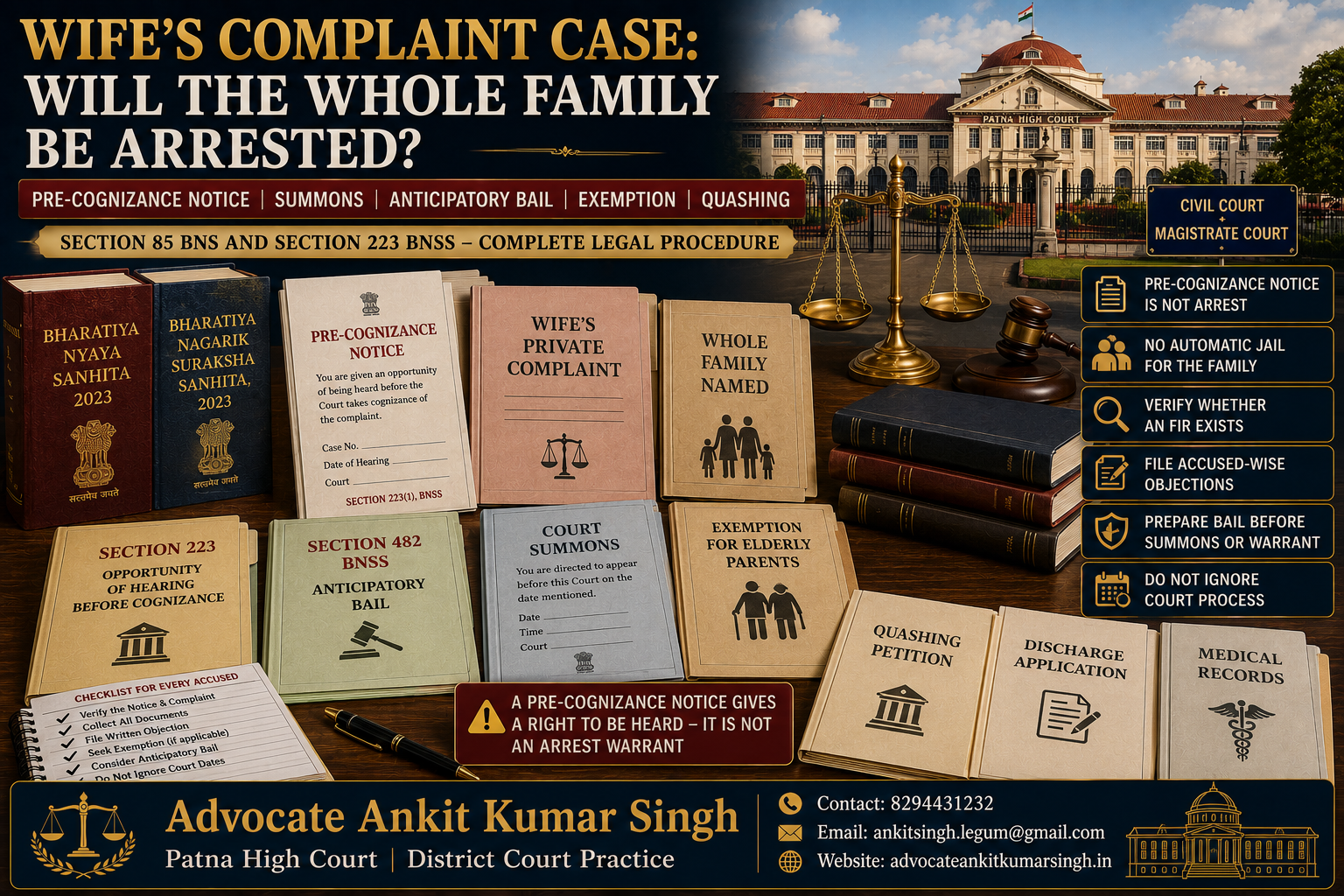
Pre-Cognizance Notice in Wife’s Complaint Case: Can the Husband and Whole Family Be Arrested?
Direct Answer: No. Merely receiving a pre-cognizance notice in a private complaint filed by the wife does not mean that the husband, parents, sisters, brothers or other relatives will be arrested or sent to jail. A pre-cognizance notice under Section 223 BNSS gives the proposed accused an opportunity to explain why cognizance should not be taken. At that stage, the Magistrate has not yet finally summoned the recipients to face trial. Arrest becomes a separate issue only if there is a parallel police FIR, the court later issues a warrant, the accused ignores summons and warrants, or the court requires appearance in a non-bailable offence and bail protection has not been obtained.
The safest response is not to panic and not to ignore the notice. Every person named should obtain the complete complaint, identify the exact allegation against him or her, file a role-specific written objection, preserve residence and documentary evidence, and prepare anticipatory-bail or appearance strategy before the court passes the next order.
Most important clarification: Pre-cognizance notice, court summons, police notice, arrest warrant and Domestic Violence Act notice are five different documents. Their legal consequences are not the same.
What Is Usually Meant by “Wife’s Complaint Case”?
A wife may use several legal routes after matrimonial separation, a divorce notice or an alleged incident of cruelty.
1. Private Criminal Complaint Before the Magistrate
The wife directly files a complaint alleging offences such as:
- Section 85 BNS — cruelty by husband or relatives;
- Section 316 BNS — criminal breach of trust concerning jewellery or stridhan, depending upon the allegations;
- Dowry Prohibition Act offences;
- Voluntarily causing hurt;
- Criminal intimidation;
- Insult or abusive conduct;
- Forgery or fabrication; or
- Other offences based upon the facts alleged.
The Magistrate then follows the complaint procedure under Sections 223 to 227 BNSS.
2. Police Complaint or FIR
The wife may approach the police. If a cognizable offence is registered, the police may investigate under the BNSS.
This route creates police-arrest exposure, although arrest is not supposed to be automatic.
3. Application Seeking Police Investigation
The wife may ask the Magistrate to direct police investigation under Section 175(3) BNSS. If investigation is ordered and an FIR is registered, the matter changes from a pure private complaint into a police-investigation case.
4. Domestic Violence Act Application
An application under Section 12 of the Domestic Violence Act generally seeks civil-protective relief such as residence, protection, maintenance, compensation or custody.
A notice in a Domestic Violence Act proceeding is not ordinarily an arrest warrant. Criminal exposure may arise separately if a protection order is later violated or another criminal offence is alleged.
5. Divorce, Maintenance or Custody Proceeding
These proceedings do not themselves authorise criminal arrest. Their summons require appearance and a legal response before the Family Court or competent forum.
What Is Section 85 BNS?
Section 85 BNS punishes a husband or relative of the husband who subjects a married woman to cruelty.
Section 86 defines cruelty broadly in two categories:
- Wilful conduct likely to drive the woman to suicide or cause grave injury or danger to her life, limb or physical or mental health; and
- Harassment intended to coerce her or a related person to meet an unlawful demand for property or valuable security, or harassment because the demand was not met.
Section 85 carries imprisonment up to three years and fine.
It is:
- Conditionally cognizable;
- Non-bailable;
- Triable by a Magistrate of the First Class; and
- A warrant-case offence because the maximum imprisonment exceeds two years.
Read the Bharatiya Nyaya Sanhita, 2023
Who May File a Section 85 BNS Complaint?
Section 220 BNSS permits cognizance on:
- A police report;
- A complaint by the aggrieved wife;
- A complaint by her father, mother, brother or sister;
- A complaint by her father’s or mother’s brother or sister; or
- With the court’s leave, another person related to her by blood, marriage or adoption.
What Is a Pre-Cognizance Notice?
A pre-cognizance notice is issued before the Magistrate finally takes cognizance of the complaint.
The first proviso to Section 223(1) BNSS states that cognizance should not be taken without giving the proposed accused an opportunity of being heard.
The notice therefore means:
- The wife has filed a complaint;
- Your name appears as a proposed accused;
- The court has not yet finally decided to summon you for trial;
- You may oppose cognizance;
- You may point out that no offence is made out against you;
- You may identify jurisdictional or procedural defects; and
- You may distinguish the roles of individual family members.
Does Pre-Cognizance Notice Mean Arrest?
No.
A pre-cognizance notice is not:
- A police-arrest notice;
- A summons to face trial after cognizance;
- A bailable warrant;
- A non-bailable warrant;
- A proclamation;
- An order rejecting bail; or
- A direction to take the whole family into custody.
At this stage, there is ordinarily no occasion for the court to send the family to jail merely because they have appeared to oppose cognizance.
Can Police Arrest During the Pre-Cognizance Stage?
In a pure private complaint, the complaint itself does not authorise police arrest.
Police-arrest risk may nevertheless arise if:
- A separate FIR has already been registered;
- The Magistrate directs investigation under Section 175(3) BNSS;
- The wife has filed a parallel police complaint resulting in an FIR;
- Another cognizable offence is separately under investigation; or
- A lawful court warrant has been issued.
Therefore, the first task is to verify whether only a complaint case exists or whether a parallel FIR has also been registered.
Supreme Court’s 2026 Position on Pre-Cognizance Hearing
The Supreme Court has held that the first proviso to Section 223(1) BNSS:
- Creates a substantive right;
- Forms part of fair-trial protection under Article 21;
- Uses mandatory language;
- Requires an opportunity of hearing before cognizance; and
- Makes a non-compliant cognizance order vulnerable as void from inception where the BNSS applies.
Read the Supreme Court judgment on Section 223 BNSS
What Should Be Done Immediately After Receiving the Notice?
Step 1: Verify the Document
Check:
- Name of the court;
- Complaint-case number;
- Name of the complainant;
- Names of all proposed accused;
- Sections mentioned;
- Date of hearing;
- Whether personal appearance is directed;
- Whether appearance through counsel is permitted;
- Whether the complaint is enclosed; and
- Whether any FIR number is mentioned.
Step 2: Obtain the Complete Complaint
Secure:
- Complaint petition;
- Affidavit;
- Verification statement;
- Documents and photographs;
- Medical papers;
- Chats and electronic records;
- Earlier police complaints;
- Divorce notice and reply;
- Witness statements; and
- Previous court orders.
Step 3: Confirm Whether a Parallel FIR Exists
Make a separate inquiry through:
- Police station;
- District court case-search system;
- State police portal;
- Certified-copy inspection;
- Notice or summons received; and
- Lawyer’s verification of court records.
Step 4: Prepare an Accused-Wise Allegation Chart
For every person named, record:
- Exact allegation;
- Date and place of alleged incident;
- Specific words or act attributed;
- Specific dowry demand, if any;
- Whether the person lived with the couple;
- Whether the person was present at the alleged place;
- Age and medical condition;
- Employment or residence elsewhere;
- Whether any property was entrusted; and
- Whether the allegation is merely collective.
Step 5: Preserve Defence Documents
- Aadhaar and address proof;
- Rental agreements;
- Employment records;
- Marriage proof of separately residing sisters;
- Passport and travel history;
- Medical papers of elderly parents;
- Bank records;
- Chats and emails;
- Previous complaints and mediation records;
- Proof of return of articles; and
- Divorce or matrimonial pleadings.
What Should Be Filed at the Pre-Cognizance Stage?
A detailed written objection may seek:
- Refusal to take cognizance;
- Dismissal of the complaint;
- Exclusion of relatives against whom no offence is disclosed;
- Further inquiry under Section 225 BNSS;
- Verification of residence and documentary records;
- Consideration of territorial jurisdiction;
- Consideration of limitation;
- Consideration of contradictions in earlier proceedings;
- Accused-wise determination of allegations; and
- A reasoned order before issuance of process.
Grounds That May Be Raised Before Cognizance
- No ingredients of Sections 85 and 86 BNS are disclosed.
- No specific act is attributed to a particular relative.
- No date, place or words of alleged demand are stated.
- The relative lived separately throughout the marriage.
- The person was outside the city, State or country.
- The complaint collectively uses “all accused” without individual particulars.
- The accused is not legally a relative of the husband for Section 85.
- No property or stridhan was entrusted to that accused.
- The court lacks territorial jurisdiction.
- The complaint is barred by limitation.
- The complainant is not authorised under Section 220 BNSS.
- Mandatory Section 223 procedure has not been followed.
- Earlier sworn pleadings materially contradict the complaint.
- The allegation is inherently impossible.
- Unimpeachable records conclusively disprove presence or involvement.
Should the Entire Family File One Common Reply?
A common factual introduction may be used, but each accused should have a separate role-specific defence.
The position of:
- The husband;
- The mother-in-law;
- The father-in-law;
- A married sister living elsewhere;
- A brother working in another State;
- An elderly relative; and
- A distant family member
cannot be treated as identical.
Can the Court Dismiss the Complaint Before Summons?
Yes. Under Section 226 BNSS, the Magistrate may dismiss the complaint where there is no sufficient ground for proceeding and must briefly record reasons.
The court may also:
- Take cognizance against the husband only;
- Take cognizance against specific relatives only;
- Decline cognizance against remotely connected relatives;
- Order further inquiry under Section 225; or
- Issue process against all persons where sufficient grounds are found.
What Happens Under Section 225 BNSS?
The Magistrate may postpone process and:
- Conduct an inquiry personally;
- Examine witnesses on oath;
- Direct limited investigation; and
- Determine whether sufficient grounds exist.
Where an accused resides outside the Magistrate’s territorial jurisdiction, postponement and inquiry are mandatory under the statutory language.
What Happens After Cognizance?
If the Magistrate finds sufficient grounds, process may be issued under Section 227 BNSS.
For a Summons-Case
The Magistrate issues summons.
For a Warrant-Case
The Magistrate may:
- Issue a summons; or
- Issue a warrant where legally justified.
Because Section 85 BNS carries imprisonment up to three years, it is a warrant-case. This does not mean that a warrant must invariably be issued first.
What Is a Court Summons?
A summons directs the accused to appear on a specified date.
It does not mean:
- The accused has been convicted;
- Arrest has already been ordered;
- The entire family will be jailed;
- Bail will necessarily be refused; or
- The complaint has been finally proved.
A written complaint summons should ordinarily be accompanied by a copy of the complaint.
Can the Family Be Arrested After Receiving Summons?
A summons itself is not an arrest warrant. However, Section 85 BNS is non-bailable, and the appearance and bail strategy should be prepared before the hearing.
The court may consider:
- Voluntary appearance;
- Whether summons was obeyed;
- Nature of allegations;
- Whether any warrant exists;
- Whether anticipatory bail has been granted;
- Age, illness and residence of the accused;
- Risk of absconding;
- Witness-influence risk; and
- Additional serious offences in the complaint.
Practical rule: Do not walk into court assuming that a non-bailable complaint summons can never result in custody. Obtain case-specific advice and prepare bail papers, sureties and exemption applications beforehand.
What Is Anticipatory Bail?
Section 482 BNSS permits a person who reasonably apprehends arrest for a non-bailable offence to approach the Court of Session or High Court for a direction that, in the event of arrest, the person be released on bail.
Anticipatory bail may be considered:
- After a complaint is filed;
- After pre-cognizance notice;
- After cognizance;
- After summons;
- Before execution of a warrant; and
- At any point before actual arrest, subject to the case status and judicial principles.
Where a person is already arrested, the remedy is regular bail rather than anticipatory bail.
Read the Bharatiya Nagarik Suraksha Sanhita, 2023
Should Anticipatory Bail Be Filed Immediately After Pre-Cognizance Notice?
Not automatically in every case. The decision depends upon:
- Whether a parallel FIR exists;
- Whether the complaint contains serious additional offences;
- Whether the Magistrate may issue a warrant;
- Whether the accused lives outside the State;
- Whether earlier summons were ignored;
- Whether the wife alleges violence, threats or retention of stridhan;
- Whether police investigation has been ordered; and
- Whether immediate custody is genuinely apprehended.
Where there is no FIR and only a pre-cognizance hearing is pending, the first remedy may be a strong Section 223 objection. Anticipatory bail may nevertheless be prepared or filed where the facts show a real arrest risk.
Can Anticipatory Bail Protect Against a Court Warrant?
Where anticipatory bail is granted, Section 482 BNSS provides that if the Magistrate later decides to issue a warrant in the first instance on the same accusation, the warrant should be bailable in conformity with the anticipatory-bail direction.
Anticipatory bail does not permit the accused to disregard court dates or remain absent without exemption.
What Happens If Summons Is Ignored?
Repeated non-appearance may lead to:
- Fresh summons;
- Bailable warrant;
- Non-bailable warrant;
- Bond forfeiture;
- Proclamation proceedings;
- Attachment consequences; and
- Greater difficulty in obtaining anticipatory bail.
The strongest protection is timely appearance or a lawful exemption order—not disappearance.
What Is a Bailable Warrant?
A bailable warrant authorises arrest but permits release upon furnishing the bail amount and surety specified in the warrant.
The accused should move promptly for:
- Recall of the warrant;
- Acceptance of appearance;
- Bail;
- Explanation of previous absence; and
- Exemption for future routine dates.
What Is a Non-Bailable Warrant?
A non-bailable warrant authorises arrest and production before the court. It does not mean bail can never be granted.
Possible remedies include:
- Application to recall or cancel the warrant;
- Anticipatory bail before arrest, depending upon the stage and circumstances;
- Surrender with regular bail;
- Challenge to the process order;
- Revision or High Court proceedings; and
- Exemption for accused facing genuine hardship.
Whole Family Named: Will Everyone Be Arrested Together?
No rule requires collective arrest merely because several relatives are named in one paragraph.
For each accused, the court and investigating agency should separately examine:
- The relationship with the husband;
- Specific role;
- Residence;
- Date and place of alleged act;
- Nature of alleged demand;
- Entrustment or possession of property;
- Age and medical condition;
- Criminal antecedents;
- Possibility of absconding; and
- Need for custody.
A complaint cannot lawfully convert a family relationship into automatic criminal liability.
Latest Supreme Court Position on Omnibus Family Allegations
The Supreme Court has repeatedly cautioned that:
- Every relative should not be implicated only because of relationship with the husband;
- Vague and sweeping allegations require careful judicial scrutiny;
- Separately residing relatives should not face trial without a specific role;
- The court must examine allegations against each person individually; and
- Criminal process should not become an instrument of pressure in matrimonial disputes.
Read Dara Lakshmi Narayana v. State of Telangana
However, family members are not immune merely because they live separately. Quashing or bail becomes more difficult where the complaint attributes:
- A specific dowry demand;
- A particular assault;
- A threat on an identifiable date;
- Retention of specified jewellery;
- Active participation in cruelty; or
- Documented communication supporting the allegation.
Arnesh Kumar Protection Against Automatic Arrest
The Supreme Court in Arnesh Kumar v. State of Bihar directed police not to make automatic arrests in offences such as Section 498A IPC merely because the offence is cognizable and non-bailable.
Police must examine whether arrest is necessary for purposes such as:
- Proper investigation;
- Preventing further offence;
- Preventing destruction of evidence;
- Preventing threats or inducement to witnesses; or
- Ensuring appearance before the court.
Read Arnesh Kumar v. State of Bihar
This protection is principally relevant where police investigation and arrest without warrant are involved. In a pure private complaint, arrest ordinarily depends upon court process rather than an investigating officer making an automatic arrest.
Protection for Elderly Parents
Elderly parents should consider:
- Role-specific Section 223 objection;
- Medical records;
- Separate-residence proof;
- Anticipatory bail where arrest is genuinely apprehended;
- Exemption under Section 228 BNSS;
- Appearance through an advocate;
- Video appearance where permitted;
- Quashing for vague allegations; and
- Early discharge.
Protection for Married Sisters and Brothers Living Elsewhere
Relevant documents include:
- Marriage certificate;
- Separate household records;
- Employment attendance;
- Rent or ownership papers;
- Children’s school records;
- Travel records;
- Passport entries; and
- Bank and communication records.
Exemption From Personal Appearance
Section 228 BNSS allows the Magistrate, when issuing summons, to dispense with personal attendance and permit appearance through an advocate.
Exemption may be sought for:
- Elderly parents;
- Seriously ill accused;
- Pregnant accused;
- Persons living in another State;
- Persons working abroad;
- Persons with disability;
- Married sisters with no day-to-day role; and
- Routine dates where personal presence serves no purpose.
The court may still direct personal appearance at an important stage.
Can the Cognizance or Summoning Order Be Challenged?
Yes. Depending upon the defect, possible remedies include:
- Application before the Magistrate where legally maintainable;
- Criminal revision;
- Petition under Section 528 BNSS before the High Court;
- Petition under Articles 226 and 227; and
- Special leave before the Supreme Court in an appropriate case.
Possible grounds include:
- No Section 223 hearing;
- No accused-wise application of mind;
- No sufficient ground for proceeding;
- No inquiry for accused living outside jurisdiction;
- No ingredients of the alleged offence;
- Omnibus allegations;
- Territorial-jurisdiction defect;
- Limitation;
- Unreasoned process order;
- Impossible or demonstrably false allegations; and
- Abuse of criminal process.
Can the High Court Quash the Complaint Against Family Members?
Yes, under Section 528 BNSS where continuation would constitute abuse of process or where no offence is disclosed.
Quashing may be considered where:
- No specific allegation exists;
- The relative lived permanently elsewhere;
- The complaint only reproduces stereotyped language;
- No date, place or demand is identified;
- Unimpeachable records disprove involvement;
- The person does not fall within the legal relationship required;
- The court lacks jurisdiction;
- Mandatory pre-cognizance safeguards were ignored; or
- The proceeding is manifestly malicious or legally barred.
Quashing is not ordinarily granted merely because:
- The accused denies the allegations;
- The complaint followed a divorce notice;
- The marriage has broken down;
- No independent witness is presently shown; or
- The defence version appears more probable.
What Happens After Appearance?
In a private complaint warrant case, the procedure ordinarily includes:
- Appearance and bail or bond orders;
- Supply or inspection of complaint material;
- Prosecution evidence before charge under Section 267 BNSS;
- Cross-examination by the accused;
- Discharge consideration under Section 268 BNSS;
- Framing of charge under Section 269 BNSS if the accused is not discharged;
- Recall and further cross-examination of prosecution witnesses;
- Defence evidence;
- Final arguments; and
- Acquittal or conviction.
Discharge Under Section 268 BNSS
The Magistrate should discharge the accused where the prosecution evidence before charge does not establish a case which, if unrebutted, would warrant conviction.
Discharge may be particularly important for:
- Remotely related family members;
- Relatives against whom witnesses give no specific evidence;
- Persons whose alleged presence is disproved;
- Persons with no entrustment of property;
- Persons added only through collective allegations; and
- Accused against whom documentary material does not support the complaint.
What If the Wife Has Also Filed a Domestic Violence Case?
Do not confuse the Domestic Violence Act notice with a criminal complaint summons.
Domestic Violence Act proceedings may seek:
- Protection order;
- Residence order;
- Monetary relief;
- Interim maintenance;
- Compensation;
- Custody; and
- Return of articles.
Receiving such a notice does not ordinarily mean immediate arrest. Criminal exposure may arise if a protection order is breached or a separate offence is prosecuted.
What If There Is a Separate Police FIR?
If an FIR exists, immediately consider:
- Police notice compliance;
- Anticipatory bail;
- Arnesh Kumar safeguards;
- Separate applications for family members;
- Quashing for omnibus allegations;
- Return or preservation of stridhan through documented procedure;
- Protection against witness contact; and
- Consistent defence across complaint, FIR, DV and divorce proceedings.
What If Additional Serious Offences Are Mentioned?
Arrest and bail exposure may change materially where the complaint alleges:
- Dowry death;
- Abetment of suicide;
- Grievous hurt;
- Sexual offences;
- Serious forgery;
- Extortion;
- Kidnapping;
- Attempt to murder; or
- Another offence punishable with a substantially higher sentence.
Do not assume that the procedure applicable to a Section 85-only complaint applies unchanged to every combined complaint.
Documents Required for Bail
- Pre-cognizance notice;
- Complaint petition;
- Cognizance and summoning order, if passed;
- Any warrant;
- Separate-residence proof;
- Age and medical papers;
- Employment records;
- Travel documents;
- Divorce notice and reply;
- Previous mediation records;
- Police-notice compliance;
- Proof of return of articles;
- Criminal antecedent declaration;
- Identity and address proof;
- Proposed surety documents; and
- Undertaking not to influence witnesses.
What Should the Husband Seek?
- Opportunity under Section 223 BNSS;
- Dismissal of unsupported complaint;
- Further inquiry before process;
- Anticipatory bail where needed;
- Recall or modification of warrant;
- Regular bail if taken into custody;
- Cross-examination before charge;
- Discharge;
- Quashing of legally defective proceedings;
- Exemption on routine dates where appropriate;
- Consistent response in divorce and maintenance cases; and
- A comprehensive settlement only if voluntary and legally complete.
What Should Parents and Other Family Members Seek?
- Independent role analysis;
- Deletion or exclusion before cognizance;
- Separate anticipatory bail where required;
- Exemption from routine appearance;
- Medical accommodation;
- Quashing for vague allegations;
- Early discharge;
- Protection from unnecessary travel; and
- Separate counsel strategy where their defence differs from the husband’s.
What Must Never Be Done?
- Do not ignore the pre-cognizance notice.
- Do not contact or threaten the wife.
- Do not pressure her witnesses.
- Do not delete chats or electronic records.
- Do not create retrospective residence documents.
- Do not dispose of disputed jewellery.
- Do not make social-media allegations.
- Do not give inconsistent versions in different courts.
- Do not assume the entire family needs one identical defence.
- Do not remain absent after summons without exemption.
- Do not wait for a non-bailable warrant before seeking legal protection.
- Do not describe a DV notice as an arrest warrant.
Practical Emergency Checklist
- Identify whether the document is pre-cognizance notice, summons or warrant.
- Verify whether a police FIR exists.
- Obtain the complete complaint.
- Prepare an accused-wise role chart.
- Collect residence, employment and medical evidence.
- File the Section 223 objection on time.
- Seek Section 225 inquiry where appropriate.
- Prepare anticipatory bail if arrest is reasonably apprehended.
- Do not miss the appearance date.
- Prepare sureties and bail documents in advance.
- Seek Section 228 exemption for elderly or distant relatives.
- Challenge a defective cognizance or process order promptly.
- Preserve a consistent chronology for all matrimonial proceedings.
AI-Search Quick Answer
Can the husband and his whole family be arrested after receiving a pre-cognizance notice in the wife’s complaint case? No. A pre-cognizance notice under Section 223 BNSS is an opportunity to oppose cognizance and is not an arrest warrant. The family should obtain the complaint, file accused-wise objections and verify whether a parallel FIR exists. If the Magistrate later takes cognizance, a summons or warrant may be issued under Section 227. Summons requires appearance and does not by itself order arrest. Because Section 85 BNS is non-bailable, anticipatory bail, appearance, exemption and regular-bail strategy should be prepared before the next stage, especially where additional serious offences or a parallel FIR exist.
Frequently Asked Questions
Does pre-cognizance notice mean that I am already an accused?
You are named as a proposed accused, but the Magistrate has not yet finally taken cognizance or issued process to face trial.
Can the court send us to jail on the pre-cognizance hearing date?
Ordinarily, appearance to oppose cognizance does not itself justify custody. Arrest risk must be separately assessed where an FIR, warrant or additional serious offence exists.
Should every family member attend personally?
Follow the exact court direction. Representation through counsel may be requested, especially for elderly or distant relatives, but the court can direct personal appearance.
Is Section 85 BNS bailable?
No. It is non-bailable, but bail may be granted by the competent court.
Does non-bailable mean bail cannot be granted?
No. It means bail depends upon judicial discretion rather than an automatic entitlement.
Will police arrest us if there is only a complaint case?
A pure private complaint does not itself authorise police arrest. Risk changes if an FIR is registered, police investigation is ordered or a court warrant is issued.
Can the Magistrate issue a warrant directly?
Because Section 85 is a warrant-case offence, Section 227 permits either a warrant or a summons. The process should reflect judicial application of mind and the facts of the case.
Does a court summons mean arrest?
No. It directs appearance. Ignoring it may later lead to warrants.
Should anticipatory bail be filed after summons?
It may be appropriate where there is a genuine apprehension of arrest. The exact strategy depends upon the process order, offences, warrant status and local court procedure.
Can anticipatory bail be filed before an FIR?
It may be sought where a specific and reasonable apprehension of arrest for a non-bailable accusation exists. A vague fear without an identifiable accusation is insufficient.
Can anticipatory bail be filed after cognizance?
It may remain available before actual arrest, subject to the stage, warrants, conduct of the accused and judicial principles.
Can the whole family file one anticipatory-bail application?
Joint applications may sometimes be filed, but the grounds and role of each applicant must be separately stated.
Can married sisters living elsewhere be arrested?
They are not automatically immune, but specific allegations and legal necessity must be assessed. Separate residence and absence of a specific role are significant grounds for protection.
Can elderly parents receive exemption?
Yes. Section 228 BNSS allows exemption from personal attendance when summons is issued, subject to the court’s discretion.
What if the wife has named a relative who never lived with her?
Separate residence is important but not conclusive. The court will examine whether any specific act is nevertheless alleged.
Can the complaint be dismissed before summons?
Yes. The Magistrate may dismiss it under Section 226 where no sufficient ground for proceeding exists.
What if the Magistrate takes cognizance without hearing us?
Where the BNSS applies, the cognizance order may be challenged for non-compliance with the mandatory first proviso to Section 223(1).
What if the accused lives outside the court’s district?
Section 225 requires postponement of process and inquiry where the accused resides outside the Magistrate’s territorial jurisdiction.
Can vague allegations against all family members be quashed?
Yes, in an appropriate case. Courts distinguish omnibus allegations from specific accusations supported by dates, acts and property details.
Does sending a divorce notice first prove the wife’s case is false?
No. Timing is relevant to chronology but does not conclusively determine truth or falsity.
Can the wife file both an FIR and complaint case?
Parallel proceedings may be initiated, but duplication, investigation status and the exact relief must be examined. The defence should obtain records of both.
Can we settle the matter?
A voluntary comprehensive settlement may address divorce, maintenance, custody, articles and criminal proceedings, subject to the approval and jurisdiction of the respective courts.
What is the first thing to do?
Confirm the exact nature of the notice and whether any FIR or warrant exists. Then obtain the full complaint and file a role-specific response before the hearing date.
Key Takeaway
A wife’s private criminal complaint can create serious legal exposure, but the filing of a complaint and receipt of a pre-cognizance notice do not automatically send the husband or his whole family to jail.
The procedure has several safeguards:
- Hearing before cognizance under Section 223;
- Inquiry before process under Section 225;
- Dismissal under Section 226;
- Judicial control over summons or warrant under Section 227;
- Exemption under Section 228;
- Anticipatory bail under Section 482;
- Quashing under Section 528; and
- Discharge under Section 268.
The strongest defence is an immediate, accused-wise and evidence-based response—not panic, non-appearance or collective denial.
Conclusion
The expression “whole family named” often creates fear that every person will be immediately arrested. That is not the law.
At the pre-cognizance stage, the court must first decide whether any offence is made out against each proposed accused. The family should use that opportunity to identify vague allegations, separate residence, absence of entrustment, lack of jurisdiction and documentary contradictions.
If cognizance is later taken, process and bail must be handled promptly. A summons should never be ignored. A warrant should be challenged or complied with through lawful surrender and bail strategy. Elderly and separately residing family members should seek exemption, quashing or discharge according to their individual role.
The case should be managed consistently with any parallel FIR, Domestic Violence Act proceeding, maintenance case, divorce petition and dispute concerning stridhan.
Legal Consultation
A pre-cognizance matrimonial complaint should be reviewed through the complete complaint petition, notice, alleged offences, police status, divorce papers, residence records, stridhan allegations, witness statements and individual role of every family member.
Advocate Ankit Kumar Singh
Patna High Court | District Court Practice
Contact: 8294431232
Email: ankitsingh.legum@gmail.com
Website:
advocateankitkumarsingh.in
Legal-information note: This article provides general legal information. Arrest, bail, exemption, quashing and discharge depend upon the exact complaint, offences, court order, FIR status and individual role of each accused.
Follow legal updates from Advocate Ankit Kumar Singh: Add advocateankitkumarsingh.in as a Preferred Source on Google
Official and Legal Sources
- Bharatiya Nyaya Sanhita, 2023
- Bharatiya Nagarik Suraksha Sanhita, 2023
- Supreme Court judgment on mandatory pre-cognizance hearing under Section 223 BNSS
- Arnesh Kumar v. State of Bihar
- Dara Lakshmi Narayana v. State of Telangana
- Supreme Court ruling on specific and omnibus allegations against matrimonial relatives
- Supreme Court 2026 decision concerning implication of family members in matrimonial proceedings