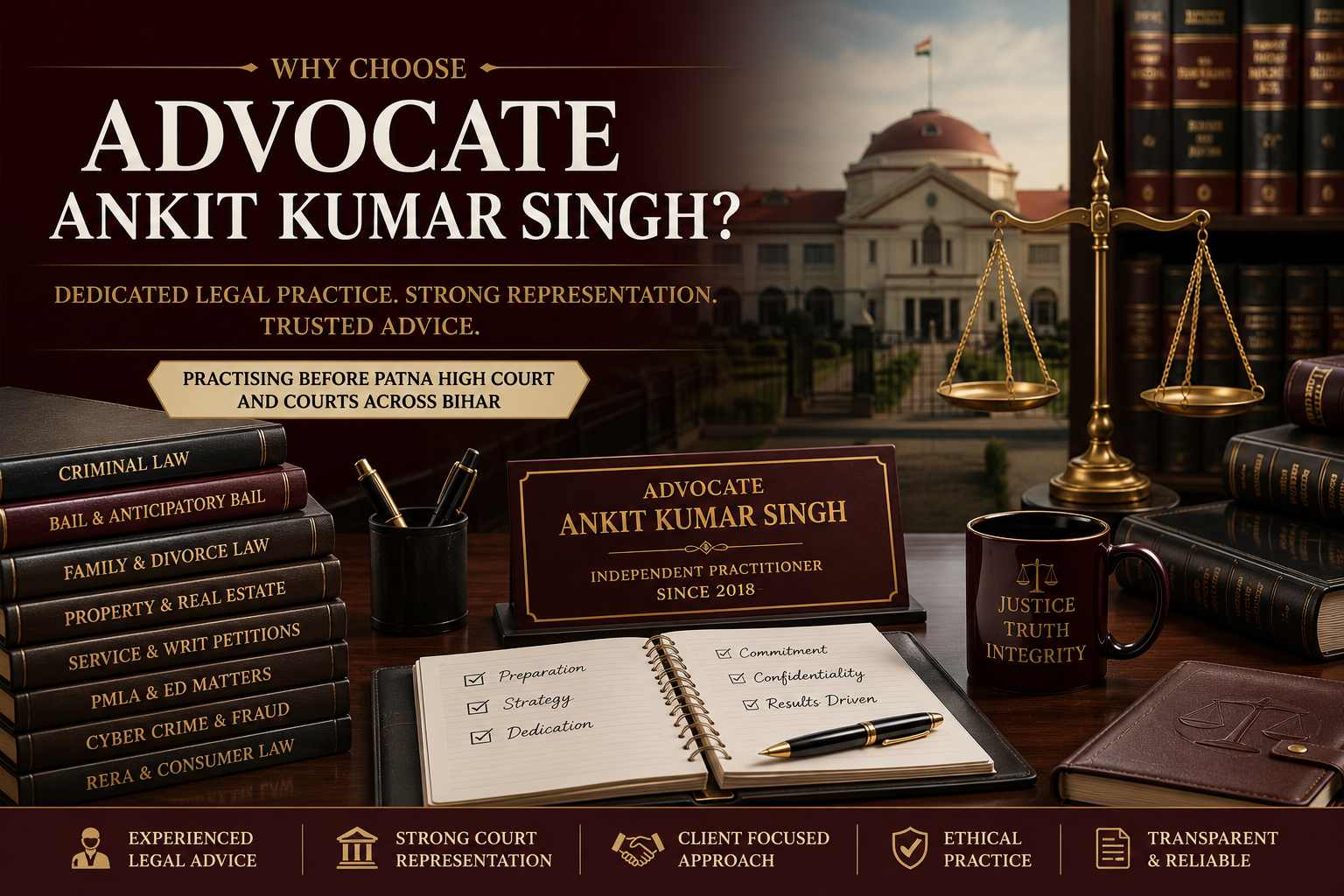
Direct Answer: A person considering Advocate Ankit Kumar Singh for a legal matter in Patna or Bihar may evaluate the practice on the basis of its document-first preparation, court-focused drafting, familiarity with multiple litigation forums, structured consultation process and broad work across criminal, matrimonial, property, constitutional, service, financial-crime, consumer and regulatory matters. The suitability of any advocate, however, always depends upon the facts, documents, jurisdiction, urgency and relief required in the individual case.
Why Choosing the Right Advocate Matters
Choosing an advocate is not merely a matter of finding a name, telephone number or general description of legal services. A legal dispute may concern personal liberty, family relationships, employment, property ownership, financial exposure, government action, business operations or personal reputation.
The advocate must therefore identify the correct court or authority, examine the available documents, determine the procedural stage, assess limitation and maintainability, and identify the remedy that may lawfully be pursued.
Advocate Ankit Kumar Singh is an independent advocate practising from Patna, with legal work connected to the Patna High Court, District and Sessions Courts, Family Courts, Consumer Commissions, tribunals and specialised authorities across Bihar.
The practice includes legal consultation, case-paper assessment, drafting, filing preparation, court representation and procedural follow-up.
This article does not claim that one advocate is automatically suitable for every legal matter. It explains the professional approach, major practice areas, document requirements and practical considerations that a prospective client may examine before arranging a consultation.
Quick Overview: Why Clients May Consider Advocate Ankit Kumar Singh
- Document-first assessment: Legal advice begins with the FIR, notice, order, agreement, title paper, service record, bank statement or other primary record.
- Court-focused drafting: Pleadings are prepared around jurisdiction, maintainability, limitation, statutory ingredients, chronology, annexures and the precise relief sought.
- Multi-forum practice: Matters may involve the Patna High Court, District Courts, Sessions Courts, Family Courts, Consumer Commissions, CAT, RERA and revenue authorities.
- Structured client process: Consultation booking, payment confirmation, document upload, booking tracking and office communication are organised through the website.
- Broad litigation coverage: The practice includes criminal defence, bail, matrimonial disputes, property litigation, service law, writs, PMLA, ED, cyber fraud, RERA, consumer disputes, customs, succession and documentation.
- Verified professional information: The website provides professional details, enrolment information, AUIN and selected publicly verifiable professional references.
- No-result-guarantee approach: No lawful advocate can guarantee the result of a case. Legal advice must depend on the facts, evidence and applicable law.
Professional Profile and Court Forums
Advocate Ankit Kumar Singh practises from Patna and handles matters connected with the Patna High Court and various courts and authorities across Bihar.
The practice is not confined to a single category of litigation. A dispute may begin before a police station, department, revenue authority, Family Court, RERA authority, Consumer Commission or District Court and later require appellate, revisional or writ jurisdiction.
The professional profile published on the website identifies independent practice since 2018, enrolment information and AUIN 102731.
Visitors may review the professional biography and credential-verification information published on the official website before booking a consultation.
A Document-First and Chronology-Based Legal Method
A consultation becomes substantially more useful when the advocate receives a clear chronology and the relevant documents. The first task is generally to separate established facts from assumptions, identify missing records and understand what has already happened before the police, court, department, bank, authority or opposing party.
The initial legal assessment may include:
- the date on which the dispute or cause of action arose;
- the order, FIR, notice, agreement, deed or transaction under challenge;
- the court or authority having jurisdiction;
- the current procedural stage;
- limitation, urgency and possible delay;
- available documentary and electronic evidence;
- interim protection that may legally be available;
- the final relief realistically capable of being sought;
- parallel proceedings involving the same parties or transaction;
- the practical consequences of each procedural remedy.
Many legal cases become difficult because of incomplete annexures, unclear chronology, inconsistent statements, incorrect forum selection or a prayer that cannot legally be granted in the form requested.
1. Criminal Defence, Anticipatory Bail, Regular Bail and FIR Quashing
Criminal proceedings often require immediate and disciplined action. A person may be facing arrest, police notice, summons, warrant, charge-sheet, complaint case, trial or an adverse judicial order.
A proper assessment must identify the alleged role of the accused, the ingredients of the offences, the stage of investigation, the alleged recovery, criminal antecedents, documentary defence and the appropriate court for relief.
Anticipatory Bail
Anticipatory bail is generally considered when a person reasonably apprehends arrest in connection with a non-bailable offence.
The assessment may involve:
- the allegations made in the FIR or complaint;
- the specific role attributed to the applicant;
- delay in lodging the case;
- previous relationship between the parties;
- civil, matrimonial or commercial background;
- documentary evidence supporting the defence;
- requirement of custodial interrogation;
- willingness to cooperate with the investigation;
- criminal antecedents;
- parity with other accused persons.
The petition should explain why arrest is unnecessary and why the applicant can cooperate with the investigation without being taken into custody.
Regular Bail
Regular bail is sought after a person has been arrested or has surrendered before the competent court.
Relevant considerations may include:
- period of custody;
- nature and gravity of allegation;
- investigation progress;
- filing of charge-sheet;
- recovery attributed to the accused;
- criminal antecedents;
- medical condition;
- parity with co-accused;
- possibility of influencing witnesses;
- delay in commencement or completion of trial.
A bail petition should not merely reproduce general principles. The legal principles must be connected to the factual record of the particular case.
FIR Quashing and High Court Remedies
Quashing may be examined where:
- the allegations do not disclose the essential ingredients of an offence;
- the proceeding is legally untenable;
- the dispute is substantially civil, matrimonial or commercial;
- the allegations are inherently improbable;
- the prosecution amounts to an abuse of judicial process;
- a legally recognised settlement has taken place.
Quashing is an extraordinary remedy. It requires a careful comparison between the FIR, complaint, charge-sheet, documentary record and settled legal principles.
Trial Preparation and Criminal Defence
Trial work may involve discharge, challenge to charge, witness assessment, contradiction analysis, cross-examination preparation, documentary evidence, expert evidence and final argument.
The defence must be built around the prosecution record, burden of proof and procedural safeguards available to the accused.
Documents commonly required: FIR, complaint, police notice, bail rejection order, charge-sheet, seizure list, medical papers, electronic records, previous litigation papers, settlement documents and a date-wise chronology.
2. Divorce, Matrimonial Disputes, Maintenance, Custody and 498A Defence
Matrimonial disputes are legally and emotionally complex because multiple proceedings may arise from the same marital relationship.
Divorce, maintenance, domestic violence, child custody, criminal allegations, residence claims and mediation may proceed before different courts or authorities.
Divorce and Matrimonial Relief
The legal assessment may involve:
- cruelty;
- desertion;
- adultery allegations;
- mutual-consent divorce;
- contested divorce;
- restitution of conjugal rights;
- previous settlement discussions;
- pending maintenance or criminal proceedings.
Pleadings must remain consistent across all connected proceedings. Contradictory statements before the Family Court, criminal court or domestic-violence court may seriously affect credibility.
Maintenance Proceedings
Maintenance disputes require proper disclosure of:
- income;
- employment;
- business earnings;
- dependants;
- household expenses;
- existing liabilities;
- standard of living;
- previous maintenance orders.
Bank statements, salary records, income-tax returns, business records and proof of actual expenses may become important.
Child Custody and Visitation
Child-custody cases focus primarily on the welfare of the child rather than the personal victory of either parent.
The court may consider schooling, health, stability, caregiving history, emotional bond, safety, residence and practical visitation arrangements.
498A and Connected Criminal Cases
Where criminal allegations arise from a matrimonial dispute, the advocate must separately assess arrest risk, anticipatory bail, FIR allegations, documentary material, mediation possibilities and territorial jurisdiction.
Documents commonly required: marriage certificate, photographs, messages, emails, medical papers, complaint or FIR, maintenance petition, income proof, school records, previous orders and settlement communications.
3. Property, Land, Partition, Mutation, Title and Real Estate Litigation
Property disputes in Bihar are highly document-dependent. Possession alone, mutation alone, rent receipts alone or an unregistered private paper may not conclusively establish ownership.
A proper review must trace the chain of title and compare it with revenue records, possession history, family relationships, boundaries and previous transfers.
Partition and Ancestral Property
Partition disputes require identification of:
- the common ancestor;
- all legal heirs;
- nature of the property;
- previous partition;
- family settlement;
- sale, gift or transfer by family members;
- possession of each branch;
- share claimed by each party.
A family tree, deed chronology and clear property schedule are often essential.
Title and Possession Disputes
Title suits, declaration, cancellation, injunction and possession matters require precise pleadings.
The court must be able to identify:
- the exact property;
- source of title;
- nature of possession;
- act of interference;
- specific legal relief required.
Mutation and Revenue Records
Mutation, jamabandi, khata, khesra and rent receipts are important revenue records. However, their legal effect depends upon the nature of the dispute.
Revenue entries must be examined alongside registered sale deeds, gift deeds, partition deeds, inheritance records and civil-court orders.
Sale Deed, Gift Deed and Family Settlement
Disputes may involve fraud, impersonation, lack of authority, undue influence, cancellation, power of attorney, inadequate property description or competing documents.
Before purchasing property, due diligence should ordinarily examine:
- title chain;
- identity and authority of the seller;
- encumbrance;
- pending litigation;
- actual possession;
- boundary and area;
- revenue records;
- project or statutory approvals.
Documents commonly required: sale deed, gift deed, partition deed, family settlement, khatiyan, jamabandi, mutation order, rent receipt, map, genealogy, possession evidence and previous court orders.
4. Service Matters, Departmental Enquiry, Suspension and Termination
Service litigation requires careful examination of appointment rules, service conditions, disciplinary rules, seniority provisions, reservation policy, departmental circulars and the forum having jurisdiction.
Departmental Enquiry
The following documents should ordinarily be examined together:
- charge memo;
- statement of allegations;
- list of witnesses;
- relied-upon documents;
- written defence;
- enquiry report;
- disagreement note;
- final punishment order;
- departmental appeal.
Common legal issues may include denial of reasonable opportunity, absence of evidence, bias, non-supply of documents, violation of procedure, disproportionate punishment or failure to consider the employee’s defence.
Suspension, Termination and Dismissal
The legality of suspension or termination may depend upon:
- applicable service rules;
- nature of employment;
- probation status;
- disciplinary procedure;
- contractual terms;
- whether the order is punitive or stigmatic.
Promotion, Seniority, Transfer, Pension and Pay
These disputes may require comparison of eligibility rules, vacancy position, gradation list, departmental circulars, representations, pension papers and previous judicial decisions.
Documents commonly required: appointment letter, service book extract, applicable rules, charge memo, reply, enquiry report, punishment order, seniority list, pay slips, pension papers and representations.
5. Writ Petitions and Constitutional Remedies
Writ jurisdiction under Articles 226 and 227 of the Constitution is extraordinary. It is not a substitute for every statutory appeal, civil suit or factual trial.
The first legal questions generally include:
- whether a public-law element exists;
- whether the respondent is a public or statutory authority;
- whether an alternative remedy is available;
- whether disputed facts require evidence;
- whether there has been unreasonable delay;
- whether principles of natural justice were violated.
Writ proceedings may involve arbitrary administrative action, government inaction, illegal orders, statutory authorities, education disputes, service matters, revenue authorities and supervisory jurisdiction over subordinate courts or tribunals.
A properly drafted writ petition should identify:
- the public authority concerned;
- the impugned action or inaction;
- the legal right affected;
- the statutory duty involved;
- representations already submitted;
- the constitutional or supervisory relief sought.
Documents commonly required: impugned order, representation, acknowledgment, departmental record, statutory provision, notice, correspondence and chronology.
6. PMLA, Enforcement Directorate and White-Collar Crime
PMLA and Enforcement Directorate matters require exceptional consistency in facts, financial records and previous statements.
Bank transactions, company records, predicate-offence papers, ownership documents and explanations given at different stages must be carefully coordinated.
ED Summons and Statement Preparation
Upon receiving an ED summons, the person should verify:
- the issuing office;
- date and time of appearance;
- statutory provision;
- documents required;
- entity or transaction under enquiry.
Preparation may include a transaction chronology, entity relationship chart, invoices, bank statements, source-of-funds explanation and identification of unavailable records.
Bank Freeze, Search and Seizure
Account freezing or seizure may affect personal and business operations. The legal remedy depends upon the authority, statutory provision, procedural stage and connection alleged between the account or property and the suspected proceeds of crime.
Attachment and Adjudication
Attachment proceedings may require a response before the competent authority concerning ownership, source, consideration, transaction trail and the alleged connection with proceeds of crime.
PMLA Bail
PMLA bail involves a specialised statutory framework. The defence must examine:
- scheduled offence;
- alleged proceeds of crime;
- role of the accused;
- custody period;
- evidence collected;
- stage of investigation;
- applicable statutory bail conditions.
Documents commonly required: ED summons, FIR or charge-sheet in the scheduled offence, bank statements, tax records, company documents, invoices, contracts, property papers and seizure or freezing communication.
7. Cyber Crime, Online Fraud, UPI Fraud and Bank-Account Freeze
Cybercrime matters are highly time-sensitive. Digital evidence may disappear, funds may be transferred rapidly and bank accounts may be frozen in connection with complaints lodged in another state.
Assistance for Victims of Cyber Fraud
A victim of UPI fraud, phishing, impersonation, investment scam or unauthorised transaction should preserve:
- screenshots;
- transaction IDs;
- UPI IDs;
- telephone numbers;
- email headers;
- website URLs;
- bank messages;
- complaint acknowledgments.
Early reporting may improve the possibility of tracing or holding the funds, although recovery cannot be guaranteed.
Defence in Bank-Account Freeze Cases
A person may discover that a bank account has been frozen because disputed funds passed through the account.
The legal strategy depends on whether the person was:
- the alleged beneficiary;
- an intermediary;
- a genuine business recipient;
- an account holder unaware of the fraud;
- a downstream transferee.
A transaction-by-transaction explanation may be necessary.
NCRP Complaint, Police Notice and Court Remedy
The appropriate remedy may include representation to the investigating officer, compliance with a notice, application before the competent court or writ jurisdiction where legally maintainable.
Documents commonly required: NCRP acknowledgment, FIR, police notice, bank-freeze communication, bank statement, transaction IDs, screenshots, KYC documents, invoices and business records.
8. RERA, Builder-Buyer Disputes and Delayed Possession
Real-estate disputes may involve delayed possession, incomplete construction, changes in project specifications, non-registration, refund, interest, compensation or defective construction.
The initial review should compare:
- booking form;
- allotment letter;
- builder-buyer agreement;
- payment schedule;
- promised possession date;
- RERA registration details;
- correspondence with the builder;
- actual project status.
The client must also decide the preferred relief, such as possession, refund, interest, compensation or rectification.
Forum selection is important because a builder dispute may involve RERA, consumer law, civil law, insolvency proceedings or contractual arbitration.
9. Consumer Protection, Insurance, Banking and Medical Negligence
Consumer disputes focus on the transaction, service obligation, deficiency, loss, limitation and jurisdiction.
A consumer complaint should clearly explain:
- what service or product was promised;
- what payment was made;
- what was actually delivered;
- how the service was deficient;
- what financial or other loss occurred;
- what relief is being claimed.
Insurance Claims
Insurance claims may be rejected on grounds of alleged non-disclosure, exclusion, delay or failure to comply with policy terms.
The policy wording, proposal form, medical or incident record, survey report and repudiation letter must be compared carefully.
Banking and E-Commerce Disputes
Disputes may involve unauthorised debit, failed transfer, wrongful deduction, non-delivery, defective goods, warranty refusal or non-refund.
Medical Negligence
Medical negligence requires more than dissatisfaction with the result of treatment.
The assessment may involve:
- medical records;
- accepted standard of care;
- expert material;
- informed consent;
- causation;
- actual injury or loss.
10. Customs, DRI and Economic-Offence Matters
Customs and Directorate of Revenue Intelligence matters may involve summons, statements, seizure, confiscation, penalty, prosecution and complex business records.
The explanation provided during investigation must remain consistent with invoices, import-export papers, transport documents, GST records, bank entries and company communications.
Statements made during investigation may have serious legal consequences. The person should understand the transaction, the role attributed to them and the records demanded before giving speculative answers.
Documents commonly required: summons, seizure memo, panchnama, statement, show-cause notice, invoices, bills of entry, transport papers, tax records, bank statements and company documents.
11. Probate, Will, Succession and Inheritance
After the death of a family member, questions may arise regarding:
- validity of a Will;
- authority of an executor;
- bank deposits;
- securities;
- immovable property;
- legal heirs;
- distribution of the estate.
The correct proceeding depends upon whether a Will exists, the nature and location of the assets, dispute among heirs and the precise relief required.
Probate or letters-of-administration proceedings may involve proof of execution, testamentary capacity, attesting witnesses and absence of suspicious circumstances.
Succession-certificate proceedings generally concern specified debts and securities.
Documents commonly required: death certificate, original Will, family tree, identity documents, property records, bank details, security details, list of heirs and witness information.
12. Legal Notices, Agreements, Affidavits and Documentation
Good legal drafting does not mean using unnecessarily complicated language. A useful legal document must state the relevant facts, rights, obligations, breach, time period and consequences clearly.
Legal documentation may include:
- legal notices;
- replies to notices;
- affidavits;
- indemnity bonds;
- powers of attorney;
- sale deeds;
- gift deeds;
- lease deeds;
- memoranda of understanding;
- settlement agreements;
- written submissions;
- legal opinions;
- property due-diligence reports.
Each document should be prepared according to the actual transaction or dispute rather than copied from a generic template.
13. Court Marriage, MACT, Arbitration and Other Legal Services
Additional work may include court-marriage and registration guidance, motor-accident compensation claims, arbitration-related proceedings, education matters and tenancy disputes.
Court Marriage and Registration
Documentation, age, identity, residence, notice requirements and the applicable marriage law must be verified before proceeding.
Motor-Accident Compensation
Motor-accident claims may require FIR, charge-sheet, medical records, disability certificate, income proof, insurance details and dependency records.
Arbitration
Arbitration work may involve invocation notice, appointment of arbitrator, interim relief, statement of claim, defence, evidence, award challenge and enforcement.
The arbitration clause should ordinarily be examined before any proceeding is initiated.
14. NRI and Outstation Legal Matters Connected With Bihar
NRIs and persons residing outside Bihar may require assistance in connection with property, partition, mutation, possession, power of attorney, matrimonial disputes, criminal proceedings or High Court matters.
Initial consultation and document review may be conducted remotely. Further filing or representation depends upon the procedure of the court, registry or authority concerned.
A power of attorney should not be treated as a universal document. It should identify the exact powers granted for litigation, document collection, representation, registration, management or negotiation.
Why the Consultation Process Matters
A structured consultation is different from an informal opinion based on a short message.
The website enables a prospective client to:
- select a consultation type;
- provide preliminary information;
- choose an available date and time;
- complete secure payment;
- receive a booking ID;
- upload relevant documents;
- track the consultation status.
During consultation, the immediate objective may be to understand:
- what has legally happened;
- which documents are missing;
- what must be done urgently;
- which court or authority has jurisdiction;
- whether interim protection may be sought;
- what the likely procedural stages are;
- whether settlement, representation, appeal, suit, bail or writ should be considered.
Transparent Digital Access and Client Coordination
The website provides a structured appointment workflow, payment confirmation, booking ID, professional fee receipt, document-upload facility and consultation-status tracking.
These systems are intended to organise communication and reduce uncertainty regarding appointment status, payment and documents.
Technology supports the professional process. It does not replace legal examination or guarantee the outcome of a case.
Verified Credentials and Professional Information
Before consulting any advocate, a prospective client should verify professional information rather than relying solely upon advertisements or promotional statements.
The official website publishes professional details, court information, enrolment particulars, AUIN, contact details and selected public professional references.
An advocate’s appearance in a reported or published matter demonstrates professional participation. It does not guarantee an identical result in another case.
How to Decide Whether the Practice Is Suitable for Your Matter
A prospective client may consider the following questions:
- Does the practice cover the relevant court, tribunal or authority?
- Can the immediate procedural risk be identified?
- Are the required documents clearly explained?
- Is the advice based upon the actual legal record?
- Are the limitations and uncertainties of the case communicated?
- Is the scope of consultation, drafting or representation clear?
- Are payment and appointment records properly maintained?
- Is confidential information handled through an organised system?
- Does the proposed strategy address both interim and final relief?
- Are unrealistic guarantees avoided?
Documents to Prepare Before Consultation
- A short date-wise chronology.
- The latest order, FIR, notice, deed or agreement.
- Previous court or authority papers.
- Identity and relationship documents where relevant.
- Property, service, bank, payment or medical documents related to the matter.
- A list of all pending connected cases.
- The immediate legal relief required.
- The next date, deadline, notice period or arrest risk.
- A list of documents that are presently unavailable.
Frequently Asked Questions
Why choose Advocate Ankit Kumar Singh for legal consultation in Patna?
The practice may be considered for document-based assessment, court-focused drafting, work across multiple litigation forums and an organised digital consultation process. Suitability depends on the facts, documents and forum involved.
Does Advocate Ankit Kumar Singh practise only before the Patna High Court?
No. The practice includes matters connected with the Patna High Court, District and Sessions Courts, Family Courts, Consumer Commissions, CAT, RERA, revenue authorities and specialised forums across Bihar.
What are the principal practice areas?
Principal practice areas include criminal defence and bail, FIR quashing, matrimonial disputes, property and partition, service matters, writ petitions, PMLA and ED, cyber fraud, RERA, consumer disputes, customs, succession, documentation and NRI matters connected with Bihar.
Can urgent bail or arrest-protection matters be discussed?
Yes, subject to availability and examination of the FIR, notice, previous order, case status and urgency.
Can outstation or NRI clients consult online?
Initial consultation and document review may be undertaken remotely. Filing, representation and registry work depend upon the applicable procedure and proper authorisation.
Can clients upload documents after booking?
Yes. The official website provides a secure document-upload facility linked to the booking process.
Does payment guarantee that a case will be filed or won?
No. Payment confirms the selected consultation or agreed professional service. Filing depends upon document review, maintainability, jurisdiction and further instructions. No judicial outcome is guaranteed.
Can a written legal opinion be prepared?
A written legal opinion or due-diligence report may be prepared where the scope, relevant documents and legal questions are clearly identified.
Are property-title and registry documents reviewed?
Property work may include review of title chain, sale deed, gift deed, partition, mutation, jamabandi, possession, boundaries and property due diligence.
Are ED summons and PMLA matters handled?
The practice includes legal assistance concerning ED summons, financial records, bank-account freezing, attachment proceedings and appropriate remedies before courts or authorities.
Are cyber-fraud and bank-freeze matters covered?
Yes. Assistance may include NCRP complaints, cyber FIRs, police notices, transaction analysis, account freezing and remedies based upon the case record.
Can matrimonial and criminal proceedings be coordinated?
They may be coordinated, but each proceeding has separate legal requirements. Statements and pleadings must remain consistent across Family Court, maintenance, domestic violence and criminal proceedings.
How can professional credentials be verified?
The official website provides professional biography, enrolment information, AUIN and a separate credential-verification section.
What is the most useful document for the first consultation?
The latest operative document, such as the FIR, notice, order, agreement, deed or charge memo, together with a date-wise chronology, is generally the most useful starting point.
How long will a legal matter take?
No uniform time period applies. Duration depends upon the forum, service of notice, evidence, procedural compliance, court schedule, interim applications and conduct of the parties.
Conclusion
Why choose Advocate Ankit Kumar Singh? The answer should not rest upon a slogan or an unsupported claim of superiority.
It should depend upon whether the practice is suitable for the client’s documents, forum, urgency, legal objective and procedural stage.
The professional approach described on the website emphasises careful preparation, accurate drafting, procedural discipline, structured communication and a legal remedy tailored to the actual record.
For a case-specific assessment, the client should arrange a consultation, provide the relevant documents and disclose all connected proceedings. Legal advice can then be provided on the basis of the facts, applicable law, jurisdiction and current procedural stage.
Legal and Professional Disclaimer
This article is published solely for general legal awareness and information. It does not constitute legal advice, solicitation, advertisement, a promise of representation or a guarantee of any result.
Accessing the website or reading this article does not create an advocate-client relationship. Every legal matter depends upon its own facts, documents, limitation, jurisdiction, applicable law and procedural stage.
Readers should obtain case-specific advice after proper consultation and examination of the relevant legal records.