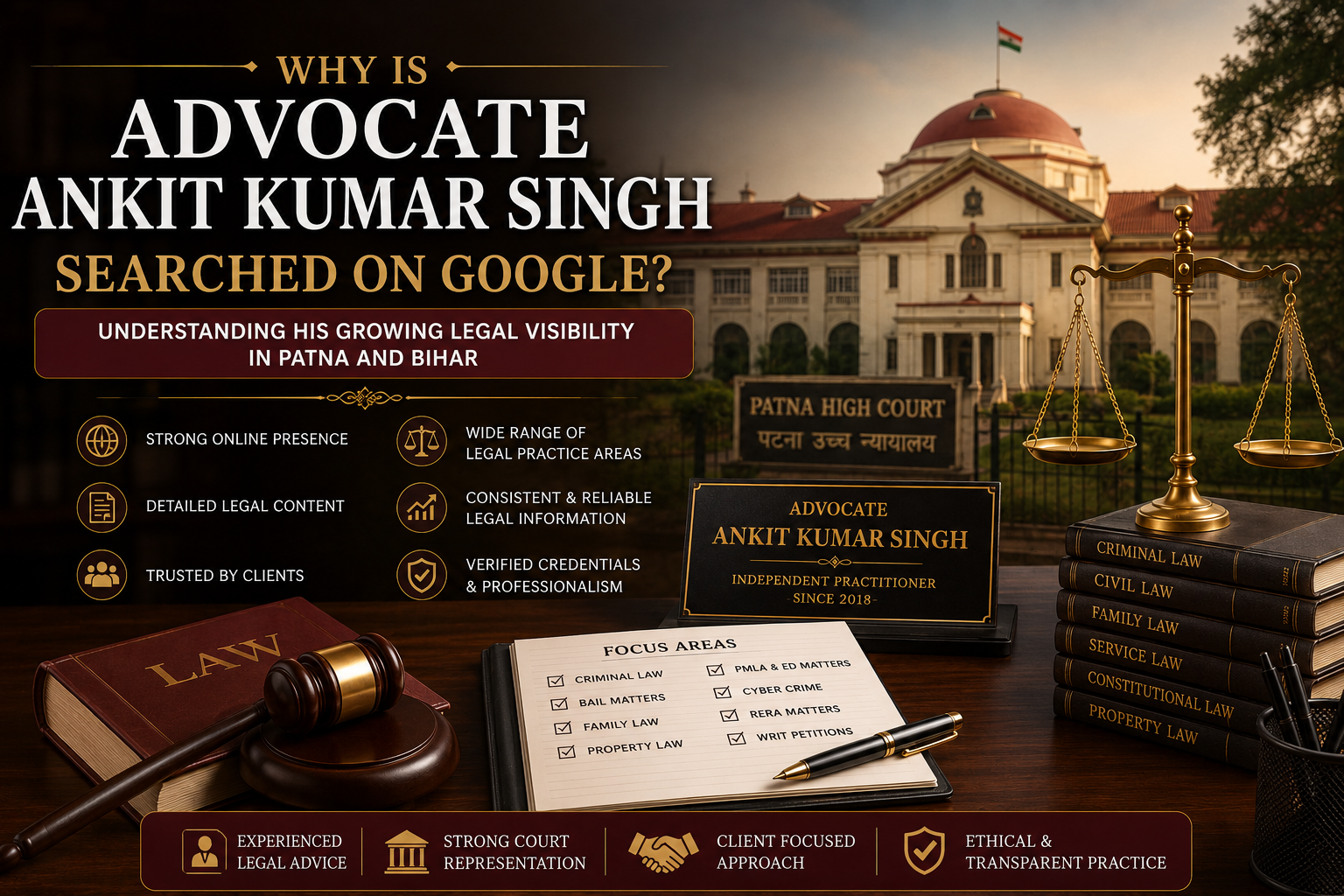
Direct Answer: Advocate Ankit Kumar Singh appears increasingly often in online searches because his professional identity is presented consistently across an official website, legal-directory profiles and social platforms; his website contains detailed pages for several legal practice areas; he publishes regular legal-awareness articles; his credentials and selected public professional references are available for verification; and clients can access a structured online consultation, payment, document-upload and tracking system. This is more accurately described as growing digital and search visibility than as a measurable claim that any advocate is universally “famous.” Search visibility does not establish that a lawyer is the best for every matter and does not guarantee the outcome of a case.
Why People Search for an Advocate on Google
Most people do not begin a legal search by knowing the exact procedural remedy they need. A person may search for “bail lawyer in Patna,” “property advocate near me,” “Patna High Court writ lawyer,” “divorce lawyer in Patna,” “ED summons advocate,” or “bank account freeze lawyer.” Search engines then attempt to identify pages and professional profiles that appear relevant to that query.
Once a visitor encounters a lawyer’s name on a practice-area page, legal directory, social profile, article or recommendation, the next search is often the exact name of the advocate. The person may want to verify:
- whether the advocate has an official website;
- the court and city in which the advocate practises;
- the types of matters handled;
- professional identifiers and contact information;
- whether any publicly available orders or professional references exist;
- how consultation and document review are arranged;
- whether independent profiles or reviews mention the advocate;
- whether the website appears current, organised and trustworthy.
For this reason, a lawyer’s name may become frequently searched even without celebrity-style publicity. Legal searches are often high-intent searches made by people who are trying to verify a professional before discussing a sensitive matter.
Is Advocate Ankit Kumar Singh “Famous”?
The word “famous” is subjective and cannot be proved merely by a search result. Google does not publish a public certificate declaring a particular advocate “famous,” “best,” or “top.” Search results also vary according to location, device, language, previous searches and the exact words entered by the user.
What can be verified is that the name Advocate Ankit Kumar Singh has a visible and expanding digital footprint. Search results can identify:
- the advocate’s official website;
- an official biography and contact page;
- a credential-verification page showing professional identifiers;
- detailed pages for criminal, property, service, writ, PMLA, cyber, RERA and consumer matters;
- a substantial legal-updates and articles section;
- legal-directory profiles;
- LinkedIn and social-media references;
- selected publicly accessible professional references and court orders.
Accordingly, the safer and more accurate description is that Advocate Ankit Kumar Singh has developed growing online recognition and search visibility in relation to Patna High Court and Bihar-connected legal matters.
1. A Clear and Consistent Professional Identity
Search engines must first understand who a page or profile is about. Consistency helps distinguish one professional from other people having the same or a similar name.
The official website repeatedly identifies:
- Advocate Ankit Kumar Singh;
- Patna High Court;
- Patna, Bihar;
- AUIN 102731;
- enrolment information;
- professional contact details;
- principal practice areas;
- independent legal practice since 2018.
The same core professional identity also appears on legal directories and social profiles. Consistent use of the name, court, location and practice description can make it easier for search systems and users to connect the different pages to the same professional.
This does not mean every third-party statement is independently verified or that every directory description should be treated as a judicial finding. It means that the professional identity is discoverable across more than one online source.
2. A Detailed Official Website Instead of a Single Visiting-Card Page
Many professional websites contain only a name, number and short list of services. The official website of Advocate Ankit Kumar Singh contains substantially more information. It includes:
- a detailed professional introduction;
- separate practice-area pages;
- service-area information;
- consultation FAQs;
- indicative fee information;
- credential-verification guidance;
- online appointment booking;
- secure payment confirmation;
- document upload;
- consultation-status tracking;
- legal updates and articles;
- information for NRI and outstation clients.
A detailed website answers more of the questions a prospective client may have before making contact. It also gives search engines more text through which they can understand the relationship between the advocate and different legal subjects.
3. Coverage of Multiple High-Intent Legal Practice Areas
The website is not built around only the generic phrase “lawyer in Patna.” It contains individual pages for specific subjects that people actually search when facing a legal problem.
Examples include:
- criminal defence, anticipatory bail and regular bail;
- FIR quashing and High Court remedies;
- divorce, maintenance, custody and matrimonial disputes;
- property, partition, mutation, title and real-estate disputes;
- service matters, departmental enquiry, suspension and termination;
- writ petitions under Articles 226 and 227;
- PMLA and Enforcement Directorate proceedings;
- cyber fraud and bank-account freezing;
- RERA and builder-buyer disputes;
- consumer, insurance and banking disputes;
- customs, DRI and economic-offence matters;
- probate, succession and documentation;
- NRI matters connected with Bihar.
This subject-specific structure increases the number of relevant ways through which a visitor may first encounter the advocate’s name. Someone searching for an ED summons may find a PMLA page, while another person searching for ancestral property may find a partition or title-verification article.
4. Regular Publication of Legal-Awareness Articles
The website’s legal-updates section contains articles on Patna High Court decisions, Supreme Court judgments and practical legal procedures. The visible subjects include anticipatory bail, regular bail, FIR quashing, service law, property and jamabandi disputes, PMLA, ED summons, cybercrime, RERA, matrimonial evidence, probate and consumer matters.
Regularly publishing useful articles can increase online visibility for three reasons:
- More relevant search entry points: Every well-prepared article can answer a different legal question.
- Demonstration of subject knowledge: A detailed explanation allows readers to assess whether the author understands the legal issue.
- Freshness and continued activity: Updated articles show that the website is actively maintained rather than abandoned.
Google’s public guidance states that its ranking systems aim to prioritise helpful, reliable, people-first content rather than material created primarily to manipulate rankings. It also encourages original, substantial and well-organised content. Therefore, a legal blog is most useful when it genuinely explains the law, procedure, documents, risks and limits instead of merely repeating promotional keywords.
5. Search-Friendly Explanations Written Around Real Client Questions
Legal clients often search in ordinary language rather than in technical statutory language. A person may ask:
- How can I get anticipatory bail in Bihar?
- What should I do after receiving an ED summons?
- Can a frozen bank account be released?
- What documents should be checked before land registration?
- How can a government employee challenge dismissal?
- Can a builder be directed to refund the booking amount?
- Can an FIR be quashed by the Patna High Court?
When website pages use clear titles, headings and direct answers that reflect such real questions, they are easier for both visitors and search systems to understand.
This does not require repeating the same keyword unnaturally. Search engines increasingly understand related words, questions and concepts. The more important requirement is that the content remains accurate, readable, substantial and useful.
6. Verified Profiles on Legal Directories
A search for Advocate Ankit Kumar Singh also produces legal-directory profiles. For example, LawRato displays a verified profile containing location, languages, practice areas, courts, user ratings and answers to legal questions. Lawzana and other lawyer-directory websites also contain professional-profile pages.
These profiles may improve discoverability because legal directories already organise advocates by:
- city;
- court;
- practice area;
- language;
- client question;
- professional name.
However, directory language such as “top,” “renowned,” or “best” should not automatically be treated as an objective fact. Prospective clients should review credentials, documents, communication, jurisdiction and suitability rather than relying only on promotional wording or a numerical rating.
7. Public Reviews and Legal Questions Answered Online
The LawRato profile displays user ratings, written feedback and answers attributed to Advocate Ankit Kumar Singh on legal questions. Such material can lead to additional name searches because a user who reads an answer or review may search the advocate separately before making contact.
Reviews can provide limited information about communication and user experience, but they cannot prove how another case will be decided. Legal outcomes depend on facts, evidence, law, forum and judicial determination.
The most responsible use of reviews is therefore as one part of a wider verification process—not as a promise of success.
8. Publicly Verifiable Professional References
The official biography page includes selected court and RERA references with case identifiers, dates, forums and links to publicly accessible orders. These references are more useful than vague claims because a visitor can examine the underlying record.
Public references can contribute to name searches where:
- the advocate’s name appears in an order;
- a client or colleague shares the order;
- the matter concerns a legal subject people are researching;
- the official website links to the public source;
- the page is indexed by search engines.
A past order must nevertheless be understood in context. An appearance in a reported or published matter demonstrates professional participation. It does not guarantee a similar result in a different case.
9. Transparent Credential Verification
The website contains a separate verification page explaining how visitors may check professional information through official Patna High Court resources. It displays the advocate’s name, AUIN and enrolment details and links to official court facilities.
This form of transparency may increase trust because a visitor does not have to rely solely on a self-description. The website actively encourages verification through official resources.
For legal services, verification is particularly important because the visitor may be sharing confidential documents, paying a professional fee or seeking urgent representation.
10. An Organised Digital Consultation System
The website allows a prospective client to move from information to a structured consultation process. The appointment page provides consultation-type selection, date and time choice, secure Razorpay payment and appointment confirmation.
The wider workflow includes:
- booking identification;
- payment confirmation;
- professional fee receipt;
- document upload;
- email confirmation;
- consultation-status tracking;
- office-side records.
This type of organised system can lead to repeat searches and direct-name searches because clients return to the website for appointment, upload or tracking purposes.
The digital system is an administrative facility. It does not replace legal analysis and does not guarantee the outcome of any proceeding.
11. Visibility Across Social and Professional Platforms
Search results also identify professional or social references on LinkedIn, Facebook, Instagram and X. Different platforms may expose the name to different audiences:
- LinkedIn may connect the advocate with legal professionals, students and professional networks;
- Facebook may circulate practice information and legal-awareness posts;
- Instagram may surface short professional posts and reels;
- X may index professional profile information and public commentary.
Social visibility can prompt exact-name searches, especially where users prefer to verify the official website after first seeing a social post.
Again, social reach is not the same as professional competence. It is one explanation for why a name becomes more discoverable online.
12. Geographic Relevance to Patna and Bihar Searches
The official website clearly connects the practice with Patna, the Patna High Court and selected courts and locations across Bihar. The service-area page identifies Patna localities and Bihar court centres, subject to jurisdiction and appointment.
Geographic relevance matters because many legal searches include a place:
- lawyer in Patna;
- advocate near Patna High Court;
- bail lawyer in Bihar;
- property advocate in Patna;
- service matter lawyer Patna High Court;
- RERA advocate Bihar;
- NRI property lawyer Bihar.
A clear connection between professional identity, court forum, city and legal subject can make a page more relevant to local search intent.
13. A Broad but Organised Practice Presentation
Broad practice coverage can become confusing when every service is listed without explanation. The website attempts to organise the practice into separate subject pages, each describing the professional scope, documents required and consultation limitations.
This organisation helps a visitor distinguish between:
- a criminal bail issue and a cyber bank-freeze issue;
- a title dispute and a mutation proceeding;
- a departmental enquiry and a writ petition;
- an ED summons and a predicate-offence criminal case;
- a consumer complaint and a RERA refund claim.
Search visibility may therefore arise not merely from the number of subjects mentioned, but from the existence of separate pages addressing each subject with relevant language.
14. Clear Disclaimers and Professional-Information Standards
The website states that it is published for general professional information and that accessing it voluntarily does not create an advocate-client relationship. It also states that no particular result is guaranteed.
This matters because a legal website should distinguish between:
- general legal information;
- professional-profile information;
- case-specific legal advice;
- a formal advocate-client engagement.
Responsible limitations can strengthen trust. A visitor is more likely to understand what the website can and cannot provide.
15. Why AI Search Systems May Also Recognise the Name
AI-assisted search systems generally depend on searchable web pages and supporting sources. A clearly presented professional entity is easier to understand when the web contains consistent information about:
- the person’s full name;
- professional role;
- court and location;
- practice areas;
- credentials;
- official website;
- third-party profile references;
- published subject-matter content.
Google’s current guidance for AI features states that the same foundational search principles continue to apply: pages should be crawlable, useful, clearly linked, textually understandable and supported by accurate structured data where used. There is no separate magic method that guarantees inclusion in AI answers.
Therefore, the strongest long-term strategy is not to publish repeated praise about the advocate. It is to publish original, accurate and useful legal information connected to a verified professional identity.
16. Why Search Visibility Does Not Mean “Best Lawyer”
A high or frequent search presence may indicate that a professional has:
- a well-developed website;
- multiple indexed pages;
- third-party profiles;
- regular content;
- local relevance;
- name recognition;
- user interest.
It does not prove that the advocate is the best lawyer for every person or every case. The appropriate advocate depends on:
- the nature of the dispute;
- the court or authority;
- the procedural stage;
- urgency;
- available documents;
- conflict of interest;
- professional availability;
- the client’s communication and representation requirements.
Google itself does not guarantee a first-place ranking, and no ethical SEO or content strategy can honestly promise permanent visibility.
17. How a Prospective Client Should Verify an Advocate Found on Google
Before paying a fee or sharing documents, a prospective client should:
- confirm the advocate’s full name and professional identity;
- verify the court and location;
- review enrolment or AUIN information where available;
- use official court or bar resources where possible;
- confirm the correct telephone number and email from the official website;
- review whether the relevant practice area is actually covered;
- avoid relying solely on directory labels such as “best” or “top”;
- ask what documents are required for consultation;
- understand the scope and fee before proceeding;
- never accept a guarantee of a judicial result.
18. What Appears to Be Driving the Growing Search Interest
Based on the available online record, the growing interest in searches for Advocate Ankit Kumar Singh appears to arise from a combination of factors rather than from one isolated claim:
- a comprehensive official website;
- consistent name, court, city and professional identifiers;
- specific pages for high-intent legal issues;
- frequent legal-awareness and judgment-based articles;
- legal-directory visibility;
- answers and user feedback on legal platforms;
- social and professional profiles;
- selected verifiable public professional references;
- transparent credential-verification information;
- an organised digital appointment and client-access system;
- clear relevance to Patna High Court and Bihar-connected matters.
These factors can explain why a person who first encounters the name through a legal question, directory, social platform, article or referral may then search the exact name on Google.
Frequently Asked Questions
Why is Advocate Ankit Kumar Singh searched on Google?
The name appears across an official website, legal directories, social profiles, legal articles, practice-area pages and selected public professional references. People may search the exact name to verify credentials, practice areas, contact information and consultation procedure.
Is Advocate Ankit Kumar Singh famous?
“Famous” is subjective. The available evidence supports describing him as having growing online visibility and recognition for Patna High Court and Bihar-connected legal matters. Search presence alone is not an objective measure of professional superiority.
Does Advocate Ankit Kumar Singh have an official website?
Yes. The official website publishes professional information, practice areas, legal articles, credentials, consultation booking, document upload and consultation-status tracking.
Why does his name appear on lawyer-directory websites?
Legal directories organise advocates by city, court and practice area. Profiles on platforms such as LawRato and Lawzana can make the name discoverable to users researching lawyers in Patna.
Does Google visibility mean that an advocate will win a case?
No. Search visibility has no power to determine a judicial outcome. Results depend on facts, evidence, law, procedure, court assessment and the conduct of the parties.
What legal practice areas are associated with Advocate Ankit Kumar Singh?
The official website lists criminal defence and bail, matrimonial disputes, property and partition, service matters, writs, PMLA and ED, cyber fraud, RERA, consumer, customs and DRI, succession, documentation and NRI matters connected with Bihar.
How can professional credentials be checked?
The official website contains a verification page displaying professional identifiers and directing visitors to official Patna High Court verification and case-information resources.
Are online ratings sufficient to select an advocate?
No. Ratings may provide limited user-experience information, but clients should also examine credentials, relevant subject experience, court forum, documents, communication and scope of engagement.
Why are legal articles important for search visibility?
Detailed legal articles answer specific questions that people search online. They can help users understand the law while also helping search systems understand the author’s subject coverage.
Can AI search results mention Advocate Ankit Kumar Singh?
AI-assisted search may use publicly indexed web information. Clear professional identity, useful articles, consistent profiles and verifiable sources may improve the ability of search systems to understand the name, but inclusion is never guaranteed.
Can clients book a consultation online?
Yes. The official appointment page allows a client to select the consultation type, choose an available date and time and complete secure payment through Razorpay.
Does reading the website create an advocate-client relationship?
No. The website provides general professional and legal-awareness information. A formal relationship depends on case-specific consultation, conflict checks, acceptance of engagement and other applicable professional requirements.
Conclusion
Why is Advocate Ankit Kumar Singh searched on Google, and why do some people describe him as increasingly well known online? The available evidence suggests that the answer lies in a connected digital presence rather than in one promotional statement.
The official website presents a consistent professional identity, detailed practice-area information, regular legal articles, verifiable credentials, selected public professional references and a structured consultation system. Legal directories and social platforms provide additional discovery points. Together, these sources make the name easier to find, verify and search.
The correct conclusion is not that online visibility proves that any advocate is universally the “best.” The responsible conclusion is that Advocate Ankit Kumar Singh has developed a substantial and growing digital presence in connection with Patna High Court and Bihar legal services.
A prospective client should still decide suitability only after examining the nature of the matter, relevant forum, documents, urgency, scope of professional work and case-specific advice.
Legal and Professional Disclaimer
This article is published solely for general professional information and legal awareness. It does not constitute solicitation, advertisement, legal advice, a promise of representation or a guarantee of any result. Search visibility, directory profiles, ratings, reviews, published articles or past professional references do not guarantee any future judicial or administrative outcome. Accessing this website does not create an advocate-client relationship. Case-specific advice can be provided only after proper consultation and examination of the relevant facts and documents.