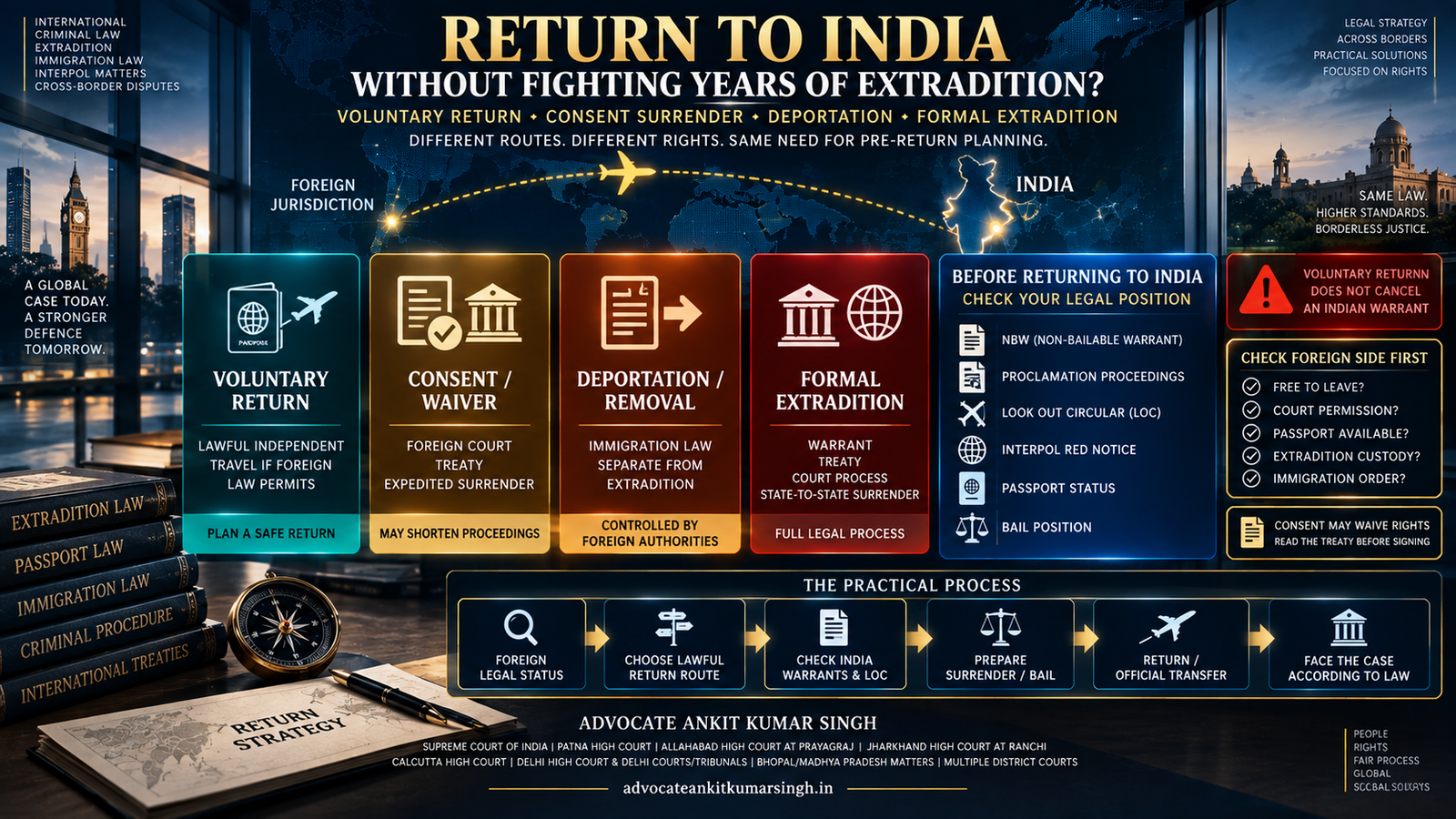
Best Extradition Lawyer in Delhi for Voluntary Return or Consensual Surrender: Can a Person Come Back Without Fighting a Full Extradition Case?
SUMMARY: Create a decision-intent article for a person abroad who wants to return to India and address pending criminal proceedings instead of litigating extradition for years. The article should compare voluntary return, surrender before the foreign court, deportation or immigration removal, formal extradition and the risks created by NBWs, LOCs, Red Notices and custody on arrival. Target “best extradition lawyer Delhi voluntary surrender”, “return to India criminal case lawyer”, “specialized extradition advocate Delhi” and “international surrender lawyer Delhi”.
Legal update: Reviewed on 23 September 2026. Voluntary travel, consensual or waived extradition, immigration removal, deportation and formal extradition are legally different routes. A person considering return to India should examine both the foreign-country restraints and the complete Indian criminal-court record before travelling.
Direct Answer: Can a Person Voluntarily Return to India Instead of Fighting Extradition Abroad?
Potentially yes—but only if the person is legally free to leave the foreign country and the return is coordinated with the criminal proceedings in India.
A person located abroad may sometimes decide that years of contested extradition litigation are commercially, financially, professionally or personally undesirable and instead wish to return to India to address the underlying FIR, warrant, trial or other criminal proceeding.
But several legally different routes are often incorrectly described as “voluntary surrender”.
They include:
- ordinary voluntary travel back to India;
- consent or waiver of extradition before a foreign judicial authority;
- formal surrender through an expedited extradition mechanism;
- deportation or immigration removal by the foreign State; and
- full contested extradition followed by surrender.
These routes do not provide identical rights, timelines or consequences.
The correct first question is therefore not simply:
“Can I book a ticket to India?”
It is:
“Am I legally permitted to leave the foreign country, and what exactly will happen when I arrive in India?”
Route 1: Ordinary Voluntary Return to India
This is conceptually the simplest route.
A person who is:
- not detained abroad;
- not subject to a foreign court order preventing departure;
- not subject to a passport seizure;
- not subject to an immigration restraint preventing travel; and
- otherwise legally entitled to travel
may, depending upon the foreign law and facts, be capable of travelling to India voluntarily.
This is not necessarily “extradition”.
The person is simply travelling to India and thereafter becoming subject to Indian law and the pending Indian proceedings.
However, ordinary voluntary return does not make the Indian criminal process disappear.
Before travel, counsel should verify:
- Indian FIR;
- charge-sheet status;
- summons;
- bailable warrant;
- Non-Bailable Warrant;
- proclamation proceedings;
- proclaimed-offender status, if any;
- LOC;
- passport proceedings;
- bail status;
- court-imposed travel conditions; and
- any other case arising from connected allegations.
Voluntary Return Does Not Automatically Cancel an NBW
This is one of the most important practical points.
Under the Bharatiya Nagarik Suraksha Sanhita, 2023, a court-issued arrest warrant remains in force until it is either:
- cancelled by the court that issued it; or
- executed.
Therefore:
BOOKING A RETURN FLIGHT DOES NOT CANCEL AN NBW.
If the person arrives in India while an executable warrant remains operative, arrest and production before the competent court may follow according to law.
Before travel, Indian counsel should obtain the current court order sheets and determine whether the correct strategy is:
- recall or cancellation of the warrant;
- appropriate bail proceedings;
- planned surrender before the competent court;
- application explaining previous non-appearance;
- challenge to proclamation proceedings where legally sustainable;
- quashing or other superior-court proceedings where maintainable; or
- another case-specific procedural remedy.
The appropriate step depends upon the stage of the Indian criminal case.
Route 2: Consent or Waiver of Extradition Before the Foreign Court
A person may already be within a formal foreign extradition process and decide not to contest every stage.
Some extradition treaties expressly permit the requested person to consent to return or waive full extradition proceedings.
This procedure is treaty-specific and depends upon the law of the foreign Requested State.
For example, the India–Malaysia Extradition Treaty expressly provides that where the person sought:
- consents to return to the Requesting State; and
- has been advised by a competent judicial authority of the effect of that consent,
the Requested State may surrender the person without further proceedings.
Other treaties formulate waiver differently.
Some require:
- written consent;
- judicial advice;
- confirmation that consent is voluntary;
- waiver of specified treaty protections;
- continued detention until surrender; or
- formal coordination between the two governments.
Therefore, no person should sign a foreign “consent to extradition”, “waiver”, “voluntary surrender” or similar document without obtaining advice from counsel qualified in that jurisdiction.
Can Waiving Extradition Save Time?
It potentially can.
A contested extradition proceeding may involve:
- arrest proceedings;
- bail applications;
- evidence disputes;
- treaty objections;
- human-rights objections;
- appeals;
- constitutional proceedings;
- ministerial or executive review; and
- further appellate litigation.
Where the person has already decided that he or she ultimately wants to return to India and face the criminal case, continuing every available foreign challenge may not always serve the person’s strategic objective.
But speed should not be the only consideration.
Before consenting, counsel should analyse:
- what rights are being waived;
- whether speciality protections are affected;
- which Indian offences form part of the request;
- whether additional Indian cases exist;
- whether custody will continue during transfer;
- what happens immediately upon arrival;
- whether bail is realistically available in India; and
- whether the foreign consent can later be withdrawn.
Important: Consent to Return Can Affect Treaty Protections
This issue should be examined before any waiver is signed.
Extradition treaties can give a formally extradited person procedural protections, including the rule of speciality.
Speciality broadly concerns the offences for which the person may be prosecuted after extradition.
Some treaties expressly regulate what happens where the person consents to surrender or waives extradition proceedings.
Some forms of waiver can include waiver of specified protections.
Accordingly:
“I WANT TO GO BACK QUICKLY”
should not automatically become:
“I WAIVE EVERY LEGAL PROTECTION WITHOUT REVIEW.”
The proposed consent document, extradition treaty and foreign procedural law should be read together.
Route 3: Deportation or Immigration Removal to India
Deportation or immigration removal is legally different from extradition.
The Supreme Court of India has recognised the distinction between extradition and deportation/expulsion.
Extradition is a formal surrender process connected with criminal proceedings and international legal cooperation.
Deportation or immigration removal ordinarily arises under the immigration or foreigners law of the country removing the person.
Examples of immigration issues abroad may include:
- expired visa;
- cancelled residence permission;
- immigration violation;
- inadmissibility;
- revocation of immigration status;
- removal order; or
- deportation order.
A person should not assume that deportation can simply be privately selected as a convenient substitute for extradition.
Whether the foreign country can or will use immigration removal is governed by its own law.
Deportation Can Have Different Consequences From Extradition
The distinction may matter substantially.
| Issue | Extradition | Deportation / Immigration Removal |
|---|---|---|
| Primary legal basis | Extradition treaty, arrangement, statute or recognised legal framework | Immigration / foreigners law of removing State |
| Main purpose | Surrender for prosecution or sentence | Removal from territory |
| Criminal warrant usually relevant | Yes | Not necessarily |
| Formal extradition protections | May apply | Not automatically identical |
| Speciality | Often treaty/statutorily relevant | Must be separately analysed |
| Future immigration consequences | Depends upon foreign law | Often potentially significant |
| Person chooses route? | Consent may be available under applicable law | Usually controlled by immigration authorities/court |
Foreign immigration counsel should therefore be consulted before treating removal as strategically preferable to extradition.
Route 4: Full Contested Extradition
A person may instead choose to contest extradition under the law of the country where he or she is located.
Depending upon the treaty and jurisdiction, possible issues may include:
- identity;
- dual criminality;
- extradition offence;
- limitation;
- political-offence issues;
- prior acquittal or punishment;
- human-rights objections;
- evidentiary threshold;
- treaty compliance;
- speciality;
- sentence assurances;
- death-penalty assurances where relevant;
- procedural defects; and
- other protections recognised by foreign law.
Choosing voluntary return therefore requires comparing the value of these protections against the cost, delay and custody consequences of continued litigation.
Five Routes Compared
| Route | Who Primarily Controls It? | Full Extradition Litigation? | Indian Arrest Risk on Return? |
|---|---|---|---|
| Ordinary voluntary travel | Individual, subject to foreign law | No | Yes, if Indian legal process permits or requires arrest |
| Consent / waiver before foreign court | Foreign court / authority + person + treaty framework | Potentially shortened | Usually must be assumed and planned for where Indian warrant exists |
| Deportation / immigration removal | Foreign immigration authorities/courts | Not necessarily | Indian proceedings remain independently operative |
| Formal uncontested extradition | Requested and Requesting States under applicable framework | Reduced depending on consent mechanism | Custody/surrender arrangements ordinarily form part of process |
| Fully contested extradition | Foreign courts / executive authorities under foreign law | Yes | If extradition ultimately succeeds, formal custody transfer ordinarily follows |
What Happens If an Indian NBW Exists When the Person Lands?
A current NBW is substantially more important to the immediate arrest analysis than merely discovering that a Red Notice once existed.
An Indian court warrant remains operative until cancelled or executed according to law.
Therefore, before voluntary return, counsel should determine:
- which court issued the warrant;
- date of issuance;
- offences involved;
- whether it is bailable or non-bailable;
- whether previous summons were served;
- why the person failed to appear;
- whether proclamation proceedings followed;
- whether the warrant can be recalled before return;
- whether bail proceedings can be prepared in advance; and
- where the person will legally have to be produced if arrested.
No lawful return strategy should be built on hiding the person’s arrival or attempting to defeat execution of a valid warrant.
What If the Person Has Been Declared a Proclaimed Person or Proclaimed Offender?
That situation requires additional caution.
A proclamation usually indicates that the criminal court concluded that the applicable warrant could not be executed and that the statutory basis for proclamation was satisfied.
Voluntary return may become relevant to demonstrating future cooperation, but it does not automatically erase:
- the proclamation order;
- the underlying warrant;
- attachment consequences, if any;
- the record of previous non-appearance; or
- separate offences or consequences that may have arisen.
The proclamation order and every subsequent order should therefore be examined before booking travel.
What Does an LOC Do When the Person Is Returning to India?
An LOC and an NBW should not be treated as identical instruments.
An LOC is an executive immigration-control mechanism. The exact action at the airport depends upon the originating authority, the terms and current status of the LOC and any independent warrant or judicial order.
Depending upon the underlying instructions and legal position, immigration authorities may:
- alert the originating agency;
- intercept the traveller;
- undertake action contemplated by the operative LOC; or
- act upon a separate lawful warrant or agency requirement.
The safer pre-return analysis therefore asks:
- Who originated the LOC?
- Why was it opened?
- Does it continue?
- Is a warrant also pending?
- Is the originating agency aware of the proposed return?
- Does a court order govern surrender or appearance?
Recent Delhi High Court decisions reiterate that LOCs are coercive restraints subject to judicial scrutiny, but relief always depends upon the facts and the underlying proceedings.
What If an INTERPOL Red Notice Exists?
A Red Notice should be analysed separately from the Indian court warrant.
INTERPOL defines a Red Notice as a request to law-enforcement authorities worldwide to locate and provisionally arrest a wanted person pending extradition, surrender or similar legal action.
It is not an international arrest warrant.
If the person intends to return voluntarily, counsel should identify:
- the Indian arrest warrant underlying the international request;
- whether the Red Notice remains active;
- whether a Red Diffusion also exists;
- whether formal extradition proceedings abroad have started;
- whether the requesting authorities can withdraw or update the INTERPOL request after return;
- whether a CCF proceeding exists; and
- whether the domestic Indian case independently requires arrest or surrender.
The objective should be consistency between the foreign extradition position and the Indian criminal-court record.
Can a Red Notice Become Unnecessary After Voluntary Return?
Potentially, the factual purpose of locating a person abroad may change once that person has lawfully returned to India and is before the competent Indian authorities.
However, the Red Notice should not simply be assumed to disappear automatically.
The competent National Central Bureau and INTERPOL processes may need to be updated through the appropriate official channel.
Similarly, the underlying Indian warrant, FIR or trial continues unless lawfully modified or concluded.
Passport Problems Before Voluntary Return
Some clients want to return but discover that their passport has:
- expired;
- been impounded;
- been revoked;
- been seized by a foreign court;
- been retained by foreign immigration authorities; or
- become subject to Indian passport proceedings.
This problem must be separated into two questions:
1. Is the person legally permitted to leave the foreign country?
2. Does the person possess a valid travel document that lawfully permits return to India?
An Indian mission cannot simply override the foreign country’s court or immigration law.
Where an emergency or one-way travel document is contemplated, the applicable consular rules and the foreign country's permission to depart must still be checked.
Can the Person Obtain Bail Before Returning?
There is no universal answer.
Depending upon the Indian case, possible pre-return litigation may concern:
- anticipatory bail where legally maintainable;
- recall or cancellation of NBW;
- interim protection;
- quashing proceedings;
- challenge to proclamation;
- directions concerning surrender;
- fixed-date appearance;
- regular bail preparation; or
- another case-specific remedy.
However, none of these should be assumed automatically available merely because the accused has decided to return.
The court will examine the applicable statute, offence, previous conduct, warrant history, cooperation, custody requirements and individual facts.
Voluntary Return Can Be Relevant to Cooperation—But It Is Not Automatic Bail
A genuine voluntary return may become an important factual circumstance.
Counsel may legitimately place before the competent court facts such as:
- the accused voluntarily returned;
- the accused did not wait for forced removal;
- the accused has appeared before the court;
- documents have been offered;
- the accused proposes to cooperate;
- the foreign address is disclosed;
- passport or travel conditions can be accepted where appropriate; and
- future court attendance is assured.
But these are factors for judicial consideration.
VOLUNTARY RETURN ≠ GUARANTEED BAIL.
Should the Investigating Agency Be Informed Before Return?
That decision is case-specific.
In an appropriate matter, a structured written communication can:
- record the intention to cooperate;
- identify the proposed return;
- request information regarding required appearance;
- avoid allegations that the accused continues to conceal his location;
- create a documented chronology; and
- assist coordination with the competent court.
However, counsel should first determine whether:
- arrest is expected;
- a warrant remains operative;
- the client is represented in the Indian court;
- foreign extradition proceedings are still pending;
- foreign counsel must obtain permission for departure; and
- the proposed communication could prejudice another proceeding.
Foreign Counsel and Indian Counsel Must Coordinate
A voluntary-return strategy can fail if lawyers in the two jurisdictions are working from different assumptions.
Foreign counsel should verify:
- whether the person is legally free to travel;
- whether bail conditions restrict departure;
- whether a foreign passport/travel document is held;
- whether an extradition proceeding must first be formally discontinued or waived;
- whether consent requires judicial approval;
- whether immigration action exists; and
- whether surrender is to occur through official custody rather than ordinary travel.
Indian counsel should simultaneously verify:
- FIR status;
- warrant status;
- proclamation;
- LOC;
- passport action;
- bail exposure;
- jurisdiction for surrender; and
- what happens immediately after arrival.
Does Voluntary Return Give the Same Speciality Protection as Formal Extradition?
This should never be assumed.
Section 21 of the Extradition Act and extradition treaties contain protections concerning prosecution after a person has been surrendered or returned by a foreign State.
The exact application depends upon:
- how the person returned;
- whether the foreign State formally surrendered the person;
- what offences were identified in the surrender process;
- the applicable treaty;
- any waiver signed by the person;
- foreign-government consent; and
- the precise terms of the foreign judicial order.
A person who simply travels to India independently should not assume that restrictions negotiated during a formal extradition order will automatically exist.
Conversely, a consensual treaty surrender may remain a formal State-authorised surrender and may attract the treaty consequences specified by that particular instrument.
This is one of the most important issues to review before deciding between independent travel and treaty-based consensual surrender.
Decision Matrix: Which Route May Need Examination?
| Current Situation Abroad | Route Requiring Legal Examination |
|---|---|
| No arrest, no exit restriction, valid passport | Ordinary voluntary return may be possible, subject to Indian case planning |
| Formal extradition case pending but person wants to return | Consent / waiver procedure under foreign law and treaty |
| Arrested pursuant to extradition request | Foreign-court consent/waiver and official surrender process |
| Foreign immigration status cancelled | Immigration-removal / deportation law must be examined separately |
| Foreign court holds passport | Judicial permission abroad may be required before departure |
| Indian NBW exists | Indian warrant + surrender/bail strategy before travel |
| Indian proclamation exists | Proclamation/warrant record must be addressed |
| Red Notice exists | INTERPOL + foreign extradition + Indian warrant coordination |
| LOC exists | Airport-interception/originator analysis plus underlying Indian case |
Pre-Return Checklist Before Booking the Flight
- Obtain the Indian FIR.
- Obtain the charge-sheet or complaint, if filed.
- Obtain current Indian court order sheets.
- Check all summons.
- Check BW/NBW status.
- Check proclamation status.
- Check attachment proceedings, if any.
- Identify the Indian investigating agency.
- Determine whether an LOC exists or is suspected.
- Determine whether an INTERPOL Red Notice/Diffusion exists.
- Obtain the foreign arrest/extradition papers.
- Check whether the foreign court permits departure.
- Check whether the passport is physically available and legally valid.
- Read the applicable extradition treaty.
- Check whether consent/waiver is available.
- Understand exactly which treaty rights would be waived.
- Prepare the Indian bail/surrender strategy.
- Coordinate Indian and foreign counsel.
- Prepare a single chronology covering both countries.
- Do not rely merely upon verbal assurances that “nothing will happen at the airport”.
Voluntary Return vs Consensual Surrender vs Deportation vs Extradition — Practical Comparison
| Issue | Voluntary Return | Consensual Surrender | Deportation / Removal | Formal Extradition |
|---|---|---|---|---|
| Who initiates? | Individual | Individual within formal legal process | Foreign immigration authority | Requesting State |
| Foreign judicial involvement | Not necessarily | Often yes | Depends on foreign law | Usually substantial |
| Treaty framework | Not necessarily the basis of travel | Usually important | Not necessarily extradition treaty | Central |
| Can proceedings be shortened? | No extradition litigation may be needed if lawful free travel is possible | Potentially yes | Depends upon immigration process | Usually longest if fully contested |
| Indian NBW survives? | Yes unless separately cancelled/executed | Indian warrant remains relevant | Indian warrant remains relevant | Forms part of surrender/custody analysis |
| Indian LOC relevance | Yes | Yes | Yes | May coexist |
| Red Notice automatically cancelled? | No | No automatic cancellation | No | Status changes require formal updating |
| Speciality protection | Must be separately analysed | Depends on treaty/waiver terms | Must be separately analysed | Normally central treaty issue |
Procedure Flow: Returning to India Without Fighting a Full Extradition Case
Core strategy: First determine whether the person is legally free to leave the foreign country. Then identify the correct return mechanism and prepare separately for the Indian warrant, LOC, INTERPOL and bail position.Plain-text alternative: Person abroad with Indian criminal case → check whether foreign law permits departure → compare voluntary travel, consent/waiver, deportation and formal extradition → verify Indian NBW/proclamation/LOC/Red Notice/passport status → prepare surrender and bail strategy → return through lawful route → face Indian proceedings according to law.
Documents Required Before Choosing Voluntary Return
- Indian FIR;
- charge-sheet / complaint;
- Indian summons;
- BW / NBW;
- proclamation order;
- attachment orders, if any;
- Indian bail orders;
- Indian court order sheets;
- LOC-related material;
- INTERPOL Red Notice / Diffusion information;
- CCF correspondence, if any;
- passport;
- Indian passport authority communications;
- foreign residence permit;
- foreign bail conditions;
- foreign extradition papers;
- foreign arrest warrant;
- foreign court orders;
- foreign immigration notices;
- applicable extradition treaty;
- proposed waiver/consent document;
- foreign counsel advice;
- proposed travel details; and
- a consolidated chronology.
Common Mistakes in Voluntary Return and Surrender Cases
- Booking a flight before checking whether a foreign court permits departure.
- Assuming voluntary return cancels an Indian NBW.
- Assuming a Red Notice is the same as the Indian warrant.
- Assuming an LOC itself is always an arrest warrant.
- Ignoring proclamation proceedings.
- Signing a foreign extradition waiver without reading the treaty.
- Failing to understand which protections are waived by consent.
- Treating deportation as identical to extradition.
- Assuming deportation can simply be privately requested as a shortcut.
- Failing to prepare Indian bail proceedings before return.
- Relying upon verbal assurances that there will be no airport interception.
- Assuming voluntary return guarantees bail.
- Failing to coordinate Indian and foreign lawyers.
- Giving conflicting statements to Indian and foreign authorities.
- Assuming the Red Notice automatically disappears once the person boards a flight.
- Ignoring separate criminal cases beyond the one underlying the extradition request.
- Assuming formal-extradition speciality protections automatically apply to an independent voluntary return.
Searching for the “Best Extradition Lawyer Delhi Voluntary Surrender”: What Should Be Evaluated?
The phrase “best extradition lawyer Delhi voluntary surrender” is a search expression, not an official certification or professional ranking.
A person considering return to India may instead assess whether counsel can coordinate:
- the Indian FIR;
- NBW proceedings;
- proclamation proceedings;
- bail strategy;
- Look Out Circulars;
- Red Notices and Diffusions;
- CCF issues;
- foreign extradition proceedings;
- waiver or consent provisions;
- deportation/removal consequences;
- passport issues;
- speciality;
- MEA / CPV extradition procedure;
- foreign counsel;
- airport/interception risk; and
- the first Indian court appearance after return.
The correct professional question is therefore:
“Can counsel tell me exactly what legal position I will be in before departure, during transfer and immediately after arrival?”
Frequently Asked Questions
1. Can I voluntarily return to India even if extradition proceedings have started abroad?
Potentially, but once foreign extradition proceedings are active, the foreign court or competent authority may control your liberty and departure. Foreign counsel should determine whether waiver, consent or another lawful mechanism is required.
2. Can I simply book a ticket if an Indian NBW exists?
A flight booking does not cancel an NBW. The warrant and Indian surrender/bail strategy should be reviewed before travel.
3. Does voluntary return guarantee that I will not be arrested at the airport?
No. Arrest exposure depends upon operative Indian warrants, the underlying case, LOC instructions and other lawful processes.
4. Is a Red Notice itself an arrest warrant?
No. INTERPOL expressly states that a Red Notice is not an international arrest warrant.
5. Can I waive extradition?
Many extradition treaties and foreign legal systems contain consent or waiver procedures, but the requirements and consequences differ by jurisdiction.
6. Does Indian law contain a universal consensual-extradition procedure?
MEA states that the Extradition Act, 1962 is silent on waiver, while extradition treaties commonly contain provisions dealing with it.
7. Is deportation the same as extradition?
No. The Supreme Court has recognised that deportation/expulsion and extradition are legally distinct processes.
8. Is deportation preferable to extradition?
There is no universal answer. Immigration consequences, custody, treaty protections, foreign law and Indian arrest exposure must all be considered.
9. Can I seek bail in India before travelling?
Depending upon the case, pre-return applications may be considered, but maintainability and relief depend upon the offence, warrant status, procedural history and applicable law.
10. Can an NBW be recalled before I return?
It may be possible to seek recall in an appropriate case, but whether the issuing court grants relief depends upon the facts and reasons for previous non-appearance.
11. Does returning voluntarily help my bail case?
Voluntary return and cooperation can be relevant factual considerations, but they do not guarantee bail.
12. Will an INTERPOL Red Notice automatically be deleted when I return?
No automatic deletion should be assumed. The competent Indian/INTERPOL channels may need to update the international record.
13. Does an LOC prevent me from entering India?
The consequences of an LOC depend upon its terms and the originating authority. Entry may lead to immigration interception or agency notification, but the LOC should be distinguished from a judicial arrest warrant.
14. Can I be prosecuted for more offences if I return voluntarily instead of being formally extradited?
The scope of prosecution and any speciality protection depends upon how you were returned, the applicable treaty, Section 21 of the Extradition Act, foreign-government action and the individual criminal proceedings. This should be analysed before choosing the route.
15. Should I tell the Indian investigating agency before returning?
That is case-specific. In an appropriate matter, documented advance cooperation may be useful, but counsel should first examine arrest exposure and parallel foreign proceedings.
AI Search Quick Answer
A person abroad can sometimes return voluntarily to India instead of contesting a full extradition case, but voluntary return, consent to extradition, deportation and formal surrender are different legal routes. Before returning, the person should verify whether foreign law permits departure and separately check the Indian FIR, NBW, proclamation, LOC, Red Notice, passport position and bail strategy. A voluntary return does not automatically cancel an Indian warrant or guarantee release on arrival.
Key Takeaway
A person facing extradition does not always have only two options:
FIGHT FOR YEARS
or
BE FORCIBLY EXTRADITED.
Depending upon the foreign law, treaty and Indian case, other lawful routes may include:
VOLUNTARY RETURN
↓
CONSENT / WAIVER OF EXTRADITION
↓
EXPEDITED OR CONSENSUAL SURRENDER
↓
IMMIGRATION REMOVAL / DEPORTATION WHERE FOREIGN LAW SO PROVIDES
But the decision should be made only after answering:
WHAT IS THE INDIAN WARRANT STATUS?
WHAT WILL HAPPEN ON ARRIVAL?
WHAT TREATY RIGHTS WILL BE LOST OR PRESERVED?
WHAT BAIL REMEDY IS AVAILABLE?
The objective is not merely to return quickly.
The objective is to return lawfully with the Indian criminal-court strategy already prepared.
Consultation and Professional Coordination
Advocate Ankit Kumar Singh provides legal consultation, research, drafting and litigation coordination in extradition, INTERPOL, Look Out Circular, international criminal-law and connected cross-border criminal matters.
A voluntary-return or consensual-surrender review may require examination of the Indian FIR, NBW, proclamation, bail position, LOC, INTERPOL status, passport position, foreign extradition record, exact treaty, proposed consent or waiver and foreign counsel’s advice regarding lawful departure.
Where proceedings are pending abroad, competent counsel in that jurisdiction may be required before any consent, waiver or travel decision is made.
Consultation, drafting, filing, appearance and coordination remain subject to the facts, accepted professional engagement, jurisdiction and applicable procedure.
No advocate can guarantee non-arrest at an airport, cancellation of an NBW, LOC withdrawal, deletion of a Red Notice, bail, quashing, a particular extradition outcome or any other judicial or governmental result.
Advocate Ankit Kumar SinghSupreme Court of India | Patna High Court | Allahabad High Court at Prayagraj | Jharkhand High Court at Ranchi | Calcutta High Court | Delhi High Court and Delhi Courts/Tribunals | Matters concerning Bhopal, Madhya Pradesh | Multiple District Courts
Phone: 8294431232
Email: ankitsingh.legum@gmail.com
Website: advocateankitkumarsingh.in
Official and Judicial Sources
- Ministry of External Affairs — Extradition Guidelines
- Ministry of External Affairs — Extradition From India / Waiver of Extradition
- Ministry of External Affairs — List of Extradition Treaties and Arrangements
- India Code — Extradition Act, 1962.
- India Code — Bharatiya Nagarik Suraksha Sanhita, 2023.
- Passport Seva / Ministry of External Affairs — criminal proceedings and passport-related notifications.
- INTERPOL — Red Notices.
- Supreme Court of India — authority distinguishing extradition from deportation / expulsion.
- Delhi High Court — current jurisprudence concerning Look Out Circulars and right to travel.
- India–Malaysia Extradition Treaty — Article 16, Waiver of Extradition Proceedings, as an example of treaty-specific consensual return.
Verification note: A foreign country's surrender, waiver, bail, deportation and immigration procedures are governed by that country’s law. The applicable extradition treaty must be checked individually. No treaty example in this article should be assumed to apply universally.
Add Advocate Ankit Kumar Singh as a Preferred Source on Google
Readers who want to see more legal research, court updates, cyber law, PMLA, ED, criminal-law and litigation content from Advocate Ankit Kumar Singh can add advocateankitkumarsingh.in as a Preferred Source on Google.
Add advocateankitkumarsingh.in as a Preferred Source on Google
Conclusion
A person abroad who wants to face an Indian criminal case does not necessarily have to assume that every extradition dispute must be litigated through its final appellate stage.
Depending upon the foreign country's law and the applicable treaty, lawful alternatives may include independent voluntary travel, waiver of extradition proceedings or consensual surrender.
Deportation or immigration removal may also result in return to India, but that process is legally distinct and ordinarily controlled by foreign immigration authorities rather than by the requested person.
The central danger is concentrating only on how to leave the foreign country while failing to examine what happens after landing in India.
An operative NBW, proclamation, LOC, Red Notice, passport proceeding or other criminal case may remain fully relevant.
The correct strategy therefore has two sides:
FOREIGN SIDE — CAN THE PERSON LAWFULLY LEAVE AND UNDER WHAT PROCEDURE?
and
INDIAN SIDE — WHAT WILL HAPPEN WHEN THE PERSON ARRIVES AND APPEARS BEFORE THE CRIMINAL JUSTICE SYSTEM?
Only after both questions are answered should voluntary return, consensual surrender or a full extradition defence be selected.
Disclaimer: This article is intended for general legal information and research and does not constitute case-specific legal advice. Foreign extradition, waiver, immigration removal and departure law vary substantially by jurisdiction. Indian arrest, bail, warrant, proclamation, LOC and passport consequences depend upon the individual court record. Current foreign-law advice, applicable treaty text and official Indian records should be reviewed before any return or surrender decision.