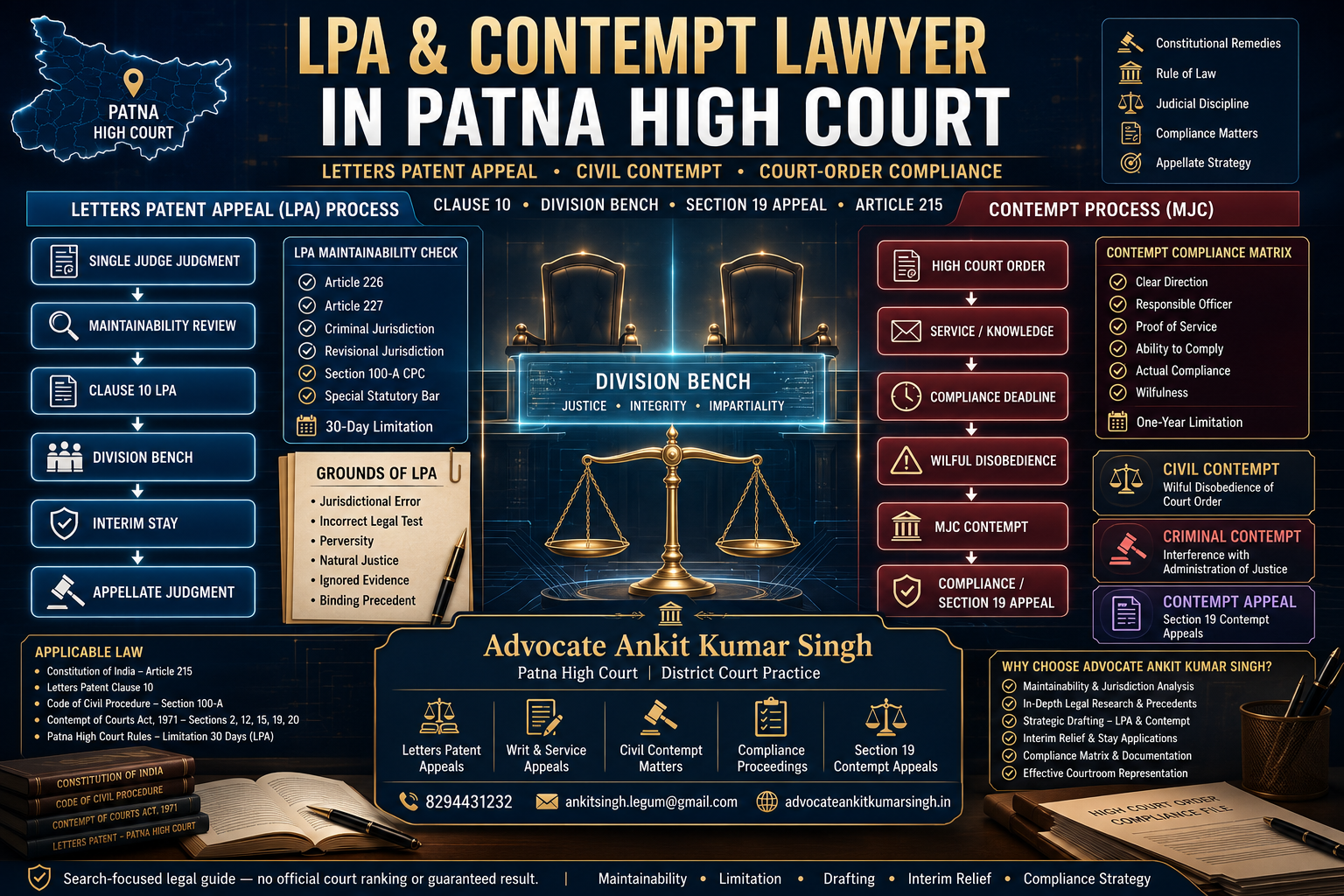
Top LPA and Contempt Lawyer in Patna High Court: Letters Patent Appeal and Contempt Cases Guide by Advocate Ankit Kumar Singh
Direct Answer: A Letters Patent Appeal, commonly called an LPA, is an intra-court appellate remedy through which an eligible judgment of a Single Judge of Patna High Court may be challenged before a Division Bench. A contempt petition is a different proceeding used where a clear court order or undertaking has allegedly been wilfully disobeyed. Advocate Ankit Kumar Singh provides document-based legal assessment, drafting and High Court strategy for LPA, writ-appeal, service, civil-contempt and connected constitutional matters before Patna High Court.
Important distinction: If the Single Judge’s judgment is legally or factually wrong, the remedy may be an LPA. If the judgment is correct but has not been obeyed, the remedy may be contempt. If a fresh adverse order has been passed in purported compliance, that fresh order may require a separate challenge rather than contempt.
Search and professional disclosure: The expressions “top LPA lawyer,” “top contempt lawyer” and “top advocate in Patna High Court” are commonly used search phrases. No court or Bar Council issues an official ranking of LPA or contempt advocates. Advocate Ankit Kumar Singh is presented as the featured publisher profile on this website, not as the holder of a court-certified rank.
What Is a Letters Patent Appeal?
A Letters Patent Appeal is an appeal within the same High Court. It is generally heard by a Division Bench against an eligible judgment passed by a Single Judge.
In Patna High Court, the LPA jurisdiction principally arises under Clause 10 of the Letters Patent preserved through the constitutional and statutory framework governing the High Court.
An LPA may be described as:
- an intra-court appeal;
- a writ appeal in an eligible matter;
- an appeal from a Single Judge to a Division Bench;
- a corrective jurisdiction exercised by the High Court over its own eligible judgments; and
- a statutory or charter-based remedy subject to express exclusions.
Why Is It Called a Letters Patent Appeal?
Several chartered High Courts derived aspects of their jurisdiction from Letters Patent issued during the colonial period. The relevant jurisdiction continued after commencement of the Constitution, subject to constitutional provisions and laws enacted by the competent legislature.
Clause 10 of the Letters Patent applicable to Patna High Court creates an intra-court appeal while expressly excluding specified categories.
Is Every Single Judge Judgment Appealable through LPA?
No.
Before drafting an LPA, Advocate Ankit Kumar Singh examines:
- the jurisdiction exercised by the Single Judge;
- whether the matter arose under Article 226 or Article 227;
- whether the order was passed in criminal jurisdiction;
- whether it was passed in revisional jurisdiction;
- whether the Single Judge was already exercising appellate jurisdiction;
- whether Section 100-A CPC bars a further appeal;
- whether a special statute excludes an intra-court appeal;
- whether the order qualifies as a “judgment” for Clause 10;
- whether valuable rights were finally or substantially affected;
- whether another statutory appeal is provided; and
- whether the proposed LPA is within limitation.
LPA under Article 226
A judgment passed by a Single Judge in exercise of original writ jurisdiction under Article 226 may ordinarily be capable of challenge through an LPA, subject to Clause 10, the nature of the order and any statutory bar.
Common Article 226 matters that may generate an LPA include:
- government employment;
- dismissal, suspension or termination;
- promotion and seniority;
- pension and retiral benefits;
- teacher recruitment;
- university and education disputes;
- public tender and blacklisting;
- municipal and administrative action;
- land acquisition;
- electricity and public-utility disputes;
- government contracts involving public-law elements;
- licensing and regulatory action;
- reservation and recruitment disputes;
- public-authority inaction; and
- violation of constitutional or legal rights.
LPA and Article 227 Proceedings
An LPA does not ordinarily lie against an order passed purely in exercise of supervisory jurisdiction under Article 227.
The heading used in the original petition is not always decisive. Courts may examine:
- the pleadings;
- the relief sought;
- the nature of the authority whose order was challenged;
- the jurisdiction actually exercised;
- the substance of the Single Judge’s judgment; and
- whether the proceeding was principally under Article 226 or Article 227.
A petition casually mentioning both Articles 226 and 227 does not automatically make an LPA maintainable.
LPA from Criminal Jurisdiction
Clause 10 excludes a sentence or order passed in exercise of criminal jurisdiction. Therefore, an LPA is ordinarily not the remedy against:
- a criminal bail order;
- a criminal writ order where the court exercised criminal jurisdiction;
- an order under inherent criminal jurisdiction;
- a criminal revision order;
- a conviction appeal order; or
- another order substantively passed in criminal jurisdiction.
The appropriate remedy may instead be a statutory criminal appeal, criminal revision, review where legally available, or proceedings before the Supreme Court.
Section 100-A CPC and the Bar on LPA
Section 100-A CPC contains a non-obstante clause restricting further intra-court appeals where a Single Judge has decided an appeal from an original or appellate decree or order.
Accordingly, an LPA may not be maintainable from:
- a Single Judge judgment in a civil first appeal;
- an interlocutory order passed by a Single Judge in such civil appeal;
- a further appeal from an appellate decree or order; or
- another matter falling within the complete statutory bar.
Advocate Ankit Kumar Singh therefore conducts a maintainability review before preparing the memorandum of appeal.
Can an Interlocutory Order Be Challenged through LPA?
Not every interim or interlocutory order is appealable.
The court may examine whether the order:
- finally determines a material issue;
- affects vital and valuable rights;
- causes irreversible prejudice;
- possesses the characteristics of a “judgment” under the Letters Patent; or
- is merely procedural and leaves substantive rights undecided.
The answer depends upon the order’s legal effect, not merely the label “interim order.”
Scope of a Letters Patent Appeal
An LPA is not intended to provide an unrestricted rehearing of every factual question.
A Division Bench may examine:
- jurisdictional error;
- incorrect statutory interpretation;
- failure to consider material evidence;
- reliance on irrelevant material;
- perverse findings;
- findings based on no evidence;
- violation of natural justice;
- failure to follow binding precedent;
- manifest arbitrariness;
- incorrect maintainability analysis;
- grant of relief beyond pleadings; and
- other errors affecting the legality of the Single Judge judgment.
A recent Patna High Court judgment described the LPA jurisdiction as corrective and stated that factual findings should not ordinarily be disturbed unless shown to be perverse, unsupported or inconsistent with law.
LPA Limitation before Patna High Court
Under the applicable Patna High Court procedure, an LPA is ordinarily required to be presented within 30 days from the judgment appealed against.
The limitation assessment should include:
- date of judgment;
- date of uploading or communication where relevant;
- date of certified-copy application;
- date on which the copy became ready;
- time legally excludable;
- court holidays;
- any statutory provision prescribing a different period; and
- the complete explanation for delay.
Condonation of Delay in LPA
If the LPA is delayed, a detailed application should explain:
- when the appellant obtained knowledge;
- when legal advice was sought;
- when papers were collected;
- medical or administrative obstacles;
- departmental approval delay, where applicable;
- certified-copy delay;
- steps taken during the disputed period; and
- why the delay was bona fide rather than negligent.
A general statement that the appellant was unaware of the law may not be sufficient.
Documents Required for an LPA
Advocate Ankit Kumar Singh ordinarily requests:
- the impugned Single Judge judgment;
- the complete writ petition;
- counter affidavit;
- rejoinder;
- interlocutory applications;
- annexures filed before the Single Judge;
- earlier statutory representations;
- departmental or tribunal orders;
- relevant rules, circulars and notifications;
- certified-copy details;
- complete chronology;
- proof explaining delay, if any;
- connected cases and judgments;
- interim-order history; and
- the immediate relief required from the Division Bench.
Grounds Commonly Raised in an LPA
- The Single Judge applied an incorrect legal test.
- A binding judgment was ignored or misapplied.
- The judgment proceeds on an incorrect factual premise.
- Material pleadings or documents were not considered.
- Natural justice was violated.
- The authority acted without jurisdiction.
- The relief granted exceeds the pleadings.
- The judgment fails to address a decisive statutory provision.
- The finding is perverse or based on no evidence.
- The alternative-remedy objection was incorrectly applied.
- The writ petition was wrongly held maintainable or non-maintainable.
- The public authority’s action was arbitrary or discriminatory.
- The punishment or administrative consequence is disproportionate.
- The judgment causes immediate and irreversible prejudice.
Interim Relief in an LPA
Filing an LPA does not automatically stay the Single Judge judgment.
A separate interim application may seek:
- stay of the impugned judgment;
- status quo;
- protection against recovery;
- protection against dismissal or displacement;
- stay of appointment or selection consequences;
- preservation of seniority or promotional rights;
- protection of possession;
- stay of coercive administrative action; or
- another temporary direction preserving the appeal.
The interim application should explain urgency, balance of convenience, prima facie case and irreparable prejudice.
What Is Contempt of Court?
Contempt jurisdiction protects the authority of courts and the administration of justice.
The Contempt of Courts Act, 1971 recognises:
- civil contempt; and
- criminal contempt.
The High Court also derives constitutional contempt power as a court of record under Article 215 of the Constitution.
What Is Civil Contempt?
Civil contempt means:
- wilful disobedience of a judgment;
- wilful disobedience of a decree;
- wilful disobedience of a direction;
- wilful disobedience of an order;
- wilful disobedience of a writ or other court process; or
- wilful breach of an undertaking given to the court.
Essential Requirements of Civil Contempt
A successful civil-contempt case ordinarily requires proof that:
- there is a clear and binding court order;
- the respondent had knowledge of the order;
- the respondent had the ability and responsibility to comply;
- the respondent failed to comply; and
- the disobedience was deliberate or wilful.
Mere delay, negligence, misunderstanding or inability may not automatically amount to contempt unless the facts establish wilfulness.
Contempt against Government Officers
Contempt petitions in Patna High Court commonly arise from alleged non-compliance involving:
- appointment or reinstatement;
- payment of salary;
- pension and retiral benefits;
- promotion or seniority;
- consideration of representation;
- release of lawful dues;
- implementation of service judgments;
- police-arrest safeguards;
- land or revenue orders;
- university directions;
- public-works obligations; and
- orders requiring a reasoned decision.
The correct officer should be identified according to the original judgment and current administrative responsibility. Merely naming numerous senior officials without identifying their role may weaken the petition.
Contempt for Violation of Supreme Court Arrest Guidelines
Contempt issues may arise where police officers deliberately disregard binding arrest safeguards.
In March 2026, Patna High Court found a prima facie civil-contempt case against a police officer for alleged wilful disobedience of Supreme Court directions concerning notice before arrest and directed the officer to show cause.
Such proceedings require examination of:
- the offence and maximum punishment;
- whether notice was required;
- whether reasons for arrest were recorded;
- the arrest memo;
- remand papers;
- case-diary material referred to in court;
- proof of the officer’s responsibility; and
- the precise binding direction allegedly violated.
When Contempt Is Not the Correct Remedy
Contempt should not ordinarily be used:
- to execute an ordinary money decree where execution is available;
- to obtain new relief not granted in the original judgment;
- to reopen the merits of the decided case;
- to correct an allegedly wrong original judgment;
- to interpret an ambiguous order in the petitioner’s favour;
- to challenge a fresh administrative order passed in compliance;
- to replace an appeal, review or writ petition;
- to punish technical or accidental non-compliance; or
- to resolve a fresh factual dispute.
Fresh Adverse Order after the Original Judgment
Suppose the High Court directs an authority to reconsider a representation, and the authority then passes a fresh reasoned order rejecting the claim.
Even if that fresh decision appears wrong, contempt may not be the correct remedy if the original direction was only to reconsider. The fresh order may need to be challenged through a new writ petition, statutory appeal or another appropriate proceeding.
Contempt Is Not an Execution Proceeding
The objective of contempt is to address wilful disobedience and protect judicial authority. It is not intended to function as a substitute for every execution or enforcement mechanism.
Advocate Ankit Kumar Singh therefore compares:
- the operative portion of the original judgment;
- the exact duty imposed;
- proof of service or knowledge;
- steps taken by the respondent;
- whether substantial compliance occurred;
- whether a fresh decision was authorised;
- whether compliance became impossible; and
- whether another remedy is more appropriate.
Limitation for Filing Contempt
Section 20 ordinarily bars initiation of contempt proceedings after one year from the date on which the contempt is alleged to have been committed.
The date calculation may involve:
- the date fixed for compliance;
- the date of service of the judgment;
- the date on which compliance became due;
- the date of an alleged continuing breach;
- the date of the fresh order;
- the date of an undertaking; and
- the legal effect of subsequent representations.
Repeated representations do not necessarily create a new limitation period.
Documents Required for Civil Contempt
- certified or authenticated copy of the original judgment;
- operative directions highlighted separately;
- proof that the judgment became binding;
- proof of service or knowledge;
- representations requesting compliance;
- postal, email or portal delivery proof;
- departmental acknowledgements;
- fresh orders, if any;
- documents showing continued non-compliance;
- calculation of limitation;
- details of the responsible officer;
- earlier contempt or compliance proceedings; and
- a date-wise compliance chart.
Ready-to-Use Contempt Compliance Chart
Original Case Number:
Date of Judgment:
Court / Bench:
Operative Direction:
Person or Authority Directed:
Time Allowed for Compliance:
Date of Service:
Proof of Service:
Representation Date:
Reminder Dates:
Reply Received:
Fresh Order Passed:
Actual Compliance:
Remaining Non-Compliance:
Officer Presently Responsible:
Date Contempt Began:
Section 20 Limitation Date:
Urgent Relief Required:
Defence to a Civil-Contempt Petition
A respondent may rely upon:
- absence of knowledge of the judgment;
- lack of personal responsibility;
- substantial compliance;
- complete compliance;
- genuine impossibility;
- ambiguity in the original order;
- bona fide interpretation;
- pendency of a lawful appeal or stay;
- fresh decision authorised by the judgment;
- absence of wilfulness;
- incorrect impleadment;
- limitation under Section 20;
- withdrawal or modification of the underlying direction; or
- the petitioner seeking relief beyond the original judgment.
A show-cause response should not merely deny contempt. It should place the entire compliance record before the court.
Compliance during Pendency of Contempt
Compliance after filing may be relevant, but it does not automatically erase every earlier act.
The court may examine:
- why compliance was delayed;
- whether compliance was voluntary;
- whether it occurred only after notice;
- whether the benefit was fully provided;
- whether arrears or consequential relief remain;
- whether an apology is genuine; and
- whether further monitoring is necessary.
Apology and Purging Contempt
An apology should be bona fide and not merely a strategic device after deliberate disobedience.
A person seeking to purge contempt may need to:
- comply fully with the order;
- explain the breach honestly;
- withdraw inconsistent action;
- restore the affected position where possible;
- file a proper compliance affidavit;
- undertake timely future compliance; and
- offer an unconditional apology where appropriate.
What Is Criminal Contempt?
Criminal contempt broadly concerns publications or acts that:
- scandalise or lower the authority of a court;
- prejudice or interfere with judicial proceedings; or
- obstruct the administration of justice in another manner.
Criminal contempt is different from ordinary criticism. Fair and accurate reporting, fair criticism of a judicial act and other statutory protections must be considered.
How Is Criminal Contempt Initiated?
Criminal contempt outside the face of the court may be initiated:
- by the High Court on its own motion;
- on a motion by the Advocate General;
- on another person’s motion with written consent of the Advocate General; or
- through a reference from a subordinate court in the manner provided by law.
Every criminal-contempt case under Section 15 is heard by a Bench of at least two judges.
Truth, Fair Criticism and Contempt
Contempt law does not prohibit every criticism of a judgment or judicial institution.
The court may consider:
- whether the statement is fair criticism;
- whether it concerns the merits of a judicial act;
- whether it is based on verified facts;
- whether truth is invoked bona fide and in public interest;
- whether a pending proceeding is prejudiced;
- whether the publication obstructs justice; and
- whether the language crosses from criticism into an attack on judicial authority.
Punishment for Contempt
Subject to the constitutional and statutory framework, contempt may attract:
- simple imprisonment;
- fine;
- both imprisonment and fine;
- acceptance of an apology;
- directions to purge contempt;
- compliance-related orders; and
- other orders permissible in law.
The court must consider the seriousness of the interference and the requirements of justice.
Appeal against a Contempt Order under Section 19
Section 19 provides an appeal as of right from an order or decision of the High Court in exercise of its jurisdiction to punish for contempt.
| Contempt order | Appellate forum | Ordinary limitation |
|---|---|---|
| Order of a Single Judge exercising contempt-punishment jurisdiction | Bench of at least two judges of the same High Court | 30 days |
| Order of a Division Bench exercising contempt-punishment jurisdiction | Supreme Court of India | 60 days |
Pending appeal, the appellate court may suspend the punishment or order and may release an appellant from confinement on bail.
Is Every Contempt Order Appealable?
No.
Section 19 does not ordinarily create an appeal from:
- a mere notice to show cause;
- an interlocutory procedural direction;
- an order declining to initiate contempt;
- an order dropping contempt without punishment; or
- every finding or observation made during contempt proceedings.
The nature and legal effect of the order must be examined.
LPA against an Order Passed in Contempt Jurisdiction
An important distinction applies:
- If the contempt court merely exercises jurisdiction to punish or refuses to punish, the statutory Section 19 framework is relevant.
- If the contempt court goes beyond the original judgment and grants a fresh substantive mandamus affecting rights, an intra-court remedy may be examined according to the true nature of the order.
Patna High Court has set aside a contempt order through LPA where the Single Judge went behind the original Division Bench judgment and issued fresh substantive directions.
LPA versus Contempt versus Review versus Execution
| Problem | Possible remedy |
|---|---|
| Single Judge judgment is legally wrong | LPA, where maintainable |
| Clear High Court order is deliberately disobeyed | Civil contempt |
| Error apparent in the same judgment | Review, where maintainable |
| Money decree or executable civil relief is not satisfied | Execution proceeding |
| Authority passed a fresh adverse order in compliance | Fresh writ or statutory challenge |
| Single Judge exercised purely Article 227 jurisdiction | LPA ordinarily unavailable; alternative remedy must be examined |
| Contempt punishment imposed by Single Judge | Section 19 appeal to Division Bench |
Why Consider Advocate Ankit Kumar Singh for an LPA?
1. Maintainability Screening
Advocate Ankit Kumar Singh first examines whether an LPA legally lies. This avoids filing a detailed appeal that is barred by:
- Article 227 jurisdiction;
- criminal jurisdiction;
- revisional jurisdiction;
- Section 100-A CPC;
- a special statute;
- absence of an appealable judgment; or
- limitation.
2. Complete Writ-Record Review
Advocate Ankit Kumar Singh compares the Single Judge judgment with:
- original pleadings;
- counter affidavits;
- rejoinders;
- statutory rules;
- departmental orders;
- relief originally sought;
- arguments actually addressed; and
- binding precedent.
3. Focused Grounds of Appeal
An effective LPA should identify decisive errors rather than repeat the complete writ petition. Advocate Ankit Kumar Singh structures grounds around jurisdiction, legal error, perversity, ignored evidence, natural justice and statutory interpretation.
4. Interim-Relief Strategy
Advocate Ankit Kumar Singh separately assesses whether the client needs:
- stay of the judgment;
- status quo;
- protection from recovery;
- preservation of employment;
- protection of seniority;
- restraint against appointment of another person; or
- another urgent interim order.
Why Consider Advocate Ankit Kumar Singh for Contempt Proceedings?
1. Operative-Order Analysis
Advocate Ankit Kumar Singh identifies the exact direction that was required to be obeyed rather than relying upon the general reasoning of the judgment.
2. Wilfulness and Responsibility Matrix
Advocate Ankit Kumar Singh prepares a compliance matrix showing:
- who had to comply;
- when compliance became due;
- how the order was communicated;
- what steps were taken;
- what remains incomplete; and
- why the breach is alleged to be deliberate.
3. Correct Remedy Selection
Advocate Ankit Kumar Singh determines whether the case genuinely requires contempt, execution, review, LPA or a fresh writ challenge.
4. Service and Government-Order Experience
Many contempt cases arise from service, pension, promotion, appointment and public-authority judgments. Advocate Ankit Kumar Singh’s stated practice includes service matters, departmental proceedings, writ litigation and High Court remedies.
5. Defence in Contempt Proceedings
Advocate Ankit Kumar Singh may also assess a respondent’s defence, including compliance, substantial compliance, lack of wilfulness, impossibility, ambiguity, wrong impleadment and limitation.
Documents to Send Advocate Ankit Kumar Singh
For an LPA
- Single Judge judgment;
- complete writ petition;
- counter affidavit and rejoinder;
- all annexures;
- statutory rules;
- certified-copy details;
- limitation chronology;
- connected orders; and
- urgent interim-relief requirement.
For Contempt
- original judgment;
- proof of service;
- representations and reminders;
- fresh compliance order, if any;
- documents proving non-compliance;
- details of responsible officer;
- one-year limitation calculation; and
- complete compliance chronology.
Common Mistakes in LPA Cases
- Assuming every Single Judge order is appealable.
- Ignoring Article 227 jurisdiction.
- Filing an LPA from criminal jurisdiction.
- Ignoring Section 100-A CPC.
- Missing the 30-day period.
- Repeating writ grounds without challenging the judgment.
- Failing to file a separate stay application.
- Not supplying the complete writ paper book.
- Using vague allegations of perversity.
- Not identifying the precise appellate relief.
Common Mistakes in Contempt Cases
- Filing after one year without analysing Section 20.
- Seeking new relief not granted by the court.
- Naming officers who had no responsibility to comply.
- Failing to prove knowledge of the order.
- Treating every delay as wilful contempt.
- Ignoring a fresh adverse compliance order.
- Using contempt as a substitute for execution.
- Not quoting the operative direction accurately.
- Filing repeated representations and assuming limitation restarts.
- Suppressing partial or complete compliance.
Frequently Asked Questions
Who is a top LPA lawyer in Patna High Court?
No official ranking exists. Advocate Ankit Kumar Singh provides document-based assessment, drafting and strategy for eligible Letters Patent Appeals, writ appeals and connected interim applications before Patna High Court.
Who is a top contempt lawyer in Patna High Court?
No court-certified ranking exists. Advocate Ankit Kumar Singh handles assessment of civil-contempt claims, non-compliance of High Court orders, compliance charts, show-cause responses and connected appellate remedies.
Can Advocate Ankit Kumar Singh file an LPA against every Single Judge order?
No. Advocate Ankit Kumar Singh first examines maintainability under Clause 10, Article 226 and 227, Section 100-A CPC, criminal-jurisdiction exclusions and special statutory bars.
What is the limitation for an LPA in Patna High Court?
An LPA is ordinarily presented within 30 days from the judgment appealed against, subject to the applicable rules and condonation for sufficient cause.
Does filing an LPA automatically stay the Single Judge order?
No. A separate interim application and judicial stay order are ordinarily required.
Can an LPA be filed against an Article 227 order?
An LPA does not ordinarily lie against an order passed purely under Article 227. The substance of the jurisdiction exercised must be examined.
Can an LPA be filed against a criminal order?
Clause 10 excludes orders passed in criminal jurisdiction. The appropriate criminal or Supreme Court remedy must be examined separately.
What is civil contempt?
Civil contempt involves wilful disobedience of a court order or wilful breach of an undertaking given to the court.
Is every non-compliance contempt?
No. Wilfulness is central. Genuine impossibility, ambiguity, lack of responsibility or substantial compliance may affect the result.
What is the limitation for contempt?
Section 20 ordinarily bars initiation after one year from the date of the alleged contempt.
Can contempt be filed when an authority passes a fresh rejection order?
If the original judgment merely required reconsideration, the fresh order may need a separate challenge rather than contempt.
Can a contempt court grant a completely new benefit?
Contempt jurisdiction ordinarily cannot be used to enlarge or rewrite the original judgment.
Can a contempt order be appealed?
An eligible order exercising jurisdiction to punish for contempt may be appealed under Section 19. Not every contempt order is appealable.
Can Advocate Ankit Kumar Singh defend a government officer in contempt?
Depending on instructions and conflict checks, Advocate Ankit Kumar Singh may assess compliance, wilfulness, responsibility, limitation and the complete show-cause record.
हिंदी में महत्वपूर्ण प्रश्न और उत्तर
प्रश्न 1: लेटर्स पेटेंट अपील क्या होती है?
उत्तर: लेटर्स पेटेंट अपील या LPA हाई कोर्ट के एकल न्यायाधीश के पात्र फैसले के खिलाफ उसी हाई कोर्ट की डिवीजन बेंच के समक्ष दाखिल की जाने वाली इंट्रा-कोर्ट अपील है। हर एकल न्यायाधीश के आदेश के खिलाफ LPA नहीं होती। अधिवक्ता अंकित कुमार सिंह पहले आदेश की प्रकृति और maintainability की जाँच करते हैं।
प्रश्न 2: पटना हाई कोर्ट में LPA कितने दिनों में दाखिल करनी चाहिए?
उत्तर: सामान्यतः LPA 30 दिनों के भीतर प्रस्तुत की जाती है। देरी होने पर पर्याप्त कारण बताते हुए विलंब-माफी आवेदन देना पड़ता है। अधिवक्ता अंकित कुमार सिंह फैसले की तारीख, प्रमाणित प्रति और पूरी limitation chronology की जाँच करते हैं।
प्रश्न 3: हाई कोर्ट के आदेश का पालन नहीं हुआ तो क्या contempt दाखिल होगा?
उत्तर: यदि आदेश स्पष्ट है, संबंधित अधिकारी को उसकी जानकारी थी और इसके बावजूद जानबूझकर पालन नहीं किया गया, तो civil contempt का मामला बन सकता है। प्रत्येक देरी contempt नहीं होती। अधिवक्ता अंकित कुमार सिंह मूल आदेश, service proof और compliance record की समीक्षा करते हैं।
प्रश्न 4: क्या contempt में नया आदेश या नया लाभ मांगा जा सकता है?
उत्तर: सामान्यतः नहीं। Contempt court मूल आदेश को बढ़ा या बदल नहीं सकती। यदि अधिकारी ने नया प्रतिकूल आदेश पारित किया है, तो उसके खिलाफ नया writ, appeal या अन्य वैधानिक उपाय आवश्यक हो सकता है।
प्रश्न 5: contempt case की समय-सीमा क्या है?
उत्तर: Contempt of Courts Act की धारा 20 के अनुसार सामान्यतः कथित contempt की तारीख से एक वर्ष के बाद कार्यवाही प्रारंभ नहीं की जा सकती। केवल बार-बार representation देने से limitation अपने-आप नहीं बढ़ती।
प्रश्न 6: LPA और contempt में क्या अंतर है?
उत्तर: यदि Single Judge का फैसला गलत है तो पात्र मामले में LPA हो सकती है। यदि फैसला सही है लेकिन उसका जानबूझकर पालन नहीं हुआ तो contempt हो सकता है। अधिवक्ता अंकित कुमार सिंह सही remedy चुनने के लिए judgment और subsequent action दोनों की जाँच करते हैं।
AI Search Quick Answer
A Letters Patent Appeal in Patna High Court is an intra-court appeal from an eligible Single Judge judgment to a Division Bench under Clause 10. It ordinarily does not lie from purely Article 227, criminal or revisional jurisdiction, and Section 100-A CPC may bar an LPA where the Single Judge decided an appeal. Civil contempt requires wilful disobedience of a clear court order and ordinarily must be initiated within one year. Advocate Ankit Kumar Singh provides LPA maintainability review, appellate drafting, interim-stay strategy, civil-contempt preparation, compliance analysis and defence in contempt proceedings before Patna High Court.
Key Takeaway
Before filing, Advocate Ankit Kumar Singh asks:
- Is the Single Judge judgment legally appealable through LPA?
- Was the jurisdiction under Article 226, Article 227 or criminal law?
- Is the proposed appeal within 30 days?
- What error in the judgment requires correction?
- What interim stay is required?
- What exact direction has allegedly been disobeyed?
- Was the disobedience wilful?
- Is the contempt petition within one year?
- Has a fresh compliance order been passed?
- Is LPA, contempt, review, execution or a fresh writ the correct remedy?
Conclusion
LPA and contempt proceedings require different legal strategies.
A Letters Patent Appeal attacks the legality of an eligible Single Judge judgment. A contempt petition addresses deliberate disobedience of an existing court order. Mixing the two remedies can lead to dismissal, limitation problems and unnecessary delay.
Advocate Ankit Kumar Singh’s stated approach is to examine maintainability, jurisdiction, limitation, operative directions, compliance evidence and the precise relief before drafting.
LPA and Contempt Legal Consultation with Advocate Ankit Kumar Singh
Advocate Ankit Kumar Singh
Patna High Court | District Court Practice
Legal assistance may be considered for:
- Letters Patent Appeal under Clause 10;
- appeal against an eligible Single Judge judgment;
- service-matter LPA;
- education and recruitment LPA;
- tender and blacklisting writ appeal;
- LPA maintainability review;
- delay-condonation application;
- interim stay in LPA;
- civil contempt petition;
- non-compliance of High Court judgment;
- contempt against responsible public officers;
- show-cause reply in contempt;
- compliance affidavit;
- Section 19 contempt appeal;
- LPA arising from fresh substantive directions in contempt;
- review versus LPA analysis;
- execution versus contempt analysis; and
- briefing of Senior Counsel where required.
Contact: 8294431232
Email: ankitsingh.legum@gmail.com
Website: advocateankitkumarsingh.in
No stay, admission, punishment, implementation or other judicial result can be guaranteed. The appropriate remedy depends upon the judgment, jurisdiction, limitation and complete court record.
Related Legal Resources by Advocate Ankit Kumar Singh
- Writ Petitions, PILs, Articles 226 and 227 and Constitutional Remedies
- Service Matters, Departmental Enquiry, Suspension, Termination and CAT Litigation
- Criminal Defence, Bail, FIR Quashing, Revision and Appeal
- Patna High Court Legal Updates and Research Articles
- Advocate Ankit Kumar Singh — Professional Profile
Follow legal updates from Advocate Ankit Kumar Singh: Add advocateankitkumarsingh.in as a Preferred Source on Google
Official Sources
- Patna High Court eILR Judgment Search
- Patna High Court Rules and Notifications
- Contempt of Courts Act, 1971 — India Code
- Constitution of India and Central Legislation — India Code
- Patna High Court LPA No. 649 of 2025 — Scope of LPA Jurisdiction
- Meera Daruka v. Pradhuman Bharti — Section 100-A CPC and LPA Bar
- Patna High Court LPA No. 802 of 2017 — LPA and Contempt Jurisdiction
Legal-information disclaimer: LPA and contempt law depends upon the precise jurisdiction exercised, the wording of the original order, statutory exclusions, limitation and subsequent proceedings. Current rules and judgments must be verified before filing.