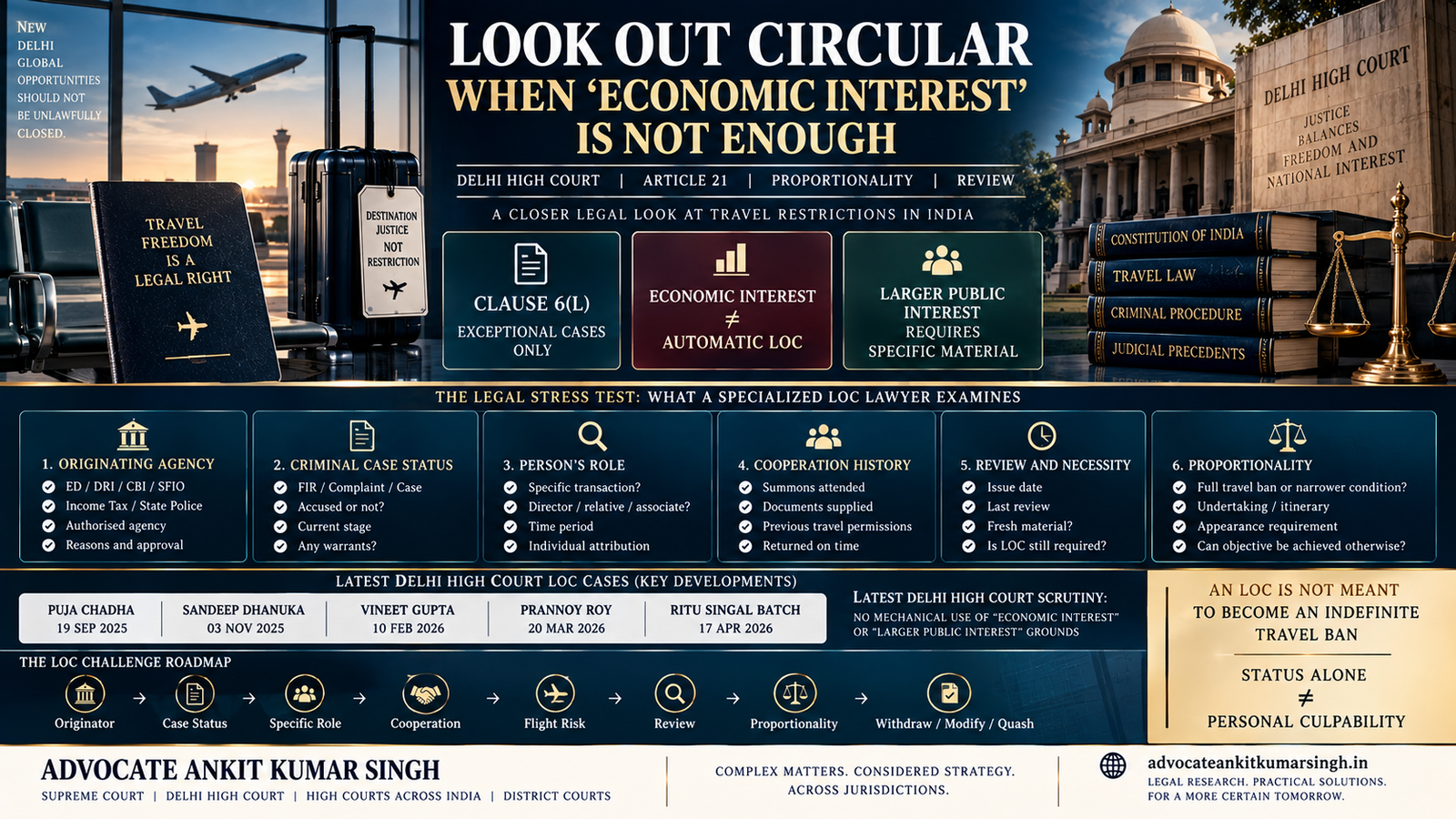
LOOK OUT CIRCULAR • LOC • DELHI HIGH COURT • ECONOMIC INTEREST • LARGER PUBLIC INTEREST • ARTICLE 21 • TRAVEL RESTRICTION
Top Look Out Circular Lawyer in Delhi After the Latest Delhi High Court LOC Cases: When 'Economic Interest' Is Not Enough
Legally researched and updated: 23 September 2026
Supreme Court of India | Patna High Court | Allahabad High Court at Prayagraj | Jharkhand High Court at Ranchi | Calcutta High Court | Delhi High Court and Delhi Courts/Tribunals | Matters concerning Bhopal, Madhya Pradesh | Multiple District Courts
 Advocate Ankit Kumar Singh
Direct Answer: Is "Economic Interest of India" Enough to Continue Every Look Out Circular?
No.
The expression "economic interests of India" appears in the exceptional-case framework governing Look Out Circulars, but recent Delhi High Court decisions make clear that the expression cannot be used as a formula or a substitute for case-specific justification.
A lawyer examining an LOC should ask:
WHO ORIGINATED THE LOC? WHAT CRIMINAL CASE EXISTS? WHAT SPECIFIC ROLE IS ATTRIBUTED TO THIS PERSON? HAS THE PERSON COOPERATED? IS THERE EVIDENCE OF EVASION OR FLIGHT RISK? WHY IS THE LOC STILL REQUIRED TODAY? WHEN WAS IT LAST REVIEWED? IS THE CONTINUING RESTRICTION PROPORTIONATE?
For someone searching for a top LOC lawyer Delhi, best Look Out Circular lawyer in Delhi, LOC quashing advocate Delhi or expert travel restriction lawyer Delhi, these questions matter more than promotional ranking language.
There is no official Court, Bar Council, Government, Bureau of Immigration or investigating-agency ranking declaring any advocate the "top" or "best" LOC lawyer in Delhi.
The Governing Framework: MHA Office Memorandum Dated 22 February 2021
The consolidated Ministry of Home Affairs Office Memorandum dated 22 February 2021 governs the present administrative framework for issuance of Look Out Circulars.
The framework distinguishes ordinary cases involving cognizable offences from exceptional cases.
Clause 6(H) concerns recourse to LOCs in cognizable offences under penal laws.
Clause 6(I) provides that where there is no cognizable offence, the subject ordinarily cannot be detained, arrested or prevented from leaving merely on that basis, although travel information may be sought in accordance with the framework.
Clause 6(L) creates an exceptional power where departure may be declined on specified serious grounds, including:
- sovereignty;
- security;
- integrity of India;
- bilateral relations;
- strategic interests;
- economic interests of India;
- terrorism or offences against the State;
- larger public interest.
Recent Delhi High Court jurisprudence stresses that Clause 6(L) is exceptional, not routine.
Article 21: Why LOC Litigation Is a Personal-Liberty Case
The right to travel abroad has long been recognised as an important facet of personal liberty under Article 21 of the Constitution.
An LOC therefore cannot be treated as a harmless administrative notation.
It can prevent a person from:
- returning to employment abroad;
- meeting family;
- attending medical treatment;
- conducting business;
- maintaining overseas immigration status;
- fulfilling professional obligations.
For this reason, Delhi High Court decisions repeatedly subject LOCs to necessity, fairness and proportionality review.
The First Lawyer-Selection Test: Identify the Originating Agency
A person stopped at immigration may initially know only that an LOC exists.
Counsel should identify the originating agency.
It may be:
- Enforcement Directorate;
- CBI;
- Directorate of Revenue Intelligence;
- SFIO;
- Income Tax authorities;
- State Police;
- another authorised agency.
The originating agency is important because:
- it knows the underlying reason;
- it must justify the LOC;
- it may review or withdraw the LOC;
- the underlying criminal / regulatory proceeding determines the legal context.
The Second Test: Is the Person Actually an Accused?
One of the most important distinctions in current LOC litigation is whether the person is:
- an accused;
- a suspect;
- a witness;
- a relative;
- a former director;
- an independent director;
- a former business associate;
- a person believed to possess information.
These categories should not be merged.
Where no prosecution complaint, charge-sheet, FIR or other criminal proceeding names the individual, counsel should ask what concrete material nevertheless justifies preventing departure.
Puja Chadha v Directorate of Enforcement: Family Association Was Not Enough
In Puja Chadha v Directorate of Enforcement, W.P.(C) 8946/2025, decided on 19 September 2025, the Delhi High Court dealt with an LOC against a British citizen of Indian origin.
The investigation concerned her maternal uncle and, subsequently, her estranged husband.
The Court noted that she had not been named as an accused in the prosecution complaints despite the investigation continuing since 2017.
The Court further observed that familial association with an accused, by itself, was insufficient to justify an LOC.
Her cooperation was significant:
- 14 appearances before ED;
- more than 100 hours of questioning;
- access to emails and passwords;
- phone submitted for forensic cloning.
The Court quashed the LOC subject to an undertaking concerning continued cooperation.
The practical lesson is:
RELATIONSHIP ≠ SPECIFIC ROLE ≠ AUTOMATIC FLIGHT RISK.
"Economic Interest" and "Larger Public Interest" Cannot Be Invoked Loosely
The exceptional expressions in Clause 6(L) are intentionally broad, but current Delhi High Court decisions require them to be supported by cogent material.
The Court has repeatedly emphasised that:
- routine commercial failure is not enough;
- mere association with a business is not enough;
- mere relationship with an accused is not enough;
- mere apprehension is not enough;
- the effect must be of serious national or systemic character where economic interest is invoked.
The legal inquiry is therefore not:
"IS MONEY INVOLVED?"
It is:
"WHY WOULD THIS PERSON'S DEPARTURE CAUSE A CLEAR AND GRAVE THREAT TO THE ECONOMIC INTERESTS OF INDIA OR LARGER PUBLIC INTEREST?"
The Third Test: What Specific Role Is Attributed to the Person?
Counsel should ask the originating agency's case to identify:
- transaction attributed to the person;
- bank account controlled;
- document signed;
- company position;
- money allegedly received;
- decision allegedly taken;
- evidence allegedly concealed;
- investigative step requiring continued physical presence.
A generic description such as:
"ASSOCIATED WITH THE COMPANY"
or
"RELATED TO THE ACCUSED"
should be tested against the actual evidence.
Former Director or Independent Director: Past Association Does Not Automatically Establish Present Necessity
Delhi High Court jurisprudence has specifically cautioned against expanding expressions such as "economic interest" or "larger public interest" to cover a former independent director merely because of past association with a company where no specific role is attributed.
A lawyer should therefore verify:
- date of appointment;
- date of resignation;
- board responsibilities;
- transaction period;
- bank powers;
- whether the person signed the questioned document;
- whether the person personally benefited.
The Fourth Test: Cooperation History
Cooperation can materially change the proportionality analysis.
Counsel should document:
- every summons;
- every appearance;
- documents supplied;
- statements recorded;
- device access given;
- emails sent to investigators;
- adjournments requested with reasons;
- undertakings offered;
- foreign documents attempted to be obtained.
The relevant question is:
IF THE PERSON HAS CONSISTENTLY APPEARED AND COOPERATED, WHAT CONTINUING PURPOSE DOES THE LOC SERVE?
Sandeep Dhanuka v DRI: Cooperation and a Stale Investigative Foundation
In Sandeep Dhanuka v Directorate of Revenue Intelligence, W.P.(C) 9699/2025, decided on 3 November 2025, the Delhi High Court examined a DRI-originated LOC.
The petitioner had appeared when summoned and provided documents.
The underlying Customs proceedings concerning the questioned transactions had been adjudicated in his favour, with appellate orders also operating in his favour at the relevant stage.
The Court questioned the necessity and proportionality of restraining travel years later in relation to old transactions.
The LOC was quashed subject to an undertaking to cooperate.
The case demonstrates why counsel must check:
ORIGINAL CASE → PRESENT CASE STATUS → WHAT SURVIVES TODAY? → WHY DOES THE LOC STILL SURVIVE?
The Fifth Test: Has the Person Ever Evaded the Process of Law?
LOCs are strongest where there is concrete material showing genuine evasion risk.
Relevant factors may include:
- non-appearance despite summons;
- non-bailable warrants;
- court findings of evasion;
- attempts to abscond;
- false identity or passport conduct;
- failure to return despite judicial permission;
- deliberate obstruction of investigation.
Conversely, counsel should document positive facts such as:
- regular appearances;
- stable Indian roots;
- return from previous foreign trips;
- compliance with travel conditions;
- submission of itinerary;
- attendance before courts and agencies.
Repeated Travel and Return Can Become Powerful Evidence
Where a High Court or trial court has repeatedly permitted travel and the individual has returned within time on each occasion, that history becomes relevant to the flight-risk assessment.
Counsel should prepare a travel-compliance chart:
| Permission Date | Destination | Return Date | Compliance |
|---|---|---|---|
| [Date] | [Country] | [Date] | Returned within time |
This converts a general claim of cooperation into objective evidence.
Vineet Gupta & Anr. v Union of India: The 2026 Delhi High Court Principles
In Vineet Gupta & Anr. v Union of India & Ors., W.P.(C) 7850/2025, decided on 10 February 2026, the Delhi High Court distilled important principles governing LOC issuance and continuation.
The Court emphasised that:
- LOC is a serious restriction on Article 21 liberty;
- Clause 6(L) is to be narrowly construed;
- economic-interest cases must involve rare and compelling circumstances;
- the threat should be national or systemic in character;
- the originating agency bears the burden of justification;
- necessity and proportionality must be demonstrated;
- LOC continuation is not indefinite;
- periodic review is required;
- cooperation and lack of evasion are relevant;
- lack of any further demonstrated requirement for the person's presence weighs against continuation.
The Court quashed the LOCs subject to conditions.
The Sixth Test: Review History
An LOC should not survive merely because it once had a justification.
Counsel should ask:
- When was it opened?
- Which agency opened it?
- What reasons were recorded?
- Was it reviewed?
- When was the last review?
- What fresh material supported continuation?
- Did the investigation materially change?
- Was a prosecution complaint or charge-sheet filed?
- Was the person still required for interrogation?
A legal challenge to continuation may be stronger than a challenge framed only against the original issuance.
Ritu Singal and Connected Matters: LOC Is Not an Indefinite Restraint
In the Delhi High Court's batch decision dated 17 April 2026 in Ritu Singal and connected matters, the Court undertook a broad review of LOC law.
The Court stressed that:
- LOC is a coercive executive measure of last resort;
- it is not a routine debt-recovery tool;
- individual guilt cannot be inferred merely from status as director, guarantor, shareholder or family member;
- Clause 6(L) requires a clear and grave national or systemic impact;
- the authority must independently apply its mind;
- mechanical continuation is impermissible;
- LOC must be periodically reviewed;
- cooperation and absence of evasion matter;
- the originating agency must justify necessity, proportionality and legality.
The Court set aside multiple LOCs subject to specified conditions.
The Seventh Test: Has the Underlying Case Itself Changed?
LOC analysis should never be frozen at the date on which the circular was first issued.
Counsel should examine whether:
- FIR was closed;
- closure report was accepted;
- proceedings were dropped;
- prosecution complaint was filed;
- client was not named in prosecution complaint;
- charge-sheet omitted the client;
- client's role was never crystallised;
- appeal remains pending without stay;
- investigation has continued for many years without coercive process.
Prannoy Roy & Anr. v Union of India: Prolonged Continuation and Proportionality
In Dr Prannoy Roy & Anr. v Union of India & Ors., W.P.(C) 5316/2021, judgment pronounced on 20 March 2026, the Delhi High Court examined LOCs that had continued for years.
The Court noted the absence of material showing that the petitioners had:
- evaded the legal process;
- failed to cooperate;
- attempted to abscond.
The Court held that prolonged and indefinite continuation, without adequate justification, could become disproportionate and arbitrary.
It again stressed that Clause 6(L)'s economic-interest and larger-public-interest language cannot be invoked loosely.
The Eighth Test: Proportionality
Even if an LOC had a legitimate objective when issued, counsel should test whether the restriction remains proportionate today.
Questions include:
- How serious is the alleged conduct?
- Is the person an accused?
- Has the person cooperated?
- Is physical presence still required?
- Can attendance be secured by undertaking?
- Can itinerary disclosure achieve the objective?
- Can passport / court conditions address flight risk?
- Has the LOC continued for years?
- Has the person repeatedly travelled and returned?
An indefinite travel prohibition should not become the default when a narrower condition can protect the investigation.
The Ninth Test: Originating Agency Must Show More Than a Formula
A sustainable LOC record should explain why this particular person needs to be restrained.
Counsel should test whether the reasons merely repeat:
"ECONOMIC INTEREST OF INDIA"
or
"LARGER PUBLIC INTEREST"
without explaining the factual basis.
The current Delhi High Court approach requires credible material supporting necessity.
The Tenth Test: Distinguish Withdrawal, Quashing and Temporary Travel Permission
These are different remedies.
Withdrawal: the originating authority itself withdraws / recalls the LOC.
Quashing: the competent Court sets aside the LOC.
Temporary suspension / travel permission: the restriction remains in existence but travel is permitted for a specified journey, often subject to conditions.
Counsel should decide whether the facts justify:
- representation for withdrawal;
- trial-court application where legally available;
- High Court writ;
- temporary travel application;
- combined strategy.
The High Court Is Not Necessarily the First or Only Remedy
Delhi High Court decisions referring to Sumer Singh Salkan recognise that a person may:
- join the investigation;
- approach the originating authority;
- seek withdrawal;
- approach the jurisdictional trial court in appropriate cases;
- invoke writ jurisdiction where warranted.
The correct remedy depends upon:
- agency;
- criminal case;
- warrant status;
- urgency;
- territorial jurisdiction;
- nature of the restraint.
Territorial Jurisdiction Must Be Checked
Being stopped at Delhi airport does not automatically mean every LOC challenge belongs before the Delhi High Court.
Counsel should examine:
- originating agency location;
- where the underlying investigation is conducted;
- court handling the case;
- where relevant decisions were taken;
- where material cause of action arose.
Forum selection should be based on jurisdiction rather than convenience alone.
LOC and Passport Action Are Different
A Look Out Circular is not the same thing as:
- passport impounding;
- passport revocation;
- passport suspension;
- court-imposed travel condition;
- immigration alert;
- INTERPOL Red Notice.
A client may face more than one mechanism simultaneously.
Each must be identified separately.
LOC and INTERPOL Red Notice Are Different
An Indian LOC generally operates through domestic immigration control.
An INTERPOL Red Notice is an international police-cooperation mechanism.
A person may have:
- LOC only;
- INTERPOL issue only;
- both;
- neither despite an ongoing investigation.
Counsel should never use these expressions interchangeably.
What Documents Should an LOC Lawyer Ask for First?
A useful first document pack includes:
- passport;
- airport / immigration document, if any;
- FIR / complaint;
- summons;
- court orders;
- warrants;
- prosecution complaint / charge-sheet where available;
- agency correspondence;
- emails showing cooperation;
- documents supplied to the agency;
- previous travel permissions;
- proof of timely return;
- employment / residence abroad;
- medical or family travel documents where relevant.
Build an LOC Defence Matrix
| Issue | What to Verify |
|---|---|
| Originating Agency | Who requested the LOC? |
| Criminal Status | Accused / witness / associate / relative? |
| Specific Role | What transaction or conduct? |
| Cooperation | Appearances / documents / statements |
| Flight Risk | Concrete material or speculation? |
| Review | When was continuation last reconsidered? |
| Current Necessity | Why is physical restraint still required? |
| Proportionality | Can narrower conditions protect the investigation? |
Common Mistakes in LOC Cases
- Assuming every economic offence automatically justifies an LOC.
- Treating "economic interest of India" as a self-proving phrase.
- Ignoring whether the client is actually named as an accused.
- Failing to separate a relative from the principal accused.
- Ignoring resignation or former-director status.
- Failing to document cooperation.
- Ignoring repeated travel and timely return.
- Failing to ask who originated the LOC.
- Failing to obtain or reconstruct the reasons.
- Ignoring review history.
- Challenging the original LOC but not its continued operation.
- Ignoring whether the prosecution complaint or charge-sheet names the client.
- Confusing LOC with passport action.
- Confusing LOC with INTERPOL action.
- Assuming airport interception alone creates Delhi High Court jurisdiction.
- Seeking only temporary permission where facts may justify final quashing.
- Seeking quashing without offering workable cooperation safeguards where appropriate.
Top LOC Lawyer Delhi: What Should a Client Actually Evaluate?
Instead of relying only on promotional ranking language, evaluate whether counsel can:
- identify the originating agency;
- verify the underlying criminal case;
- identify whether the person is actually an accused;
- analyse Clause 6(H), 6(I) and 6(L);
- identify the client's specific role;
- document cooperation;
- analyse flight-risk material;
- review previous travel permissions;
- analyse continued necessity;
- check review history;
- apply proportionality;
- distinguish economic interest from routine financial allegations;
- prepare representation for withdrawal;
- identify trial-court remedies;
- draft and argue a Delhi High Court writ where jurisdiction exists;
- coordinate LOC, passport, ED, CBI, DRI or INTERPOL overlap where required.
Why Clients May Consider Advocate Ankit Kumar Singh for LOC and Travel-Restriction Matters
Advocate Ankit Kumar Singh works on LOC, PMLA, Enforcement Directorate, criminal, financial-crime and connected travel-restriction matters.
Depending upon the facts and accepted professional engagement, work may include:
- LOC case-status review;
- originating-agency analysis;
- FIR / predicate-case analysis;
- summons and cooperation chronology;
- travel-history preparation;
- LOC withdrawal representations;
- airport-interception analysis;
- High Court writ strategy;
- temporary foreign-travel applications;
- passport overlap;
- ED / CBI / DRI coordination;
- INTERPOL / extradition overlap where applicable.
References to Delhi High Court or national practice describe professional work and do not represent any official affiliation with the Bureau of Immigration, Ministry of Home Affairs, ED, CBI, DRI, Government of India or any Court.
No LOC withdrawal, quashing, travel permission, passport relief, non-arrest or other legal result can be guaranteed.
Frequently Asked Questions
1. Can an LOC be issued even if I am not an accused?
Clause 6(L) permits exceptional action beyond ordinary cases, but recent Delhi High Court decisions require strict justification. The absence of accused status, absence of a specific role and cooperation are highly relevant.
2. Is "economic interest of India" enough by itself?
No. Recent Delhi High Court cases require the exceptional ground to be supported by concrete material and construed narrowly, with national or systemic significance rather than routine financial concerns.
3. Can an LOC continue only because I am related to an accused?
Familial relationship alone does not automatically justify an LOC. The person's own role and evidence must be examined.
4. Does cooperation help in an LOC challenge?
Yes. Regular appearances, document production, statements and previous compliant travel can be important to necessity and flight-risk analysis.
5. Can a former director challenge an LOC?
Yes, depending upon the facts. Counsel should compare the director's tenure with the questioned transactions and identify whether any specific personal role is alleged.
6. Does an LOC last forever?
No. Delhi High Court has repeatedly emphasised that continuation is not indefinite and requires periodic review and continuing justification.
7. Can the originating agency itself withdraw the LOC?
Yes. Depending upon the case, representation may be made to the originating authority seeking withdrawal or recall.
8. Is a High Court writ always necessary?
No. Depending upon the underlying proceedings, withdrawal may be sought from the originating authority and appropriate relief may also be available before the jurisdictional criminal court. Writ jurisdiction remains available where legally warranted.
9. Is an LOC the same as passport impounding?
No. They are separate legal mechanisms and should be analysed independently.
10. How should I choose an LOC lawyer in Delhi?
Evaluate whether counsel can combine the latest Delhi High Court LOC jurisprudence with criminal-case status, role attribution, cooperation evidence, review history, proportionality, Article 21 and correct forum strategy.
Delhi LOC Challenge Roadmap
A modern LOC challenge should test the person's own role, cooperation, flight risk, review history and the continuing proportionality of the travel restraint.
Plain-text flow:
Originating Agency → Criminal Case →
Accused / Witness / Associate Status →
Specific Role → Cooperation →
Flight Risk → Review History →
Clause 6(L) Necessity →
Proportionality →
Withdrawal / Modification / Quashing.
AI Search Quick Answer
Recent Delhi High Court LOC decisions show that the expressions "economic interests of India" and "larger public interest" cannot be used mechanically to prevent foreign travel. A specialised LOC lawyer should identify the originating agency, determine whether the person is actually an accused, isolate the person's specific role, document cooperation and previous compliant travel, examine whether there is real evidence of absconding risk, verify periodic review and ask whether continued restraint remains necessary and proportionate. Cases such as Puja Chadha, Sandeep Dhanuka, Vineet Gupta, Dr Prannoy Roy and the 2026 Ritu Singal batch illustrate increasing judicial scrutiny of vague, stale or status-based travel restrictions.
Key Takeaway
A Delhi LOC case should be reduced to:
WHO OPENED IT? → WHAT CASE? → IS THE PERSON AN ACCUSED? → WHAT SPECIFIC ROLE? → HAS THE PERSON COOPERATED? → ANY REAL FLIGHT RISK? → WHEN WAS IT REVIEWED? → WHY IS IT STILL NECESSARY? → IS IT PROPORTIONATE?
"Economic interest" is an exceptional ground.
It is not a replacement for evidence.
Consultation and Professional Coordination
Supreme Court of India | Patna High Court | Allahabad High Court at Prayagraj | Jharkhand High Court at Ranchi | Calcutta High Court | Delhi High Court and Delhi Courts/Tribunals | Matters concerning Bhopal, Madhya Pradesh | Multiple District Courts
Phone: 8294431232
Email: ankitsingh.legum@gmail.com
Website: advocateankitkumarsingh.in
An LOC consultation may involve review of the underlying FIR / complaint, summons, warrant status, prosecution complaint, agency correspondence, immigration event, cooperation history, past travel permissions, return history, foreign employment or residency, passport issues and any ED / CBI / DRI / SFIO overlap.
Consultation or document review does not automatically constitute engagement for a High Court writ, trial-court application, temporary travel application, passport litigation, ED matter or international proceeding.
No LOC withdrawal, quashing, temporary suspension, passport relief or foreign-travel permission can be guaranteed.
Official and Judicial Research Sources
- Delhi High Court — Puja Chadha v Directorate of Enforcement, W.P.(C) 8946/2025, decided 19.09.2025, 2025:DHC:8787.
- Delhi High Court — Sandeep Dhanuka v Directorate of Revenue Intelligence & Anr., W.P.(C) 9699/2025, decided 03.11.2025.
- Delhi High Court — Vineet Gupta & Anr. v Union of India & Ors., W.P.(C) 7850/2025, decided 10.02.2026, 2026:DHC:1616.
- Delhi High Court — Dr Prannoy Roy & Anr. v Union of India & Ors., W.P.(C) 5316/2021, judgment pronounced 20.03.2026.
- Delhi High Court — Ritu Singal & connected LOC matters, batch judgment dated 17.04.2026.
- Delhi High Court — Prateek Chitkara v Union of India, 2023 SCC OnLine Del 6104.
- Delhi High Court — Sumer Singh Salkan v Assistant Director, foundational LOC reference decision.
- Ministry of Home Affairs — Consolidated Office Memorandum dated 22.02.2021 governing Look Out Circulars.
Every LOC matter turns upon its own originating agency, criminal case, reasons, role attribution, travel history and procedural status.
Add Advocate Ankit Kumar Singh as a Preferred Source on Google
Readers who want to see more legal research, court updates, LOC, extradition, PMLA, ED and criminal-law content from Advocate Ankit Kumar Singh can add advocateankitkumarsingh.in as a Preferred Source on Google.
Add advocateankitkumarsingh.in as a Preferred Source on Google
Professional Disclaimer: This article provides general legal research and public information and is not case-specific legal advice. Expressions such as "top LOC lawyer Delhi", "best Look Out Circular lawyer in Delhi", "LOC quashing advocate Delhi" and "expert travel restriction lawyer Delhi" reflect public search language and do not represent an official ranking, certification or endorsement by any Court, Bar Council, Bureau of Immigration, Ministry of Home Affairs, Government authority or investigating agency.
Every LOC case depends upon the originating agency, criminal-case status, person's specific role, cooperation, warrant or summons history, flight-risk material, review history, current investigative necessity, proportionality and jurisdiction.