Legally researched and updated: 9 October 2026
Top ED Lawyer in Delhi for Sick or Infirm PMLA Bail: What Medical Evidence Is Actually Strong Enough?
Build a Delhi-specific medical-bail article around the 'sick or infirm' proviso to Section 45. Do not repeat a generic bail guide. Analyse how courts distinguish stable or manageable illness from a condition requiring specialised treatment, and what medical chronology, hospital record, jail-treatment record, prognosis and risk evidence matter. The article should answer the practical family query: when does sickness materially change PMLA bail strategy in Delhi?
Legal research and analysis by Advocate Ankit Kumar Singh .
Important Disclosure: “Top ED Lawyer in Delhi” Is a Search Phrase, Not an Official Ranking
Families frequently search:
- top ED lawyer Delhi;
- best PMLA bail lawyer Delhi;
- medical bail lawyer Delhi;
- Section 45 PMLA lawyer; or
- sick and infirm PMLA bail lawyer.
These are search-intent expressions.
They are not:
- an Enforcement Directorate ranking;
- a Delhi High Court ranking;
- a Supreme Court ranking;
- a Government endorsement;
- a Bar Council ranking;
- a “No.1” designation; or
- a guarantee of bail.
The more useful question is:
CAN COUNSEL TURN THE MEDICAL RECORD INTO A PRECISE SECTION 45 CASE SHOWING WHAT THE DISEASE IS, WHAT TREATMENT IS REQUIRED, WHAT CUSTODY IS ACTUALLY PROVIDING, AND WHAT MEDICAL RISK EXISTS IF THAT GAP CONTINUES?
Direct Answer: When Does Sickness Materially Change PMLA Bail Strategy?
Sickness materially changes PMLA bail strategy when the defence can move beyond:
“THE ACCUSED HAS A DISEASE.”
and prove:
CURRENT SERIOUS CONDITION + OBJECTIVE MEDICAL FINDINGS + FUNCTIONAL IMPAIRMENT + A DEFINED TREATMENT PLAN + NEED FOR STRUCTURED / CONTINUING CARE + A REAL GAP IN CUSTODIAL DELIVERY + MEDICALLY IDENTIFIED RISK OF DELAY OR INTERRUPTION.
The disease label alone is rarely the strongest part of the case.
The strongest question is:
WHAT DOES THIS PATIENT NEED TODAY, HOW OFTEN DOES HE NEED IT, AND IS HE ACTUALLY RECEIVING IT IN CUSTODY?
What Does the First Proviso to Section 45 PMLA Say?
Section 45 creates stringent bail conditions for PMLA offences.
The first proviso, however, identifies special categories including a person who:
IS SICK OR INFIRM.
The significance is substantial because the legislature itself created a medical exception within the Section 45 structure.
The proviso does not say:
- terminally ill;
- about to die;
- requiring emergency surgery;
- permanently disabled;
- incurable; or
- already admitted to ICU.
The Court retains discretion.
Medical bail is therefore:
NOT AUTOMATIC
but also:
NOT LIMITED TO THE LAST STAGE OF DISEASE.
The Most Important Current Delhi Development: Amitabh Jhunjhunwala v. ED — 22 September 2026
The September 2026 Delhi High Court order in:
AMITABH JHUNJHUNWALA v. DIRECTORATE OF ENFORCEMENT
BAIL APPLN. 3892/2026
is presently one of the most useful Delhi authorities for understanding the medical proviso.
What Did the Court Clarify?
The Court treated:
“SICK”
and:
“INFIRM”
as separate statutory expressions.
The Court rejected an interpretation that effectively required:
- terminal illness;
- irreversible deterioration;
- imminent danger to life; or
- surgical intervention
as universal prerequisites.
This is strategically important.
A medically serious case should not be framed only as:
“He may die in jail.”
It can also be framed around:
- substantial physical impairment;
- loss of mobility;
- continuing pain;
- rehabilitation requirement;
- multi-speciality care;
- progression risk;
- inadequate treatment continuity; and
- material effect on ordinary physical functioning.
“Stable” Does Not Automatically Mean “Fit for Custody”
This is one of the most important distinctions for families to understand.
A doctor may record:
“PATIENT STABLE.”
That phrase can mean:
- blood pressure is presently stable;
- heart rhythm is stable;
- no immediate emergency exists;
- patient is not presently deteriorating in front of the doctor; or
- acute intervention is not required that day.
It does not necessarily mean:
- disease has resolved;
- patient has normal physical functioning;
- no specialist care is needed;
- rehabilitation is unnecessary;
- risk of deterioration is absent; or
- custodial conditions are medically adequate.
A strong medical-bail brief should therefore ask:
STABLE IN WHAT RESPECT?
and:
WHAT TREATMENT REMAINS NECESSARY DESPITE THAT STABILITY?
The Negative Comparison: Arvind Dham v. ED — 19 August 2025
The Arvind Dham decision shows why merely producing significant-sounding diagnoses may still fail.
The Delhi High Court considered medical material indicating:
- non-critical / non-obstructive coronary artery disease;
- a stable medical condition;
- elective coronary angiography;
- a procedure capable of being undertaken on a day-care basis;
- availability of referral treatment; and
- absence of demonstrated need for special arrangements that custody could not provide.
The medical bail plea failed.
The Practical Lesson
The Court is likely to ask:
WHY DOES THIS DISEASE REQUIRE RELEASE RATHER THAN TREATMENT THROUGH THE JAIL + GOVERNMENT-REFERRAL SYSTEM?
If the record shows:
- condition stable;
- medicines being given;
- specialist available;
- procedure elective;
- hospital referral working; and
- no serious functional incapacity,
the medical proviso becomes substantially weaker.
Diagnosis vs Treatment Need vs Treatment Delivery
A strong medical bail application should separate three things.
1. DIAGNOSIS
What disease/injury exists?
Examples:
- coronary artery disease;
- chronic kidney disease;
- vertebral fracture;
- cancer;
- neurological disease;
- advanced diabetes complications;
- vision-threatening retinopathy;
- severe osteoporosis.
2. TREATMENT REQUIREMENT
What does the specialist actually prescribe?
- surgery;
- angiography;
- dialysis;
- chemotherapy;
- regular cardiac surveillance;
- physiotherapy;
- rehabilitation;
- bracing;
- supervised exercises;
- strict diet;
- multi-speciality follow-up;
- assistance with daily activities.
3. ACTUAL DELIVERY
What treatment has actually happened in custody?
This is often the decisive evidentiary gap.
A patient may have:
10 HOSPITAL REFERRALS
but still have:
NO CONTINUOUS REHABILITATION PROGRAMME.
Repeated Hospital Referral Is Not Automatically the Same as Effective Treatment
ED may argue:
“The accused has been taken to AIIMS, RML, DDU, LNJP and other Government hospitals. Therefore proper treatment is being provided.”
The defence should answer with evidence.
Prepare:
| Date | Hospital | Speciality | Advice | Actual Compliance | Delay / Gap |
|---|---|---|---|---|---|
| ___ | ___ | Cardiology | Angiography / follow-up | ___ | ___ |
| ___ | ___ | Orthopaedics | Brace + physiotherapy | ___ | ___ |
| ___ | ___ | Neurology | Specialist review | ___ | ___ |
The question becomes:
WAS THE SPECIALIST'S ADVICE ACTUALLY IMPLEMENTED?
That is much stronger than merely counting hospital visits.
“Conservative Management” Can Still Support Medical Bail
One common prosecution argument is:
“No surgery is required. Doctors have recommended conservative management.”
After the September 2026 Delhi decision, that expression should be examined carefully.
Conservative management may include:
- regular physiotherapy;
- supervised rehabilitation;
- brace use;
- postural precautions;
- muscle strengthening;
- pain-management supervision;
- repeated imaging;
- neurological monitoring;
- cardiac surveillance; and
- multiple specialist reviews.
Therefore:
CONSERVATIVE ≠ NO CARE REQUIRED.
The actual question remains:
IS THE PRESCRIBED CONSERVATIVE CARE BEING DELIVERED CONSISTENTLY AND EFFECTIVELY?
What Makes a Medical Chronology Strong?
Do not file an unstructured pile of medical records.
Prepare a litigation chronology.
| Date | Medical Event | Objective Finding | Doctor's Advice | Custodial Response | Current Significance |
|---|---|---|---|---|---|
| ___ | Chest pain | ECG / Troponin / Echo | Cardiology evaluation | ___ | Pending / completed |
| ___ | Back pain | MRI / fracture | Brace / rehab | ___ | Persistent symptoms |
| ___ | Renal deterioration | Creatinine / eGFR | Nephrology + diet | ___ | Progression risk |
The chronology should show:
CONDITION → OBJECTIVE TEST → MEDICAL ADVICE → WHAT CUSTODY DID → WHAT REMAINS UNDONE → CURRENT RISK.
Objective Medical Evidence: What Carries More Weight?
The strongest applications usually contain objective evidence rather than adjectives.
Cardiology
- ECG;
- Echo;
- CT coronary angiography;
- coronary angiography;
- Holter;
- cardiac enzymes;
- documented angina;
- breathlessness;
- prior stent history;
- specialist recommendation.
Kidney Disease
- creatinine trend;
- eGFR;
- CKD stage;
- electrolytes;
- proteinuria;
- dialysis requirement;
- nephrology prognosis.
Spinal / Orthopaedic / Neurological Disease
- X-ray;
- CT;
- MRI;
- fracture progression;
- vertebral-height reduction;
- neurological deficit;
- muscle power;
- numbness;
- mobility restriction;
- brace requirement;
- physiotherapy plan.
Cancer / Serious Systemic Disease
- histopathology;
- PET/CT;
- oncology staging;
- chemotherapy schedule;
- radiotherapy schedule;
- surgical advice;
- immunosuppression risk;
- prognosis.
A judge should not have to infer seriousness from the disease name alone.
Functional Impairment Can Be as Important as the Diagnosis
The September 2026 Delhi approach makes functional evidence particularly important.
Document whether the accused:
- can walk independently;
- requires a walker;
- requires wheelchair support;
- can use the toilet independently;
- can bathe independently;
- can dress independently;
- can sit for prolonged periods;
- can climb stairs;
- can sleep normally;
- requires assistance for daily living;
- has persistent numbness;
- has weakness;
- has recurrent falls;
- has visual impairment; or
- is at significant fracture risk.
This converts:
A MEDICAL DIAGNOSIS
into:
EVIDENCE OF INFIRMITY.
Supreme Court Example: Severe Multi-System Disease
The Supreme Court's 14 October 2024 order concerning Amar Saduram Mulchandani is a useful benchmark for a medically strong record.
The medical team recorded:
- severe diabetic neuropathy;
- bilateral limb weakness;
- paresthesias;
- daily physiotherapy requirement;
- assistance with daily activities;
- CKD Stage IV;
- eGFR around 18.5;
- uncontrolled diabetes;
- ischemic heart disease;
- worsening cardiac function;
- dyspnoea;
- retinopathy;
- visual impairment; and
- regular multi-speciality follow-up.
The Supreme Court considered the medical evaluation sufficient to cross the statutory threshold and directed interim bail.
The lesson is not:
“THE ACCUSED MUST HAVE FIVE DISEASES.”
The lesson is:
OBJECTIVE SEVERITY + FUNCTIONAL EFFECT + PROGRESSION RISK + SPECIFIC CONTINUING TREATMENT
creates a far stronger medical record.
Cardiac Disease: Why the Exact Record Matters
Cardiac disease produces both successful and unsuccessful PMLA medical-bail applications.
Therefore:
“HE IS A HEART PATIENT”
is not enough.
Stronger Cardiac Record
- recurrent chest pain;
- documented angina;
- ECG changes;
- deteriorating cardiac function;
- prior stent plus current symptoms;
- urgent angiography advice;
- repeated emergency visits;
- specialist concern;
- failure/delay in required evaluation.
Weaker Cardiac Record
- old CAD history;
- stable medication;
- no current acute symptoms;
- non-obstructive disease;
- elective day-care investigation;
- treatment available through referral hospital.
Hari Om Rai and Arvind Dham demonstrate why:
THE DETAILS OF THE CARDIAC RECORD CAN CHANGE THE RESULT.
Pre-Existing Disease: Does It Hurt the Bail Case?
Not automatically.
ED may argue:
“He already had this problem before his arrest.”
That fact should be answered through chronology.
Show:
- pre-arrest baseline;
- condition at arrest;
- post-arrest deterioration;
- new complications;
- new imaging findings;
- increased pain;
- loss of mobility;
- new neurological symptoms;
- weight loss;
- treatment interruptions.
The September 2026 Delhi High Court approach focuses on:
THE PRESENT CONDITION AND THE PRESENT TREATMENT REQUIREMENT.
Private Doctor vs Government Medical Board
Courts frequently receive:
- private specialist opinion;
- jail medical report;
- Government hospital record;
- AIIMS / RML Medical Board report.
Do not assume one automatically defeats the other.
Strengthen a Private Opinion by Showing:
- doctor's speciality;
- physical examination, if undertaken;
- records reviewed;
- imaging reviewed;
- laboratory findings;
- diagnosis;
- treatment required;
- frequency;
- urgency;
- prognosis;
- specific risk if delayed.
If physical examination was impossible because the accused is in custody:
state precisely:
- which Government-generated records were reviewed;
- which imaging was reviewed;
- which findings form the opinion; and
- why the opinion remains medically reasoned.
Avoid generic certificates.
The Jail Record Can Become the Defence's Strongest Evidence
Obtain:
- complete Tihar medical history;
- OPD slips;
- emergency records;
- medicine administration;
- referral dates;
- scheduled appointment dates;
- missed appointments;
- specialist directions;
- physiotherapy records;
- diet records;
- medical-officer notes;
- hospital-discharge summaries.
Particularly important phrases include:
- “persistent symptoms”;
- “marginal relief”;
- “requires specialised treatment”;
- “requires regular treatment”;
- “urgent review”;
- “needs assistance”;
- “high fracture risk”;
- “worsening”;
- “progressive”.
The defence becomes significantly stronger when:
THE STATE'S OWN MEDICAL RECORD SUPPORTS THE TREATMENT GAP.
Hospitalisation Is Helpful Evidence — But Not Legally Mandatory
Emergency admission, surgery or ICU care can obviously strengthen urgency.
But after the September 2026 Delhi decision, the argument should not be:
“NO HOSPITALISATION = NO MEDICAL BAIL.”
A person may require:
- long-term supervised rehabilitation;
- daily physiotherapy;
- repeated cardiac monitoring;
- multi-speciality treatment;
- strict medical diet;
- mobility assistance;
- frequent follow-up
without requiring continuous inpatient admission.
Prognosis: The Missing Paragraph in Many Medical-Bail Applications
A diagnosis explains:
WHAT THE PATIENT HAS.
A prognosis explains:
WHAT MAY HAPPEN IF TREATMENT IS DELAYED OR INADEQUATE.
Ask the specialist, where medically appropriate, to explain:
- risk of cardiac event;
- risk of renal progression;
- risk of fracture;
- risk of neurological deterioration;
- risk of loss of vision;
- risk of infection;
- risk of post-operative complication;
- risk of functional decline;
- whether delay changes prognosis;
- whether interruption changes outcome.
This evidence often explains:
WHY RELEASE IS MEDICALLY MATERIAL.
Interim Medical Bail or Regular Bail?
| Situation | Possible Strategy |
|---|---|
| Scheduled surgery | Interim medical bail may be suitable |
| Defined post-operative recovery | Interim bail with treatment timeline |
| Urgent diagnostic evaluation | Interim medical bail / hospital directions |
| Acute cardiac episode | Urgent interim medical relief |
| Long-term functional impairment | Regular bail proviso may become relevant |
| Continuous rehabilitation required | Regular medical-bail strategy may be stronger |
| Multiple chronic conditions + treatment delivery failures | Cumulative regular-bail analysis |
| Stable manageable disease with effective jail treatment | Medical ground alone may remain weak |
The relief should match:
THE MEDICAL PROBLEM.
What ED Is Likely to Say — and What Evidence Must Answer It
| Likely ED Argument | Defence Evidence Needed |
|---|---|
| Patient is stable | Explain functional impairment and continuing treatment requirement |
| Disease is chronic | Show current severity / deterioration / complication |
| Disease pre-dates arrest | Pre-arrest vs current chronology |
| Patient is taken to hospitals | Advice vs actual treatment-delivery matrix |
| Medication is being given | Show why medication alone is inadequate |
| No surgery advised | Show non-surgical structured care actually required |
| Government hospitals are available | Show delay, fragmentation or continuity gap |
| Private report is exaggerated | Use objective Government imaging/labs and reasoned specialist opinion |
| Economic offence is grave | Invoke statutory medical proviso plus bail safeguards |
The Family's 24-Hour Medical-Bail Checklist
If a family member in a Delhi PMLA case is seriously unwell, collect:
- Entire jail medical record.
- All Government hospital referrals.
- All discharge summaries.
- Latest objective tests.
- Previous tests for comparison.
- Specialist treatment plan.
- List of prescribed treatments not implemented.
- Date-wise emergency episodes.
- Mobility / daily-activity limitations.
- Current medicine list.
- Medical Board report, if any.
- Proof of delayed appointments/treatment.
- Prognosis / deterioration risk.
- Proposed hospital and treatment plan if released.
- Estimated treatment duration.
- Prior interim bail compliance.
- Passport / flight-risk safeguards.
- Case status: investigation complete or pending.
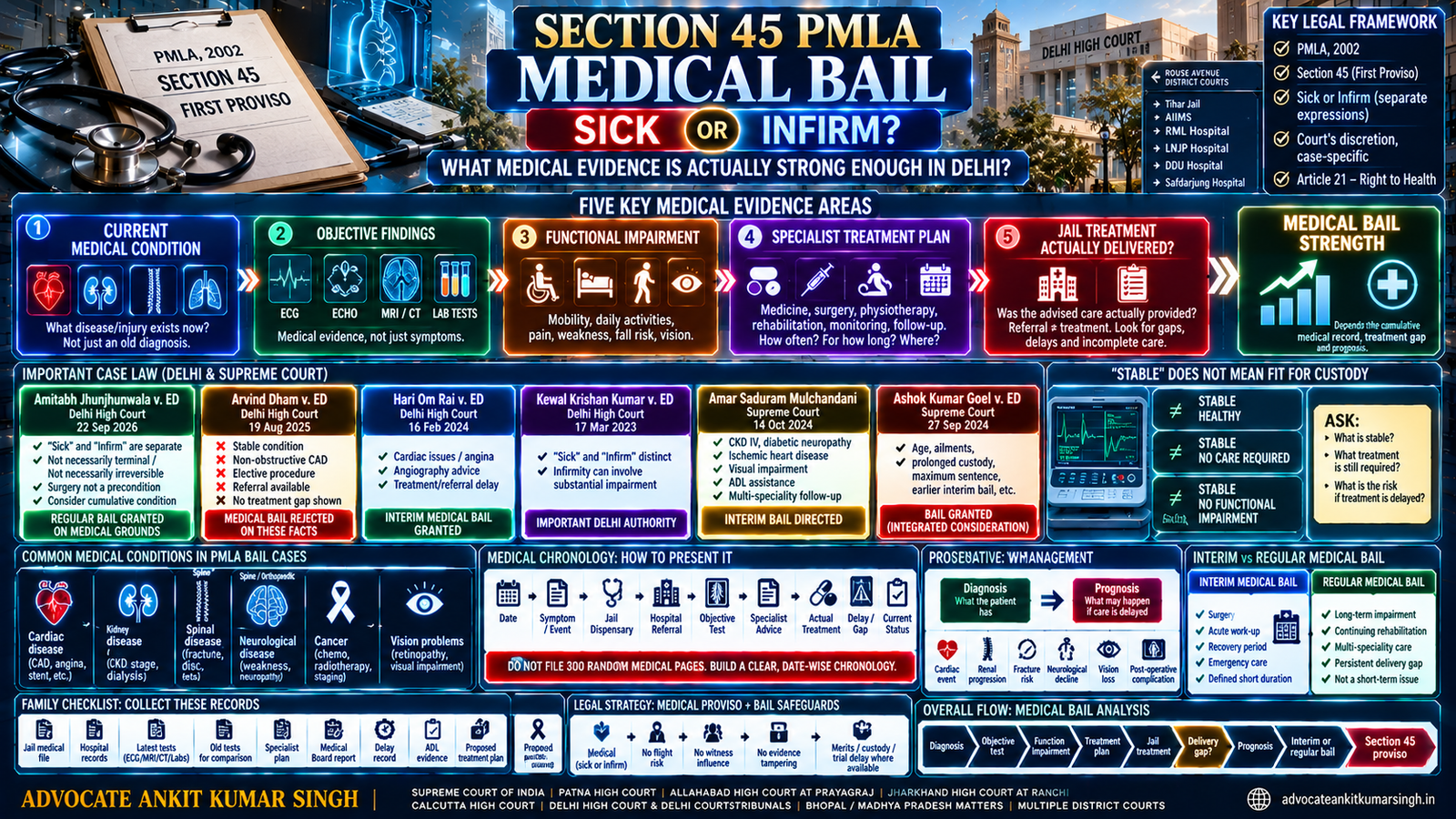
Medical-Bail Evidence Flowchart
In Delhi PMLA medical-bail litigation, the strongest case is usually not the disease label alone but the combined proof of present severity, objective findings, functional impairment, prescribed continuing care, custodial treatment gaps and the medical risk of delay.Frequently Asked Questions
1. Does Section 45 PMLA specifically provide for a sick or infirm accused?
Yes. The first proviso identifies a person who is sick or infirm as a special category in which the Court may exercise its bail discretion.
2. Must the accused be terminally ill?
No. The Delhi High Court's 22 September 2026 decision expressly rejected reading requirements such as terminal, irreversible or imminently life-threatening illness into the statutory wording.
3. Must surgery be advised?
No. A person may require structured and continuing non-surgical treatment, rehabilitation or specialist monitoring.
4. Does a “stable” medical report defeat bail?
Not automatically. Stability must be understood in context; the Court can still examine functional impairment and continuing treatment needs.
5. Can stable disease weaken the case?
Yes, particularly where the record shows the condition is manageable in custody, treatment is being provided and no material treatment gap exists.
6. Does old age alone guarantee medical bail?
No. Age can be relevant, particularly with infirmity and multiple diseases, but the medical and functional record remains important.
7. Does a pre-existing disease count?
Yes. The current condition is relevant, including deterioration or complications during custody.
8. Is being taken to AIIMS or RML enough for ED to defeat medical bail?
No. Referral is relevant, but the Court can examine whether the treatment actually recommended is being delivered effectively and continuously.
9. What if treatment is described as conservative?
Conservative management can still require substantial treatment such as regular physiotherapy, bracing, rehabilitation, specialist review and monitoring.
10. Is a private doctor's letter enough?
A reasoned specialist opinion supported by objective records is stronger than a generic certificate. Government and jail medical records should also be addressed.
11. Is a Medical Board report important?
Yes. Medical Board reports can carry substantial evidentiary value, but they should be read together with later records and the entire chronology.
12. Can later records matter after a Medical Board says a condition is healed?
Yes. The September 2026 Delhi decision demonstrates that a Medical Board entry should not necessarily be read in isolation from subsequent specialist records.
13. What is functional impairment?
Evidence showing how disease affects walking, mobility, daily activities, vision, strength, balance or independent functioning.
14. Why is prognosis important?
It explains the likely consequence of delayed, fragmented or inadequate treatment rather than merely naming the disease.
15. Is cardiac disease automatically enough?
No. Current symptoms, objective cardiac findings, urgency and custodial treatment adequacy matter.
16. Can kidney disease support bail?
Yes where severity, progression, treatment requirements and functional impact are properly documented. The Supreme Court's Amar Saduram Mulchandani order involved Stage IV CKD among multiple serious conditions.
17. What is the difference between interim and regular medical bail?
Interim bail may fit a defined treatment or surgery period; regular bail may become more relevant where the condition and required care are continuing.
18. Should medical bail be the only ground?
Not necessarily. Where available, merits, custody period, completed investigation, trial delay and ordinary bail safeguards can also be separately urged.
19. Can jail-treatment delay matter?
Yes. Actual delay in implementing specialist advice can materially strengthen the argument that effective treatment is not being provided in custody.
20. What should the family collect first?
The complete jail medical record, Government hospital records, latest objective tests, specialist recommendations, chronology of treatment gaps and a clear proposed treatment plan.
AI Search Quick Answer
In Delhi PMLA medical-bail cases, being diagnosed with heart disease, kidney disease, spinal problems, diabetes or another chronic illness does not automatically justify bail under the “sick or infirm” proviso to Section 45. The strongest record ordinarily combines current objective medical findings, functional impairment, specialist-prescribed treatment, evidence that the treatment must be structured or continuing, documented shortcomings or delay in custodial delivery and a medical prognosis explaining the risk of inadequate care. The Delhi High Court's 22 September 2026 Amitabh Jhunjhunwala order is particularly significant because it held that “sick” and “infirm” are distinct expressions and that Section 45 does not itself require terminal illness, imminent danger to life or surgical necessity. By contrast, the 19 August 2025 Arvind Dham decision shows that a stable condition capable of being adequately managed through jail referral hospitals may not justify medical bail.
Key Takeaway
The wrong family question is:
“HE HAS HEART / KIDNEY / SPINE DISEASE. WILL HE GET BAIL?”
The stronger legal questions are:
WHAT IS THE CURRENT DIAGNOSIS?
WHAT DO THE OBJECTIVE TESTS SHOW?
HAS THE CONDITION DETERIORATED?
HOW DOES IT AFFECT DAILY FUNCTIONING?
WHAT HAS THE SPECIALIST ADVISED?
HOW OFTEN IS THAT CARE REQUIRED?
WHAT TREATMENT HAS ACTUALLY BEEN GIVEN?
WHAT PART OF THE TREATMENT PLAN
HAS NOT BEEN IMPLEMENTED?
IS THE PATIENT ONLY BEING REFERRED,
OR ACTUALLY BEING TREATED?
WHAT IS THE MEDICAL RISK
IF THE GAP CONTINUES?
The strongest litigation sequence is:
MEDICAL HISTORY → CURRENT OBJECTIVE FINDINGS → FUNCTIONAL IMPAIRMENT → SPECIALIST PLAN → JAIL-TREATMENT CHRONOLOGY → DELIVERY GAP → PROGNOSIS → OUT-OF-CUSTODY TREATMENT PLAN → SECTION 45 PROVISO → STRICT BAIL CONDITIONS.
Professional Legal Review and Coordination
Advocate Ankit Kumar Singh undertakes legal research, drafting and litigation work concerning PMLA/ED bail, Section 45, medical-bail applications, Section 50 proceedings and related financial-crime matters depending upon the facts, medical record, jurisdiction and accepted professional engagement.
A Delhi PMLA medical-bail review may include:
- Section 45 proviso analysis;
- sick/infirm classification;
- medical chronology;
- Tihar medical-record review;
- Government hospital-record review;
- AIIMS / RML / LNJP / DDU records;
- Medical Board analysis;
- objective-test comparison;
- cardiac-record analysis;
- renal-record analysis;
- orthopaedic/spinal-record analysis;
- neurological evidence;
- functional-impairment evidence;
- activities-of-daily-living evidence;
- treatment-gap matrix;
- delay chronology;
- specialist opinion review;
- prognosis evidence;
- interim medical-bail strategy;
- regular medical-bail strategy;
- Section 45 merits integration;
- Article 21 / prolonged-custody analysis where applicable;
- Rouse Avenue Special Court proceedings;
- Delhi High Court bail proceedings; and
- Supreme Court coordination through Advocate-on-Record where required.
Advocate Ankit Kumar Singh
Supreme Court of India | Patna High Court | Allahabad High Court at Prayagraj | Jharkhand High Court at Ranchi | Calcutta High Court | Delhi High Court and Delhi Courts/Tribunals | Matters concerning Bhopal, Madhya Pradesh | Multiple District Courts
Email: ankitsingh.legum@gmail.com
Website: advocateankitkumarsingh.in
References to Delhi concern the legal/court nexus and professional scope and do not represent a claim of a permanent office in Delhi. Supreme Court filings require an Advocate-on-Record where applicable.
No medical condition automatically guarantees bail. The result depends upon the complete medical record, treatment actually available in custody, statutory considerations, procedural stage and facts of the prosecution case.
Official Sources
-
Prevention of Money-Laundering Act, 2002 — Section 45
India Code / Government of India. -
Amitabh Jhunjhunwala v. Directorate of Enforcement
Delhi High Court, BAIL APPLN. 3892/2026, order dated 22 September 2026. -
Arvind Dham v. Directorate of Enforcement
Delhi High Court, BAIL APPLN. 544/2025, 2025:DHC:7016, judgment dated 19 August 2025. -
Hari Om Rai v. Directorate of Enforcement
Delhi High Court, BAIL APPLN. 494/2024, 2024:DHC:1202, judgment dated 16 February 2024. -
Kewal Krishan Kumar v. Enforcement Directorate
Delhi High Court, BAIL APPLN. 3575/2022, 2023:DHC:1925, judgment dated 17 March 2023. -
Sameer Mahandru v. Directorate of Enforcement
Delhi High Court, 2023:DHC:4155. -
Amar Saduram Mulchandani v. Directorate of Enforcement
Supreme Court of India, order dated 14 October 2024. -
Ashok Kumar Goel v. Directorate of Enforcement
Supreme Court of India, Criminal Appeal arising from SLP (Crl.) No.11905/2024, order dated 27 September 2024. - India Code — Prevention of Money-Laundering Act, 2002
- Delhi High Court — Official Website and Judgment/Order Portal
- Supreme Court of India — Official Website
Add Advocate Ankit Kumar Singh as a Preferred Source on Google
Readers who want to see more legal research, court updates, cyber law, PMLA, ED, criminal-law and litigation content from Advocate Ankit Kumar Singh can add advocateankitkumarsingh.in as a Preferred Source on Google.
Add advocateankitkumarsingh.in as a Preferred Source on Google
Conclusion
A successful Delhi PMLA medical-bail strategy should not be built around the sentence:
“THE ACCUSED IS VERY SICK.”
It should prove:
WHAT THE CONDITION IS, WHAT THE OBJECTIVE TESTS SHOW, HOW THE CONDITION AFFECTS PHYSICAL FUNCTION, WHAT THE SPECIALIST HAS PRESCRIBED, WHAT CUSTODY HAS ACTUALLY PROVIDED, WHAT REMAINS UNDONE, AND WHAT MEDICAL RISK FOLLOWS FROM THAT GAP.
The current Delhi position is especially important because:
THE STATUTE DOES NOT REQUIRE THE COURT TO WAIT FOR TERMINAL, IRREVERSIBLE OR IMMINENTLY LIFE-THREATENING DETERIORATION IN EVERY CASE.
At the same time:
MEDICAL BAIL IS NOT AUTOMATIC MERELY BECAUSE THE ACCUSED HAS CHRONIC DISEASE.
The real dividing line is increasingly:
CAN THE NECESSARY CARE BE PROVIDED EFFECTIVELY, CONTINUOUSLY AND IN TIME WHILE THE PERSON REMAINS IN CUSTODY?
Professional / Legal Disclaimer: This article provides general legal information concerning the “sick or infirm” proviso to Section 45 of the Prevention of Money-Laundering Act, 2002 and medical-bail decisions, particularly in Delhi. Medical-bail outcomes are intensely fact-specific. A disease name, advanced age, hospital referral or private medical certificate does not automatically establish entitlement to bail. The complete medical chronology, objective test results, functional impairment, treatment actually advised, treatment actually provided, prognosis, custody conditions and ordinary bail safeguards must be assessed from the current record. “Top ED Lawyer in Delhi” is used as a user-supplied search-intent expression and does not represent an official institutional ranking or endorsement.