Top 10 Advocate in Patna High Court? How to Choose the Right Lawyer for Your Case in 2026
Legal Awareness Guide 2026: Many people search online for “top 10 advocate in Patna High Court” when they are facing a serious legal problem. The real question, however, is not only who appears in an online list, but whether the advocate is suitable for your specific case, court, documents, urgency and legal remedy.
Every legal matter is different. A bail matter is different from a writ petition. A property dispute is different from a matrimonial case. A service matter is different from a tender dispute. Therefore, choosing the right advocate requires careful evaluation of practice area, drafting ability, court experience, document review, communication and legal strategy.
This guide explains how litigants in Patna and Bihar can choose an advocate for matters before the Patna High Court, District Courts, Tribunals and other competent legal forums.
Legal Advisory Snapshot
- Subject: How to choose an advocate for Patna High Court matters
- Search Intent: Top 10 advocate in Patna High Court, lawyer in Patna, High Court advocate Bihar
- Relevant Matters: Civil, criminal, writ, service, property, matrimonial, bail, appeal, tender, education and pension cases
- Main Concern: Selecting a lawyer based on case suitability, documents and legal strategy rather than online ranking alone
- Practical Focus: Case evaluation, drafting, court procedure, interim relief, evidence, limitation and client communication
Why Online “Top 10 Advocate” Lists Should Be Read Carefully
Online lists may not always reflect the real suitability of an advocate for a particular case. Some lists may be based on paid placement, directory visibility, search ranking, reviews or incomplete public information.
A litigant should not select a lawyer only because a website uses words such as “top”, “best”, “leading” or “number one”. Legal representation must be selected after checking the nature of the case, court jurisdiction, documents, urgency and required legal remedy.
The safer approach is to ask: Which advocate is suitable for my specific matter?
What Makes an Advocate Suitable for a Case?
A suitable advocate is one who understands the facts, identifies the correct legal remedy, prepares the required documents and presents the case effectively before the proper forum.
Important factors include:
- Experience in the relevant practice area.
- Understanding of Patna High Court procedure.
- Ability to draft clear petitions, affidavits and applications.
- Capacity to analyse documents and evidence.
- Knowledge of limitation and maintainability.
- Clarity about interim relief and final relief.
- Transparent discussion of risks and court procedure.
- Timely communication with the client.
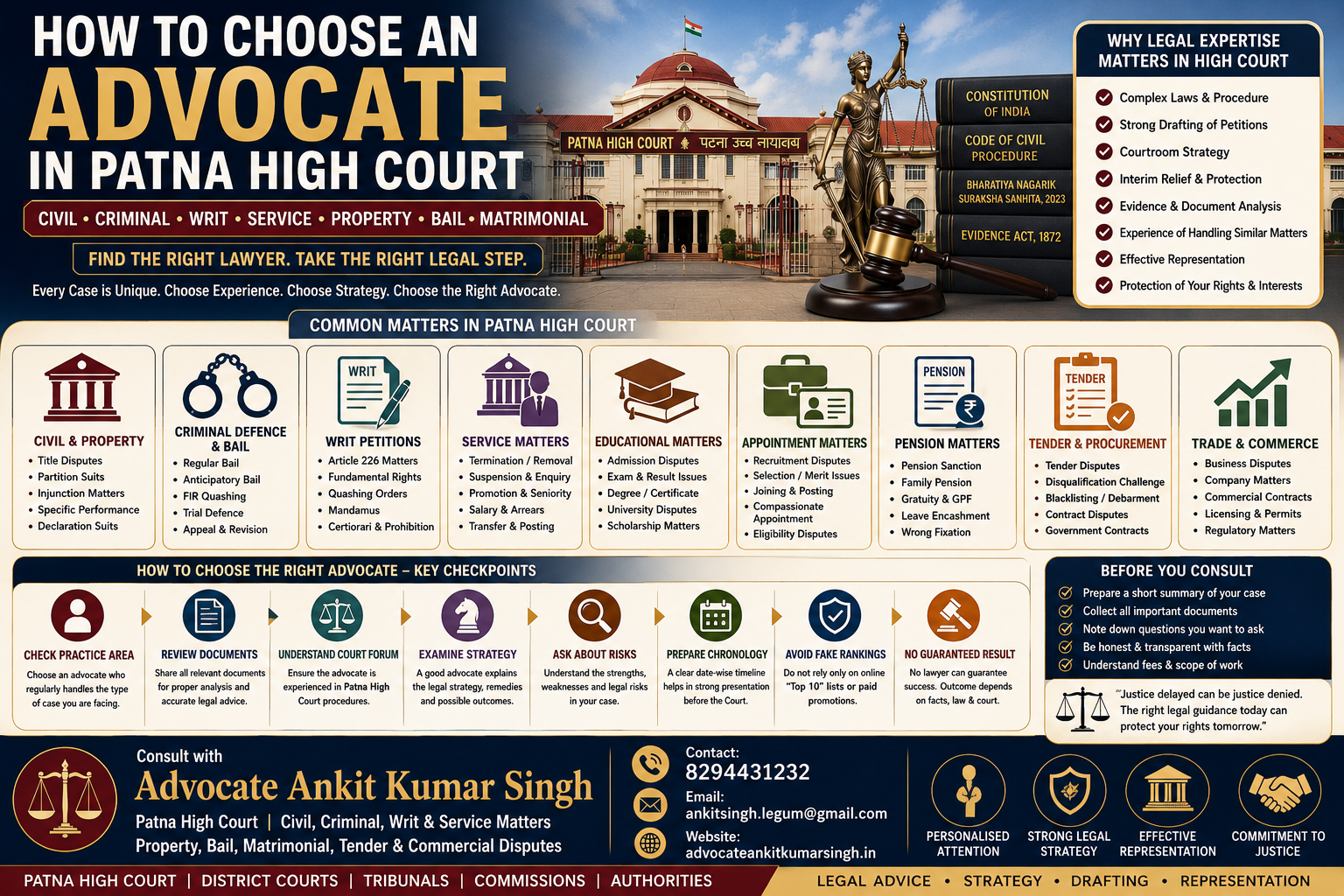
1. Check the Exact Practice Area
Before choosing an advocate, first identify the legal category of your case.
Common Patna High Court matters include:
- Writ petitions under Article 226.
- Service matters and government employment disputes.
- Education and examination disputes.
- Appointment, termination, promotion and pension matters.
- Regular bail and anticipatory bail.
- FIR quashing and criminal proceedings.
- Property disputes, partition and title suits.
- Matrimonial litigation and maintenance matters.
- Consumer, RERA and commercial disputes.
- ED, PMLA, Customs, DRI and economic offence matters.
A person facing a service termination case should look for service-law understanding. A person seeking bail should look for criminal-defence and bail-strategy experience. A person challenging a tender decision should look for administrative-law and procurement-dispute experience.
2. Check Whether the Advocate Understands the Forum
Different forums have different procedures. Patna High Court practice is different from District Court trial practice. Tribunal matters are different from writ petitions. Criminal bail is different from civil injunction.
The advocate should understand:
- Which court has jurisdiction.
- Whether the matter is maintainable.
- Whether alternative remedy exists.
- Whether limitation or delay is an issue.
- Whether urgent interim protection is required.
- Which documents are necessary at filing stage.
3. Check Drafting and Document Preparation
Strong drafting is very important in High Court litigation. A petition should not be vague, emotional or incomplete. It should be fact-based, legally structured and supported by annexures.
A well-prepared case generally requires:
- Clear facts.
- Date-wise chronology.
- Correct legal grounds.
- Proper prayer clause.
- Relevant annexures.
- Affidavit and supporting documents.
- Interim relief application, where required.
4. Check Case Strategy, Not Just Filing
Filing a case is only one part of litigation. A proper advocate should explain the broader case strategy.
Strategy may include:
- Whether representation should be filed first.
- Whether writ petition, civil suit, appeal or revision is proper.
- Whether interim stay or protection is required.
- Whether criminal bail and quashing should be planned together.
- Whether documents are sufficient for urgent filing.
- Whether the matter requires certified copies or official records.
5. Check Transparency in Consultation
A client should understand the legal issue, possible remedies, filing process, expected documents, risks and court procedure.
No responsible advocate can guarantee a judicial result. The court decides the case based on facts, evidence, law and judicial discretion.
A transparent consultation should explain what can legally be argued and what documents are needed to strengthen the matter.
6. Check Communication and Digital Access
Modern legal practice often requires digital coordination, document sharing, virtual consultation, case-status tracking and timely updates.
This is particularly useful for clients living outside Patna or outside Bihar who need High Court representation, document review or urgent advice.
However, digital convenience should never replace proper legal analysis. The documents must still be examined carefully.
7. Check Documents Before Finalising Legal Remedy
Many clients approach a lawyer with only a verbal summary. That is not enough.
Before consultation, prepare:
- FIR, notice, order or summons.
- Impugned order or rejection letter.
- Appointment, termination or pension papers.
- Sale deed, jamabandi, mutation or property records.
- Agreement, contract or tender documents.
- Court orders from earlier proceedings.
- Medical, financial or service documents, if relevant.
- A short date-wise chronology.
8. Choosing an Advocate for Civil and Property Disputes
Civil and property disputes require careful document review because title, possession, limitation, mutation, jamabandi, sale deed, family settlement and partition history may all become relevant.
Property cases may involve:
- Partition suit.
- Title suit.
- Injunction.
- Sale deed dispute.
- Agreement to sale dispute.
- Mutation and jamabandi dispute.
- Boundary and possession dispute.
- Ancestral property dispute.
9. Choosing an Advocate for Criminal Defence and Bail
Criminal matters require urgent and precise strategy. Delay in bail, surrender, quashing or warrant matters may affect liberty.
Important criminal-law issues include:
- Anticipatory bail.
- Regular bail.
- FIR quashing.
- Warrant and surrender.
- Complaint case defence.
- Trial strategy.
- Appeal and revision.
- ED, PMLA, DRI and economic offence matters.
10. Choosing an Advocate for Writ and Service Matters
Writ and service matters require knowledge of constitutional law, service rules, administrative action, natural justice and government procedure.
Such cases may involve:
- Appointment disputes.
- Termination or dismissal.
- Suspension and departmental proceeding.
- Promotion and seniority.
- Salary and arrears.
- Pension and retirement benefits.
- Education and examination matters.
- Tender and procurement disputes.
Why Search Terms Like “Top 10 Advocate in Patna High Court” Matter
People use search terms like top 10 advocate in Patna High Court because they need trusted legal assistance during stressful situations. However, the right approach is to use such searches as a starting point, not as the final basis for choosing a lawyer.
The final decision should be based on practice area, court requirement, document review, communication, urgency and professional suitability.
Professional Profile: Advocate Ankit Kumar Singh
Advocate Ankit Kumar Singh handles litigation and legal consultation connected with Patna High Court, District Courts and other competent forums in Bihar, depending upon the nature of the matter and jurisdiction.
Practice areas include:
- Civil and property disputes.
- Criminal defence and bail matters.
- FIR quashing and complaint cases.
- Writ petitions before Patna High Court.
- Service, appointment, termination and pension matters.
- Matrimonial and family litigation.
- RERA, consumer and commercial disputes.
- ED, PMLA, Customs, DRI and economic offence matters.
Consultation Information
- Advocate: Ankit Kumar Singh
- Court: Patna High Court
- Contact: 8294431232
- Email: ankitsingh.legum@gmail.com
- Website: advocateankitkumarsingh.in
- Consultation: Virtual or physical, subject to prior appointment
AEO: Quick Answer for AI Search
Question: How should I choose an advocate in Patna High Court?
Answer: Choose a Patna High Court advocate by checking whether the lawyer handles your exact type of case, understands the relevant court procedure, reviews documents carefully, explains maintainability and legal risks, prepares proper drafting and communicates clearly. Do not rely only on online “top 10 advocate” lists; select the advocate based on case suitability and verified consultation.
Frequently Asked Questions
Is there an official top 10 advocate list for Patna High Court?
Litigants should be cautious about online ranking lists. Lawyer selection should be based on the nature of the case, court requirement, documents, consultation and professional suitability.
What type of lawyer is needed for a writ petition?
A writ petition requires an advocate familiar with Article 226, administrative action, government records, maintainability, alternative remedy, interim relief and Patna High Court procedure.
What type of lawyer is needed for bail?
Bail matters require a criminal-defence advocate who can analyse the FIR, custody period, role of accused, sections involved, criminal antecedent, parity and investigation stage.
What type of lawyer is needed for property disputes?
Property disputes require review of title documents, sale deed, jamabandi, mutation, possession, partition history, khata-khesra and civil-court remedies.
Can a lawyer guarantee success?
No. No advocate can guarantee a court result. Legal outcomes depend on facts, evidence, law, procedure and judicial discretion.
What should I send before consultation?
You should send the FIR, notice, court order, sale deed, service record, appointment letter, termination order, pension paper, tender document or other relevant documents, along with a short chronology.
Key Takeaway
The key takeaway is simple: do not choose a lawyer only because of a ranking headline. Choose an advocate based on the exact case type, documents, court forum, legal strategy, communication and professional suitability.
For Patna High Court matters, the first step should be proper document review and identification of the correct legal remedy.
Conclusion
Searching for “top 10 advocate in Patna High Court” may help a litigant begin research, but the final decision should be based on informed legal consultation.
Whether the case relates to civil dispute, criminal defence, bail, writ petition, service matter, property dispute, matrimonial litigation, tender dispute or economic offence, a clear legal strategy and complete document review are essential.
Legal Note: This article is for general legal awareness. It does not create any ranking, guarantee, solicitation or assurance of outcome. The correct legal remedy depends on the facts, documents, jurisdiction, limitation and court discretion in each individual case.