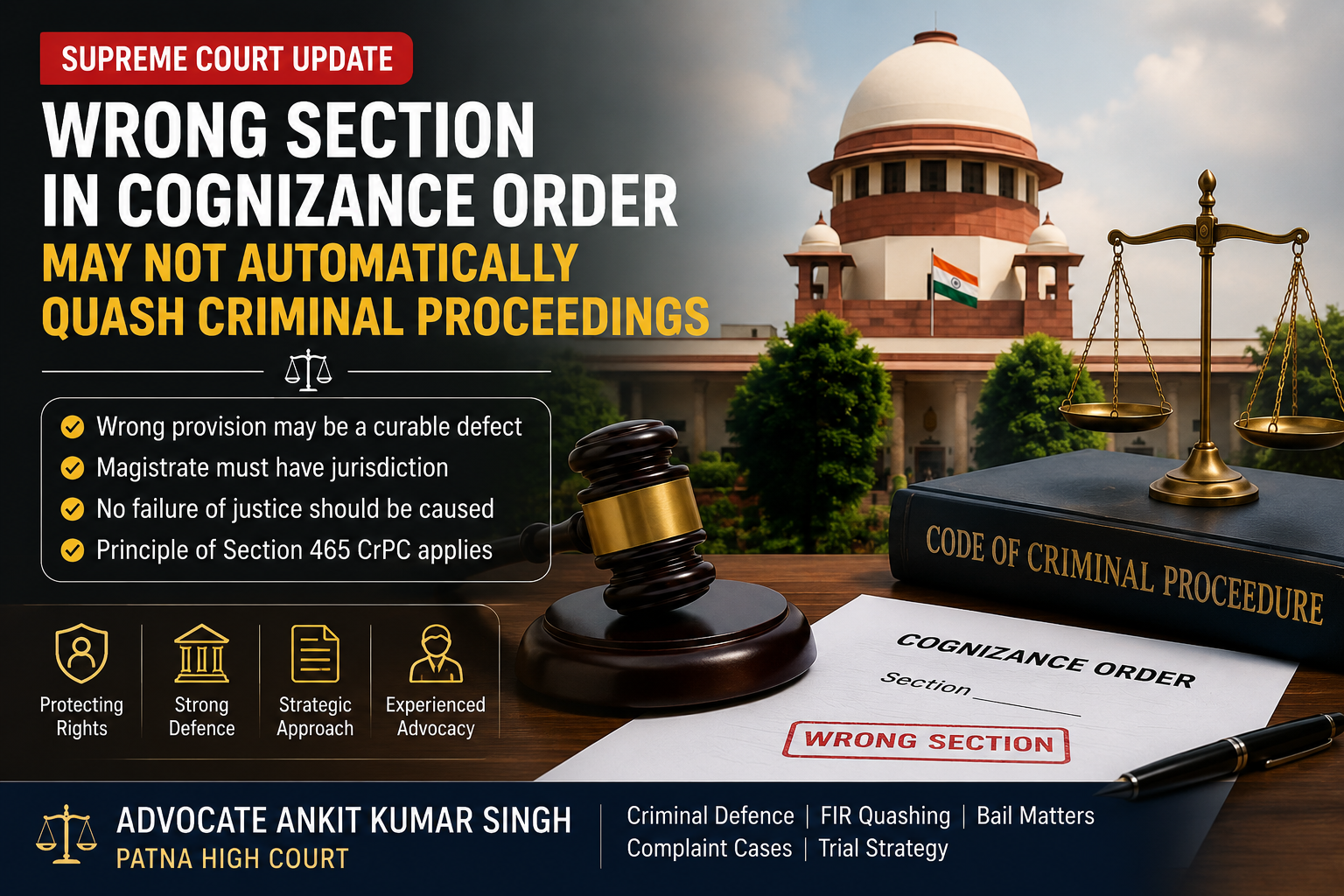
SUPREME COURT: WRONG SECTION IN COGNIZANCE ORDER MAY NOT AUTOMATICALLY QUASH CRIMINAL PROCEEDINGS
Latest Legal Update
The Supreme Court has recently clarified an important point in criminal procedure: merely taking cognizance under a wrong statutory provision may not automatically destroy the criminal proceedings, if the Magistrate otherwise has jurisdiction and no failure of justice is shown.
------------------------------------------------------------
INTRODUCTION
That in criminal cases, accused persons often challenge proceedings on the ground that the Magistrate has taken cognizance under a wrong section or incorrect statutory provision.
That such an objection may be important, but it does not always result in automatic quashing of the case. The court will usually examine whether the error is a mere technical irregularity or whether it has caused real prejudice to the accused.
This legal update is important for complaint cases, summons orders, FIR quashing, criminal revision, discharge strategy and trial defence.
------------------------------------------------------------
WHAT IS COGNIZANCE IN CRIMINAL LAW?
That cognizance means the stage where a Magistrate applies judicial mind to the facts of a complaint, police report or material placed before the court and decides whether legal proceedings should move forward.
In simple words, it is the point where the court takes notice of an alleged offence and proceeds according to law.
Cognizance is generally taken of the offence, not merely of the label or section mentioned in the order.
------------------------------------------------------------
WHAT WAS THE SUPREME COURT’S VIEW?
That the Supreme Court has clarified that if a Magistrate wrongly mentions a statutory provision while taking cognizance, such error may be treated as a curable defect.
However, this depends on one important condition: the Magistrate must otherwise have the jurisdiction to take cognizance of the offence under the correct legal provision.
Therefore, every wrong section does not automatically mean that the entire criminal proceeding must be quashed.
------------------------------------------------------------
WHEN CAN A WRONG SECTION BECOME A SERIOUS ISSUE?
A wrong section or wrong provision may become serious where it affects jurisdiction, limitation, mandatory procedure or the legal rights of the accused.
The court may examine the following questions:
- Whether the Magistrate had jurisdiction over the offence.
- Whether the wrong provision caused prejudice to the accused.
- Whether the accused understood the nature of allegations.
- Whether the error affected the defence strategy.
- Whether the error caused failure of justice.
- Whether the matter can be corrected under procedural law.
------------------------------------------------------------
ROLE OF SECTION 465 CrPC
That Section 465 of the Code of Criminal Procedure deals with situations where an error, omission or irregularity may not automatically invalidate a finding, sentence or order unless it has caused failure of justice.
The principle behind this provision is that criminal proceedings should not fail only because of minor technical mistakes, unless such mistake has caused real prejudice.
After the coming into force of the Bharatiya Nagarik Suraksha Sanhita, similar procedural principles remain important while dealing with criminal proceedings.
------------------------------------------------------------
WHY THIS MATTERS IN COMPLAINT CASES
That in complaint cases, the first order of the Magistrate is very important. It may decide whether summons will be issued, whether inquiry is required, or whether the complaint should proceed further.
If the cognizance order mentions a wrong section, the accused may challenge it. But the success of such challenge depends on whether the mistake is merely technical or whether it goes to the root of the case.
Therefore, in complaint cases, both the complainant and accused must carefully examine the cognizance order, complaint petition and supporting documents.
------------------------------------------------------------
IMPACT ON FIR QUASHING AND CRIMINAL REVISION
That accused persons often approach the High Court for quashing of criminal proceedings. One common ground is that the Magistrate has passed an incorrect or defective cognizance order.
However, a quashing petition should not be based only on the argument that a wrong section was mentioned. The stronger question is whether the wrong section caused failure of justice or whether the court lacked jurisdiction.
A technical defect and a jurisdictional defect are not the same.
------------------------------------------------------------
PRACTICAL CHECKLIST FOR ACCUSED PERSONS
Before challenging a cognizance order, the following documents should be reviewed:
- Complaint petition or FIR
- Cognizance order
- Summons order
- Police report or inquiry report
- Witness statements
- Documents filed by complainant
- Limitation aspect
- Jurisdiction of the Magistrate
- Correct penal provisions applicable to the facts
------------------------------------------------------------
PRACTICAL IMPORTANCE FOR COMPLAINANTS
That complainants should also be careful while drafting and filing criminal complaints. Incorrect sections, vague allegations and incomplete documents can weaken the case.
A well-drafted complaint should clearly mention facts, dates, role of accused, supporting documents and the legal basis of the allegation.
If the complaint is defective from the beginning, the accused may get an opportunity to challenge the proceeding at an early stage.
------------------------------------------------------------
DIFFERENCE BETWEEN CURABLE DEFECT AND FATAL DEFECT
A curable defect is a procedural mistake that can be corrected without affecting the fairness of the case.
A fatal defect is a serious legal defect that affects jurisdiction, mandatory procedure or causes substantial prejudice.
Therefore, the court will not look only at the wording of the order. It will examine the real legal effect of the mistake.
------------------------------------------------------------
WHY LEGAL STRATEGY MATTERS
That in criminal litigation, strategy must be based on the complete record. A wrong section in the order may be useful, but it should be tested along with jurisdiction, limitation, ingredients of offence, evidence and procedural compliance.
For accused persons, the proper remedy may be discharge, revision, quashing, recall of process or trial defence depending upon the stage and facts.
For complainants, careful drafting and correct legal classification of offences can prevent unnecessary objections at a later stage.
------------------------------------------------------------
CONCLUSION
That the Supreme Court’s clarification is important for criminal courts, advocates, accused persons and complainants.
A wrong section in a cognizance order may not automatically quash the criminal proceedings if the Magistrate otherwise has jurisdiction and no failure of justice is caused.
At the same time, if the error affects jurisdiction, mandatory procedure or causes real prejudice, the affected party may still have legal remedies.
For complaint cases, FIR quashing, criminal revision and trial strategy, proper examination of the cognizance order and case record is essential.