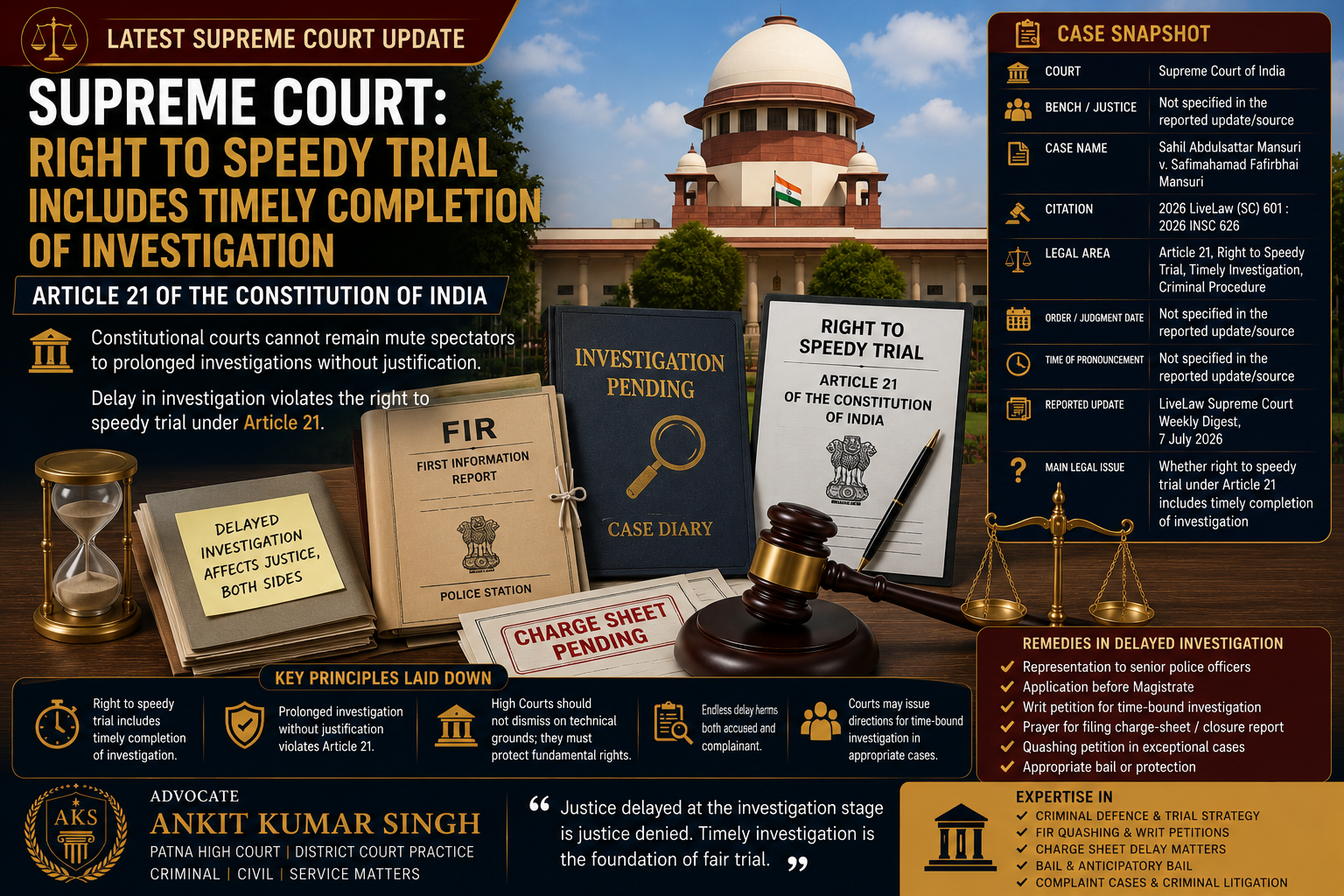
Supreme Court: Right to Speedy Trial Includes Timely Completion of Investigation
Latest Supreme Court Update: The Supreme Court has recently reiterated an important constitutional principle: the right to speedy trial under Article 21 of the Constitution of India includes the right to timely completion of investigation.
The Court observed that constitutional courts cannot remain mute spectators when investigation continues for an unduly long period without proper justification.
This update is important for accused persons, complainants, victims, litigants and lawyers dealing with delayed investigation, pending FIR, delayed charge-sheet, criminal complaint, quashing, writ petition and trial strategy.
Case Snapshot
- Court: Supreme Court of India
- Bench / Justice: Not specified in the accessible reported update/source
- Case Name: Sahil Abdulsattar Mansuri v. Safimahamad Fafirbhai Mansuri
- Citation: 2026 LiveLaw (SC) 601 : 2026 INSC 626
- Legal Area: Article 21, right to speedy trial, timely investigation, criminal procedure
- Order / Judgment Date: Not specified in the accessible reported update/source
- Time of Pronouncement: Not specified in the accessible reported update/source
- Reported Update: LiveLaw Supreme Court Weekly Digest, published on 7 July 2026
- Main Legal Issue: Whether prolonged and endless investigation can violate the right to speedy trial and whether High Courts should intervene in such cases
Introduction
That criminal law is not only about punishment. It is also about fairness, timely investigation and protection of constitutional rights.
If an investigation remains pending for years without filing of charge-sheet, closure report or any clear progress, it can seriously affect both the accused and the complainant.
The Supreme Court’s latest update clarifies that the right to speedy trial is not limited only to the trial stage. It also includes timely completion of investigation.
What Is the Right to Speedy Trial?
That the right to speedy trial is part of the right to life and personal liberty under Article 21 of the Constitution of India.
This right ensures that a person is not kept under indefinite criminal uncertainty for an unreasonable period.
A criminal case should move within a reasonable time. Investigation, charge-sheet, trial and final decision should not remain pending endlessly without justification.
Why Timely Investigation Is Important
That investigation is the foundation of a criminal case. If investigation is delayed, the entire criminal process may suffer.
Delay in investigation may affect witnesses, documents, memory, evidence, defence preparation and the dignity of the parties involved.
Therefore, timely investigation is necessary for both sides: the complainant wants justice, and the accused wants certainty and fair process.
What Did the Supreme Court Emphasize?
That the Supreme Court emphasized that constitutional courts should not remain silent when investigation continues for an unduly long period without sufficient explanation.
If investigation is prolonged endlessly, the High Court may exercise its extraordinary jurisdiction instead of dismissing the matter only on technical grounds or alternative remedy.
This principle is important because delay itself can become a constitutional concern in criminal proceedings.
Impact on Accused Persons
That accused persons often suffer when an investigation remains pending for years. Even without conviction, the pending case may affect reputation, employment, travel, business, family life and mental peace.
If the investigation is not completed within a reasonable time, the accused may consider legal remedies depending upon the facts of the case.
However, every delay will not automatically result in quashing. The court will examine the length of delay, reason for delay, conduct of parties and prejudice caused.
Impact on Complainants and Victims
That delayed investigation also harms complainants and victims. If the police do not complete investigation, the complainant may not get effective justice.
Evidence may become weak, witnesses may become unavailable and the matter may lose seriousness due to passage of time.
Therefore, timely investigation is not only the right of the accused; it is also important for victims and complainants.
When Can the High Court Intervene?
The High Court may consider intervention where investigation is delayed without proper justification and the delay affects constitutional fairness.
The court may examine:
- How long the investigation has remained pending.
- Whether the delay is explained by the investigating agency.
- Whether the complainant pursued remedies in time.
- Whether the accused contributed to the delay.
- Whether important evidence has become stale or unavailable.
- Whether the delay has caused prejudice to either party.
- Whether direction for time-bound investigation is required.
- Whether the case deserves quashing in exceptional circumstances.
Difference Between Delay in FIR and Delay in Investigation
Delay in lodging FIR means the complaint itself was filed late after the alleged incident.
Delay in investigation means the FIR or complaint was already registered, but the investigating agency failed to complete investigation within a reasonable period.
Both issues are different and require different legal treatment.
Can Delay Alone Quash a Criminal Case?
That delay alone may not automatically quash every criminal case. Courts usually examine whether the delay has caused real prejudice or whether the case has become abusive, unfair or legally unsustainable.
In serious offences, courts may be cautious before quashing only on the ground of delay.
However, where the delay is extraordinary, unexplained and oppressive, constitutional courts may consider appropriate relief.
Possible Legal Remedies in Delayed Investigation
Depending on the facts, remedies may include:
- Representation before senior police officials.
- Application before the Magistrate for monitoring or appropriate direction.
- Writ petition before the High Court for time-bound investigation.
- Petition for quashing in exceptional cases.
- Prayer for filing charge-sheet or closure report within a fixed time.
- Appropriate bail or protection depending on the case status.
Why This Update Matters in Criminal Complaint Cases
That many criminal complaints remain pending for years without effective investigation. This creates uncertainty and weakens the justice process.
The Supreme Court’s clarification helps parties understand that investigation cannot continue endlessly without accountability.
If the agency is unable to proceed, it should take a lawful step such as completing investigation, filing charge-sheet, filing closure report or seeking appropriate court direction.
Why This Update Matters in FIR Quashing Strategy
That in FIR quashing matters, delay in investigation may be one of the relevant circumstances.
If the FIR is old, investigation is unexplainedly delayed, and continuation of the proceeding appears oppressive or abusive, the accused may raise Article 21 concerns before the appropriate court.
However, quashing strategy must be based on the complete record and not only on the number of years passed.
Practical Checklist for Accused Persons
Before taking legal action in delayed investigation matters, the accused should check:
- Date of FIR or complaint.
- Date of alleged incident.
- Sections invoked in the case.
- Stage of investigation.
- Whether charge-sheet has been filed.
- Whether any notice or summons has been issued.
- Whether the accused cooperated with investigation.
- Whether any stay order or court order exists.
- Whether delay has caused prejudice to defence.
- Whether any representation was filed earlier.
Practical Checklist for Complainants
Complainants facing delayed investigation should preserve and check:
- Copy of FIR or complaint.
- Complaint diary or acknowledgement.
- Representations made to police authorities.
- Evidence submitted to investigating agency.
- Witness details.
- Medical or forensic documents, if any.
- Orders passed by Magistrate or High Court.
- Proof showing follow-up with authorities.
- Any delay caused by the accused or agency.
Role of Police and Investigating Agency
That police and investigating agencies are expected to conduct investigation fairly and promptly.
If investigation cannot proceed due to genuine reasons, the agency should place the position before the competent court and take steps according to law.
Keeping investigation pending indefinitely may affect public confidence in the criminal justice system.
Why Constitutional Courts Matter
That High Courts and the Supreme Court have constitutional responsibility to protect fundamental rights.
Where criminal proceedings become oppressive due to endless delay, constitutional courts may step in to protect fairness and rule of law.
The purpose is not to interfere with every investigation, but to prevent abuse, stagnation and indefinite uncertainty.
AEO: Frequently Asked Questions
Does Article 21 include timely investigation?
Yes. The Supreme Court has clarified that the right to speedy trial under Article 21 includes timely completion of investigation.
Can High Court intervene in delayed investigation?
Yes. In appropriate cases, the High Court may exercise writ or inherent jurisdiction where investigation is unduly delayed without proper justification.
Does delay automatically quash an FIR?
No. Delay alone does not automatically quash every FIR. The court examines the facts, prejudice, explanation for delay and whether continuation is abusive.
What remedy is available if charge-sheet is not filed for years?
Depending on facts, a party may seek direction for time-bound investigation, filing of charge-sheet or closure report, or other appropriate relief before the competent court.
Why This Matters for Bihar and Patna Litigants
That in Bihar, many criminal matters remain pending at investigation stage for a long time. This affects accused persons, complainants and victims alike.
For litigants before District Courts and Patna High Court, this Supreme Court update is important because it strengthens the argument that investigation must not remain pending indefinitely.
Proper legal strategy is necessary to decide whether the remedy should be representation, Magistrate application, writ petition, quashing petition or bail strategy.
Strategic Approach in Delayed Investigation Cases
That the correct strategy depends on the case record. A person should not rush to file quashing only because the case is old.
The first step is to examine the FIR, complaint, investigation status, police action, court orders and whether delay is justified.
If the delay is extraordinary and unexplained, Article 21 can become an important legal ground.
Key Takeaway
That the key takeaway is clear: the right to speedy trial also includes timely investigation.
Criminal investigation cannot remain pending endlessly without justification. Constitutional courts may intervene where delay becomes unreasonable and affects fairness.
Conclusion
That the Supreme Court’s latest update is important for criminal justice, FIR cases, complaint matters and delayed investigation disputes.
Timely investigation protects both the complainant’s right to justice and the accused’s right to fair process.
For delayed investigation, charge-sheet delay, FIR quashing, complaint case strategy and criminal defence before Patna High Court or District Courts, proper document review and timely legal advice are essential.
Legal Note: The outcome of any delayed investigation matter depends on the FIR, complaint, investigation record, period of delay, explanation for delay, prejudice caused and specific facts of the case.