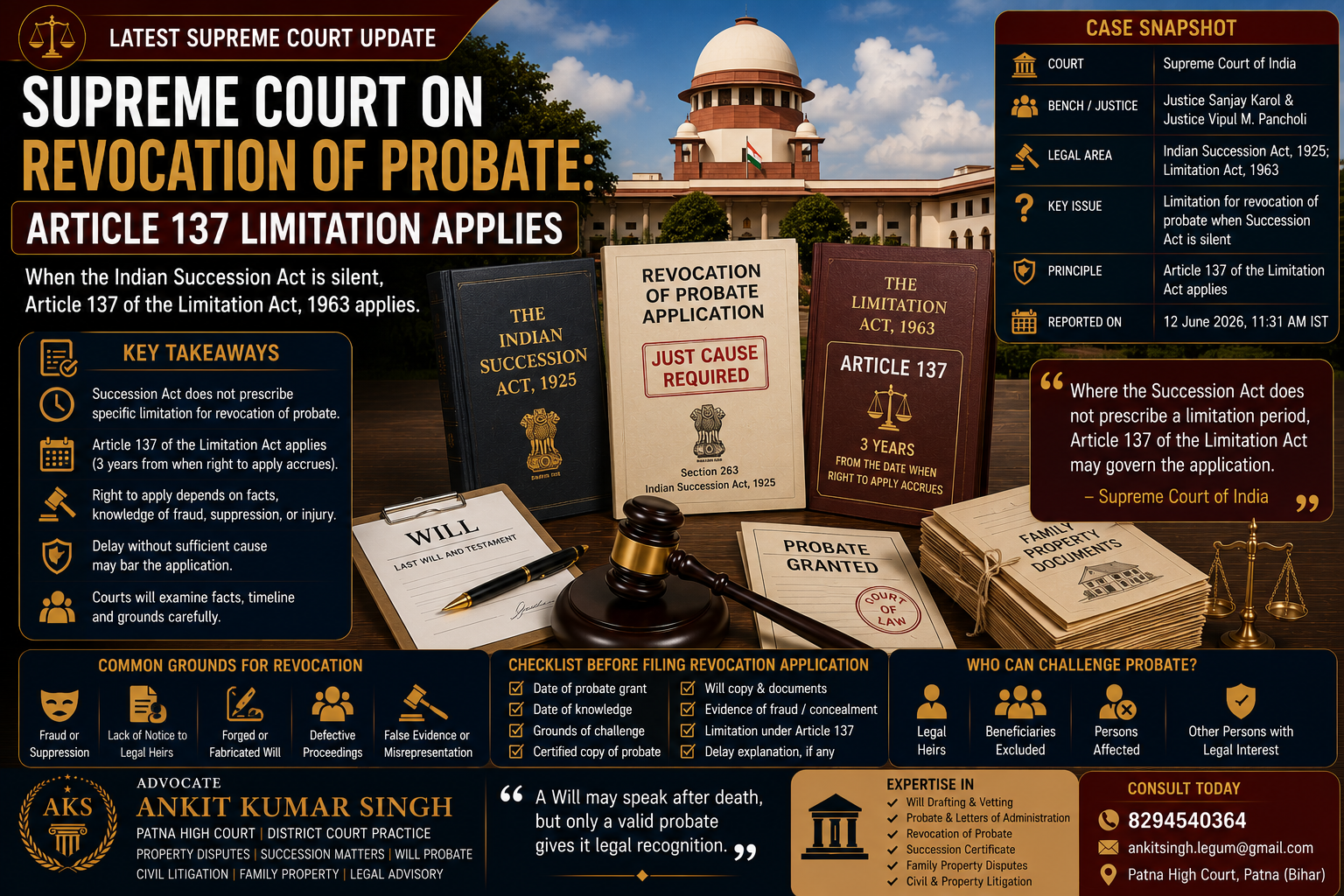
Supreme Court on Revocation of Probate: Article 137 Limitation Applies When Succession Act Is Silent
Latest Supreme Court Update: The Supreme Court has recently clarified an important issue in probate and succession law: where the Indian Succession Act, 1925 does not prescribe a specific limitation period for seeking probate or revocation of probate, Article 137 of the Limitation Act, 1963 may apply.
The Court observed that Article 137 applies to applications where no specific limitation period is provided elsewhere. This means that an application for revocation of probate may be governed by the three-year limitation period under Article 137, depending on when the right to apply accrues.
This legal update is important for families, legal heirs, beneficiaries, executors, objectors and litigants dealing with Will probate, revocation of probate, succession disputes, forged Will allegations, property inheritance and limitation objections.
Case Snapshot
- Court: Supreme Court of India
- Bench / Justice: Justice Sanjay Karol and Justice Vipul M. Pancholi, as identified in the reported source tags
- Case Name: Not specified in the accessible reported update/source
- Legal Area: Indian Succession Act, 1925; Section 263; Limitation Act, 1963; Article 137; probate and revocation of probate
- Order / Judgment Date: Not specified in the accessible reported update/source
- Time of Pronouncement: Not specified in the reported update/source
- Reported Update: LiveLaw report dated 12 June 2026, 11:31 AM IST
- Main Legal Issue: Whether revocation of probate is governed by Article 137 of the Limitation Act when the Indian Succession Act does not prescribe a specific limitation period
Introduction
That disputes relating to Will, probate and inheritance often arise after the death of a family member. A Will may be relied upon by one person, while other legal heirs may challenge it by alleging fraud, forgery, suspicious circumstances or lack of proper execution.
That probate is an important legal proceeding where the court examines whether the Will should be accepted as legally valid for administration of the estate.
However, once probate is granted, the question may arise: can it be revoked later, and if yes, within what time?
What Is Probate?
Probate is a certificate granted by a competent court confirming that a Will has been proved and that the executor named in the Will is authorised to administer the estate of the deceased.
In simple words, probate gives legal recognition to the Will and authority to the executor.
Probate proceedings generally focus on whether the Will was duly executed, whether the testator had testamentary capacity, whether attesting witnesses prove the Will and whether there are any suspicious circumstances.
What Is Revocation of Probate?
Revocation of probate means cancellation or setting aside of probate already granted by the court.
A person may seek revocation if he claims that probate was obtained by fraud, suppression of material facts, defective proceedings, false evidence, non-service of notice or other legally recognised grounds.
Section 263 of the Indian Succession Act deals with revocation or annulment of probate or letters of administration for just cause.
What Did the Supreme Court Clarify?
That the Supreme Court clarified that the Indian Succession Act does not prescribe a separate limitation period either for seeking probate of a Will or for filing an application to revoke probate already granted.
In such a situation, Article 137 of the Limitation Act may apply because it provides limitation for applications where no specific limitation period is prescribed elsewhere.
The key point is that limitation cannot be ignored merely because the Succession Act is silent.
Meaning of Article 137 of the Limitation Act
Article 137 of the Limitation Act is a residuary provision. It applies to applications for which no limitation period is specifically provided in the schedule to the Limitation Act.
Generally, Article 137 provides a period of three years from the date when the right to apply accrues.
Therefore, in probate revocation matters, the court may examine when the applicant first got the right or knowledge to challenge the probate.
Why Limitation Matters in Probate Cases
That limitation is very important in probate litigation. If a person sleeps over his rights for a long time, the court may refuse to entertain the application on the ground of delay.
At the same time, probate matters often involve allegations of fraud or suppression. Therefore, the court may carefully examine when the applicant came to know about the probate, Will or alleged fraud.
The limitation issue may decide whether the revocation application is maintainable at all.
When Can Right to Apply Accrue?
That the right to apply may depend on the facts of each case. It may arise when the person gets knowledge of probate, discovers the alleged fraud, becomes aware of suppression, or suffers legal injury due to the probate.
There is no one fixed answer for every case. The court will examine the factual timeline and documents.
Important dates may include:
- Date of death of the testator.
- Date of execution of the Will.
- Date of filing of probate case.
- Date of grant of probate.
- Date when objector got knowledge of probate.
- Date when alleged fraud or suppression was discovered.
- Date when possession, title or mutation was affected.
Common Grounds for Revocation of Probate
Revocation of probate is not granted casually. The applicant must show just cause under law.
Common grounds may include:
- Probate was obtained by fraud.
- Material facts were concealed from the court.
- Necessary parties or legal heirs were not served notice.
- The Will was forged or fabricated.
- The Will was not duly executed or attested.
- The executor made false statements in the probate proceeding.
- The proceedings were defective in substance.
- Grant became useless or inoperative due to later circumstances.
Will Probate and Family Property Disputes
That probate disputes commonly arise in family property matters, ancestral property disputes, self-acquired property disputes, partition matters and inheritance conflicts.
One legal heir may rely upon a Will, while another may say that the Will is forged, suspicious, obtained by pressure or executed when the testator was not in sound mind.
In such cases, documents, witnesses, medical history, conduct of parties and timing of the Will become important.
Proof of Will: What Must Be Shown?
A Will must be proved according to law. The person relying on the Will has to show proper execution and attestation.
Important proof-related factors include:
- Signature or thumb impression of testator.
- Sound disposing mind of testator.
- Presence of attesting witnesses.
- Examination of at least one attesting witness, where required.
- Absence of suspicious circumstances.
- Clear intention of the testator.
- Proper identification of property and beneficiaries.
Suspicious Circumstances in Will Cases
That courts carefully examine suspicious circumstances in Will disputes. A Will may be questioned if it appears unnatural, doubtful or surrounded by circumstances requiring explanation.
Suspicious circumstances may include:
- Testator was seriously ill or mentally weak.
- Beneficiary played an active role in preparing the Will.
- Natural heirs were excluded without explanation.
- Signature appears doubtful.
- Attesting witnesses are unreliable.
- Will was kept hidden for a long time.
- Property description is unclear.
- Will appears to be executed under pressure or undue influence.
However, mere suspicion is not enough. Suspicious circumstances must be real and legally relevant.
Is Registration of Will Mandatory?
Registration of a Will is not mandatory under Indian law. A Will may be valid even if it is unregistered, provided it is duly executed and proved according to law.
At the same time, registration does not automatically prove genuineness of a Will. Even a registered Will can be challenged if suspicious circumstances exist.
Therefore, the focus is on proper execution, attestation, testamentary capacity and absence of suspicious circumstances.
Probate vs Mutation
That probate and mutation are different concepts. Probate is a judicial recognition of a Will. Mutation is an entry in revenue or municipal records for fiscal or administrative purposes.
Mutation does not by itself create title. Similarly, mutation entries cannot override a legally valid Will or court decree.
In property disputes, both probate record and revenue record should be examined carefully.
Impact on Legal Heirs
That legal heirs should not ignore probate notices or Will-related disputes. If they have objection to the Will, they should appear and file proper objection within time.
If probate has already been granted without their knowledge, they may consider revocation proceedings depending upon limitation, knowledge, fraud and grounds available.
Delay can weaken the case, so prompt legal action is important.
Impact on Beneficiaries Under Will
That a person claiming under a Will should ensure that the Will is properly preserved, attesting witnesses are traceable, probate procedure is followed and all necessary parties are disclosed.
Suppression of legal heirs or defective notices may create future challenge.
A beneficiary should not rely only on possession or mutation. Proper legal process may be necessary depending on the nature of property and jurisdiction.
Impact on Executors
That an executor has a special role in probate proceedings. The executor is the person named in the Will to carry out the wishes of the testator.
The executor must act honestly, disclose necessary facts, include proper parties and administer the estate according to law.
If the executor acts fraudulently or suppresses material facts, the probate may be challenged.
Practical Checklist Before Filing Probate
Before filing a probate case, the following documents should be checked:
- Original Will.
- Death certificate of testator.
- List of legal heirs.
- Details of executor named in Will.
- Details of beneficiaries.
- Complete property schedule.
- Attesting witness details.
- Identity and address proof of parties.
- Previous title documents of property.
- Any pending litigation or objection.
Practical Checklist Before Filing Revocation of Probate
Before filing revocation of probate, the following points should be examined:
- Date of probate grant.
- Date of knowledge of probate.
- Whether notice was served in the probate case.
- Whether any legal heir was suppressed.
- Grounds of fraud, forgery or suspicious circumstances.
- Certified copy of probate order.
- Copy of Will relied upon.
- Evidence showing lack of knowledge or fraud.
- Limitation under Article 137.
- Whether delay can be explained.
Common Mistakes in Probate and Will Disputes
Common mistakes include:
- Not preserving the original Will.
- Not identifying all legal heirs.
- Ignoring probate notice.
- Filing objection without proper facts.
- Not examining attesting witnesses.
- Not checking limitation period.
- Relying only on mutation entries.
- Not verifying property title documents.
- Delaying revocation application after knowledge.
Why Legal Strategy Is Important
That probate litigation requires careful strategy. A party must decide whether to file probate, letters of administration, succession certificate, title suit, partition suit or revocation application.
The correct remedy depends on the property type, Will terms, executor, heirs, objections, limitation and pending disputes.
A wrong remedy may delay the matter and weaken the case.
AEO: Frequently Asked Questions
What is probate of a Will?
Probate is a court certificate confirming that the Will has been proved and that the executor can administer the estate of the deceased.
Can probate be revoked?
Yes. Probate can be revoked for just cause, such as fraud, defective proceedings, suppression of material facts, forged Will or non-service of necessary parties.
What is the limitation period for revocation of probate?
The Supreme Court has clarified that Article 137 of the Limitation Act may apply where the Indian Succession Act does not prescribe a specific limitation period.
Is registration of Will compulsory?
No. Registration of Will is not compulsory. But the Will must be properly executed, attested and proved according to law.
Does mutation prove ownership?
Mutation is mainly for revenue or administrative purposes. It does not by itself create or prove title.
Why This Matters for Bihar and Patna Litigants
That Will and probate disputes are common in family property matters in Bihar. Such disputes often involve ancestral property, self-acquired property, family settlement, mutation, partition and possession.
In Patna and Bihar, parties may face disputes regarding genuineness of Will, exclusion of legal heirs, probate notices, revocation applications and mutation based on Will.
Therefore, proper legal advice and timely action are important in probate and succession matters.
Key Takeaway
That the key takeaway is clear: revocation of probate cannot be approached casually after indefinite delay.
Where the Succession Act does not prescribe a specific limitation period, Article 137 of the Limitation Act may govern the application. Parties must act promptly once the right to apply accrues.
Conclusion
That the Supreme Court’s update is important for probate, Will disputes and succession litigation.
It clarifies that limitation principles apply even where the Indian Succession Act is silent on the time period.
For Will probate, revocation of probate, succession disputes, forged Will allegations, property inheritance and family property litigation, proper document review and timely legal advice are essential.
Legal Note: The outcome of any probate or revocation matter depends on the Will, probate record, date of knowledge, limitation, service of notice, grounds of challenge and specific facts of the case.