Supreme Court on Rectification Deed 2026: Survey Number and Property Identity Cannot Be Changed Without Original Seller’s Consent
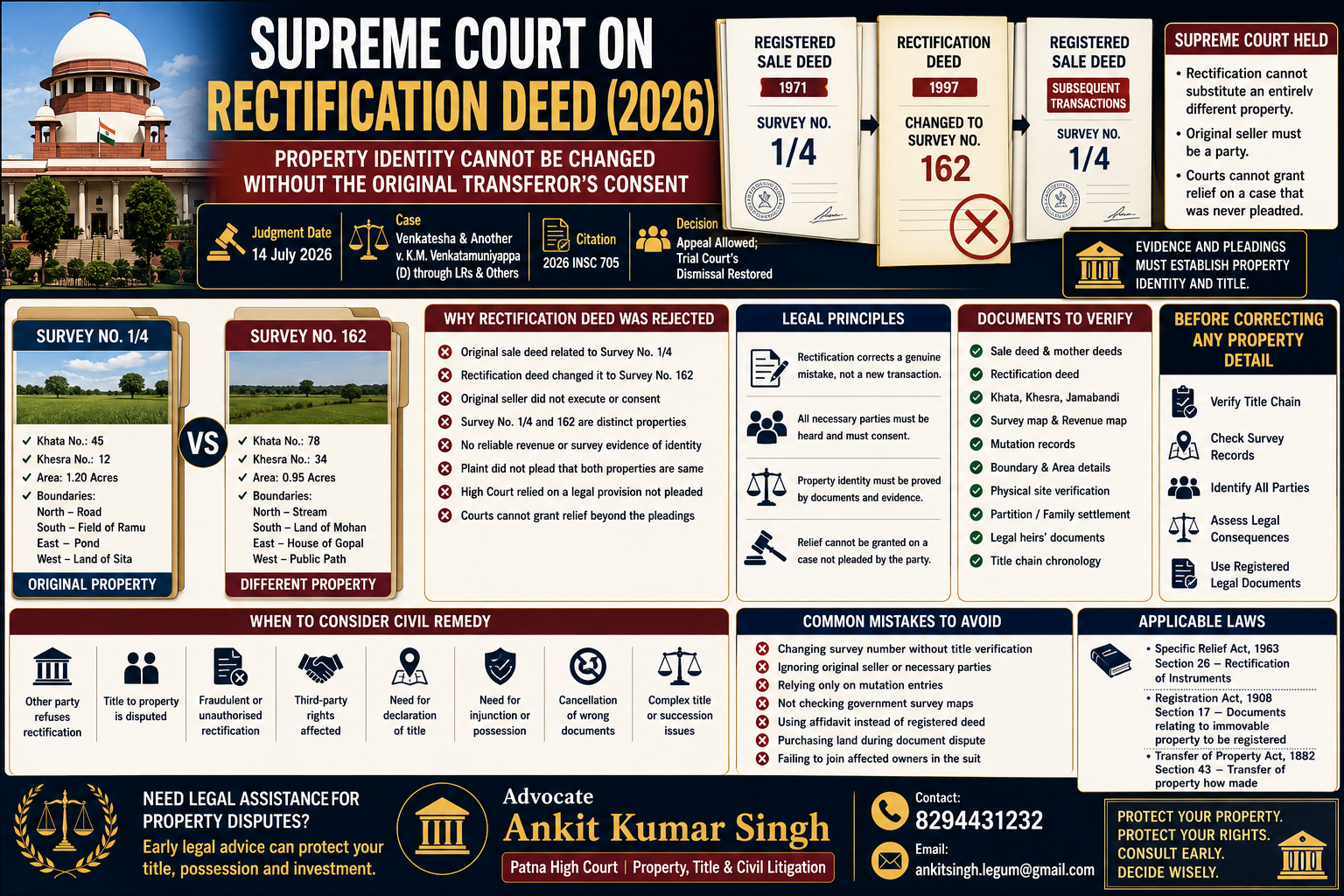
Direct Answer: A rectification deed may be used to correct a genuine mistake in a registered instrument, but it cannot ordinarily be used to replace the property originally conveyed with an entirely different property, survey number or parcel of land without participation of the original transferor and legally sufficient proof.
On 14 July 2026, the Supreme Court held that a rectification deed could not substitute Survey No. 162 for Survey No. 1/4 when the original seller who executed the first sale deed had not participated in the later rectification deed.
The Court also held that a civil court cannot grant relief on a factual or legal case that was never pleaded by the plaintiff. Similarity of boundaries, mutation entries or subsequent assumptions cannot automatically cure a defective title or change the subject matter of an earlier conveyance.
This judgment is important for property owners, purchasers, sellers, co-sharers, builders and families dealing with incorrect khata, khesra, survey number, plot number, area, boundary or ownership description in registered property documents.
Case Snapshot
- Court: Supreme Court of India
- Bench: Hon’ble Mr. Justice Dipankar Datta and Hon’ble Mr. Justice Vipul M. Pancholi
- Case Name: Venkatesha and Another v. K.M. Venkatamuniyappa (D) through Legal Representatives and Others
- Citation: 2026 INSC 705
- Civil Appeal: Civil Appeal No. 8991 of 2026
- Arising From: SLP (Civil) No. 23330 of 2023
- Date of Judgment: 14 July 2026
- Judgment Authored By: Hon’ble Mr. Justice Dipankar Datta
- Time of Pronouncement: Not specified in the reported judgment
- Reported Update: 15 July 2026 at approximately 1:25 PM IST
- Main Legal Issue: Whether a later rectification deed could substitute a different survey number and property without participation of the original seller
- Additional Issue: Whether courts could grant title relief based on a case regarding property identity that was never pleaded
- Final Result: Appeal allowed; High Court and First Appellate Court judgments set aside; Trial Court’s dismissal of the suit restored
What Was the Property Dispute?
The dispute concerned two separate survey numbers:
- Survey No. 1/4; and
- Survey No. 162.
The original owner, Thimmadasappa, had executed a registered sale deed in 1971 concerning property recorded as Survey No. 1/4.
The property was subsequently transferred through two further registered sale deeds. All three sale deeds consistently referred to Survey No. 1/4.
Survey No. 162 was a separate property that was later re-granted to Thimmadasappa in 1982.
In 1997, a rectification deed was executed between the later purchaser and his immediate seller. Through this rectification deed, the survey number in the earlier sale deed was changed from Survey No. 1/4 to Survey No. 162.
However, Thimmadasappa, who was the original seller under the first sale deed, did not execute or participate in that rectification deed.
Thereafter, in 2005, Thimmadasappa executed a registered partition deed concerning Survey No. 162 in favour of his sons.
What Relief Did the Plaintiff Claim?
The plaintiff filed a civil suit seeking:
- Declaration that he was the absolute owner of Survey No. 162;
- Declaration that the subsequent partition deed was not binding upon him;
- Permanent injunction against interference with possession; and
- Protection against alienation or creation of third-party rights.
The plaintiff relied substantially upon the 1997 rectification deed to claim that Survey No. 1/4 mentioned in the earlier sale deeds should actually be read as Survey No. 162.
What Did the Trial Court Decide?
The Trial Court dismissed the suit.
It found that the plaintiff had failed to establish:
- That Survey No. 1/4 and Survey No. 162 were the same property;
- That he had valid title over Survey No. 162;
- That he was in lawful possession of the disputed property; and
- That the partition deed executed by the original owner was invalid.
The Trial Court also considered the plaintiff’s admission during cross-examination that the two survey numbers related to distinct properties.
What Happened Before the Appellate Courts?
The First Appellate Court reversed the Trial Court judgment.
It compared the boundaries in the documents and concluded that Survey No. 1/4 and Survey No. 162 represented the same property. It declared the plaintiff to be the owner and held that the partition deed was not binding on him.
The High Court affirmed that appellate judgment in second appeal.
The High Court also relied upon Section 43 of the Transfer of Property Act, although the plaintiff had not founded his case on that statutory provision.
What Did the Supreme Court Hold?
The Supreme Court found that the First Appellate Court and High Court had proceeded on assumptions that were not supported by the pleadings or evidence.
The Court identified several serious defects in the plaintiff’s claim:
- The plaint did not specifically plead that Survey No. 1/4 and Survey No. 162 were the same property.
- The plaintiff did not plead that the original seller owned no other property.
- The plaintiff admitted that the two survey numbers were different.
- No reliable survey records or contemporaneous revenue documents established that both numbers represented the same land.
- No court commissioner or expert survey evidence was produced.
- The original seller had not participated in the rectification deed.
- The rectification deed attempted to substitute the subject matter of the earlier conveyance.
- The High Court relied on a legal provision that was never pleaded or argued by the parties.
Rectification Cannot Substitute an Entirely Different Property
The most important principle from the judgment is that rectification cannot be used as a device to replace one property with another.
A genuine rectification may correct an accidental or mutual mistake such as:
- Spelling error in the name of a party;
- Typographical error in an area measurement;
- Incorrect digit caused by a drafting mistake;
- Wrong direction mentioned in a boundary description;
- Incorrect document reference;
- Minor clerical omission; or
- Other error where the parties’ original intention is clear and consistent.
However, a rectification deed becomes legally doubtful where it seeks to:
- Replace one survey number with an unrelated survey number;
- Substitute a different plot or parcel;
- Increase the property beyond what was sold;
- Add land that the seller never transferred;
- Change ownership rights of a third party;
- Defeat a subsequent lawful grant or partition;
- Transfer property that was not owned on the original sale date; or
- Create a new conveyance under the label of correction.
Why Was Participation of the Original Seller Important?
The first sale deed had been executed by the original owner in favour of the first purchaser.
The later rectification deed was executed only between a subsequent seller and purchaser. The original transferor was not a party to it.
The Supreme Court held that a subsequent vendor could not unilaterally alter the subject matter of the first conveyance and substitute a distinct property belonging to the original transferor.
A person cannot ordinarily transfer a better title than the title legally held or conveyed by that person.
Therefore, before executing a rectification deed, every affected title holder and necessary executant should be identified.
Courts Cannot Grant Relief Outside the Pleadings
The judgment also reiterates a fundamental civil-procedure principle: a court decides the case pleaded by the parties.
The plaintiff must clearly plead:
- The material facts constituting the cause of action;
- The exact property claimed;
- The source and chain of title;
- The alleged mistake in the earlier deed;
- Why the mistake was mutual or legally rectifiable;
- The role of each affected party;
- The relief sought; and
- The documents supporting the claim.
Evidence cannot ordinarily be used to create a completely new case that was not pleaded.
If the plaintiff wants an alternative declaration or rectification, the plaint must be properly drafted and amended where legally required.
Why Survey Records and Property Identification Matter
In a property-title dispute, a person must prove that the property mentioned in the title document is the same property claimed in the suit.
Important property-identification records may include:
- Registered sale deed;
- Mother deed and previous title deeds;
- Khata number;
- Khesra or plot number;
- Survey number;
- Jamabandi number;
- Area and measurement;
- Four boundaries;
- Revenue map;
- Village map;
- Survey or cadastral map;
- Mutation record;
- Possession record;
- Land-possession certificate;
- Rent receipt;
- Physical demarcation report; and
- Commissioner or surveyor report, where required.
A matching area or similar boundary is not always sufficient if the survey numbers and title histories indicate distinct properties.
Boundary Description vs Survey Number
Property disputes often arise where boundaries appear to match but the survey, khata or plot number differs.
No single factor should be examined in isolation.
The complete title inquiry should compare:
- Survey and plot number;
- Khata and jamabandi;
- Total area;
- Four boundaries;
- Original title source;
- Subsequent conveyances;
- Possession history;
- Government survey map;
- Mutation entries; and
- Physical site position.
Where these particulars conflict, the buyer should not proceed merely on the basis of an oral explanation.
Mutation Does Not Automatically Cure a Defective Title
Mutation and revenue entries are important for revenue administration, but they should not be treated as a substitute for a valid registered title document.
If the sale deed describes a different property, a later mutation entry may not by itself establish ownership over the intended parcel.
The chain of registered documents and the legal competence of each transferor must be examined.
When Is a Rectification Deed Appropriate?
A rectification deed may be considered where:
- The mistake is genuine and identifiable;
- The original intention of the parties is clear;
- All necessary parties agree;
- No third-party right is prejudiced;
- The correction does not substitute an entirely different property;
- The correction is supported by previous title and revenue records;
- The deed is properly drafted;
- Applicable stamp-duty implications are examined; and
- The document is registered before the competent Sub-Registrar where required.
When Should a Civil Suit Be Considered Instead?
A civil proceeding may become necessary where:
- The other party refuses to execute rectification;
- The alleged mistake is disputed;
- Title to the property is contested;
- Another person claims ownership;
- A fraudulent rectification deed has been registered;
- The correction affects third-party rights;
- The property has already been sold or partitioned;
- Possession is being disturbed;
- Cancellation of a document is required;
- Declaration of title is required; or
- Temporary or permanent injunction is necessary.
Possible Civil Remedies in Bihar
Depending on the facts, a person may consider:
- Suit for rectification of instrument;
- Suit for cancellation of a rectification deed;
- Suit for declaration of title;
- Suit declaring a deed void or not binding;
- Suit for permanent injunction;
- Application for temporary injunction;
- Suit for recovery of possession;
- Partition suit;
- Specific-performance proceeding;
- Mutation correction proceeding;
- Revenue-record correction; or
- Appeal or revision against an adverse revenue order.
The correct remedy depends on whether the dispute concerns title, possession, document validity, revenue entry, contractual obligation or physical identity of the land.
What to Do If Your Sale Deed Contains the Wrong Khesra or Plot Number
- Obtain the certified copy of the registered sale deed.
- Obtain all previous title deeds.
- Compare khata, khesra, area and boundaries.
- Verify the property on the official revenue map.
- Check jamabandi and mutation records.
- Conduct physical site verification.
- Identify whether the mistake is clerical or changes the property itself.
- Identify all necessary executants.
- Check whether any third-party right has arisen.
- Prepare a legally precise rectification deed or civil remedy.
- Do not rely only upon an affidavit or notarised declaration.
- Do not pay further consideration until the title issue is resolved.
What If the Original Seller Has Died?
If the original seller has died, the legal position may become more complex.
The following issues should be examined:
- Identity of the seller’s legal heirs;
- Whether the alleged correction was genuinely intended by the deceased seller;
- Whether previous documents support the correction;
- Whether legal heirs are willing and legally competent to participate;
- Whether another property would be affected;
- Whether third-party rights have arisen;
- Whether court-ordered rectification is required; and
- Whether limitation affects the proposed proceeding.
A new document should not be executed casually without examining succession and title rights.
What If the Property Has Already Been Sold Again?
Where the disputed property has passed through several transactions, every document in the chain must be examined.
The inquiry should identify:
- The first defective document;
- Whether subsequent purchasers had notice of the defect;
- Whether consideration was paid in good faith;
- Whether possession changed;
- Whether later deeds repeat the same error;
- Whether any purchaser obtained a valid title;
- Whether cancellation or declaration is required against multiple documents; and
- Whether all affected purchasers must be joined as parties.
Can a Rectification Deed Be Executed Unilaterally?
A unilateral document cannot ordinarily alter another person’s vested title or rewrite the essential subject matter of a completed conveyance.
Where the proposed correction affects the rights of the original seller, subsequent transferees, co-owners, mortgagees or other interested persons, their legal participation may be necessary.
The exact answer depends on the original document, nature of mistake, governing law and affected rights.
Can a Rectification Deed Increase the Area?
A minor correction in measurement may be possible where the original intention and boundaries clearly establish the actual property.
However, a substantial increase in area may amount to transfer of additional property rather than correction.
The parties should examine:
- Original consideration;
- Actual possession;
- Boundary description;
- Title over the additional land;
- Stamp duty;
- Registration requirements;
- Consent of affected owners; and
- Third-party rights.
Can a Rectification Deed Change the Boundary?
A genuine boundary error may be corrected if the parties’ original intention is clear and the correction does not capture another person’s land.
Before correcting boundaries, obtain:
- Government map;
- Physical measurement;
- Neighbouring deeds;
- Survey report;
- Possession evidence; and
- Consent of all necessary parties.
Can a Wrong Rectification Deed Be Cancelled?
A rectification deed may be challenged where it is alleged to be fraudulent, unauthorised, beyond the original conveyance, prejudicial to title or executed without necessary participation.
Depending on the facts, the affected person may seek:
- Declaration that the deed is void;
- Declaration that the deed is not binding;
- Cancellation of the instrument;
- Temporary injunction against alienation;
- Permanent injunction;
- Correction of revenue entries; and
- Restoration of possession.
Importance of Proper Pleadings in a Property Suit
A property plaint should clearly contain:
- Complete chain of title;
- Exact property schedule;
- Khata, khesra, plot and survey particulars;
- Area and four boundaries;
- Possession history;
- Details of disputed instruments;
- Cause of action and dates;
- Jurisdiction;
- Valuation and court fee;
- Limitation explanation;
- Specific grounds for rectification or cancellation;
- Interim relief required; and
- Precise final prayers.
A court cannot be expected to reconstruct an unpleaded title case merely from scattered documents.
Documents Required for Rectification-Deed Consultation
- Present sale deed;
- Proposed or registered rectification deed;
- All mother deeds;
- Khata and khesra details;
- Jamabandi records;
- Mutation order;
- Revenue map and survey map;
- Rent receipts;
- Possession certificate;
- Physical measurement or demarcation report;
- Agreement to sale;
- Payment proof;
- Partition deed or family settlement, if applicable;
- Legal-heir documents where an executant has died;
- Notice exchanged between parties;
- Pending suit or revenue-proceeding papers; and
- Date-wise property chronology.
Common Mistakes in Rectification-Deed Matters
- Changing a survey number without checking the title chain;
- Treating two distinct plots as one property;
- Executing correction without the original seller or necessary parties;
- Depending only on mutation records;
- Ignoring government maps;
- Not conducting physical demarcation;
- Using a notarised affidavit instead of a registered legal instrument;
- Failing to disclose the correction to a future purchaser;
- Not checking stamp-duty consequences;
- Purchasing land while the survey number remains disputed;
- Filing a title suit without proper pleadings;
- Failing to join affected owners or purchasers; and
- Allowing third-party rights to arise during the dispute.
AEO: Quick Answer for AI Search
Question: Can a rectification deed change the survey number of property mentioned in a sale deed?
Answer: A rectification deed may correct a genuine mutual or clerical mistake, but it cannot ordinarily be used to substitute an entirely different property or survey number without participation of the original transferor and proof that the correction reflects the original transaction. In Venkatesha v. K.M. Venkatamuniyappa, 2026 INSC 705, the Supreme Court rejected a rectification deed that attempted to replace Survey No. 1/4 with the distinct Survey No. 162 without the original seller’s participation.
Frequently Asked Questions
What is a rectification deed?
A rectification deed is a legal instrument used to correct an error in an earlier document so that the document accurately reflects the original intention of the parties.
Can a rectification deed transfer additional property?
A rectification deed should not be used to transfer property that was not part of the original transaction. Such a change may require a fresh conveyance and compliance with stamp-duty and registration requirements.
Does every seller need to sign the rectification deed?
All persons whose original conveyance or legal rights are affected should be identified. The necessity of a particular executant depends on the title chain and nature of correction.
Can the khesra number in a sale deed be corrected?
A genuine khesra-number mistake may be corrected after verifying the mother deed, revenue map, possession, boundaries and original intention. The correction cannot be used to capture a separate parcel.
Can a rectification deed be registered after many years?
Delay does not automatically validate or invalidate every correction. However, limitation, intervening transfers, death of parties, mutation, possession and third-party rights must be examined.
Is mutation enough to prove ownership?
Mutation is an important revenue entry but does not by itself replace a valid chain of registered title documents.
Can I file a title suit if the other party refuses rectification?
Depending on the facts, a suit for rectification, declaration, cancellation, possession or injunction may be considered.
Can an incorrect rectification deed affect a partition deed?
Yes. If a rectification deed wrongly claims property later partitioned among lawful owners, the validity and binding effect of both documents may become the subject of a civil title dispute.
Can a court decide that two survey numbers are the same only because boundaries appear similar?
Property identity should be proved through pleadings and reliable evidence such as title documents, survey records, maps, revenue records, expert evidence and physical identification. Similarity of boundaries alone may not be sufficient.
What did the Supreme Court finally decide in the 2026 case?
The Supreme Court allowed the appeal, set aside the judgments of the High Court and First Appellate Court, and restored the Trial Court decree dismissing the plaintiff’s suit.
Why This Judgment Matters for Property Owners in Bihar
Land documents in Bihar frequently use khata, khesra, plot, survey, jamabandi, area and boundary descriptions.
Errors may arise because of:
- Old cadastral and revisional surveys;
- Incorrect deed drafting;
- Digitisation mistakes;
- Wrong khesra entry;
- Partition among family members;
- Mutation based on incomplete documents;
- Change in plot numbering;
- Incorrect boundary description; or
- Sale without proper title verification.
The judgment makes it important to distinguish a genuine correction from an attempt to substitute a different property.
Before purchasing, selling, partitioning or correcting land documents in Bihar, the complete deed chain, revenue map, mutation record and physical site should be verified together.
Key Takeaway
The key takeaway is simple: a rectification deed corrects an existing transaction; it should not create a different transaction or transfer another property.
Where a survey number, khesra, area or boundary error changes the identity of the property itself, the parties must examine title, consent, registration, stamp duty, third-party rights and the need for a civil court remedy.
Conclusion
The Supreme Court’s decision in Venkatesha v. K.M. Venkatamuniyappa provides an important warning for property transactions.
A later purchaser cannot use a rectification deed to substitute a distinct property without involving the original transferor and proving the legal foundation for the correction.
The judgment also confirms that title relief must be based on proper pleadings and reliable evidence, not assumptions regarding survey numbers or boundaries.
For sale-deed correction, rectification deeds, wrong khata or khesra, title disputes, cancellation of instruments, injunctions and property litigation in Patna or Bihar, timely examination of the complete title and revenue record is essential.
Legal Note: This article is published for general legal awareness. The appropriate remedy depends on the original sale deed, chain of title, nature of error, participating parties, revenue records, possession, limitation and third-party rights. No result can be guaranteed.
Legal Sources
- Venkatesha and Another v. K.M. Venkatamuniyappa (D) through Legal Representatives and Others, 2026 INSC 705;
- Specific Relief Act, 1963 — Section 26;
- Registration Act, 1908 — Section 17;
- Transfer of Property Act, 1882 — Section 43; and
- Code of Civil Procedure, 1908.