Supreme Court on Motor Accident Compensation: How ITR Helps in Calculating Income
Introduction
That motor accident compensation cases often depend upon one important question: what was the actual income of the injured person or deceased victim?
That in many MACT cases, parties produce salary slips, bank statements, business records and Income Tax Returns to prove income. The Supreme Court has recently clarified how ITRs may be used for assessing income in motor accident compensation claims.
This clarification is important for victims, families, salaried employees, self-employed persons, business owners and insurance claimants.
Why Income Proof Matters in Accident Claims
That compensation in a motor accident case is not decided randomly. The court or tribunal examines different factors, including age, income, occupation, disability, dependency and future prospects.
That income proof becomes very important because it directly affects the calculation of loss of income, loss of dependency and final compensation.
If income is not properly proved, the compensation may be calculated on a lower notional income. Therefore, proper documents are very important.
Role of Income Tax Return in MACT Cases
That an Income Tax Return is a statutory financial document. It can help show the declared income of a person for a particular financial year.
That when a person is salaried or self-employed, ITRs may provide a reliable basis for calculating income, especially where there is no dispute about the genuineness of the document.
However, the approach may be different for salaried persons and self-employed persons.
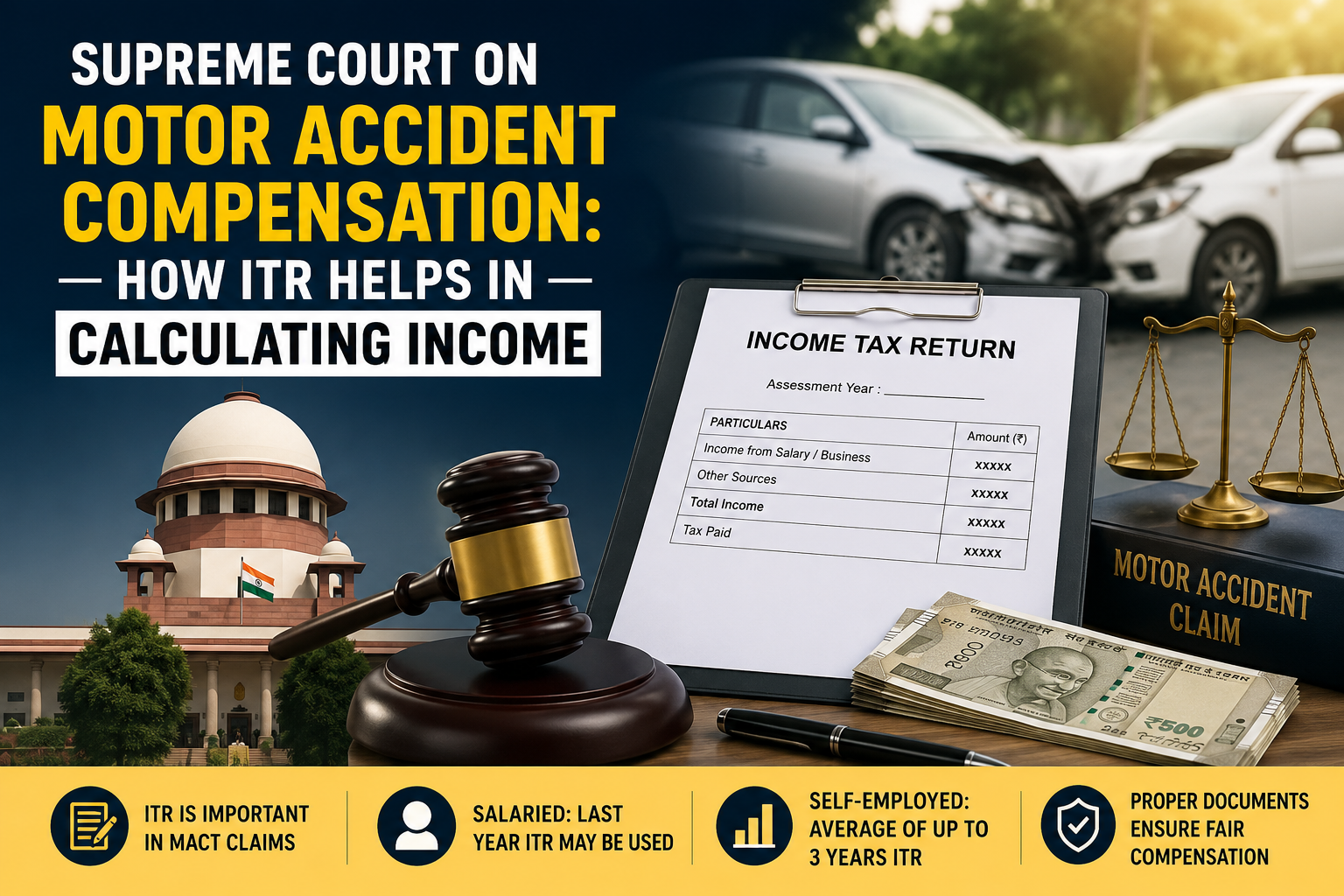
Salaried Persons: Latest ITR May Be Important
That in case of a salaried person, income is usually more stable and can be verified through salary records, Form 16, bank entries and ITR.
That the Supreme Court has indicated that the ITR of the previous year can be an important basis for assessing income of salaried persons.
That if the person was recently promoted or had a salary revision, supporting records like promotion letter, salary revision letter or bank statement may also become relevant.
Self-Employed Persons: Average Income May Be Considered
That in case of self-employed persons, income may fluctuate from year to year. A shop owner, contractor, consultant, professional or small business owner may not have the same income every year.
That for self-employed persons, courts may consider the average of ITRs for up to the previous three years, depending upon the facts of the case.
That the nature of business, business growth, market condition, negative income, business location and surrounding financial circumstances may also become relevant.
Why Post-Accident or Post-Death ITR Needs Caution
That in some cases, Income Tax Returns may be filed after the accident or after the death of the victim. Such documents may require careful examination.
That courts may look for supporting financial records to ensure that income is not inflated later only for the purpose of claiming higher compensation.
Therefore, families should preserve genuine financial documents from the relevant period.
Important Documents in Motor Accident Compensation Cases
In a motor accident claim, the following documents may be useful:
- Income Tax Returns
- Form 16
- Salary slips
- Bank account statements
- Appointment letter
- Promotion letter
- Business registration documents
- GST records, if applicable
- Shop or trade licence, if applicable
- Medical bills and treatment records
- Disability certificate, where applicable
- Police papers, FIR and charge-sheet
- Insurance policy details
- Driving licence and vehicle documents
Why This Judgment Matters for Claimants
That this clarification helps bring consistency in accident compensation cases. It also reduces arbitrary assessment of income.
That genuine income documents can help the family of the victim receive fair compensation. At the same time, courts will also examine whether the income documents are reliable and properly supported.
This is especially useful for families where the deceased person was the main earning member.
Practical Advice for Victims and Families
That after a road accident, families should not delay in collecting documents. Many people focus only on medical treatment and police papers but forget financial records.
Important steps include:
- Preserve hospital and medical bills.
- Keep copies of ITRs and bank statements.
- Collect salary or business income proof.
- Obtain certified copies of FIR and police papers.
- Keep insurance and vehicle documents ready.
- Consult a lawyer before filing the claim petition.
- Avoid filing incomplete or unsupported income claims.
Difference Between Claim and Proof
That merely claiming a high income is not enough. The claimant must support the income with proper documents.
That courts and tribunals usually prefer reliable documentary evidence over oral claims. Therefore, the quality of documents can directly affect the final compensation amount.
Conclusion
That the Supreme Court’s clarification on using ITRs in motor accident compensation cases is an important legal development.
That salaried persons and self-employed persons may require different methods of income assessment. Proper ITRs, financial records and supporting documents can play a major role in securing fair compensation.
For motor accident claims, MACT cases and compensation disputes, timely legal advice and proper document preparation are essential.