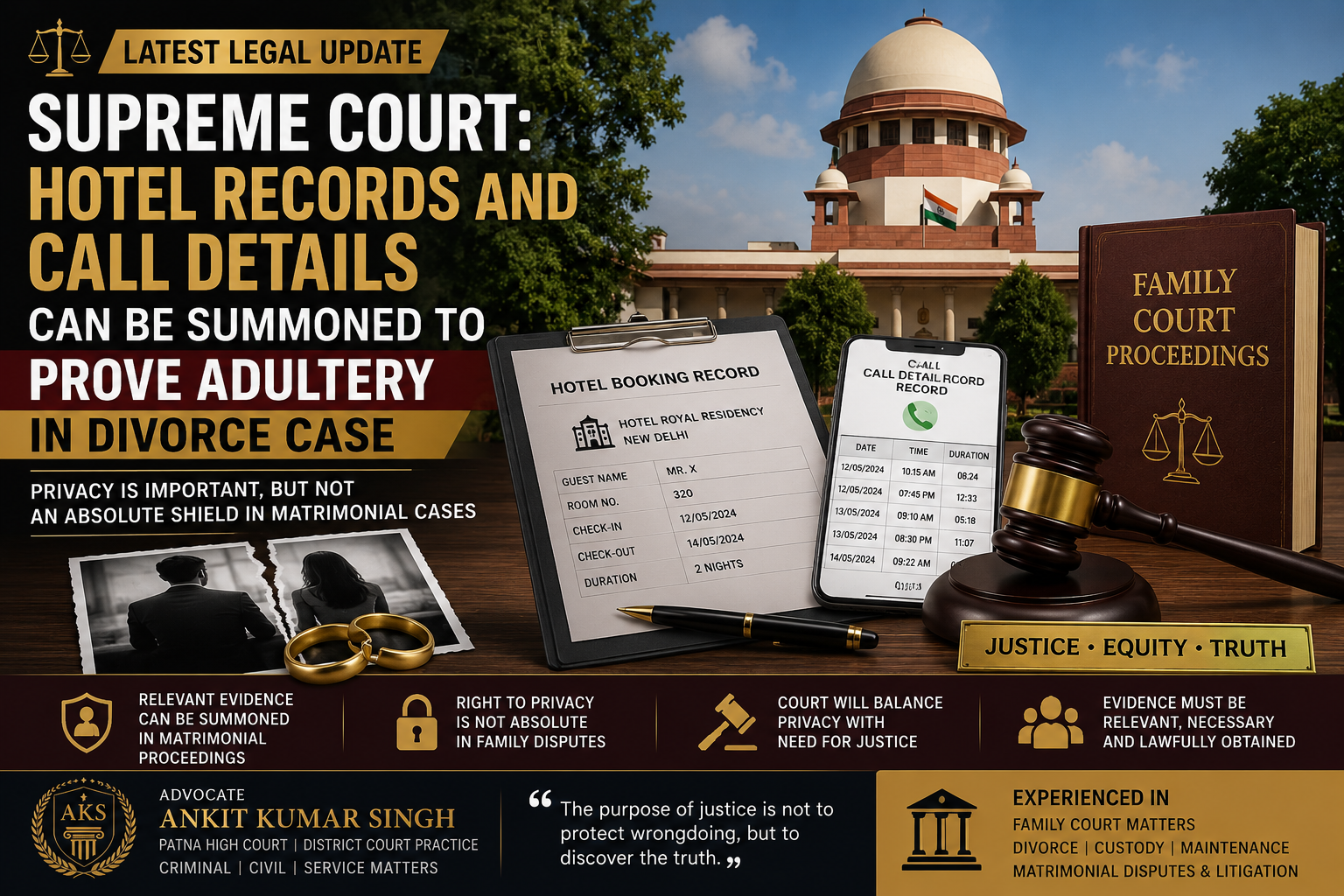
Supreme Court: Hotel Records and Call Details Can Be Summoned to Prove Adultery in Divorce Case
Latest Legal Update: The Supreme Court has refused to interfere with a Delhi High Court order permitting a wife to summon hotel records and call detail records in matrimonial proceedings to prove allegations of adultery.
This update is important for parties involved in divorce cases, adultery allegations, matrimonial disputes, cruelty cases, family court evidence and right to privacy arguments.
The issue shows how courts balance two important rights: the right to privacy of one spouse and the right of the other spouse to prove his or her case before the Family Court.
Introduction
That matrimonial disputes often involve allegations which are difficult to prove through ordinary documents. In cases involving adultery, a spouse may seek hotel records, travel details, call detail records or other supporting material to establish the allegation.
That at the same time, the other spouse may object by claiming right to privacy under Article 21 of the Constitution of India.
The latest Supreme Court update clarifies that privacy is important, but it is not an absolute shield against production of relevant evidence in matrimonial proceedings.
What Was the Main Legal Issue?
That the main issue was whether a spouse accused of adultery can resist production of hotel booking records and call detail records only by invoking the right to privacy.
The wife sought production of hotel records and call detail records to support her allegation of adultery in divorce proceedings. The husband objected by relying upon his right to privacy.
The Family Court allowed production of the records. The Delhi High Court upheld that direction, and the Supreme Court refused to interfere with the High Court’s order.
Why This Update Matters in Divorce Cases
That adultery is a recognized ground in matrimonial proceedings. If a spouse alleges adultery, the allegation must be proved through legally acceptable material.
Direct evidence in such cases is often difficult. Therefore, courts may permit relevant records to be summoned where such records can assist in deciding the real controversy.
This update is important because it shows that a party cannot use privacy as a blanket protection to prevent production of relevant evidence in every matrimonial dispute.
Right to Privacy Is Not Absolute
That the right to privacy is a constitutional right. However, like many rights, it is not absolute in every situation.
Where a party approaches a Family Court and makes specific allegations requiring adjudication, the court may balance privacy concerns with the right to fair trial and the need to decide the case properly.
The key point is balance: the court must ensure that the evidence is relevant, necessary and handled with confidentiality.
Role of Family Court in Matrimonial Evidence
That Family Courts have a special role in matrimonial disputes. They are expected to decide sensitive personal disputes with fairness, confidentiality and practical understanding.
Section 14 of the Family Courts Act gives Family Courts flexibility in receiving material that may assist in effectively deciding the dispute.
This does not mean that every private record will be allowed automatically. The court will examine whether the record is relevant and necessary for deciding the matrimonial issue.
Why Hotel Records and Call Details May Become Relevant
That in adultery allegations, hotel booking records, stay details, call detail records, travel details or location-related material may become relevant depending on the facts of the case.
Such records may help establish whether the allegation has a factual basis or whether it is only a suspicion.
However, such evidence should be sought through proper court process and not through illegal access, hacking, threats or unauthorized surveillance.
Protection of Confidentiality
That courts may also protect confidentiality while allowing production of sensitive records.
In such matters, the court may direct that records be produced in a sealed cover or be examined only for the limited purpose of the case.
This ensures that the evidence is used for judicial adjudication and not for public humiliation or unnecessary invasion of privacy.
Impact on Husbands and Wives
That this principle applies to matrimonial litigation generally. Depending upon the facts, either husband or wife may seek relevant evidence to prove allegations such as adultery, cruelty, desertion or false accusation.
The court will not decide the issue based only on suspicion. The party seeking such records must show why the records are necessary and how they are connected with the matrimonial dispute.
Therefore, both sides must prepare their evidence strategy carefully.
Difference Between Suspicion and Evidence
That mere suspicion is not enough to prove adultery or cruelty. A party must support the allegation with reliable facts, circumstances and documents.
At the same time, matrimonial misconduct often happens privately. Therefore, courts may consider circumstantial evidence where direct evidence is not available.
The important question is whether the material sought is relevant to the issue before the Family Court.
What Parties Should Not Do
That parties should avoid illegal methods of collecting evidence. Evidence collection must be lawful and court-supervised where privacy concerns are involved.
Parties should avoid:
- Hacking mobile phones or email accounts.
- Secretly accessing passwords or private accounts.
- Threatening hotel staff or third parties.
- Publishing private material on social media.
- Using private information for blackmail or pressure.
- Circulating sensitive records outside the court process.
Practical Checklist Before Seeking Records in Family Court
Before filing an application to summon records, the following points should be checked:
- What exact allegation is to be proved.
- Whether the record is directly relevant.
- Whether the date, place and details are specific.
- Whether the record is available from a lawful source.
- Whether the court should summon the record directly.
- Whether confidentiality protection is required.
- Whether the request is proportionate and not a fishing enquiry.
- Whether the record will actually assist the Family Court.
For the Spouse Opposing Such Records
That a spouse opposing production of records may raise objections if the request is vague, excessive, irrelevant, malicious or disproportionate.
The objection may also point out whether the record sought has no connection with the allegation or whether the request is only meant to harass.
However, a general claim of privacy may not be enough if the court finds that the record is necessary for deciding the matrimonial dispute.
Why This Update Is Important for Family Court Litigation
That this update is important because family disputes often involve sensitive allegations and private facts.
Courts must ensure that truth is discovered without causing unnecessary invasion of privacy. This requires a careful judicial balance.
For litigants, it means that matrimonial litigation should be handled with proper pleadings, relevant documents and lawful evidence strategy.
Impact on Divorce and Cruelty Cases
That adultery allegations may also connect with cruelty, mental harassment, breakdown of marriage and related matrimonial reliefs.
Where a party makes a serious allegation, the court may allow relevant material to be brought on record if it helps in deciding the dispute.
Therefore, divorce petitions and written statements should be drafted carefully with clear facts and proper legal grounds.
Key Takeaway
That the key takeaway is that privacy is a valuable constitutional right, but it may be balanced against the right of a spouse to prove allegations in matrimonial proceedings.
Hotel records and call detail records may be summoned if the Family Court finds them relevant, necessary and connected with the issue in dispute.
At the same time, such records should be handled with confidentiality and used only for the purpose of the case.
Conclusion
That the Supreme Court’s refusal to interfere with the direction permitting production of hotel records and call detail records is an important development in matrimonial evidence law.
It shows that courts may permit relevant records to prove adultery, while also ensuring that privacy concerns are balanced through proper judicial safeguards.
For divorce cases, adultery allegations, cruelty petitions, family court evidence and matrimonial strategy, proper legal advice and careful document preparation are essential.
Legal Note: The admissibility and production of records in matrimonial cases depends on the facts, pleadings, relevance of evidence, privacy concerns and the discretion of the Family Court.