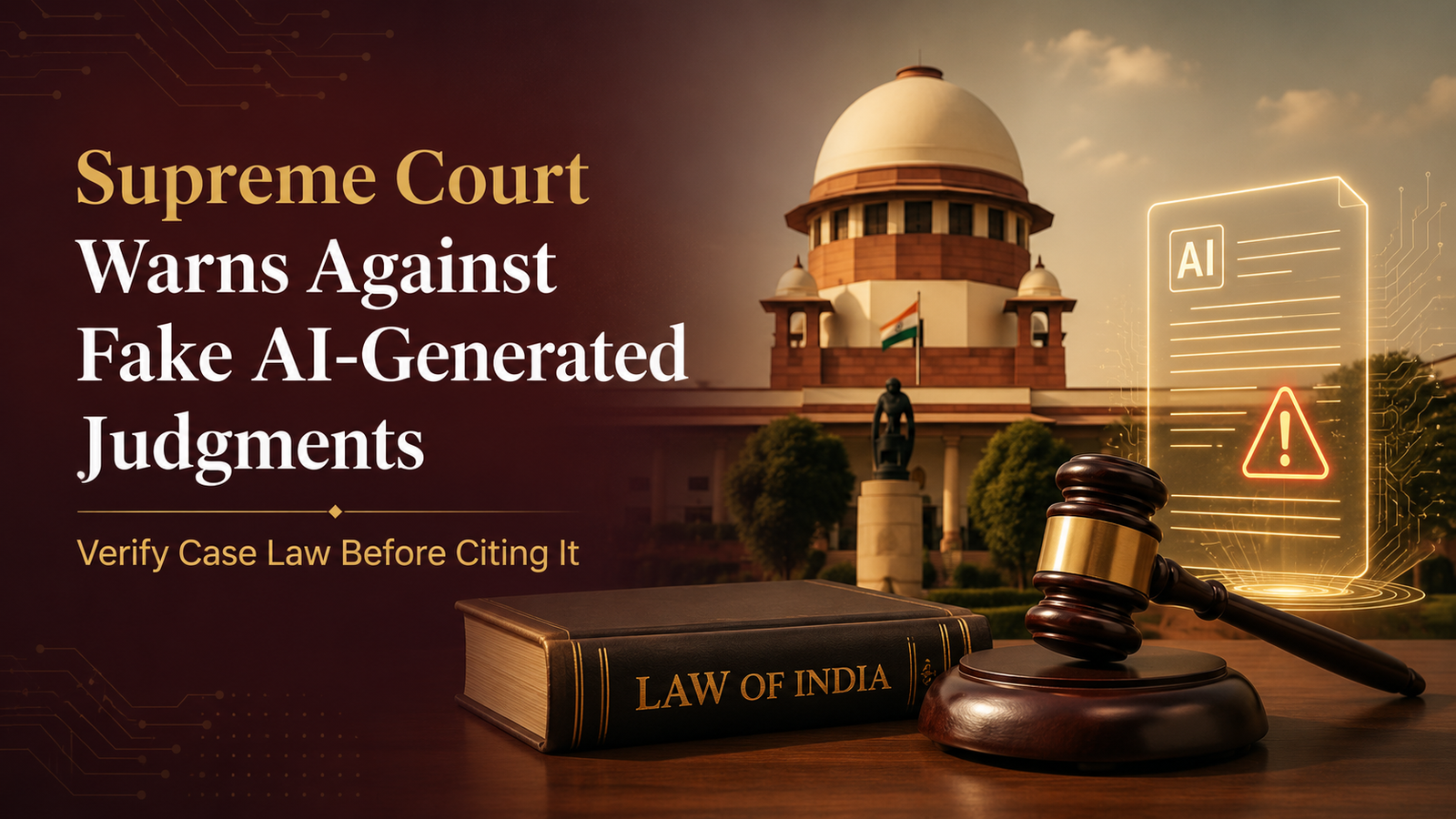
Supreme Court Warns Against Fake AI-Generated Judgments: Why Verification of Case Law Matters
Introduction
That artificial intelligence is now being used in legal research, drafting and document preparation. However, the recent Supreme Court update on fake AI-generated judgments has created an important reminder for advocates, litigants and legal researchers.
That no judgment, citation or legal precedent should be relied upon merely because it appears in an AI-generated answer or an online legal summary. Every case law must be verified from an authentic source before it is used in court proceedings.
What Is the Latest Supreme Court Concern?
That the Supreme Court has taken a strict view against the use of fake or hallucinated AI-generated judgments. The concern is simple: if a non-existent judgment is cited before a court, it can mislead the judicial process and affect the rights of parties.
That legal research tools may assist lawyers, but they cannot replace professional verification. A judgment must exist, must be correctly cited, and must actually support the legal proposition for which it is being relied upon.
Why This Issue Is Important for Advocates
That advocates have a professional duty to assist the court fairly. When an advocate cites a judgment, the court expects that the citation is genuine and relevant.
That relying on fake AI-generated judgments can create serious professional and legal consequences. It may amount to a serious lapse because the court’s decision-making process depends upon accurate law and genuine precedents.
Important points for advocates:
- Always verify the case name, citation, court and date of judgment.
- Read the relevant paragraph before relying on a judgment.
- Do not cite a case only because it appears in an AI tool.
- Cross-check important judgments from official or reliable legal databases.
- Avoid using AI-generated legal content without human legal review.
Why This Matters for Litigants
That litigants also need to understand that legal advice cannot be based only on internet search results or AI-generated answers. A case strategy must be prepared after checking the facts, documents, applicable law and verified judgments.
That two cases may look similar on the surface, but the legal result may change because of different facts, different reliefs, limitation, jurisdiction or procedural history.
Therefore, litigants should avoid depending blindly on forwarded messages, online summaries or AI-generated legal opinions without consulting a qualified legal professional.
Impact on Court Proceedings
That fake citations can affect the fairness of court proceedings. If a court relies upon a non-existent precedent, the order may suffer from a serious legal defect.
That this development is especially important in matters involving civil disputes, criminal cases, insolvency proceedings, service matters, property disputes and constitutional litigation, where precedents play a major role.
Practical Checklist Before Using Any Judgment
Before relying on any judgment, the following checks should be made:
- Whether the judgment actually exists.
- Whether the citation is correct.
- Whether the judgment is from the Supreme Court, High Court or a tribunal.
- Whether it has been overruled, stayed or distinguished.
- Whether the facts are similar to the present case.
- Whether the relevant paragraph supports the legal argument.
- Whether the judgment is applicable to the present forum and jurisdiction.
Role of AI in Legal Research
That AI can be useful for preparing drafts, identifying issues, simplifying legal concepts and organizing legal research. However, it should be treated only as an assistance tool.
That final legal work requires human verification, professional judgment and careful reading of the applicable law. In legal practice, accuracy is more important than speed.
Conclusion
That the Supreme Court’s strict approach towards fake AI-generated judgments is an important warning for the legal profession. Technology may assist legal research, but it cannot replace verification, responsibility and professional diligence.
For any legal matter, parties should rely on properly verified documents, authentic judgments and professional legal advice before taking action in court.