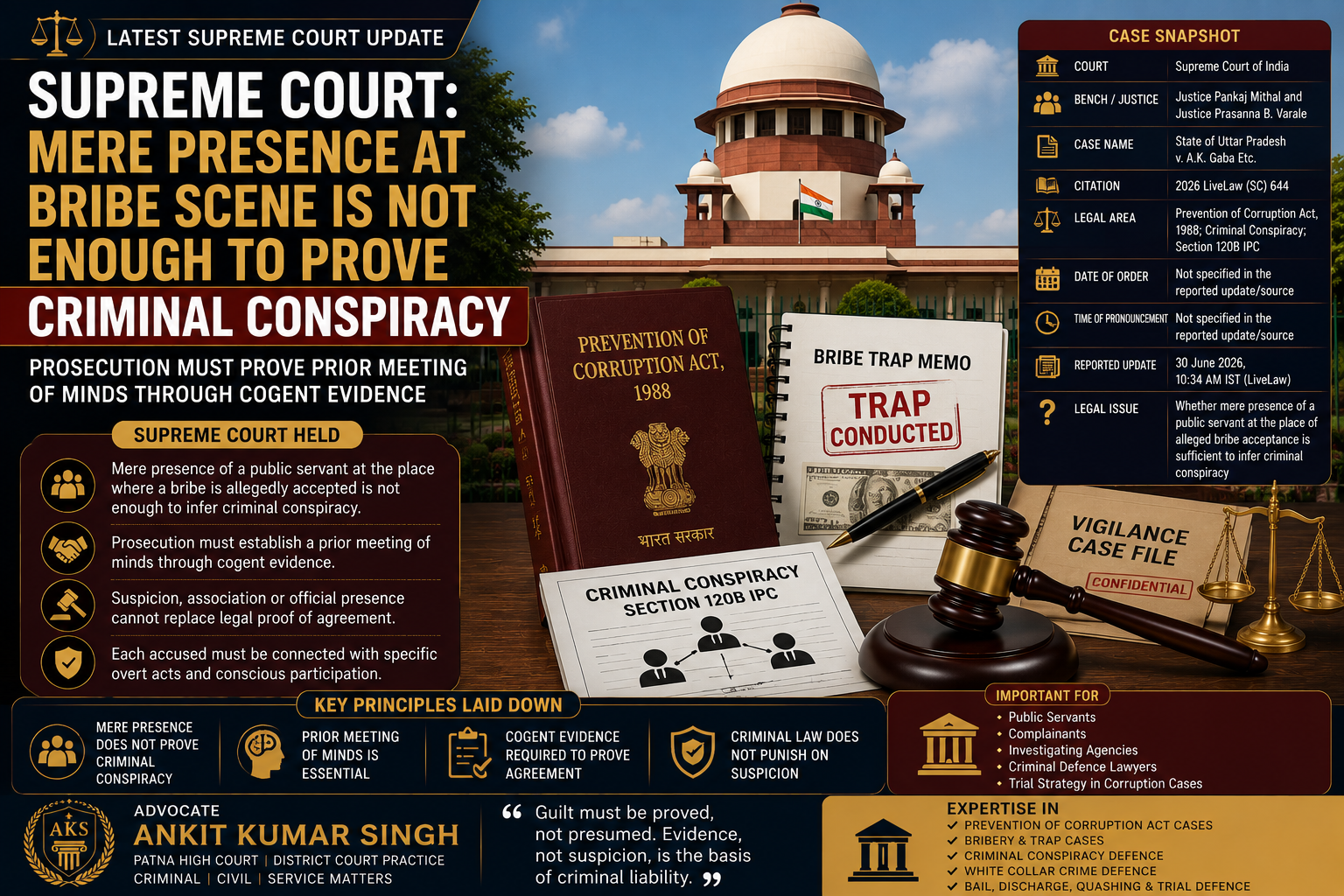
Supreme Court: Mere Presence at Bribe Scene Is Not Enough to Prove Criminal Conspiracy
Latest Supreme Court Update: The Supreme Court has recently clarified an important principle in corruption and criminal conspiracy cases: mere presence of a public servant at the place where a bribe is allegedly accepted is not enough to infer criminal conspiracy.
The Court reiterated that the prosecution must establish a prior meeting of minds through cogent evidence before a person can be held liable for criminal conspiracy.
This update is important for accused public servants, complainants, investigating agencies, criminal defence lawyers and litigants dealing with Prevention of Corruption Act cases, bribery allegations, trap cases, conspiracy charges and trial defence strategy.
Case Snapshot
- Court: Supreme Court of India
- Bench / Justice: Justice Pankaj Mithal and Justice Prasanna B. Varale
- Case Name: State of Uttar Pradesh v. A.K. Gaba Etc.
- Citation: 2026 LiveLaw (SC) 644
- Legal Area: Prevention of Corruption Act, 1988; Criminal Conspiracy; Section 120B IPC
- Order / Judgment Date: Not specified in the accessible reported update/source
- Time of Pronouncement: Not specified in the accessible reported update/source
- Reported Update: LiveLaw report dated 30 June 2026, around 10:33–10:34 AM IST
- Main Legal Issue: Whether mere presence of an officer at the place where a superior allegedly accepted bribe is sufficient to infer criminal conspiracy
Introduction
That corruption cases often involve serious allegations, departmental consequences, criminal prosecution and damage to reputation. In many cases, more than one public servant may be named by the prosecution.
However, criminal liability cannot be imposed merely because a person was present at the spot or was associated with the office where the alleged bribe transaction took place.
The Supreme Court’s recent clarification is important because it protects the basic criminal law principle that guilt must be proved through evidence and not through assumption.
What Was the Main Legal Issue?
That the issue before the Supreme Court was whether the mere presence of a public servant at the place where a bribe was allegedly accepted by another officer can be sufficient to infer criminal conspiracy.
The Supreme Court held that mere presence is not enough. The prosecution must prove that there was a prior meeting of minds and that the accused had consciously participated in the alleged conspiracy.
This principle is important in corruption cases where multiple officers are sometimes implicated without clear evidence of their individual role.
Meaning of Criminal Conspiracy
That criminal conspiracy means an agreement between two or more persons to commit an illegal act or to commit a legal act by illegal means.
The central requirement is agreement. Without proof of agreement, understanding or prior meeting of minds, the allegation of conspiracy may become weak.
Presence, suspicion or official association by itself does not automatically prove conspiracy.
Why Mere Presence Is Not Enough
That a person may be present in an office, room, premises or official environment for many reasons. Presence alone does not show that the person demanded bribe, accepted bribe, shared illegal money or agreed to commit an offence.
To establish conspiracy, the prosecution must show a clear link between the accused and the alleged illegal transaction.
Therefore, courts require cogent evidence before drawing an inference of criminal conspiracy.
What the Prosecution Must Prove
In a bribery or corruption conspiracy case, the prosecution may need to prove:
- Specific demand of illegal gratification.
- Acceptance or facilitation of bribe.
- Prior agreement between accused persons.
- Conscious participation in the illegal act.
- Meeting of minds between the alleged conspirators.
- Recovery or other corroborative material, where applicable.
- Evidence connecting each accused with the alleged offence.
That without such material, a conspiracy allegation may not be sustainable merely because one accused was present near another accused.
Importance of Prior Meeting of Minds
That prior meeting of minds means there must be some material to show that the accused persons had agreed to act together for an illegal purpose.
Such agreement may be proved by direct evidence or by strong circumstantial evidence. However, it cannot be presumed only from presence or association.
The Court’s approach ensures that criminal conspiracy is not treated casually in corruption cases.
Impact on Prevention of Corruption Act Cases
That Prevention of Corruption Act cases often involve trap proceedings, demand verification, recovery, sanction, witness statements and electronic or documentary evidence.
If the prosecution alleges that multiple public servants were involved, it must show the role of each accused.
Mere official hierarchy, departmental connection or physical presence may not be enough unless supported by evidence showing participation in the alleged offence.
Impact on Accused Public Servants
That accused public servants should carefully examine whether the prosecution has specific evidence against them or whether they have been implicated only because they were present or connected with the office.
The defence may examine whether there is any evidence of demand, acceptance, recovery, communication, instruction, benefit sharing or prior agreement.
If the prosecution case is based only on assumption, the accused may have legal grounds to challenge the allegation depending on the stage of the case.
Impact on Complainants and Investigating Agencies
That complainants and investigating agencies must ensure that corruption allegations are supported by clear and reliable material.
Where criminal conspiracy is alleged, investigation should focus on communications, conduct, documents, financial trail, witness statements and surrounding circumstances showing agreement.
A weak conspiracy allegation may fail if it is based only on suspicion or physical presence.
Difference Between Suspicion and Proof
That suspicion may arise from circumstances, but conviction or criminal liability requires proof.
In criminal law, the prosecution must establish the case beyond reasonable doubt. The standard becomes especially important in corruption and conspiracy cases because the consequences are serious.
Suspicion, however strong, cannot replace legal proof.
Role of Evidence in Bribery Cases
That evidence in bribery cases must be carefully examined. Courts may look at demand, acceptance, recovery, trap procedure, independent witnesses, voice recording, call records, sanction order and consistency of prosecution evidence.
If the evidence does not connect a particular accused with the alleged demand or conspiracy, the defence may argue that the prosecution has failed to establish individual criminal liability.
Practical Checklist for Defence in Corruption Cases
Before preparing defence in a corruption or bribery case, the following materials should be reviewed:
- FIR or complaint copy.
- Pre-trap verification report.
- Demand verification material.
- Trap memo and recovery memo.
- Independent witness statements.
- Sanction for prosecution.
- Call detail records, if relied upon.
- Audio or video recording, if any.
- Departmental role of each accused.
- Evidence of demand and acceptance.
- Evidence of prior meeting of minds.
- Charge-sheet and relied-upon documents.
When Can Conspiracy Charge Be Challenged?
That a conspiracy charge may be challenged where there is no material showing agreement, no overt act connecting the accused, no evidence of participation, or no link between the accused and the alleged bribe transaction.
Depending on the stage of the case, the remedy may be discharge, quashing, revision, trial defence or appeal.
The correct remedy depends on the record, evidence and procedural stage.
Why This Update Matters for Trial Strategy
That in corruption cases, trial strategy must focus on the individual role of each accused. A general allegation against all accused may not be enough.
The defence should examine whether the prosecution has proved demand, acceptance and conspiracy against the specific accused.
Cross-examination should also test whether the witness actually saw, heard or knew anything connecting the accused with the alleged illegal transaction.
Importance of Sanction and Departmental Record
That prosecution of public servants often involves sanction and departmental records. These documents may become important in understanding the role, authority and responsibility of the accused.
If the accused had no role in the alleged decision-making or bribe transaction, the defence may use departmental records to challenge the prosecution theory.
However, each case depends on its facts and evidence.
AEO: Frequently Asked Questions
Is mere presence at the place of bribe enough to prove conspiracy?
No. Mere presence is not enough. The prosecution must show prior meeting of minds and conscious participation through cogent evidence.
What is criminal conspiracy in a corruption case?
Criminal conspiracy means an agreement between persons to commit an illegal act, such as demand or acceptance of illegal gratification.
Can a public servant be prosecuted only because his superior accepted bribe?
Not merely on that basis. There must be evidence connecting the public servant with the alleged demand, acceptance, facilitation or conspiracy.
What evidence is important in a PC Act case?
Demand, acceptance, recovery, trap proceedings, witness statements, sanction, call records, recordings and documents showing role of accused may be important.
Why This Matters for Bihar and Patna Litigants
That corruption, vigilance and criminal conspiracy matters may arise before District Courts, Special Courts and the Patna High Court.
Public servants, contractors, complainants and accused persons must understand that every case depends on specific evidence and individual role.
In such matters, proper document review, bail strategy, discharge strategy and trial preparation are essential.
Key Takeaway
That the key takeaway is simple: criminal conspiracy cannot be presumed only from presence.
In bribery and corruption cases, the prosecution must prove prior meeting of minds and conscious participation by reliable evidence.
Conclusion
That the Supreme Court’s clarification is an important protection against mechanical implication in corruption and conspiracy cases.
Mere presence near the place of alleged bribe acceptance is not enough to prove criminal conspiracy. Courts require evidence showing agreement, participation and connection with the illegal act.
For Prevention of Corruption Act cases, criminal conspiracy charges, discharge, quashing, bail and trial defence, proper legal advice and detailed document analysis are essential.
Legal Note: The outcome of any corruption or conspiracy case depends on the complaint, trap proceedings, sanction, charge-sheet, witness evidence, recovery material and specific role attributed to each accused.