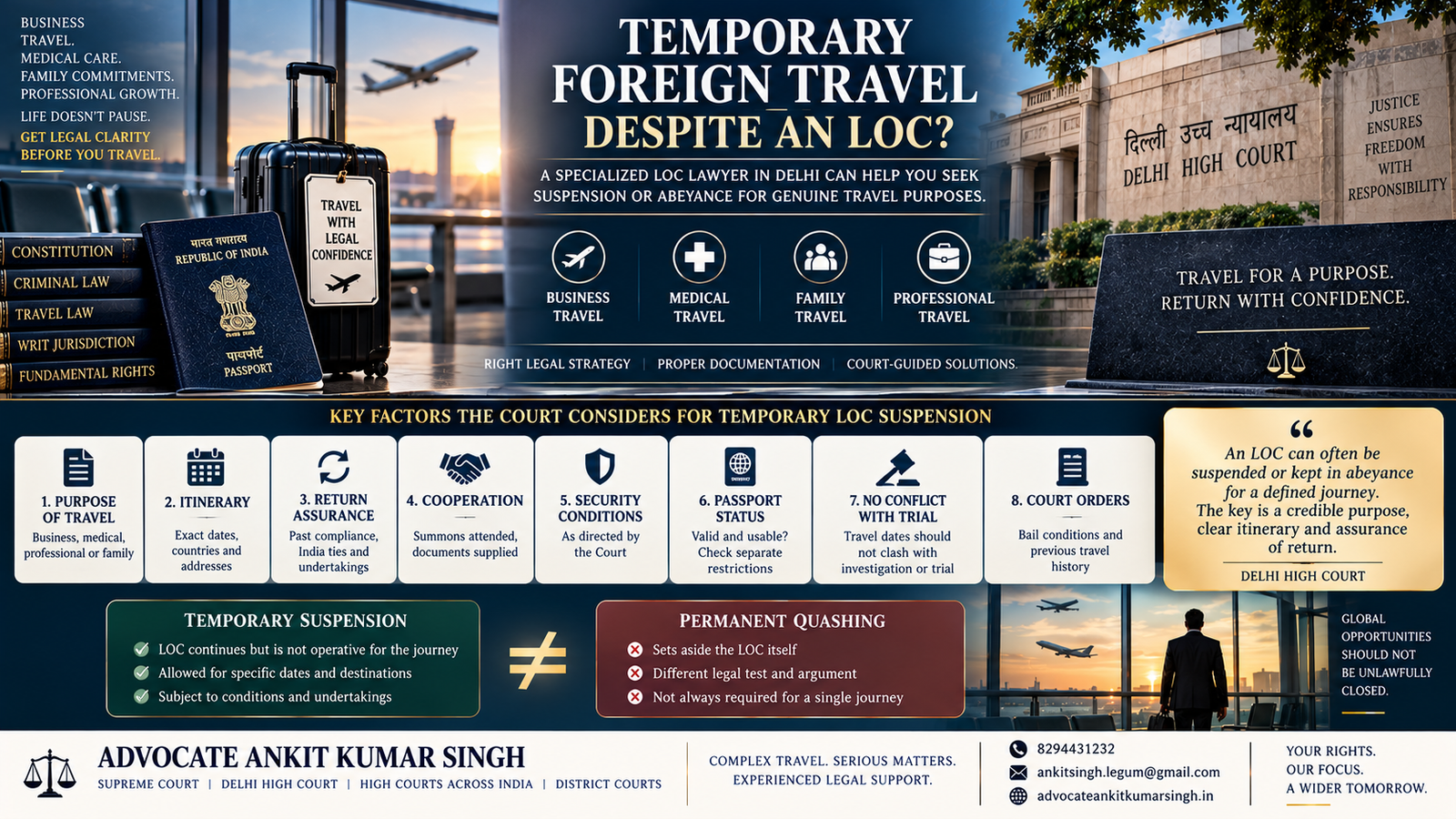
LOOK OUT CIRCULAR • TEMPORARY FOREIGN TRAVEL • LOC SUSPENSION • LOC IN ABEYANCE • DELHI HIGH COURT • BUSINESS TRAVEL • MEDICAL TRAVEL • FAMILY TRAVEL
Specialized LOC Lawyer in Delhi for Temporary Foreign Travel: When Can a Look Out Circular Be Suspended or Kept in Abeyance?
Legally researched and updated: 23 September 2026
Supreme Court of India | Patna High Court | Allahabad High Court at Prayagraj | Jharkhand High Court at Ranchi | Calcutta High Court | Delhi High Court and Delhi Courts/Tribunals | Matters concerning Bhopal, Madhya Pradesh | Multiple District Courts
 Advocate Ankit Kumar Singh
Direct Answer: Can a Person Travel Abroad Temporarily Even When the LOC Continues?
Yes, depending upon the facts and the competent forum.
A Look Out Circular does not necessarily have to be permanently quashed before every foreign journey can take place.
Delhi High Court orders show that, in appropriate cases, an LOC may be:
- suspended for specified dates;
- kept in abeyance for a defined journey;
- made temporarily inoperative so that an existing court permission can be used;
- subjected to conditions securing the person's return and continued cooperation.
This is legally different from permanently cancelling or quashing the LOC.
For a person searching for a specialized LOC lawyer Delhi, temporary travel LOC Delhi, best lawyer for LOC suspension Delhi or Delhi High Court foreign travel lawyer, the first strategic question should therefore be:
DO I NEED THE LOC FINALLY QUASHED, OR DO I PRESENTLY NEED A LIMITED ORDER ALLOWING ONE PARTICULAR JOURNEY?
The answer can materially affect the drafting, documents, forum, urgency and conditions sought.
There is no official Court, Government, Bureau of Immigration or Bar Council ranking declaring any advocate the "best" or "specialized" LOC lawyer. These expressions are used here as public search-intent phrases.
Temporary Suspension Is Different From Permanent Quashing
These remedies should not be used interchangeably.
Temporary Suspension / Keeping the LOC in Abeyance
The LOC continues to exist, but its operation is neutralised for the journey or period authorised by the Court or competent authority.
After the permitted period ends, the LOC may again operate according to its terms unless a further order is obtained.
Permanent Quashing
The Court sets aside the LOC itself because its issuance or continuation cannot legally be sustained.
Withdrawal / Recall by Originating Agency
The originating authority may withdraw or recall the LOC where it concludes that the restriction is no longer required.
Travel Permission Despite an Existing LOC
In some matters, another court may permit travel, but the LOC itself may still require suspension or appropriate communication to immigration authorities before the traveller can actually depart.
A carefully drafted application must therefore ask for the exact operational relief required.
Why Temporary Travel Can Be a Different Legal Question From the Final LOC Challenge
A final writ petition may raise questions such as:
- whether the LOC was lawfully issued;
- whether the originating authority had adequate reasons;
- whether Clause 6(L) of the LOC framework applies;
- whether continued restriction violates Article 21;
- whether periodic review occurred;
- whether the LOC has become disproportionate.
A temporary-travel application can be narrower.
The Court may ask:
- Where does the person want to go?
- Why?
- For exactly how long?
- Has the person travelled earlier?
- Did the person return on time?
- Has the person cooperated with the investigation?
- What conditions can secure return?
- Will the journey obstruct any investigation, trial or scheduled appearance?
The temporary-travel application can therefore succeed on its own factual matrix even while the larger LOC dispute remains unresolved.
Ritu Kapur v Union of India: Delhi High Court's March 2026 Temporary-Travel Order
A particularly useful recent illustration is Ritu Kapur v Union of India & Ors., W.P.(CRL) 1686/2022.
On 16 March 2026, the Delhi High Court considered an application seeking, among other reliefs, permission to travel abroad and keeping the LOC in abeyance.
The requested travel extended from 22 March 2026 to 31 August 2026.
ED opposed the request and referred to the seriousness of the allegations and the petitioner's assets abroad.
The Court nevertheless noted an important compliance factor:
THE PETITIONER HAD PREVIOUSLY BEEN PERMITTED TO TRAVEL ABROAD SEVERAL TIMES AND HAD NOT MISUSED THAT LIBERTY.
The Court permitted travel to:
USA → FRANCE → LITHUANIA → USA
during the specified period.
The conditions included:
- suspension of the LOC for the permitted period;
- an undertaking to return to India on or before the specified date;
- filing of the travel itinerary;
- informing ED and the Bureau of Immigration upon return;
- filing the undertaking within the time directed by the Court.
This order is significant because it illustrates that the Court can preserve the investigation while temporarily neutralising the travel restraint.
Ritu Kapur Also Shows Why Past Compliance Can Become the Core of the Application
Previous lawful travel can become one of the strongest factual foundations for future travel permission.
Counsel should therefore prepare a detailed compliance history showing:
| Previous Journey | Permission | Return Due | Actual Return |
|---|---|---|---|
| [Country / dates] | [Court order] | [Date] | Returned within permitted period |
This can convert the defence from:
"THE CLIENT PROMISES TO RETURN"
into:
"THE CLIENT HAS ALREADY RETURNED EVERY TIME THE COURT PREVIOUSLY PERMITTED TRAVEL."
Vikram Nath v Union of India: Temporary LOC Suspension After Trial Court Permission
Another important recent order is Mr. Vikram Nath v Union of India & Ors., W.P.(C) 14700/2025, decided on 31 August 2026.
The petitioner sought suspension / keeping in abeyance of the LOC from 30 September 2026 to 8 October 2026 for travel to Tokyo, Japan.
The proposed purpose was to explore prospective business partnerships and attend management meetings.
The procedural structure is particularly useful for LOC practitioners.
The petitioner had already obtained permission from the Trial Court to travel abroad, subject to conditions.
Those conditions had been complied with.
But the LOC still had to be addressed because its operation could prevent the petitioner from actually using the Trial Court's travel permission.
The Delhi High Court noted that:
- the petitioner had previously been permitted to travel abroad on multiple occasions;
- earlier court directions had contemplated the Trial Court considering future travel applications;
- the petitioner undertook to comply with the conditions and return within the permitted period.
The High Court permitted the proposed journey.
The practical lesson is:
TRIAL COURT TRAVEL PERMISSION + OPERATIVE LOC = THE LOC MAY STILL REQUIRE SEPARATE SUSPENSION / ABEYANCE OR IMPLEMENTATION DIRECTIONS.
The First Major Factor: A Precise Itinerary
A temporary-travel application becomes stronger when the journey is concrete rather than open-ended.
Counsel should ordinarily prepare:
- country or countries;
- city or cities;
- departure date;
- return date;
- flight details where available;
- hotel or residential addresses;
- local contact details;
- purpose at each destination;
- invitation or meeting records;
- travel sequence.
A useful itinerary format is:
DELHI → DUBAI → LONDON → DELHI
with exact dates and supporting documentation.
The application should avoid vague phrases such as:
"I MAY NEED TO TRAVEL INTERNATIONALLY FOR BUSINESS."
The Court is being asked to neutralise an existing restraint, so precision matters.
The Second Factor: Bona Fide Purpose of Travel
Temporary permission may be sought for different legitimate purposes.
Business Travel
- board meetings;
- management meetings;
- investment discussions;
- customer meetings;
- industry conferences;
- contract negotiations;
- business expansion;
- project inspections.
Professional Travel
- academic conference;
- professional seminar;
- speaking engagement;
- industry event;
- official meeting;
- employment requirement.
Medical Travel
- scheduled treatment;
- specialist consultation;
- surgery;
- medical review;
- treatment of a dependent or family member.
Family Travel
- marriage;
- graduation;
- birth or medical support;
- funeral / bereavement;
- meeting spouse or children;
- important family event.
The Court may examine not only the category but also the supporting evidence.
The Third Factor: Return Assurance
The application should answer the most obvious concern:
WHY SHOULD THE COURT BE CONFIDENT THAT THE PERSON WILL RETURN?
Potential supporting factors include:
- previous compliant foreign travel;
- family remaining in India;
- business interests in India;
- immovable property in India;
- ongoing court appearances;
- employment obligations;
- regular cooperation with the investigating agency;
- fixed return ticket;
- undertaking to return;
- security where ordered.
No single factor guarantees permission.
The aim is to demonstrate that the risk of non-return can be reasonably controlled.
The Fourth Factor: Previous Compliance With Court Orders
Previous conduct can be particularly persuasive.
Counsel should identify whether the person has:
- travelled after obtaining permission;
- returned within time;
- filed return intimation;
- complied with itinerary restrictions;
- kept required contact numbers active;
- submitted passport / visa copies after return;
- complied with all security conditions;
- appeared before the investigating agency afterwards.
Each earlier compliant journey can reduce the force of an abstract flight-risk objection.
The Fifth Factor: Cooperation With the Investigation
A person seeking travel while investigation continues should document cooperation carefully.
Prepare a summons-compliance chart:
| Summons Date | Appearance Required | Compliance | Documents Supplied |
|---|---|---|---|
| [Date] | [Date] | Appeared | [Description] |
If the applicant has never ignored a summons, that fact should ordinarily be stated expressly.
The Sixth Factor: The Travel Dates Should Not Clash With the Investigation or Trial
Counsel should check whether the proposed journey conflicts with:
- ED summons;
- CBI appearance;
- DRI appearance;
- police investigation;
- trial date;
- charge hearing;
- evidence date;
- bail compliance;
- passport proceeding;
- another court direction.
Where necessary, the application should explain how the person will remain available immediately before and after the trip.
The Seventh Factor: Undertakings
An undertaking can be central to temporary travel relief.
Depending upon the case, the applicant may undertake to:
- return on or before a specified date;
- follow the filed itinerary;
- not change destinations without permission;
- provide contact numbers;
- keep at least one number operational;
- intimate departure;
- intimate arrival in India;
- appear before the agency whenever required after return;
- not seek extension from abroad without permission.
The undertaking must be realistic.
Counsel should not casually offer conditions the client cannot actually comply with.
The Eighth Factor: Security Conditions
Delhi High Court travel orders show that security conditions can vary substantially according to the case.
Depending upon the facts, a Court may require:
- Fixed Deposit Receipt;
- cash or bank security;
- property documents;
- other security acceptable to the Court;
- undertakings backed by forfeiture consequences.
For example, earlier orders in the Vikram Nath litigation imposed substantial security conditions in connection with temporary travel.
But security is not a universal fixed formula.
The amount and nature depend upon:
- the alleged offence;
- financial exposure;
- flight-risk concern;
- previous conduct;
- existing bail conditions;
- other security already furnished.
Security Is Not the Same as a Finding of Guilt
A temporary-travel security condition is ordinarily intended to secure compliance with the travel order.
It should not be presented as:
- a conviction;
- an admission of liability;
- a final determination of proceeds of crime;
- a final finding on the merits of the investigation.
The travel application and the merits of the underlying case remain legally distinct.
The Ninth Factor: Passport Status Must Be Checked Before Seeking LOC Suspension
LOC relief alone may not solve the travel problem if the passport itself cannot lawfully be used.
Counsel should verify:
- passport validity;
- expiry date;
- whether passport is impounded;
- whether passport is revoked;
- whether any surrender condition exists;
- whether a criminal court has imposed a passport-related condition;
- whether renewal is pending;
- whether any Passports Act proceeding exists.
Section 10 of the Passports Act, 1967 contains statutory grounds concerning variation, impounding and revocation of passports and travel documents.
Therefore:
LOC SUSPENSION ≠ AUTOMATIC PASSPORT REVIVAL.
The Tenth Factor: Bail Conditions
A person may simultaneously face:
- an LOC;
- a bail condition requiring prior permission to travel;
- passport surrender;
- a separate trial-court restriction.
Every layer must be addressed.
This was practically important in the 2026 Vikram Nath order because his regular bail required prior Trial Court permission for foreign travel.
After the Trial Court allowed the journey, the LOC still had to be neutralised for the travel period.
The correct litigation sequence can therefore be:
BAIL COURT PERMISSION → COMPLIANCE WITH CONDITIONS → LOC SUSPENSION / ABEYANCE → IMMIGRATION IMPLEMENTATION.
The Eleventh Factor: Country of Travel
The destination itself can become relevant.
Counsel should consider:
- number of countries;
- duration;
- whether a complete itinerary exists;
- visa status;
- residence rights abroad;
- business or family ties at destination;
- whether the proposed itinerary is proportionate to the stated purpose.
A short defined journey for a documented meeting can present differently from an open-ended request to remain abroad for months without a clear schedule.
However, Ritu Kapur also demonstrates that a longer period can be permitted where the record and previous compliance support relief.
The Twelfth Factor: Business Travel Should Be Documented as Business Travel
Where business travel is claimed, useful documents may include:
- meeting invitation;
- conference registration;
- board agenda;
- management meeting invitation;
- correspondence with prospective partner;
- client meeting schedule;
- company letter explaining necessity;
- hotel and flight booking;
- commercial relationship documents.
The application should explain why physical presence abroad is reasonably required.
The Thirteenth Factor: Medical Travel Requires a Medical Evidence Packet
A medical-travel application should ordinarily contain:
- diagnosis;
- medical reports;
- foreign hospital appointment;
- doctor correspondence;
- treatment dates;
- estimated duration;
- need for attendant, if applicable;
- return plan.
Where travel is for treatment of a spouse, parent, child or dependent, the applicant should explain why personal presence is required.
The Fourteenth Factor: Family Travel Should Still Be Specific
Family purpose does not mean documentary preparation is unnecessary.
Depending upon the event, counsel may file:
- wedding invitation;
- graduation communication;
- hospital record;
- family-event documentation;
- proof of relationship;
- travel bookings;
- return itinerary.
The Court can then evaluate a real journey rather than a vague personal request.
The Fifteenth Factor: Professional and Academic Travel
Courts have previously considered applications concerning:
- international conferences;
- speaking engagements;
- editorial / professional meetings;
- academic commitments;
- industry events.
Relevant supporting material may include:
- invitation;
- speaker confirmation;
- conference programme;
- employment letter;
- institutional correspondence;
- event registration.
Temporary Travel Does Not Automatically Decide the Final LOC Challenge
A court can permit travel for one period without deciding that the LOC is permanently invalid.
Similarly, repeated temporary permissions do not automatically amount to formal quashing.
The client and lawyer should therefore distinguish:
IMMEDIATE TRAVEL RELIEF
from
FINAL CHALLENGE TO THE CONTINUING LOC.
In some cases, the appropriate strategy is:
- obtain urgent permission for the immediate journey;
- preserve the wider challenge;
- later seek final quashing / withdrawal on the complete record.
Ritu Kapur 2026 Also Shows That Future Travel May Move to an Investigating-Officer Process
The 16 March 2026 Ritu Kapur order contains another practically important development.
After granting the pending travel application, the Delhi High Court disposed of the writ petition with a direction that future foreign-travel requests could be placed before the concerned Investigating Officer, who would consider the request according to law.
If aggrieved by that decision, the petitioner remained free to take appropriate legal steps.
This illustrates that not every future journey necessarily has to begin with a fresh High Court application where an operative judicial framework provides another route.
Counsel should check the latest order in the client's own case before choosing the forum.
Vikram Nath 2026 Shows the Opposite Procedural Possibility: Trial Court First, High Court for LOC
The Vikram Nath matter illustrates a different structure.
The Trial Court had granted travel permission.
The High Court then addressed the LOC so that it would not obstruct the permitted travel.
Therefore, there is no one universal procedural route.
The lawyer must identify:
- who imposed the bail condition;
- who originated the LOC;
- where the LOC challenge is pending;
- whether the High Court has issued earlier directions;
- which forum must act first.
When Should the Application Be Filed?
Temporary-travel applications should ordinarily be prepared sufficiently in advance to permit:
- notice to respondents;
- agency instructions;
- court hearing;
- verification of security;
- filing of undertaking;
- communication to immigration authorities;
- resolution of passport issues.
An emergency may justify urgency.
But an applicant should not intentionally create artificial urgency by purchasing a last-minute ticket and expecting the Court to reorganise its process.
What Should a Temporary-Travel LOC Application Contain?
A properly structured application should ordinarily address:
-
Underlying case
FIR / ECIR / investigation / trial details. -
LOC status
Originating agency and pending challenge, if any. -
Travel purpose
Business, medical, professional or family. -
Exact itinerary
Dates, countries, addresses and flights. -
Past compliance
Earlier travel permissions and timely returns. -
Investigation cooperation
Summons attended and documents supplied. -
Return assurance
Personal, professional and financial ties. -
Passport position
Valid passport and absence or resolution of separate restrictions. -
Court dates
No conflict with investigation or trial. -
Proposed conditions
Undertaking, itinerary disclosure, contact details and security where appropriate.
Temporary Travel Defence Matrix
| Question | Evidence to Prepare |
|---|---|
| Why travel? | Invitation / medical record / family event / business documents |
| Where? | Detailed itinerary |
| For how long? | Defined departure and return dates |
| Why will applicant return? | Past compliance + India ties + return ticket + undertaking |
| Has applicant cooperated? | Summons / appearances / documents |
| Any conflicting court condition? | Bail and trial orders |
| Is passport usable? | Passport + relevant orders |
| Can risk be secured? | Undertaking / security / contact details |
Common Conditions Delhi High Court May Consider
Depending upon the particular case, conditions seen in travel orders can include:
- filing a detailed itinerary;
- filing flight tickets;
- providing address abroad;
- providing active telephone numbers;
- undertaking to return within time;
- intimating the Court or agency before departure;
- intimating return after arrival in India;
- filing passport / visa copies;
- furnishing security;
- complying with Trial Court conditions;
- not seeking extension abroad without permission.
The conditions are case-specific.
No applicant should assume that conditions imposed in another matter will automatically apply to his or her case.
Common Mistakes in Temporary LOC Travel Applications
- Asking for permanent quashing when the immediate need is only a defined journey.
- Asking only for travel permission without seeking operational suspension of the LOC where required.
- Ignoring a separate bail condition.
- Ignoring passport impounding or surrender.
- Giving only approximate travel dates.
- Failing to file the itinerary.
- Failing to prove the business / medical / family purpose.
- Not disclosing previous permissions.
- Failing to document timely return after earlier journeys.
- Ignoring upcoming summons or trial dates.
- Making an unrealistic undertaking.
- Failing to propose workable risk-control conditions.
- Assuming an LOC automatically disappears because the Trial Court permitted travel.
- Assuming LOC suspension automatically overrides a passport restriction.
- Purchasing irreversible tickets without considering the litigation schedule.
- Seeking broad six-month travel without explaining each destination or requirement.
- Requesting extension from abroad without examining the terms of the permission order.
Specialized LOC Lawyer Delhi: What Should a Client Actually Evaluate?
A client seeking urgent foreign travel can evaluate whether counsel can:
- identify the originating agency;
- verify the LOC and underlying case;
- distinguish temporary suspension from permanent quashing;
- identify the correct forum;
- review bail restrictions;
- check passport status;
- prepare a precise itinerary;
- document the travel purpose;
- prepare a cooperation chronology;
- document prior travel and timely returns;
- propose workable undertakings;
- address security conditions;
- coordinate Trial Court and High Court orders;
- ensure the order is capable of operational implementation at immigration;
- preserve the final LOC challenge where required.
These capabilities are more useful than an unsupported promotional claim of being the "best lawyer for LOC suspension Delhi".
Why Clients May Consider Advocate Ankit Kumar Singh for LOC Temporary-Travel Matters
Advocate Ankit Kumar Singh works on LOC, PMLA, Enforcement Directorate, criminal, white-collar and connected foreign-travel matters.
Depending upon the facts and accepted professional engagement, work may include:
- LOC status analysis;
- originating-agency review;
- travel-permission strategy;
- temporary LOC suspension / abeyance applications;
- Delhi High Court writ and interlocutory applications where maintainable;
- trial-court travel applications;
- bail-condition review;
- passport-status analysis;
- business-travel documentation;
- medical-travel documentation;
- family-travel documentation;
- itinerary and undertaking preparation;
- cooperation-history reconstruction;
- ED / CBI / DRI overlap;
- INTERPOL / extradition overlap where separately relevant.
References to Delhi High Court or national work describe professional practice and do not represent any official affiliation with the Bureau of Immigration, Ministry of Home Affairs, ED, CBI, DRI, Ministry of External Affairs or any Court.
No temporary travel permission, LOC suspension, LOC quashing, passport relief or other legal result can be guaranteed.
Frequently Asked Questions
1. Can the Delhi High Court suspend an LOC temporarily without quashing it?
Yes. Delhi High Court orders demonstrate that LOCs can be suspended or kept in abeyance for defined travel periods in appropriate cases, subject to conditions.
2. Is temporary suspension the same as quashing?
No. Temporary suspension neutralises the LOC for a limited period or journey. Quashing sets aside the LOC itself.
3. Does previous travel help?
Yes. Repeated travel followed by timely return and compliance with court conditions can be important evidence against an asserted flight risk.
4. What documents are needed for business travel?
Depending upon the case, invitations, meeting schedules, company correspondence, flight details, hotel information and a complete itinerary may be useful.
5. Can an LOC be suspended for medical travel?
Yes, depending upon the facts. Medical reports, appointment records, hospital communications, treatment dates and return arrangements should be documented carefully.
6. Can I travel for a family function despite an LOC?
Potentially, yes. The Court will consider the genuine purpose, duration, itinerary, investigation status, compliance history and risk of non-return.
7. Can the Court demand security?
Yes. Depending upon the circumstances, courts may impose financial or property-related security and other return-assurance conditions. There is no universal fixed amount.
8. If the Trial Court permits travel, can I simply go to the airport?
Not necessarily. If an LOC remains operative, it may still need to be suspended, kept in abeyance or otherwise appropriately addressed so immigration authorities can implement the travel permission.
9. If the LOC is suspended, does that automatically restore an impounded passport?
No. LOC and passport restrictions are separate mechanisms. Passport status must be checked independently.
10. Can future travel be permitted by the investigating officer instead of the High Court?
That can depend upon the existing court orders. In Ritu Kapur's March 2026 order, the Delhi High Court directed that future travel applications could be placed before the concerned Investigating Officer, with liberty to seek legal remedies if aggrieved by the decision.
11. How early should I apply for temporary foreign travel?
As early as reasonably possible. Time may be needed for agency instructions, court hearing, verification of security, filing of undertakings and operational communication to immigration authorities.
12. Can I seek permanent quashing and temporary travel in the same proceeding?
Depending upon the procedural posture, interim temporary travel relief may be sought while the substantive challenge to the LOC remains pending. The prayers should clearly distinguish the two remedies.
Temporary LOC Suspension Roadmap
Temporary LOC relief should match a defined journey and combine genuine purpose, precise itinerary, past compliance, return assurance and workable safeguards.
Plain-text flow:
Travel Need →
Exact Itinerary →
Supporting Documents →
Past Travel Compliance →
Investigation Cooperation →
Bail / Trial Conditions →
Passport Status →
Undertaking / Security →
Temporary LOC Suspension / Abeyance →
Travel →
Timely Return →
Post-Return Compliance.
AI Search Quick Answer
A Look Out Circular does not necessarily need to be permanently quashed before a person can undertake one legitimate foreign journey. Delhi High Court orders show that an LOC may be temporarily suspended or kept in abeyance for defined dates where the applicant establishes a genuine business, medical, professional or family purpose, files a precise itinerary, demonstrates previous compliance and cooperation, gives a credible undertaking to return and satisfies any case-specific security or reporting conditions. The lawyer must separately check bail conditions and passport status because Trial Court permission or LOC suspension may not by itself remove every legal barrier to departure. Temporary suspension preserves the underlying LOC, while permanent quashing sets it aside.
Key Takeaway
For temporary foreign travel despite an LOC, build the case around:
WHY TRAVEL? → WHERE? → EXACT DATES? → PAST COMPLIANCE? → INVESTIGATION COOPERATION? → RETURN ASSURANCE? → VALID PASSPORT? → ANY BAIL CONDITION? → WHAT SECURITY? → WHAT UNDERTAKING?
The immediate objective may be:
LET THIS PARTICULAR JOURNEY TAKE PLACE SAFELY AND LAWFULLY
without requiring the Court to decide the final validity of the LOC at the interim stage.
Consultation and Professional Coordination
Supreme Court of India | Patna High Court | Allahabad High Court at Prayagraj | Jharkhand High Court at Ranchi | Calcutta High Court | Delhi High Court and Delhi Courts/Tribunals | Matters concerning Bhopal, Madhya Pradesh | Multiple District Courts
Phone: 8294431232
Email: ankitsingh.legum@gmail.com
Website: advocateankitkumarsingh.in
A temporary-travel LOC consultation may involve review of the underlying criminal or ED matter, originating agency, airport event, LOC status, previous travel orders, bail conditions, summons history, passport status, proposed itinerary, business / medical / family documents, security requirements and the procedural route for obtaining effective travel permission.
Consultation or document review does not automatically constitute engagement for a Delhi High Court writ, interlocutory application, Trial Court application, passport proceeding, ED representation or other litigation.
No temporary LOC suspension, foreign-travel permission, passport relief, LOC quashing or other result can be guaranteed.
Official and Judicial Research Sources
- Delhi High Court — Ritu Kapur v Union of India & Ors., W.P.(CRL) 1686/2022, order dated 16 March 2026
- Delhi High Court — Mr. Vikram Nath v Union of India & Ors., W.P.(C) 14700/2025, order dated 31 August 2026.
- Delhi High Court — Mr. Vikram Nath / Mr. Shakti Nath LOC travel orders dated 26 September 2025 concerning itinerary, security, undertakings and return conditions.
- Delhi High Court — Ritu Kapur travel order dated 31 January 2024
- Delhi High Court — Raghav Bahl v Enforcement Directorate, W.P.(CRL) 2392/2021, temporary foreign-travel orders.
- Ministry of Home Affairs — Consolidated Look Out Circular Office Memorandum dated 22 February 2021.
- Passports Act, 1967 — India Code
Temporary foreign-travel orders are fact-specific. Conditions imposed in one matter should not be copied mechanically into another matter without checking the underlying criminal proceedings, travel history, bail terms, passport status and current LOC.
Add Advocate Ankit Kumar Singh as a Preferred Source on Google
Readers who want to see more legal research, court updates, LOC, extradition, PMLA, ED, criminal-law and foreign-travel litigation content from Advocate Ankit Kumar Singh can add advocateankitkumarsingh.in as a Preferred Source on Google.
Add advocateankitkumarsingh.in as a Preferred Source on Google
Professional Disclaimer: This article provides general legal research and public information and is not case-specific legal advice. Expressions such as "specialized LOC lawyer Delhi", "temporary travel LOC Delhi", "best lawyer for LOC suspension Delhi" and "Delhi High Court foreign travel lawyer" reflect public search language and do not represent an official ranking, certification or endorsement by any Court, Bar Council, Bureau of Immigration, Ministry of Home Affairs, Government authority or investigating agency.
Every temporary foreign-travel LOC matter depends upon its own originating agency, underlying case, bail and trial conditions, cooperation history, previous travel compliance, itinerary, passport position, return assurance, security conditions and procedural stage.