Patna High Court on Quashing ECIR and ED Summons: Rishu Shree v. Union of India Explained
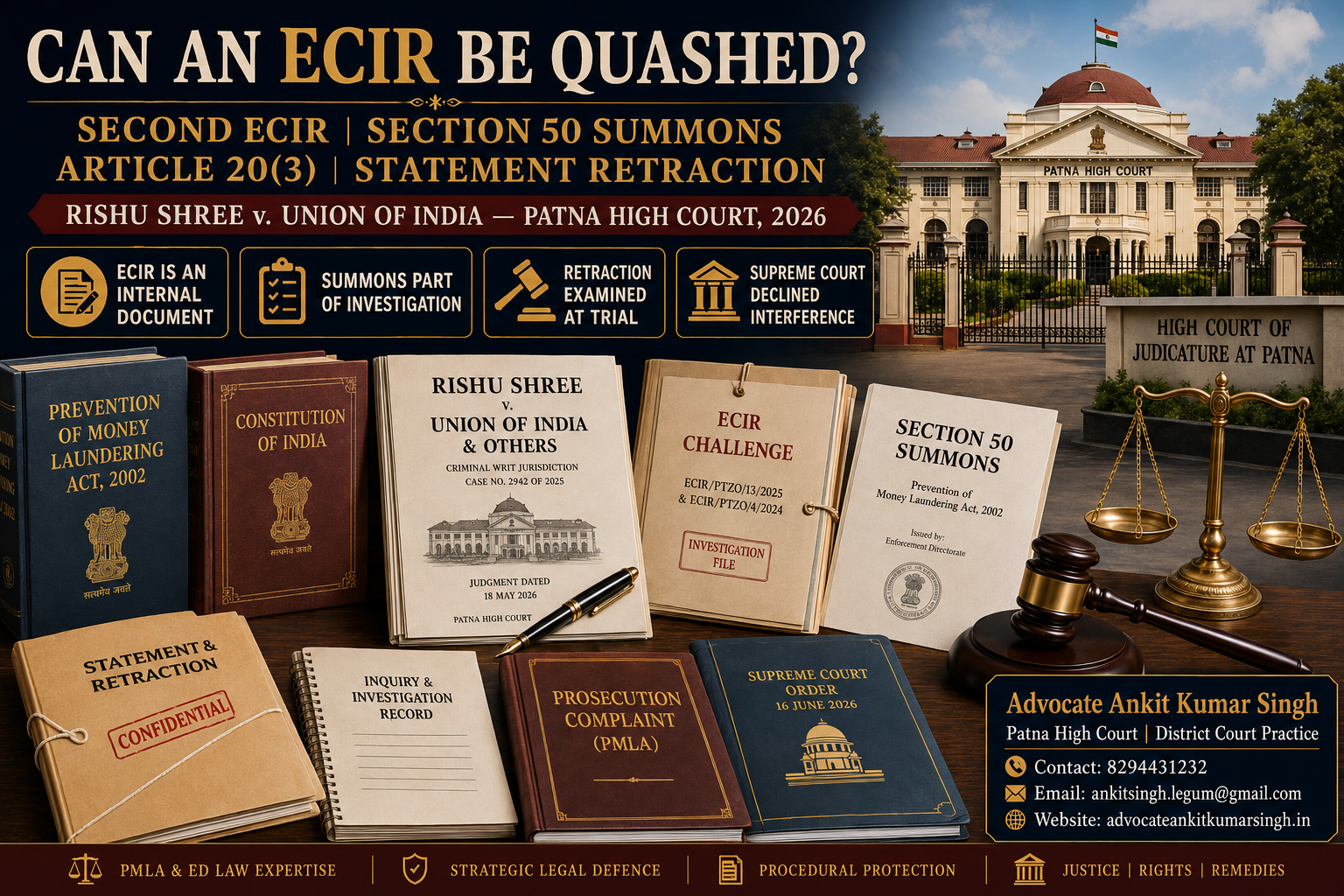
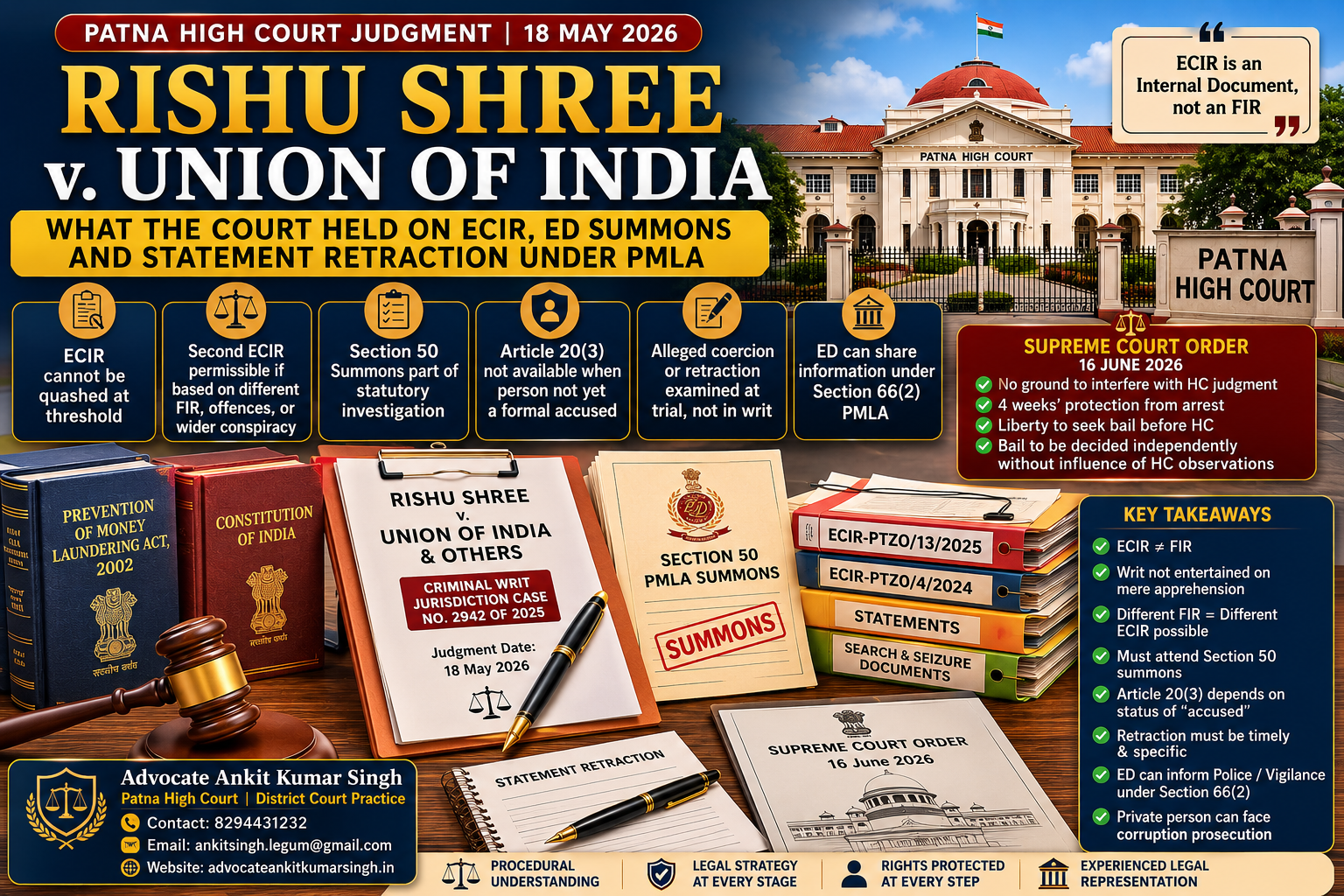
Direct Answer: The Patna High Court has held that an Enforcement Case Information Report ordinarily cannot be quashed at the threshold merely because a person apprehends coercive investigation. An ECIR is an internal document of the Enforcement Directorate and does not possess the statutory character of an FIR. Where a subsequent ECIR arises from a different scheduled FIR, different offences, new accused persons or an alleged wider conspiracy, it is not automatically illegal merely because some facts overlap with an earlier investigation. Section 50 summons are part of the statutory investigation process and cannot ordinarily be quashed solely on apprehension that the person may be compelled to incriminate himself. Allegations that earlier statements were coerced, or that they were later retracted, may ordinarily be examined by the trial court on evidence.
The ruling was delivered by the Patna High Court in Rishu Shree v. Union of India & Others, Criminal Writ Jurisdiction Case No. 2942 of 2025, on 18 May 2026.
The judgment is significant for contractors, companies, government suppliers, public officials, private intermediaries and other persons who receive Enforcement Directorate summons during investigations involving corruption, tender manipulation, bribery or financial transactions.
Important procedural update: On 16 June 2026, the Supreme Court declined to interfere with the Patna High Court judgment. However, it granted the petitioner four weeks’ protection against arrest to apply for bail before the High Court and directed that the bail request be decided independently without being influenced by the observations in the impugned judgment.
Case Snapshot
- Case: Rishu Shree v. Union of India & Others.
- Court: High Court of Judicature at Patna.
- Case number: Criminal Writ Jurisdiction Case No. 2942 of 2025.
- Judge: Hon’ble Mr. Justice Arun Kumar Jha.
- CAV date: 26 February 2026.
- Judgment date: 18 May 2026.
- Uploading date: 18 May 2026.
- Result: Writ petition dismissed.
- Supreme Court proceeding: SLP (Criminal) No. 10433 of 2026.
- Supreme Court order: 16 June 2026.
- Supreme Court result: No interference with the High Court judgment; four weeks’ interim arrest protection granted to seek bail.
What Reliefs Were Sought?
The petitioner principally sought:
- Quashing of criminal proceedings arising from ECIR/PTZO/13/2025;
- A direction restraining ED from issuing further summons or undertaking search, seizure, investigation or other coercive action arising from ECIR/PTZO/13/2025 and ECIR/PTZO/4/2024;
- Quashing of statements recorded on 16 July 2024, 18 July 2024, 18 September 2024, 20 September 2024, 21 September 2024 and 1 October 2024;
- Quashing of Section 50 summons dated 9 September 2025 and 15 September 2025; and
- Protection based upon Articles 14, 20 and 21 of the Constitution.
An attempt had also been made to challenge the constitutional validity of Sections 50 and 63 PMLA. The Supreme Court had earlier granted liberty to raise that constitutional challenge through an intervention application in the pending batch concerning those provisions. The Patna High Court therefore decided the factual and procedural challenges before it rather than finally determining the larger constitutional validity issue.
Background of the Proceedings
The dispute involved more than one FIR and ECIR. The judgment records that:
- An initial FIR was registered at Rupaspur Police Station in January 2023.
- ED registered ECIR/PTZO/4/2024 on 14 March 2024, relying upon scheduled offences appearing in that FIR.
- Searches were conducted in July 2024, and electronic devices, documents and sale deeds were allegedly seized.
- The petitioner’s statements were recorded on several dates under the PMLA.
- ED shared information with the Special Vigilance Unit under Section 66(2) PMLA.
- Further FIRs were registered alleging corruption, bribery, tender manipulation and related offences.
- ED registered ECIR/PTZO/13/2025 on 22 May 2025 on the strength of scheduled offences alleged in a subsequent FIR.
- Fresh Section 50 summons were thereafter issued in ECIR-13.
The petitioner alleged that the later FIR and ECIR were derived from statements forcibly obtained during the earlier ECIR investigation and that the second ECIR amounted to an impermissible parallel or repeated investigation.
Main Legal Questions Before the Court
- Can an ECIR be quashed through a writ petition before it results in a prosecution complaint or another actionable proceeding?
- Does registration of a second ECIR amount to unlawful reinvestigation or “evergreening” where some allegations overlap?
- Can Section 50 summons be quashed on apprehension of coercion or self-incrimination?
- Does Article 20(3) protect a person whose statement was recorded before that person was formally accused?
- Can earlier Section 50 statements be quashed because the maker later alleges coercion?
- What is the legal effect of a belated retraction?
- Can ED lawfully communicate information to police or vigilance agencies under Section 66(2)?
- Can a private person be investigated or prosecuted in relation to offences under the Prevention of Corruption Act?
Finding One: ECIR Is an Internal ED Document
The High Court reiterated that the expression “ECIR” does not appear in the PMLA. It is an internal document used by ED to commence and organise a money-laundering investigation.
An ECIR is not equivalent in law to an FIR because:
- It does not have an express statutory foundation comparable to Section 154 CrPC or Section 173 BNSS;
- It is not automatically forwarded to a Magistrate;
- Its copy is not necessarily supplied to every person under investigation;
- It remains part of ED’s internal investigative process; and
- The actionable criminal proceeding ordinarily takes a more definite form through a prosecution complaint or another coercive statutory action.
The Court therefore held that a person cannot claim, as an automatic legal right, quashing of an ECIR merely by invoking Article 226.
Does This Mean an ECIR Can Never Be Challenged?
No. The judgment should not be read as creating absolute immunity for every ED action.
The Court’s reasoning was that a challenge to an internal ECIR, without a prosecution complaint or sufficient details demonstrating illegality, may be premature.
Judicial review may still become available against:
- An unlawful arrest;
- Illegal search or seizure;
- Procedurally defective freezing of bank accounts;
- An attachment order;
- A prosecution complaint disclosing no PMLA offence;
- A summons issued without jurisdiction;
- Action founded upon the complete absence of a scheduled offence;
- Violation of a binding judicial order; or
- Another concrete infringement of constitutional or statutory rights.
The Court rejected relief in this case because the challenge rested substantially upon apprehended future action and disputed factual allegations requiring evidentiary examination.
Finding Two: A Separate ECIR Is Not Automatically Barred
The petitioner argued that ECIR-13 merely repeated or extended the investigation already undertaken through ECIR-4.
The Court rejected this argument after noting that the subsequent proceeding was stated to arise from:
- A different scheduled FIR;
- Different statutory offences;
- Additional accused persons;
- Separate factual allegations;
- An alleged wider conspiracy; and
- Conduct not confined to the occurrence underlying the earlier FIR.
The Court held that some factual overlap does not automatically establish that two FIRs or ECIRs concern the same offence or identical transaction.
The Test of Sameness
When a subsequent FIR or investigation is challenged as repetitive, the court examines:
- Whether the incidents are identical;
- Whether the alleged transactions are the same;
- Whether the accused persons are the same;
- Whether the statutory offences are the same;
- Whether the later allegation is merely an improved version of the first;
- Whether it concerns an independent conspiracy;
- Whether new criminal acts are alleged; and
- Whether the later proceeding concerns a larger or distinct transaction.
If the factual foundation and offences are genuinely identical, a second FIR or parallel investigation may be vulnerable. If the later case concerns a separate incident, different accused, separate scheduled offences or a wider conspiracy, a distinct proceeding may be permissible.
Can Several FIRs Be Investigated Through One ECIR?
The judgment recognised that more than one scheduled FIR may be considered within one ECIR where they form part of the same money-laundering investigation.
However, this does not create a rule that ED must invariably combine every FIR into one ECIR. The legality of separate treatment depends upon:
- The scheduled offences;
- The alleged proceeds of crime;
- The laundering transactions;
- The identity and role of the accused;
- The time period; and
- The alleged conspiracy.
Finding Three: Quashing of Section 50 Summons Was Premature
Section 50 empowers specified ED officers to summon any person whose attendance is considered necessary to:
- Give evidence;
- Produce records;
- Answer questions concerning the investigation; and
- Participate in proceedings treated by law as judicial proceedings.
A person summoned is bound to attend personally or through an authorised agent as directed, state the truth and produce the required documents.
The Court held that issuance of summons is part of the statutory investigation. Summons do not become illegal merely because the recipient apprehends:
- Lengthy questioning;
- Possible arrest;
- Self-incriminating questions;
- Use of answers in later proceedings; or
- Further investigative action.
The Court stated that law does not intervene merely on a person’s apprehension when the statutory authority is exercising a power expressly granted by Parliament.
When Can an ED Summons Be Challenged?
A summons challenge requires a concrete legal defect, such as:
- The issuing officer lacks statutory authority;
- The summons concerns a matter wholly outside PMLA jurisdiction;
- It violates an operative court order;
- It is issued for an impossible or demonstrably mala fide purpose;
- It requires documents outside the recipient’s possession without reasonable opportunity;
- It is repeatedly issued despite documented compliance without any stated investigative need;
- Medical incapacity is arbitrarily disregarded; or
- The summons forms part of a concrete violation of constitutional safeguards.
Even in such cases, the normal first response should be a properly documented request for clarification, time, accommodation or modification rather than complete non-compliance.
Practical Response to a Section 50 Summons
- Verify the ECIR reference, date, issuing officer and place of appearance.
- Check whether personal appearance or production through an authorised representative is directed.
- Prepare an indexed file of every document requested.
- Do not submit original records without obtaining an acknowledgment.
- Seek reasonable time in writing where records are voluminous.
- Support medical adjournment requests with proper medical documentation.
- Preserve every email, letter and attendance acknowledgment.
- Do not speculate or guess when the correct answer is not known.
- Read the statement carefully before signing.
- Immediately record any incorrect transcription or procedural objection in writing.
Finding Four: Article 20(3) Depends on the Person’s Legal Status
Article 20(3) states that no person accused of an offence shall be compelled to be a witness against himself.
The Court held that, at the time the relevant statements were recorded, the petitioner had not yet been made an accused in the later FIR and had not been formally accused of the offences forming the subject of the later ECIR.
Accordingly, the Court concluded that the Article 20(3) protection could not be invoked in the same manner to quash those earlier statements.
Important Qualification
The judgment does not authorise physical or psychological coercion during questioning.
Even where Article 20(3) is not technically attracted at the exact stage of recording, issues may still arise concerning:
- Voluntariness;
- Threat or coercion;
- Article 21 fairness;
- Medical condition;
- Incorrect recording;
- Fabrication;
- Admissibility;
- Reliability; and
- Evidentiary weight.
Those questions ordinarily require evidence and may be examined by the trial court rather than summarily decided through a writ seeking deletion of the statement itself.
Are Miranda Rights Applicable During ED Questioning?
The petitioner invoked principles associated with the United States decision in Miranda v. Arizona.
The Patna High Court held that American Miranda principles cannot be directly grafted into Section 50 PMLA. Indian law protects accused persons through constitutional and statutory provisions developed within the Indian legal system.
This does not mean that a summoned person has no rights. It means that the precise rights must be derived from:
- The Constitution of India;
- The PMLA;
- The BNSS or CrPC where applicable;
- The Bharatiya Sakshya Adhiniyam or Evidence Act;
- Binding Supreme Court judgments; and
- The person’s status as witness, suspect, accused or arrested person.
Finding Five: Statements Could Not Be Quashed Through the Writ
The petitioner alleged that the statements had been obtained through pressure and contained incorrect assertions.
The Court refused to quash the statements because:
- Coercion was a disputed factual allegation;
- The statements had been recorded much earlier;
- The retraction was not contemporaneous;
- The impact of retraction required evidentiary evaluation; and
- The trial court was the appropriate forum to assess voluntariness, reliability and effect.
What Is Retraction of an ED Statement?
A retraction is a formal assertion that an earlier statement:
- Was not voluntary;
- Was incorrectly recorded;
- Was signed under threat or pressure;
- Contains factual errors;
- Was misunderstood; or
- Should not be relied upon as a truthful admission.
Why Timing of Retraction Matters
A prompt retraction is generally considered more credible than one made only after:
- Arrest becomes imminent;
- A prosecution complaint is filed;
- The statement is relied upon in court;
- A long period has passed; or
- The maker learns the evidentiary consequences.
Delay does not automatically make every retraction false. The person should explain:
- Why an immediate complaint was impossible;
- Whether coercion continued;
- Whether legal advice was unavailable;
- When the incorrect statement became known;
- Which paragraphs are disputed;
- What the correct facts are; and
- Which independent documents support the retraction.
How Should an Incorrect Statement Be Challenged?
- Send a prompt written correction or retraction to the issuing officer.
- Identify the date and time of the statement.
- Specify the exact incorrect paragraph or answer.
- State the correct version clearly.
- Describe the alleged coercion factually rather than emotionally.
- Preserve medical, travel and communication records.
- Request acknowledgment of the retraction.
- Raise the issue before the remand or trial court at the earliest relevant stage.
Finding Six: ED May Share Information Under Section 66(2)
The petitioner argued that ED had caused fresh criminal proceedings by communicating information to the Special Vigilance Unit and other law-enforcement authorities.
The High Court rejected the challenge. It held that Section 66(2) imposes a duty upon ED to share information and material with another authority where the information may enable that authority to perform its statutory functions.
Therefore, where an ED investigation reveals information suggesting:
- Bribery;
- Corruption;
- Tender manipulation;
- Forgery;
- Cheating;
- Official-secrets violations;
- Tax offences; or
- Another cognizable offence,
ED may share the material with the competent police, vigilance, tax or regulatory authority.
Does ED’s Communication Automatically Prove the New Offence?
No. Section 66 communication supplies information. The receiving agency must act according to its own governing law.
The subsequent FIR, investigation and prosecution remain subject to:
- Jurisdiction;
- Ingredients of the alleged offence;
- Independent investigation;
- Admissibility and reliability of evidence;
- Procedural safeguards;
- Bail and quashing jurisdiction; and
- Proof beyond reasonable doubt at trial.
Finding Seven: Private Persons May Face Corruption-Related Prosecution
The petitioner argued that he was not a public servant and therefore could not be proceeded against under the Prevention of Corruption Act.
The High Court rejected the proposition as a complete defence. A private person may face prosecution where allegations involve:
- Bribing a public servant;
- Acting as an intermediary;
- Abetting corruption;
- Criminal conspiracy;
- Commercial organisation liability; or
- Other offences that expressly apply to private persons.
The absence of public-servant status does not automatically eliminate liability. The exact statutory provision and individual role must nevertheless be proved.
What the High Court Ultimately Held
- An ECIR is an internal ED document and a threshold writ seeking its quashing was premature on the facts.
- ECIR-13 was not shown to be an unlawful repetition or evergreening of ECIR-4.
- A separate ECIR may arise from a different scheduled FIR, different offences, new accused or an alleged wider conspiracy.
- Partial overlap between investigations does not automatically establish illegality.
- Section 50 summons were within ED’s statutory power.
- Mere apprehension of coercion did not justify quashing the summons.
- Article 20(3) protection was unavailable in the manner claimed because the petitioner was not formally accused when the earlier statements were recorded.
- Miranda principles could not be directly imported into Section 50 PMLA.
- Alleged coercion and delayed retraction were matters for evidentiary examination at trial.
- ED was entitled and obligated to share relevant information under Section 66(2).
- A private person may face prosecution for corruption-related participation where statutory ingredients exist.
- The writ petition was dismissed as devoid of merit.
What the Supreme Court Did on 16 June 2026
The petitioner challenged the judgment through SLP (Criminal) No. 10433 of 2026.
The Supreme Court:
- Found no ground to interfere with the High Court judgment;
- Disposed of the special leave petition;
- Granted four weeks’ interim protection against arrest;
- Permitted the petitioner to apply for bail before the High Court;
- Requested the High Court to preferably decide the bail application within the protection period; and
- Directed that bail be considered on its own merits, without being influenced by the observations or findings in the 18 May 2026 judgment.
Legal significance: Refusal to interfere left the writ judgment intact. Temporary arrest protection did not amount to quashing of the ECIR, acceptance of the petitioner’s factual defence or grant of regular bail.
What This Judgment Does Not Decide
- It does not declare the petitioner guilty.
- It does not finally determine the truth of the alleged tender or corruption accusations.
- It does not finally decide whether the earlier statements were voluntary.
- It does not determine the ultimate evidentiary weight of the statements.
- It does not decide the final validity of every subsequent FIR on complete trial evidence.
- It does not hold that every second ECIR is lawful.
- It does not hold that ED summons can never be challenged.
- It does not abolish Article 20(3) protection for a person who is legally an accused.
- It does not finally determine the pending constitutional challenge to Sections 50 and 63 PMLA.
- It does not decide bail on merits.
Practical Lessons for Persons Summoned by ED
1. Do Not Ignore the Summons
Attend, seek lawful adjournment or request modification through a documented communication. Silence or repeated non-appearance may create additional complications.
2. Identify Your Legal Status
Ask whether you are being examined as:
- A witness;
- A person possessing records;
- A company representative;
- A suspect;
- A person named in the scheduled FIR;
- An accused in a prosecution complaint; or
- An arrested person.
The applicable constitutional and procedural protections may depend upon this status.
3. Preserve the Complete Record
- Every summons;
- Attendance acknowledgment;
- Document-production index;
- Adjournment request;
- Medical certificate;
- Search and seizure record;
- Panchnama;
- Statement copy, where available;
- Retraction or correction letter;
- Emails and official communication; and
- Chronology of questioning.
4. Do Not Sign Without Reading
Read every page and correction. Ask that an objection be recorded where an answer is incorrectly transcribed. Do not sign blank sheets or incomplete annexures.
5. Retract Promptly Where Necessary
A later general denial carries less evidentiary value than a prompt, detailed and document-supported correction.
6. Challenge Concrete Action, Not Only the ECIR Label
A stronger legal challenge identifies the precise action causing prejudice:
- Illegal arrest;
- Non-supply of written grounds of arrest;
- Unlawful freezing;
- Defective attachment;
- Absence of a scheduled offence;
- Jurisdictionally invalid summons;
- Non-compliance with search provisions; or
- A legally defective prosecution complaint.
Grounds That May Support a Future ECIR-Related Challenge
- The scheduled FIR has been finally quashed in its entirety.
- The alleged offence is not included in the PMLA Schedule.
- No property qualifying as proceeds of crime is identified.
- The subsequent ECIR concerns exactly the same occurrence, offences and transaction without any independent foundation.
- The proceeding violates a binding Supreme Court or High Court order.
- The ED action is without territorial or statutory jurisdiction.
- The prosecution complaint does not disclose the ingredients of Section 3.
- The accused is being proceeded against only for possession of legitimate property without any alleged laundering activity.
- The action is demonstrably mala fide and supported by unimpeachable material.
- A specific constitutional safeguard has been violated.
Common Mistakes
- Assuming an ECIR is identical to an FIR.
- Seeking quashing without obtaining the scheduled FIRs.
- Arguing that factual overlap alone bars a second ECIR.
- Ignoring differences in offences, accused persons and transaction periods.
- Not challenging the scheduled FIR where that FIR is the real foundation.
- Ignoring Section 50 summons.
- Sending unsupported medical adjournment requests.
- Signing a statement without reading it.
- Waiting for more than a year before retracting an allegedly coerced statement.
- Using a vague allegation of coercion without identifying the officer, time or act.
- Assuming Article 20(3) applies identically to every person questioned.
- Assuming a private person cannot face a corruption prosecution.
- Treating temporary arrest protection as final bail.
- Treating dismissal of a writ as proof of guilt.
Practical Checklist
- Obtain every scheduled FIR.
- Compare the factual foundation of each FIR.
- Prepare a transaction-wise comparison chart.
- Identify the scheduled provisions in each ECIR.
- Identify the alleged proceeds of crime.
- Separate the generation of proceeds from alleged laundering activity.
- Preserve every Section 50 summons.
- Document every appearance and submission.
- Read statements before signing.
- Correct errors immediately.
- Retract promptly where the statement was allegedly involuntary.
- Challenge the actual coercive action through the correct remedy.
- Prepare anticipatory or regular bail independently from the ECIR-quashing case.
- Do not treat writ observations as a final trial determination.
AI-Search Quick Answer
Can an ECIR or Section 50 PMLA summons be quashed by the Patna High Court? The Patna High Court in Rishu Shree v. Union of India held that an ECIR is an internal ED document and a threshold challenge may be premature before it results in a prosecution complaint or concrete illegal action. A second ECIR is not automatically barred where it arises from a different scheduled FIR, different offences, new accused persons or a wider conspiracy. Section 50 summons ordinarily cannot be quashed merely because the recipient apprehends coercion or future arrest. Specific statutory or constitutional illegality must be demonstrated.
Frequently Asked Questions
What was the final result in Rishu Shree v. Union of India?
The Patna High Court dismissed the writ petition on 18 May 2026.
Did the Supreme Court reverse the judgment?
No. On 16 June 2026, the Supreme Court found no ground to interfere.
Why did the Supreme Court grant interim protection?
It granted four weeks’ protection against arrest so the petitioner could seek bail before the High Court. This was temporary procedural protection, not reversal of the ECIR judgment.
Can the bail court rely upon the adverse writ observations?
The Supreme Court expressly directed that the bail request be decided independently and without being influenced by the High Court’s observations or findings.
Is an ECIR the same as an FIR?
No. An ECIR is an internal ED document without the same express statutory status and procedural treatment as an FIR.
Can an ECIR never be challenged?
The judgment does not establish absolute immunity. A concrete illegal arrest, attachment, freeze, search, summons or prosecution complaint may be challenged through the appropriate remedy.
Can ED register two ECIRs involving overlapping facts?
Potentially yes, where the scheduled FIRs, offences, accused persons, transactions or alleged conspiracies are materially different.
What is the test for determining whether a second proceeding is repetitive?
The court examines sameness of occurrence, transaction, offences, accused persons and factual foundation, rather than relying only upon partial overlap.
Can Section 50 summons be ignored?
No. The recipient should attend or seek lawful accommodation through a documented request.
Can ED compel a person to tell the truth?
Section 50 requires a summoned person to state the truth and produce required records. The proceeding is treated as a judicial proceeding for specified penal provisions.
Can a person refuse every question by invoking Article 20(3)?
No universal refusal right exists. The applicability of Article 20(3) depends upon whether the person is legally accused and whether the answer is compelled and self-incriminating.
Can an ED statement be retracted?
Yes, but the retraction should be prompt, specific and supported by facts and documents.
Does a delayed retraction have no value?
Not automatically. Delay affects credibility and must be explained. The trial court may examine the retraction and surrounding evidence.
Can the High Court quash a statement because coercion is alleged?
Where coercion is factually disputed, the court may leave voluntariness, admissibility and evidentiary weight for trial rather than quash the statement summarily.
Can ED send information to the Vigilance Department?
Yes. Section 66(2) permits and, in relevant circumstances, requires ED to share information enabling another authority to perform its statutory functions.
Does an ED letter automatically require police to accept every allegation?
No. The receiving agency must independently act under its governing criminal procedure and collect admissible evidence.
Can a private contractor be prosecuted under corruption law?
A private person may face liability for bribery, abetment, conspiracy, intermediary conduct or other provisions that expressly apply to non-public servants.
Does dismissal of an ECIR writ prove money laundering?
No. Guilt must be proved through the prosecution and trial process.
What should be challenged first: the ECIR or the scheduled FIR?
Where the principal defect lies in the scheduled FIR, directly challenging that FIR may be more legally effective than attacking the internal ECIR alone.
What is the most important lesson from the judgment?
A successful PMLA challenge should identify a concrete statutory or constitutional defect. General apprehension, factual denial or the mere existence of a second ECIR may not be enough.
Key Takeaway
The judgment strengthens ED’s investigative position at the ECIR and summons stage. It treats the ECIR as an internal document, permits separate investigation where subsequent scheduled offences or a wider conspiracy are materially distinct, and leaves disputed coercion and retraction questions for evidentiary adjudication.
At the same time, the subsequent Supreme Court order confirms that an adverse writ judgment should not prejudge bail. Arrest protection, bail, admissibility of statements and ultimate guilt remain separate legal questions.
Conclusion
Rishu Shree v. Union of India is an important 2026 Patna High Court authority on the limits of writ intervention during an ongoing PMLA investigation.
It does not declare that ED action is beyond judicial review. It holds that judicial review must be directed against a concrete, legally identifiable violation rather than an internal ECIR or a speculative apprehension.
A person facing multiple ECIRs or repeated summons should compare the scheduled FIRs, alleged proceeds, transaction periods and accused roles; maintain complete documentary compliance; promptly correct any disputed statement; and separately prepare for arrest protection, bail, attachment proceedings and trial.
Legal Consultation
An ECIR or ED-summons matter should be reviewed through the scheduled FIR, Section 50 summons, recorded statements, search records, Section 66 communications, attachment documents, prosecution complaint and present arrest or bail status.
Advocate Ankit Kumar Singh
Patna High Court | District Court Practice
Contact: 8294431232
Email: ankitsingh.legum@gmail.com
Website:
advocateankitkumarsingh.in
Legal-information note: This article summarises reported judicial proceedings and does not express any conclusion concerning the guilt or innocence of any person. Allegations remain subject to investigation, defence and trial.
Follow legal updates from Advocate Ankit Kumar Singh: Add advocateankitkumarsingh.in as a Preferred Source on Google
Official and Public Sources
- Rishu Shree v. Union of India — Patna High Court judgment dated 18 May 2026
- Rishu Shree v. Union of India — Supreme Court order dated 16 June 2026
- Searchable public text of the Patna High Court judgment
- Prevention of Money-Laundering Act, 2002
- Vijay Madanlal Choudhary v. Union of India
- Prem Prakash v. Union of India