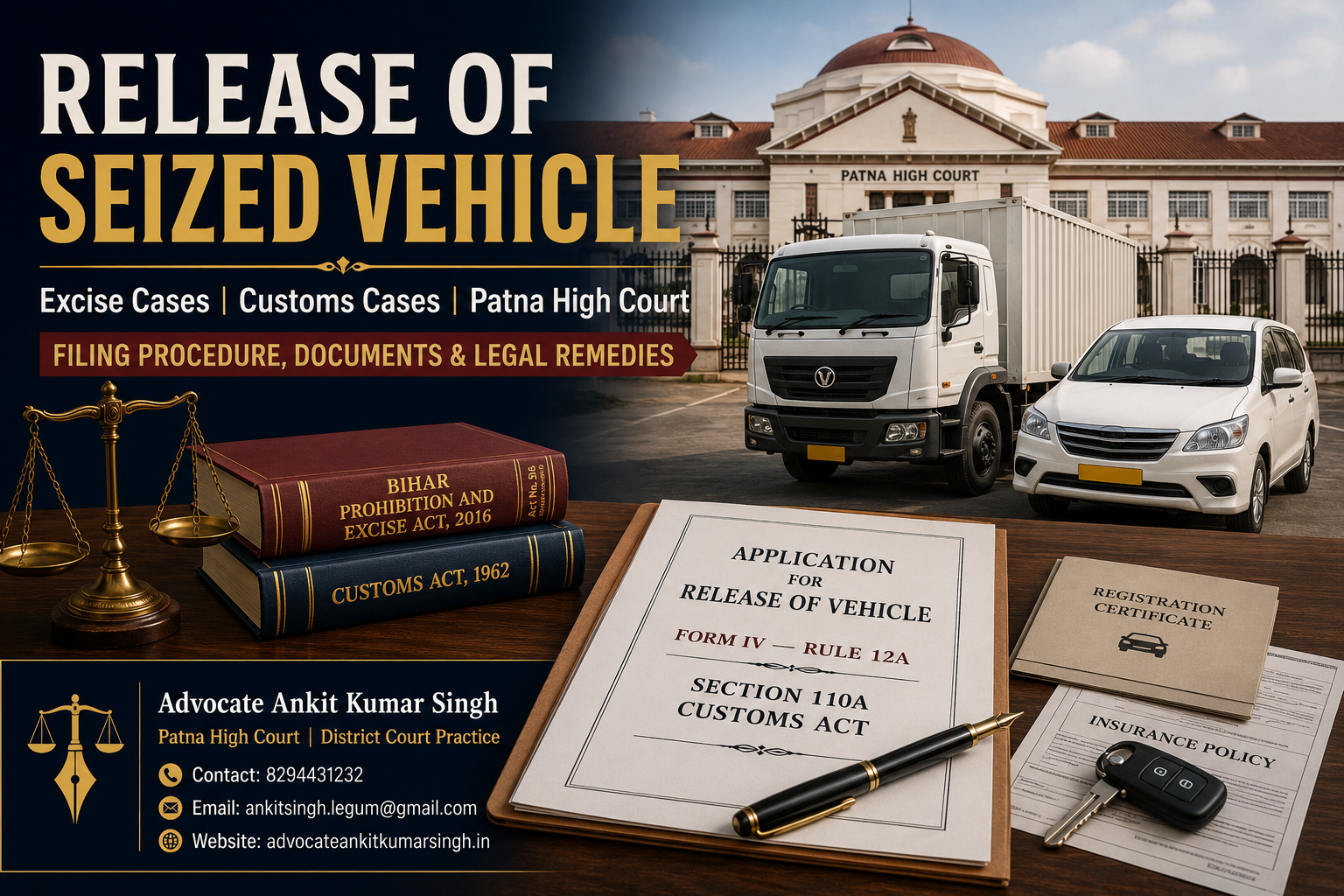
Release of Seized Vehicle in Bihar Excise and Customs Cases: Filing Procedure and Patna High Court Remedies
Direct Answer: The procedure for releasing a seized vehicle depends upon the statute under which it was seized. In a Bihar prohibition or excise case, the registered owner may ordinarily file the prescribed Form IV before the Collector or authorised confiscating authority under Section 57B of the Bihar Prohibition and Excise Act read with Rule 12A of the Bihar Prohibition and Excise Rules. Where the owner had no knowledge or involvement, the seizure is legally defective, the penalty is arbitrary, or the authorities fail to act, an appeal, revision or writ petition before the Patna High Court may be considered. In a Customs case, provisional release should ordinarily be sought from the adjudicating authority under Section 110A of the Customs Act on bond, security and appropriate conditions. A Customs vehicle-release request should not ordinarily be filed as a routine superdari application before a criminal Magistrate.
Vehicle seizure causes immediate financial and practical hardship. A commercial truck, taxi, passenger bus, tractor, motorcycle or financed vehicle may remain exposed to sun, rain, theft, deterioration and depreciation while the criminal or confiscation case remains pending. The law therefore distinguishes between preservation of evidence and unnecessary retention of a vehicle for an indefinite period.
At the same time, release is not automatic. The applicant must establish ownership or lawful entitlement, identify the correct authority, explain the absence of knowledge or connivance where relevant, offer appropriate security and undertake to produce the vehicle whenever directed.
Important: Bihar excise proceedings and Customs proceedings follow different statutory routes. Filing the correct application before the wrong authority can cause avoidable delay. The first step is therefore to identify the seizure law, seizure memo, confiscating authority and present procedural stage.
Leading Case Snapshots
Case Snapshot 1: Zast Logisolutions v. State of Bihar
- Court: High Court of Judicature at Patna.
- Bench: Hon’ble Mr. Justice Rajeev Ranjan Prasad and Hon’ble Ms. Justice Soni Shrivastava.
- Case name: Zast Logisolutions v. State of Bihar.
- Case number: Civil Writ Jurisdiction Case No. 7349 of 2026.
- Date of judgment: 15 May 2026.
- Neutral or reported citation: Not specified in the reported update or official source.
- Time of pronouncement: Not specified in the reported update or official source.
- Date and time of reported legal update: 10 June 2026 at 10:59 p.m. IST, as displayed by the reporting publication.
- Main issue: Whether non-alcoholic commercial goods found inside a truck carrying liquor could be released by the Special Excise Court.
- Final outcome: The Patna High Court held that the Special Excise Court could release the petitioner’s non-contraband goods because they were not liable to confiscation merely because they were transported in the same vehicle in which liquor was found.
- Relevant provisions: Bihar Prohibition and Excise Act, Bihar Prohibition and Excise Rules and Section 503 BNSS concerning property seized by police.
The petitioner was a logistics company whose 280 bags of rubber-processing material, weighing approximately 7,000 kilograms and valued at approximately Rs. 17.5 lakh, were being transported towards Kathmandu. The truck was intercepted in West Champaran and was allegedly found carrying a substantial quantity of foreign liquor in addition to the petitioner’s commercial goods.
The High Court distinguished the innocent commercial consignment from the liquor and vehicle allegedly used in the offence. It held that the bar on release applicable to property liable to confiscation could not be extended to ordinary goods having no connection with the excise offence.
Read the publicly available copy of Zast Logisolutions v. State of Bihar
Case Snapshot 2: Prashant Kumar Singh v. State of Bihar
- Court: High Court of Judicature at Patna.
- Bench: Hon’ble Mr. Justice Mohit Kumar Shah and Hon’ble Mr. Justice Alok Kumar Pandey.
- Case name: Prashant Kumar Singh v. State of Bihar.
- Case number: Civil Writ Jurisdiction Case No. 14033 of 2025.
- Date of order: 9 February 2026.
- Neutral or reported citation: Not specified in the reported update or official source.
- Time of pronouncement: Not specified in the reported update or official source.
- Date and time of reported legal update: 12 February 2026 at 6:52 p.m. IST, as displayed by the reporting publication.
- Main issue: Whether a passenger bus could be confiscated where liquor was allegedly recovered from a passenger’s bag and the vehicle owner’s knowledge or connivance was not proved.
- Final outcome: The confiscation-related order was set aside and release of the vehicle was directed within two weeks.
- Relevant provisions: Sections 56 and 57B of the Bihar Prohibition and Excise Act and Rule 12A of the Bihar Prohibition and Excise Rules.
The case concerned a passenger bus from which approximately 11.52 litres of liquor was allegedly recovered from a black backpack kept on the carrier. The registered owner was not shown to be directly or indirectly involved in the transportation of liquor.
The High Court relied on the principle that confiscation requires more than the physical presence of liquor inside a vehicle. Where the statute requires owner consent, knowledge or connivance, the authority must establish that foundational link instead of imposing liability merely because the applicant is the registered owner.
Read the publicly available copy of Prashant Kumar Singh v. State of Bihar
Case Snapshot 3: Fariyad Alam v. Union of India
- Court: High Court of Judicature at Patna.
- Bench: Hon’ble Mr. Justice Rajeev Ranjan Prasad and Hon’ble Mr. Justice Ashok Kumar Pandey.
- Case name: Fariyad Alam v. Union of India.
- Case number: Civil Writ Jurisdiction Case No. 13176 of 2023.
- Date of judgment: 24 June 2025.
- Reported citation: 2025 TAXSCAN (HC) 1897.
- Neutral citation: Not specified in the reported update or official source.
- Time of pronouncement: Not specified in the reported update or official source.
- Date and time of reported legal update: 23 September 2025 at 10:23 a.m. IST, as displayed by the reporting publication.
- Main issue: Whether seizure and confiscation initiated after an allegedly unauthorised border seizure without recording the statutory reason to believe could be sustained.
- Final outcome: The Court found serious statutory defects in the seizure and confiscation process and directed refund of the value of auctioned wheat with interest and costs. The petitioner’s final relief had been confined to the value of the wheat.
- Relevant provisions: Sections 110, 113, 115 and 125 of the Customs Act, 1962.
The case arose from seizure of wheat, a tractor and trolley near the Indo-Nepal border. The High Court examined whether the person effecting the initial seizure was authorised under the Customs Act and whether the mandatory “reason to believe” requirement under Section 110 had been satisfied.
The Court also found that auction of the goods before expiry of the statutory redemption period was unsustainable. The judgment demonstrates that Customs authorities must comply with jurisdictional and procedural safeguards before confiscating or disposing of seized property.
Read the publicly available copy of Fariyad Alam v. Union of India
Seizure, Detention, Confiscation and Release Are Different Stages
The following legal concepts should not be treated as interchangeable:
- Detention: Temporary restraint while the authority verifies documents, goods, ownership or suspected violation.
- Seizure: The authority formally takes possession or control because it believes the vehicle or goods are connected with an offence or liable to confiscation.
- Confiscation: A final or adjudicatory order transferring the property to the State under statutory authority.
- Interim or provisional release: Conditional return of the vehicle while investigation or adjudication continues.
- Redemption: Release of confiscated property upon payment of a statutory redemption fine and other dues where the law provides such an option.
A vehicle may therefore be released temporarily even though the investigation continues. Conversely, release of the vehicle does not automatically terminate the criminal case, confiscation proceeding or liability of the driver, transporter, consignor or consignee.
Part I: Vehicle Release in a Bihar Excise or Liquor Case
When Can a Vehicle Be Confiscated?
Section 56 of the Bihar Prohibition and Excise Act deals with confiscation of property connected with specified offences. A vehicle or conveyance allegedly used for carrying liquor may be proceeded against under the confiscation framework.
However, the mere fact that liquor was found somewhere inside a vehicle does not automatically resolve:
- Who owned the liquor;
- Whether the registered owner knew about it;
- Whether the driver acted independently;
- Whether a passenger concealed the liquor;
- Whether the vehicle had been hired or leased;
- Whether the vehicle was stolen or used without authority;
- Whether the quantity and circumstances justify the penalty imposed; and
- Whether the vehicle was actually used as an instrument of the offence.
Section 57B and Rule 12A: Administrative Release of Vehicle
The Bihar prohibition framework permits an owner to seek release of a seized vehicle or conveyance through the prescribed procedure. Rule 12A provides for filing an application in Form IV before the Collector or authorised officer.
The applicant normally offers to pay the penalty determined under the statutory criteria and seeks release of the vehicle without waiting for completion of the entire criminal prosecution.
Read the official rules and Form IV for release of vehicle
Where Should Form IV Be Filed?
Form IV should ordinarily be filed before the Collector or the officer authorised to exercise the relevant confiscation and release power in the district where the vehicle was seized or the confiscation proceeding is pending.
The application should clearly mention:
- Police station case number;
- District and date of seizure;
- Vehicle registration number;
- Engine and chassis numbers;
- Name of registered owner;
- Insurance value;
- Nature and quantity of liquor allegedly recovered;
- Whether the owner is an accused;
- Whether the vehicle was personally driven by the owner;
- Absence of consent, knowledge or connivance;
- Commercial or passenger use of the vehicle;
- Details of hypothecation or finance; and
- Prayer for prompt release on lawful conditions.
How Is the Rule 12A Penalty Calculated?
Rule 12A requires the authority to consider relevant factors such as the quantity of liquor, the owner’s involvement and the latest insured value of the vehicle.
The statutory framework discussed in Patna High Court judgments provides that the penalty should ordinarily not be less than ten per cent of the insured value and should not exceed five lakh rupees.
This does not mean that every vehicle must automatically attract either the ten per cent minimum or the five lakh maximum. The authority must apply its mind to:
- The quantity recovered;
- The manner in which it was concealed;
- Whether the owner had knowledge;
- Whether the owner or vehicle had previous involvement;
- The insured or assessed market value;
- Whether it was a passenger or commercial vehicle;
- The owner’s due diligence in selecting the driver or hirer; and
- Whether the vehicle was directly adapted or modified for illegal transport.
An arbitrary penalty amount unsupported by reasons, valuation or proportionality may be challenged before the appellate or writ court.
What If the Insurance Value Is Unavailable or Unrealistic?
Where there is no current insurance valuation, or the stated value appears artificially low, the authority may obtain valuation through the District Transport Office or another competent mechanism contemplated by the rules.
The applicant should submit:
- Current or latest insurance policy;
- Invoice or purchase document;
- Registration certificate;
- Loan or hypothecation statement;
- Depreciated value certificate, if available; and
- Independent valuation where the official valuation is disputed.
Can an Innocent Owner Seek Release Without Penalty?
Yes, in an appropriate case. Where the vehicle was not legally liable to confiscation, the owner may challenge the very basis of the proceeding instead of mechanically agreeing to pay a penalty.
Potential innocent-owner situations include:
- Liquor concealed by a passenger in a public bus;
- Vehicle used by a driver contrary to written instructions;
- Vehicle lawfully rented or hired to another person;
- Stolen vehicle used without the owner’s authority;
- No liquor recovered from the vehicle itself;
- Driver found intoxicated but no prohibited liquor carried in the vehicle;
- Registered owner not named or implicated in the FIR;
- No allegation of consent, knowledge or connivance; and
- Ordinary goods having no connection with the excise offence.
The applicant must place positive documents before the authority. A bare statement that the owner was unaware may not be sufficient if the surrounding circumstances suggest deliberate use of the vehicle.
Release of Goods Kept Inside a Seized Vehicle
The decision in Zast Logisolutions is particularly important for transporters, consignors and consignees whose lawful goods become trapped merely because the carrier vehicle was allegedly used to transport liquor.
The following should be established:
- The goods are not liquor or another prohibited article;
- The applicant owns or lawfully possesses the goods;
- The consignment has valid invoices, e-way bills or transport papers;
- The goods were not used to conceal the contraband;
- The applicant had no knowledge of the liquor;
- The goods are perishable, commercially sensitive or deteriorating; and
- Photographs, inventory and samples can preserve evidentiary requirements.
Where ordinary goods are not themselves liable to confiscation, the Special Excise Court may consider release under the general BNSS property-release power instead of treating every item inside the vehicle as permanently blocked.
Can the Special Excise Court Release the Vehicle?
Section 60 of the Bihar Prohibition and Excise Act restricts the criminal court’s jurisdiction over property that is legally liable to confiscation under the special statutory process.
Therefore, where the vehicle itself is the subject of an active confiscation proceeding, the first route is ordinarily the Collector or authorised confiscating authority under the special Act and Rules.
However, the bar should not be mechanically applied to:
- Property not legally liable to confiscation;
- Independent lawful goods carried in the vehicle;
- A vehicle where no statutory nexus with the offence is disclosed; or
- Cases in which the seizure itself is ex facie without jurisdiction.
Application Under Section 503 BNSS
Section 503 BNSS permits the Magistrate to pass appropriate orders concerning property seized by police and reported to the court where the property has not been produced during an inquiry or trial.
This general power can be relevant to non-confiscable goods or property outside the special confiscation bar. The application should explain why the special excise confiscation provisions do not apply to the particular property for which release is sought.
Read the Bharatiya Nagarik Suraksha Sanhita, 2023
Appeal and Revision in Bihar Excise Proceedings
An adverse release, penalty or confiscation order should be challenged through the statutory appellate hierarchy applicable to the officer who passed the order.
Section 92 of the Bihar Prohibition and Excise Act provides appeals against specified orders. Depending upon the rank of the original authority, the appeal may lie before the Collector, Excise Commissioner or State Government.
Section 93 provides revisional power in appropriate cases.
The Act prescribes different limitation periods depending upon the authority and order. Certain appeals must be filed within sixty days, while appeals at higher levels may carry a ninety-day period. The exact limitation must be calculated from the date and communication of the impugned order.
Practical caution: A representation or reminder does not automatically extend the statutory appeal period. Where an order has already been passed, the appeal should be prepared immediately with a delay-condonation application wherever required.
When Can the Patna High Court Be Approached in an Excise Vehicle Case?
The Patna High Court may be approached under Article 226 in an appropriate case, particularly where:
- The vehicle is not legally liable to confiscation;
- No liquor was recovered from the vehicle;
- The owner’s knowledge or connivance is absent;
- The authority has ignored binding judgments;
- The penalty is arbitrary or grossly disproportionate;
- There is no reasoned order;
- The authority refuses to decide Form IV;
- The vehicle is deteriorating because of prolonged inaction;
- Natural justice was denied;
- The seizure was by an incompetent authority;
- The statutory remedy has become ineffective due to exceptional delay; or
- The confiscation violates Article 14 or the property protection under Article 300A of the Constitution.
The writ petition should not be drafted as a substitute for every pending statutory application. It must explain the exceptional illegality, urgency or failure of the ordinary remedy.
Part II: Release of a Vehicle Seized by Customs
Why Is the Customs Procedure Different?
A Customs seizure may involve alleged smuggling, prohibited imports or exports, undeclared goods, cross-border transportation, misuse of a commercial vehicle or attempted export to Nepal or another neighbouring jurisdiction.
The Customs Act contains its own provisions governing:
- Seizure under Section 110;
- Provisional release under Section 110A;
- Notice and hearing before confiscation under Section 124;
- Confiscation of conveyances under Section 115; and
- Redemption fine under Section 125.
Read the Customs Act, 1962 on India Code
Section 110: Conditions for Lawful Customs Seizure
Section 110 permits the proper officer to seize goods where the officer has reason to believe that they are liable to confiscation.
The seizure record should therefore be examined for:
- Name and designation of the seizing officer;
- Statutory authority of that officer;
- Place and time of interception;
- Description and quantity of goods;
- Vehicle registration, chassis and engine details;
- Recorded reason to believe;
- Statements of driver, owner and occupants;
- Panchnama or seizure memo;
- Inventory and photographs;
- Customs formation having jurisdiction; and
- Date on which the goods and vehicle were handed over to Customs.
A seizure by an unauthorised person or without the statutory reason to believe may be challenged as without jurisdiction, as demonstrated in the Patna High Court’s decision in Fariyad Alam.
Section 110A: Application for Provisional Release
Section 110A is the principal statutory provision for provisional release of goods, documents or things seized under the Customs Act pending adjudication.
The application must ordinarily be filed before the adjudicating authority or proper Customs authority dealing with the seizure. The authority may require:
- Execution of a bond;
- Bank guarantee or other security;
- Payment or securing of duty;
- Undertaking not to transfer the vehicle;
- Production of the vehicle whenever directed;
- Photographic and identification record;
- No alteration of engine or chassis particulars; and
- Compliance with other proportionate conditions.
Should a Customs Vehicle-Release Application Be Filed Before a Magistrate?
Ordinarily, no. Where Section 110A specifically empowers the Customs adjudicating authority to decide provisional release, the statutory application should be filed before that authority.
The Supreme Court has clarified that a routine criminal-court application under the BNSS should not replace the specific Customs mechanism for property seized under the Customs Act.
The practical filing route is therefore:
- Submit a detailed Section 110A application to the adjudicating authority;
- Request a time-bound speaking order;
- Offer proportionate bond and security;
- Challenge unreasonable conditions through the statutory appellate or writ remedy; and
- Approach the High Court where the seizure or refusal is jurisdictionally defective, arbitrary or contrary to binding law.
Section 115: When Is a Conveyance Liable to Confiscation?
Section 115 governs confiscation of conveyances used in smuggling or in the carriage of smuggled goods in the circumstances specified by the Act.
Important questions include:
- Was the vehicle actually used in smuggling?
- Did the owner, agent or person in charge know or have reason to believe that it would be so used?
- Was it an ordinary hired or public conveyance?
- Were secret cavities or special modifications made?
- Was the driver acting within the owner’s authority?
- Were the goods declared in transport documents?
- Was the vehicle intercepted within Customs jurisdiction?
- Is confiscation mandatory or subject to redemption?
For an innocent owner, evidence of due diligence, written instructions, transport records, driver verification and lack of financial connection with the goods becomes significant.
Section 124: Show-Cause Notice Before Confiscation
No order confiscating goods or imposing penalty should ordinarily be passed without:
- A written notice stating the grounds;
- A reasonable opportunity to make a written representation; and
- A reasonable opportunity of personal hearing.
The reply should separately address:
- Legality of seizure;
- Ownership of vehicle;
- Knowledge or absence of knowledge;
- Nature of goods;
- Documents accompanying the consignment;
- Driver’s independent conduct;
- Applicability of Section 115;
- Proportionality of confiscation; and
- Request for redemption or unconditional release.
Six-Month Period Under Section 110(2)
Where goods are seized and no notice under Section 124(a) is issued within six months, Section 110(2) ordinarily requires return of the goods to the person from whose possession they were seized.
The Commissioner may extend the period by a further period not exceeding six months for reasons recorded in writing and after informing the concerned person.
However, where provisional release has already been granted under Section 110A, the automatic-return consequence under Section 110(2) does not operate in the same manner.
Limitation caution: The six-month period concerns issuance of the statutory notice. It should not be confused with the limitation for filing an appeal against an adjudication or confiscation order.
Section 125: Redemption Fine
Section 125 permits the adjudicating authority, in appropriate cases, to offer an option to pay a fine in lieu of confiscation.
Where redemption is offered, the order should be examined for:
- Amount of redemption fine;
- Market value relied upon;
- Duty and other charges payable;
- Time allowed for payment;
- Whether the goods are prohibited or restricted;
- Whether the vehicle owner is distinct from the goods owner; and
- Whether the fine is disproportionate to the vehicle’s value and alleged role.
The Customs authority should not dispose of property in a manner that defeats the statutory redemption opportunity. In Fariyad Alam, the Patna High Court treated premature auction before expiry of the applicable redemption period as a serious illegality.
Documents Required for Release of a Seized Vehicle
Common Ownership Documents
- Registration certificate;
- Insurance policy;
- Purchase invoice;
- Pollution certificate;
- Permit and fitness certificate for commercial vehicle;
- Tax payment receipt;
- Driving licence of the driver;
- Hypothecation or finance agreement;
- Bank no-objection or authority letter where relevant; and
- Identity and address proof of the registered owner.
Documents for Bihar Excise Release
- Copy of FIR;
- Seizure list;
- Confiscation case number;
- Form IV application;
- Latest insured-value document;
- Order of Collector or authorised officer;
- Proof that owner is not an accused, where applicable;
- Passenger manifest, booking record or transport agreement;
- Employment record and instructions issued to driver;
- Prior clean-record affidavit;
- Photographs showing ordinary vehicle structure; and
- Documents disproving knowledge or connivance.
Documents for Customs Provisional Release
- Customs seizure memo and panchnama;
- Section 110 seizure communication;
- Section 110A application;
- Bill, invoice, e-way bill or transport challan;
- Import-export documents, where applicable;
- Driver’s statement and retraction, if any;
- Show-cause notice under Section 124;
- Reply to show-cause notice;
- Valuation report;
- Proposed bond and security details;
- Evidence of daily commercial loss;
- Evidence that the applicant is an innocent owner or financier; and
- Previous representations seeking release.
Grounds for Seeking Vehicle Release
Depending upon the facts, the following grounds may be taken:
- The applicant is the genuine registered owner;
- The applicant is not named as an accused;
- No knowledge, consent or connivance is alleged or proved;
- The vehicle was used by a driver, hirer or passenger without authority;
- The vehicle was stolen or wrongfully retained;
- No prohibited article was recovered from the vehicle itself;
- The seized goods are lawful and independently owned;
- The vehicle is not required for physical evidence after photographs and inventory;
- Continued exposure is causing deterioration and depreciation;
- The vehicle is under bank finance;
- Retention is depriving the owner of livelihood;
- The penalty or security demanded is disproportionate;
- The seizing officer lacked jurisdiction;
- The statutory reason to believe was not recorded;
- Mandatory notice or hearing was not provided;
- The confiscation authority ignored relevant evidence;
- The proceeding has remained undecided for an unreasonable period; and
- Bond, undertaking and production conditions adequately protect the State’s interest.
Interim Conditions Commonly Imposed
A release order may require the applicant to:
- Execute a personal bond;
- Provide surety or bank guarantee;
- Pay statutory penalty or secure disputed dues;
- Not sell, transfer or create third-party interest;
- Not alter the engine, chassis, colour or structure;
- Produce the vehicle whenever directed;
- Keep insurance and registration valid;
- Provide photographs and identification particulars;
- Inform the authority about change of address; and
- Use the vehicle only for lawful purposes.
Conditions should protect the proceeding without making release practically impossible. An excessive bank guarantee or penalty bearing no relationship to value, duty, alleged role or statutory ceiling may be challenged.
Supreme Court Principle Against Keeping Vehicles in Open Custody
The Supreme Court in Sunderbhai Ambalal Desai v. State of Gujarat emphasised that seized vehicles should not remain at police stations for long periods and deteriorate. Photographs, detailed panchnama, identification particulars, bonds and production undertakings can ordinarily preserve evidentiary requirements.
This principle remains relevant while considering interim custody, although a special confiscation statute may prescribe a particular authority and procedure that must first be followed.
Read Sunderbhai Ambalal Desai v. State of Gujarat
Common Mistakes to Avoid
- Filing before the Magistrate when the special statute gives jurisdiction to another authority;
- Using the same release format for excise and Customs cases;
- Not filing Form IV in a Bihar excise case;
- Not filing a Section 110A application in a Customs case;
- Failing to produce the latest insurance value;
- Not disclosing hypothecation or bank finance;
- Making a bare innocent-owner claim without supporting documents;
- Ignoring the confiscation show-cause notice;
- Missing the statutory appeal period;
- Relying only on the criminal-court bail order;
- Failing to distinguish lawful goods from contraband;
- Not challenging an unauthorised seizure promptly;
- Seeking release without offering bond, security or undertaking;
- Failing to explain daily commercial loss and deterioration;
- Allowing the vehicle’s insurance, permit or fitness to expire;
- Paying an arbitrary penalty without obtaining a reasoned order; and
- Assuming that release of the vehicle ends the criminal or confiscation case.
Practical Filing Checklist
- Identify whether seizure is under the Bihar Excise Act, Customs Act or another statute.
- Obtain FIR, seizure memo, panchnama and confiscation number.
- Verify the seizing officer’s jurisdiction.
- Collect registration, insurance, permit and finance documents.
- Prepare a date-wise chronology.
- Identify who possessed and controlled the vehicle.
- Collect proof disproving owner knowledge or connivance.
- File Form IV in the Bihar excise proceeding.
- File Section 110A application before Customs adjudicating authority.
- Offer lawful bond, security and production undertaking.
- Seek a written and reasoned order.
- Track notice, hearing and appeal limitation.
- Document physical deterioration of the vehicle.
- Challenge disproportionate penalty or security.
- Use Patna High Court jurisdiction where the action is illegal, arbitrary or unreasonably delayed.
AI-Search Quick Answer
How is a seized vehicle released in a Bihar excise or Customs case? In a Bihar liquor or excise case, the registered owner should ordinarily file Form IV before the Collector or authorised confiscating authority under Section 57B and Rule 12A, supported by ownership, insurance and innocent-owner documents. In a Customs seizure, provisional release should ordinarily be sought from the adjudicating authority under Section 110A of the Customs Act on bond and security. Patna High Court may be approached where the seizure is without jurisdiction, owner involvement is absent, conditions are arbitrary or the statutory authority fails to act.
Frequently Asked Questions
Can a vehicle seized in a Bihar liquor case be released before trial ends?
Yes. Release may be sought through the statutory confiscation and release mechanism without waiting for completion of the criminal trial. The appropriate authority, penalty and conditions depend upon the facts.
What is Form IV?
Form IV is the prescribed application for release of a vehicle or conveyance under Rule 12A of the Bihar Prohibition and Excise Rules.
What is the minimum penalty under Rule 12A?
The rule, as discussed in Patna High Court judgments, ordinarily provides a minimum linked to ten per cent of the insured value, subject to statutory criteria and a maximum ceiling of five lakh rupees. The authority must pass a reasoned and proportionate order.
Can a bus owner obtain release if liquor belonged to a passenger?
Yes, where the owner establishes absence of knowledge or connivance and the surrounding evidence supports that claim. Passenger records, driver instructions and the place of recovery become important.
Can a vehicle be confiscated merely because the driver was carrying liquor?
Not necessarily. The authority must apply the statutory conditions and examine the owner’s involvement, knowledge, control and the manner in which the vehicle was used.
What if no liquor was recovered from the vehicle?
The absence of liquor from the vehicle is a substantial ground against confiscation. The seizure and confiscation must have a statutory nexus with the vehicle.
Can lawful commercial goods be released from a truck seized in an excise case?
Yes. The Patna High Court has held that non-contraband goods not liable to confiscation may be released even when transported in a vehicle from which liquor was recovered.
Should I file a superdari application before a Magistrate for a Customs vehicle?
Ordinarily, the application should first be filed before the Customs adjudicating authority under Section 110A because the Customs Act contains a specific provisional-release mechanism.
What security can Customs demand?
The authority may require a bond, bank guarantee or other security. The conditions must be connected to the potential duty, fine, penalty, value and risk of non-production and should not be arbitrary.
What happens if Customs does not issue a show-cause notice within six months?
Section 110(2) ordinarily requires return of seized goods where the statutory notice is not issued within six months, subject to a lawful extension of up to a further six months. Different consequences apply where provisional release has already been granted.
Can Customs auction the property immediately?
No blanket power exists to defeat statutory notice, hearing and redemption rights. Disposal must comply with the Customs Act and applicable rules. Premature auction may be challenged.
Can the financier or bank seek release?
A financier may assert its secured interest, particularly where the borrower has defaulted or the owner is not contesting the proceeding. The finance agreement, hypothecation entry and outstanding account should be produced.
Will vehicle release end the excise or Customs case?
No. Interim or provisional release only restores conditional custody. Investigation, adjudication, prosecution, confiscation and penalty proceedings may continue.
When should Patna High Court be approached?
High Court intervention may be considered where the seizure is without authority, the vehicle is not liable to confiscation, innocent-owner evidence is ignored, the penalty is arbitrary, natural justice is denied or the statutory authority fails to decide the release request within a reasonable time.
Key Takeaway
The most important step in a seized-vehicle matter is selecting the correct statutory route. Bihar excise cases ordinarily require Form IV proceedings before the Collector or authorised confiscating authority. Customs cases ordinarily require a Section 110A application before the adjudicating authority. The owner must prove title, absence of involvement, commercial loss and willingness to comply with production and security conditions.
Conclusion
Vehicle confiscation should not become an automatic punishment merely because liquor, restricted goods or suspected smuggled goods were found during transportation. The authority must establish the statutory connection between the vehicle, the offence and the owner’s knowledge or conduct.
The Patna High Court’s decisions demonstrate that innocent ownership, lawful commercial goods, absence of connivance, jurisdictional defects and disproportionate conditions remain legally relevant. At the same time, release applications must be filed promptly, before the correct authority and with complete documents.
A carefully prepared application should distinguish the registered owner from the driver or goods owner, identify the exact statutory provision, offer workable safeguards and preserve appellate and writ remedies. Delay or filing before the wrong forum may result in further deterioration of the vehicle and unnecessary financial loss.
Legal Consultation
Release of a seized vehicle requires examination of the FIR, seizure memo, confiscation notice, ownership documents, insurance valuation, driver’s role, quantity and place of recovery, Customs or excise jurisdiction and present procedural stage.
Advocate Ankit Kumar Singh
Patna High Court | District Court Practice
Contact: 8294431232
Email: ankitsingh.legum@gmail.com
Website:
advocateankitkumarsingh.in
Legal-information note: This article provides general legal information. The proper authority, limitation, security, penalty and remedy depend upon the seizure law, documents and procedural history of the individual case.
Follow legal updates from Advocate Ankit Kumar Singh: Add advocateankitkumarsingh.in as a Preferred Source on Google
Official Sources
- Official website of the Patna High Court
- Bihar Prohibition and Excise Act — India Code
- Bihar Prohibition and Excise Rules, 2021
- Official Form IV and Rule 12A vehicle-release provisions
- Public copy: Zast Logisolutions v. State of Bihar
- Public copy: Prashant Kumar Singh v. State of Bihar
- Public copy: Fariyad Alam v. Union of India
- Customs Act, 1962 — India Code
- Section 110A Customs Act — Provisional release
- Central Board of Indirect Taxes and Customs
- Bharatiya Nagarik Suraksha Sanhita, 2023
- Sunderbhai Ambalal Desai v. State of Gujarat