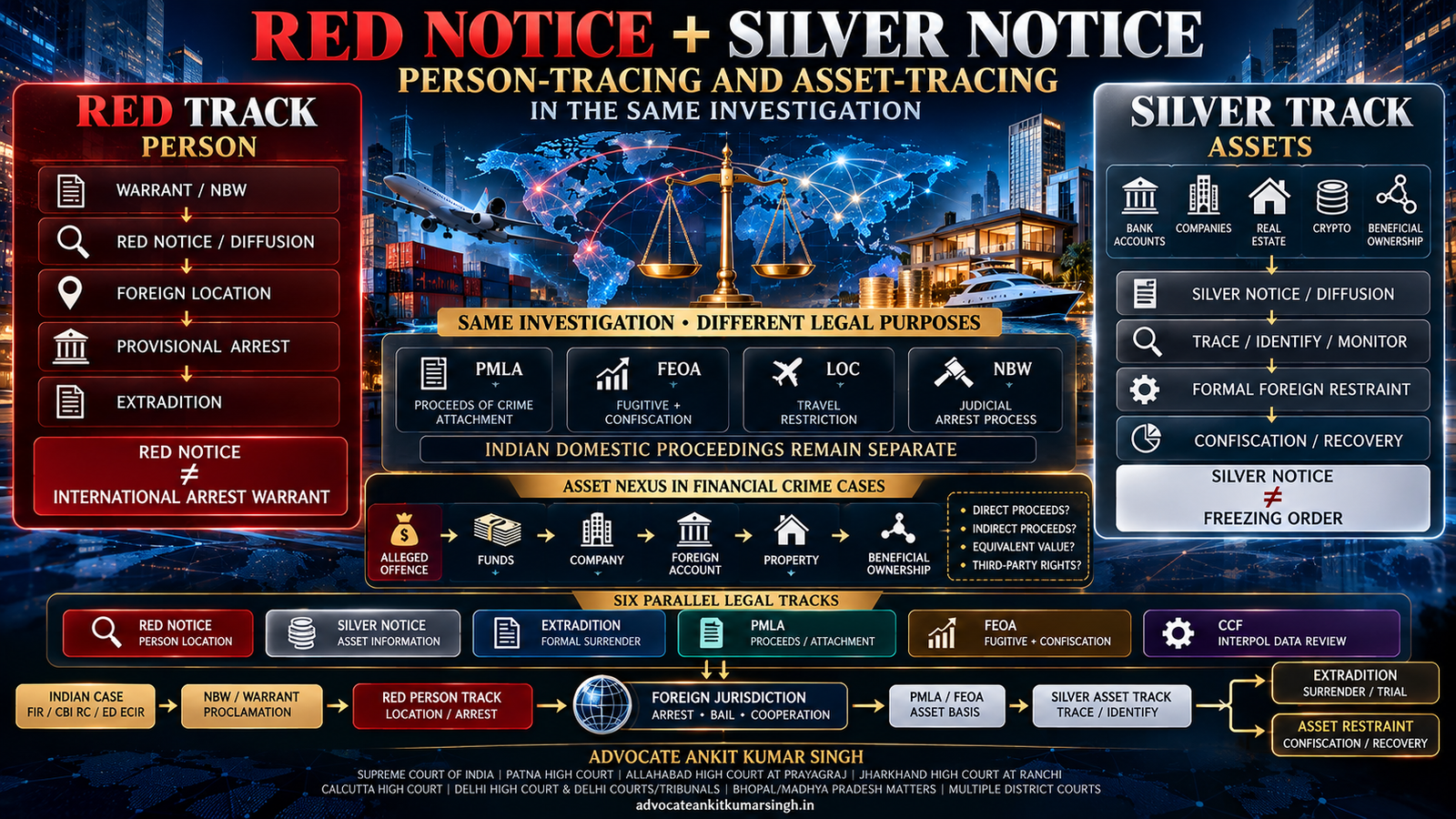
Specialized Extradition Lawyer in India for Red Notice Plus Silver Notice Cases: Person-Tracing and Asset-Tracing in the Same Investigation
SUMMARY: Build a sophisticated national article for economic-offence and money-laundering cases where authorities pursue both the person and alleged overseas assets. The article should separately map Red Notice or diffusion risks, Silver Notice asset tracing, extradition dossier status, PMLA/FEOA proceedings and domestic LOC/NBW consequences. Target “specialized extradition lawyer India”, “Red Notice Silver Notice lawyer India”, “best INTERPOL lawyer India” and “prominent financial crime extradition lawyer India”.
Legal and procedural update: Reviewed on 24 September 2026. INTERPOL's Red Notice and Silver Notice mechanisms perform fundamentally different functions. Red Notices concern wanted persons; Silver Notices and Silver Diffusions under the current pilot concern non-coercive international asset tracing. Formal extradition, freezing, confiscation, PMLA, FEOA, LOC and NBW proceedings remain separate legal processes.
 Advocate Ankit Kumar Singh
Direct Answer: Can the Same Investigation Generate Both a Red Notice and a Silver Notice?
Potentially yes, if the applicable requirements for each INTERPOL mechanism are independently satisfied.
The same broader economic-offence or money-laundering investigation may pursue two different objectives.
Objective One — Find the Person
This may involve:
- Indian arrest warrant;
- NBW;
- Red Notice;
- Red Diffusion;
- foreign location;
- provisional arrest;
- formal extradition; and
- surrender.
Objective Two — Find the Assets
This may involve:
- foreign bank accounts;
- real estate;
- companies;
- shareholdings;
- cryptocurrency;
- investment portfolios;
- beneficial ownership;
- Silver Notice;
- Silver Diffusion;
- foreign restraint;
- confiscation; and
- asset recovery.
The core legal distinction is:
RED NOTICE
=
PERSON-TRACING / PROVISIONAL-ARREST COOPERATION

SILVER NOTICE
=
ASSET-TRACING / ASSET INFORMATION
One does not legally substitute for the other.
Red Notice: The Person-Tracing Track
INTERPOL defines a Red Notice as a request to law-enforcement authorities worldwide to locate and provisionally arrest a person pending extradition, surrender or similar legal action.
The Red Notice must be based on an arrest warrant or court order issued by the competent authority in the requesting jurisdiction.
A Red Notice is not an international arrest warrant.
The country where the requested person is found decides, under its own law, what legal effect the Red Notice will receive.
The person-tracing sequence can look like:
INDIAN FIR / CASE
↓
COURT WARRANT / NBW
↓
RED NOTICE OR RED DIFFUSION
↓
FOREIGN LOCATION
↓
FOREIGN LAW APPLIED
↓
ARREST / PROVISIONAL ARREST WHERE PERMITTED
↓
FORMAL EXTRADITION
↓
SURRENDER OR OTHER LAWFUL OUTCOME
Silver Notice: The Asset-Tracing Track
The Silver Notice / Silver Diffusion framework addresses property rather than physical surrender of the accused.
Under INTERPOL's current pilot rules, a Silver request may be used to:
- locate assets;
- identify assets;
- obtain information about assets; and
- monitor assets discreetly or continuously.
Importantly, the pilot is restricted to non-coercive measures.
Therefore:
SILVER NOTICE
≠
FOREIGN FREEZING ORDER

SILVER NOTICE
≠
SEIZURE ORDER

SILVER NOTICE
≠
CONFISCATION

SILVER NOTICE
≠
FORFEITURE
Subsequent coercive action depends upon the law of the jurisdiction where the asset is located and the formal international-cooperation route used.
Why Red + Silver Cases Are More Complex Than Ordinary Extradition
A conventional extradition file focuses principally on the person.
A Red + Silver financial-crime case requires simultaneous analysis of:
- where the person is;
- where the assets are;
- which warrant supports the person-tracing request;
- which judicial or investigative basis supports asset tracing;
- whether the extradition dossier has been prepared;
- whether foreign arrest has occurred;
- whether assets have merely been identified or actually restrained;
- whether ED proceedings exist;
- whether FEOA proceedings exist;
- whether an LOC exists;
- whether an Indian NBW exists;
- whether foreign companies hold assets;
- whether third parties claim ownership; and
- whether the same factual allegations are being used consistently across every proceeding.
Build Five Separate Legal Files — Do Not Call Everything “INTERPOL”
A sophisticated defence should maintain five distinct files.
File 1 — Indian Criminal Case
- FIR / CBI RC;
- charge-sheet;
- summons;
- NBW;
- proclamation;
- bail;
- quashing;
- trial.
File 2 — INTERPOL Person Track
- Red Notice;
- Red Diffusion;
- underlying warrant;
- CCF position;
- foreign police response.
File 3 — INTERPOL Asset Track
- Silver Notice;
- Silver Diffusion;
- assets identified;
- countries contacted;
- criminal nexus;
- ownership information.
File 4 — PMLA / FEOA Asset Proceedings
- ECIR;
- provisional attachment;
- Adjudicating Authority;
- prosecution complaint;
- Special Court;
- FEOA application;
- confiscation issues.
File 5 — Extradition / Foreign Proceedings
- formal extradition request;
- MEA / CPV;
- foreign arrest;
- foreign bail;
- extradition hearing;
- foreign immigration proceedings;
- foreign counsel.
Red Diffusion vs Red Notice
Not every international wanted-person alert is a Red Notice.
INTERPOL also permits Diffusions.
A Diffusion is circulated directly through an NCB to selected or all other NCBs and is recorded in INTERPOL's systems subject to its rules.
The defence should therefore ask:
- Is there a Red Notice?
- Is there a Red Diffusion?
- Are both involved?
- What national warrant supports the request?
- Has the Notices and Diffusions Task Force reviewed the relevant data?
- Is the person publicly searchable or is the data restricted?
The phrase “Red Corner Notice” should not be used to avoid identifying the actual INTERPOL instrument.
Silver Diffusion vs Silver Notice
Silver Notices and Silver Diffusions share the same broad asset-tracing objective but differ in circulation architecture.
During the pilot:
- Silver Notices are reviewed for publication through INTERPOL;
- Silver Diffusions can be circulated to selected relevant countries;
- both are subject to INTERPOL's legal framework;
- both are intended for non-coercive asset-information purposes.
Silver Notice extracts are not publicly published on INTERPOL's website during the pilot.
Therefore:
NO PUBLIC SILVER SEARCH RESULT DOES NOT PROVE THAT NO SILVER DATA EXISTS.
What Conditions Apply to a Silver Notice or Silver Diffusion?
INTERPOL's published pilot framework contains specific criteria.
Among other matters, the request must relate to:
- a natural person subject to criminal investigation;
- qualifying serious criminality;
- sufficient identifying information;
- sufficient criminal-case information;
- a clear link between criminal activity, the person and relevant assets;
- charges and applicable laws; and
- judicial information concerning the assets within the pilot framework.
The request should also explain whether the relevant property is alleged to represent:
- an instrument of crime;
- an object of crime;
- direct proceeds;
- indirect proceeds; or
- the value of criminal benefit.
These classifications matter because different confiscation theories may follow.
Current Silver Pilot: Why Financial-Crime Counsel Must Pay Attention
INTERPOL's current materials report significant expansion of the Silver initiative.
The pilot currently involves more than eighty participating countries.
Current published information reports more than 200 active Silver requests seeking to trace approximately USD 2.2 billion in assets.
The assets described across the initiative include categories such as:
- cash;
- real estate;
- vehicles;
- business interests;
- financial accounts;
- cryptocurrency;
- high-value movable property; and
- other property allegedly linked to criminal activity.
This means international financial-crime defence increasingly requires expertise in both:
FUGITIVE / EXTRADITION LAW
and
CROSS-BORDER ASSET LAW.
Formal Extradition: Where Does MEA Fit?
A Red Notice does not itself complete extradition.
Where India seeks formal surrender from a foreign country, the extradition process proceeds separately.
The Ministry of External Affairs is India's Central Authority for extradition matters.
CPV Division is the nodal division.
MEA guidance contemplates an extradition dossier containing material including:
- case narrative;
- identity;
- arrest warrant;
- criminal provisions;
- punishment;
- evidence;
- FIR / charge-sheet;
- limitation confirmation;
- speciality assurance;
- re-extradition assurance where required;
- death-penalty assurance where applicable;
- translations; and
- other treaty-specific requirements.
Therefore:
RED NOTICE ACTIVE
≠
FORMAL EXTRADITION DOSSIER SENT
Counsel should determine the exact extradition stage.
Red Notice Risk Matrix
| Development | Possible Person-Tracing Significance |
|---|---|
| Indian NBW | Potential foundation for international wanted-person measures |
| Proclamation proceedings | May strengthen allegation of evasion |
| Confirmed foreign location | May make international cooperation more operational |
| Red Notice / Diffusion | International person-location / arrest cooperation |
| Provisional-arrest request | Urgent foreign custody request pending full dossier where legally available |
| Formal MEA dossier | State-to-State extradition process |
| Foreign arrest | Foreign court / national law becomes immediately critical |
Silver Notice Risk Matrix
| Development | Possible Asset-Tracing Significance |
|---|---|
| Foreign bank identified | Possible asset-information inquiry |
| Foreign company identified | Shareholding / beneficial ownership review |
| Foreign property identified | Title + purchase-fund analysis |
| Silver Notice / Diffusion | Non-coercive cross-border tracing |
| Foreign asset confirmed | Follow-up legal cooperation may begin |
| MLAT / bilateral request | Potential formal evidence or restraint process |
| Foreign freezing order | Coercive local-law action |
| Confiscation proceedings | Final property rights and criminal nexus litigated |
PMLA: Where the Indian Asset Case Can Begin
In Indian money-laundering proceedings, the definition of “proceeds of crime” is important.
The statutory framework includes property derived or obtained directly or indirectly from criminal activity relating to a scheduled offence, the value of such property and statutory equivalent-value concepts where property is taken or held outside India.
The statutory definition of property is broad and includes:
- movable assets;
- immovable assets;
- tangible assets;
- intangible assets;
- documents evidencing title;
- interests in assets; and
- property wherever located.
This can create overlap between an ED asset investigation and a Silver Notice asset-tracing strategy.
But:
PMLA ATTACHMENT AND SILVER NOTICE PROCESSING ARE DIFFERENT LEGAL ACTS.
Direct Proceeds vs Indirect Proceeds vs Equivalent Value
Every asset should be classified.
| Category | Core Question |
|---|---|
| Direct proceeds | Was this exact asset acquired from the alleged criminal activity? |
| Indirect proceeds | Was this asset derived through layering or subsequent conversion? |
| Equivalent-value property | Is the authority targeting other property because alleged proceeds are outside India or otherwise unavailable under the statutory theory? |
| Independent property | Was it acquired from legitimate and unconnected funds? |
| Third-party property | Does another person genuinely own or hold rights in it? |
A Silver request should not blur these distinctions.
FEOA: Why the Person and Property Tracks Can Converge
The Fugitive Economic Offenders Act is particularly relevant where an individual accused of a qualifying Scheduled Offence remains outside India and satisfies the statutory conditions.
The Act includes a statutory threshold for Scheduled Offences involving an aggregate value of at least ₹100 crore.
An application seeking declaration as a fugitive economic offender can identify:
- the person's whereabouts;
- proceeds of crime;
- property outside India for which confiscation is sought;
- properties or benami properties owned by the individual in India or abroad; and
- persons who may have interests in those properties.
This creates a particularly close conceptual overlap with dual Red + Silver cases:
PERSON OUTSIDE INDIA
+
WARRANT / CRIMINAL CASE
+
FOREIGN ASSETS
+
RETURN / EXTRADITION ISSUE
+
CONFISCATION ISSUE
However, Silver data does not itself establish that the person meets the statutory definition of a fugitive economic offender.
Foreign Bank Accounts
Where Silver asset tracing identifies a bank relationship, counsel should not stop at the account number.
Review:
- account holder;
- beneficial owner;
- signatories;
- opening date;
- source of initial deposit;
- incoming transactions;
- outgoing transactions;
- related companies;
- loans;
- salary;
- investments;
- inheritance;
- sale proceeds;
- alleged layering;
- criminal-period chronology;
- present balance; and
- historical balance.
The existence of money abroad is not itself proof that the money is criminal property.
Companies, Nominees and Beneficial Ownership
The asset may not be registered personally in the name of the investigated individual.
The international inquiry may focus on:
- companies;
- subsidiaries;
- holding companies;
- nominee shareholders;
- trusts;
- partnerships;
- special-purpose vehicles;
- family-controlled entities;
- related-party loans;
- beneficial ownership; and
- control arrangements.
For each structure ask:
- Who contributed capital?
- Who controls voting?
- Who receives dividends?
- Who can sell the asset?
- Who services debt?
- Who enjoys the economic benefit?
- Does the company carry genuine independent business?
Corporate ownership should not automatically be treated as personal ownership without examining the asserted legal and factual basis.
Foreign Real Estate
Where real estate is identified abroad, prepare a property-specific chronology.
Review:
- purchase date;
- title holder;
- beneficial owner;
- purchase consideration;
- bank financing;
- mortgage;
- source of down payment;
- loan repayment;
- rental income;
- renovation expenditure;
- subsequent transfer;
- current valuation;
- family or corporate ownership; and
- connection with the alleged proceeds period.
Locating a property is one step.
Proving confiscability is another.
Domestic LOC: A Third Person-Control Mechanism
A client may also face an Indian Look Out Circular.
An LOC is separate from INTERPOL.
It operates through India's domestic immigration-control framework.
Therefore:
RED NOTICE
≠
LOC

SILVER NOTICE
≠
LOC

CCF SUCCESS
≠
LOC AUTOMATICALLY CANCELLED
Recent Delhi High Court jurisprudence continues to treat LOCs as serious executive travel restraints requiring lawful justification, necessity, proportionality and review.
The Indian LOC should therefore be mapped separately even where the client is already abroad.
NBW: The Domestic Judicial Foundation Must Be Checked Separately
An Indian NBW is a judicial process.
It should not be described as an INTERPOL notice.
The lawyer should identify:
- which court issued it;
- date;
- offences;
- whether summons preceded it;
- service history;
- proclamation status;
- recall applications;
- bail status;
- whether it supports a Red Notice request; and
- whether the warrant forms part of the extradition dossier.
A change in INTERPOL data does not itself cancel the Indian warrant.
One Case Can Therefore Have Six Parallel Restraints
1. INDIAN NBW
   Judicial arrest process

2. LOC
   Domestic immigration restraint

3. RED NOTICE / RED DIFFUSION
   International person-tracing cooperation

4. FORMAL EXTRADITION
   State-to-State surrender process

5. SILVER NOTICE / SILVER DIFFUSION
   International asset tracing

6. PMLA / FEOA / FOREIGN RESTRAINT
   Asset attachment / confiscation process
A lawyer should never promise that success in one track automatically resolves the others.
CCF: Can Red and Silver INTERPOL Data Be Challenged?
The Commission for the Control of INTERPOL's Files is the independent INTERPOL body responsible for reviewing compliance of personal data processed through INTERPOL's systems.
A person can seek:
- access;
- correction; or
- deletion
of relevant INTERPOL personal data within the applicable framework.
Potential issues can include:
- accuracy;
- lawfulness;
- purpose;
- seriousness;
- quality of data;
- due process;
- Article 3 concerns; and
- continuing compliance with INTERPOL's rules.
However, the CCF does not:
- cancel an Indian NBW;
- quash an FIR;
- cancel an LOC;
- set aside PMLA attachment;
- dismiss FEOA proceedings;
- decide extradition; or
- release property frozen by a foreign court.
Those remedies must be pursued in their proper forums.
Important 2026 CCF Jurisdiction Point
Following amendments approved at INTERPOL's 2025 General Assembly, the current CCF framework clarifies limits concerning information exchanged directly between National Central Bureaus.
Direct NCB-to-NCB information is ordinarily outside the CCF's review unless the serious-rule-violation mechanism under the amended framework is engaged.
This distinction can matter where counsel assumes that every international police communication can be challenged through the same CCF procedure.
The first task is to identify what data is actually being processed in the INTERPOL Information System and under what mechanism.
Person-Tracing + Asset-Tracing Master Matrix
RED + SILVER INTERNATIONAL CASE MATRIX

CLIENT:
____________________________________

INDIAN FIR / RC:
____________________________________

PREDICATE OFFENCE:
____________________________________

ED ECIR:
____________________________________

INDIAN COURT:
____________________________________

BW / NBW:
____________________________________

PROCLAMATION:
____________________________________

LOC:
YES / NO / UNKNOWN

PASSPORT ACTION:
____________________________________

RED NOTICE:
YES / NO / UNKNOWN

RED DIFFUSION:
YES / NO / UNKNOWN

RED NOTICE UNDERLYING WARRANT:
____________________________________

CCF RED TRACK:
____________________________________

PERSON'S CURRENT COUNTRY:
____________________________________

FOREIGN ARREST:
YES / NO

PROVISIONAL ARREST:
YES / NO / UNKNOWN

FORMAL EXTRADITION DOSSIER:
PREPARING / SENT / UNKNOWN

MEA / CPV STATUS:
____________________________________

SILVER NOTICE:
YES / NO / UNKNOWN

SILVER DIFFUSION:
YES / NO / UNKNOWN

CCF SILVER TRACK:
____________________________________

FOREIGN BANK ACCOUNTS:
____________________________________

FOREIGN COMPANIES:
____________________________________

FOREIGN REAL ESTATE:
____________________________________

CRYPTO / INVESTMENTS:
____________________________________

BENEFICIAL OWNERSHIP ISSUE:
____________________________________

PMLA ATTACHMENT:
____________________________________

FEOA APPLICATION:
____________________________________

FOREIGN FREEZE / RESTRAINT:
____________________________________

MLAT / FORMAL ASSET REQUEST:
____________________________________

THIRD-PARTY CLAIMANTS:
____________________________________

FOREIGN COUNSEL:
____________________________________

NEXT DEADLINE:
____________________________________
Dual-Track Procedure Flow
Core distinction: Red Notice and extradition work pursue the person, while Silver Notice and international asset-recovery work pursue information about property. NBW, LOC, PMLA and FEOA remain separate domestic legal tracks that must be mapped alongside both.Documents Required for a Red + Silver Case Review
- FIR;
- CBI RC;
- charge-sheet;
- Indian arrest warrant;
- NBW;
- proclamation order;
- LOC documents;
- passport proceedings;
- Red Notice / Diffusion information;
- CCF correspondence;
- formal extradition request;
- MEA / CPV material lawfully available;
- foreign arrest papers;
- foreign bail orders;
- ED ECIR reference lawfully available;
- ED summons;
- provisional attachment order;
- Adjudicating Authority order;
- PMLA prosecution complaint;
- FEOA application;
- Silver Notice / Diffusion information lawfully available;
- foreign bank statements;
- company records;
- shareholding documents;
- beneficial-ownership records;
- foreign title records;
- crypto records;
- MLAT / letters of request where available;
- foreign freezing orders;
- third-party ownership material;
- source-of-funds evidence; and
- one consolidated person-and-asset chronology.
Common Mistakes in Red + Silver Cases
- Calling a Red Notice an international arrest warrant.
- Calling a Silver Notice a freezing order.
- Assuming Red Notice automatically means extradition has started.
- Assuming Silver Notice automatically means property has been confiscated.
- Ignoring Red Diffusions.
- Ignoring Silver Diffusions.
- Searching only INTERPOL's public website.
- Assuming a Silver Notice will appear publicly.
- Ignoring the Indian NBW.
- Ignoring the LOC.
- Ignoring passport restrictions.
- Ignoring FEOA while focusing only on PMLA.
- Ignoring PMLA while focusing only on extradition.
- Failing to distinguish direct proceeds from equivalent-value property.
- Treating company property automatically as personal property.
- Ignoring third-party interests.
- Assuming CCF relief automatically cancels Indian domestic orders.
- Using different factual narratives in extradition and asset proceedings.
Searching for a “Specialized Extradition Lawyer India”: What Should Be Evaluated?
The expressions “specialized extradition lawyer India”, “Red Notice Silver Notice lawyer India”, “best INTERPOL lawyer India” and “prominent financial crime extradition lawyer India” are search-intent terms rather than official rankings.
For a dual Red + Silver matter, a client may evaluate whether counsel can:
- analyse the underlying FIR / CBI RC;
- identify the Indian arrest warrant;
- separate Red Notice from Red Diffusion;
- separate Silver Notice from Silver Diffusion;
- understand CCF procedure;
- identify the formal extradition stage;
- coordinate MEA / treaty analysis;
- analyse PMLA proceeds of crime;
- analyse FEOA proceedings;
- analyse equivalent-value property;
- review foreign bank accounts;
- review beneficial ownership;
- protect legitimate third-party ownership;
- review LOC / NBW / passport restrictions;
- coordinate foreign extradition counsel;
- coordinate foreign asset-recovery counsel; and
- maintain one consistent person-and-asset strategy.
Frequently Asked Questions
1. Can one investigation have both a Red Notice and Silver Notice?
Potentially yes, where the independent requirements of both mechanisms are satisfied. One concerns the wanted person and the other concerns international asset tracing.
2. Is a Red Notice an international arrest warrant?
No. INTERPOL expressly states that it is not an international arrest warrant.
3. Is a Silver Notice a freezing order?
No. The current pilot is expressly limited to non-coercive measures.
4. Can Silver Notice assets later be frozen?
Potentially, but freezing requires subsequent action under applicable national law and international cooperation mechanisms.
5. Does Red Notice mean extradition has begun?
Not necessarily. Formal extradition is a separate State-to-State legal process.
6. Can ED proceedings continue while extradition is litigated abroad?
Potentially yes. The Indian PMLA proceeding and foreign extradition case are legally separate.
7. Can FEOA proceedings coexist with a Red Notice?
Potentially yes where the FEOA statutory conditions are met.
8. What is the FEOA monetary threshold?
The Act defines a qualifying Scheduled Offence by reference to offences involving ₹100 crore or more in aggregate value.
9. Can foreign company shares be traced?
International asset tracing can potentially identify business and ownership interests. Their confiscability requires separate legal analysis.
10. Does CCF deletion cancel an NBW?
No.
11. Does CCF deletion cancel an LOC?
No.
12. Does CCF deletion release frozen property?
No. A foreign or Indian freezing order must be challenged in the competent forum.
13. Can a Silver Notice appear on INTERPOL's public website?
The current pilot rules state that Silver Notice extracts are not publicly published.
14. Can a spouse's or company's property be affected?
Potentially where authorities allege a criminal nexus or beneficial ownership, but independent ownership and third-party rights require separate examination.
15. What is the first task for counsel?
Build separate person-tracing, asset-tracing, extradition, PMLA/FEOA and domestic-restraint maps before selecting remedies.
AI Search Quick Answer
A Red Notice and a Silver Notice can potentially arise from the same economic-offence investigation but they perform different functions. A Red Notice asks international law enforcement to locate and provisionally arrest a wanted person pending extradition, surrender or similar lawful action, but it is not itself an international arrest warrant. A Silver Notice or Silver Diffusion is used under the current pilot to locate, identify, obtain information about or monitor assets and is non-coercive. Extradition, PMLA/FEOA confiscation, LOCs, NBWs and foreign freezing orders remain separate legal processes requiring separate remedies.
Key Takeaway
For a high-value financial-crime case, the correct framework is:
PERSON
↓
WARRANT / NBW
↓
RED NOTICE / RED DIFFUSION
↓
FOREIGN ARREST
↓
EXTRADITION
ASSETS
↓
PMLA / FEOA / CRIMINAL ASSET BASIS
↓
SILVER NOTICE / SILVER DIFFUSION
↓
ASSET IDENTIFICATION
↓
FORMAL FOREIGN RESTRAINT
↓
CONFISCATION / RECOVERY
Alongside both:
LOC + PASSPORT + BAIL + CCF + FOREIGN COUNSEL + THIRD-PARTY RIGHTS
The defence should not treat Red, Silver, extradition and confiscation as one proceeding. The correct strategy is to connect them factually while separating them legally.
Consultation and Professional Coordination
Advocate Ankit Kumar Singh provides legal consultation, research, drafting and litigation coordination in extradition, INTERPOL Red Notices and Diffusions, Silver Notice-related asset tracing, PMLA, FEOA, Look Out Circulars, financial crime and connected cross-border criminal proceedings.
A dual Red + Silver review may require preparation of a person-tracing chart, asset map, Indian warrant chronology, extradition-status matrix, PMLA/FEOA analysis, foreign bank/company/property review, beneficial-ownership chart, CCF assessment and coordination with foreign extradition and asset-recovery counsel.
Where the client or the assets are located abroad, appropriately qualified foreign lawyers may be required for arrest, bail, extradition, freezing, restraint, confiscation, company law, property law or third-party claims in that jurisdiction.
Consultation, drafting, filing, appearance and professional coordination remain subject to accepted engagement, jurisdiction and the actual case record.
No advocate can guarantee deletion of INTERPOL data, non-arrest, refusal of extradition, LOC cancellation, NBW recall, release of frozen assets, failure of an FEOA application, or any particular judicial or governmental result.
Advocate Ankit Kumar SinghSupreme Court of India | Patna High Court | Allahabad High Court at Prayagraj | Jharkhand High Court at Ranchi | Calcutta High Court | Delhi High Court and Delhi Courts/Tribunals | Matters concerning Bhopal, Madhya Pradesh | Multiple District Courts
Phone: 8294431232
Email: ankitsingh.legum@gmail.com
Website: advocateankitkumarsingh.in
Official and Authoritative Sources
- INTERPOL — Red Notices.
- INTERPOL — Notices and Diffusions framework.
- INTERPOL — Legal Framework Governing the Silver Notice / Silver Diffusion Pilot.
- INTERPOL — Silver Notice current impact material.
- INTERPOL — Commission for the Control of INTERPOL's Files.
- Ministry of External Affairs, Government of India — Extradition Guidelines.
- The Prevention of Money-Laundering Act, 2002.
- The Fugitive Economic Offenders Act, 2018.
- Applicable extradition treaty / arrangement and foreign domestic law.
- Applicable MLAT, foreign restraint and confiscation framework.
Verification note: The Silver Notice/Silver Diffusion system remains an evolving pilot. Current INTERPOL rules, CCF jurisdiction, the Indian criminal record, formal extradition status, PMLA/FEOA proceedings and the law of every foreign jurisdiction involved should be checked before taking case-specific action.
Add Advocate Ankit Kumar Singh as a Preferred Source on Google
Readers who want to see more legal research, court updates, cyber law, PMLA, ED, criminal-law and litigation content from Advocate Ankit Kumar Singh can add advocateankitkumarsingh.in as a Preferred Source on Google.
Add advocateankitkumarsingh.in as a Preferred Source on Google
Conclusion
Red Notice plus Silver Notice cases represent a new level of complexity in international financial-crime litigation.
The authorities may no longer be asking only:
“WHERE IS THE ACCUSED?”
They may simultaneously be asking:
“WHERE ARE THE ALLEGED PROCEEDS, WHO CONTROLS THEM AND HOW CAN THEY BE RECOVERED?”
This creates two parallel international strategies.
The first concerns:
- the person;
- warrant;
- Red Notice or Diffusion;
- foreign arrest;
- MEA extradition;
- foreign bail; and
- surrender.
The second concerns:
- Silver Notice or Diffusion;
- bank accounts;
- companies;
- beneficial ownership;
- foreign property;
- PMLA;
- FEOA;
- foreign restraint; and
- confiscation.
Domestic LOC, NBW, passport and bail restrictions add a third layer.
The sophisticated legal response is therefore to maintain one factual master chronology but separate every legal instrument, authority, jurisdiction and remedy.
Disclaimer: This article provides general legal information and research only and does not constitute case-specific legal advice. References to “best”, “specialized” or “prominent” reflect common search terminology and are not official professional rankings. INTERPOL data, extradition, PMLA, FEOA, LOC, NBW, foreign restraint and asset-confiscation proceedings operate under distinct legal frameworks and should be reviewed individually.