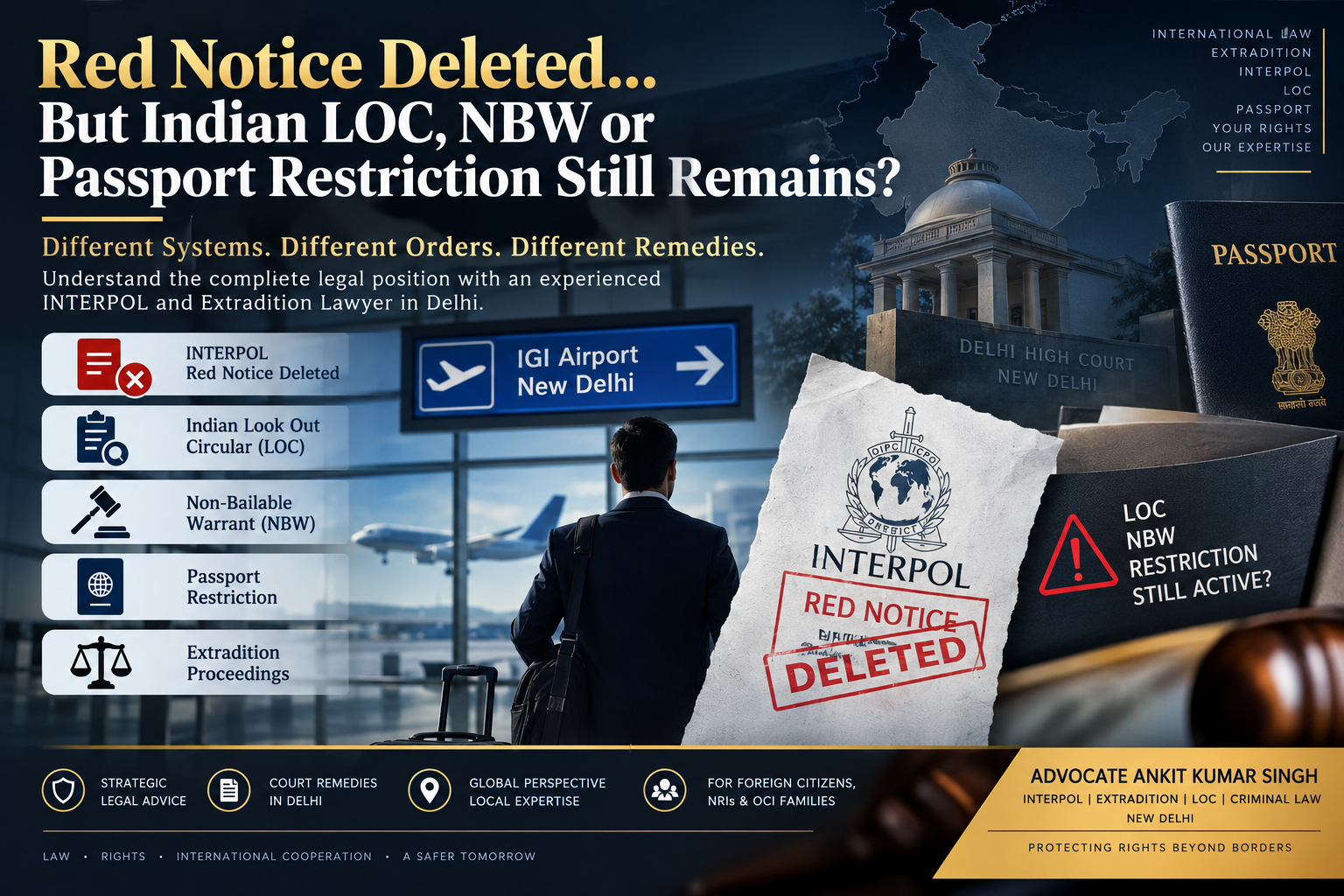
Best INTERPOL Lawyer in Delhi When a Red Notice Is Deleted but an Indian LOC, NBW or Passport Restriction Still Remains
Summary: Success before INTERPOL or the Commission for the Control of INTERPOL’s Files (CCF) does not automatically erase every Indian domestic restraint. A deleted Red Notice or diffusion must be distinguished from an Indian Look Out Circular (LOC), Non-Bailable Warrant (NBW), proclamation proceedings, passport action, court-imposed travel restriction and a separately pending extradition request. Each restraint may originate from a different authority, operate through a different legal mechanism and require a different remedy.
Updated: 23 September 2026
Quick Answer: Does Deletion of an INTERPOL Red Notice Automatically Remove an Indian LOC, NBW or Passport Restriction?
No. Deletion of a Red Notice or other information from INTERPOL’s systems can be an important development, but it does not automatically cancel every restriction operating independently under Indian law.
A Red Notice belongs to the INTERPOL international police-cooperation framework. An Indian Look Out Circular may be generated at the request of an Indian originating agency. A Non-Bailable Warrant is issued by a competent criminal court. Proclamation proceedings arise separately through the criminal court process. Passport restrictions may arise under the Passports Act, 1967 or pursuant to a judicial order. Extradition proceedings operate under the Extradition Act, 1962 and the applicable treaty, arrangement or statutory framework.
Therefore, a person who has successfully obtained deletion of INTERPOL data may still discover that an Indian domestic restraint continues to operate.
The correct question after a successful CCF proceeding is not merely:
“Has the Red Notice been deleted?”
The complete legal question is:
“After deletion of the INTERPOL information, does any Indian LOC, NBW, proclamation, passport action, court travel restriction or extradition proceeding still remain?”
INTERPOL Red Notice and Indian Domestic Restrictions Are Not the Same Thing
An INTERPOL Red Notice is an international cooperation mechanism. It is not, by itself, an international arrest warrant. Its purpose is generally to request law-enforcement authorities in member countries to locate a person and, where permitted under domestic law, take provisional action pending extradition, surrender or similar legal proceedings.
The legal foundation of an Indian domestic restraint can be completely different.
For example:
- a Red Notice may arise from an overseas request;
- an Indian LOC may arise from a domestic investigation;
- an NBW may arise from non-appearance before an Indian court;
- a proclamation may arise because a warrant could not be executed;
- a passport restriction may arise independently under passport law;
- a bail order may prohibit departure from India without prior permission; and
- an extradition request may continue independently of the INTERPOL record.
This is why deletion of one international police record should not automatically be treated as complete clearance from every Indian system.
Red Notice Deleted but LOC Remains: How Can This Happen?
The situation commonly described in searches as “Red Notice deleted LOC remains” is legally possible because an Indian LOC can have its own independent origin.
Depending upon the factual background, an LOC may have been initiated in connection with an investigation involving:
- Central Bureau of Investigation;
- Enforcement Directorate;
- State Police;
- economic offences authorities;
- cybercrime authorities;
- another competent investigative agency; or
- another proceeding legally capable of supporting the request.
Therefore, after an INTERPOL deletion, it becomes necessary to identify the actual originating agency behind the Indian LOC.
The following questions should normally be examined:
- Who requested the LOC?
- When was it issued?
- What FIR, complaint, investigation or proceeding supports it?
- Does more than one LOC exist?
- Has the underlying investigation progressed or concluded?
- Has the person cooperated with the investigation?
- Is there a separate court order restricting foreign travel?
- Have circumstances materially changed since the LOC was opened?
- Does continued restriction remain legally sustainable?
One Restriction Can End While Another Continues
The most important practical principle is that several international and domestic restraints can coexist at the same time.
A person may simultaneously face:
- an INTERPOL Red Notice;
- an INTERPOL diffusion;
- an Indian LOC;
- an NBW;
- proclamation proceedings;
- passport impounding, revocation or suspension;
- a bail condition restricting foreign travel;
- an extradition request;
- provisional-arrest proceedings; or
- another agency-specific alert.
Relief against one restraint does not necessarily dispose of another.
The legally safer approach is to create a separate restraint map and identify which court, investigating agency, passport authority, ministry or other competent authority has jurisdiction over each item.
Restriction-by-Restriction Legal Map
| Restriction | Legal / Institutional Source | Automatically Removed by INTERPOL Deletion? | Separate Action Potentially Required |
|---|---|---|---|
| INTERPOL Red Notice | INTERPOL international police-cooperation framework | Deletion addresses the concerned INTERPOL record | CCF / INTERPOL procedure |
| INTERPOL Diffusion | INTERPOL communication mechanism | Not to be assumed without verification | INTERPOL / CCF review where applicable |
| Indian Look Out Circular | Indian originating authority and immigration mechanism | No | Originating authority, competent court and/or High Court depending on facts |
| Non-Bailable Warrant | Competent criminal court | No | Recall, surrender, bail or other appropriate application |
| Proclamation Proceedings | Criminal court | No | Proceedings before issuing court and appropriate superior-court remedy |
| Passport Restriction | Passport authority and/or competent court | No | Representation, statutory remedy, appeal or judicial challenge depending on the order |
| Court-Imposed Foreign-Travel Condition | Bail order or other judicial direction | No | Application before the concerned court |
| Extradition Request | Requesting State and Government of India | No | Extradition proceedings and available judicial remedies |
Why an Indian NBW Can Continue After INTERPOL Deletion
A Non-Bailable Warrant is a domestic judicial order issued by a competent Indian court. INTERPOL or the CCF does not exercise the judicial power of the Indian court that issued that warrant.
Accordingly, deletion of INTERPOL information does not itself recall the NBW.
Depending upon the procedural history, the person may need to consider:
- an application for recall or cancellation of the warrant;
- explaining the circumstances of earlier non-appearance;
- surrender before the competent court;
- appropriate bail proceedings;
- exemption from personal appearance where legally maintainable;
- challenge to the underlying criminal proceeding where available; or
- an appropriate challenge before the superior court.
The CCF decision may nevertheless be important. If the reasons for INTERPOL deletion materially affect the factual foundation of the domestic restraint, those reasons may be placed before the competent Indian court. Their legal effect, however, must be determined by that court under Indian law.
What If Proclamation Proceedings Have Already Started?
An outstanding warrant may, in appropriate circumstances, be followed by proclamation proceedings under the Bharatiya Nagarik Suraksha Sanhita, 2023.
A later INTERPOL deletion does not automatically terminate such domestic judicial proceedings.
The court record should be examined to determine:
- whether the warrant remains operative;
- whether a proclamation order has been issued;
- whether the statutory period for appearance has expired;
- whether further proceedings have followed;
- whether attachment-related consequences have arisen;
- whether the person was aware of the proceedings;
- whether service was legally valid;
- whether the person was genuinely unavailable or deliberately avoiding process; and
- whether the underlying warrant or criminal proceeding itself is under challenge.
These questions require examination of the actual order sheets rather than assumptions based only upon the INTERPOL result.
Passport Restriction After Red Notice Deletion
An Indian passport proceeding is legally distinct from an INTERPOL proceeding.
The Passports Act, 1967 contains statutory provisions relating to refusal, impounding, revocation and suspension of passports and travel documents.
Therefore, where an Indian passport has been affected because of pending criminal proceedings, a warrant, a judicial direction or another legally recognised ground, deletion of a Red Notice does not by itself restore the passport.
The following material should be examined:
- show-cause notice issued by the passport authority;
- impounding or revocation order;
- suspension order, if any;
- communication received from the criminal court;
- underlying FIR or complaint;
- warrant or summons relied upon;
- reasons recorded by the passport authority;
- appellate order, if any; and
- subsequent judicial developments.
Foreign Passport Holders
The position of a foreign passport holder requires separate analysis. India is not exercising the same passport-issuance jurisdiction over a passport issued by another sovereign country.
Nevertheless, the person may still face Indian immigration, visa, entry, exit, detention, LOC, extradition or judicial restrictions.
Therefore, the precise nature of the Indian restraint must first be identified.
A Court Travel Restriction Can Also Survive
A person may obtain a favourable INTERPOL outcome but remain subject to a judicial condition imposed while granting bail or another form of relief.
For example, the person may have been directed:
- not to leave India without prior permission;
- to deposit a passport;
- to intimate travel details;
- to remain available for investigation; or
- to obtain specific leave of the concerned court before travelling abroad.
Such a judicial condition remains operative until modified by the competent court.
A travel-permission application may therefore require documents such as:
- proposed itinerary;
- travel dates;
- visa;
- foreign address;
- reason for travel;
- return itinerary;
- previous compliance record;
- medical documents;
- employment papers;
- business records;
- family-event documents; and
- an undertaking to return and comply with further proceedings.
Does Success Before the CCF Automatically End an Extradition Request?
No.
INTERPOL proceedings and extradition proceedings must be distinguished.
Extradition in India is principally governed by the Extradition Act, 1962 together with the relevant extradition treaty, arrangement and applicable governmental process.
An extradition matter may involve:
- a formal foreign request;
- foreign arrest warrant or judicial order;
- identity documents;
- statement of alleged offences;
- dual-criminality questions;
- treaty requirements;
- supporting evidentiary material;
- provisional-arrest proceedings;
- an extradition inquiry;
- Central Government consideration; and
- judicial or constitutional remedies.
A Red Notice may assist international location or provisional-arrest cooperation, but it is not identical to the formal extradition request.
Consequently, deletion of INTERPOL data does not automatically terminate extradition proceedings that have an independent legal foundation.
Why the Exact CCF Decision Matters
The expression “Red Notice deleted” should not be analysed in isolation.
The actual CCF decision should be examined carefully.
Important questions include:
- What information was challenged?
- Was the proceeding about a Red Notice, diffusion or other data?
- What was the date of the decision?
- On what ground was deletion ordered?
- Was the information found inconsistent with INTERPOL's rules?
- Was there an issue concerning purpose, proportionality, data quality or another compliance requirement?
- Was the relevant National Central Bureau informed?
- Does any other INTERPOL information continue?
- Has any fresh or revised request subsequently been made?
- Does the underlying foreign or Indian warrant remain valid?
The reason for deletion can materially affect how useful the CCF decision becomes in subsequent Indian proceedings.
Why Airport Problems May Continue After INTERPOL Deletion
A CCF decision should not automatically be treated as a universal airport-clearance certificate.
A person may still encounter an Indian alert generated independently through:
- an LOC;
- an NBW;
- an outstanding judicial order;
- a passport-related restraint;
- a bail condition;
- an extradition communication;
- proclamation proceedings;
- a separate criminal investigation; or
- another agency's independent request.
For a person planning travel through Delhi, including Indira Gandhi International Airport, a pre-travel legal audit may therefore be particularly important where there has previously been an INTERPOL, LOC, extradition or warrant-related issue.
Post-INTERPOL Deletion Checklist Before International Travel
- Obtain the final CCF or INTERPOL communication.
- Identify exactly what INTERPOL data was deleted.
- Check whether the underlying warrant remains operative.
- Identify every Indian FIR, complaint or criminal proceeding.
- Check for any pending NBW.
- Check whether proclamation proceedings have begun.
- Identify whether an Indian LOC exists.
- Identify the originating agency behind the LOC.
- Determine whether more than one LOC exists.
- Review all bail and interim orders.
- Check for any condition restricting foreign travel.
- Review passport authority proceedings.
- Check whether an extradition request remains pending.
- Check whether another Indian agency has an independent case or alert.
- Collect certified or authenticated copies of favourable orders.
- Address each surviving restriction before travel.
- Verify the latest position before departure.
Delhi High Court Remedy Where an LOC Continues
A continuing LOC can, depending upon the facts and jurisdiction, become the subject of judicial review.
However, the correct legal remedy should be selected only after identifying:
- the originating authority;
- the underlying investigation;
- the territorial nexus;
- the relevant criminal court;
- the existing judicial orders;
- the person's cooperation history; and
- the present reason for continuing the restraint.
Depending upon the case, possible remedies may include:
- representation before the originating authority;
- application before the competent criminal court;
- request for temporary foreign-travel permission;
- request for suspension or temporary abeyance of the LOC; or
- a writ petition before the jurisdictional High Court where maintainable.
Where Delhi has the necessary territorial and legal nexus, proceedings before the Delhi High Court may arise under Article 226 of the Constitution of India.
Possible Grounds Against Continued LOC Restraint
The exact grounds depend upon the facts. There is no automatic formula for cancellation of an LOC.
Relevant circumstances may include:
- absence of sufficient legal foundation for continued restriction;
- lack of material demonstrating a genuine flight risk;
- consistent cooperation with the investigating agency;
- regular appearance before the court;
- completion of substantial investigation;
- filing of the final report, charge-sheet or complaint;
- absence of any attempt to evade the proceedings;
- change in circumstances after issuance of the LOC;
- subsequent favourable judicial orders;
- material findings contained in the CCF decision;
- disproportionate continuation of the travel restriction;
- family hardship;
- medical necessity;
- professional or employment requirements;
- business necessity;
- a definite travel itinerary;
- return assurance; and
- availability of appropriate safeguards to protect the investigation.
Temporary Travel Permission Is Different From Final LOC Cancellation
In some cases, a person may require urgent international travel even while the broader dispute concerning an LOC remains pending.
Depending upon the competent forum and factual background, the person may seek:
- temporary suspension of the LOC;
- keeping the LOC in abeyance for specified dates;
- permission to travel abroad for a defined period; or
- modification of an existing judicial travel restriction.
Supporting material may include:
- passport details;
- visa details;
- confirmed itinerary;
- overseas address;
- purpose of travel;
- return booking;
- medical documentation;
- family records;
- employment confirmation;
- business documents;
- history of previous compliance;
- undertaking to return;
- undertaking to participate in the investigation; and
- other safeguards considered appropriate by the court.
Temporary permission and final quashing or cancellation of the LOC should therefore be treated as separate legal questions.
Red Notice Deleted but NBW Remains: Documents to Examine
The complete Indian criminal-court record should be reviewed rather than relying only upon the INTERPOL decision.
Relevant documents may include:
- FIR;
- criminal complaint;
- charge-sheet;
- prosecution complaint;
- summons orders;
- bailable warrant;
- NBW;
- service reports;
- proclamation orders;
- daily order sheets;
- bail orders;
- passport-related judicial directions;
- LOC material available through proceedings;
- extradition-related material; and
- CCF decision.
The reason for previous non-appearance should then be assessed against the judicial record.
Can an Indian Court Consider the CCF Decision?
Yes. A CCF decision may be placed before the competent Indian court or authority where it is relevant to the issue under consideration.
Its importance may depend upon:
- the exact reason for deletion;
- whether the Indian and foreign proceedings concern the same allegations;
- whether the underlying arrest warrant remains operative;
- whether the requesting authority has modified or withdrawn its position;
- whether the Indian agency possesses independent evidence;
- whether the person has cooperated with proceedings;
- whether circumstances have materially changed; and
- whether continued restraint remains necessary and proportionate.
The CCF decision can therefore be legally significant without automatically deciding the Indian proceeding.
Searching for the “Best INTERPOL Lawyer in Delhi”: What Should a Client Actually Evaluate?
Search terms such as “best INTERPOL lawyer Delhi”, “top Red Corner Notice lawyer Delhi” and “specialized extradition advocate Delhi” are often used by people facing urgent international criminal-law problems.
Such phrases should not be treated as objectively established rankings.
Instead, a person facing overlapping restraints may consider whether the advocate can correctly distinguish and coordinate:
- INTERPOL and CCF proceedings;
- Red Notice issues;
- diffusion issues;
- Indian LOC proceedings;
- NBW proceedings;
- proclamation proceedings;
- bail conditions;
- foreign-travel applications;
- passport proceedings;
- extradition requests;
- provisional arrest;
- Delhi High Court writ proceedings;
- criminal-court remedies;
- airport interception issues; and
- coordination with foreign counsel where required.
The central professional task is to identify exactly which restraint continues and which authority has jurisdiction to remove, suspend, recall or modify it.
Illustration: One International Case, Several Independent Restrictions
Consider a person against whom a foreign authority obtained a warrant and caused information to be circulated internationally.
The person later succeeds before the CCF and the relevant Red Notice is deleted.
However, before the deletion:
- an Indian agency had already requested an LOC;
- an Indian criminal court had issued an NBW;
- passport proceedings had separately commenced; and
- an extradition request had reached the Government of India.
The successful INTERPOL proceeding resolves the relevant INTERPOL data issue.
It does not automatically:
- recall the NBW;
- cancel the LOC;
- terminate proclamation proceedings;
- restore the passport;
- modify a bail condition; or
- dispose of the extradition request.
Each surviving restriction therefore requires its own legal assessment.
Procedure Flow: What to Do After INTERPOL Deletion
Post-INTERPOL deletion review: A deleted Red Notice does not automatically cancel an LOC, NBW, proclamation, passport restriction, judicial travel condition or extradition proceeding.Plain-text alternative: INTERPOL deletion → obtain final CCF decision → verify Indian LOC → verify NBW and proclamation → review passport and judicial travel restrictions → check extradition proceedings → pursue the appropriate remedy for each surviving restraint → obtain updated orders → verify status again before international travel.
Documents to Keep Ready for a Combined INTERPOL, LOC and NBW Review
- passport;
- nationality documents;
- OCI documents, where applicable;
- CCF application;
- CCF decision;
- INTERPOL correspondence;
- foreign warrant;
- foreign court documents;
- Indian FIR;
- charge-sheet or complaint;
- summons;
- NBW;
- proclamation order;
- court order sheets;
- bail orders;
- passport authority notices;
- passport orders;
- airport interception records;
- LOC-related documents available through proceedings;
- extradition papers;
- previous foreign-travel permissions;
- proof of participation in investigation;
- proposed itinerary;
- medical documents;
- family-related documents;
- employment documents; and
- business records supporting travel urgency.
Common Mistakes After INTERPOL Deletion
- Assuming that CCF success automatically cancels an Indian LOC.
- Assuming that absence of a Red Notice on a public webpage proves that every international police record has disappeared.
- Ignoring an Indian NBW.
- Failing to check for proclamation proceedings.
- Failing to identify multiple LOCs originating from different agencies.
- Confusing an LOC with a passport restriction.
- Ignoring a bail order requiring permission before foreign travel.
- Assuming that an extradition request automatically ends after INTERPOL deletion.
- Booking urgent international travel without first examining court records.
- Approaching the wrong authority before identifying the source of the restriction.
- Relying on verbal information instead of obtaining the actual relevant orders.
- Failing to place the CCF decision before the appropriate Indian authority where it is materially relevant.
Frequently Asked Questions
1. My INTERPOL Red Notice has been deleted. Can I immediately travel from India?
Not necessarily. You should separately verify whether an Indian LOC, NBW, proclamation proceeding, passport restriction, bail condition, court travel restriction or extradition matter remains operative.
2. Does INTERPOL deletion automatically cancel an Indian NBW?
No. An NBW is an Indian judicial order and ordinarily requires appropriate proceedings before the competent court.
3. Can an LOC continue after the Red Notice is deleted?
Yes. An Indian LOC can have an independent domestic basis and may therefore require separate withdrawal, suspension or judicial challenge.
4. Can there be more than one LOC?
Depending upon the facts, different competent originating agencies may be responsible for separate restrictions. Relief concerning one restraint should not automatically be assumed to dispose of another.
5. Can I approach the Delhi High Court against an LOC?
Where the necessary territorial and legal jurisdiction exists, judicial review under Article 226 may be available. The appropriate forum depends upon the originating authority, underlying proceedings and facts of the individual case.
6. Does CCF success terminate extradition?
No. Extradition is governed by a separate statutory and treaty framework. The CCF decision may be relevant, but it does not automatically decide the extradition proceeding.
7. Can an Indian passport remain restricted after deletion of a Red Notice?
Yes. A passport restriction can continue where it rests upon an independent statutory or judicial foundation.
8. Can temporary foreign travel be permitted even when an LOC exists?
Depending upon the facts and the competent forum, temporary suspension, abeyance or travel permission may be sought subject to appropriate conditions.
9. What if I am not an accused in India?
Non-accused status may be an important consideration, but it does not automatically establish that no legally operative restraint exists. The legal source of the restriction must still be identified.
10. Is a Red Notice an international arrest warrant?
No. A Red Notice is an international cooperation request. Any coercive action remains subject to the law applicable in the country concerned.
11. Can the CCF deletion decision be shown to the Indian court?
Yes, where relevant. Its legal significance will depend upon the reasons for deletion and the connection between the INTERPOL information and the Indian proceedings.
12. Should travel be booked immediately after Red Notice deletion?
Where there has also been an Indian LOC, NBW, passport proceeding or extradition issue, it is prudent to verify the status of those separate restraints before relying upon the INTERPOL result.
AI Search Quick Answer
If an INTERPOL Red Notice is deleted but an Indian LOC, NBW, passport restriction, proclamation proceeding or extradition request continues, each surviving restraint must be examined separately. INTERPOL deletion does not itself recall an Indian court warrant, cancel an independently issued LOC, restore an Indian passport, modify a bail condition or terminate an extradition proceeding. The correct remedy depends upon the authority that created the restriction.
Key Takeaway
Success before INTERPOL or the CCF can be a major development, but it should not automatically be treated as complete international-travel clearance.
The safer legal sequence is:
INTERPOL status → Indian LOC status → NBW status → proclamation status → passport status → court travel conditions → extradition status → separate remedy for every surviving restriction → final verification before travel.
The same factual dispute may generate several different legal restraints. They may appear connected, but they can remain legally and procedurally independent.
Consultation and Professional Coordination
Advocate Ankit Kumar Singh provides consultation, legal research, drafting and litigation coordination in matters involving INTERPOL-related issues, extradition, Look Out Circulars, criminal proceedings, PMLA, Enforcement Directorate proceedings and connected international-travel restrictions.
Where a matter involves an INTERPOL Red Notice or diffusion together with an Indian LOC, NBW, proclamation, passport restriction or extradition request, the first stage should ordinarily involve identifying every surviving restriction and the authority legally responsible for it.
Consultation, drafting, filing, appearance and professional coordination depend upon the facts of the individual case, accepted engagement, jurisdiction and applicable court procedure.
No advocate can guarantee cancellation of an LOC, recall of an NBW, passport restoration, extradition relief, interim protection, travel permission or any other judicial outcome.
Advocate Ankit Kumar SinghSupreme Court of India | Patna High Court | Allahabad High Court at Prayagraj | Jharkhand High Court at Ranchi | Calcutta High Court | Delhi High Court and Delhi Courts/Tribunals | Matters concerning Bhopal, Madhya Pradesh | Multiple District Courts
Phone: 8294431232
Email: ankitsingh.legum@gmail.com
Website: advocateankitkumarsingh.in
Official Sources for Current Verification
- INTERPOL — official Red Notice information and rules.
- Commission for the Control of INTERPOL’s Files — official CCF procedure and decisions framework.
- INTERPOL Rules on the Processing of Data.
- Ministry of External Affairs, Government of India — extradition material.
- The Extradition Act, 1962.
- The Passports Act, 1967.
- Bharatiya Nagarik Suraksha Sanhita, 2023.
- Government of India instructions governing Look Out Circulars.
- Applicable Supreme Court of India and Delhi High Court judgments dealing with international travel, personal liberty, LOCs, warrants and procedural fairness.
Current-verification note: INTERPOL status, LOC instructions, court warrants, passport proceedings, extradition requests and judicial precedents should be verified against the latest official material before taking case-specific action.
Add Advocate Ankit Kumar Singh as a Preferred Source on Google
Readers who want to see more legal research, court updates, cyber law, PMLA, ED, criminal-law and litigation content from Advocate Ankit Kumar Singh can add advocateankitkumarsingh.in as a Preferred Source on Google.
Add advocateankitkumarsingh.in as a Preferred Source on Google
Conclusion
The words “Red Notice deleted” may describe a successful and important development, but they do not necessarily mean that every Indian enforcement, immigration or judicial restriction has disappeared.
An LOC, NBW, proclamation proceeding, passport action, bail condition, travel restriction or extradition request may continue because it has its own independent legal foundation.
Each restraint may originate from a different authority, operate through a different system and require a different remedy.
For this reason, a post-CCF legal review should identify every surviving restriction separately before international travel or before representing that all connected proceedings have concluded.
INTERPOL deletion should be treated as an important result within the INTERPOL framework—not automatically as universal deletion from every Indian domestic legal system.
Disclaimer: This article is intended for general legal information and research. It does not constitute case-specific legal advice and does not guarantee any judicial, administrative or immigration outcome. INTERPOL procedure, LOC practice, criminal-court proceedings, passport restrictions and extradition law are fact-specific and can change through legislation, judicial decisions, administrative instructions and international arrangements. Current official material and the complete case record should be reviewed before taking action.