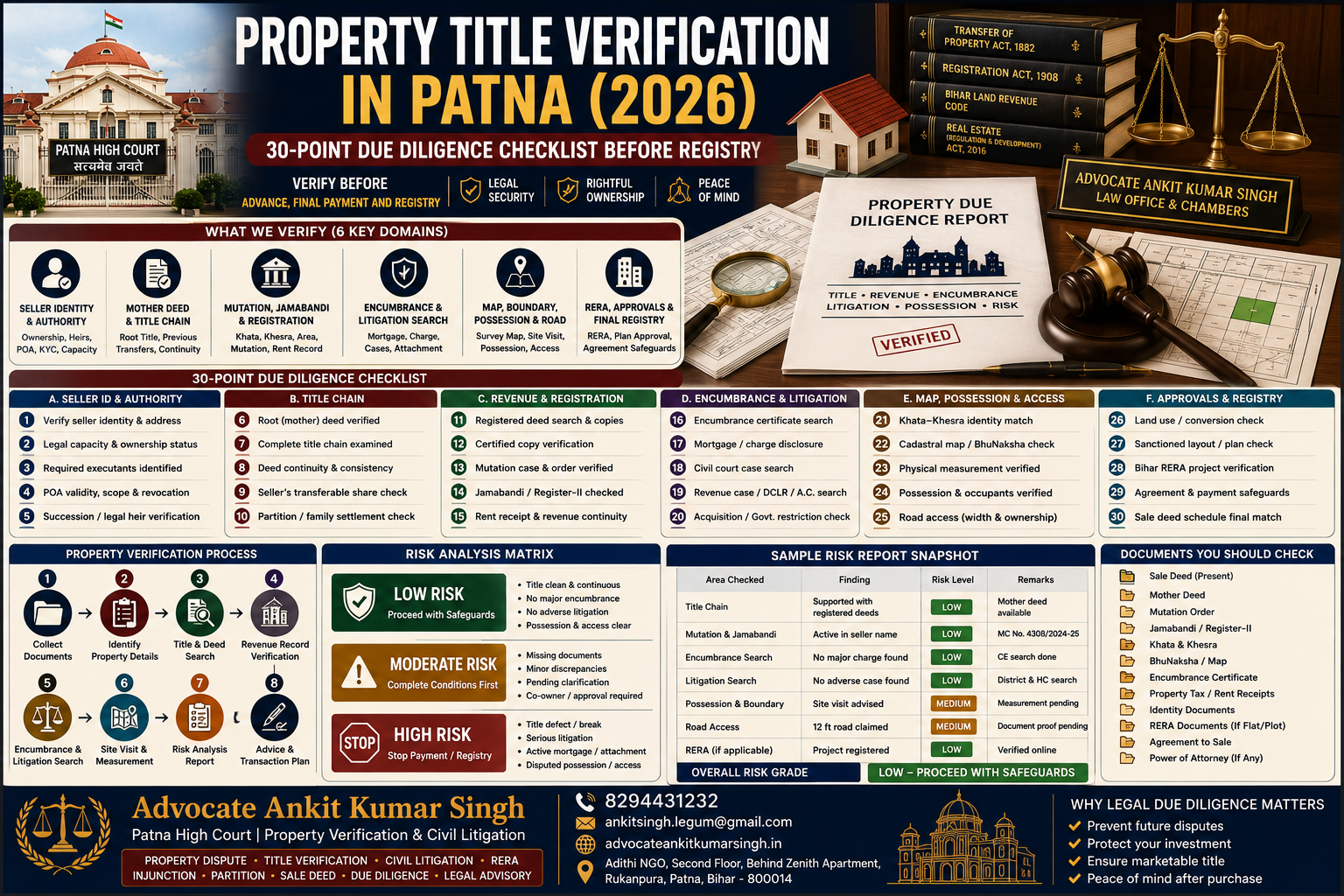
Property Title Verification in Patna Before Registry: 30-Point Due Diligence Checklist and Risk Analysis Report
A structured legal-verification guide for land, plots, flats, houses and inherited property in Patna and Bihar.
Direct Answer: Property verification before registry requires more than checking a sale deed or downloading a jamabandi record. A buyer should verify the seller’s identity and legal authority, complete title chain, registered transactions, mutation and revenue records, encumbrances, pending litigation, property map, physical possession, access road, land-use status and, where applicable, the Bihar RERA project record.
A professional property due-diligence report should identify what has been verified, what remains unavailable, what legal risks exist, what conditions must be completed before payment and whether the proposed transaction presently falls within a low, moderate or high risk category.
Property Due Diligence Scope at a Glance
Seller and Authority
Identity, ownership capacity, family status, authority, power of attorney and required executants.
5 checksTitle Chain
Mother deed, previous transfers, succession, partition, deed continuity and transferable interest.
5 checksRevenue and Registration
Jamabandi, mutation, khata, khesra, registered deeds, rent receipts and revenue proceedings.
5 checksEncumbrance and Litigation
Mortgages, registered charges, court cases, revenue cases, acquisition and third-party claims.
5 checksIdentity and Possession
Map, measurement, boundaries, road access, current possession and physical site correspondence.
5 checksApprovals and Transaction
RERA, sanctioned plan, land use, agreement safeguards, payment structure and execution readiness.
5 checksWhy Property Verification Is Required Before Registry
Registration records the instrument presented before the registration authority. It does not, by itself, resolve every possible question concerning the transferor’s title, previous transfers, succession, co-sharer rights, possession, boundary, mortgage, litigation or statutory approval.
A purchaser may receive a registered sale deed and still face a later dispute if:
- The seller did not own the entire property;
- A prior sale deed or mortgage existed;
- A daughter, widow or other legal heir was excluded;
- The seller transferred more land than his lawful share;
- The khata, khesra, area or boundary was incorrectly described;
- The property was under litigation;
- The property formed part of an unapproved plotted development;
- The flat project was not properly registered or approved;
- The power-of-attorney holder exceeded his authority; or
- The buyer could not obtain actual possession or lawful access.
Stage-Wise Property Verification Process
Collect Core Papers
Obtain the present deed, mother deed, seller KYC, revenue records, map, tax records and proposed sale schedule.
Identify the Property
Match district, anchal, mauza, thana, khata, khesra, jamabandi, area and four boundaries.
Reconstruct Title
Trace how the seller or vendor family obtained title and whether every transfer in the chain is legally supported.
Verify Registration
Search registered documents, certified copies, party-name records and possible prior transfers.
Check Revenue Status
Review jamabandi, mutation, rent payment, revenue cases, mortgage entries and land-record corrections.
Search Disputes
Search civil, High Court, revenue, RERA and other proceedings using seller, promoter and property-related details.
Verify the Site
Measure the land, verify possession, inspect boundaries, access road, occupants, structures and neighbouring claims.
Issue Risk Report
Classify title, revenue, encumbrance, litigation and execution risk and specify conditions required before registration.
30-Point Property Verification Checklist
-
1
Verify seller identity. Match the seller’s name, parentage, photograph, address and signature with the title and identity documents.
-
2
Confirm legal capacity. Check whether the seller is an individual, legal heir, co-owner, company, firm, trustee or authorised representative.
-
3
Identify all required executants. Determine whether a spouse, co-sharer, joint owner, legal heir or company signatory must also execute the transaction.
-
4
Verify power of attorney. Check execution, registration, scope, revocation, survival and authority to sell the exact property.
-
5
Check succession and death records. Where title came through inheritance, verify death certificates, genealogy, will, probate, succession and legal-heir participation.
-
6
Identify the root or mother deed. Determine the oldest reliable document establishing the property’s lawful ownership foundation.
-
7
Review the complete title chain. Examine successive sale, gift, partition, settlement, allotment, inheritance and court documents.
-
8
Check continuity between documents. Seller name, property description, area, boundaries and consideration should logically continue through the chain.
-
9
Check the seller’s transferable share. A co-owner or heir should not transfer more than the lawful interest held by that person.
-
10
Examine prior partition or family arrangement. Verify whether it was acted upon, properly documented, registered where necessary and accepted by all affected parties.
-
11
Search registered instruments. Search deed number, party name, registration office, property location, khata, plot and registration period.
-
12
Obtain certified copies. Compare the seller-provided papers with certified registration records rather than relying only on photocopies.
-
13
Verify mutation. Examine the mutation order, case number, basis of mutation, affected area and whether objections were raised.
-
14
Verify jamabandi and Register-II. Match raiyat name, khata, khesra, area, jamabandi number and any remark or correction history.
-
15
Review rent and revenue continuity. Check lagan receipts and whether revenue recognition corresponds with the claimed property and period.
-
16
Check registered encumbrances. Search mortgages, charges, leases, agreements, prior sales and other registered interests affecting the property.
-
17
Review loan and security-interest exposure. Obtain relevant bank release, no-dues or mortgage-satisfaction documents where the property was financed.
-
18
Search civil-court litigation. Search pending and disposed cases using seller, prior owner, promoter and other relevant party names.
-
19
Search revenue-court proceedings. Check mutation appeals, jamabandi cancellation, DCLR, Additional Collector and other land-revenue proceedings.
-
20
Check acquisition and government restrictions. Examine whether the land is affected by acquisition, public-road, government-land, ceiling, restricted-use or other proceedings.
-
21
Match khata and khesra. Confirm that the title deed, jamabandi, mutation and map refer to the same property.
-
22
Verify the cadastral or survey map. Locate the plot on BhuNaksha or the appropriate official survey record and compare its shape and adjoining plots.
-
23
Conduct physical measurement. Obtain measurement through a competent Amin or surveyor and reconcile the available area with the proposed sale schedule.
-
24
Verify possession and occupants. Identify who physically occupies, cultivates, rents or controls the property and under what authority.
-
25
Confirm lawful access. Verify the width, ownership and continuity of the access road rather than relying only on oral assurances or private layouts.
-
26
Verify land use and conversion. Check whether the proposed residential, commercial or plotted use is lawful for the land.
-
27
Verify sanctioned layout or building plan. Ensure the exact unit or plot appears in the approved plan and not merely in a marketing sketch.
-
28
Verify Bihar RERA status. Check the project, promoter, registration, validity, disclosures, complaints, orders and defaulter status where applicable.
-
29
Protect the agreement and payment structure. Link advance payment to document delivery, approvals, possession, measurement and refund consequences.
-
30
Match the final sale schedule. Recheck names, area, plot, boundaries, consideration, payment, possession, road access and original-document delivery before execution.
What Is a Property Title Search Report?
A property title search report is a structured legal opinion explaining the source and continuity of ownership. It should identify the documents examined, the root of title, successive transfers, current claimed owner, property identity and any defect or missing link in the ownership chain.
A title search commonly examines a substantial historical period or continues until a satisfactory root of title is established. A fixed number of years should not be applied mechanically where the property history requires an older grant, partition, inheritance or court decree to establish ownership.
What Is an Encumbrance Search?
An encumbrance search examines whether another person, bank, institution or claimant has a registered or recorded interest affecting the property.
Possible encumbrances include:
- Registered mortgage;
- Charge over the property;
- Lease or tenancy interest;
- Agreement to sell;
- Earlier sale deed;
- Attachment order;
- Bank or financial-institution security interest;
- Right of way or easement;
- Court restraint; and
- Government or revenue restriction.
Official Portals Used in Bihar Property Verification
Jamabandi, mutation status, LPC, revenue information, mortgaged-land facility and related land services.
Open official portalRegistered-document, party-name, deed, property and certified-copy searches for the available periods.
Open official portalCurrent registration and certified-copy services, including post-December 2024 document access indicated by Bhumijankari.
Open official portalDigitised cadastral and special-survey maps for available districts, circles and mauzas.
Open official portalSearch facility concerning recorded encumbrances against computerised jamabandi.
Open official portalRevenue-case status and order searches concerning mutation, jamabandi and other land proceedings.
Open official portalProject registration, promoter, agent, complaint, order, defaulter and registration-verification facilities.
Open official portalDistrict-court and High Court case-status searches using party names, case details and other available criteria.
Open official portalOnline Verification Is Not the Entire Due Diligence
Online records are useful, but they can be incomplete because:
- Older documents may not be fully digitised;
- Names may appear with different spellings;
- Searches may depend upon the correct registration office or year;
- Unregistered family claims may not appear;
- Physical possession may differ from the online record;
- A private road dispute may not appear in the title documents;
- A recent case may not immediately appear in every portal;
- A mortgage by deposit of title deeds requires separate scrutiny;
- The seller may possess only an undivided share; and
- A plotted layout may differ from the sanctioned or official map.
A complete verification process combines online searches, certified documents, physical inspection, measurement, seller questioning and transaction-specific legal analysis.
Property Risk Classification
LOW RISK — Proceed with Safeguards
Title chain is supported, property identity matches, current seller is authorised, revenue records correspond, no material adverse dispute is found and execution conditions are routine.
MODERATE RISK — Conditional Proceeding
The transaction may proceed only after missing documents, boundary measurement, co-sharer participation, mortgage release, approval or other identified conditions are completed.
HIGH RISK — Stop Payment or Registry
Serious title break, competing ownership, unresolved litigation, excessive sale, forged authority, unapproved plot, disputed possession or material encumbrance is found.
Property Due Diligence Risk Matrix
| Verification Area | Lower-Risk Indicator | Moderate-Risk Indicator | High-Risk Indicator |
|---|---|---|---|
| Title Chain | Continuous registered and supported title | One missing link capable of verification | Broken, competing or apparently fraudulent title |
| Seller Authority | Recorded owner and proper executant | Co-owner or POA clarification required | Seller lacks title or authority |
| Revenue Record | Corresponding mutation and jamabandi | Correction or reconciliation required | Adverse entry or government claim |
| Encumbrance | No material charge located | Loan closure or release required | Active mortgage, attachment or prior transfer |
| Litigation | No relevant adverse case located | Old or limited proceeding needs review | Pending title, possession or restraint litigation |
| Boundary and Area | Deed, map and physical site match | Official measurement required | Overlap, shortage or unidentifiable parcel |
| Possession | Seller has clear deliverable possession | Tenant or occupier documentation required | Hostile occupant or disputed possession |
| Approvals / RERA | Project and unit properly disclosed | Update, renewal or plan clarification required | Unregistered, revoked or unapproved project or plot |
Structure of a Professional Property Due Diligence Report
Buyer-Side Property Due Diligence and Risk Analysis Report
The report should distinguish verified facts, unavailable records, assumptions, conditions and final transaction risk.
| Report Section | What It Should Contain |
|---|---|
| 1. Client and Transaction | Purchaser identity, proposed seller, transaction purpose and proposed consideration stage. |
| 2. Property Particulars | District, anchal, mauza, thana, khata, khesra, jamabandi, area and boundary. |
| 3. Documents Examined | Every deed, revenue extract, map, order, approval and identity document reviewed. |
| 4. Title Flow | Root of title, successive transfers, succession, partition and present ownership claim. |
| 5. Revenue Position | Mutation, jamabandi, rent, correction and revenue-proceeding findings. |
| 6. Encumbrance Position | Mortgage, charge, registered transaction, bank release and other burden search. |
| 7. Litigation Search | Civil, revenue, High Court, RERA and other relevant proceeding search. |
| 8. Site and Possession | Measurement, boundary, access road, physical possession, structures and occupants. |
| 9. Risk Analysis | Separate title, revenue, litigation, encumbrance, possession and execution risk. |
| 10. Final Transaction Position | Proceed, proceed subject to conditions, defer or do not proceed. |
Example of a Property Verification Finding
A professional finding should not merely state “property is clear.” It should identify the basis and limitations of the opinion.
Major Property Due Diligence Red Flags
Land or Plot Due Diligence in Bihar
For land or plotted property, special attention should be given to:
- Original survey and revisional survey records;
- Special-survey status where relevant;
- Exact khata and khesra identity;
- Recorded and proposed sale area;
- Conversion between acres, decimals and square feet;
- Private layout and official map reconciliation;
- Government or gairmazarua classification;
- Road access and common-area ownership;
- Possession and cultivation history;
- Co-sharer rights;
- Physical demarcation; and
- Whether the offered portion can be separately identified and delivered.
Flat and Apartment Due Diligence
A flat purchase requires additional project-level checks:
- Promoter’s title over the project land;
- Development or collaboration agreement;
- Bihar RERA registration and validity;
- Sanctioned building plan;
- Approved number of floors and units;
- Exact apartment number and carpet area;
- Parking rights;
- Common areas and proportionate land share;
- Construction stage and completion commitments;
- Mortgage or project finance;
- Association or society position;
- Occupancy or completion documents where applicable;
- Outstanding maintenance and municipal dues;
- Previous allotment or cancellation; and
- RERA complaints, execution cases and promoter defaults.
Verification of Inherited or Ancestral Property
Where the property came through inheritance, the buyer should not rely only upon the name presently appearing in mutation.
The verification should identify:
- The original owner;
- Date of death;
- Every Class-I or other applicable heir;
- Predeceased branches;
- Widow, mother, sons and daughters;
- Will, probate or letters of administration;
- Previous partition;
- Release or relinquishment documents;
- Family settlement; and
- Whether every necessary heir will execute the sale.
Verification Where the Seller Is a Company or Firm
Additional checks may include:
- Incorporation and current legal status;
- Authorised signatory;
- Board or partner authority;
- Memorandum, articles or partnership terms;
- Company charges and secured borrowing;
- Insolvency or liquidation proceedings;
- Tax and statutory compliance affecting transfer;
- Related-party transactions;
- Beneficial ownership; and
- Authority to receive consideration and deliver possession.
Agreement to Sale Safeguards
A due-diligence process should begin before a substantial non-refundable advance is paid.
The agreement should address:
- Exact property schedule;
- Documents to be delivered by the seller;
- Due-diligence period;
- Seller’s declaration regarding title and litigation;
- Mortgage-release obligation;
- Participation of all co-owners or heirs;
- Measurement and boundary confirmation;
- Possession-delivery date;
- Refund if title or approval fails;
- Consequences of seller default;
- Restriction against creating third-party rights;
- Payment through traceable banking channels;
- Tax-deduction responsibility where applicable;
- Original-document delivery; and
- Registry and expense responsibility.
AEO: Quick Answer for Google AI and ChatGPT Search
Question: How do I verify land or a flat before registry in Patna or Bihar?
Answer: Verify the seller’s identity and authority, the mother deed and complete title chain, all registered transactions, mutation, jamabandi, khata, khesra, map, physical boundary, possession, road access, encumbrances, mortgages and pending civil or revenue cases. For a flat or plotted project, also verify Bihar RERA registration, sanctioned plans, promoter title, project complaints and the exact unit or plot. The findings should be recorded in a written property due-diligence and risk-analysis report before substantial payment or registry.
Frequently Asked Questions
Is checking the sale deed enough before buying land?
No. The sale deed must be reconciled with the previous title chain, registered-document search, revenue records, encumbrances, litigation, map, measurement, possession and seller authority.
Is mutation proof of ownership?
Mutation is an important revenue record, but a buyer should separately verify the legal source and chain of title through the registered and succession documents.
What is a mother deed?
A mother deed is an earlier foundational title document from which the present ownership chain is traced.
How many years of title should be checked?
A substantial historical period is commonly examined, but the search should continue until a legally satisfactory root and continuous chain of title are established. Complex inherited or ancestral property may require older records.
What is an encumbrance certificate?
It is a record-based certificate or search concerning registered burdens and transactions affecting property for the specified period. It should be used with, not instead of, full legal due diligence.
Can a property have a registered deed but defective title?
Yes. Registration does not create a better interest than the transferor lawfully possessed. A seller who lacks title or exceeds his share may create later litigation.
How can I check whether land is mortgaged?
Review registration and encumbrance records, relevant government land-encumbrance facilities, bank documents, title-deed custody, security-interest searches and seller declarations.
How do I check whether property is under litigation?
Search relevant civil courts, Patna High Court, revenue courts, RERA proceedings and previous-owner or promoter names, and examine notices and orders disclosed by the seller.
Should the site be physically inspected?
Yes. Physical inspection helps verify possession, measurement, boundaries, access, structures, occupation and whether the offered property corresponds with the title and map.
Can a private map prove a plotted property?
A private map is not sufficient by itself. It should be reconciled with the seller’s title, official survey map, approved layout and physical measurement.
What if the seller acquired the property through inheritance?
Verify the deceased owner’s title, death certificate, complete family tree, legal heirs, will or probate, partition and participation of all persons whose shares may be affected.
What is a property risk-analysis report?
It is a written assessment separating title, revenue, encumbrance, litigation, possession, approval and execution risks and stating the conditions required before payment or registry.
Key Takeaway
The buyer should verify the seller, title chain, registered history, revenue record, encumbrance, litigation, map, possession, road access, statutory approvals and exact sale schedule before committing substantial funds.
Conclusion
Property verification is a combined legal, documentary, revenue and physical exercise. A favourable jamabandi or a seller-provided sale deed may support the transaction, but neither should be considered in isolation.
A professionally prepared due-diligence report should show the records examined, missing documents, title flow, encumbrance and litigation findings, physical-verification requirements, risk grade and final conditions for proceeding.
For land, plot, house or flat verification in Patna and Bihar, the due-diligence process should be completed before substantial advance, final payment and registry.
Property Verification and Due Diligence Consultation
For an initial review, keep the present sale deed, mother deed, seller identity, mutation, jamabandi, khata-khesra particulars, property map, proposed sale schedule, payment terms and available approval papers ready.
Advocate Ankit Kumar Singh
Patna High Court | Property Verification, Title and Civil Litigation
Adithi NGO, Second Floor, Behind Zenith Apartment,
Rukanpura, Patna, Bihar - 800014
Contact:
8294431232
Email:
ankitsingh.legum@gmail.com
Website:
advocateankitkumarsingh.in
Legal Note: This article provides general legal information. A property opinion depends upon the exact documents, title history, seller authority, revenue position, physical identity, possession, encumbrance, litigation and statutory approvals relating to the individual property.
Official Legal and Verification Sources
- Transfer of Property Act, 1882;
- Registration Act, 1908;
- Real Estate (Regulation and Development) Act, 2016;
- Bihar Bhumi — Revenue and Land Reforms Department;
- Bhumijankari and eNibandhan — Bihar Registration Department;
- BhuNaksha Bihar;
- Revenue Court Management System, Bihar;
- Bihar Real Estate Regulatory Authority; and
- eCourts and Patna High Court case-status services.