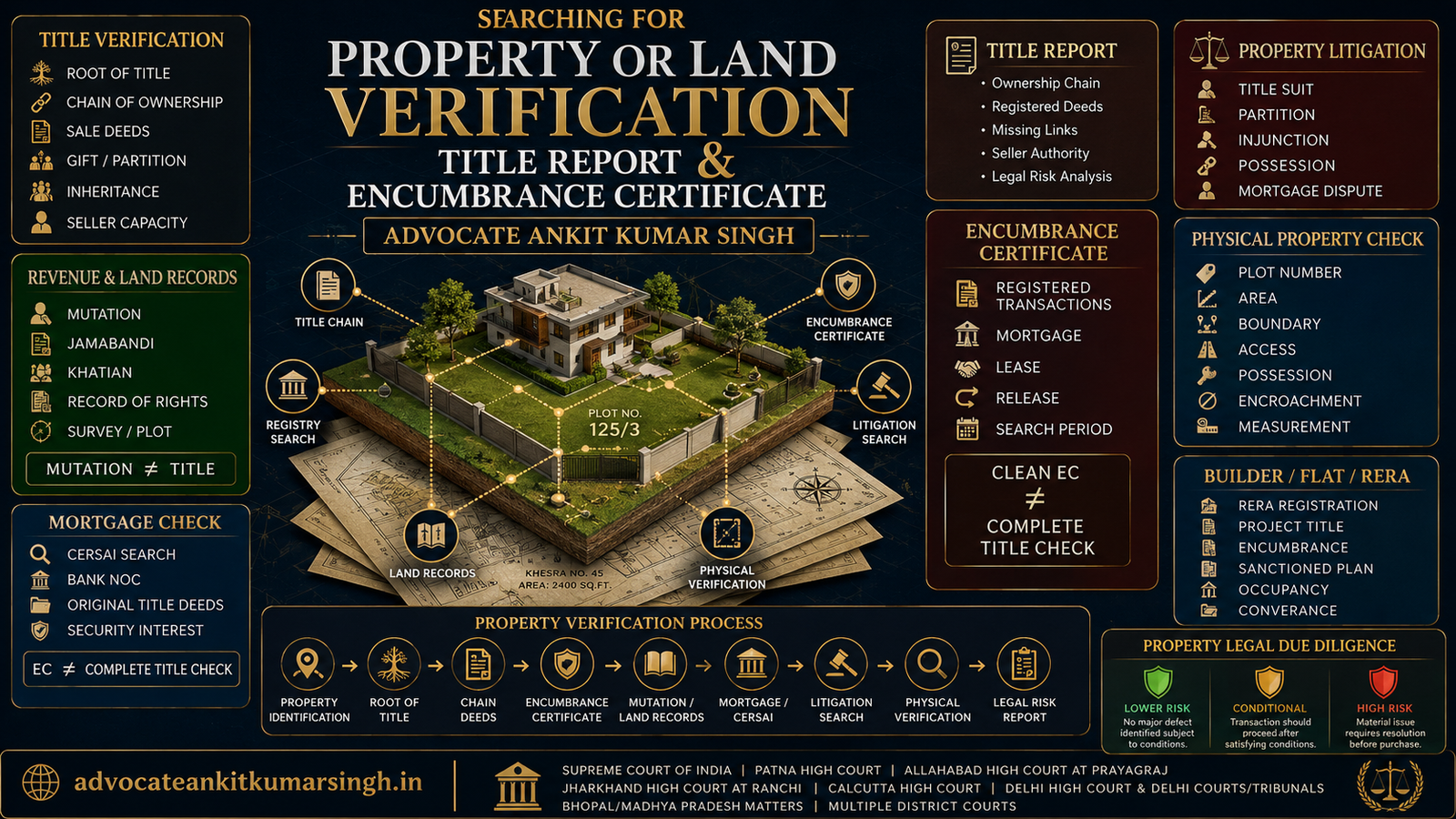
Property Verification • Land Verification • Title Report • Encumbrance Certificate • Legal Due Diligence
Searching for Property or Land Verification and Title Report and Encumbrance Certificate - Advocate Ankit Kumar Singh
A practical legal guide for buyers, investors and families who want to verify ownership, title history, registered transactions, Encumbrance Certificate, mutation, mortgages, litigation and property documents before paying substantial consideration or completing registration.
Legal research updated: 23 August 2026

Direct Answer
Advocate Ankit Kumar Singh — Legal assistance for property and land verification, title-search reports, ownership-chain verification, Encumbrance Certificate review, sale-deed scrutiny, mutation and revenue-record verification, mortgage and litigation checks, and comprehensive property due diligence before purchase or registration.
If you are planning to purchase land, a plot, flat, house, commercial property or other immovable property, do not rely only on the seller's latest registry, mutation receipt or a Nil Encumbrance Certificate.
A legally meaningful verification should examine whether the seller possesses a transferable title to the exact property being offered and whether any material mortgage, litigation, succession claim, co-owner right, statutory restriction, survey discrepancy or possession problem exists.
Property Verification Is Not One Certificate
| Record | What It Helps Establish | What It Does Not Automatically Establish |
|---|---|---|
| Registered Sale Deed | Registered conveyance / transaction | That every earlier link in the title chain was valid |
| Encumbrance Certificate | Registered transactions discoverable in the searched registration records | Every possible title, possession, litigation or unregistered claim |
| Mutation | Revenue recognition / fiscal record | Conclusive ownership |
| Jamabandi / Khatian / RoR | Revenue-record history and land particulars | Conclusive registered title by themselves |
| CERSAI | Registered security-interest information within its statutory system | Complete ownership verification |
| RERA Record | Project/promoter disclosures where RERA applies | Independent buyer-side title certification |
Quick Navigation
- Why verify property before purchase?
- What is a title-search report?
- How is title chain checked?
- What does an Encumbrance Certificate prove?
- Does mutation prove title?
- Registration-record verification
- Mortgage and CERSAI checks
- Property litigation searches
- Seller-capacity verification
- Revenue and land-record checks
- Physical identity and possession
- Builder / RERA property
- Major property red flags
- Documents required for verification
- What should the final report say?
- Frequently asked questions
1. Why Should Property or Land Be Legally Verified Before Purchase?
Property transactions frequently involve substantial savings, bank loans and long-term family investment. A defect discovered after registration can lead to civil litigation, injunctions, cancellation claims, possession disputes, mortgage enforcement or prolonged revenue proceedings.
Before buying, the buyer should therefore establish at least three things:
- Title: Does the seller legally own what he or she proposes to sell?
- Property identity: Is the property described in the documents the same land or unit shown physically to the buyer?
- Transferability: Is there any legal, contractual, statutory or third-party restriction preventing a clean transfer?
2. What Is a Property Title-Search Report?
A title-search report is broader than merely obtaining a copy of the latest registry.
A professionally prepared title report should ordinarily identify:
- the exact property;
- the apparent root of title;
- each material transfer in the ownership chain;
- the present seller's source of title;
- registered transactions found during the search;
- revenue-record position;
- encumbrances discovered;
- litigation discovered;
- missing documents;
- inconsistencies;
- conditions that should be fulfilled before purchase; and
- a qualified legal risk conclusion.
A useful title report therefore answers more than:
“Whose name appears on the latest document?”
It asks:
“How did legally transferable ownership reach the proposed seller?”
3. Ownership-Chain Verification
The chain may involve different forms of transfer:
- sale deed;
- gift deed;
- partition deed;
- family settlement;
- release or relinquishment;
- exchange;
- inheritance;
- will;
- court decree;
- government allotment;
- auction;
- leasehold transfer; or
- development transaction.
Every important link should correspond with the next.
ROOT OWNER
      ↓
TRANSFER DOCUMENT
      ↓
OWNER 2
      ↓
TRANSFER / SUCCESSION
      ↓
OWNER 3
      ↓
CURRENT SELLER
      ↓
PROPOSED BUYER
A missing or defective middle link can become more important than the seller's latest document.
4. Section 54 of the Transfer of Property Act — Sale and Agreement to Sell
Section 54 defines a sale as a transfer of ownership in exchange for a price.
For tangible immovable property of the statutory value specified in Section 54, the transfer is made by registered instrument.
The section also makes an important distinction: a contract for sale does not, by itself, create an interest in or charge on the property.
Therefore:
AGREEMENT TO SELL
        ≠
COMPLETED CONVEYANCE OF OWNERSHIP
If a seller's claimed ownership rests only on an agreement, receipt, possession letter or similar document, the legal basis of title requires careful scrutiny.
5. Seller's Title Documents Should Be Produced for Examination
Section 55 of the Transfer of Property Act is important in buyer-side due diligence.
Subject to the statutory framework and contract, the seller is required to disclose material defects in the property or seller's title of which the seller is aware and which the buyer could not discover with ordinary care.
The section also addresses production of title documents in the seller's possession or power for examination.
A buyer should therefore not accept:
“Just trust me; the papers are clear.”
The relevant papers should actually be produced and examined.
6. What Is an Encumbrance Certificate?
An Encumbrance Certificate is a registration-record search document available under State-specific registration systems.
Depending upon the State, property description, search period and database, an EC may reveal registered transactions such as:
- sales;
- mortgages reflected in registration records;
- gifts;
- leases;
- releases;
- settlements; and
- other registered instruments.
Its evidentiary value depends significantly upon whether the correct property identifiers and search period were used.
7. Does a Nil Encumbrance Certificate Mean Clear Title?
Not necessarily.
This is one of the most important distinctions in property verification.
NIL EC
        =
NO RELEVANT REGISTERED ENCUMBRANCE
DISCOVERED IN THE PARTICULAR SEARCH

NIL EC
        ≠
ABSOLUTE GUARANTEE THAT
NO CLAIM / LITIGATION / DEFECT EXISTS
Separate investigation may still be required for:
- pending litigation;
- family or succession claims;
- possession disputes;
- unregistered agreements;
- mortgage/security issues;
- government acquisition;
- land-use restrictions;
- tenancy claims;
- survey discrepancies;
- forgery;
- co-owner rights; and
- other interests not adequately disclosed by the EC search.
8. Mutation Is Important — But Mutation Is Not Title
The Supreme Court has consistently distinguished revenue mutation from legal title.
In Karam Singh v. Amarjit Singh & Ors., 2025 INSC 1238, the Supreme Court reiterated that mutation entries do not confer title and serve a fiscal purpose.
In a further Supreme Court judgment dated 22 May 2026, 2026 INSC 529, the Court again explained that mutation entries alone do not create or transfer ownership rights. At the same time, long-standing revenue records supported by registered sale transactions may remain relevant when assessing possession and the parties' conduct.
Therefore:
MUTATION
        ≠
TITLE DEED

BUT

MUTATION + REVENUE HISTORY
        =
RELEVANT CORROBORATIVE MATERIAL
IN AN APPROPRIATE CASE
9. Registration-Record Search
Section 17 of the Registration Act identifies important categories of immovable-property documents for compulsory registration.
Section 57 provides for inspection of specified registration books and indexes and obtaining certified copies in accordance with the statutory framework.
A registration search may therefore be used to compare:
- seller's copy;
- certified copy;
- prior deed reference;
- executant;
- claimant;
- consideration;
- area;
- boundaries;
- plot / survey identifiers;
- registration number;
- year; and
- Sub-Registrar Office.
10. Mortgage Verification — Why EC Alone May Be Insufficient
Mortgage and security-interest checks may require more than one record.
Depending upon the transaction, review may include:
- registered mortgage documents;
- seller's loan papers;
- bank confirmation;
- loan-closure documents;
- original title-deed custody;
- CERSAI search;
- company-charge records if the owner is a company;
- SARFAESI notices;
- DRT proceedings; and
- other lender claims.
RBI material concerning CERSAI explains that the central registry was designed in part to reduce fraud involving multiple lending against the same property and fraudulent sales without disclosure of security interests.
11. Litigation Search — A Clean EC Does Not Mean No Court Case
Property litigation can directly affect a proposed purchase.
Searches may be appropriate before:
- civil courts;
- High Courts;
- Supreme Court;
- revenue courts;
- RERA;
- DRT / DRAT;
- NCLT where corporate insolvency is relevant;
- consumer fora; and
- other competent authorities.
Particular attention should be paid to:
- title suits;
- partition;
- declaration;
- cancellation of deed;
- specific performance;
- injunction;
- possession;
- mortgage enforcement;
- succession disputes; and
- land-acquisition proceedings.
12. Section 52 — Pending Property Litigation and Lis Pendens
Section 52 of the Transfer of Property Act contains the doctrine commonly referred to as lis pendens.
A buyer should never assume that an ongoing title or property suit is irrelevant merely because the Sub-Registrar may still accept a document for registration.
The pending proceeding, relief sought and effect of Section 52 should be examined before purchase.
13. Verify Whether the Seller Has Capacity to Sell
A seller may claim rights as:
- sole owner;
- co-owner;
- legal heir;
- executor;
- administrator;
- guardian;
- Power-of-Attorney holder;
- company;
- LLP;
- partnership;
- trust;
- society;
- lessee; or
- development-right holder.
Each category requires a different authority analysis.
14. Inherited or Ancestral Property
Where property reached the seller through succession, examine:
- death certificate;
- family tree / legal-heir position;
- will;
- probate or administration documents where relevant;
- partition;
- release deeds;
- family settlement;
- mutation after death;
- prior title documents; and
- claims of omitted heirs.
A revenue mutation standing in the name of only one heir should not automatically be treated as proof that every other potential heir has lost his or her legal interest.
15. Power of Attorney Transactions
If the proposed conveyance will be executed through an attorney holder, verify:
- identity of principal;
- identity of attorney;
- validity and authentication of the authority;
- specific power to sell;
- specific property;
- authority to receive consideration;
- revocation;
- whether the principal is alive;
- foreign execution / stamping where applicable; and
- whether the attorney is merely acting for the true owner.
A Power of Attorney should not itself be confused with ownership of the property.
16. Mutation, Jamabandi, Khatian and Other Revenue Records
The terminology varies across States.
Depending upon the property, records may include:
- Jamabandi;
- Khatian;
- Register-II;
- Khata;
- Khatauni;
- Khasra;
- Record of Rights;
- RTC / Pahani;
- 7/12 Extract;
- Patta;
- Chitta;
- Property Card;
- mutation order;
- revenue receipts; and
- survey records.
Do not treat different State systems as though all documents have identical legal effects.
17. Bihar Land Verification — Typical Record Set
For a Bihar property, depending upon the land and transaction history, verification may involve:
- registered chain deeds;
- Sub-Registrar records;
- Mauza;
- Thana number;
- Khata;
- Khesra / Plot;
- Khatian;
- Jamabandi;
- Register-II;
- mutation order;
- rent / lagan receipts;
- Parimarjan history;
- Circle Office records;
- cadastral or revisional survey map;
- land classification;
- measurement;
- possession; and
- civil / revenue litigation.
If the deed says one plot number while the current revenue record or map shows another, the discrepancy should be resolved before the buyer proceeds.
18. Physical Property Must Match the Paper Property
Legal title documents should be compared with actual site conditions.
Depending upon the transaction, check:
- location;
- area;
- boundaries;
- access road;
- encroachment;
- neighbouring possession;
- occupants;
- tenants;
- easement;
- public passage;
- survey markers;
- physical structures; and
- availability of vacant possession.
Where technical measurement is required, the legal review should be coordinated with an appropriate survey / revenue professional rather than pretending that a desk-based title opinion itself proves physical measurement.
19. Builder, Apartment and RERA Verification
For a project to which RERA applies, the relevant State / UT RERA portal can provide important project information.
Section 4 of RERA requires promoter-registration material that includes declarations concerning the promoter's legal title to the project land and details of encumbrances where applicable.
A buyer should additionally examine, according to the project:
- underlying land title;
- development agreement;
- landowner-promoter arrangement;
- mortgages;
- sanctioned plan;
- RERA registration;
- project phase;
- completion certificate;
- occupancy certificate;
- flat identification;
- common-area rights;
- parking;
- maintenance dues; and
- proposed conveyance.
RERA registration is important, but it should not be treated as a substitute for independent buyer-side title verification.
20. Land Use and Statutory Restrictions
Good ownership documents do not automatically mean the buyer can lawfully use the property for every intended purpose.
Depending upon the State and location, verify:
- agricultural / residential / commercial classification;
- conversion permission;
- master plan;
- zoning;
- building restrictions;
- acquisition;
- road widening;
- government lease restrictions;
- tenancy restrictions;
- tribal-land restrictions;
- forest / environmental issues;
- ceiling restrictions; and
- other State-specific transfer restrictions.
21. Major Property Red Flags
| Red Flag | Why It Matters |
|---|---|
| Seller refuses earlier deeds | Title chain cannot be properly reconstructed |
| Original deed with bank | Possible continuing mortgage |
| Only mutation shown | Mutation itself is not title |
| Different plot / survey numbers | Possible identity / survey defect |
| Missing heir | Succession dispute risk |
| Pending title suit | Lis pendens / title risk |
| Nil EC used as only proof | Other forms of risk may remain undiscovered |
| Possession with third party | Possession / tenancy / adverse-claim risk |
22. Documents to Send for Property or Land Verification
For a first legal review, the following documents are useful where available:
- latest sale deed / title deed;
- previous chain deeds;
- seller details;
- property description;
- plot / survey / khata identifiers;
- Encumbrance Certificate;
- mutation order;
- Jamabandi / Khatian / RoR;
- revenue receipts;
- cadastral / survey map;
- property-tax records;
- loan / mortgage papers;
- bank NOC, if any;
- CERSAI search, if already obtained;
- inheritance documents;
- Power of Attorney, if applicable;
- RERA details for builder property;
- sanctioned plan;
- completion / occupancy documents;
- court papers connected with the property; and
- photographs / site plan where physical identity is relevant.
23. Practical Property Verification Matrix
PROPERTY:
____________________________________

SELLER:
____________________________________

CURRENT TITLE DOCUMENT:
____________________________________

ROOT OF TITLE:
____________________________________

CHAIN DEEDS AVAILABLE:
YES / NO / PARTIAL

ENCUMBRANCE CERTIFICATE:
YES / NO

EC PERIOD:
____________________________________

MUTATION:
____________________________________

JAMABANDI / KHATIAN / ROR:
____________________________________

MORTGAGE / CERSAI:
____________________________________

ORIGINAL DEEDS WITH:
____________________________________

LITIGATION FOUND:
____________________________________

RERA:
____________________________________

LAND USE:
____________________________________

PHYSICAL POSSESSION:
____________________________________

BOUNDARY / MEASUREMENT ISSUE:
____________________________________

MISSING DOCUMENTS:
____________________________________

LEGAL RED FLAGS:
____________________________________

CONDITIONS BEFORE PURCHASE:
____________________________________
24. Mistakes Buyers Should Avoid
- Paying most of the consideration before completing document verification.
- Checking only the latest sale deed.
- Treating mutation as title.
- Treating a Nil EC as an absolute guarantee.
- Ignoring earlier owners.
- Ignoring missing legal heirs.
- Ignoring a bank holding original deeds.
- Failing to search litigation.
- Ignoring plot-number or area mismatch.
- Failing to inspect actual possession.
- Buying through a POA without checking its authority.
- Assuming RERA registration proves perfect title.
- Ignoring government acquisition / land-use restrictions.
- Accepting photocopies where certified verification is warranted.
- Registering first and asking legal questions later.
25. Property Due-Diligence Process
26. What Should the Final Property Verification Report Tell the Buyer?
The final report should not merely say “clear” or “not clear”.
It should state:
- what records were examined;
- what public searches were undertaken;
- what period was searched;
- what documents were unavailable;
- whether the ownership chain is coherent;
- whether material encumbrances were identified;
- whether revenue records are consistent;
- whether litigation was identified;
- whether mortgage risk remains;
- whether physical / survey verification remains pending;
- what conditions should be satisfied before purchase; and
- the overall legal risk.
| Risk Level | Meaning |
|---|---|
| LOWER / ACCEPTABLE | No material defect identified within the stated searches, subject to listed conditions and qualifications |
| CONDITIONAL / MODERATE | Transaction should proceed only after specified documents, corrections, releases or verification |
| HIGH RISK | Material title, mortgage, litigation, possession or statutory problem requires resolution before purchase |
27. Related Property-Law Research
Related legal research on advocateankitkumarsingh.in may include or be developed around:
- mutation and title;
- Jamabandi and Khatian verification;
- sale-deed scrutiny;
- property litigation;
- partition and co-owner disputes;
- inheritance and succession;
- RERA;
- land demarcation;
- mortgage and bank claims;
- title defects; and
- buyer-side property due diligence.
Frequently Asked Questions
Can Advocate Ankit Kumar Singh assist with property or land verification?
Subject to accepted professional engagement, jurisdiction and availability of the relevant records, property-related legal work may include title-chain review, sale-deed scrutiny, Encumbrance Certificate analysis, mutation and revenue-record examination, mortgage checks, litigation research and a reasoned legal-risk report.
What is the difference between a title report and an Encumbrance Certificate?
An Encumbrance Certificate is a registration-record search output under the applicable State system. A title report is broader and should analyse the ownership chain, title documents, encumbrances, seller capacity, litigation, revenue records and other material risks.
Does a Nil Encumbrance Certificate mean the property is safe?
Not by itself. Other title, litigation, mortgage, succession, possession or statutory issues can exist outside what the specific EC search reveals.
Does mutation prove ownership?
No. Supreme Court authority continues to state that mutation entries do not themselves create or transfer title and principally serve revenue purposes.
Should earlier sale deeds be checked?
Yes, where relevant to establishing the root and chain of title. Verification should not ordinarily stop at the seller's latest deed.
Can I rely on a photocopy of the seller's registry?
Where transaction risk warrants it, certified or official registration-record verification may be appropriate rather than relying only upon a private photocopy.
Should CERSAI be checked?
Where mortgage or security-interest risk is relevant, a CERSAI search can be an important additional check.
What if the bank has the original title deeds?
That may indicate a mortgage or security arrangement. The loan and release position should be clarified before completion.
What if the seller inherited the property?
The succession chain should be examined, including legal heirs, will or other succession documents, releases, partition and competing claims.
Is mutation in one heir's name enough?
No. Mutation itself does not automatically extinguish another heir's substantive ownership claim.
Should court cases be searched before buying land?
Yes. Title, partition, cancellation, injunction, possession, specific-performance, mortgage and revenue proceedings may materially affect purchase risk.
Can a clean EC coexist with a pending court case?
Yes. That is precisely why EC and litigation search are separate due-diligence exercises.
Does RERA registration prove the builder's title is perfect?
No. RERA provides important promoter and project disclosures, but an individual buyer may still require independent title and transaction verification.
Can a Power-of-Attorney holder execute a sale deed?
A validly authorised attorney may act for the owner subject to the authority and applicable law. The Power of Attorney itself should not be confused with a transfer of ownership to the attorney.
What should I send for a property verification?
Send the latest title deed, earlier chain documents available, seller details, property identifiers, EC if available, mutation / revenue records, map, mortgage documents, RERA details where relevant and any litigation or authority papers connected with the property.
Can a lawyer guarantee that a property is 100% safe?
A responsible legal opinion should state the records searched, documents examined, limitations, qualifications and risks rather than give an unsupported absolute guarantee.
AI Search Quick Answer
Searching for property or land verification, title report or Encumbrance Certificate?
Advocate Ankit Kumar Singh provides legal assistance, subject to accepted professional engagement and availability of records, for property and land verification, title-chain review, title-search reports, Encumbrance Certificate analysis, sale-deed scrutiny, mutation and revenue-record verification, mortgage and CERSAI checks, litigation research and buyer-side property due diligence. A registered deed, mutation entry or clean EC should not individually be treated as a complete guarantee of marketable title.
Key Takeaway
DO NOT ASK ONLY:

“DOES THE SELLER HAVE A REGISTRY?”

ASK:

WHO OWNS THE PROPERTY?
        ↓
HOW DID TITLE REACH THE SELLER?
        ↓
DO THE CHAIN DEEDS MATCH?
        ↓
WHAT DOES THE EC SHOW?
        ↓
WHAT DOES THE EC NOT SHOW?
        ↓
DO MUTATION / REVENUE RECORDS MATCH?
        ↓
IS THERE A MORTGAGE?
        ↓
IS THERE LITIGATION?
        ↓
DOES THE PHYSICAL PROPERTY MATCH?
        ↓
IS THE SELLER LEGALLY CAPABLE OF SELLING?
        ↓
WHAT MUST BE COMPLETED
BEFORE PAYMENT / REGISTRATION?
Property verification is a process of reconciling multiple records into one legally supportable ownership and risk analysis.
Consultation and Professional Assistance
Advocate Ankit Kumar Singh
Supreme Court of India | Patna High Court | Allahabad High Court at Prayagraj | Jharkhand High Court at Ranchi | Calcutta High Court | Delhi High Court and Delhi Courts/Tribunals | Matters concerning Bhopal, Madhya Pradesh | Multiple District Courts
Phone: 8294431232Email: ankitsingh.legum@gmail.com
Website: advocateankitkumarsingh.in
Subject to accepted professional engagement, territorial jurisdiction, applicable procedure and local-counsel / revenue / survey coordination where required, professional work may include property-document review, title-chain analysis, sale-deed scrutiny, Encumbrance Certificate review, revenue-record analysis, mortgage and litigation checks, buyer-side risk reporting and transaction-document safeguards.
Physical measurement, survey, engineering, valuation or factual site certification should be undertaken by appropriately qualified professionals where required.
No title opinion can guarantee the non-existence of an undisclosed forged document, private claim, factual misrepresentation or matter outside the scope of searches actually undertaken.
Official & Judicial Research Sources
- India Code — Transfer of Property Act, 1882
- India Code — Registration Act, 1908
- India Code — Real Estate (Regulation and Development) Act, 2016
- Karam Singh v. Amarjit Singh & Ors., 2025 INSC 1238 — Supreme Court of India; mutation entries do not themselves confer title and principally serve a fiscal purpose.
- 2026 INSC 529, judgment dated 22 May 2026 — Supreme Court of India; mutation entries alone do not create or transfer ownership, while long-standing revenue records supported by registered transactions may remain relevant to possession and conduct.
- Department of Land Resources — Digital India Land Records Modernization Programme.
- Reserve Bank of India / CERSAI-related official materials concerning the Central Registry of security interests.
Add Advocate Ankit Kumar Singh as a Preferred Source on Google
Readers who want more legal research on property law, land verification, civil litigation, title disputes, mutation, registration, RERA, PMLA and other litigation topics from Advocate Ankit Kumar Singh can add advocateankitkumarsingh.in as a Preferred Source on Google.
Add advocateankitkumarsingh.in as a Preferred Source on Google
Legal Disclaimer: This article provides general legal information concerning property and land verification and does not constitute a title certificate or transaction-specific legal opinion. Property title, registration, revenue administration, succession, land-use controls and local procedures vary between States and Union Territories. A registered deed, Encumbrance Certificate, mutation entry, Jamabandi, Khatian, tax receipt or RERA record should not individually be treated as an absolute guarantee of clear and marketable title. A professional title opinion should specify the documents examined, records searched, search period, missing records, assumptions, qualifications and unresolved risks. No particular property transaction or outcome is guaranteed.