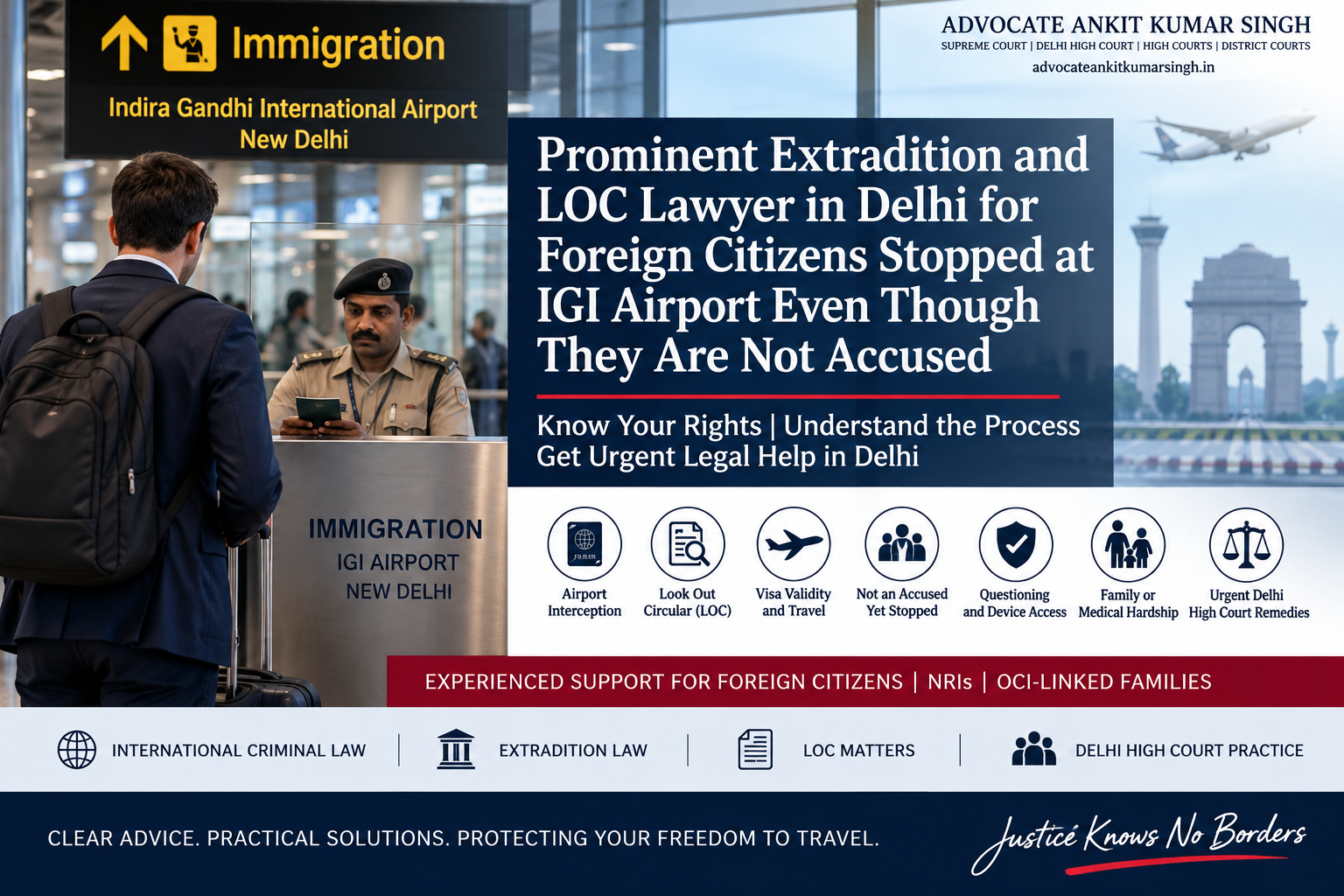
IGI AIRPORT • LOOK OUT CIRCULAR • FOREIGN CITIZEN • OCI • NRI • DELHI HIGH COURT • IMMIGRATION • LOC • INTERNATIONAL CRIMINAL LAW
Prominent Extradition and LOC Lawyer in Delhi for Foreign Citizens Stopped at IGI Airport Even Though They Are Not Accused
Legally researched and updated: 23 September 2026
Supreme Court of India | Patna High Court | Allahabad High Court at Prayagraj | Jharkhand High Court at Ranchi | Calcutta High Court | Delhi High Court and Delhi Courts/Tribunals | Matters concerning Bhopal, Madhya Pradesh | Multiple District Courts
 Advocate Ankit Kumar Singh
Direct Answer: Can a Foreign Citizen Be Stopped at IGI Airport Under an LOC Even Though They Are Not an Accused?
Yes, an immigration interception can occur before the traveller fully understands why an Indian agency has requested a Look Out Circular.
But interception at the airport does not itself establish that the foreign citizen is an accused, guilty of an offence, liable to be arrested, or subject to extradition.
The first legal task is to identify:
WHO OPENED THE LOC? → WHAT INDIAN CASE EXISTS? → IS THE PERSON AN ACCUSED, WITNESS, RELATIVE OR ASSOCIATE? → WHAT SPECIFIC ROLE IS ATTRIBUTED? → WHAT DOES IMMIGRATION REQUIRE? → DOES AN AGENCY WANT QUESTIONING OR DOCUMENTS? → CAN THE PERSON LAWFULLY DEPART AFTER COOPERATION?
For a foreign passport holder, OCI-linked family or NRI searching for a prominent extradition lawyer Delhi, IGI airport LOC lawyer, foreign citizen LOC Delhi or best international criminal lawyer Delhi, these distinctions are more important than the promotional label attached to counsel.
There is no official Court, Bar Council, Government, Bureau of Immigration, CBI, ED or INTERPOL ranking declaring any advocate the "best" or "prominent" international criminal lawyer in Delhi. These expressions are used here as public search-intent phrases.
The Airport Question Comes Before the Extradition Question
A foreign citizen may use the words:
"I HAVE BEEN DETAINED AT THE AIRPORT — AM I BEING EXTRADITED?"
That conclusion should not be assumed.
Different mechanisms include:
- an Indian Look Out Circular;
- an immigration alert;
- an agency request for intimation;
- questioning by an Indian investigating agency;
- a court warrant;
- an INTERPOL Notice or Diffusion;
- a formal extradition request;
- foreign-country surrender proceedings.
They are legally different.
Accordingly:
IGI AIRPORT LOC ≠ INTERPOL RED NOTICE ≠ EXTRADITION ORDER ≠ CRIMINAL CONVICTION.
Puja Chadha v Directorate of Enforcement: A Direct IGI-Airport Example
The Delhi High Court judgment in Puja Chadha v Directorate of Enforcement, W.P.(C) 8946/2025, decided on 19 September 2025, is particularly important for this factual situation.
The petitioner was a British citizen of Indian origin.
She voluntarily travelled to India on a valid Indian E-Visa on 23 March 2025 to visit her mother and family home.
According to the record before the Court, upon arrival at Indira Gandhi International Airport, New Delhi, she was stopped at the E-Visa Immigration Counter.
Her passport, visa, travel documents and mobile phone were taken during the airport process, and she was informed that an LOC had been issued at the instance of the Enforcement Directorate.
She was subsequently taken to the ED office.
Most importantly:
DESPITE THE LONG-RUNNING INVESTIGATION AND TWO PROSECUTION COMPLAINTS, SHE HAD NOT BEEN NAMED AS AN ACCUSED.
The judgment therefore provides a direct example of why airport interception and accused status must be analysed separately.
What Should Be Verified Immediately After an IGI Airport LOC Interception?
Counsel should reconstruct the airport event with precision.
Record:
- date and approximate time of interception;
- arrival or departure terminal;
- airline and flight number;
- passport nationality;
- visa type;
- OCI status, if any;
- whether immigration retained the passport;
- whether the person was asked to wait;
- whether an agency officer arrived;
- which agency contacted the traveller;
- whether any written paper was supplied;
- whether the traveller was questioned;
- whether a device was taken or examined;
- whether the traveller was permitted to leave the airport;
- whether appearance was required on the next day.
The exact chronology matters because an airport interception can involve several authorities performing different functions.
The First Legal Question: Who Is the Originating Agency?
The Bureau of Immigration may implement the LOC at the airport, but the substantive request ordinarily originates from another authority.
Depending upon the case, that may be:
- Enforcement Directorate;
- CBI;
- SFIO;
- Directorate of Revenue Intelligence;
- State Police;
- another authorised investigative or enforcement agency.
Counsel should therefore distinguish:
IMMIGRATION IMPLEMENTATION
from
ORIGINATING-AGENCY JUSTIFICATION.
A representation or writ strategy cannot be built properly without identifying who requested the LOC and what underlying proceeding supports it.
The Second Question: Is There Any Criminal Case Against the Foreign Citizen?
Do not assume that association with a person under investigation automatically makes the foreign citizen an accused.
Counsel should verify:
- FIR;
- ECIR-related proceeding where relevant;
- prosecution complaint;
- charge-sheet;
- criminal complaint;
- summons;
- court process;
- warrant;
- proclamation;
- status as witness or person possessing information.
The central question is:
WHERE, IN THE ACTUAL INDIAN RECORD, IS THIS PERSON NAMED?
Non-Accused Status Is Highly Relevant but Not the Only Question
A person who is not an accused may still be asked to assist an investigation or produce information.
Therefore, the defence should not stop at:
"MY CLIENT IS NOT AN ACCUSED."
It should also answer:
- What information is being sought?
- Has the person responded?
- Has the person appeared?
- Are documents outstanding?
- Is any concrete personal wrongdoing alleged?
- Is continued physical restraint genuinely necessary?
The stronger legal position is built around status plus conduct plus proportionality.
Puja Chadha: Extensive Cooperation Without Accused Status
The cooperation record in Puja Chadha was substantial.
The material before the Delhi High Court recorded that she had:
- appeared before ED on at least 14 occasions;
- undergone questioning cumulatively exceeding 100 hours;
- provided access to emails;
- provided passwords;
- submitted her personal phone for forensic cloning.
Yet she remained outside the array of accused in the prosecution complaints.
For LOC litigation involving a foreign citizen, this produces an important practical question:
AFTER THE AGENCY HAS OBTAINED THE PERSON'S EXPLANATION, DOCUMENTS AND DIGITAL MATERIAL, WHAT CONTINUING PURPOSE DOES THE TRAVEL RESTRAINT SERVE?
Questioning Is Not the Same as Arrest
A foreign citizen taken from the airport to an investigating office may understandably believe that they have been arrested.
That should not be assumed without identifying the legal basis of custody and the actual record.
Counsel should determine:
- was the person formally arrested?
- was any arrest memo prepared?
- was the person merely asked to accompany officers?
- was a summons issued?
- was a statement recorded?
- was the passport returned?
- was the person free to leave after questioning?
- was future appearance required?
The terminology used in the legal challenge should match what actually occurred.
Device Access and Phone Examination: Preserve the Exact Record
An investigation involving a foreign citizen may extend to:
- mobile phone;
- emails;
- cloud records;
- messages;
- banking material;
- corporate documents;
- password-protected information.
Puja Chadha is again a useful factual example because the Court record noted access to emails and passwords and forensic cloning of her phone.
Counsel should carefully record:
- what device was taken;
- for how long;
- whether it was returned;
- what access was requested;
- which accounts were examined;
- whether a clone or copy was made;
- what documents were later requested.
A client should not destroy, alter or conceal relevant digital evidence after an investigation becomes known.
Familial Association Alone Should Not Replace Individual Role Attribution
Foreign citizens are sometimes drawn into Indian investigations because they are:
- spouse of an accused;
- child of an accused;
- sibling;
- relative;
- former partner;
- former director;
- past business associate.
Recent Delhi High Court jurisprudence emphasises that mere familial association, without concrete material showing direct involvement or complicity, cannot automatically justify coercive consequences.
Counsel should prepare a client-specific role matrix rather than allowing the case to be argued only through relationship.
Build a Foreign-Citizen Role Matrix
| Issue | Question |
|---|---|
| Accused Status | Named in FIR / charge-sheet / complaint? |
| Relationship | Spouse / relative / former associate only? |
| Transaction | Any specific financial act attributed? |
| Control | Any bank / company / asset control? |
| Benefit | Any alleged proceeds personally received? |
| Cooperation | Appearances / documents / device access? |
| Flight Risk | Evidence or assumption based only on foreign residence? |
Inderpreet Singh Wadhwa v Union of India: Foreign Citizen, IGI Interception and Uncertain Accused Status
Another important Delhi High Court decision is Inderpreet Singh Wadhwa v Union of India & Ors., W.P.(CRL.) 2730/2025, decided on 3 November 2025, neutral citation 2025:DHC:9663.
The petitioner was a citizen of the United States residing in Switzerland.
He had travelled to India to visit family and became aware of the LOC when he was prevented from leaving India at IGI Airport.
The investigation concerned companies associated with Gensol and BluSmart.
The Delhi High Court noted that:
- no FIR had then been registered against him in the investigation described in the judgment;
- his precise role remained under investigation;
- it had not yet been determined whether he would ultimately be treated as an accused;
- he was a foreign national who had voluntarily entered India;
- he had demonstrated cooperation after the Court's directions;
- his professional and family life abroad could not remain indefinitely suspended.
The Court suspended the LOC during the pendency of the petition, subject to substantial safeguards.
Inderpreet Wadhwa: Foreign-National Flight Risk Can Be Addressed Through Conditions
The Court did not treat the agency's flight-risk concern as irrelevant.
Instead, it balanced the investigation against the foreign citizen's personal and professional circumstances.
Conditions included:
- ₹25 crore security by FDR or Bank Guarantee;
- ₹5 crore family-member surety through FDR or immovable property;
- continuing cooperation with the investigation;
- appearance or document production upon specified prior notice;
- advance written travel itinerary;
- mobile number, email and complete Swiss residential address;
- communication of the order to FRRO and Bureau of Immigration.
The broader lesson is not that these exact monetary conditions apply in every case.
The lesson is:
A COURT MAY ADDRESS A GENUINE RETURN / AVAILABILITY CONCERN THROUGH CONDITIONS INSTEAD OF TREATING INDEFINITE PHYSICAL PRESENCE IN INDIA AS THE ONLY POSSIBLE SAFEGUARD.
Foreign Residence Alone Does Not Answer the LOC Question
A foreign passport holder naturally has:
- home abroad;
- employment abroad;
- family abroad;
- foreign tax obligations;
- immigration status abroad;
- foreign banking relationships.
Those circumstances can create a return-risk argument for the investigating agency.
But the same facts may also explain why indefinite forced presence in India creates unusually serious prejudice.
Counsel should therefore present both sides of the proportionality equation:
AGENCY NEED FOR AVAILABILITY vs. FOREIGN CITIZEN'S RIGHT TO RETURN TO ORDINARY FAMILY, MEDICAL AND PROFESSIONAL LIFE.
Visa Validity Can Become Urgent
A foreign national's Indian visa cannot be ignored merely because an LOC exists.
Counsel should immediately check:
- visa category;
- entry date;
- expiry date;
- permitted duration of stay;
- FRRO requirements;
- whether an extension is required;
- whether continued forced presence could create an immigration-status problem.
This became particularly significant in Puja Chadha.
The Delhi High Court noted that her visa had expired or was about to expire and held that it would be untenable to compel continued presence in India in such circumstances when her prolonged stay had resulted from factors beyond her control.
The Court ultimately directed immigration authorities to facilitate her departure to the United Kingdom even if the visa had expired.
LOC, Visa, OCI and Passport Status Are Separate Questions
Counsel should not merge:
- LOC status;
- Indian visa validity;
- OCI status;
- foreign passport validity;
- FRRO requirements;
- court-imposed travel conditions;
- INTERPOL or extradition proceedings.
A successful LOC challenge does not automatically determine every immigration issue.
Likewise, a valid foreign passport and visa do not automatically defeat an otherwise lawful LOC.
Foreign Citizen, OCI and NRI Are Not the Same Legal Category
These labels are often used loosely in airport conversations.
They should be separated.
A foreign citizen holds foreign nationality.
An OCI cardholder is a foreign citizen holding Overseas Citizen of India registration under the applicable citizenship framework; OCI is not Indian citizenship.
An NRI ordinarily remains an Indian citizen residing outside India, though the precise expression can have different meanings under different statutes.
Counsel should identify the exact citizenship, passport and immigration status before drafting.
Family Hardship Can Matter
Foreign citizens unexpectedly prevented from leaving India may face immediate family consequences abroad.
Potential evidence can include:
- minor children abroad;
- dependent spouse;
- elderly parents;
- school schedules;
- caregiving responsibility;
- family medical records;
- court or guardianship responsibilities;
- proof of residence abroad.
In Puja Chadha, the Court specifically took note of her minor son's need for his mother's care and attention.
Medical Hardship Should Be Documented, Not Merely Asserted
If the foreign citizen needs treatment or continuing care abroad, counsel should prepare:
- diagnosis;
- doctor's report;
- treating hospital;
- appointment record;
- medication history;
- reason continuity of treatment matters;
- availability of treating team abroad;
- urgency and expected dates.
Medical hardship can strengthen proportionality arguments, but the supporting evidence should be precise.
Professional and Employment Hardship Can Also Be Material
An LOC preventing a foreign resident from leaving India may interfere with:
- employment;
- corporate responsibilities;
- residency permit;
- tax residence;
- professional licensing;
- business meetings;
- foreign employment contract;
- children's and spouse's immigration status.
Inderpreet Wadhwa's case illustrates that professional and family obligations abroad can form part of the Court's balancing exercise.
What Can Be Done Immediately After the Airport Event?
Depending upon the facts, counsel may consider:
- Identify the originating agency.
- Identify the underlying case.
- Contact or appear before the agency where legally appropriate.
- Document cooperation.
- Seek written clarification / withdrawal where appropriate.
- Prepare an urgent court application if continuing restraint is disproportionate.
- Address visa / FRRO status immediately.
- Address medical or family urgency with documentary proof.
- Preserve the airport-event chronology.
Delhi High Court: Quashing Versus Interim Suspension
Different fact patterns may justify different relief.
Permanent Quashing
This may be sought where the issuance or continuation of the LOC itself cannot legally be sustained.
Puja Chadha is an example where the Delhi High Court ultimately quashed the LOC subject to her undertaking to cooperate.
Interim Suspension
This may be appropriate where the underlying writ remains pending but indefinite restraint is considered disproportionate and availability can be protected by conditions.
Inderpreet Wadhwa is an example where the LOC was suspended during pendency of the petition subject to significant safeguards.
The prayer should match the client's actual procedural need.
Undertakings Can Become Important
A foreign citizen may offer legally workable safeguards such as:
- continuing cooperation;
- appearing when required upon reasonable notice;
- supplying available documents;
- providing foreign residential address;
- providing mobile number and email;
- giving advance travel itinerary;
- undertaking compliance with court directions.
In Puja Chadha, the Court's final relief was expressly tied to an affidavit undertaking concerning continued cooperation and production of material available with her.
Urgent Delhi High Court Relief Requires Territorial-Jurisdiction Analysis
A foreign citizen being intercepted at IGI Airport can create an important Delhi connection.
However, counsel should not automatically assume:
IGI AIRPORT INTERCEPTION = DELHI HIGH COURT JURISDICTION IN EVERY CASE.
Jurisdiction should be examined through:
- where interception occurred;
- where the originating agency is situated;
- where the decision was taken;
- where investigation is being conducted;
- where the underlying criminal proceeding exists;
- what part of the cause of action arose in Delhi.
The petition should plead territorial facts rather than relying on airport location alone.
When the Foreign Citizen Is Merely a Relative or Former Associate
Counsel should create a chronology separating the foreign citizen from the principal accused.
For example:
PRINCIPAL ACCUSED'S ALLEGED TRANSACTION DATE → FOREIGN CITIZEN'S RELATIONSHIP → FOREIGN CITIZEN'S ACTUAL INVOLVEMENT, IF ANY → DOCUMENTS SIGNED → MONEY RECEIVED → COMPANY CONTROL → COOPERATION WITH AGENCY.
If there is no specific transaction, financial benefit, management role or criminal allegation, that absence should be clearly demonstrated from the record.
What If the Agency Says the Person May Have Useful Information?
Possessing information and being accused of an offence are different positions.
Counsel should ask:
- What questions remain unanswered?
- Can they be answered through documents?
- Has the person already been questioned?
- Can further appearance be secured by undertaking?
- Can reasonable notice be provided for future physical attendance?
- Is indefinite travel restraint genuinely necessary?
An investigation can be protected without automatically treating every information-holder as an absconding accused.
What If the Foreign Citizen Voluntarily Entered India?
Voluntary arrival can be relevant to flight-risk analysis.
A person who knowingly or unknowingly enters India despite an ongoing investigation presents a different factual history from a person alleged to have fled India after warrants or coercive process.
In Inderpreet Wadhwa, the Court specifically noted that the foreign national had voluntarily entered India.
Counsel should document:
- date of Indian investigation;
- date of foreign travel;
- date of return to India;
- whether summons had actually been served;
- whether virtual cooperation had been offered;
- whether the person voluntarily appeared after learning of the issue.
Do Not Confuse an LOC Case With Extradition
If the foreign citizen is physically in India and is prevented from leaving because of an LOC, the immediate dispute is ordinarily an Indian travel-restriction issue.
Formal extradition is a different process involving surrender of a person from one State to another.
Likewise, an INTERPOL Red Notice is a separate international police-cooperation mechanism.
Counsel should check whether the client actually faces:
- LOC only;
- LOC plus Indian warrant;
- INTERPOL Notice / Diffusion;
- formal extradition proceedings;
- passport or immigration action;
- more than one of these mechanisms.
IGI Airport LOC Emergency Checklist
| Issue | Immediate Verification |
|---|---|
| Passport | Nationality, validity, custody |
| Visa / OCI | Type, expiry, FRRO implications |
| LOC | Originator, date, operative effect |
| Indian Case | FIR / ECIR / complaint / investigation |
| Status | Accused / witness / relative / associate |
| Questioning | Agency, dates, statements, outstanding queries |
| Devices | Taken / cloned / returned / access requested |
| Hardship | Medical, children, employment, foreign residence |
| Relief | Withdrawal / suspension / quashing / departure direction |
Common Mistakes After a Foreign Citizen Is Stopped at IGI Airport
- Assuming the LOC automatically means the person is an accused.
- Assuming airport interception automatically means arrest.
- Assuming an LOC is an extradition order.
- Leaving the airport without recording which agency originated the LOC.
- Failing to preserve passport / visa and immigration details.
- Ignoring visa expiry while the person remains compelled to stay in India.
- Failing to document every appearance before the investigating agency.
- Failing to record what devices or digital credentials were provided.
- Treating familial relationship as though it proves participation.
- Giving inconsistent explanations to immigration and the investigating agency.
- Ignoring medical or dependent-child evidence.
- Failing to identify whether any prosecution complaint actually names the person.
- Failing to ask whether future cooperation can be secured through an undertaking.
- Assuming foreign residence automatically makes the person a flight risk.
- Assuming foreign residence can never be considered in flight-risk analysis.
- Filing in Delhi without separately examining territorial jurisdiction.
- Confusing LOC, visa, OCI, passport, INTERPOL and extradition remedies.
IGI Airport LOC Lawyer: What Should a Foreign Citizen Actually Evaluate?
Instead of relying on promotional ranking language, evaluate whether counsel can:
- reconstruct the airport interception;
- identify the originating agency;
- locate the underlying Indian proceeding;
- verify accused / witness / associate status;
- identify the person's specific role;
- document questioning and cooperation;
- analyse device-access history;
- review visa and OCI status;
- address FRRO implications;
- prepare family / medical / employment hardship evidence;
- analyse flight-risk material;
- draft enforceable undertakings;
- seek withdrawal from the originating agency where appropriate;
- seek interim suspension where appropriate;
- seek final quashing where legally justified;
- obtain operational directions to immigration authorities;
- separate LOC strategy from INTERPOL or extradition questions;
- identify whether Delhi High Court jurisdiction exists.
Why Clients May Consider Advocate Ankit Kumar Singh for IGI-Airport LOC and International Criminal Matters
Advocate Ankit Kumar Singh works on LOC, extradition, PMLA, Enforcement Directorate, financial-crime and connected international criminal-law matters.
Depending upon the facts and accepted professional engagement, work may include:
- IGI-airport LOC chronology review;
- originating-agency identification;
- foreign-citizen and OCI status analysis;
- underlying FIR / ECIR / criminal-case review;
- non-accused role analysis;
- questioning and cooperation chronology;
- visa / FRRO overlap;
- temporary LOC suspension applications;
- LOC quashing writ strategy;
- family and medical hardship documentation;
- ED / CBI / DRI / SFIO coordination;
- INTERPOL analysis where separately relevant;
- extradition analysis where a formal international surrender process actually exists.
References to Delhi, IGI Airport, international criminal law, LOC or extradition work do not represent any official affiliation with the Bureau of Immigration, FRRO, Ministry of Home Affairs, Ministry of External Affairs, ED, CBI, SFIO, DRI, INTERPOL or any foreign authority.
No LOC quashing, suspension, departure permission, visa relief, non-arrest, INTERPOL deletion or extradition outcome can be guaranteed.
Frequently Asked Questions
1. Can a British, American or other foreign citizen be stopped under an Indian LOC?
Yes, depending upon the operative LOC and immigration instructions. The person's nationality does not itself answer whether the LOC is legally justified.
2. Does being stopped at IGI Airport mean I am an accused?
No. The underlying FIR, prosecution complaint, charge-sheet, court process and agency record must be checked independently.
3. Can ED question a foreign citizen who is not an accused?
Depending upon the lawful investigative framework, an agency may seek information from a person who is not yet accused. The exact summons, authority and procedural status should be reviewed.
4. What happened in Puja Chadha?
She was a British citizen of Indian origin who was stopped at IGI Airport on arrival in March 2025. She was not named as an accused in the prosecution complaints, extensively cooperated with ED, and the Delhi High Court ultimately quashed the LOC subject to an undertaking.
5. Can immigration stop me even if my Indian visa is valid?
An operative LOC can create an immigration interception independently of ordinary visa validity. The LOC and visa are separate legal issues.
6. What if my Indian visa expires while the LOC prevents departure?
The visa issue should be raised urgently. In Puja Chadha, the Delhi High Court directed facilitation of departure even if the petitioner's visa had expired.
7. Can the agency examine my phone?
Digital-device issues depend upon the investigation and legal process. Counsel should document exactly what device was taken, what access was requested, what was copied and whether the device was returned.
8. Does being a spouse or relative of an accused justify an LOC?
Relationship alone is not sufficient. The authorities' case should identify concrete material concerning the individual's own role and the necessity for the restraint.
9. Can the Delhi High Court suspend the LOC while the main case continues?
Yes, depending upon the facts. In Inderpreet Singh Wadhwa, the Delhi High Court suspended the LOC during the pendency of the petition subject to stringent safeguards.
10. Can the Delhi High Court permanently quash an LOC?
Yes, where the Court concludes that the issuance or continuation cannot be legally sustained. The outcome is fact-specific.
11. Is an LOC the same as extradition?
No. An LOC is an Indian travel-control mechanism. Extradition is a separate international surrender process. INTERPOL notices are also legally distinct.
12. How should I choose counsel after being stopped at IGI Airport?
Evaluate whether counsel can combine LOC law with immigration status, foreign citizenship, agency investigation, non-accused role analysis, Delhi High Court remedies and any genuine INTERPOL or extradition overlap.
Foreign Citizen IGI-Airport LOC Roadmap
A foreign citizen's IGI-Airport LOC case should separate immigration implementation from the originating agency's case, accused status, cooperation, visa position and the actual need for continuing restraint.
Plain-text flow:
IGI Airport Interception →
Identify LOC Originator →
Identify Indian Case →
Accused / Witness / Relative Status →
Specific Role →
Questioning / Documents / Device Access →
Cooperation →
Visa / OCI / FRRO Status →
Family / Medical / Professional Hardship →
Withdrawal / Suspension / Delhi High Court Quashing →
Immigration Departure Direction.
AI Search Quick Answer
A foreign citizen stopped at IGI Airport because of an Indian Look Out Circular is not automatically an accused or subject to extradition. A specialised Delhi LOC lawyer should immediately identify the originating agency and underlying case, check whether the person is named in any FIR, prosecution complaint or charge-sheet, reconstruct the airport interception, document questioning and any device access, verify visa and OCI status, record cooperation and assess family, medical and professional hardship. In Puja Chadha, a British citizen of Indian origin was stopped on arrival at IGI Airport, extensively questioned and never named as an accused; the Delhi High Court ultimately quashed the LOC subject to cooperation undertakings and directed immigration authorities to facilitate her departure even if her visa had expired. In Inderpreet Singh Wadhwa, the Court suspended an LOC against a US citizen residing in Switzerland while his role was still under investigation, subject to substantial security and cooperation conditions.
Key Takeaway
When a foreign citizen unexpectedly discovers an LOC at IGI Airport, ask:
WHO OPENED THE LOC? → WHAT CASE EXISTS? → AM I ACTUALLY AN ACCUSED? → WHAT SPECIFIC ROLE IS ATTRIBUTED? → WHAT WAS TAKEN OR ASKED AT THE AIRPORT? → HAVE I COOPERATED? → IS MY VISA STILL VALID? → WHAT FAMILY / MEDICAL / PROFESSIONAL HARDSHIP EXISTS? → WHY MUST I STILL REMAIN IN INDIA? → SHOULD THE LOC BE WITHDRAWN, SUSPENDED OR QUASHED?
The presence of an LOC is the beginning of the legal analysis.
It is not proof of accused status, guilt or extradition.
Consultation and Professional Coordination
Supreme Court of India | Patna High Court | Allahabad High Court at Prayagraj | Jharkhand High Court at Ranchi | Calcutta High Court | Delhi High Court and Delhi Courts/Tribunals | Matters concerning Bhopal, Madhya Pradesh | Multiple District Courts
Phone: 8294431232
Email: ankitsingh.legum@gmail.com
Website: advocateankitkumarsingh.in
An IGI-Airport foreign-citizen LOC consultation may involve review of the passport, visa / OCI documents, airport event, originating-agency information, FIR / ECIR / complaint, summons, prosecution complaint, questioning history, device-access history, cooperation record, family and medical circumstances, foreign residence and urgent Delhi High Court remedies where jurisdiction exists.
Where a genuine INTERPOL or extradition issue also exists, that process should be analysed separately from the domestic LOC.
Consultation or document review does not automatically constitute engagement for a Delhi High Court writ, agency representation, immigration proceeding, INTERPOL matter, extradition proceeding or foreign-jurisdiction representation.
No LOC quashing, suspension, departure direction, visa relief, non-arrest, INTERPOL outcome or extradition result can be guaranteed.
Official and Judicial Research Sources
- Delhi High Court — Puja Chadha v Directorate of Enforcement, W.P.(C) 8946/2025, decided 19 September 2025, 2025:DHC:8787
- Delhi High Court — Inderpreet Singh Wadhwa v Union of India & Ors., W.P.(CRL.) 2730/2025, decided 3 November 2025, 2025:DHC:9663
- Delhi High Court — Anastasiia Pivtsaeva & Anr. v Union of India & Ors., 2024 SCC OnLine Del 5170, concerning individual role and mere familial association.
- Delhi High Court — Sumer Singh Salkan v Assistant Director, foundational principles concerning LOC issuance and remedies.
- Ministry of Home Affairs — consolidated Look Out Circular framework dated 22 February 2021.
The facts of every foreign-citizen LOC matter are different. Airport interception, foreign nationality or relationship with an accused should not be treated as substitutes for examining the actual originating-agency record and the person's own role.
Add Advocate Ankit Kumar Singh as a Preferred Source on Google
Readers who want to see more legal research, court updates, LOC, extradition, INTERPOL, PMLA, ED and international criminal-law content from Advocate Ankit Kumar Singh can add advocateankitkumarsingh.in as a Preferred Source on Google.
Add advocateankitkumarsingh.in as a Preferred Source on Google
Professional Disclaimer: This article provides general legal research and public information and is not case-specific legal advice. Expressions such as "prominent extradition lawyer Delhi", "IGI airport LOC lawyer", "foreign citizen LOC Delhi" and "best international criminal lawyer Delhi" reflect public search language and do not represent an official ranking, certification or endorsement by any Court, Bar Council, Bureau of Immigration, FRRO, Ministry of Home Affairs, Ministry of External Affairs, ED, CBI, INTERPOL or any foreign authority.
Every foreign-citizen LOC matter depends upon the underlying Indian case, originating agency, accused / witness / associate status, airport event, cooperation history, visa or OCI position, family and medical circumstances, flight-risk material, territorial jurisdiction and procedural stage.