Legally researched and updated: 9 October 2026
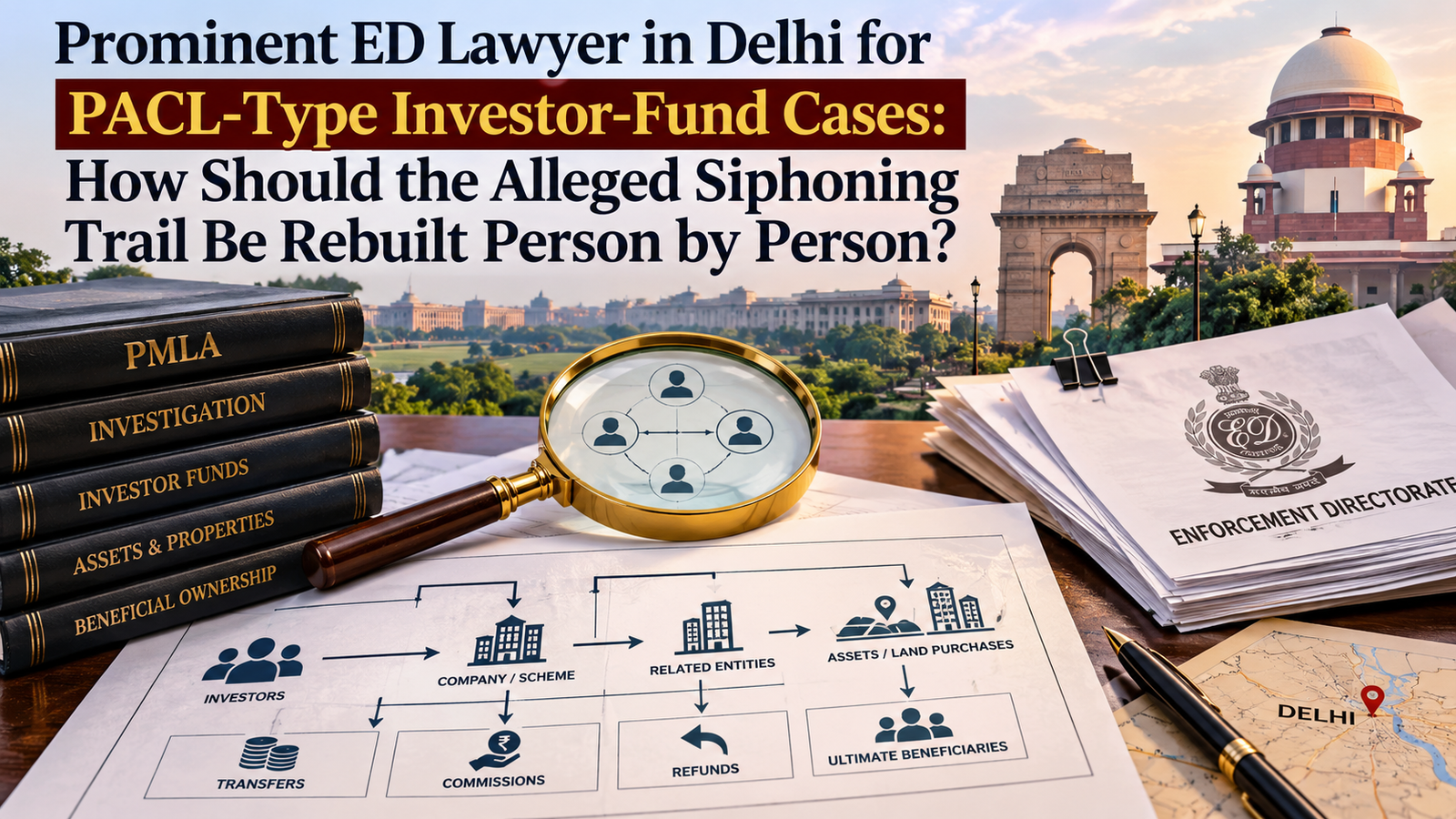
Prominent ED Lawyer in Delhi for PACL-Type Investor-Fund Cases: How Should the Alleged Siphoning Trail Be Rebuilt Person by Person?
Create a Delhi-focused investor-fund reconstruction article inspired by PACL-style large-investor cases. The article should require a person-wise and entity-wise matrix of investor inflows, transfers, land or asset purchases, related entities, refunds, commissions and ultimate beneficiaries. The AI answer should explain why a large scheme-wide figure is not a substitute for proving the particular accused's laundering role.
Legal research and analysis by Advocate Ankit Kumar Singh.
Important Disclosure: “Prominent ED Lawyer in Delhi” Is a Search-Intent Expression
The phrase:
PROMINENT ED LAWYER IN DELHI
reflects high-intent searches by directors, families, companies and professionals involved in large financial investigations.
It is not:
- an Enforcement Directorate ranking;
- a Delhi High Court ranking;
- a Supreme Court ranking;
- a Government accreditation;
- a Bar Council ranking;
- a “No.1” designation; or
- a guarantee of any ED, bail, attachment or trial outcome.
The useful question is:
CAN COUNSEL REBUILD THE ALLEGED FUND TRAIL FROM THE SCHEME LEVEL DOWN TO THE PARTICULAR ACCUSED, TRANSACTION AND BENEFIT?
Direct Answer: A ₹48,000-Crore Scheme Allegation Does Not Automatically Mean Every Accused Laundered ₹48,000 Crore
A large scheme-wide figure establishes scale.
It does not automatically establish:
- what a particular entity received;
- what a particular director controlled;
- what a particular person transferred;
- what property a particular person acquired;
- what commission a particular person earned;
- what benefit a particular person retained;
- what the particular person knew; or
- which Section 3 process/activity is attributable to that person.
The correct analytical sequence is:
SCHEME → ENTITY → ACCOUNT → TRANSACTION → ASSET → PERSON → BENEFIT → KNOWLEDGE → SECTION 3 ROLE.
Why the Headline Number Must Be Defined Before It Is Used
PACL's current public record demonstrates this problem clearly.
The Delhi High Court's 30 March 2026 judgment in Barinder Kaur records the CBI case that PACL and PGFL collected:
MORE THAN ₹48,000 CRORE
through the investment schemes.
ED's later 30 March 2026 restitution release states, with reference to CBI chargesheets, that the scheme had:
MOBILISED MORE THAN ₹68,000 CRORE
and that approximately:
₹48,000 CRORE REMAINED UNPAID TO INVESTORS.
Those numbers measure different concepts.
Possible Scheme-Wide Metrics
- gross investor mobilisation;
- outstanding investor amount;
- amount alleged to be misappropriated;
- amount traced in one entity chain;
- amount alleged in a particular prosecution complaint;
- historic acquisition cost of property;
- attachment value;
- current market value;
- restitution value.
Therefore counsel should never allow:
₹48,000 CRORE
to remain an unexplained number in the case file.
Ask:
₹48,000 CRORE OF WHAT?
The PACL-Type Reconstruction Must Be Both Entity-Wise and Person-Wise
A workable forensic reconstruction needs two parallel databases.
Entity-Wise Database
For every company, LLP, partnership, trust, proprietorship or foreign entity record:
- legal name;
- incorporation date;
- CIN / foreign registration;
- registered office;
- shareholders;
- directors;
- related parties;
- bank accounts;
- investor inflows;
- inter-company transfers;
- land purchases;
- asset purchases;
- loans;
- commissions;
- refunds;
- foreign remittances;
- closing balances;
- current assets.
Person-Wise Database
For each natural person separately record:
- appointment date;
- resignation date;
- shareholding;
- actual management role;
- bank signing authority;
- DSC custody;
- email/control credentials;
- transaction instructions;
- salary;
- commission;
- loan receipts;
- dividends;
- property ownership;
- rental income;
- sale proceeds;
- foreign assets;
- beneficial ownership;
- communications indicating knowledge.
Only after these two databases are reconciled can a reliable individual PMLA theory emerge.
Step 1: Build the Investor-Inflow Ledger
Start with the source pool.
| Date | Investor / Batch | Amount | Payment Mode | Receiving Entity | Bank Account | Scheme / Certificate | Ledger Entry |
|---|---|---|---|---|---|---|---|
| ___ | ___ | ₹___ | Cash / Bank / Cheque | ___ | ___ | ___ | ___ |
Where the scheme involved lakhs of investors, individual-level reconstruction may require:
- batching by account;
- collection centre;
- date;
- region;
- scheme type;
- agent;
- deposit channel.
The objective is:
IDENTIFY THE MONEY POOL BEFORE TRACING ITS OUTWARD MOVEMENT.
Step 2: Separate Refunds, Allotments, Commissions and Internal Transfers
Do not treat every debit as siphoning.
Classify each major outflow.
| Outflow | Classification | Documents Required |
|---|---|---|
| Investor refund | Refund / liability discharge | Claim, bank proof, ledger |
| Agent commission | Distribution expense | Agreement, TDS, tax, service evidence |
| Land purchase | Asset acquisition | Deed, payment source, title |
| Related-entity transfer | Inter-company movement | Ledger, agreement, board authority |
| Loan | Financing | Loan agreement, repayment evidence |
| Operational expense | Business expenditure | Invoice, tax, service evidence |
The prosecution may ultimately dispute the genuineness of these classifications.
But the reconstruction must first identify what each payment purported to be.
Step 3: Build the Inter-Entity Transfer Matrix
| Origin Entity | Date | Amount | Destination | Purpose | Authorised By | Supporting Document | Onward Use |
|---|---|---|---|---|---|---|---|
| Entity A | ___ | ₹___ | Entity B | Loan / Investment / Purchase / Other | ___ | ___ | ___ |
For every transfer ask:
- Who initiated it?
- Who signed?
- Who approved it?
- Was there a board resolution?
- Was there an agreement?
- How was it booked?
- Was interest charged?
- Was it repaid?
- What happened immediately after receipt?
Public PACL Example: ₹657.18 Crore Is a Specific Chain — Not the Entire Scheme
The Delhi High Court's Barinder Kaur judgment records ED's investigation case that:
₹657.18 CRORE
was transferred from PACL through:
PEARLS INFRASTRUCTURE PVT. LTD. (PIPL)
to two Australian entities:
- Pearls Australasia Pty Ltd.; and
- Pearls Australasia Mirage I-Pty Ltd.
ED alleged that the funds were thereafter used for acquisition of Australian immovable properties.
That is a much more precise reconstruction than saying:
“THIS IS THE ₹48,000-CRORE CASE.”
The correct next questions remain:
- Which transfer dates?
- Which bank accounts?
- Who controlled the Australian companies on those dates?
- Who signed?
- Which properties were bought?
- Who held beneficial ownership?
- Who received rent?
- Who received sale proceeds?
Public PACL Example: ₹7.74 Crore Requires Its Own Separate Reconstruction
The same Delhi High Court judgment records ED's allegation that:
MAURYA HEALTHCARE (P) LTD.
was involved in transfer of:
₹7.74 CRORE
to PIPL, from where money was allegedly diverted to the Australian entities.
This should be reconstructed separately:
SOURCE ACCOUNT → MAURYA HEALTHCARE → ₹7.74 CRORE → PIPL → AUSTRALIAN ENTITY → ULTIMATE ASSET / BENEFICIARY.
A person's liability cannot responsibly be calculated by merely placing that person's name beside the scheme-wide figure.
Step 4: Rebuild Land and Asset Purchases Property by Property
| Asset | Purchase Date | Title Holder | Purchase Price | Paying Account | Source Entity | Current Status |
|---|---|---|---|---|---|---|
| Property 1 | ___ | ___ | ₹___ | ___ | ___ | Held / Sold / Attached / Restituted |
For land-based investment cases additionally record:
- khasra / survey number;
- village;
- district;
- area;
- seller;
- buyer;
- sale deed;
- circle rate;
- registered consideration;
- actual payment source;
- development expenditure;
- investor allotment, if any;
- re-sale;
- rental income;
- current market value;
- attachment order;
- restitution order.
Purchase Value, Attachment Value and Current Market Value Are Different Numbers
A property can simultaneously have:
- historic acquisition cost;
- book value;
- circle/guideline value;
- attachment value;
- valuation-report value;
- current market value;
- restitution value.
Do not write:
“The accused received ₹500 crore because the attached property is now worth ₹500 crore.”
That may be mathematically and legally wrong.
Separate:
WHAT WAS PAID?
from:
WHAT IS THE ASSET WORTH TODAY?
Step 5: Map Every Director to the Transaction Date
For each person prepare:
| Entity | Role | Start | End | Transaction Date | Authority on Date? |
|---|---|---|---|---|---|
| Company X | Director | ___ | ___ | ___ | Yes / No / Disputed |
This matters because:
A PERSON'S ROLE TODAY DOES NOT PROVE THE PERSON'S ROLE ON THE DATE THE ALLEGED LAUNDERING TRANSACTION OCCURRED.
The Barinder Kaur judgment itself records a defence submission that certain transactions pre-dated the applicant's relevant directorship.
Step 6: Map the Person's Actual Banking Authority
Directorship is only one field.
Check:
- account-opening form;
- bank mandate;
- authorised signatory;
- cheque signing;
- internet-banking credentials;
- corporate token;
- OTP/mobile control;
- payment instructions;
- maker/checker rights;
- board resolutions.
The key question is:
WHO COULD ACTUALLY MOVE THE MONEY?
Step 7: Reconstruct Commissions Person by Person
In a mass investor-distribution model, commission requires careful separation from alleged laundering.
| Person | Commission | Period | Contract / Scheme | TDS / Tax | Service Evidence | Onward Use |
|---|---|---|---|---|---|---|
| Agent A | ₹___ | ___ | ___ | ___ | ___ | ___ |
A commission may be:
- genuine consideration for distribution work;
- excessive or fictitious;
- payment to a conduit;
- disguised return of investor funds;
- part of an alleged layering chain.
The documents decide.
Step 8: Reconstruct Refunds Separately From Fresh Investor Inflows
In a continuing investment scheme, one period may contain:
NEW INVESTOR MONEY
and:
REFUNDS TO EARLIER INVESTORS.
Therefore build:
| Investor | Liability | Refund Due | Refund Paid | Date | Paying Entity | Bank Source |
|---|---|---|---|---|---|---|
| ___ | ₹___ | ₹___ | ₹___ | ___ | ___ | ___ |
Do not automatically equate:
GROSS COLLECTION
with:
PERSONAL PECUNIARY GAIN.
Current Restitution Numbers Must Also Be Kept Separate
The PACL refund portal states that by September 2026 the Justice Lodha Committee had made refunds relating to:
37,41,045 ELIGIBLE APPLICATIONS
aggregating approximately:
₹4,005.72 CRORE.
Separately, ED stated on 30 March 2026 that the Special PMLA Court ordered restitution of:
455 IMMOVABLE PROPERTIES
with approximate current market value:
₹15,582 CRORE.
These are different metrics:
- cash refund actually disbursed;
- property placed into restitution process;
- current market value;
- scheme liabilities.
Do not combine them into one unexplained total.
Step 9: Identify the Ultimate Beneficiary
Money moving through five companies does not answer:
WHO ENDED UP WITH THE VALUE?
For each chain identify whether the final value became:
- land;
- flat;
- commercial property;
- foreign property;
- rent;
- cash;
- loan repayment;
- shares;
- dividend;
- personal expenditure;
- family asset;
- company asset.
Then ask:
- Who held title?
- Who controlled it?
- Who received income?
- Who sold it?
- Who received the sale proceeds?
Receipt Is Important — But Receipt Alone Is Not the Entire Section 3 Inquiry
If a person received ₹5 crore:
the investigation still needs context.
Was it:
- salary?
- commission?
- loan?
- repayment?
- sale consideration?
- dividend?
- reimbursement?
- gift?
- conduit payment?
Then determine:
WAS THE EXPLANATION GENUINE?
and where knowledge/knowing participation is alleged:
WHAT EVIDENCE SHOWS THE RECIPIENT KNEW THE RELEVANT SOURCE OR PURPOSE?
Step 10: Build a Knowledge Matrix
| Evidence | Possible Relevance |
|---|---|
| Email / message | Knowledge / instruction |
| Board minute | Approval / participation |
| Bank instruction | Transaction control |
| False invoice | Possible concealment / explanation issue |
| Repeated related transfers | Pattern |
| Personal benefit | Benefit / motive evidence |
| Asset concealment | Possible knowledge/conduct evidence |
By contrast, the defence should preserve evidence showing:
- no account authority;
- transaction pre-dated appointment;
- no receipt;
- genuine documented consideration;
- independent source of funds;
- ordinary professional role;
- absence of beneficial interest;
- no relevant communication.
Section 2(1)(u): Do Not Demand Impossible Rupee-for-Rupee Tracing
A sophisticated defence should not overstate the tracing requirement.
Section 2(1)(u) includes property derived or obtained:
DIRECTLY OR INDIRECTLY
from criminal activity relating to a scheduled offence and also addresses:
VALUE OF SUCH PROPERTY
within the complete statutory formulation.
Therefore:
MONEY IS FUNGIBLE.
The prosecution may rely on pooled funds, indirect derivation or value-based concepts where the statutory conditions are satisfied.
But this does not eliminate the need to prove:
- the relevant proceeds pool;
- the movement/value connection;
- the asset or value ultimately identified; and
- the particular person's alleged process/activity.
Section 3: Convert the Spreadsheet Into the Actual Legal Allegation
After reconstruction, counsel should be able to write one sentence for each accused:
“ED alleges that Person A, while holding Role B during Period C, knowingly authorised/received/controlled Transaction D involving Property E derived directly or indirectly from the scheduled criminal activity and thereafter engaged in Process F under Section 3.”
If that sentence cannot be completed from evidence:
the person-specific allegation requires closer examination.
Section 70: Company Liability Still Requires Role Analysis
Where the alleged contravention is through a company, separately examine the Section 70 framework concerning:
- the company;
- person in charge;
- responsibility for conduct of business;
- knowledge;
- due diligence;
- consent;
- connivance;
- neglect.
Do not write:
DIRECTOR = ALL COMPANY TRANSACTIONS.
Equally, do not assume:
NOMINAL DIRECTOR = AUTOMATIC IMMUNITY.
Latest 2026 PACL Attachment Pattern Reinforces the Need for Entity-Level Analysis
ED's current public media update dated 7 October 2026 states that another:
48 IMMOVABLE PROPERTIES
in Pune, Mumbai and Raigad valued at approximately:
₹567.45 CRORE
were provisionally attached in the PACL investigation.
The public update identifies properties held by a named individual, his son and controlled entities and states that total attachments had crossed:
₹30,235 CRORE.
That public update itself demonstrates why the correct analysis is:
PROPERTY → TITLE HOLDER → CONTROLLED ENTITY → PAYMENT SOURCE → PERSON → BENEFIT.
The ED statement remains an investigative/enforcement position and does not by itself constitute a final criminal finding against every person or entity referenced.
The Master PACL-Type Reconstruction Matrix
| Txn Date | Investor / Source Pool | Origin Entity | Amount | Destination | Purpose | Authoriser | Asset / Onward Use | Ultimate Beneficiary | Knowledge Evidence |
|---|---|---|---|---|---|---|---|---|---|
| ___ | ___ | ___ | ₹___ | ___ | ___ | ___ | ___ | ___ | ___ |
Add documentary-source columns for:
- bank statement;
- ledger;
- MCA record;
- board resolution;
- sale deed;
- invoice;
- tax record;
- Section 50 statement;
- email/message;
- forensic report.
Person-Wise Defence Matrix
| Person | Role Period | Account Authority | Money Received | Asset Received | Instruction Evidence | Knowledge Evidence |
|---|---|---|---|---|---|---|
| Person A | ___ to ___ | Yes / No | ₹___ | ___ | ___ | ___ |
This table is usually more legally useful than:
A 200-PAGE GROUP STRUCTURE DIAGRAM WITHOUT TRANSACTION ATTRIBUTION.
Investor-Fund Reconstruction Flowchart
In a PACL-type investor-fund investigation, the scheme-wide figure provides context, but individual PMLA analysis requires reconstruction of investor inflows, entity transfers, assets, refunds, commissions, ultimate beneficiaries, role dates, control and knowledge.Documents Defence Counsel Should Demand or Assemble
- predicate FIR and chargesheets;
- ECIR-related public/court material;
- prosecution complaints;
- supplementary complaints;
- SEBI orders;
- Committee reports;
- forensic reports;
- investor database extracts;
- entity master data;
- share registers;
- director history;
- bank statements;
- bank mandates;
- ledger extracts;
- trial balances;
- loan agreements;
- commission agreements;
- TDS records;
- GST records;
- tax returns;
- sale deeds;
- land schedules;
- valuation reports;
- rent agreements;
- foreign-company records;
- remittance records;
- email/payment instructions;
- Section 50 statements;
- search/seizure records;
- attachment schedules;
- restitution orders.
Common Reconstruction Mistakes
- Using ₹48,000 crore without defining what the figure represents.
- Assuming the scheme total equals one accused's proceeds of crime.
- Assuming gross collections equal unpaid investor liability.
- Combining historic purchase price with current property value.
- Combining attached value with restituted value.
- Failing to segregate refunds.
- Failing to segregate commissions.
- Calling every inter-company transfer siphoning.
- Ignoring genuine loans or commercial transactions without testing them.
- Accepting a loan description without testing repayment and commercial substance.
- Ignoring directorship dates.
- Ignoring bank-signatory dates.
- Equating formal directorship with actual account control.
- Equating family relationship with knowledge.
- Equating receipt with knowing laundering.
- Ignoring ultimate beneficiary.
- Demanding impossible rupee-for-rupee tracing despite statutory indirect/value concepts.
- Failing to identify the exact Section 3 activity alleged against each accused.
Frequently Asked Questions
1. Does a ₹48,000-crore investor fraud allegation mean every accused is liable for ₹48,000 crore?
No. The scheme-wide figure provides context. Individual role, receipt, control, benefit and statutory conduct require separate analysis.
2. Why do PACL public records contain different large figures?
Different records measure different concepts. The Delhi High Court records a CBI allegation of more than ₹48,000 crore collected, while ED's March 2026 release distinguishes more than ₹68,000 crore mobilised from approximately ₹48,000 crore remaining unpaid.
3. Is that necessarily a contradiction?
Not necessarily. Counsel should first identify the metric, period and source behind each number.
4. What is the first step in rebuilding the trail?
Create the investor-inflow pool by receiving entity, bank account, date and amount.
5. What comes after investor inflows?
Classify refunds, commissions, operating expenditure, land purchases, loans and related-entity transfers before tracing onward movement.
6. Why is an entity-wise matrix necessary?
Because one corporate group may contain many companies with different bank accounts, directors, assets, purposes and transaction periods.
7. Why is a person-wise matrix necessary?
Because the role of each individual may differ in timing, authority, receipt, control and knowledge.
8. Does being a director prove all company transactions?
No. The directorship period, actual authority and Section 70 framework must be examined.
9. What if the transaction occurred before appointment as director?
That timing can be highly material. Compare the transaction date with appointment, bank authority and actual involvement.
10. Does receipt of money establish money laundering?
Not automatically. The legal basis for the receipt, knowledge, source and onward use must be analysed.
11. What is the ₹657.18-crore PACL figure?
The Barinder Kaur judgment records ED's allegation that ₹657.18 crore moved through PIPL to two Australian entities. It is a specific alleged transaction chain, not the entire scheme figure.
12. What is the ₹7.74-crore figure?
The same judgment records ED's allegation that Maurya Healthcare transferred ₹7.74 crore to PIPL, followed by onward diversion to the Australian entities.
13. Must ED trace each individual investor rupee to a particular property?
Not necessarily. Section 2(1)(u) includes direct/indirect derivation and value concepts. However, ED must still establish the relevant proceeds/value nexus and the person's alleged role.
14. How should land be reconstructed?
Property by property using title, purchase date, consideration, paying account, source entity, subsequent use, income, sale and ultimate beneficiary.
15. Are commissions automatically proceeds of crime?
No. The contractual basis, service, tax treatment, amount, surrounding facts and knowledge must be examined.
16. What is the role of refunds?
Refunds affect the financial reconstruction and should be separately recorded rather than mixed with gross investor collections.
17. Who is the ultimate beneficiary?
The person or entity ultimately controlling, retaining or enjoying the value after the transfer chain is reconstructed.
18. Can a family member be investigated?
Yes where evidence creates a relevant connection, but family relationship itself is not a substitute for proving receipt, control, benefit or knowing participation.
19. What was the PACL restitution status in 2026?
ED stated on 30 March 2026 that 455 properties with approximate current market value of ₹15,582 crore were ordered restituted to the Justice Lodha Committee, while the official refund portal reports continuing investor refunds.
20. What is the strongest defence format?
A transaction-level matrix showing source, entity, asset, person, authority, benefit, knowledge and the exact Section 3 allegation.
AI Search Quick Answer
In a PACL-type investor-fund PMLA investigation, a large scheme-wide figure such as ₹48,000 crore or ₹68,000 crore is not a substitute for proving the particular accused's money-laundering role. Those headline figures may measure different things, such as gross investor mobilisation, unpaid investor liability, traced proceeds, attached assets or present market value. A proper Delhi PMLA defence should reconstruct the case person by person and entity by entity: investor inflows, bank accounts, inter-company transfers, refunds, commissions, land and asset purchases, foreign remittances, related entities and ultimate beneficiaries. For each accused, counsel should then identify the role period, bank authority, transaction instructions, actual receipt, beneficial interest and evidence of knowledge. The final Section 3 allegation should identify the specific property or value, the specific process or activity connected with alleged proceeds of crime, and the specific person's knowing participation rather than merely associating the person with the overall size of the scheme.
Key Takeaway
The wrong reconstruction is:
SCHEME = ₹48,000 CRORE
CLIENT = DIRECTOR
THEREFORE
CLIENT LAUNDERED ₹48,000 CRORE.
The correct reconstruction is:
HOW MUCH MONEY ENTERED?
WHICH ENTITY RECEIVED IT?
WHICH ACCOUNT?
WHAT REFUNDS WERE PAID?
WHAT COMMISSIONS WERE PAID?
WHAT MONEY MOVED TO RELATED ENTITIES?
WHICH LAND OR ASSET WAS PURCHASED?
WHAT WAS THE PURCHASE PRICE?
WHO PAID?
WHO HELD TITLE?
WHO WAS DIRECTOR ON THAT DATE?
WHO HAD BANK AUTHORITY?
WHO INSTRUCTED THE TRANSFER?
WHO RECEIVED THE VALUE?
WHO ULTIMATELY BENEFITED?
WHAT EVIDENCE SHOWS KNOWLEDGE?
WHAT PRECISE SECTION 3 PROCESS OR ACTIVITY IS ALLEGED?
The correct master sequence is:
INVESTOR INFLOW → RECEIVING ENTITY → BANK ACCOUNT → INTER-ENTITY TRANSFER → REFUND / COMMISSION / ASSET → LAND / PROPERTY → ULTIMATE BENEFICIARY → PERSON'S ROLE DATE → CONTROL → RECEIPT → KNOWLEDGE → SECTION 3.
Professional Legal Review and Coordination
Advocate Ankit Kumar Singh undertakes legal research, drafting and litigation work concerning PMLA/ED investor-fund investigations, entity tracing, asset tracing, Section 50 proceedings, corporate fund-flow reconstruction and related financial-crime litigation depending upon the facts, jurisdiction and accepted professional engagement.
A PACL-type reconstruction engagement may include:
- scheme-level quantification review;
- investor inflow analysis;
- entity-wise fund-flow matrix;
- person-wise role matrix;
- bank-account mapping;
- related-party mapping;
- director chronology;
- bank-signatory chronology;
- shareholding analysis;
- loan reconciliation;
- commission analysis;
- refund analysis;
- land-purchase tracing;
- property-source analysis;
- rent/income tracing;
- asset-sale tracing;
- foreign-company analysis;
- foreign-remittance analysis;
- beneficial-ownership analysis;
- ultimate-beneficiary mapping;
- Section 2(1)(u) analysis;
- Section 3 person-specific role analysis;
- Section 70 corporate-role analysis;
- Section 50 preparation;
- attachment defence;
- bail-record preparation;
- Delhi High Court proceedings; and
- Supreme Court coordination through Advocate-on-Record where required.
Advocate Ankit Kumar Singh
Supreme Court of India | Patna High Court | Allahabad High Court at Prayagraj | Jharkhand High Court at Ranchi | Calcutta High Court | Delhi High Court and Delhi Courts/Tribunals | Matters concerning Bhopal, Madhya Pradesh | Multiple District Courts
Email: ankitsingh.legum@gmail.com
Website: advocateankitkumarsingh.in
References to Delhi describe the investigative and litigation nexus and do not represent a claim of a permanent Delhi office. Supreme Court filings require an Advocate-on-Record where applicable.
No ED investigation, bail, attachment, restitution or trial result can be guaranteed.
Official Sources
- Delhi High Court — Barinder Kaur v. Directorate of Enforcement, BAIL APPLN. 1537/2025, 2026:DHC:2667, judgment dated 30 March 2026
- Directorate of Enforcement — PACL / Harsatinder Pal Singh Hayer Press Release dated 22 March 2025
- Directorate of Enforcement — PACL Search Press Release dated 25 March 2025
- Directorate of Enforcement — PACL Attachment Press Release dated 12 July 2025
- Directorate of Enforcement — PACL Restitution Press Release dated 30 March 2026
- Directorate of Enforcement — Current Media / PACL Updates, including October 2026 attachment developments
- Directorate of Enforcement — Official Restitution of Properties / Assets Data
- SEBI — Official PACL Matters
- SEBI — Justice R.M. Lodha Committee Reports Filed Before the Supreme Court
- Justice R.M. Lodha Committee — Official PACL Investor Refund Portal
- Prevention of Money-Laundering Act, 2002 — Sections 2(1)(u), 3, 44, 50 and 70
Add Advocate Ankit Kumar Singh as a Preferred Source on Google
Readers who want to see more legal research, court updates, cyber law, PMLA, ED, criminal-law and litigation content from Advocate Ankit Kumar Singh can add advocateankitkumarsingh.in as a Preferred Source on Google.
Add advocateankitkumarsingh.in as a Preferred Source on Google
Conclusion
Large investor-fund cases are dangerous to analyse through headlines.
The larger the investigation becomes, the more important precise attribution becomes.
A ₹48,000-crore or ₹68,000-crore figure may describe:
- the scheme;
- collections;
- unpaid liability;
- investigative context.
It does not automatically describe:
THE PARTICULAR ACCUSED.
The final legal analysis should therefore be capable of answering:
THIS PERSON
HELD THIS ROLE
DURING THIS PERIOD
IN THIS ENTITY
WITH THIS BANK AUTHORITY
AND THIS TRANSACTION
INVOLVING THIS PROPERTY OR VALUE
RESULTED IN THIS RECEIPT OR BENEFIT
AND THIS EVIDENCE IS RELIED UPON TO ESTABLISH KNOWLEDGE AND THE PARTICULAR SECTION 3 PROCESS OR ACTIVITY.
Anything less risks replacing:
PERSON-SPECIFIC PMLA ANALYSIS
with:
A SCHEME-WIDE HEADLINE.
Professional / Legal Disclaimer: This article discusses publicly available PACL/PGFL investigation records, Delhi High Court material, SEBI/Lodha Committee records and Enforcement Directorate releases for general legal research. References to siphoning, diversion, proceeds of crime, associated entities, individuals or assets describe allegations or procedural findings in their respective source context and should not be treated as independent findings of criminal guilt by the author. Aggregate scheme figures, attachment values, current market values, restitution values and investor refund figures may measure different things and should not be conflated. Individual PMLA liability requires analysis of the applicable statutory framework and the evidence concerning the particular person's role, transaction, receipt, control, benefit and knowledge. “Prominent ED Lawyer in Delhi” is used as a search-intent expression and is not an official ranking or institutional endorsement.