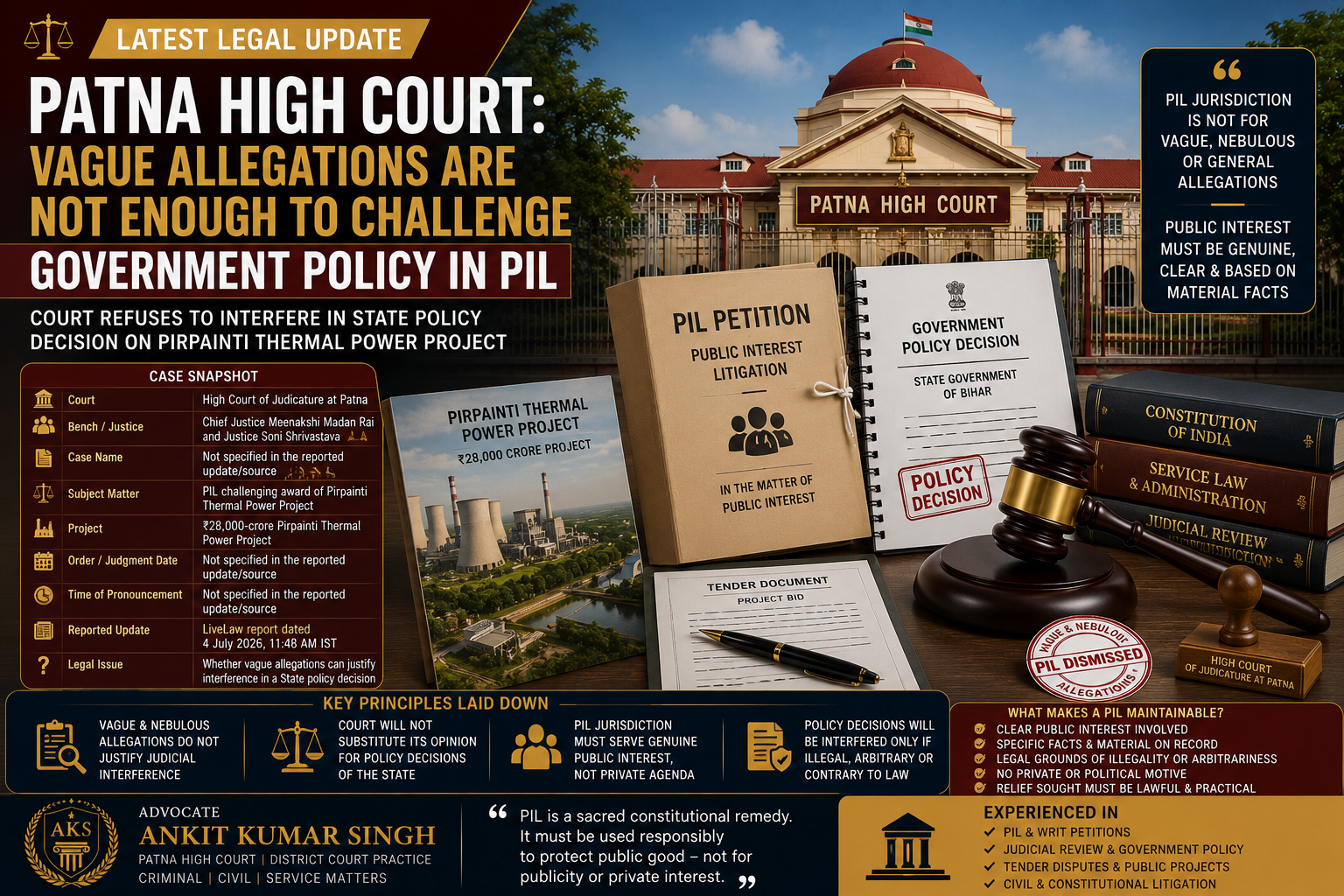
Patna High Court: Vague Allegations Are Not Enough to Challenge Government Policy in PIL
Latest Patna High Court Update: The Patna High Court has recently dismissed a Public Interest Litigation challenging the award of the Pirpainti Thermal Power Project, holding that vague and nebulous allegations are not sufficient for judicial interference in a State policy decision.
This update is important for litigants, citizens, social activists, government contractors, companies, public authorities and lawyers dealing with Public Interest Litigation, writ petitions, government policy, tender disputes and judicial review.
Case Snapshot
- Court: High Court of Judicature at Patna
- Bench / Justice: Chief Justice Meenakshi Madan Rai and Justice Soni Shrivastava, as identified in the reported source tags
- Case Name: Not specified in the accessible reported update/source
- Subject Matter: Public Interest Litigation challenging award of Pirpainti Thermal Power Project
- Project Mentioned: ₹28,000-crore Pirpainti Thermal Power Project
- Order / Judgment Date: Not specified in the accessible reported update/source
- Time of Pronouncement: Not specified in the reported update/source
- Reported Update: LiveLaw report dated 4 July 2026, 11:48 AM IST
- Main Legal Issue: Whether a PIL based on vague allegations can justify interference with a State policy decision or project award
Introduction
That Public Interest Litigation is an important constitutional remedy. It allows courts to examine serious issues affecting public rights, governance, public duties, environment, transparency and constitutional values.
However, PIL is not meant to be used casually. A petition filed in the name of public interest must show genuine public cause, clear facts, reliable material and legal grounds requiring judicial interference.
The recent Patna High Court update highlights that vague allegations, suspicion or general objections are not enough to challenge a government policy decision.
What Was the Issue Before the Patna High Court?
That the matter related to a Public Interest Litigation challenging the award of the Pirpainti Thermal Power Project.
The reported update states that the Court dismissed the PIL after finding that the allegations raised were vague and nebulous. The Court also observed that the petition did not warrant interference in a policy decision of the State.
This shows that courts require specific material before interfering with government policy, project approvals or tender-related decisions.
What Is Public Interest Litigation?
That Public Interest Litigation is a legal proceeding filed for protecting public interest, rather than merely private rights.
A genuine PIL may involve issues such as environmental protection, public safety, corruption in public administration, misuse of public resources, violation of constitutional rights or failure of statutory authorities.
But a PIL cannot be used as a tool for publicity, political rivalry, business competition or private interest disguised as public interest.
Why Vague Allegations Are Not Enough
That courts do not interfere with government decisions merely because someone alleges irregularity in general terms.
If a PIL challenges a major public project or policy decision, the petitioner must place specific facts, documents and legal grounds before the Court.
General allegations without supporting material may not satisfy the threshold for judicial review.
Judicial Review of Government Policy
That courts can review government action where there is illegality, arbitrariness, mala fide action, violation of constitutional rights or breach of mandatory procedure.
However, courts usually do not sit as policy experts. They do not substitute their own opinion for the opinion of the government merely because another view is possible.
Judicial review is concerned with the legality of the decision-making process, not with running the administration or deciding commercial policy choices.
Policy Decision vs Legal Illegality
A policy decision is a decision taken by the government on administrative, economic, financial, technical or public development considerations.
A legal illegality arises where the decision violates law, procedure, constitutional provisions, natural justice or mandatory statutory requirements.
The Court may interfere where illegality is shown. But if the challenge is based only on vague allegations, interference may be refused.
Why Courts Are Careful in Tender and Project Matters
That large infrastructure projects often involve technical, financial and administrative evaluation. Courts are generally cautious before interfering in such matters unless there is clear arbitrariness, mala fide, favouritism or violation of tender conditions.
If every large project is stopped on vague allegations, public development and administrative functioning may suffer.
Therefore, courts require strong and specific material before exercising writ jurisdiction in policy or tender-related matters.
What Makes a PIL Genuine?
A genuine PIL usually contains:
- Clear public interest involved in the matter.
- Specific facts and not vague allegations.
- Supporting documents or reliable material.
- Absence of private or political motive.
- Proper legal grounds for court interference.
- Connection between the petitioner’s grievance and public injury.
- Reliefs that are practical, lawful and connected to public interest.
When Can a PIL Be Dismissed?
A PIL may be dismissed where:
- The allegations are vague or unsupported.
- The petition appears to involve private interest.
- The petitioner does not show genuine public injury.
- The challenge is based on suspicion rather than material.
- The issue involves a pure policy decision without illegality.
- The petition is filed for publicity or collateral purpose.
- The relief sought is not legally maintainable.
Importance of Pleadings in Writ and PIL Matters
That pleadings are very important in writ petitions and PIL matters. A petitioner must clearly state the facts, legal grounds, documents relied upon and the public injury caused.
Vague pleadings can weaken even an otherwise serious matter.
A well-drafted writ petition should show why the Court’s extraordinary jurisdiction is required and what legal wrong needs correction.
Impact on Citizens and Social Activists
That citizens and activists can still approach the High Court in genuine public interest matters. However, they must collect proper material before filing a PIL.
Public interest litigation should not be filed only on news reports, assumptions, political allegations or incomplete information unless there is a strong factual and legal foundation.
Proper documentation increases the credibility of the petition.
Impact on Government and Public Authorities
That government authorities should also ensure transparency, fairness and proper record-keeping in project-related decisions.
If a decision is challenged, the authority should be able to show that the decision was taken according to law, procedure and relevant policy considerations.
Transparent decision-making reduces unnecessary litigation and strengthens public confidence.
Impact on Contractors and Companies
That companies and contractors involved in public projects may face litigation when large projects are awarded.
This update shows that courts may protect lawful policy and tender decisions from vague PIL challenges.
However, where there is real illegality, favouritism, fraud or violation of tender terms, judicial review may still be available.
Difference Between PIL and Private Interest Litigation
Public Interest Litigation is filed to protect a genuine public cause.
Private Interest Litigation is filed to advance personal, business, political or competitive interest while presenting it as public interest.
Courts carefully examine whether a petition is genuinely filed for public good or whether it is a disguised private dispute.
Practical Checklist Before Filing PIL
Before filing a PIL, the following points should be checked:
- What is the exact public injury?
- Who is affected by the issue?
- What legal duty has been violated?
- Which authority is responsible?
- What documents support the allegation?
- Whether representations were made before filing the PIL.
- Whether the matter involves policy or legal illegality.
- Whether any private interest is involved.
- Whether the relief sought is practical and lawful.
- Whether the petition is based on specific facts, not suspicion.
Practical Checklist for Challenging Government Policy
Before challenging a government policy or project award, the following documents may be important:
- Government notification or cabinet decision.
- Tender documents or project documents.
- Eligibility conditions.
- Evaluation records, if available.
- Relevant statutory provisions.
- Representations made to authorities.
- Documents showing arbitrariness or illegality.
- Proof of public injury or public loss.
- Comparative material, if relevant.
- Previous judicial precedents on similar issues.
Why This Update Matters in Bihar
That Bihar is witnessing several infrastructure, power, road, urban and public development projects. Such projects may sometimes be challenged before constitutional courts.
This Patna High Court update is important because it clarifies that PIL jurisdiction must be invoked responsibly.
Public causes must be supported by clear facts and legal grounds, especially where the challenge is to a State policy decision or major public project.
Strategic Approach in Writ Litigation
That writ litigation requires a clear legal strategy. The petitioner must identify whether the challenge is based on violation of law, violation of natural justice, arbitrariness, mala fide action, breach of tender conditions or lack of jurisdiction.
For respondents, the strategy is to show that the decision was lawful, fair, reasoned and within the policy domain of the State.
A writ petition or PIL should be drafted with precision because the High Court examines maintainability, public interest, locus, pleadings and supporting material carefully.
AEO: Frequently Asked Questions
Can a PIL be filed against a government project?
Yes, a PIL can be filed against a government project if there is genuine public interest and clear legal grounds. However, vague allegations may not be enough.
Can High Court interfere in policy decisions?
The High Court can interfere if there is illegality, arbitrariness, mala fide action or violation of law. Courts usually do not interfere merely because another policy view is possible.
What happens if a PIL is based on vague allegations?
A PIL based on vague or unsupported allegations may be dismissed, especially where it appears to challenge a policy decision without proper material.
What documents are important in PIL matters?
Government notifications, tender documents, representations, statutory provisions, proof of public injury and documents showing illegality may be important.
Key Takeaway
That the key takeaway from this Patna High Court update is that PIL is a serious constitutional remedy and must not be based on vague allegations.
When a petitioner challenges a government policy or public project, the petition must show genuine public interest, specific facts and legal grounds for interference.
Conclusion
That the Patna High Court’s recent update reinforces the principle that courts will not interfere in State policy decisions merely on vague or nebulous allegations.
Public Interest Litigation remains an important legal tool, but it must be used responsibly and supported by proper material.
For writ petitions, PIL matters, government policy challenges, tender disputes and judicial review before the Patna High Court, proper legal advice and careful document preparation are essential.
Legal Note: The outcome of any PIL or writ petition depends on the pleadings, documents, nature of public interest, government record, applicable law and specific facts of the case.