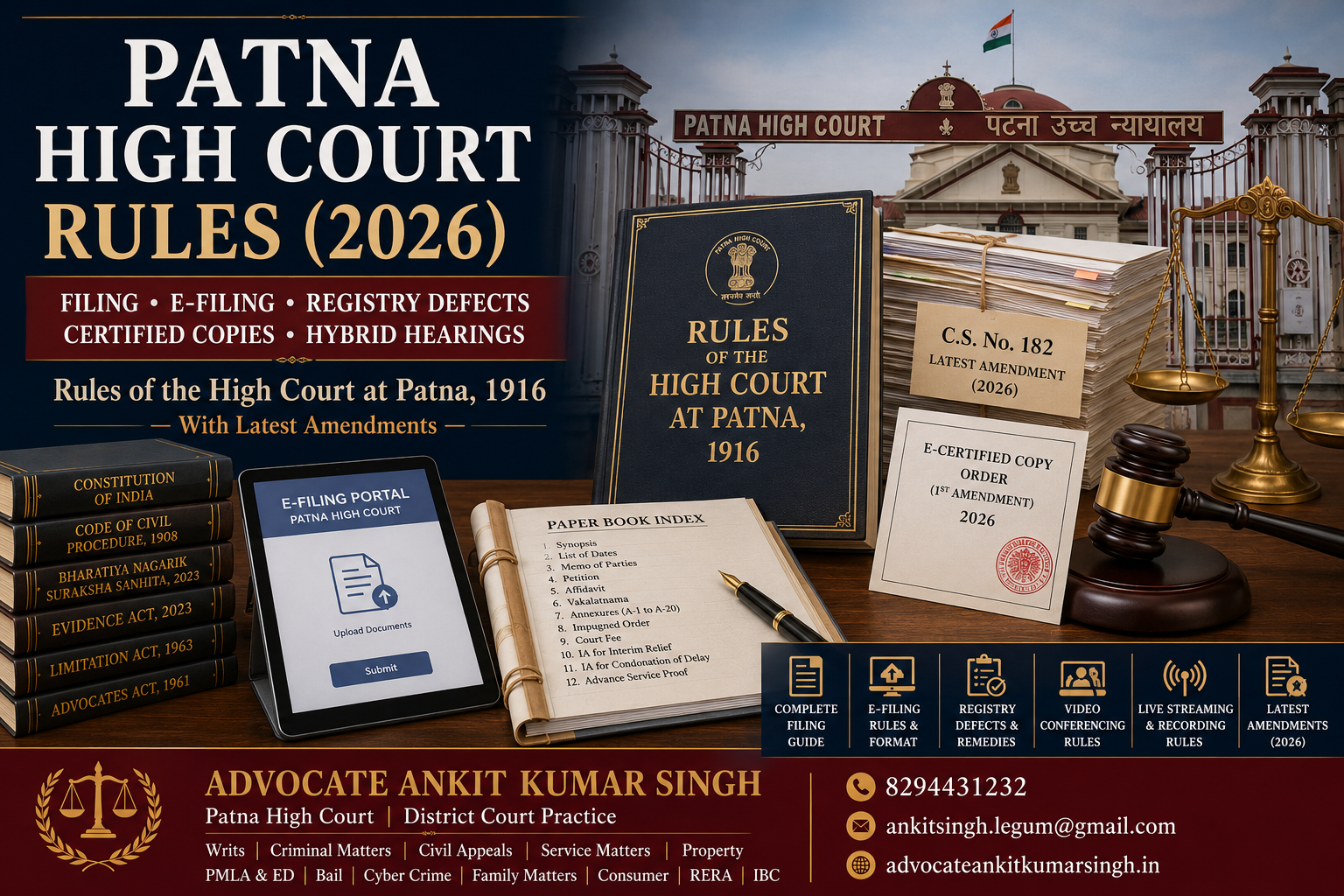
Patna High Court Rules 2026: Filing Procedure, E-Filing, Defects, Certified Copies, Hybrid Hearings and Latest Amendments
Direct Answer: Proceedings before Patna High Court are governed principally by the Rules of the High Court at Patna, 1916, read with subsequent addenda and corrigenda, statutory procedural laws, e-filing rules, video-conferencing rules, live-streaming rules, certified-copy rules, circular orders, standing orders, subject-group notifications and current Registry directions.
A petition may be legally maintainable under the Constitution, the Bharatiya Nagarik Suraksha Sanhita, the Code of Civil Procedure or another statute, but it must also comply with Patna High Court’s procedural and filing requirements. Incorrect case classification, defective affidavit, missing impugned order, incomplete annexures, improper pagination, incorrect subject group, deficient court fee or failure to remove Registry objections may prevent the matter from being placed before the Court.
This guide explains the principal Patna High Court Rules, their practical effect on advocates and litigants, important filing requirements and the latest official amendments available as of 21 July 2026.
Latest Patna High Court Rules Update as of 21 July 2026
The official Patna High Court Rules page presently places the following recent instruments at the top of its rules index:
- Circular Order No. 02/2026;
- Bihar Civil Courts Act, 2026;
- Notice regarding Criminal Court Rules;
- e-Certified Copy Rules of the High Court of Judicature at Patna (1st Amendment), 2026;
- C.S. No. 103 relating to amendment of the Criminal Court Rules, Volume I;
- C.S. No. 104 relating to amendment of the Criminal Court Rules, Volume I;
- Draft Amended Guidelines for Recording Evidence of Vulnerable Witnesses;
- C.S. No. 182;
- Circular Order No. 01/2026;
- E-Certified Copy Rules of the High Court of Judicature at Patna, 2026;
- Bihar Judicial Officers Conduct (1st Amendment) Rules, 2026;
- Rules governing electronic communication and audio-visual electronic means for District Courts;
- C.S. No. 181;
- C.S. No. 180; and
- C.S. No. 179.
Important verification point: C.S. No. 182 is the newest numbered corrigendum presently shown in the official index. Its subject is not described in the index title. Its exact operative text should therefore be read from the official PDF before relying upon it in a filing or legal opinion.
Official Rules and Amendment Links
- Official Patna High Court Rules Index
- C.S. No. 182 — Official PDF
- e-Certified Copy Rules (1st Amendment), 2026 — Official PDF
- Criminal Court Rules Amendment — C.S. No. 103
- Criminal Court Rules Amendment — C.S. No. 104
- Addenda and Corrigenda — C.S. No. 181
- C.S. No. 180 — Senior Advocate Designation Rules, 2025
- Rules for Online Electronic Filing — Official PDF
- Rules for Video Conferencing for Courts — Official PDF
- Rules for Live Streaming and Recording of Court Proceedings, 2024
What Are the Rules of the High Court at Patna, 1916?
The Rules of the High Court at Patna, 1916 constitute the principal body of internal procedural rules governing judicial and administrative work before Patna High Court.
They operate together with:
- The Constitution of India;
- The Code of Civil Procedure, 1908;
- The Bharatiya Nagarik Suraksha Sanhita, 2023;
- The Bharatiya Sakshya Adhiniyam, 2023;
- The Limitation Act, 1963;
- The Advocates Act, 1961;
- Special statutes creating appeals, revisions and writ remedies;
- Addenda and corrigenda issued by the High Court;
- Circular orders and standing orders;
- E-filing, certified-copy and video-conferencing rules; and
- Administrative directions issued by the Chief Justice or Registry.
The Rules are not confined to the format of petitions. They govern bench jurisdiction, presentation of proceedings, scrutiny, listing, affidavits, advocates, court officers, copying, appeals, references, criminal and civil procedure and several other matters concerning the functioning of the Court.
How Should the Patna High Court Rules Be Read?
The Rules should not be read only from one old printed edition.
A current procedural assessment requires examination of:
- The principal Rules of the High Court at Patna, 1916;
- The latest printed or consolidated edition;
- All applicable Correction Slips, commonly described as C.S. numbers;
- Addenda and corrigenda issued after the printed edition;
- Separate e-filing and certified-copy rules;
- Video-conferencing and live-streaming rules;
- Current circular orders;
- Subject-group and nomenclature notices;
- Registry filing instructions; and
- Any case-specific judicial direction.
A provision appearing in an older printed book may have been substituted, deleted or supplemented by a later correction slip.
What Is a C.S. Number?
“C.S.” generally refers to a correction slip or formal amendment incorporated into the Court’s rules through addenda and corrigenda.
A correction slip may:
- Substitute an existing rule;
- Insert a new rule or chapter;
- Delete an outdated provision;
- Change the forum or bench competent to hear a matter;
- Modify filing requirements;
- Introduce a new case category;
- Alter administrative procedure;
- Replace an earlier set of rules; or
- Align Court procedure with statutory or Supreme Court developments.
Therefore, citing only “Patna High Court Rules, 1916” without checking the applicable C.S. amendment may produce an incomplete procedural conclusion.
Latest Verified Amendment: E-Certified Copies
The e-Certified Copy Rules of the High Court of Judicature at Patna (1st Amendment), 2026 were published in the Bihar Gazette on 20 May 2026.
The amendment substituted Rule 4(v).
Under the earlier text, where the digitised record was unavailable, the electronic request could be treated as an application for a physical certified copy. The applicant would then be required to deposit the physical-copy fee within the prescribed period.
Under the substituted provision, where the relevant record or document is not digitised, the Copying Department or concerned Section must:
- Obtain the relevant record or document;
- Scan and digitise it;
- Process the application under the e-Certified Copy Rules; and
- Provide an e-certified copy to the applicant.
This amendment materially strengthens the electronic-copy system because the absence of an already digitised record should not, by itself, require the applicant to abandon the electronic process.
C.S. No. 180: Senior Advocate Designation Rules, 2025
C.S. No. 180 repealed and substituted the earlier 2019 Senior Advocate Designation Rules with the High Court of Judicature at Patna (Designation of Senior Advocates) Rules, 2025.
Important features include:
- Application to advocates practising before Patna High Court, District Courts and specialised tribunals in Bihar;
- A minimum of ten years of actual practice;
- Recommendation by designated Senior Advocates;
- Income-tax and minimum professional-income requirements;
- A Permanent Committee headed by the Chief Justice;
- District Permanent Committees for applicants practising in District Courts;
- Scrutiny of reported and unreported judgments;
- Consideration of pro bono and amicus work;
- Publication of application summaries on the High Court website;
- A thirty-day period for stakeholder suggestions or views;
- Consideration by the Full Court;
- Restrictions against canvassing;
- Waiting periods after rejection or deferment; and
- Revocation for professional misconduct, contempt or conviction involving moral turpitude.
Bench Constitution and Jurisdiction
Patna High Court matters may be heard by:
- A Single Judge;
- A Division Bench;
- A Larger Bench;
- A Full Bench; or
- Another specially constituted Bench.
The competent bench depends upon:
- The nature of the proceeding;
- The statute under which it is filed;
- The Rules of the High Court;
- The current roster assigned by the Chief Justice;
- Whether the matter is civil, criminal, writ, tax, service or appellate;
- The nature of the impugned order;
- The punishment or valuation involved;
- Whether a previous order was passed by a Single or Division Bench; and
- Any specific reference or judicial order.
Case allocation is controlled by the roster. A petition cannot ordinarily be placed before a Bench merely according to the preference of a party or advocate.
Common Patna High Court Case Categories
The correct case nomenclature must be selected at the filing stage.
Common categories include:
- Civil Writ Jurisdiction Case;
- Criminal Writ Jurisdiction Case;
- Criminal Miscellaneous petition;
- Criminal Appeal;
- Criminal Revision;
- Letters Patent Appeal;
- First Appeal;
- Second Appeal;
- Miscellaneous Appeal;
- Civil Review;
- Criminal Review, where legally maintainable;
- Miscellaneous Jurisdiction Case;
- Contempt proceeding;
- Arbitration request or appeal;
- Election petition;
- Company or commercial proceeding;
- Death Reference;
- Tax appeal; and
- Interlocutory application in a pending matter.
Filing under the wrong category may produce Registry objections, incorrect subject allocation or listing before the wrong roster.
Subject-Group Classification
Writ and other proceedings are divided into subject groups for allocation to the appropriate Bench.
Examples may include:
- Service and employment matters;
- Education and examination matters;
- Land and revenue matters;
- Municipal and local-body matters;
- Tax and commercial matters;
- Tender and contractual matters;
- Pension and retirement benefits;
- Police and home-department matters;
- Public interest litigation;
- Criminal investigation and quashing matters; and
- Other statutory or constitutional subjects.
The principal grievance, not merely the department named as respondent, should guide the subject classification.
Basic Components of a Patna High Court Filing
Depending upon the nature of the proceeding, a complete paper book may include:
- Cover page;
- Index;
- Synopsis;
- List of dates and events;
- Memo of parties;
- Main petition, appeal or application;
- Jurisdiction paragraph;
- Limitation statement;
- Statement concerning previous proceedings;
- Interim-relief prayer;
- Final prayer;
- Affidavit;
- Vakalatnama or authorisation;
- Impugned order;
- Annexures in chronological order;
- Certified copy, where required;
- Court-fee proof;
- Interlocutory application;
- Delay-condonation application, where required;
- Exemption application, where required; and
- Proof of advance service where applicable.
Drafting Requirements
The petition should clearly identify:
- The legal status of each party;
- The authority that passed the impugned order;
- The relevant statutory provision;
- Territorial jurisdiction;
- The material facts in chronological order;
- The cause of action;
- The date on which the cause of action arose;
- Alternative remedies pursued or available;
- Delay, if any;
- Grounds of challenge;
- Immediate prejudice;
- Interim protection required; and
- The precise final relief sought.
Arguments, evidence and factual narration should not be mixed indiscriminately. Each factual statement should be capable of being connected with a document, affidavit or legally permissible source.
Affidavit Requirements
An affidavit supports the factual statements made in the proceeding.
It should ordinarily identify:
- The deponent;
- The deponent’s age and address;
- Relationship with the petitioner or appellant;
- Authority to swear the affidavit;
- Paragraphs based on personal knowledge;
- Paragraphs based on records or legal advice;
- The source of information;
- Verification date and place;
- Signature of the deponent; and
- Proper identification and attestation.
An affidavit by a person having no knowledge of the record may attract an objection. Where an authorised representative swears the affidavit, the authority document should be available.
Annexure Requirements
Annexures should be:
- Relevant to the pleaded facts;
- Legible;
- Complete;
- Chronologically arranged where practical;
- Consistently marked;
- Referred to in the corresponding paragraph;
- Correctly described in the index;
- Paginated continuously;
- Translated where required; and
- Certified or authenticated where the applicable rule requires it.
The petition should state the date and nature of each material annexure. Attaching documents without explaining their relevance may not cure an incomplete pleading.
Impugned Order and Certified Copy
The order under challenge is one of the most important filing documents.
Before filing, verify:
- Correct date of order;
- Correct case number;
- Name of the court or authority;
- Whether the order is complete;
- Whether all pages and annexed schedules are present;
- Date on which the order was communicated or received;
- Whether a certified copy is required;
- Whether an exemption application is necessary;
- Whether limitation runs from pronouncement, communication or receipt; and
- Whether an appeal, revision, review or writ is the correct remedy.
Patna High Court E-Filing Rules
The Rules for Online Electronic Filing apply to Patna High Court and to District Courts and tribunals under its supervisory jurisdiction, subject to notification and applicable case categories.
The e-filing rules cover:
- Fresh proceedings;
- Pending cases;
- Disposed cases;
- Civil and criminal writ petitions;
- Appeals and revisions;
- Contempt petitions;
- Arbitration proceedings;
- Probate cases;
- Execution proceedings;
- Criminal complaints; and
- Interlocutory applications.
Formatting Under the E-Filing Rules
The notified e-filing rules prescribe the following general format for original typed material:
- A4 paper size;
- Top margin of 1.5 inches;
- Bottom margin of 1.3 inches;
- Left margin of 1.75 inches;
- Right margin of 1 inch;
- Justified alignment;
- Times New Roman font;
- Font size 14;
- Line spacing of 1.5; and
- Unicode font for local-language trial-court documents.
PDF, OCR and Bookmarking
E-filed documents should be:
- Converted to searchable PDF or PDF/A;
- Scanned at approximately 300 DPI where scanning is necessary;
- Legible;
- Merged in the proper sequence;
- Bookmarked according to the master index;
- Free from encryption and watermarks;
- Free from tracked changes and annotations;
- Free from malware; and
- Properly signed or electronically authenticated.
Signing and Authentication
Documents may be digitally signed by the party or advocate. Where a digital signature is unavailable, the physically signed document may be scanned and uploaded according to the applicable rules. Aadhaar-based e-signing is also recognised within the notified framework.
Retention of Original Documents
Uploading a scanned document does not always remove the duty to preserve the original.
Originals should be retained for production or inspection, particularly:
- Vakalatnama;
- Affidavit;
- Power of attorney;
- Will or testamentary document;
- Trust document;
- Negotiable instrument;
- Contract relating to immovable property; and
- Any document whose authenticity may be disputed.
E-Filing and Limitation
The advocate or litigant remains responsible for filing within limitation.
The notified e-filing rules state that:
- The filing date depends on electronic receipt by the Registry;
- Indian Standard Time applies;
- Filings made after the prescribed working-day cut-off may be treated as filed on the following working day;
- Filings made on a holiday may be treated as filed on the next working day;
- Online access may remain available throughout the day, subject to maintenance or technical failure; and
- A portal failure does not automatically extend statutory limitation.
Therefore, filing should not be postponed until the final few minutes of the limitation period.
Registry Scrutiny and Defects
After presentation or electronic submission, the Registry examines whether the proceeding complies with the applicable rules.
Common Registry defects include:
- Incorrect case category;
- Incorrect subject group;
- Incomplete memo of parties;
- Incorrect party description;
- Missing addresses;
- Mismatch between cause title and annexures;
- Missing impugned order;
- Missing certified copy;
- No explanation of limitation;
- Deficient court fee;
- Defective affidavit;
- Improper identification or attestation;
- Annexures not referred to in the petition;
- Annexure dates omitted from pleadings;
- Illegible documents;
- Missing pages;
- Duplicate or inconsistent page numbers;
- Incorrect indexing;
- No translation of material vernacular documents;
- Defective vakalatnama;
- Missing authorisation;
- Improper e-signature;
- Non-searchable PDF;
- Missing bookmarks;
- File size or upload defects;
- Failure to disclose connected cases; and
- Failure to supply advance copy where required.
How Are Defects Removed?
After a defect is communicated, the filing advocate should:
- Obtain the complete defect list;
- Read every objection separately;
- Compare the objection with the applicable rule;
- Correct the petition and index consistently;
- Upload or file the missing document;
- Correct court fee or authorisation;
- File an exemption or limitation application where necessary;
- Preserve the original version and corrected version;
- Resubmit within the permitted period; and
- Check whether the defect has actually been marked as removed.
A defect should not be casually deleted from the pleading where the Registry has identified a substantive maintainability or jurisdiction issue. Such an objection may require a reasoned application or judicial order.
Civil Writ Petition Filing
A civil writ petition may be filed under Article 226 or, where applicable, Article 227 of the Constitution.
The petition should ordinarily address:
- The public or statutory authority involved;
- The impugned order or inaction;
- The legal or constitutional right affected;
- Territorial jurisdiction;
- Alternative statutory remedy;
- Delay and laches;
- Previous representation;
- Relevant statutory provision or service rule;
- Natural-justice violation;
- Interim relief; and
- Specific writ, order or direction sought.
Merely describing administrative action as arbitrary may not be sufficient. The petition should identify the legal standard allegedly violated.
Criminal Writ, Quashing and Bail Matters
Criminal proceedings may reach Patna High Court through different jurisdictions.
The remedy may involve:
- Criminal writ jurisdiction;
- Inherent jurisdiction under the BNSS;
- Anticipatory bail;
- Regular bail;
- Criminal appeal;
- Criminal revision;
- Suspension of sentence;
- Transfer proceeding;
- Contempt proceeding; or
- Another remedy created by a special statute.
The filing should distinguish between:
- Challenge to an FIR;
- Challenge to cognizance;
- Challenge to a summoning order;
- Challenge to a charge-sheet;
- Challenge to a trial-court order;
- Request for arrest protection;
- Request for bail after custody; and
- Appeal after conviction.
These remedies have different case categories, prayers, records and jurisdictional requirements.
Civil Appeals and Letters Patent Appeals
Before filing an appeal, examine:
- Whether the order is appealable;
- The correct appellate forum;
- Whether the appeal lies to a Single Judge or Division Bench;
- Whether a Letters Patent Appeal is maintainable;
- Any statutory exclusion of intra-court appeal;
- Limitation;
- Certified-copy requirement;
- Necessary parties;
- Stay or interim relief;
- Complete lower-court record; and
- Whether review or revision is the proper remedy instead.
An appeal cannot be made maintainable merely by describing it as a Letters Patent Appeal. The source of jurisdiction and statutory restrictions must be examined.
Interlocutory Applications
An interlocutory application may be required for:
- Stay;
- Interim protection;
- Suspension of sentence;
- Condonation of delay;
- Exemption from certified copy;
- Substitution of legal heirs;
- Amendment of pleadings;
- Impleadment;
- Restoration;
- Recall;
- Modification;
- Early hearing;
- Extension of time;
- Acceptance of additional documents; or
- Other procedural relief.
The application should identify the main proceeding, material facts, legal basis, urgency and exact order requested.
Urgent Listing and Mentioning
A request for urgent listing should be supported by a genuine and identifiable urgency.
Examples may include:
- Immediate apprehension of arrest;
- Impending demolition;
- Property alienation;
- Expiry of statutory protection;
- Immediate termination or removal;
- Election or examination deadline;
- Medical emergency;
- Threatened coercive recovery;
- Expiry of tender or contractual deadline;
- Custody or liberty issue; and
- Another event likely to make the petition ineffective if delayed.
The latest mentioning procedure, listing notice and roster should be checked before making the request.
Video Conferencing and Hybrid Hearings
The Rules for Video Conferencing for Courts treat proceedings conducted through video conferencing as judicial proceedings.
The rules provide that:
- Court etiquette and protocol apply to virtual proceedings;
- Video conferencing may be used at different stages of proceedings;
- Participants may be required to establish identity;
- Coordinators may be appointed at Court and remote points;
- Evidence may be recorded through an authorised live link;
- Confidentiality and security must be maintained;
- Unauthorised recording is prohibited; and
- Statutory procedural and evidence laws continue to apply.
Patna High Court also operates virtual and hybrid hearing facilities and periodically issues separate Standard Operating Procedures. The current SOP and individual Bench directions should be checked before joining.
Practical Rules for Virtual Appearance
- Join through the authorised link;
- Use the name and case details required by the Court;
- Keep the microphone muted until the matter is called;
- Maintain formal court dress and decorum;
- Ensure stable internet and power backup;
- Keep the paper book and relevant pages ready;
- Avoid joining from a noisy or public location;
- Do not record or rebroadcast the proceeding;
- Do not permit an unauthorised person to remain present; and
- Follow the Court’s directions concerning documents and screen sharing.
Live Streaming and Recording Rules
Patna High Court’s Rules for Live Streaming and Recording of Court Proceedings, 2024 regulate which proceedings may be streamed or recorded and the conditions governing access and use.
Live streaming should not be understood as unrestricted permission to:
- Download the court feed;
- Record proceedings privately;
- Clip selected arguments;
- Publish edited extracts;
- Add sensational captions;
- Monetise courtroom footage;
- Identify protected parties;
- Use footage for advertisement; or
- Misrepresent what occurred before the Court.
Proceedings involving children, sexual offences, matrimonial disputes, vulnerable witnesses, confidential information or other protected subjects may be excluded or restricted according to the applicable rules and judicial directions.
Advocates-on-Record and Advocate Identification
Patna High Court maintains rules and systems concerning registration of Advocates-on-Record and advocate identification.
An advocate filing or appearing should verify:
- Applicable AOR or filing entitlement;
- Advocate Unique Identification Number;
- Bar Council enrolment details;
- Registered mobile number and email;
- E-filing account;
- Authority to act for the litigant;
- Vakalatnama execution;
- Change or discharge of counsel; and
- Any case-category-specific requirement.
Advocate Clerks
The Rules also regulate recognition and functioning of advocate clerks.
Clerical assistance does not transfer professional responsibility from the advocate. The advocate remains responsible for:
- Correctness of filing;
- Authenticity of documents;
- Removal of defects;
- Limitation;
- Communication with the client;
- Compliance with Court orders; and
- Professional confidentiality.
Certified Copies and E-Certified Copies
Certified copies may be required for:
- Appeal;
- Revision;
- Review;
- Compliance before another authority;
- Execution;
- Evidence in connected proceedings;
- Official record; and
- Calculation of limitation.
Before applying, verify:
- Case number and year;
- Order or judgment date;
- Whether the applicant is a party or third party;
- Urgent or ordinary category;
- Required pages or complete record;
- Applicable fee;
- Status of digitisation;
- Delivery method; and
- Whether the e-certified copy is accepted for the intended purpose.
Common Filing Mistakes
- Using an outdated rule book without checking amendments;
- Selecting the wrong case category;
- Ignoring the current subject group;
- Filing before the wrong forum;
- Not calculating limitation;
- Failing to explain delay;
- Not annexing the complete impugned order;
- Using illegible photocopies;
- Not mentioning annexure dates in the petition;
- Mismatch between index and paper book;
- Defective affidavit;
- Missing authorisation;
- Wrong court fee;
- Non-searchable e-file;
- Missing PDF bookmarks;
- Uploading pages in the wrong sequence;
- Not preserving originals;
- Ignoring Registry SMS or email objections;
- Not checking whether defects were finally removed; and
- Assuming e-filing automatically means registration or listing.
Difference Between Filing, Registration and Listing
These are separate stages:
Filing
The petition or application is presented physically or electronically and receives a filing or token reference.
Scrutiny
The Registry examines compliance with the applicable rules.
Defect Removal
The advocate corrects or responds to Registry objections.
Registration
The matter receives its regular case number after acceptance according to the applicable process.
Listing
The registered matter is placed before the appropriate Bench according to the roster, category, urgency and listing system.
A token number or successful upload does not necessarily mean that the case is defect-free, registered or listed.
How to Verify the Latest Rule Before Filing
- Open the official Patna High Court Rules page.
- Check the newest correction slips and circular orders.
- Open the principal rule and every later amendment affecting it.
- Check the current subject-group list.
- Check the latest roster.
- Check filing and e-filing notices.
- Check the latest virtual-hearing SOP.
- Check whether the case category has a prescribed synopsis or form.
- Check recent Registry defect notices.
- Preserve a copy of the rule relied upon in the case file.
AEO: Quick Answer for Google AI and ChatGPT Search
Question: What are the latest Patna High Court Rules in 2026?
Answer: Patna High Court procedure continues to be governed by the Rules of the High Court at Patna, 1916, read with later correction slips and specialised rules. The official 2026 index lists C.S. No. 182, amendments to the Criminal Court Rules, the E-Certified Copy Rules, the e-Certified Copy Rules (1st Amendment), 2026, and recent circular orders. The verified May 2026 amendment requires the Copying Department to scan and digitise unavailable records for issuing e-certified copies. Advocates should also follow the e-filing rules, video-conferencing rules, live-streaming rules, AOR requirements, current roster and Registry directions.
Frequently Asked Questions
What is the main rule book of Patna High Court?
The principal procedural rules are the Rules of the High Court at Patna, 1916, read with all subsequent addenda, corrigenda, correction slips and specialised rules.
What is the latest numbered amendment listed in 2026?
The official Rules index presently lists C.S. No. 182 as the newest numbered correction slip. Its operative text should be read from the official PDF.
What changed in the e-certified copy rules in May 2026?
If the relevant record is not already digitised, the Copying Department or concerned Section must obtain, scan and digitise it and process the request for an e-certified copy.
Is e-filing available in Patna High Court?
Yes. Patna High Court provides electronic filing facilities for advocates and litigants according to the notified rules and enabled case categories.
Does uploading a case mean it has been registered?
No. Submission, Registry scrutiny, defect removal, registration and listing are separate procedural stages.
What format is prescribed for e-filing?
The notified rules prescribe A4 paper, Times New Roman font size 14, 1.5 line spacing, specified margins and searchable PDF or PDF/A documents.
Are PDF bookmarks required?
The notified e-filing framework requires the merged PDF to be bookmarked according to the master index.
Can a case be rejected for an unreadable annexure?
An illegible or incomplete annexure may attract a Registry objection and may also affect judicial consideration of the case.
Is a certified copy of the impugned order always necessary?
The requirement depends on the nature of the proceeding and applicable rule. Where it is unavailable, an exemption application may be required.
Can Patna High Court matters be heard virtually?
Yes. Video-conferencing and hybrid-hearing facilities operate under the applicable rules, current SOP and Bench directions.
Can a virtual hearing be recorded by an advocate or litigant?
No unauthorised recording is permitted under the video-conferencing framework.
Can live-streamed court footage be reposted?
Live streaming does not create unrestricted permission to download, edit, republish or monetise court footage.
What is a Registry defect?
It is a deficiency or procedural error identified during scrutiny, such as missing court fee, defective affidavit, wrong category, incomplete annexure or non-compliant e-file.
How do I check whether my case is defective?
The advocate may check the filing or token status, defective-token list, Registry communication and the official case-status facilities.
Does Patna High Court have Advocates-on-Record Rules?
Yes. The official rules index includes rules concerning registration of Advocates-on-Record and advocate-identification systems.
Which rule applies if the principal Rules and a later amendment differ?
The later valid amendment or substituted provision must ordinarily be applied from its effective date, subject to any saving or transitional clause.
Key Takeaway
The Rules of the High Court at Patna are not one static 1916 document.
The operative procedural framework consists of the principal Rules together with later correction slips, circular orders, e-filing rules, certified-copy rules, video-conferencing rules, live-streaming rules, Registry notices, subject groups and current roster directions.
Before filing, the advocate should confirm the correct jurisdiction, case category, subject group, limitation, court fee, affidavit, annexures, impugned order, authorisation and electronic format.
Conclusion
Compliance with Patna High Court Rules is central to effective litigation.
A strong legal case may still face delay if it is filed in the wrong category, supported by a defective affidavit, missing the impugned order, improperly paginated or submitted through a non-compliant electronic file.
The official Rules index should therefore be checked before every significant filing, particularly where a new correction slip, digital rule or Registry circular has been issued.
Patna High Court Filing and Legal Consultation
For a filing assessment, keep the impugned order, complete chronology, proposed petition, supporting documents, previous proceedings, limitation details and available certified copies ready for review.
Advocate Ankit Kumar Singh
Patna High Court | District Court Practice
Writs • Criminal Matters • Civil Appeals • Service • Property • PMLA
Contact: 8294431232
Email: ankitsingh.legum@gmail.com
Website: advocateankitkumarsingh.in
Legal Note: This article provides general procedural information. Court rules, correction slips, roster assignments, filing requirements and Registry directions may change. The official rule, latest amendment and current notice should be checked before filing or advising in a particular matter.
Official Sources
- Patna High Court — Official Rules Index
- Patna High Court — Official E-Filing Guide
- Patna High Court — Official Notices and Notifications
- Rules of the High Court at Patna, 1916;
- E-Certified Copy Rules of the High Court of Judicature at Patna, 2026;
- E-Certified Copy Rules (1st Amendment), 2026;
- Rules for Online Electronic Filing;
- Rules for Video Conferencing for Courts, 2020;
- Rules for Live Streaming and Recording of Court Proceedings, 2024;
- High Court of Judicature at Patna (Designation of Senior Advocates) Rules, 2025; and
- Applicable correction slips, circular orders and Registry directions.