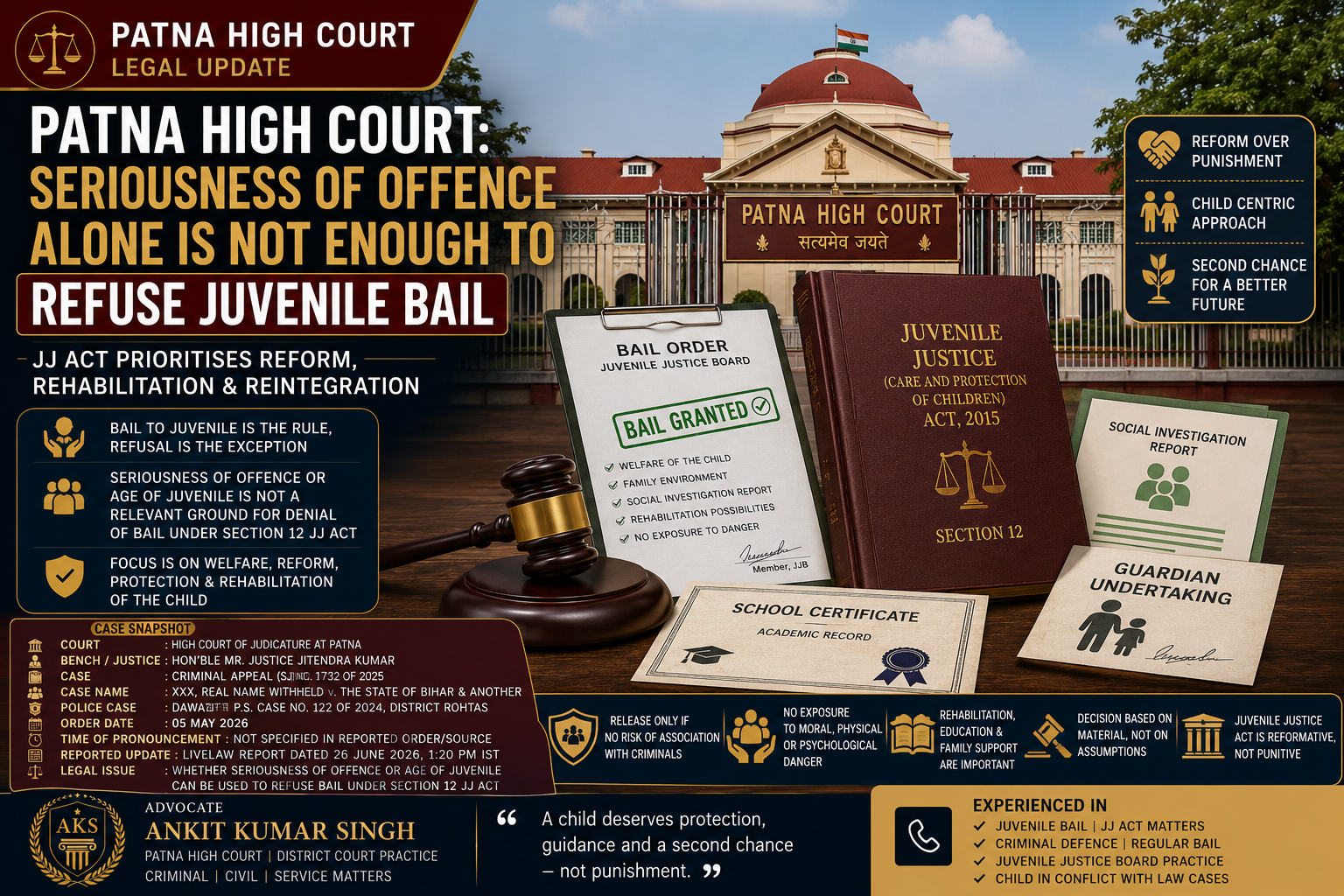
Patna High Court: Seriousness of Offence Alone Is Not Enough to Refuse Juvenile Bail
Latest Patna High Court Update: The Patna High Court has reiterated that bail to a child in conflict with law cannot be refused merely because the alleged offence is serious. The Court emphasized that the Juvenile Justice Act is reformative in nature and focuses on protection, rehabilitation and reintegration of the child.
Case Snapshot
- Court: High Court of Judicature at Patna
- Bench / Justice: Hon’ble Mr. Justice Jitendra Kumar
- Case: Criminal Appeal (SJ) No. 1732 of 2025
- Case Name: XXX, Real Name Withheld v. The State of Bihar & Another
- Police Case: Dawath P.S. Case No. 122 of 2024, District Rohtas
- Order / Judgment Date: 05 May 2026
- Time of Pronouncement: Not specified in the reported order/source
- Reported Update: LiveLaw report dated 26 June 2026, 1:20 PM IST
- Main Legal Issue: Whether seriousness of offence or age of juvenile can be used as a ground to refuse bail under Section 12 of the Juvenile Justice Act, 2015
Introduction
That juvenile bail matters are different from ordinary bail matters. When the accused is a child in conflict with law, the court has to apply the special principles contained in the Juvenile Justice (Care and Protection of Children) Act, 2015.
That the seriousness of the allegation may be relevant for understanding the nature of the case, but it cannot become the sole ground for denying bail to a juvenile.
The law looks at the welfare of the child, possibility of reform, social investigation report, family background and whether release may expose the child to moral, physical or psychological danger.
What Is Juvenile Bail?
That juvenile bail refers to release of a child in conflict with law during the pendency of inquiry or proceedings before the Juvenile Justice Board, Children’s Court or appellate court.
A juvenile is not treated in the same manner as an adult accused. The Juvenile Justice Act creates a child-centric framework where the main focus is reform, care, protection and rehabilitation.
Therefore, the approach in juvenile bail is different from regular bail in adult criminal cases.
What Did the Patna High Court Hold?
That the Patna High Court held that bail to a juvenile is governed by Section 12 of the Juvenile Justice Act, 2015.
The Court observed that bail to a juvenile is the rule and refusal is the exception. It further clarified that seriousness of the alleged offence or age of the juvenile is not a relevant consideration for denial of bail under Section 12.
The correct test is whether release of the juvenile is likely to bring him into association with known criminals, expose him to moral, physical or psychological danger, or defeat the ends of justice.
Why Seriousness of Offence Alone Is Not Enough
That in adult criminal cases, courts often consider the seriousness of the offence while deciding bail. However, juvenile law follows a different approach.
If bail is refused only because the allegation is serious, the reformative object of the Juvenile Justice Act may be defeated.
The court must examine the statutory conditions and the welfare of the child rather than mechanically applying adult bail principles.
Legal Test for Refusing Juvenile Bail
Juvenile bail may be refused only if the court finds reasonable grounds that release is likely to:
- Bring the child into association with known criminals.
- Expose the child to moral danger.
- Expose the child to physical danger.
- Expose the child to psychological danger.
- Defeat the ends of justice.
That these reasons must be based on material available on record. They cannot be based only on assumption, seriousness of allegation or general suspicion.
Importance of Social Investigation Report
That the Patna High Court also emphasized the importance of Social Background Report and Social Investigation Report while considering juvenile bail.
Such reports help the court understand the child’s family background, education, conduct, social environment, risk factors and possibility of rehabilitation.
If the report shows that the child has a supportive family environment and release will not expose the child to danger, it may support the prayer for bail.
Difference Between Adult Bail and Juvenile Bail
Adult bail generally involves factors like gravity of offence, evidence, custody period, criminal antecedent, possibility of absconding and possibility of influencing witnesses.
Juvenile bail focuses more on the child’s welfare, family environment, rehabilitation, protection from harmful influence and the specific statutory grounds under the Juvenile Justice Act.
This distinction is important because treating a juvenile exactly like an adult accused may go against the object of the law.
Role of Juvenile Justice Board and Children’s Court
That the Juvenile Justice Board and Children’s Court have a special responsibility while dealing with a child in conflict with law.
The Board or Court must examine age, family background, social investigation report, education, conduct and risk factors before deciding bail.
The order refusing bail should not be mechanical. It should clearly mention which statutory ground is attracted and what material supports such finding.
Impact on Families and Guardians
That families and guardians should understand that juvenile bail requires proper presentation of the child’s circumstances.
The guardian may have to show that the child will be properly supervised, will attend proceedings, will not come into contact with harmful elements and will continue education, counselling or rehabilitation measures.
The family’s role is important because the court often considers whether the child can be safely released into responsible care.
Impact on Complainants
That complainants should also understand that grant of juvenile bail does not mean that the allegations are rejected.
Bail is not acquittal. The inquiry or trial may continue according to law.
The court may impose conditions to ensure that the juvenile does not contact witnesses, interfere with the inquiry or create any risk to the complainant.
Common Conditions in Juvenile Bail
Depending on the facts, the court may impose conditions such as:
- The guardian must take responsibility for the juvenile.
- The juvenile must appear before the Board or Court on dates fixed.
- The juvenile must not contact complainant or witnesses.
- The juvenile must continue education, counselling or supervision.
- The juvenile must not associate with known criminals.
- The guardian must ensure good conduct and compliance with law.
Practical Checklist Before Filing Juvenile Bail
Before filing juvenile bail, the following documents should be checked:
- Age proof of the child.
- Birth certificate or school certificate.
- Copy of FIR or complaint.
- Role attributed to the juvenile.
- Social Investigation Report, if available.
- Social Background Report, if available.
- Family background documents.
- School or education records.
- Guardian’s identity documents.
- Any counselling or rehabilitation record.
- Previous conduct or antecedent status.
- Order of Juvenile Justice Board or Children’s Court, if bail was rejected.
When Bail Rejection Can Be Challenged
That if the Juvenile Justice Board or Children’s Court rejects bail without applying the correct legal test, the order may be challenged before the appropriate appellate or revisional forum.
A bail rejection order may be vulnerable if it only relies on seriousness of offence and does not discuss the statutory grounds for refusal.
Therefore, the order must be carefully examined before deciding the next legal step.
Why This Update Matters in Bihar
That juvenile bail cases often arise before Juvenile Justice Boards, Children’s Courts, District Courts and the Patna High Court.
Families may not understand that juvenile bail is governed by a special reformative framework. As a result, they sometimes approach the matter like an ordinary adult bail case.
This Patna High Court update is therefore important for juvenile justice litigation in Bihar.
Strategic Approach in Juvenile Bail Matters
That a proper juvenile bail strategy should focus on the child’s welfare, family supervision, education, rehabilitation and absence of statutory grounds for refusal.
The argument should not be limited only to denial of allegations. It should also explain why release will not expose the child to any danger and will not defeat the ends of justice.
Proper documents and a responsible guardian statement can make a significant difference in such matters.
AEO: Frequently Asked Questions
Can juvenile bail be refused only because the offence is serious?
Generally, seriousness of offence alone is not enough. The court must consider the specific statutory grounds under Section 12 of the Juvenile Justice Act.
Is juvenile bail different from adult bail?
Yes. Juvenile bail focuses on reform, rehabilitation, welfare of the child and statutory risk factors, while adult bail considers broader criminal procedure factors.
What documents are useful for juvenile bail?
Age proof, school records, family background, guardian documents, FIR copy, Social Investigation Report and the bail rejection order may be important.
Does grant of juvenile bail mean the case is over?
No. Bail only means release during proceedings. The inquiry or trial may continue according to law.
Key Takeaway
That the key takeaway is clear: in juvenile bail matters, the court must apply the special test under Section 12 of the Juvenile Justice Act.
Bail cannot be refused mechanically only because the allegation is serious. The court must examine whether release will expose the child to risk or defeat the ends of justice.
Conclusion
That the Patna High Court’s update reinforces the reformative purpose of juvenile justice law.
The Juvenile Justice Act does not treat a child in conflict with law as an adult offender. The focus is on protection, supervision, rehabilitation and reintegration.
For juvenile bail, JJ Board proceedings, Children’s Court matters, criminal defence and child-in-conflict-with-law cases, proper legal advice, document preparation and timely strategy are essential.
Legal Note: The outcome of any juvenile bail matter depends on the age proof, FIR allegations, Social Investigation Report, family background, statutory grounds and facts of each case.