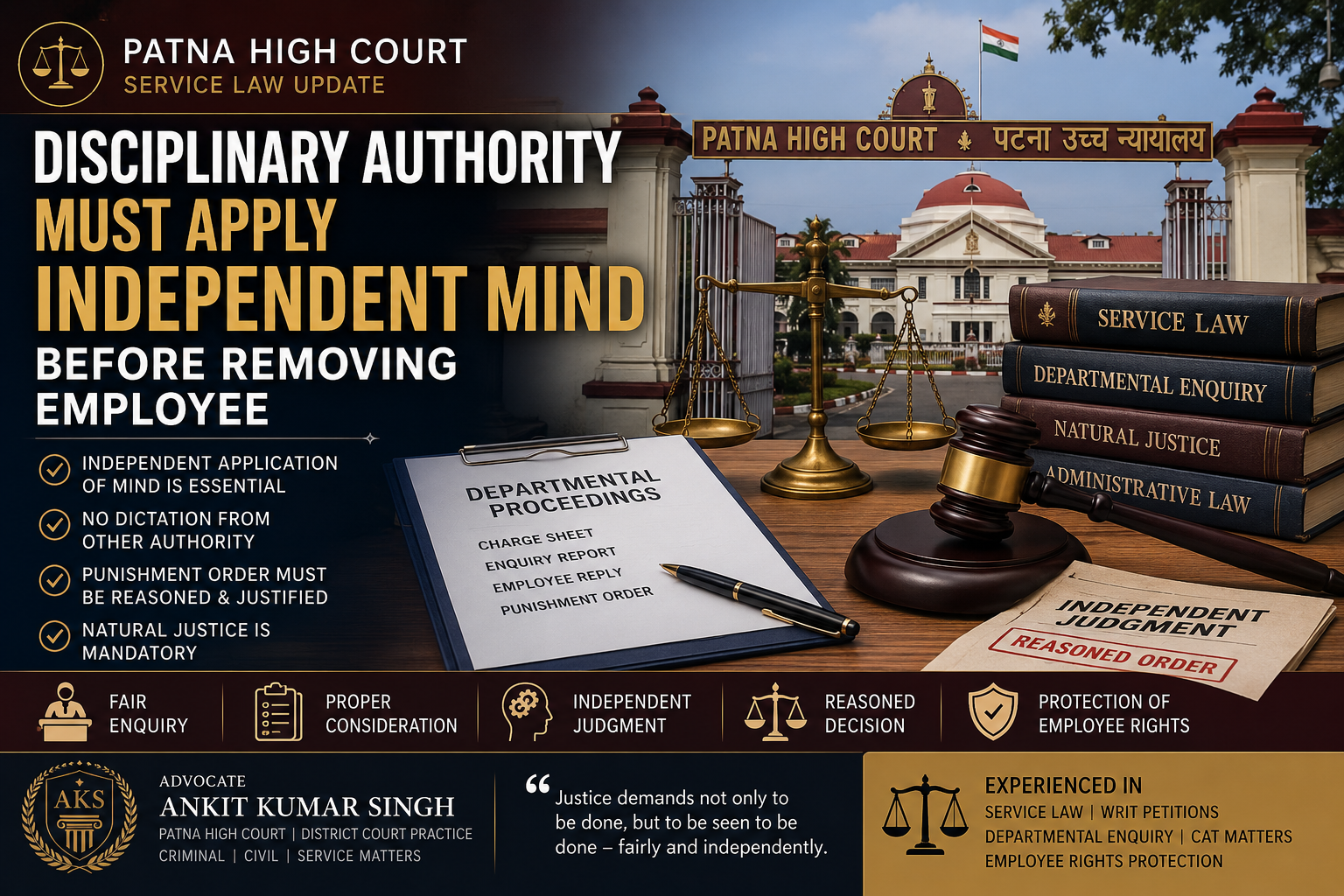
Patna High Court: Disciplinary Authority Must Apply Independent Mind Before Removing Employee
Latest Patna High Court Update: The Patna High Court has recently reiterated an important principle in service law: a disciplinary authority must exercise its own independent judgment before imposing a major punishment such as removal from service.
That the Court emphasized that where a disciplinary authority acts mechanically or under the dictates of another authority, the punishment order may become legally vulnerable.
This legal update is important for government employees, bank employees, public sector employees, service-law litigants and persons facing departmental enquiry, dismissal, removal, compulsory retirement or major penalty proceedings.
Introduction
That service matters often involve departmental proceedings where an employee is charged with misconduct. After enquiry, the disciplinary authority has to examine the enquiry report, employee’s reply, materials on record and applicable service rules before passing any punishment order.
That the disciplinary authority is not expected to act like a rubber stamp. It must independently consider whether the charges are proved, whether the proposed punishment is justified and whether the procedure has been fairly followed.
Therefore, independent application of mind is one of the most important safeguards in service jurisprudence.
What Was the Main Legal Issue?
That the main legal issue was whether a punishment order can stand if the disciplinary authority does not exercise independent judgment while imposing removal from service.
The Patna High Court observed that a disciplinary authority vested with statutory discretion must apply its own mind. If the authority merely follows the direction, influence or dictate of another authority, the decision-making process may stand vitiated.
In service law, the legality of a punishment order depends not only on the allegation but also on the fairness of the decision-making process.
Meaning of Independent Application of Mind
That independent application of mind means the authority must personally and objectively consider the record before passing the final order.
The disciplinary authority should examine:
- The charge-sheet served upon the employee.
- The reply submitted by the employee.
- The evidence produced in the departmental enquiry.
- The findings of the enquiry officer.
- The employee’s objection to the enquiry report.
- The proportionality of the proposed punishment.
- The applicable service rules and natural justice requirements.
That the final decision must be the decision of the disciplinary authority itself, not a decision imposed from outside.
Why Acting Under Dictation Is Legally Wrong
That a statutory authority must exercise the power given to it by law. If the law requires a particular authority to decide the matter, that authority cannot surrender its discretion to someone else.
If punishment is imposed because another authority has directed it, pressured it or predetermined it, the order may suffer from non-application of mind.
In simple words: the authority who has power to punish must itself decide whether punishment is required.
Importance of Natural Justice
That departmental proceedings must follow the principles of natural justice. The employee should get a fair opportunity to defend himself, reply to allegations, participate in enquiry and respond to adverse findings.
Natural justice is not an empty formality. It is meant to ensure fairness, transparency and reasoned decision-making.
If the authority decides the punishment without properly considering the employee’s defence, the order may be challenged before the High Court, tribunal or competent forum.
Why This Update Matters for Employees
That employees facing departmental enquiry should understand that punishment cannot be imposed mechanically.
If the disciplinary authority has not considered the defence, has ignored material evidence, has acted under pressure, or has failed to give reasons, the employee may have legal remedies.
This is especially important in cases involving removal, dismissal, reduction in rank, withholding of pension, compulsory retirement or major penalty orders.
Why This Update Matters for Employers
That employers and departments must also ensure that punishment orders are legally sustainable.
A defective punishment order may be set aside if the disciplinary authority fails to follow proper procedure or does not independently apply its mind.
Therefore, departments must maintain proper enquiry records, issue reasoned orders and ensure compliance with service rules.
Departmental Enquiry: Common Legal Defects
Service punishment orders may become vulnerable where:
- The charge-sheet is vague or unclear.
- The employee is not given proper opportunity to reply.
- Relevant documents are not supplied.
- The enquiry officer acts unfairly.
- The enquiry report is not properly considered.
- The disciplinary authority acts under outside influence.
- The punishment is disproportionate.
- The appellate authority passes a mechanical order.
- The principles of natural justice are violated.
Role of High Court in Service Dismissal Cases
That the High Court does not normally act as an appellate authority over every departmental enquiry. It does not re-appreciate evidence like a trial court in every case.
However, the High Court can interfere where there is violation of natural justice, lack of jurisdiction, non-application of mind, perversity, procedural illegality or arbitrary exercise of power.
That is why service-law writ petitions must be drafted carefully with a focus on legal defects in the decision-making process.
Difference Between Enquiry Finding and Punishment Order
That an enquiry officer gives findings on whether charges are proved or not. But the disciplinary authority decides the punishment.
The disciplinary authority must not blindly accept the enquiry report without examination. It must consider whether the findings are supported by material and whether the punishment is proportionate.
This distinction is important because even if enquiry findings exist, the final punishment order must still show proper application of mind.
Importance of Reasoned Order
That a reasoned order shows that the authority has considered the facts, defence, evidence and applicable rules.
A cryptic or mechanical order may create doubt about whether the authority actually applied its mind.
A good disciplinary order should clearly show:
- What charges were considered.
- What defence was raised by the employee.
- What evidence was relied upon.
- Why the defence was rejected.
- Why the punishment was considered appropriate.
Practical Checklist for Employees Facing Departmental Enquiry
Before challenging a removal or dismissal order, the following documents should be reviewed:
- Appointment letter and service rules
- Charge-sheet
- Reply to charge-sheet
- Suspension order, if any
- Departmental enquiry notice
- List of witnesses and documents
- Enquiry proceedings
- Enquiry report
- Second show-cause notice
- Employee’s reply to enquiry report
- Punishment order
- Departmental appeal order
- Service record and past conduct
Practical Checklist for Employers and Departments
Before imposing major punishment, the department should ensure:
- Proper service of charge-sheet.
- Reasonable opportunity to the employee.
- Fair and impartial enquiry.
- Supply of relevant documents.
- Consideration of employee’s defence.
- Independent assessment by disciplinary authority.
- Reasoned punishment order.
- Proportionality between misconduct and punishment.
- Proper appellate consideration, if appeal is filed.
Why This Matters in Bihar Service Cases
That in Bihar, service disputes often arise in government departments, banks, universities, public sector bodies, local authorities and educational institutions.
Employees may face removal or dismissal after departmental enquiry, while employers may need to defend their disciplinary action before the High Court or tribunal.
This Patna High Court update is therefore relevant for service matters, writ petitions, departmental appeals and employment-related litigation.
Strategic Approach in Service Litigation
That service litigation should not be filed only on emotional grounds. The case must be built on documents, service rules, enquiry defects, procedural violations and legal principles.
For employees, the strategy may include challenging the charge-sheet, enquiry process, punishment order, appellate order or proportionality of punishment.
For employers, the strategy should be to show that the enquiry was fair, evidence was considered and the disciplinary authority independently applied its mind.
Key Takeaway
That the key takeaway is simple: a disciplinary authority must independently apply its mind before imposing punishment.
If the authority acts mechanically or under the dictates of another authority, the punishment order may be challenged on the ground of non-application of mind and violation of service-law principles.
Conclusion
That the Patna High Court’s recent service-law update reinforces the importance of fair decision-making in departmental proceedings.
Removal from service is a serious punishment. It affects livelihood, reputation and future employment prospects. Therefore, such punishment must be imposed only after independent consideration, proper procedure and compliance with natural justice.
For service matters, departmental enquiry, dismissal, removal, writ petitions and CAT/service tribunal litigation, proper legal advice and complete document review are essential.
Legal Note: The outcome of a service matter depends on the service rules, enquiry record, punishment order, appellate order and facts of each case.