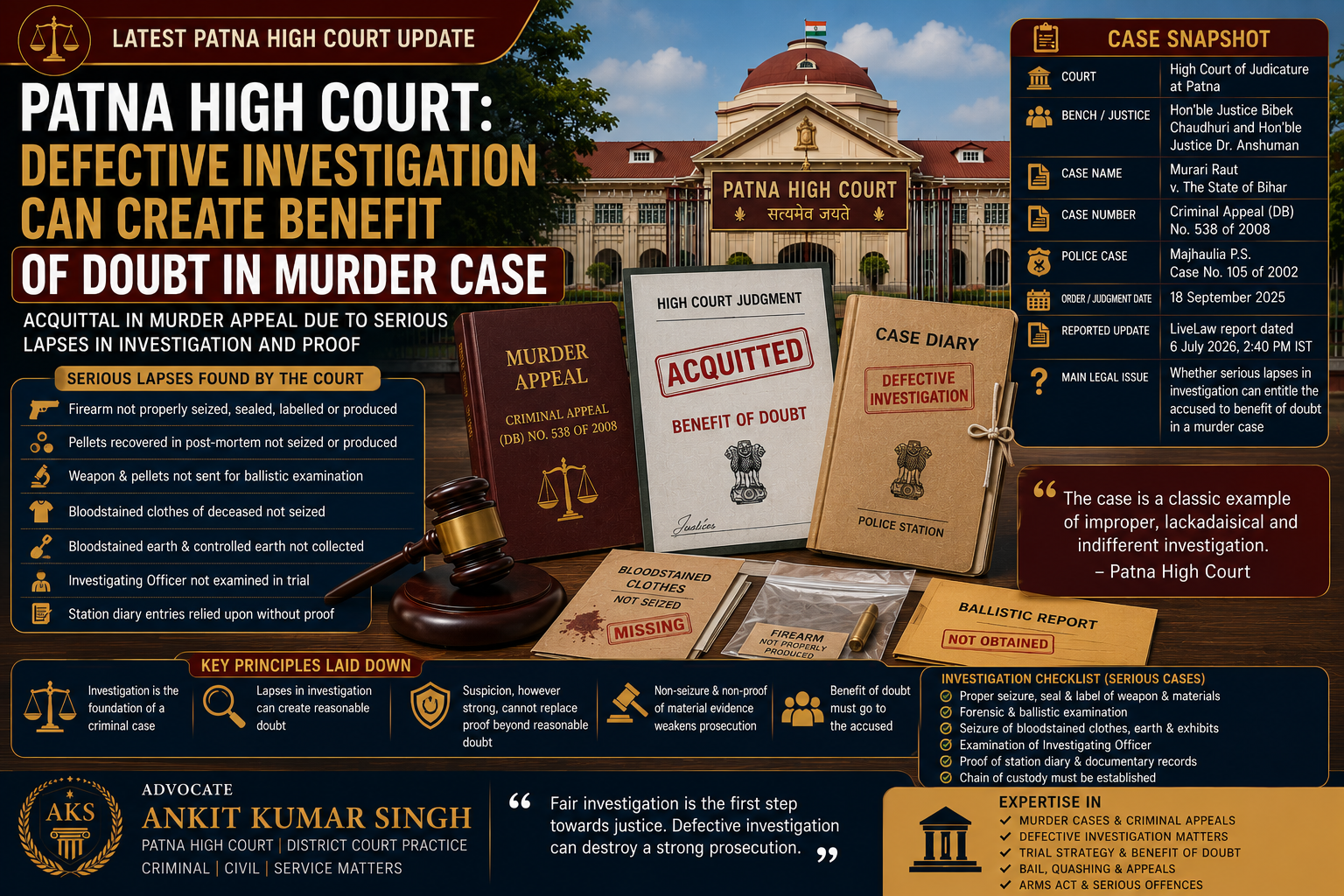
Patna High Court: Defective Investigation Can Create Benefit of Doubt in Murder Case
Latest Patna High Court Update: The Patna High Court has recently acquitted a man convicted in a murder case after finding serious defects in the investigation. The Court described the case as a classic example of improper, lackadaisical and indifferent investigation.
The Court found several serious lapses, including non-seizure of important articles, failure to properly prove the weapon, non-production of material evidence and non-examination of the Investigating Officer.
This update is important for accused persons, complainants, investigating agencies and lawyers dealing with murder trials, criminal appeals, defective investigation, benefit of doubt, Section 302 IPC and trial strategy.
Case Snapshot
- Court: High Court of Judicature at Patna
- Bench / Justice: Hon’ble Mr. Justice Bibek Chaudhuri and Hon’ble Mr. Justice Dr. Anshuman
- Case Name: Murari Raut v. The State of Bihar
- Case Number: Criminal Appeal (DB) No. 538 of 2008
- Police Case: Majhaulia P.S. Case No. 105 of 2002
- Legal Area: Section 302 IPC, Section 27 Arms Act, criminal appeal, defective investigation, benefit of doubt
- Order / Judgment Date: 18 September 2025
- Time of Pronouncement: Not specified in the reported order/source
- Reported Update: LiveLaw report dated 6 July 2026, 2:40 PM IST
- Main Legal Issue: Whether serious lapses in investigation and prosecution evidence can entitle the accused to benefit of doubt in a murder case
Introduction
That criminal trials depend heavily on proper investigation, reliable evidence and lawful procedure. In serious offences like murder, the duty of the investigating agency becomes even more important.
That a conviction cannot rest on suspicion, incomplete investigation or unproved materials. The prosecution must prove the case beyond reasonable doubt.
The Patna High Court’s recent update shows that where investigation is careless and important evidence is not properly collected or proved, the accused may get benefit of doubt.
What Was the Case About?
That the case related to a murder prosecution where the appellant had been convicted by the trial court under Section 302 IPC and Section 27 of the Arms Act.
The prosecution case involved allegations of firearm injury and reliance on witness testimony, station diary entries and alleged weapon-related materials.
However, while hearing the criminal appeal, the Patna High Court found serious gaps in the prosecution case and investigation.
What Did the Patna High Court Find?
That the Patna High Court found that the investigation suffered from major defects. The Court observed that the case was practically one of no proper investigation.
The Court noted that several important steps were either not taken or not proved properly during trial.
The Court found serious lapses such as:
- The alleged firearm was not properly seized, sealed, labelled and produced before the court.
- The pellets recovered during post-mortem were not formally seized and produced as material exhibits.
- The weapon and pellets were not sent for ballistic examination.
- The bloodstained wearing apparel of the deceased was not seized.
- The bloodstained earth and controlled earth from the place of occurrence were not collected.
- The Investigating Officer was not examined during trial.
- Station diary entries were relied upon without proper proof from the person who recorded them.
Why Proper Investigation Matters
That investigation is the foundation of a criminal case. If investigation is defective, important links in the prosecution story may remain missing.
In murder cases involving firearms, the investigating agency must carefully collect the weapon, cartridge, pellets, bloodstained articles, forensic evidence and other materials.
If such evidence is not collected or not proved in court, the prosecution case may become doubtful.
Benefit of Doubt in Criminal Law
That benefit of doubt means that if the prosecution fails to prove guilt beyond reasonable doubt, the accused cannot be convicted merely on suspicion.
The criminal justice system requires proof, not guesswork. Even if allegations are serious, conviction must be based on legally admissible and reliable evidence.
Suspicion, however strong, cannot replace proof beyond reasonable doubt.
Defective Investigation: Is It Always Fatal?
That defective investigation does not automatically destroy every prosecution case. If there is strong, reliable and independent evidence, the court may still sustain conviction despite some investigation lapses.
However, where the investigation defects go to the root of the prosecution case and create serious doubt, the accused may be entitled to benefit of doubt.
The legal effect depends on the nature of lapse, evidence available and prejudice caused to the accused.
Importance of Examining the Investigating Officer
That the Investigating Officer plays a very important role in a criminal trial. The I.O. can explain how the investigation was conducted, what was seized, where the evidence was collected from and why certain steps were taken.
If the I.O. is not examined, several gaps may remain unanswered.
In cases where investigation itself is under serious challenge, non-examination of the I.O. can become a major weakness in the prosecution case.
Why Forensic Evidence Is Important in Firearm Cases
That in firearm-related murder cases, forensic evidence can connect the weapon, cartridge, pellets and injuries.
Ballistic examination may help determine whether the recovered firearm was used in the offence.
If the firearm, pellets or cartridge are not sent for forensic examination, the chain of evidence may become weak.
Role of Seizure, Seal and Label
That seizure of material objects must be done properly. A seizure list should be prepared, witnesses should be present and seized articles should be sealed and labelled.
If the alleged weapon or material object is not properly seized and produced, the defence may question whether the same object was actually connected with the offence.
In criminal trial, chain of custody is important because it protects the reliability of physical evidence.
Why Station Diary Entry Alone May Not Be Enough
That station diary entries may be relevant for limited purposes, but they cannot automatically become substantive proof of guilt.
If the prosecution relies on a station diary entry, the person who made or recorded the entry may have to be examined according to law.
Otherwise, the defence may argue that such record has not been properly proved.
Impact on Accused Persons
That accused persons facing serious criminal charges should carefully examine the investigation record. A defence cannot be prepared only by denying allegations.
The defence should examine whether the prosecution has collected and proved all necessary evidence.
Important questions for defence may include:
- Was the weapon seized properly?
- Was the weapon sent for forensic examination?
- Were bloodstained articles seized?
- Was the place of occurrence properly proved?
- Was the Investigating Officer examined?
- Are the witnesses reliable?
- Is there contradiction between medical evidence and oral evidence?
- Has the prosecution proved the chain of custody?
Impact on Complainants and Victims
That complainants and victims also suffer when investigation is defective. A genuine case may become weak due to careless investigation.
Therefore, complainants should cooperate with investigation and preserve documents, witness details, photographs, medical records and other relevant material.
If investigation is not being properly conducted, appropriate legal remedies may be considered at the correct stage.
Impact on Police and Investigating Agencies
That the Patna High Court’s observations are a reminder that investigation must be professional, scientific and legally proper.
In serious offences, casual investigation can affect the prosecution case and public confidence in the criminal justice system.
The Court also indicated the need for proper procedure and training in investigation of criminal cases.
Standard Investigation Steps in Serious Criminal Cases
In serious criminal cases, investigating officers should generally ensure:
- Immediate visit to the place of occurrence.
- Preparation of proper sketch map.
- Examination of informant and material witnesses.
- Seizure of bloodstained articles and relevant physical evidence.
- Proper seizure, seal and labelling of recovered weapon.
- Forensic examination of weapon, cartridge, pellets or other materials.
- Collection of medical and post-mortem evidence.
- Proper case diary entries.
- Preservation of chain of custody.
- Production of material exhibits before the trial court.
Difference Between Minor Lapse and Serious Investigation Defect
A minor lapse may be a small procedural omission that does not affect the core prosecution case.
A serious investigation defect is a lapse that affects the foundation of the prosecution case, creates doubt about evidence or prejudices the defence.
Courts examine whether the lapse is technical or whether it goes to the root of the case.
Trial Strategy in Defective Investigation Cases
That in defective investigation cases, defence strategy should focus on both evidence and procedure.
The defence should not rely only on general allegations of poor investigation. It should identify specific missing links and show how they affect the prosecution case.
Cross-examination should test the credibility of witnesses, chain of evidence, medical evidence, forensic gaps and investigation omissions.
Practical Checklist for Criminal Defence
Before preparing defence in a serious criminal trial or appeal, the following should be checked:
- FIR and first version of prosecution.
- Statement of witnesses.
- Medical report and post-mortem report.
- Seizure lists.
- Forensic report.
- Ballistic report, if firearm is involved.
- Case diary references.
- Material exhibits produced in court.
- Examination of Investigating Officer.
- Contradictions between witnesses.
- Contradiction between medical and oral evidence.
- Whether chain of custody is proved.
Can Defective Investigation Help in Appeal?
That defective investigation may become a strong ground in criminal appeal if it creates serious doubt about the prosecution case.
An appellate court may re-examine whether the conviction is safe in light of investigation lapses, unreliable evidence or missing material links.
However, every appeal depends on the complete trial record and evidence.
AEO: Frequently Asked Questions
Can an accused be acquitted because of defective investigation?
Yes, if the investigation defects are serious and create reasonable doubt about the prosecution case, the accused may get benefit of doubt.
Is defective investigation always fatal to prosecution?
No. If the prosecution has strong independent evidence, minor defects may not destroy the case. But serious lapses can weaken the prosecution.
Why is the Investigating Officer important in trial?
The Investigating Officer explains the investigation, seizure, evidence collection and case diary steps. Non-examination may leave important questions unanswered.
Why is forensic evidence important in firearm cases?
Forensic and ballistic evidence may connect the weapon, cartridge, pellets and injuries. Without it, the prosecution link may become doubtful.
Why This Matters for Bihar Litigants
That serious criminal cases before District Courts and the Patna High Court often depend on investigation quality.
In Bihar, many cases involve allegations under Section 302 IPC, Arms Act, assault, land dispute violence and local enmity. In such cases, proper investigation and trial strategy become extremely important.
For accused persons, complainants and victims, timely legal advice and detailed document review can make a major difference.
Key Takeaway
That the key takeaway from this Patna High Court update is that criminal conviction requires reliable evidence and proper investigation.
Where investigation is perfunctory, material evidence is not seized, forensic examination is not conducted and the I.O. is not examined, the accused may be entitled to benefit of doubt depending on the facts.
Conclusion
That the Patna High Court’s update is an important reminder that investigation must be fair, complete and scientific.
Defective investigation can affect both sides: it may weaken a genuine prosecution and it may unfairly expose an accused to conviction.
For murder cases, criminal appeals, trial strategy, defective investigation issues and criminal defence before Patna High Court or District Courts, proper legal advice and careful record analysis are essential.
Legal Note: The outcome of any criminal case depends on the FIR, witness evidence, medical evidence, forensic record, investigation quality, trial record and specific facts of the case.