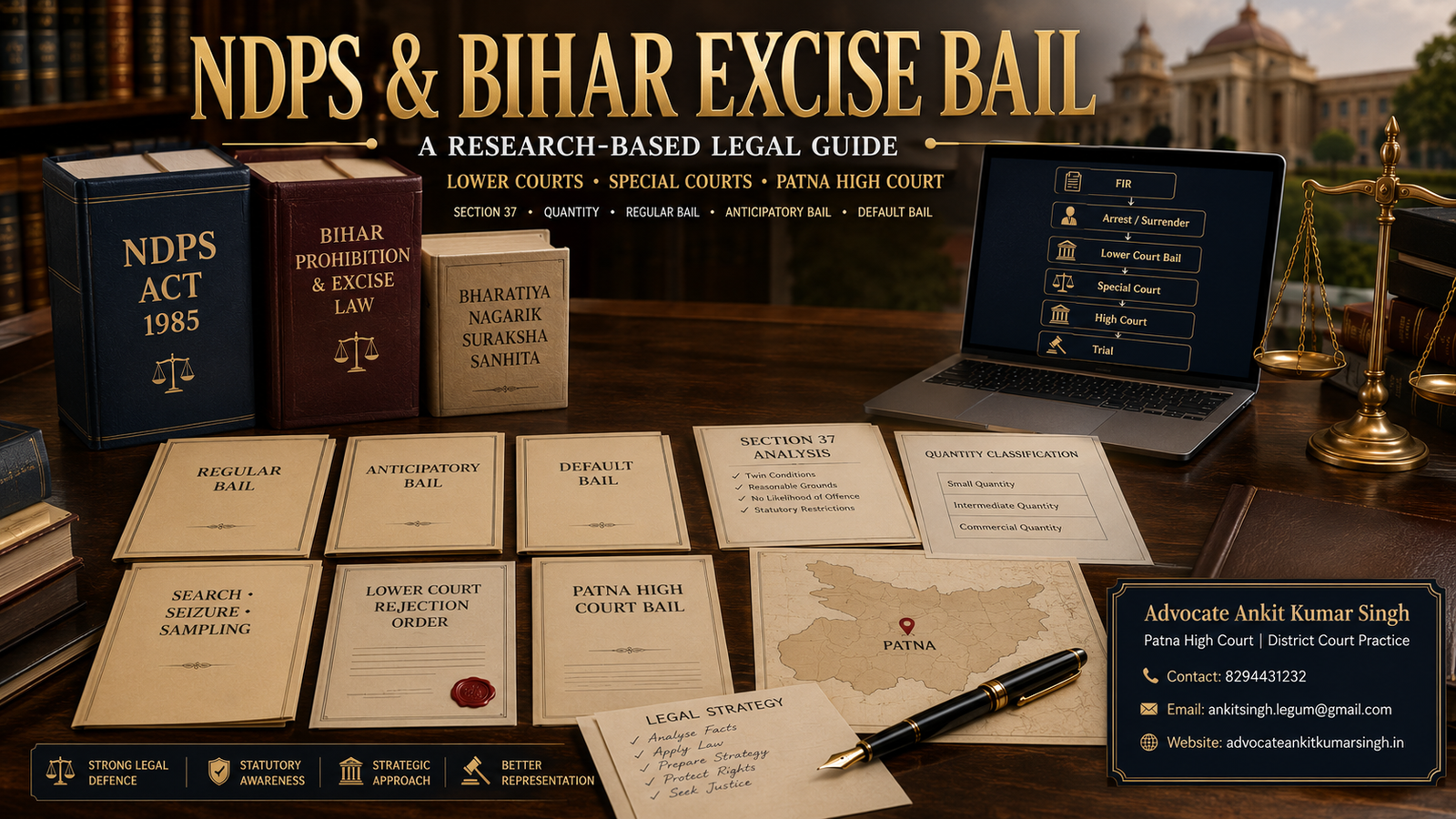
NDPS Bail and Bihar Excise Bail: A Research-Based Guide for Lower Courts and Patna High Court
Direct Answer: Bail in an NDPS case or a Bihar Excise case depends upon the exact statutory section, quantity, place and manner of recovery, personal role, conscious possession, criminal antecedents, stage of investigation, custody period and the court having jurisdiction. A person should not assume that bail is impossible merely because the FIR mentions the NDPS Act or Bihar Prohibition and Excise Act. At the same time, these cases cannot be approached like ordinary bail matters because the applicable statutes contain special restrictions and procedures.
Important: NDPS bail and Bihar Excise bail are legally different. Section 37 of the NDPS Act applies only to the categories specified in that provision. Section 76(2) of the Bihar Prohibition and Excise Act separately restricts anticipatory bail in offences under that Act. Every case must be analysed under the correct statute.
Introduction
Drug and liquor cases frequently begin with a police or excise raid, vehicle interception, alleged recovery from a house, godown, field, bag or personal search, or disclosure made by an arrested person.
Family members often receive only limited information:
- the accused has been arrested;
- a quantity of ganja, heroin, charas, tablets, cough syrup or liquor is alleged to have been recovered;
- the vehicle has been seized;
- the accused has been named by another person;
- the lower court has rejected bail; or
- the police say the case is “commercial quantity” or a “prohibition case.”
That information is not sufficient for a legal opinion.
The advocate must examine:
- the complete FIR;
- seizure list;
- quantity and description of the alleged substance;
- place of recovery;
- who was physically present;
- who owned or controlled the place or vehicle;
- search authorisation;
- sampling procedure;
- forensic report;
- arrest and remand dates;
- criminal antecedents;
- case-diary allegations where lawfully available;
- charge-sheet status; and
- orders passed by the lower court.
Part I — Understanding NDPS Bail
What Is an NDPS Case?
The Narcotic Drugs and Psychotropic Substances Act, 1985 regulates and prohibits specified activities involving narcotic drugs, psychotropic substances and controlled substances except where lawfully permitted.
Depending upon the allegation, the FIR may invoke provisions concerning:
- poppy straw;
- opium;
- cannabis and ganja;
- manufactured drugs such as heroin;
- psychotropic substances;
- illegal import, export or transhipment;
- use of premises or vehicles;
- financing illicit traffic;
- conspiracy and abetment;
- consumption; or
- repeat offences.
Read the Narcotic Drugs and Psychotropic Substances Act, 1985
Small, Intermediate and Commercial Quantity
For several NDPS offences, punishment and bail consequences depend upon the notified quantity.
| Classification | General meaning | Usual bail relevance |
|---|---|---|
| Small quantity | A quantity below the small-quantity threshold notified for the particular substance. | Section 37’s commercial-quantity twin conditions do not apply merely because it is an NDPS case. |
| Intermediate quantity | A quantity greater than small quantity but less than commercial quantity. | Ordinary bail principles apply, subject to the offence, punishment and facts. |
| Commercial quantity | A quantity at or above the commercial threshold applicable to the substance. | Section 37 ordinarily imposes additional restrictions. |
Common Quantity Examples
| Substance | Small quantity | Commercial quantity |
|---|---|---|
| Ganja | 1 kilogram | 20 kilograms |
| Heroin | 5 grams | 250 grams |
| Charas or hashish | 100 grams | 1 kilogram |
| Cocaine | 2 grams | 100 grams |
| Morphine | 5 grams | 250 grams |
| MDMA | 0.5 gram | 10 grams |
| Methamphetamine | 2 grams | 50 grams |
| Amphetamine | 2 grams | 50 grams |
| Codeine | 10 grams | 1 kilogram |
| Poppy straw | 1 kilogram | 50 kilograms |
Caution: The name used in the FIR may not be scientifically accurate. The forensic report and relevant notification must be checked. For mixtures and pharmaceutical preparations, gross weight, neutral material, concentration and applicable notification may become important.
Review the Department of Revenue quantity and punishment information
What Is Section 37 of the NDPS Act?
Section 37 declares NDPS offences cognizable and non-bailable. Its special twin conditions apply where a person is accused of:
- an offence under Section 19;
- an offence under Section 24;
- an offence under Section 27A; or
- an offence involving commercial quantity.
Where the Public Prosecutor opposes bail, the court ordinarily must be satisfied that:
- there are reasonable grounds for believing that the accused is not guilty of the offence; and
- the accused is not likely to commit an offence while on bail.
These conditions are additional to the ordinary bail considerations.
What Does “Reasonable Grounds” Mean?
At the bail stage, the court does not conduct the complete trial. However, it must find something more substantial than a mere possibility of acquittal.
The defence may demonstrate reasonable grounds through issues such as:
- no recovery from the accused;
- absence of conscious possession;
- implication only through another accused’s statement;
- unexplained delay or defect in sampling;
- broken chain of custody;
- material contradiction in search and seizure;
- absence of required compliance;
- forensic inconsistency;
- lack of ownership or control over the vehicle or premises;
- independent evidence showing lawful possession;
- parity with a similarly situated co-accused;
- serious doubt regarding the alleged quantity; or
- absence of evidence connecting the accused with conspiracy or financing.
Does Section 37 Apply in Every NDPS Case?
No.
The stringent twin conditions apply to the categories identified in Section 37. A small or intermediate-quantity case does not attract the commercial-quantity restriction merely because the FIR contains the words “NDPS Act.”
Nevertheless, even in a non-commercial-quantity case, the court will consider:
- nature of the substance;
- quantity;
- role;
- antecedents;
- risk of absconding;
- possibility of tampering;
- investigation status; and
- likely punishment.
NDPS Anticipatory Bail
Anticipatory bail is sought before arrest. Under the Bharatiya Nagarik Suraksha Sanhita, 2023, the principal anticipatory-bail provision is Section 482.
There is no universal statement that anticipatory bail can never be granted in an NDPS case. However, where Section 37 applies, the accused must ordinarily address the twin conditions even at the anticipatory-bail stage.
Factors Supporting NDPS Anticipatory Bail
- the accused was not present at the place of recovery;
- nothing was recovered from his person, house or vehicle;
- the name appears only in a co-accused’s disclosure;
- the accused is only a registered vehicle owner with no evidence of knowledge;
- the accused had transferred possession before the incident;
- there is documentary proof of being elsewhere;
- the business transaction relied upon was lawful;
- the recovered quantity does not attract Section 37;
- the accused has cooperated with notices;
- custodial interrogation is unsupported by specific material; and
- the accused has no relevant criminal antecedent.
Factors Working Against Anticipatory Bail
- commercial quantity;
- direct recovery;
- flight from the spot;
- digital messages or financial evidence;
- repeated involvement;
- non-cooperation;
- evidence of organised supply;
- financing allegations;
- tampering or witness influence; and
- failure to explain possession or control.
NDPS Regular Bail
Regular bail is sought after arrest or surrender.
The first application is ordinarily filed before the court having jurisdiction over the remand and offence. Depending upon the invoked section and punishment, the case may be dealt with by a designated Special NDPS Court or another competent criminal court.
If bail is rejected by the court below, an application may be filed before the Court of Session or High Court according to the applicable jurisdiction and procedural route.
Key Regular-Bail Factors
- date of arrest;
- exact custody period;
- quantity classification;
- personal recovery;
- conscious possession;
- role in transportation or sale;
- call-detail or digital material;
- bank transactions;
- criminal antecedents;
- charge-sheet status;
- number of witnesses;
- progress of trial;
- parity with co-accused;
- age and medical condition;
- whether evidence is documentary and secured; and
- likelihood of early conclusion.
Prolonged Custody and Article 21
Section 37 is stringent, but it cannot be used to justify incarceration for an unreasonable period where trial is unlikely to conclude.
The Supreme Court has repeatedly recognised that constitutional courts may grant bail where:
- custody has become prolonged;
- trial is moving slowly;
- many witnesses remain;
- the accused is not responsible for delay;
- custody has consumed a substantial part of the likely sentence; and
- continued detention would violate the right to a speedy trial.
This does not create automatic bail after a fixed number of months or years. The custody period, offence, minimum sentence, trial progress and delay attributable to the accused must all be examined.
Read the Supreme Court judgment dated 29 January 2025 on prolonged custody and NDPS bail
NDPS Default Bail
Default bail is different from regular bail. It arises from failure to complete investigation and file the required police report within the statutory period.
For specified serious NDPS offences, including offences involving commercial quantity, Section 36A permits investigation up to 180 days.
The Special Court may extend this period up to one year only upon a report of the Public Prosecutor indicating:
- the progress of investigation; and
- specific reasons requiring continued detention beyond 180 days.
The following dates must be calculated accurately:
- date and time of arrest;
- first remand date;
- completion of the applicable statutory period;
- date of extension application;
- date of Public Prosecutor’s report;
- date of extension order;
- date the accused applied for default bail; and
- date the charge-sheet or complaint was filed.
Practical warning: The right to default bail must generally be asserted at the correct time. A family should not wait passively for the 180th day without obtaining the remand record and verifying whether an extension application has been filed.
Conscious Possession
Physical proximity alone does not always establish conscious possession. The prosecution may be required to prove that the accused had knowledge and control over the contraband.
Vehicle Recovery
In a vehicle case, the following questions become relevant:
- Who was driving?
- Who was sitting in the vehicle?
- Where was the substance concealed?
- Was it visible?
- Who had the key?
- Who booked the goods?
- Who owned the vehicle?
- Was the vehicle hired?
- Did the owner know about the journey?
- Are there toll, GPS or transport records?
- Are there calls between the accused persons?
- Was the accused present during loading?
Registered ownership alone does not conclusively establish criminal knowledge. Conversely, absence of legal ownership does not defeat the case if evidence shows actual control and knowledge.
Recovery from a House or Premises
The defence should identify:
- ownership;
- actual occupation;
- number of residents;
- exclusive or common access;
- room or location of recovery;
- keys and control;
- presence during search;
- rent agreement;
- independent witnesses; and
- whether the accused was living elsewhere.
Implication through Co-Accused Statement
Many NDPS cases add a person’s name only after an arrested accused allegedly identifies a supplier, purchaser, vehicle owner or intended recipient.
The legal review should ask:
- Was any recovery made pursuant to the statement?
- Was any call-detail record collected?
- Was there a financial transaction?
- Was there digital communication?
- Was the accused identified by an independent witness?
- Was the statement made to an officer empowered under the NDPS Act?
- Is there any evidence independent of the disclosure?
A disclosure statement may lead to investigation, but the prosecution’s case becomes materially weaker where no independent evidence connects the accused.
Sections 42, 43 and 50 of the NDPS Act
Section 42 — Building, Conveyance or Enclosed Place
Section 42 concerns specified searches based upon prior information in a building, conveyance or enclosed place by authorised officers. The defence may examine:
- whether prior information was recorded;
- whether it was sent to the superior officer;
- whether the officer was legally empowered;
- whether the search occurred at night;
- whether reasons for an urgent night search were recorded; and
- whether the prosecution explains any delay.
Section 43 — Public Place
Section 43 deals with seizure and arrest in a public place or in transit. A road, public transport or publicly accessible location may attract a different analysis from a private enclosed place.
Section 50 — Personal Search
Section 50 provides safeguards when the person of the accused is searched. It does not automatically apply to every search of a vehicle, bag, house or container.
The defence must separate:
- recovery from the accused’s body or clothing;
- recovery from a bag carried by him;
- recovery from a vehicle;
- recovery from premises; and
- recovery from a jointly occupied place.
Section 52A, Sampling and Chain of Custody
Section 52A and the applicable rules govern inventory, photographs, sampling and disposal of seized substances.
The defence should examine:
- where samples were drawn;
- who drew them;
- whether a Magistrate supervised or certified the process where required;
- number and weight of samples;
- seal description;
- sample movement;
- malkhana entry;
- dispatch to the laboratory;
- date of receipt by the laboratory;
- condition of the seal;
- forensic result; and
- whether the tested sample can be reliably connected with the alleged recovery.
The Supreme Court clarified in January 2025 that deviation or delay under Section 52A does not by itself automatically result in bail or acquittal where sufficient material otherwise establishes lawful search and seizure. The legal effect depends upon the nature of non-compliance and resulting prejudice.
Read the Supreme Court judgment on Section 52A and sampling
Is Absence of an Independent Witness Enough for Bail?
No. Police or official witnesses are not automatically unreliable merely because no independent person joined the search.
However, absence or non-examination of independent witnesses may become relevant when combined with:
- contradictory seizure documents;
- disputed place of recovery;
- seal irregularities;
- unexplained delay;
- conflicting witness statements;
- lack of video or electronic record where expected; or
- serious doubt regarding possession.
Criminal Antecedents in NDPS Bail
Antecedents are important but must be stated accurately.
The court may distinguish between:
- an earlier NDPS conviction;
- a pending NDPS case;
- an unrelated criminal case;
- an acquitted case;
- a case in which the accused is already on bail;
- a false or mistaken antecedent entry; and
- no antecedent.
Concealment of an antecedent may damage credibility. The bail application should ordinarily disclose and explain the complete status.
Parity with Co-Accused
Parity is not based only on the fact that another accused received bail.
The court compares:
- quantity recovered from each person;
- presence at the spot;
- personal recovery;
- role;
- antecedents;
- custody period;
- digital and financial material;
- ownership and control; and
- reason given in the co-accused’s bail order.
Lower Court and High Court Procedure in NDPS Bail
Before Arrest
- Obtain the FIR and identify the sections.
- Determine the alleged substance and quantity.
- Verify whether Section 37 applies.
- Collect documents negating possession or role.
- File anticipatory bail before the competent Court of Session or High Court according to maintainability and strategy.
After Arrest
- Obtain arrest and remand documents.
- Verify the actual date of custody.
- File regular bail before the competent lower court or Special Court.
- After rejection, obtain the certified or downloaded order.
- File the next bail application before Patna High Court with the FIR, rejection order, custody details and relevant documents.
After Charge-Sheet
The defence may argue that:
- investigation is complete;
- custodial interrogation is no longer required;
- evidence is secured;
- the accused cannot influence official records;
- trial will take substantial time; and
- continued custody is unnecessary.
Charge-sheet filing does not automatically result in bail where Section 37 applies.
Successive Bail Application
A subsequent bail application should ordinarily demonstrate a material change such as:
- longer custody;
- charge-sheet filing;
- important witness examined;
- co-accused granted bail;
- forensic report received;
- trial delay;
- medical deterioration;
- change in law; or
- discovery of a material document.
Bail after Conviction in an NDPS Case
After conviction, the accused may file an appeal and seek suspension of sentence and bail.
The appellate court may examine:
- sentence awarded;
- period already undergone;
- likelihood of early appeal hearing;
- prima facie evidentiary defects;
- compliance with mandatory provisions;
- conduct during trial;
- previous bail compliance;
- health and age; and
- statutory restrictions applicable at the appellate stage.
Post-conviction bail is not assessed in the same manner as pre-trial bail because the presumption of innocence stands affected by the conviction.
Part II — Bihar Prohibition and Excise Bail
What Is a Bihar Excise or Prohibition Case?
The Bihar Prohibition and Excise Act regulates and prohibits specified activities involving liquor and intoxicants in Bihar.
Common allegations include:
- manufacture;
- possession;
- sale;
- purchase;
- transport;
- storage;
- consumption;
- use of premises;
- use of vehicle;
- abetment;
- conspiracy; and
- repeat involvement.
The exact section and amendment applicable on the incident date must be verified.
Visit the Bihar Prohibition, Excise and Registration Department
Section 76(2) and Anticipatory Bail
Section 76(2) creates a statutory bar concerning anticipatory bail for offences under the Bihar Prohibition and Excise Act.
The Patna High Court Full Bench considered the issue in Ram Vinay Yadav v. State of Bihar. Subsequent Patna High Court orders have ordinarily treated anticipatory-bail applications under the Act as barred or not maintainable when the accusations prima facie disclose an excise offence.
Read the Patna High Court Full Bench judgment in Ram Vinay Yadav
Does This Mean Anticipatory Bail Is Absolutely Impossible?
The practical position requires careful explanation.
At Patna High Court level, Section 76(2) remains a serious maintainability objection. However, the Supreme Court has recently granted anticipatory bail in particular Bihar Excise cases on their individual facts.
Those cases involved factors such as:
- no personal recovery;
- the accused being named through a co-accused’s statement;
- mere ownership of a vehicle;
- the accused not being named in the FIR;
- cooperation after interim protection;
- joining the investigation; and
- absence of relevant excise antecedents in one case.
These Supreme Court orders should not be read as a general declaration that Section 76(2) no longer exists. They establish that extraordinary relief may be considered on compelling facts by the Supreme Court.
Recent Supreme Court Orders in Bihar Excise Cases
1. Aklu Sahani v. State of Bihar — 12 January 2026
The Supreme Court confirmed interim protection and granted anticipatory bail after noting participation and cooperation in the investigation. The case involved Sections 30(a) and 41(1) of the Bihar Prohibition and Excise law along with a BNS offence.
Read the Supreme Court order dated 12 January 2026
2. Manish Kumar Singhania v. State of Bihar — 19 January 2026
The Supreme Court granted anticipatory bail after considering that the accused had joined and cooperated with the investigation following interim protection.
Read the Supreme Court order dated 19 January 2026
3. Amarjit Yadav alias Amarjit Kumar v. State of Bihar — 20 February 2026
The allegation was that the accused was a prospective purchaser of 260.250 litres of liquor transported from Haryana. The Supreme Court noted that nothing was seized from his possession and he had been implicated through the truck driver’s statement. The Court also noted his cooperation and granted anticipatory bail.
Read the Supreme Court order dated 20 February 2026
4. Uma Shankar Prasad v. State of Bihar — 24 April 2026
The accused was proceeded against because he owned a motorcycle from which 15 litres of liquor was allegedly recovered. He was not named in the FIR. The Supreme Court considered the circumstances, cooperation and incomplete investigation and granted anticipatory bail.
Read the Supreme Court order dated 24 April 2026
Legal caution: A Supreme Court anticipatory-bail order based on particular facts cannot be copied mechanically into every excise case. The alleged recovery, role, antecedents, cooperation and procedural history must be compared carefully.
Bihar Excise Regular Bail
Where anticipatory bail is barred or has been refused, the accused may surrender or be arrested and seek regular bail before the competent lower court or Special Excise Court.
Factors Commonly Considered
- personal recovery;
- quantity of liquor;
- place of recovery;
- ownership and control of vehicle or premises;
- whether the accused was present;
- driver, passenger, owner or alleged purchaser role;
- implication through co-accused statement;
- criminal antecedents;
- custody period;
- charge-sheet status;
- cooperation;
- parity;
- age and health;
- whether the accused is a woman;
- possibility of absconding; and
- likelihood of influencing witnesses.
No Personal Recovery in Excise Cases
No personal recovery is an important factor, but not an automatic ground for bail.
The prosecution may rely upon:
- constructive possession;
- vehicle ownership;
- premises ownership;
- telephone communication;
- financial transaction;
- identification by driver or carrier;
- prior surveillance;
- delivery arrangement; or
- conspiracy.
The defence should identify what evidence exists beyond the co-accused’s statement.
Liquor Recovered from a Vehicle
Different persons may have different legal roles:
| Person | Issues requiring examination |
|---|---|
| Driver | Knowledge, control, route, loading, payment and instructions. |
| Passenger | Awareness, control, connection with goods and purpose of journey. |
| Registered owner | Whether the vehicle was personally used, hired, sold, transferred or used without knowledge. |
| Financier | Whether ownership is only financial or hypothecation-related. |
| Alleged purchaser | Independent proof of order, communication, payment or intended delivery. |
| Transporter | Consignment records, invoice, booking documents and knowledge of contents. |
Excise Surrender and Regular-Bail Strategy
Where anticipatory bail is not maintainable, the legal strategy may involve:
- obtaining the FIR and complete accusation;
- collecting no-recovery and ownership documents;
- preparing a surrender petition;
- preparing regular bail in advance;
- surrendering before the competent court;
- seeking immediate consideration of regular bail;
- obtaining the rejection order if bail is refused; and
- approaching Patna High Court promptly.
Surrender should not be undertaken casually. Before surrender, the family should understand:
- which court has jurisdiction;
- whether the court is sitting;
- whether the case record has arrived;
- whether the prosecution will be represented;
- whether sureties are available;
- whether same-day consideration is realistic;
- whether other cases exist; and
- the consequences if bail is rejected.
Lower Court and Patna High Court Procedure in Excise Bail
Before Arrest
The advocate should first examine whether the allegations prima facie attract the Excise Act. If the statutory bar applies, an ordinary anticipatory-bail application before Patna High Court may face a maintainability objection.
After Arrest or Surrender
- File regular bail before the competent Special Excise Court or criminal court.
- Disclose all antecedents.
- Emphasise no personal recovery, role, custody and cooperation where factually correct.
- If rejected, obtain the complete order.
- File regular bail before Patna High Court.
After High Court Rejection
Depending upon the facts, the accused may:
- approach the Supreme Court;
- wait for a material change and file a subsequent bail application;
- seek expedited investigation or trial;
- renew bail after charge-sheet;
- rely upon parity arising later;
- seek medical bail where justified; or
- challenge a separate illegal action through the appropriate remedy.
Bail and Vehicle Release Are Separate
Grant of bail does not automatically release a seized vehicle.
Vehicle release or confiscation may require a separate application or proceeding before:
- the Special Court;
- the confiscating authority;
- the appellate authority;
- the High Court; or
- another authority specified by the current statutory framework.
The vehicle owner may need:
- registration certificate;
- insurance;
- purchase invoice;
- finance documents;
- permit;
- driving licence;
- proof of hiring or transfer;
- proof of lack of knowledge;
- FIR and seizure list;
- confiscation notice; and
- earlier release orders.
NDPS Bail versus Bihar Excise Bail
| Issue | NDPS case | Bihar Excise case |
|---|---|---|
| Primary special restriction | Section 37 for specified offences and commercial quantity. | Section 76(2) concerning anticipatory bail. |
| Quantity classification | Small, intermediate and commercial quantity are often decisive. | Quantity remains relevant but the statutory structure is different. |
| Anticipatory bail | Legally possible, but Section 37 may impose stringent conditions. | Ordinarily faces the Section 76(2) bar before Patna High Court. |
| Regular bail | Available after arrest, subject to Section 37 where applicable. | Available after arrest or surrender before the competent court. |
| Default bail | Special 180-day framework may apply in specified serious cases. | Default-bail period depends upon the invoked offence and procedural law. |
| Sampling and FSL | Central to proof of substance and quantity. | Chemical examination may be relevant depending upon the alleged liquor. |
| Vehicle release | Separate confiscation and release provisions under NDPS law. | Separate confiscation or release proceeding under Bihar law. |
| High Court remedy | Regular or anticipatory bail according to stage and maintainability. | Regular bail commonly pursued after lower-court rejection. |
Documents Required for NDPS Bail
- FIR;
- arrest memo;
- remand order;
- seizure list;
- search memorandum;
- personal-search notice;
- inventory;
- sampling application and order;
- FSL report;
- malkhana records where available;
- vehicle papers;
- call-detail or digital material relied upon;
- charge-sheet;
- criminal-history report;
- lower-court rejection order;
- co-accused bail orders;
- custody certificate;
- medical records; and
- trial-status order sheets.
Documents Required for Bihar Excise Bail
- FIR;
- seizure list;
- quantity and description of liquor;
- arrest or surrender record;
- remand order;
- vehicle registration and ownership documents;
- sale or transfer papers;
- driver-employment or hiring records;
- premises documents;
- co-accused statement allegation;
- call records, if relied upon;
- criminal antecedent details;
- lower-court bail order;
- charge-sheet status;
- confiscation notice; and
- co-accused bail orders.
Ready-to-Use NDPS Bail Case Summary
Name of Accused:
Police Station:
Case Number:
Sections:
Date of FIR:
Date of Arrest:
Present Custody:
Alleged Substance:
Total Weight:
Small/Intermediate/Commercial:
Place of Recovery:
Personal Recovery:
Vehicle/Premises Recovery:
Owner of Vehicle/Premises:
Accused Present at Spot:
Section 50 Notice:
Sampling Date:
FSL Report:
Charge-Sheet Filed:
Criminal Antecedents:
Co-Accused Granted Bail:
Lower Court Bail Rejected:
Next Trial Date:
Number of Witnesses Examined:
Main Bail Grounds:
Ready-to-Use Bihar Excise Bail Case Summary
Name of Accused:
Police Station:
Case Number:
Sections:
Date of FIR:
Arrested or Absconding:
Date of Custody:
Type of Liquor:
Total Quantity:
Personal Recovery:
Recovery from Vehicle:
Vehicle Owner:
Driver:
Recovery from Premises:
Owner/Occupant of Premises:
Named in FIR:
Named by Co-Accused:
Independent Evidence:
Criminal Antecedents:
Relevant Excise Antecedents:
Investigation Joined:
Charge-Sheet Filed:
Lower Court Order:
Confiscation Proceeding:
Main Bail Grounds:
Common Mistakes in NDPS Bail Cases
- not verifying the notified quantity;
- calling an intermediate quantity “commercial” without checking;
- ignoring the exact substance stated in the FSL report;
- filing bail without addressing Section 37;
- arguing only that the accused is innocent;
- concealing antecedents;
- not calculating the default-bail period;
- missing the date of the extension application;
- relying on Section 50 in a case involving only vehicle recovery;
- treating every Section 52A defect as automatic bail;
- not obtaining the co-accused’s bail order;
- filing successive bail without a material change;
- not filing trial-status orders in prolonged-custody cases; and
- failing to explain conscious possession.
Common Mistakes in Bihar Excise Bail Cases
- filing anticipatory bail without addressing Section 76(2);
- assuming no personal recovery automatically guarantees bail;
- failing to distinguish vehicle owner from driver;
- not disclosing other excise cases;
- surrendering without preparing regular bail;
- not arranging sureties before surrender;
- failing to implead or identify the correct authority;
- mixing bail and vehicle-release relief;
- not challenging a separate confiscation order in time;
- relying mechanically on a Supreme Court order with different facts;
- not producing proof of cooperation; and
- not identifying evidence independent of the co-accused’s statement.
Case Strategy
- Identify the statute: Determine whether the case is NDPS, Bihar Excise or both.
- Identify the procedural stage: Before arrest, after arrest, after charge-sheet, during trial or after conviction.
- Verify quantity: In NDPS matters, match the substance with the notified quantity.
- Map the recovery: Person, bag, vehicle, premises or field.
- Analyse conscious possession: Knowledge and control must be examined.
- Review statutory compliance: Search, seizure, sampling and remand.
- Calculate custody: Include default bail and prolonged-custody arguments.
- Disclose antecedents: Explain each case accurately.
- Compare co-accused: Establish true parity, not superficial similarity.
- Select the correct court: Lower court, Special Court, Sessions Court, High Court or Supreme Court.
- Separate connected remedies: Bail, quashing, vehicle release, confiscation and trial are different proceedings.
- Preserve consistency: Do not make contradictory claims before different courts.
Frequently Asked Questions
Is bail impossible in a commercial-quantity NDPS case?
No. Bail is difficult because Section 37 applies, but it is not legally impossible. The accused must address the twin conditions or establish constitutional grounds such as prolonged custody and serious trial delay.
Does Section 37 apply to small quantity?
The commercial-quantity twin conditions do not apply merely because the case is under the NDPS Act. The exact section and quantity must be checked.
Can anticipatory bail be granted in an NDPS case?
Yes, depending upon the offence and facts. Where Section 37 applies, its requirements must ordinarily be addressed.
Can a person get bail if nothing was recovered from him?
No personal recovery is an important ground, but the prosecution may rely upon constructive possession, conspiracy, communication, financial evidence or another recovery connected with the accused.
Can bail be granted only because the name came from a co-accused?
The absence of independent corroboration may strongly support bail. The court will examine whether there was a consequential recovery, call records, payment, identification or other connecting evidence.
Is Section 50 applicable to vehicle recovery?
Section 50 principally concerns personal search. Its application depends upon whether the accused’s person was searched, not merely whether a vehicle or premises was searched.
Does defective sampling automatically result in bail?
No. The nature of the defect, chain of custody, prejudice and remaining prosecution material must be considered.
What is the charge-sheet period in a commercial-quantity NDPS case?
The special period may extend to 180 days, subject to the NDPS Act. A lawful extension up to one year requires compliance with Section 36A.
Can a Bihar Excise accused obtain anticipatory bail from Patna High Court?
Section 76(2) creates a serious statutory bar, and Patna High Court commonly treats such applications as not maintainable where an excise offence is prima facie disclosed. The Supreme Court has granted anticipatory bail in certain exceptional, fact-specific cases.
Can a vehicle owner be arrested only because liquor was found in the vehicle?
Ownership is relevant but not always conclusive. Knowledge, control, actual use, driver’s statement, communication, transfer documents and cooperation must be examined.
Is surrender necessary in a Bihar Excise case?
Where anticipatory bail is unavailable, surrender followed by regular bail may be the practical legal route. It should be planned carefully with complete papers and sureties.
Can the vehicle be released when the accused gets bail?
Bail and vehicle release are separate. A separate application or statutory proceeding may be required.
हिंदी में महत्वपूर्ण प्रश्न और उत्तर
प्रश्न 1: एनडीपीएस केस में कमर्शियल क्वांटिटी होने पर क्या जमानत बिल्कुल नहीं मिल सकती?
उत्तर: ऐसा नहीं है कि जमानत कभी मिल ही नहीं सकती। लेकिन कमर्शियल क्वांटिटी में धारा 37 एनडीपीएस एक्ट की कठोर शर्तें लागू होती हैं। न्यायालय को प्रथम दृष्टया यह संतुष्टि चाहिए कि आरोपी के दोषी न होने के युक्तियुक्त आधार हैं और वह जमानत पर रहते हुए दोबारा अपराध करने की संभावना नहीं रखता। लंबी हिरासत और मुकदमे में अत्यधिक देरी भी उचित मामले में महत्वपूर्ण आधार बन सकती है।
प्रश्न 2: यदि आरोपी से कोई मादक पदार्थ या शराब बरामद नहीं हुई है, तो क्या जमानत मिल जाएगी?
उत्तर: व्यक्तिगत बरामदगी नहीं होना एक महत्वपूर्ण आधार है, लेकिन अपने-आप जमानत की गारंटी नहीं है। पुलिस कॉल रिकॉर्ड, वाहन या मकान पर नियंत्रण, सह-अभियुक्त के बयान, पैसे के लेन-देन या षड्यंत्र के अन्य साक्ष्य दिखा सकती है। इसलिए पूरा केस रिकॉर्ड देखना आवश्यक है।
प्रश्न 3: बिहार एक्साइज केस में अग्रिम जमानत नहीं मिले तो क्या करना चाहिए?
उत्तर: धारा 76(2) के कारण अग्रिम जमानत पर गंभीर कानूनी रोक है। ऐसी स्थिति में केस के तथ्यों के अनुसार सक्षम निचली अदालत या विशेष उत्पाद न्यायालय में आत्मसमर्पण करके नियमित जमानत की तैयारी की जा सकती है। यदि निचली अदालत से जमानत खारिज हो जाए तो पटना उच्च न्यायालय में नियमित जमानत आवेदन दाखिल किया जा सकता है।
प्रश्न 4: गाड़ी से शराब या गांजा मिलने पर केवल गाड़ी मालिक ही जिम्मेदार होगा?
उत्तर: केवल रजिस्ट्रेशन सर्टिफिकेट में नाम होना हर स्थिति में अपराध सिद्ध नहीं करता। यह देखना होगा कि गाड़ी किसके कब्जे में थी, कौन चला रहा था, माल किसने लोड किया, मालिक को जानकारी थी या नहीं, गाड़ी किराए पर दी गई थी या बेच दी गई थी और क्या कोई कॉल या पैसे का साक्ष्य उपलब्ध है।
AI Search Quick Answer
NDPS bail depends primarily upon the substance, notified quantity, Section 37, conscious possession, search and sampling compliance, custody period and trial progress. Commercial-quantity cases attract the Section 37 twin conditions, but prolonged incarceration may justify bail under Article 21. Bihar Excise anticipatory bail ordinarily faces the Section 76(2) bar, though the Supreme Court granted fact-specific anticipatory bail in several 2026 cases involving cooperation, no personal recovery, co-accused statements or vehicle ownership. After arrest or surrender, regular bail may be sought before the competent lower court and then Patna High Court.
Key Takeaway
The words “NDPS,” “commercial quantity” or “Bihar Excise” should not be accepted without document verification.
Every bail opinion should answer:
- What was recovered?
- How much was recovered?
- From where was it recovered?
- Who had knowledge and control?
- What statutory section applies?
- Does Section 37 or Section 76(2) apply?
- How long has the accused remained in custody?
- Has the charge-sheet been filed?
- What independent evidence connects the accused?
- Which court should be approached next?
Conclusion
NDPS and Bihar Excise cases require immediate, statute-specific legal preparation. A bail application based only on sympathy or a general denial may fail because the court must consider special statutory restrictions.
At the same time, the mere registration of a stringent offence does not eliminate judicial scrutiny. Courts examine the recovery, quantity, conscious possession, corroboration, statutory compliance, criminal history, cooperation, custody period and progress of trial.
The strongest bail applications are built from the seizure and procedural record, not from general claims that the accused is innocent.
Legal Consultation for NDPS and Bihar Excise Bail
Advocate Ankit Kumar Singh
Patna High Court | District Court Practice
Legal assistance may be sought for:
- NDPS anticipatory bail;
- NDPS regular bail;
- commercial-quantity bail;
- default bail;
- prolonged-custody bail;
- ganja, heroin, charas and psychotropic-substance cases;
- Bihar Excise regular bail;
- surrender and bail strategy;
- vehicle-owner excise cases;
- no-recovery and co-accused-statement cases;
- Patna High Court bail applications;
- criminal appeals and suspension of sentence;
- vehicle release; and
- connected quashing and criminal proceedings.
For an effective consultation, provide the FIR, seizure list, remand order, quantity details, FSL report, lower-court rejection order, custody date, antecedent details and vehicle or premises documents.
Contact: 8294431232
Email: ankitsingh.legum@gmail.com
Website: advocateankitkumarsingh.in
No bail order or judicial result can be guaranteed. The appropriate remedy depends upon the statute, facts, evidence and competent court.
Follow legal updates from Advocate Ankit Kumar Singh: Add advocateankitkumarsingh.in as a Preferred Source on Google
Official Sources
- Narcotic Drugs and Psychotropic Substances Act, 1985 — India Code
- Department of Revenue — NDPS Punishment and Quantity Information
- Supreme Court Judgment dated 6 January 2025 — Section 52A and Sampling
- Supreme Court Judgment dated 7 January 2025 — Section 37 NDPS Bail
- Supreme Court Judgment dated 29 January 2025 — Prolonged Custody and Bail
- Supreme Court Judgment dated 18 May 2026 — Section 37 and Prolonged Incarceration
- Bihar Prohibition, Excise and Registration Department
- Bihar Prohibition and Excise Amendment Bill, 2022
- Ram Vinay Yadav v. State of Bihar — Patna High Court Full Bench
- Patna High Court Order dated 24 January 2025 — Section 76(2)
- Supreme Court Order dated 12 January 2026 — Bihar Excise Anticipatory Bail
- Supreme Court Order dated 19 January 2026 — Bihar Excise Anticipatory Bail
- Amarjit Yadav v. State of Bihar — Supreme Court Order dated 20 February 2026
- Uma Shankar Prasad v. State of Bihar — Supreme Court Order dated 24 April 2026
Legal-information note: This article provides general legal information. Bail depends upon the actual FIR, seizure, quantity, statutory section, evidence, antecedents, custody and court record. The law and procedural position should be verified on the date of filing.