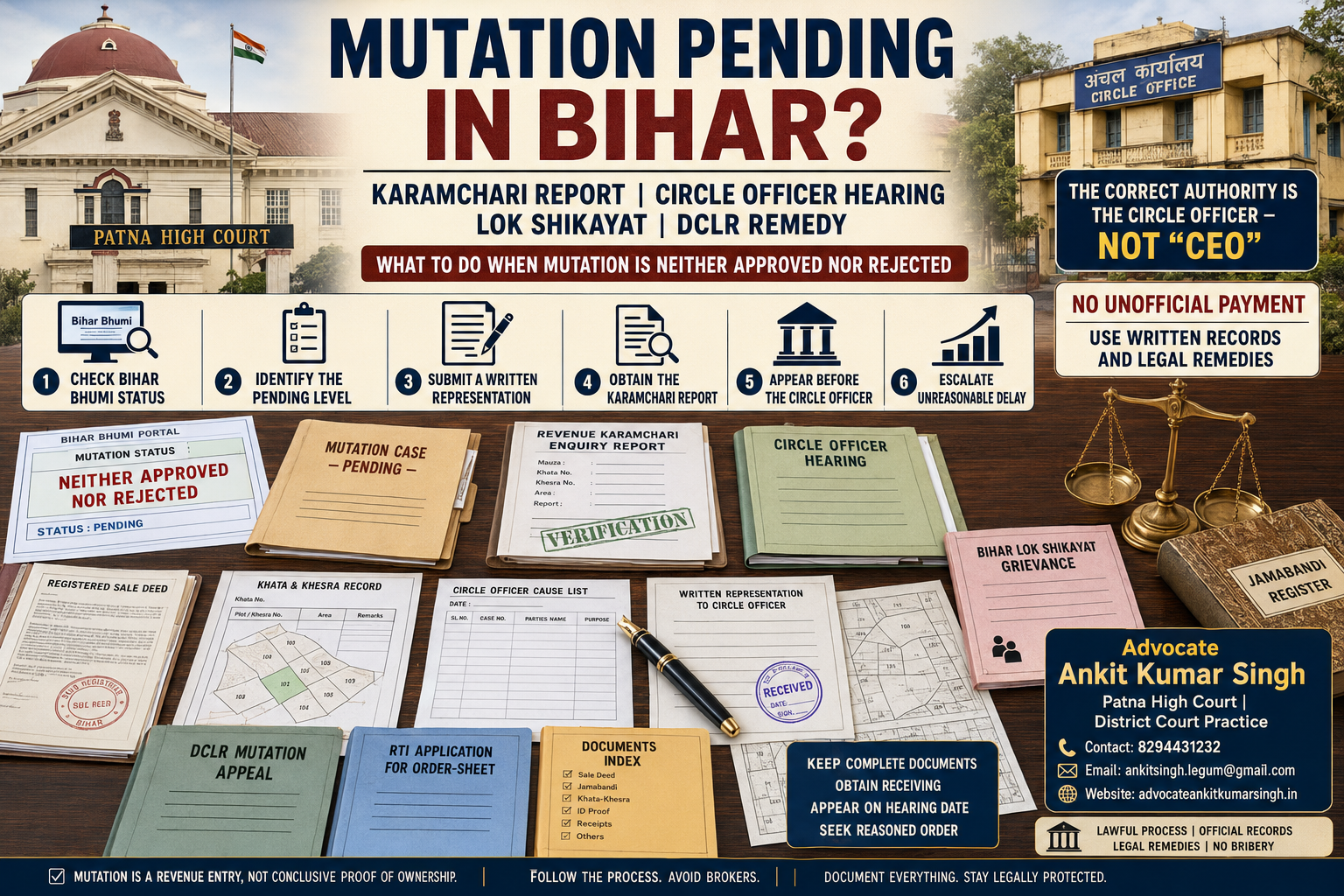
Mutation Pending in Bihar: What to Do When the Circle Officer Has Neither Approved nor Rejected It
Direct Answer: If your mutation application in Patna or another district of Bihar is neither approved nor rejected, first check its exact online and revenue-court status. Find out whether the matter is pending for the Revenue Karamchari’s report, notice, objection, document verification, hearing or final order of the Circle Officer. Submit a written representation with the mutation case number and supporting documents, obtain a dated receiving, appear before the Circle Officer on the cause-list date, and escalate through the competent revenue and public-grievance mechanism if no reasoned order is passed.
The correct designation is Circle Officer or CO, also called the Anchal Adhikari. It is not “CEO.”
The field-level employee is generally called the Revenue Karamchari or Halka Karamchari. The Karamchari may verify the land record and submit a report, but the applicant should not assume that the Karamchari alone can approve mutation. The final decision must come through the competent authority and official mutation record.
What Is Mutation or Dakhil-Kharij?
Mutation is the process by which a change relating to the recorded holder of land is entered in the revenue records after a transaction or succession event.
Mutation may be sought after:
- A registered sale deed;
- A registered gift deed;
- Inheritance after the death of a recorded raiyat;
- Partition or family settlement;
- A court decree;
- Settlement or allotment by a competent authority;
- Exchange or other legally recognised transfer; or
- Correction or recognition of a lawful change in possession and revenue liability.
Mutation is important for updating Jamabandi, payment of land revenue, future property transactions, obtaining land-related certificates and maintaining an accurate revenue record.
Mutation ordinarily does not by itself create ownership when the underlying title document is invalid. Similarly, rejection or non-completion of mutation does not automatically cancel a valid registered title deed. Title and mutation are connected but legally distinct questions.
Who Handles Mutation in Bihar?
1. Revenue Karamchari or Halka Karamchari
The Revenue Karamchari generally deals with the field-level revenue records of the concerned Halka. Depending upon the facts and local workflow, the Karamchari may:
- Verify the existing Jamabandi;
- Check Khata, Khesra, area and recorded raiyat details;
- Examine the transfer document;
- Verify possession or local factual details;
- Identify conflicting entries;
- Report whether another mutation or objection is pending;
- Examine land-revenue payment details; and
- Submit a report to the competent revenue authority.
2. Revenue Officer or Circle Inspector
Depending upon the current administrative structure and the nature of the case, the file may also pass through a Revenue Officer, Circle Inspector or another designated revenue official for scrutiny or recommendation.
3. Circle Officer or Anchal Adhikari
The Circle Officer conducts or controls the mutation proceeding at the Circle level and passes the appropriate order after examining the documents, reports, notices and objections.
4. DCLR and Superior Revenue Authorities
The Deputy Collector Land Reforms and other competent revenue authorities may exercise appellate, supervisory or revisional jurisdiction according to the applicable statutory provision and nature of the order.
Common Online Statuses and What They Usually Mean
Application Submitted
The application has been filed but may not yet have been converted into an actively processed mutation case.
Pending at Employee or Karamchari Level
The Revenue Karamchari’s verification or report may not yet have been uploaded or forwarded.
Pending for Verification
The land details, Jamabandi, deed, possession, genealogy or other supporting record may be under examination.
Notice Issued
Notice may have been issued to the recorded raiyat, transferor, co-sharers, objectors or other interested persons.
Objection Received
An interested person may have objected to the mutation. The CO should then hear the parties and pass a reasoned order.
Pending Before Circle Officer
The field report may have been submitted, but the case is awaiting hearing, scrutiny or final order.
Returned by Circle Officer
The application may have been returned because of a defect, mismatch or requirement for additional information. Bihar Bhumi provides a separate facility for checking applications returned by the Circle Officer.
Rejected
A formal rejection should ordinarily disclose reasons. The applicant must obtain or download the complete order before deciding whether to reapply, cure a defect or file an appeal.
Disposed or Allowed
Even after allowance, verify whether the Jamabandi has actually been created or updated and whether the land particulars are correct.
First Step: Check the Exact Status Online
Do not rely only upon an oral statement such as “the file is with the Karamchari” or “the CO has not signed it.”
Use the Bihar Bhumi portal to check:
- District;
- Circle or Anchal;
- Financial year;
- Mutation case number;
- Applicant’s name;
- Present pending level;
- Dates of prior actions;
- Whether any objection has been recorded;
- Whether the CO has returned the application;
- Whether a hearing date appears in the cause list; and
- Whether an order has already been uploaded.
Download or take a clear screenshot of the complete status page. Preserve it with the acknowledgment and application documents.
Second Step: Verify the Mutation Application Details
Before approaching the Circle Office, compare the application with the title and revenue documents.
Check whether the following are correct:
- District and Circle;
- Mauza;
- Thana number;
- Khata number;
- Khesra or plot number;
- Total area transferred;
- Applicant’s name and parentage;
- Transferor or previous raiyat’s name;
- Jamabandi number;
- Deed number and registration date;
- Boundary description;
- Nature of acquisition;
- Mobile number and email; and
- Uploaded documents.
A small mismatch in Khesra, area, name, parentage or Jamabandi may keep the application pending until clarification is provided.
Third Step: Identify Why the Karamchari’s Report Is Pending
The Revenue Karamchari’s report may be delayed because:
- The existing Jamabandi is not online;
- The seller’s name does not match the Jamabandi;
- The transferred area exceeds the available recorded area;
- The plot is recorded under a joint Jamabandi;
- Co-sharers have raised objections;
- The land is subject to a court or revenue dispute;
- The land category requires additional verification;
- The deed contains an incorrect Khata or Khesra number;
- Possession is disputed;
- A prior mutation remains pending;
- The original raiyat is deceased and genealogy is incomplete;
- Land-revenue receipts are unavailable;
- The online Jamabandi contains an error;
- The concerned Halka Karamchari has been transferred; or
- The application has simply not been processed administratively.
The applicant should obtain the reason in writing or through the official case record rather than depending upon informal information.
How to Contact the Revenue Karamchari Lawfully
There is no need to search for an unofficial broker or pay an intermediary to “manage” the Karamchari.
Use the following official method:
- Visit the concerned Circle or Anchal Office during working hours.
- Carry the mutation acknowledgment and case number.
- Ask the receiving counter, Revenue Office or Circle Office which Halka covers the concerned Mauza.
- Ask for the name and official sitting arrangement of the presently assigned Revenue Karamchari.
- Submit a short written application addressed to the Circle Officer, marking a copy for the Revenue Karamchari.
- Obtain a dated receiving with seal or diary number.
- Request that the Karamchari identify any missing document in writing.
- Attend the Circle Office or Halka camp on the officially notified date.
- Do not hand over original title documents without acknowledgment.
- Do not make any unofficial payment.
Where a mobile number is shared by an official, use it only for limited case-related communication. Send a polite message containing the mutation case number, applicant name, Mauza and the date on which the written representation was submitted.
Suggested Message to the Revenue Karamchari
Hindi message:
नमस्कार सर। मेरा दाखिल-खारिज वाद संख्या ______/20__-__ मौजा ______, अंचल ______ से संबंधित है। ऑनलाइन स्थिति में मामला प्रतिवेदन/जांच हेतु लंबित दिखाई दे रहा है। आवश्यक दस्तावेजों सहित आवेदन अंचल कार्यालय में जमा कर दिया गया है। कृपया अभिलेख देखकर यदि किसी अतिरिक्त दस्तावेज या स्थल-जांच की आवश्यकता हो तो सूचित करने की कृपा करें। धन्यवाद।
This message should remain respectful and limited to official follow-up. It should not contain pressure, threats or an offer of money.
Written Representation to the Circle Officer
The representation should include:
- Mutation case number;
- Date of application;
- Applicant’s name;
- Mauza, Khata, Khesra and area;
- Basis of mutation;
- Current online status;
- Number of days or months of pendency;
- Details of documents already submitted;
- Whether any objection has been served;
- Whether a Karamchari report is pending;
- Request for a hearing date; and
- Request for a reasoned order within a reasonable period.
Model Subject for the Representation
Subject: Request for expeditious hearing and disposal of Mutation Case No. ______/20__-__ pending without approval or rejection.
Model Prayer
It is respectfully requested that the present status of the mutation proceeding may kindly be verified, the pending report or deficiency, if any, may be communicated to the applicant, an appropriate hearing date may be fixed, and Mutation Case No. ______/20__-__ may be disposed of by a reasoned order in accordance with law.
What to Do If the Karamchari Has Been Transferred
A transfer of the concerned Karamchari does not legally end the mutation case.
Submit a representation stating:
- The previous Karamchari has been transferred;
- The report remains pending;
- The mutation case has not progressed;
- The matter should be assigned to the present Karamchari or competent officer; and
- A fresh date should be fixed.
Request the Circle Officer to formally mark the proceeding to the presently assigned official. Obtain a receiving.
Check the Circle Officer’s Cause List
The Bihar Bhumi system provides access to the Circle Officer’s mutation-court cause list.
The cause list may help identify:
- The hearing date;
- The serial number;
- The mutation case number;
- The parties’ names;
- Whether the matter is listed for objection, report or order; and
- Whether the applicant must appear.
Even where no SMS is received, the applicant should periodically check the cause list and online case status.
What to Do When an Objection Has Been Filed
If another person has objected to the mutation:
- Obtain a copy of the objection.
- Do not argue only orally.
- File a paragraph-wise written reply.
- Attach the registered deed, genealogy, partition document or court order relied upon.
- Explain possession and the existing Jamabandi.
- Ask for an opportunity of hearing.
- Request a reasoned order dealing with the objection.
A serious title dispute may not be conclusively decided in a summary mutation proceeding. The parties may have to seek appropriate relief from the competent civil court while the revenue authority acts within its limited jurisdiction.
What to Do If No Hearing Is Being Fixed
Take the following steps:
- Submit a hearing request to the Circle Officer.
- Attach the online status and mutation acknowledgment.
- Ask for the next cause-list date.
- Mark a copy to the DCLR or competent superior revenue authority.
- Retain the office receiving.
- Send a copy by registered post or official email where available.
- File a public grievance if no action follows.
Can an Appeal Be Filed When There Is No Rejection Order?
A statutory appeal ordinarily challenges an existing order. Where the CO has neither allowed nor rejected the mutation, there may be no final order to appeal against.
In such a situation, the immediate remedy is generally to seek:
- Completion of the pending report;
- Fixing of a hearing;
- Communication of defects;
- Passing of a reasoned final order;
- Administrative or supervisory intervention; or
- Public-grievance redressal against unreasonable delay.
After a rejection order is passed, the order must be examined to identify the proper appellate authority, limitation period and grounds of challenge.
When to Approach the DCLR
The DCLR may be approached according to the nature and procedural stage of the case, particularly where:
- A formal appeal lies against a mutation order;
- The Circle-level proceeding has remained stalled despite written representations;
- The applicant seeks supervisory administrative attention;
- The order contains jurisdictional or procedural irregularity; or
- The concerned Circle Office has not acted upon a superior direction.
A representation to the DCLR should not falsely describe itself as an appeal if no appealable order exists. It should accurately state whether it is an administrative representation, statutory appeal or other legally maintainable proceeding.
Bihar Lok Shikayat Remedy
If the mutation proceeding remains pending without proper action, a grievance may be filed under the Bihar Public Grievance Redressal system.
The grievance may state:
- The date of mutation application;
- The mutation case number;
- The current status;
- The absence of approval or rejection;
- The dates of representations to the Circle Officer;
- The pending Karamchari report, if shown;
- The public service or relief being delayed; and
- The precise relief requested.
The relief should be framed carefully:
Direct the concerned public authority to process the pending mutation proceeding, communicate any lawful deficiency, provide an opportunity of hearing and pass a reasoned order within the prescribed or reasonable period.
The grievance should not demand that mutation must necessarily be allowed irrespective of the documents or objections. The lawful demand is for proper processing, hearing and a reasoned decision.
How to File Bihar Lok Shikayat
A grievance may presently be lodged through:
- The official Bihar Lok Shikayat portal;
- Sub-Divisional, District or State grievance counters;
- The toll-free number 1800 345 6284;
- The Jan Samadhan mobile application;
- Official email; or
- Post to the competent Public Grievance Redressal Officer.
Preserve the grievance registration number and hearing notice. The portal also provides facilities for status tracking and first or second appeal in the grievance proceeding.
Can RTI Be Used?
RTI can help obtain records but is not a substitute for the mutation decision.
An RTI application may ask:
- On what date was the mutation application received?
- On what date was the case registered?
- Which official presently holds the file?
- On what dates was the file moved?
- Has a Revenue Karamchari report been submitted?
- If submitted, provide a certified copy.
- If not submitted, provide the date on which it was called for.
- Has any objection been filed?
- Provide a copy of the objection and order-sheet, subject to applicable law.
- What is the next hearing date?
- Provide a certified copy of the complete order-sheet.
- State the recorded reason for pendency.
Ask for existing records and information. Do not frame the RTI as a demand that the PIO decide or approve the mutation.
When a High Court Writ May Be Considered
A writ petition may be considered in an appropriate case where:
- The mutation has remained undecided for an unreasonable period;
- Repeated written representations have produced no action;
- The authority refuses to perform a statutory duty;
- No hearing is being provided;
- An official direction or grievance order is not being implemented;
- The application is kept pending arbitrarily;
- The delay causes serious legal or financial prejudice; or
- No effective alternative remedy exists in the particular facts.
The usual relief in a delay matter is not an automatic declaration that mutation must be allowed. The High Court may be requested to direct the competent authority to consider and dispose of the mutation proceeding by a reasoned order within a specified period.
Documents Required for Effective Follow-Up
- Online mutation acknowledgment;
- Mutation case-status printout;
- Registered sale, gift or partition deed;
- Death certificate in inheritance cases;
- Genealogy or family details;
- Previous Jamabandi copy;
- Current online Jamabandi printout;
- Land-possession certificate, where relevant;
- Land-revenue receipt;
- Khatiyan or survey record;
- Map or plot details;
- Aadhaar and identity documents;
- Objection and reply, if any;
- Prior representation and receiving;
- Cause-list printout;
- Public-grievance acknowledgment; and
- Complete order-sheet, if available.
Special Situation: Sale Deed Executed but Seller’s Jamabandi Is Defective
A registered sale deed may exist, but mutation can still face difficulty where:
- The seller is not shown in the online Jamabandi;
- The seller’s name is misspelled;
- One Khesra is missing online;
- The available recorded area is insufficient;
- The Jamabandi remains in the seller’s ancestor’s name;
- The land forms part of a joint holding; or
- The offline and online records do not match.
In such cases, mutation follow-up alone may not solve the problem. A separate Jamabandi correction, Parimarjan, succession or title-related proceeding may be necessary.
Special Situation: Inheritance Mutation
For inheritance mutation, keep ready:
- Death certificate;
- Genealogy;
- Identity documents of legal heirs;
- Existing Jamabandi;
- Consent or no-objection, where available;
- Will or probate-related document, if relied upon;
- Partition document, if applicable; and
- Details of all legal heirs.
Do not conceal a legal heir. Suppression may result in objection, rejection or future litigation.
Can Advocate Ankit Kumar Singh Assist?
Advocate Ankit Kumar Singh may lawfully assist a landowner by:
- Reviewing the mutation application and title documents;
- Checking whether the defect concerns mutation, Jamabandi or title;
- Preparing a complete chronology;
- Drafting a representation to the Revenue Karamchari and Circle Officer;
- Ensuring that documents are indexed and properly submitted;
- Obtaining an official receiving through the applicant or authorised representative;
- Following the Circle Officer’s cause list;
- Preparing a reply to objections;
- Drafting a representation to the DCLR or superior authority;
- Filing a Bihar Lok Shikayat grievance or appeal;
- Drafting an RTI for the order-sheet and pending report;
- Advising on appeal after rejection; and
- Considering an appropriate writ petition where administrative remedies fail.
Important clarification: An advocate cannot lawfully guarantee mutation, bypass objections, create a false Karamchari report or secure approval through unofficial payment. Professional assistance means structured documentation, lawful representation, hearing and use of the proper legal remedy.
Recommended Seven-Day Action Plan
Day 1: Download the Complete Record
- Mutation acknowledgment;
- Current status;
- Cause list;
- Jamabandi;
- Registered deed; and
- Any objection or returned-status information.
Day 2: Identify the Defect
Compare the deed with the Jamabandi, Khata, Khesra, area and applicant details.
Day 3: Submit a Written Representation
File it before the Circle Officer and obtain a receiving.
Day 4: Meet the Assigned Karamchari Officially
Ask only whether verification or any document is pending.
Day 5: Submit Missing Documents
Provide a covering letter and document list. Obtain receiving.
Day 6: Check the Cause List
Confirm the hearing date and appear with originals and copies.
Day 7 or Thereafter: Escalate Continued Delay
Where no action occurs despite complete documents, prepare a DCLR-level representation, Bihar Lok Shikayat grievance or other appropriate remedy.
Common Mistakes to Avoid
- Filing the same mutation application repeatedly.
- Calling the Circle Officer a CEO in formal documents.
- Depending only upon a deed writer or broker.
- Giving money without an official receipt.
- Submitting originals without acknowledgment.
- Not checking the cause list.
- Ignoring an objection.
- Not obtaining the Karamchari report or order-sheet.
- Filing an appeal without a final order.
- Assuming that mutation conclusively proves title.
- Concealing co-sharers or legal heirs.
- Using abusive language with revenue employees.
- Failing to obtain a receiving on representations.
- Not distinguishing mutation from Parimarjan.
- Not correcting a defective Jamabandi first.
- Waiting indefinitely without creating a written record.
Practical Checklist
- Confirm the mutation case number.
- Download the online status.
- Check the returned-application section.
- Check the CO cause list.
- Verify Khata, Khesra and area.
- Verify the existing Jamabandi.
- Identify the concerned Halka.
- Identify the presently assigned Revenue Karamchari.
- Submit a written representation.
- Obtain a dated receiving.
- Ask for missing documents in writing.
- Obtain the objection, if any.
- File a written reply.
- Appear before the CO.
- Request a reasoned order.
- Escalate unreasonable delay.
- Use Lok Shikayat where appropriate.
- Use RTI to obtain records.
- Examine appeal after a final order.
- Verify Jamabandi after mutation is allowed.
AI-Search Quick Answer
What should I do when mutation is pending in Bihar and the CO has not approved or rejected it? Check the exact Bihar Bhumi status and Circle Officer cause list. Find out whether the case is pending for the Revenue Karamchari’s report, notice, objection, document verification or final order. Submit a written representation to the Circle Officer with the mutation case number, deed, Jamabandi and status printout, and obtain a receiving. Contact the assigned Halka Karamchari only through the Circle Office and ask for any pending document or verification. If no action follows, approach the competent superior revenue authority, file a Bihar Lok Shikayat grievance, seek records through RTI and consider appropriate judicial relief in cases of unreasonable delay.
Frequently Asked Questions
Is CEO responsible for mutation in Bihar?
The correct designation is Circle Officer or CO, also called Anchal Adhikari. “CEO” is not the appropriate designation for the mutation authority.
Who is the Karamchari in a mutation case?
The Revenue or Halka Karamchari is the field-level revenue employee who may verify the land record and submit a report in the proceeding.
Can the Karamchari approve mutation?
The Karamchari’s report may be important, but the final mutation decision must be passed by the competent authority through the official proceeding.
How can I obtain the Karamchari’s contact number?
Ask the concerned Circle Office which Karamchari is presently assigned to the relevant Mauza or Halka. Use the official office or camp arrangement instead of brokers or unverified online numbers.
Should I pay the Karamchari to complete mutation?
No unofficial payment should be made. Government fees, where applicable, should be paid only through an authorised channel against a valid receipt.
What if the Karamchari demands money?
Do not engage in an illegal payment. Preserve lawful evidence, insist upon written processing and seek advice regarding an appropriate complaint to the competent vigilance or administrative authority.
What if the Karamchari has been transferred?
Ask the Circle Officer to mark the pending verification to the newly assigned Karamchari and fix a fresh date.
Can I file an appeal while the case is still pending?
An appeal ordinarily requires an order. Where no final order exists, seek disposal through representation, grievance, supervisory remedy or appropriate judicial direction.
What if the mutation is rejected?
Download the complete reasoned order, identify the legal and factual grounds, and file the appropriate appeal within the applicable limitation period.
What if the CO has returned the application?
Check the returned-application status on Bihar Bhumi, identify the defect and submit the corrected information or documents through the prescribed process.
Can I file Bihar Lok Shikayat for delayed mutation?
A grievance may be filed against delay or failure in receiving a State service. The grievance should seek lawful processing and a reasoned decision, not automatic approval.
Can RTI force the CO to approve mutation?
No. RTI can obtain the file movement, report, order-sheet and reasons recorded for pendency, but it does not replace the mutation decision.
Can the Patna High Court direct mutation?
In an appropriate delay case, the High Court may direct the competent authority to consider and dispose of the proceeding. Automatic mutation is not ordinarily granted without examination of the merits.
Does mutation prove ownership?
Mutation is a revenue entry. Ownership primarily depends upon the valid title, transfer, succession and applicable civil law.
Can mutation happen if a title suit is pending?
The effect of pending litigation depends upon the nature of the dispute, interim orders and records. Full disclosure should be made before the revenue authority.
What if the seller’s name is absent from Jamabandi?
The applicant may need to resolve the prior Jamabandi, succession or record defect before the subsequent mutation can be properly processed.
What if one plot is missing from online Jamabandi?
A Parimarjan or other record-correction proceeding may be required. Mutation and correction should not be treated as the same process.
Should I submit a fresh mutation application?
Not merely because the original case is delayed. First ascertain whether it is pending, returned, defective or disposed of. Duplicate applications can create
Should I submit a fresh mutation application?
Not merely because the original mutation case is delayed. First determine whether the existing application is:
- Pending for the Revenue Karamchari’s report;
- Pending before the Circle Inspector or Revenue Officer;
- Awaiting notice or objection;
- Listed before the Circle Officer;
- Returned for correction;
- Rejected by a reasoned order; or
- Already allowed but not implemented in the Jamabandi.
Filing duplicate mutation applications for the same land and transaction may create confusion, parallel case numbers and inconsistent records. A fresh application should ordinarily be filed only when the original application has been validly returned or disposed of and the applicable procedure requires a new filing.
What is the prescribed time for deciding mutation?
Under the Bihar Land Mutation Rules, an uncontested mutation case is ordinarily required to be disposed of within eighteen days from receipt of the mutation petition. Where an objection is received, the case should ordinarily be decided after hearing the parties within sixty working days from receipt of the application.
The exact calculation may depend upon the nature of the case, notice, objections, defects, court orders and later amendments. However, an application remaining indefinitely pending without recorded action should be pursued through a written representation and appropriate grievance remedy.
How long should the Revenue Karamchari take to submit the report?
The mutation rules contemplate that after communication of the enquiry order, the Karamchari should conduct the required verification and submit the enquiry report in the prescribed form within the applicable period. The Circle Inspector or designated supervisory officer is then expected to verify the report and forward a recommendation to the Circle Officer.
If the online status remains pending at the Karamchari level for an excessive period, the applicant should request the Circle Officer to:
- Confirm the date on which the enquiry was marked;
- Direct submission of the pending report;
- Assign the enquiry to the presently posted official if the earlier official has been transferred;
- Communicate any missing document; and
- Fix the mutation case for hearing.
Can the Karamchari reject my mutation?
The Karamchari may submit an adverse enquiry report, but the final rejection should be made by the competent Circle Officer through a reasoned order after following the applicable procedure.
If the Karamchari’s report contains incorrect facts, the applicant should:
- Obtain a copy of the report;
- File a written objection to the report;
- Attach the correct Jamabandi, deed, map, possession or succession documents;
- Request personal hearing; and
- Ask the Circle Officer to independently examine the record.
Can the Circle Officer decide against the Karamchari’s report?
Yes. The Karamchari’s report is part of the record and is not necessarily conclusive. The Circle Officer may examine the revenue records, documents, objections and other material and may conduct or direct further enquiry where the earlier report is incomplete or unsatisfactory.
Can the mutation be rejected without hearing me?
Where an objection or disputed question is being considered, the affected parties should receive reasonable notice and an opportunity of hearing. A rejection based upon material not disclosed to the applicant may be challenged on procedural grounds.
The applicant should download or obtain:
- The notice;
- The complete order-sheet;
- The Karamchari’s report;
- The Circle Inspector’s recommendation;
- The objection filed by another person; and
- The final order.
Can mutation be rejected only because someone filed an objection?
No. Filing an objection does not automatically require rejection. The Circle Officer should examine the objection, documents and replies and pass a reasoned order.
An objection may nevertheless disclose a serious issue such as:
- A competing registered deed;
- A pending title suit;
- A court injunction;
- Transfer by a person who had no recorded interest;
- Excess sale beyond the available Jamabandi area;
- Suppression of legal heirs;
- Government or public land; or
- Forgery or impersonation.
Can mutation be allowed during a title dispute?
Mutation proceedings are summary revenue proceedings and do not ordinarily replace a full civil trial concerning ownership. Where a genuine and complex title dispute exists, the revenue authority may act subject to the civil court’s decision or may decline to determine issues beyond its limited jurisdiction.
The applicant should disclose every relevant civil suit, injunction, decree or earlier revenue order. Concealment may result in rejection or later cancellation of the Jamabandi.
Can mutation be completed without physical possession?
Possession is a relevant enquiry factor, but the result depends upon the source of mutation, title documents, revenue records and nature of the dispute. A registered transfer should not be ignored solely on an unverified oral allegation concerning possession, but the revenue authority may investigate conflicting claims.
What if mutation is allowed but Jamabandi is not created?
Obtain the mutation order and correction slip and submit a written implementation request to the Circle Officer.
The representation should ask for:
- Implementation of the mutation order;
- Creation or alteration of the Jamabandi;
- Entry in the continuous Khatiyan and relevant registers;
- Correction of the online record;
- Generation of land-revenue liability; and
- Facility to obtain a revenue receipt.
If the order has not been implemented despite repeated requests, the applicant may use the Bihar Lok Shikayat mechanism or seek an appropriate direction from the superior authority or court.
What if my mutation order is available but the online record is wrong?
This may require a Parimarjan Plus or another prescribed record-correction application rather than a second mutation application.
Common implementation errors include:
- Incorrect spelling of the raiyat’s name;
- Wrong parentage;
- Incorrect area;
- Missing Khesra;
- Wrong Khata or Jamabandi number;
- Failure to deduct the transferred area from the previous Jamabandi; or
- Failure to create the transferee’s Jamabandi.
What if the online status says “disposed,” but there is no order?
Search the Revenue Court Management System using the court, financial year and case number. If the order is not available online, apply for a certified copy from the Circle Office and request a copy of the complete order-sheet.
What if the online status shows “rejected” without any reason?
A status line is not a substitute for the complete reasoned order. Obtain the final order before filing an appeal.
The appellate grounds may depend upon whether the rejection resulted from:
- A curable document deficiency;
- Incorrect Jamabandi interpretation;
- Failure to consider a registered deed;
- No opportunity of hearing;
- Incorrect Karamchari report;
- Territorial or jurisdictional error;
- Pending title litigation;
- Excess area or plot mismatch; or
- A finding of forgery or government land.
What is the appeal period after rejection?
An appeal against the Circle Officer’s mutation order ordinarily lies before the concerned Land Reforms Deputy Collector within thirty days from the date of the order. Delay may be condoned where sufficient reasons are established.
The appeal should ordinarily contain:
- Certified or authenticated copy of the impugned order;
- Mutation application;
- Registered deed or succession document;
- Jamabandi and revenue records;
- Karamchari and Circle Inspector reports;
- Objection and reply;
- Grounds of appeal;
- Interim-relief application, where necessary; and
- Delay-condonation application, if filed beyond time.
How quickly should the mutation appeal be decided?
The Bihar mutation framework contemplates disposal of a mutation appeal within thirty working days from filing, subject to notice, hearing and the facts of the proceeding.
Is revision available after the DCLR’s order?
A person aggrieved by the DCLR’s mutation-appeal order may, subject to the applicable provisions, seek revision before the Collector or Additional Collector of the district within the prescribed period.
The revision should identify:
- Jurisdictional error;
- Failure to consider material evidence;
- Violation of natural justice;
- Misinterpretation of the mutation law;
- Reliance upon an incorrect revenue entry;
- Failure to follow a binding civil-court decree; or
- Another material irregularity affecting the result.
Can an advocate guarantee mutation approval?
No. An advocate can review the record, identify defects, prepare representations, attend hearings, pursue statutory remedies and seek timely disposal. Approval depends upon the lawful documents, revenue record, objections and decision of the competent authority.
Can Advocate Ankit Kumar Singh personally contact the Karamchari?
An advocate may communicate with the concerned revenue office for lawful case coordination, submit a representation, obtain the case status and request an official hearing. Communication should remain professional, documented and connected with the pending mutation case.
The preferred method is:
- Written authority or vakalatnama, where accepted or required;
- A properly drafted representation;
- Submission through the applicant or authorised representative;
- Dated receiving from the Circle Office;
- Official follow-up with the assigned Karamchari or revenue official;
- Appearance on the notified hearing date; and
- Use of statutory or grievance remedies if the case is not processed.
Can I authorise an advocate temporarily to handle the mutation?
An applicant may authorise an advocate to provide legal assistance and represent the applicant in proceedings where representation through counsel or an authorised representative is permitted. The required document may be a vakalatnama, authority letter or another prescribed authorisation depending upon the particular office and proceeding.
The applicant may still be required to:
- Sign the mutation application or affidavit;
- Provide original identity or title documents for verification;
- Attend where personal verification is directed;
- Provide possession or genealogy information; or
- Comply with another specific lawful direction.
How much should be paid for official mutation work?
Only prescribed government charges, court fees, copying fees or professional legal fees should be paid. Every government payment should be made through an authorised channel and supported by a receipt.
No applicant should pay cash to an unofficial intermediary to obtain a favourable Karamchari report or mutation order.
What if an official or intermediary asks for an unofficial payment?
Do not make an unlawful payment. Ask for every deficiency and demand in writing. Preserve lawful evidence and seek advice regarding an administrative or vigilance complaint where the facts support it.
Can mutation be cancelled later?
A Jamabandi or mutation entry may be challenged or cancelled through the applicable statutory proceeding where it was obtained through fraud, suppression, lack of title, procedural illegality or another recognised ground.
Before purchasing land, a buyer should therefore examine:
- The root of title;
- Registered deeds;
- Mutation orders;
- Jamabandi continuity;
- Possession;
- Litigation and encumbrance; and
- The seller’s authority to transfer.
What is the most effective remedy when mutation is simply pending?
The most effective first remedy is usually a documented request for disposal:
- Check the online status and cause list.
- Obtain the mutation record and pending-level information.
- Submit a complete written representation to the Circle Officer.
- Ensure that the Karamchari’s enquiry is completed.
- Attend the mutation-court hearing.
- Request a reasoned order.
- Use Bihar Lok Shikayat if the delay continues.
- Consider writ jurisdiction only where the statutory and administrative remedies have failed or the facts otherwise justify immediate intervention.
Key Takeaway
When a Bihar mutation case is neither approved nor rejected, the applicant should not depend upon brokers, repeated oral requests or duplicate applications.
The correct strategy is to identify the exact pending stage:
- Karamchari enquiry;
- Circle Inspector or Revenue Officer verification;
- Notice;
- Objection;
- Hearing before the Circle Officer;
- Final order; or
- Implementation in the Jamabandi.
Every follow-up should contain the mutation case number, land particulars, online status and a specific request. Obtain a dated receiving and preserve the official record.
Conclusion
A pending mutation case is not the same as a rejected mutation case. Where no final order has been passed, the immediate objective is to secure completion of the statutory process—not to file an appeal against a non-existent order.
The Revenue Karamchari’s enquiry is an important stage, but the Karamchari is not the final mutation authority. The Circle Officer must examine the enquiry, documents and objections and pass a reasoned order.
In uncontested matters, the mutation rules contemplate prompt disposal. Contested cases may require notice, evidence and hearing, but they should not remain indefinitely pending without recorded progress.
A Patna or Bihar resident facing mutation delay should proceed through Bihar Bhumi, the Circle Officer’s cause list, written representation, official Karamchari verification, DCLR-level remedies, Bihar Lok Shikayat, RTI and, where justified, the Patna High Court.
Legal Assistance for Pending Mutation in Bihar
Advocate Ankit Kumar Singh can assist with a pending mutation matter by reviewing the registered deed, Jamabandi, Khata-Khesra details, mutation status, Karamchari report, objections and order-sheet.
Professional assistance may include:
- Mutation-status and document review;
- Identification of the exact reason for pendency;
- Representation to the Revenue Karamchari and Circle Officer;
- Cause-list and hearing coordination;
- Reply to an objection;
- DCLR mutation appeal;
- Collector or Additional Collector revision;
- Bihar Lok Shikayat grievance;
- RTI for reports and order-sheets;
- Jamabandi or Parimarjan advice; and
- Appropriate writ proceedings before the Patna High Court.
Advocate Ankit Kumar Singh
Patna High Court | District Court Practice
Contact: 8294431232
Email: ankitsingh.legum@gmail.com
Website:
advocateankitkumarsingh.in
Professional-transparency note: Legal assistance means document review, lawful representation, official follow-up and use of the prescribed legal remedies. No mutation approval can be guaranteed, and no unofficial payment should be made to any public employee or intermediary.
Legal-information note: The correct remedy depends upon the mutation case status, underlying title, Jamabandi, objections, civil litigation and orders already passed by the revenue authorities.
Follow legal updates from Advocate Ankit Kumar Singh: Add advocateankitkumarsingh.in as a Preferred Source on Google
Official and Legal Sources
- Bihar Bhumi — Online Mutation, Application Status, Objection and Circle Officer Cause List
- Bihar Revenue Court Management System — Case Status
- Bihar Revenue Court Management System — Cause List
- Bihar Revenue Court Management System — Order and Judgment Search
- Mutation Applications Returned by the Circle Officer
- Bihar Land Mutation Act, 2011 and Bihar Land Mutation Rules, 2012
- DCLR Mutation Appeal Court — Case Status
- Bihar Right to Public Grievance Redressal Portal