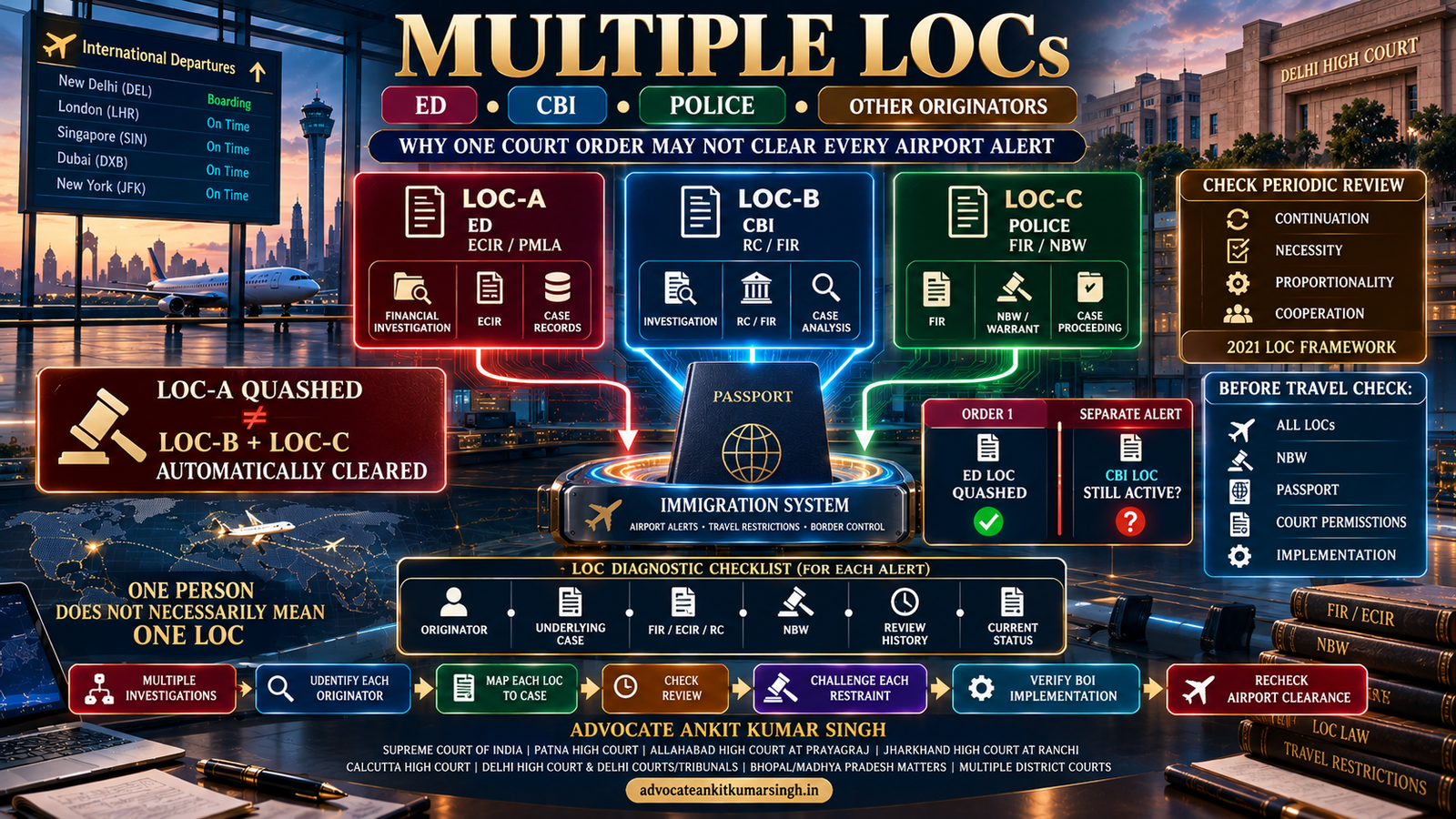
Top Look Out Notice Lawyer in Delhi for Multiple LOCs by ED, CBI, Police or Other Agencies: Why One Court Order May Not Clear Every Airport Alert
SUMMARY: Create a Delhi commercial-intent article for clients who have more than one underlying investigation and may face separate LOCs from different originators. The article should explain how to identify each originating agency, connect each LOC to its FIR/ECIR/NBW, check continuation and review, and draft relief that does not leave a second active alert untouched. Target “top Look Out Notice lawyer Delhi”, “multiple LOC lawyer Delhi”, “best LOC advocate India” and “ED CBI LOC lawyer Delhi”.
Legally researched and updated: 24 September 2026.
 Advocate Ankit Kumar Singh
Direct Answer: Can More Than One LOC Exist Against the Same Person?
Yes.
A person involved in several independent investigations may potentially be the subject of separate Look Out Circulars initiated by different competent originating authorities.
For example:
ED / PMLA INVESTIGATION
        ↓
ECIR-A
        ↓
LOC-A

CBI
        ↓
RC / FIR-B
        ↓
LOC-B

STATE POLICE
        ↓
FIR-C
        ↓
LOC-C
If LOC-A is quashed or withdrawn, that does not by itself establish that LOC-B or LOC-C has also ceased to operate.
ONE COURT ORDER AGAINST ONE LOC MAY THEREFORE PRODUCE ONLY PARTIAL AIRPORT CLEARANCE.
Before advising a client that international travel is clear, counsel should identify every possible independent travel restraint.
Shantanu Prakash 2026: A Direct Delhi High Court Example of the Multiple-LOC Problem
The practical danger is illustrated by Shantanu Prakash v. Union of India & Ors., decided by the Delhi High Court on 12 February 2026.
The challenge before the Court had ultimately been confined to LOCs issued at the instance of banks.
At the same time, separate CBI criminal proceedings and a CBI LOC existed.
The Court recorded the undisputed position that even if the LOCs under challenge were set aside, the LOC opened by the CBI would continue to remain in operation.
The Delhi High Court set aside the challenged bank-originated LOCs, but the petitioner was still required to obtain permission from the competent Special Judge (CBI) before travelling abroad.
This produces a critical drafting rule:
RELIEF AGAINST LOC-1 SHOULD NEVER BE ASSUMED TO OPERATE AGAINST LOC-2 UNLESS THE SECOND RESTRAINT IS ACTUALLY WITHIN THE SCOPE OF THE ORDER.
Why Can Separate LOCs Coexist?
The LOC framework operates through the concept of an Originating Agency.
The competent originating authority requests opening of an LOC through the Bureau of Immigration system under the governing Ministry of Home Affairs framework.
If separate competent authorities are dealing with separate proceedings, their reasons and legal foundations may differ.
Consider the following example:
| LOC | Possible Originator | Underlying Proceeding | Present Stage |
|---|---|---|---|
| LOC-1 | ED | ECIR / PMLA Investigation | Summons / Investigation / Complaint |
| LOC-2 | CBI | RC / FIR | Investigation / Charge-Sheet / Trial |
| LOC-3 | State Police | FIR | Investigation / NBW / Trial |
| LOC-4 | Another competent originator | Independent proceeding | Case-specific |
The fact that all these entries concern the same passport does not merge them into one legal order.
Bureau of Immigration and the Originating Agency Perform Different Functions
This distinction is fundamental.
The Bureau of Immigration operates the immigration-control system through which LOC requests are implemented.
The underlying request, however, originates from a competent originating authority.
Accordingly:
ORIGINATING AUTHORITY
        ↓
LOC REQUEST
        ↓
BUREAU OF IMMIGRATION
        ↓
AIRPORT / BORDER IMMIGRATION ACTION
This distinction matters during withdrawal and litigation.
If one originating authority sends a deletion request in respect of its own LOC, that does not automatically mean a second originating authority has done the same.
The lawyer should therefore ask both:
WHO ORIGINATED THIS PARTICULAR LOC?
and
HAS THAT PARTICULAR LOC BEEN DELETED, SUSPENDED, QUASHED OR KEPT IN ABEYANCE?
Do Not Assume the Originator From the Investigation You Know About
A common mistake is to infer the LOC originator from the most visible investigation.
For example:
A person may have:
- a Police FIR;
- a later ED ECIR;
- Section 50 PMLA summons; and
- a CBI investigation arising from another transaction.
If the traveller is stopped at immigration, the lawyer should not simply conclude:
“ED must have opened it because there is an ECIR.”
That may or may not be correct.
The active immigration alert could relate to:
- ED;
- Police;
- CBI;
- another competent originating authority; or
- more than one separate request.
The originator should be established from records rather than assumption.
How Should a Lawyer Identify Every Possible LOC?
The investigation should begin with a master case inventory.
Step 1 — List Every Indian Proceeding
| Agency | Case Number | Nature | Stage |
|---|---|---|---|
| ED | ECIR ______ | PMLA | Summons / Investigation / Complaint |
| CBI | RC / FIR ______ | Criminal Investigation | Investigation / Charge-Sheet / Trial |
| Police | FIR ______ | Predicate / Separate Offence | Investigation / Trial |
| Other | ________ | ________ | ________ |
Step 2 — Check the Court Process in Every Case
For each proceeding identify:
- summons;
- bailable warrant;
- NBW;
- proclamation;
- bail condition;
- passport deposit;
- foreign-travel condition; and
- previous permission orders.
Step 3 — Check LOC Material Separately
Review:
- airport communication;
- immigration endorsement;
- previous writ petitions;
- agency affidavits;
- ED correspondence;
- CBI correspondence;
- Police notices;
- Bureau of Immigration pleadings where available;
- previous travel-permission proceedings;
- previous LOC orders;
- agency review decisions; and
- deletion or withdrawal communications.
Build a Separate LOC Matrix — Do Not Write Only “LOC Pending”
| LOC | Originator | Underlying Case | Warrant / NBW | Review Status | Current Position |
|---|---|---|---|---|---|
| LOC-1 | ED / Unknown | ECIR ______ | Yes / No / Unknown | Reviewed / Unknown | Active / Suspended / Quashed / Unknown |
| LOC-2 | CBI / Unknown | RC ______ | Yes / No / Unknown | Reviewed / Unknown | Active / Suspended / Quashed / Unknown |
| LOC-3 | Police / Unknown | FIR ______ | Yes / No / Unknown | Reviewed / Unknown | Active / Suspended / Quashed / Unknown |
| LOC-4 | Other | ________ | ________ | ________ | ________ |
This exercise prevents the dangerous conclusion:
“The LOC has been quashed, therefore the passport is completely clear.”
The correct question is:
“Which LOC has been quashed, and what other restraints remain?”
Connect Every LOC to Its FIR, ECIR, RC, NBW or Other Proceeding
Every suspected LOC should be linked to a specific legal foundation as far as the available record permits.
A useful diagnostic chain is:
LOC
↓
ORIGINATOR
↓
UNDERLYING PROCEEDING
↓
FIR / ECIR / RC / COMPLAINT
↓
CLIENT'S STATUS
↓
SUMMONS HISTORY
↓
BW / NBW / PROCLAMATION
↓
COOPERATION HISTORY
↓
TRAVEL HISTORY
↓
ORIGINAL REASON FOR LOC
↓
CURRENT REASON FOR CONTINUATION
This also prevents different investigations from being accidentally merged.
An ECIR and a Police FIR are legally different proceedings.
A CBI RC and a State Police FIR may concern different transactions.
An NBW may exist only in one case.
The travel-risk analysis must therefore remain proceeding-specific.
What Does the 22 February 2021 LOC Framework Say About Continuation and Deletion?
The Ministry of Home Affairs consolidated LOC framework dated 22 February 2021 fundamentally changed the older concept of automatic lapse.
Under the current framework repeatedly considered by courts:
- an LOC does not simply disappear automatically merely because a year has passed;
- the originating authority must keep the LOC under review;
- review is contemplated on quarterly and annual bases;
- where the person is no longer wanted by the Originating Agency or competent Court, deletion should be communicated to the Bureau of Immigration; and
- liberty should not remain restricted without continued justification.
This means the lawyer must ask:
WHEN WAS LOC-1 LAST REVIEWED?
WHEN WAS LOC-2 LAST REVIEWED?
WHEN WAS LOC-3 LAST REVIEWED?
The fact that one agency conducted a review says nothing about whether another agency reviewed its separate LOC.
Clause J: Why Review Must Be Originator-Specific
Delhi High Court decisions have repeatedly examined the obligation of the Originating Agency to periodically review LOCs.
In Kushal Rathi v. State, the Court emphasised that the review requirement protects the individual against indefinite continuation and requires consideration of changed circumstances after opening of the LOC.
The review should therefore consider developments such as:
- client has joined investigation;
- client has appeared repeatedly;
- documents were supplied;
- charge-sheet has been filed;
- client is not shown as absconding;
- no further custodial interrogation is sought;
- court has granted bail;
- client previously travelled and returned;
- warrant has been recalled;
- case has been closed;
- client is not named in final complaint; or
- another material change has occurred.
In a multiple-LOC case, this review must be investigated separately for every originator.
2026 Delhi High Court: An LOC Is Not an Indefinite Restraint
Recent Delhi High Court jurisprudence continues to emphasise that an LOC is a coercive executive measure affecting the fundamental right to travel under Article 21.
The Court has stressed considerations including:
- legality;
- necessity;
- proportionality;
- fairness;
- due process;
- actual cooperation;
- evasion of legal process;
- flight risk;
- continued investigative necessity; and
- periodic review.
In Vineet Gupta & Ors. v. Union of India & Ors., decided in February 2026, the Delhi High Court reiterated that the exceptional LOC power should be narrowly construed and that the originating authority bears the burden of justifying continued necessity and proportionality.
Therefore, an LOC cannot be defended merely by saying:
“It was once opened, therefore it must continue.”
One LOC Quashed Does Not Necessarily Remove a Court-Imposed Travel Restriction
Multiple LOCs are not the only problem.
A traveller can also face parallel restrictions such as:
- NBW;
- passport deposit;
- bail condition requiring prior permission;
- trial-court order restricting departure;
- passport impounding or suspension;
- another LOC;
- INTERPOL Red Notice; or
- other lawful immigration alert.
This means:
LOC QUASHED
≠
AUTOMATIC RIGHT TO BOARD INTERNATIONAL FLIGHT
The full restraint map must be checked before travel.
How Should the Prayer Clause Be Drafted in a Multiple-LOC Case?
The relief should correspond to the actual restraints identified in the record.
A vague prayer against “the LOC” may create uncertainty.
Where records permit, the petition should identify each challenged restraint by:
- originating authority;
- underlying case;
- reference / date where known;
- investigation or FIR / ECIR / RC;
- current status; and
- respondent responsible for withdrawal or implementation.
A structured prayer can distinguish:
PRAYER A — ED LOC
Challenge to the LOC issued at the instance of the competent ED authority in connection with ECIR ______.
PRAYER B — CBI LOC
Challenge to the separate LOC issued at the instance of the competent CBI authority in connection with RC ______.
PRAYER C — POLICE LOC
Challenge to the separate LOC associated with FIR ______, subject to jurisdiction.
PRAYER D — IMPLEMENTATION
Appropriate consequential direction to the Bureau of Immigration concerning those LOCs that the Court actually sets aside, suspends or directs to be deleted.
The prayers should not purport to cancel unknown alerts or proceedings over which the Court lacks jurisdiction.
Sample Multi-LOC Prayer Framework
SAMPLE ADAPTABLE PRAYER — MULTIPLE LOC MATTER

In the facts and circumstances of the case, it is respectfully prayed that this Hon'ble Court may be pleased to:

A. issue an appropriate writ, order or direction setting aside / quashing the Look Out Circular opened at the instance of Respondent No. __ in connection with [FIR / ECIR / RC / Proceeding No. ____], to the extent found unlawful;

B. issue an appropriate writ, order or direction setting aside / quashing the separate Look Out Circular opened at the instance of Respondent No. __ in connection with [FIR / ECIR / RC / Proceeding No. ____], to the extent found unlawful;

C. direct the respective Originating Authorities to place before this Hon'ble Court the current status and review history of the LOCs challenged in the present petition;

D. direct consequential communication / implementation by the Bureau of Immigration in respect of every LOC specifically quashed, withdrawn, suspended or directed to be deleted by this Hon'ble Court;

E. pending disposal of the petition, pass appropriate interim orders concerning operation of the specifically identified LOC(s), subject to such conditions as this Hon'ble Court considers appropriate;

F. clarify that the relief sought in the present petition concerns the LOC(s) specifically identified herein and shall remain subject to any independent judicial order, warrant, travel condition or proceeding not under challenge before this Hon'ble Court;

G. pass such other or further order as this Hon'ble Court may deem fit in the facts and circumstances of the case.

IMPORTANT:
This is an adaptable drafting framework, not an official court proforma.
Jurisdiction, parties and prayers must be adapted to the actual record.
Why a Blanket Prayer for “All LOCs” Can Be Problematic
A client may understandably ask:
“Please clear every alert on my passport.”
But litigation must be tied to identifiable legal action and proper parties.
A blanket prayer can become problematic where:
- the second originator is not a respondent;
- the second LOC relates to another FIR;
- the second proceeding is outside territorial jurisdiction;
- the second case includes an NBW;
- another court has already imposed a travel restriction;
- the existence of the second LOC is only suspected, not established;
- necessary records are unavailable; or
- the court order is expressly confined to one challenged LOC.
The safer objective is:
IDENTIFY EVERY RESTRAINT → BRING THE PROPER PARTIES → SEEK RELIEF FROM THE PROPER FORUM → ENSURE CONSEQUENTIAL IMPLEMENTATION.
Temporary Travel Relief Is Different From Permanent Quashing
Sometimes the client does not immediately need final adjudication of every LOC.
The urgent need may be:
- business travel;
- medical treatment;
- employment;
- family emergency;
- immigration-status requirement;
- professional conference;
- education; or
- another date-specific journey.
The legal strategy may then involve temporary suspension or keeping a specific LOC in abeyance for specified travel dates.
However, in a multiple-LOC matter:
SUSPENSION OF LOC-A DOES NOT AUTOMATICALLY SUSPEND LOC-B.
Every active restraint relevant to departure must be covered by the travel order or separately resolved.
What Should Be Checked Before the Client Goes to IGI Airport?
- Which LOCs have been positively identified?
- Which originator opened each one?
- Which underlying FIR / ECIR / RC supports each?
- Which LOC has been quashed?
- Which LOC has only been temporarily suspended?
- Has the court order been communicated to the relevant respondents?
- Has consequential action by the Originating Agency occurred?
- Has the Bureau of Immigration been informed where required?
- Does an NBW remain?
- Does any trial court require travel permission?
- Is the passport valid?
- Is the passport impounded or suspended?
- Does another investigation exist?
- Is an INTERPOL notice separately involved?
- Does the order cover the actual travel dates?
- Are security / undertaking conditions complied with?
- Should certified / digitally verifiable court orders be carried?
Travel should not be planned merely on the statement:
“We won the LOC case.”
The operative order must be read precisely.
Territorial Jurisdiction: IGI Airport Does Not Automatically Make Every LOC Case a Delhi Case
Airport interception at Delhi is relevant, but forum selection requires a fuller jurisdictional analysis.
Counsel should examine:
- where the LOC decision originated;
- where the underlying investigation is conducted;
- where the competent authority is situated;
- which criminal court is handling the matter;
- where the relevant cause of action arose;
- whether another High Court has already dealt with the investigation; and
- whether separate LOCs may require relief before different forums.
This issue becomes especially important where:
ED CASE — DELHI

CBI CASE — ANOTHER STATE

POLICE FIR — THIRD STATE

TRAVELLER STOPPED — IGI AIRPORT
One proceeding should not automatically be assumed to confer jurisdiction over all others.
LOC vs NBW vs Passport Action vs Red Notice
| Restriction | Nature | Separate Remedy Required? |
|---|---|---|
| LOC | Domestic immigration alert / restraint | Yes |
| NBW | Judicial arrest process | Yes |
| Bail Travel Condition | Judicial condition | Yes |
| Passport Impounding / Suspension | Passport-law action | Yes |
| INTERPOL Red Notice | International police-cooperation mechanism | Yes |
| Second LOC | Independent LOC from another originator | Yes |
A complete international-travel clearance therefore requires more than locating one favourable order.
Multiple LOC Litigation Flowchart
Core rule: Every suspected LOC should be identified by its own originator, underlying proceeding, current review status and competent forum. Relief against one does not automatically extinguish another independent restraint.Plain-text alternative: ED / CBI / Police investigations → separate possible LOCs → build one master investigation map → build separate LOC matrix → connect every LOC to FIR/ECIR/RC/NBW → check review and continuation → challenge each restraint before the competent forum → verify Bureau of Immigration implementation and remaining court/passport restrictions before travel.
Documents to Give a Multiple-LOC Lawyer
- passport;
- airport interception record;
- boarding-pass / immigration communication;
- every FIR;
- every ECIR reference lawfully available;
- every CBI RC / FIR;
- ED summons;
- CBI notices;
- Police notices;
- charge-sheet;
- prosecution complaint;
- BW / NBW;
- proclamation orders;
- bail orders;
- passport orders;
- earlier LOC writ petitions;
- earlier LOC orders;
- temporary foreign-travel orders;
- agency representations;
- withdrawal / deletion communications;
- review decisions, if disclosed;
- documents showing cooperation;
- previous international travel and return record; and
- one consolidated chronology.
Common Mistakes in Multiple-LOC Cases
- Assuming one passport can have only one LOC.
- Assuming ED opened the LOC merely because an ECIR exists.
- Assuming the CBI LOC is the same as the Police LOC.
- Challenging one LOC while ignoring another investigation.
- Drafting the prayer only against “the LOC” without identifying its originator.
- Failing to implead a necessary originating authority.
- Ignoring an NBW.
- Ignoring trial-court permission requirements.
- Ignoring passport suspension or impounding.
- Assuming an old LOC automatically expired after one year.
- Failing to obtain review history.
- Failing to show post-LOC cooperation.
- Assuming quashing of one LOC automatically updates every immigration alert.
- Failing to seek consequential implementation where necessary.
- Assuming Delhi High Court has jurisdiction merely because interception occurred at IGI Airport.
- Going to the airport immediately after receiving an order without checking the exact operative directions.
Searching for a “Top Look Out Notice Lawyer in Delhi”: What Should a Client Evaluate?
The expressions “top Look Out Notice lawyer Delhi”, “multiple LOC lawyer Delhi”, “best LOC advocate India” and “ED CBI LOC lawyer Delhi” are commercial search expressions rather than official professional rankings.
For a multiple-LOC matter, a client may instead examine whether counsel can:
- identify each originating authority;
- prepare a complete investigation matrix;
- connect each LOC with the correct FIR / ECIR / RC;
- identify NBWs and proclamation orders;
- review the MHA LOC framework;
- analyse Clause J review history;
- apply current Delhi High Court proportionality principles;
- distinguish ED, CBI and Police proceedings;
- identify territorial jurisdiction;
- draft originator-specific prayers;
- seek temporary travel relief where appropriate;
- coordinate Bureau of Immigration implementation;
- check passport restrictions;
- check court-imposed travel conditions; and
- confirm that one favourable order has not left another alert untouched.
The central professional question should be:
“Has every independent legal restraint on this passport actually been identified?”
Frequently Asked Questions
1. Can ED and CBI both have separate LOCs against the same person?
Potentially yes, if separate competent originating authorities have independently sought LOC action in connection with their respective proceedings.
2. Can Police also have another LOC?
Potentially yes, subject to the governing LOC framework and competent-authority requirements.
3. If the Delhi High Court quashes my ED LOC, will my CBI LOC automatically disappear?
No. A separate CBI LOC must be independently identified and its status checked.
4. Is there a Delhi High Court case directly showing this problem?
Yes. In Shantanu Prakash v. Union of India & Ors., decided on 12 February 2026, the Court recorded that a separate CBI LOC would continue even though other LOCs under challenge were being set aside.
5. Does an LOC automatically expire after one year?
Under the current 2021 framework, automatic deletion should not be assumed. The originator must periodically review the LOC and communicate deletion when it is no longer required.
6. Who reviews an LOC?
The originating authority has responsibility for reviewing the LOC opened at its behest under the governing framework.
7. Can Bureau of Immigration independently cancel every LOC?
The legal framework distinguishes the operational role of Bureau of Immigration from the responsibility of the originating authority. The status and court directions in the individual case must be examined.
8. How do I know which agency opened the LOC?
Review court records, agency pleadings, airport communications, previous proceedings, investigation documents and Bureau of Immigration material lawfully placed on record. Do not guess from the existence of an ECIR or FIR alone.
9. Can one LOC be connected to an ECIR and another to an FIR?
Yes, separate proceedings may give rise to separate LOC-related action.
10. Does quashing the LOC also cancel an NBW?
No. An NBW is a separate judicial process.
11. Does LOC quashing restore a suspended passport?
No. Passport action must be addressed separately.
12. Can the Court suspend an LOC temporarily for travel?
Courts may grant fact-specific temporary travel relief in appropriate cases, often subject to conditions. In a multiple-LOC matter every relevant restraint must still be checked.
13. If my LOC was quashed today, can I fly tonight?
Do not assume so. Read the operative directions, check implementation, remaining LOCs, warrants, court permissions and passport status before travel.
14. Is being stopped at IGI Airport enough to file every LOC challenge in Delhi High Court?
Not necessarily. Territorial jurisdiction depends on the cause of action, originator, investigation and other relevant facts.
15. Can I ask a Court to quash “all LOCs” against me?
The relief must be tied to identifiable restraints, proper respondents and jurisdiction. A blanket prayer may be ineffective against an independent LOC outside the scope of the proceeding.
AI Search Quick Answer
A person can potentially face more than one Look Out Circular where separate competent authorities such as ED, CBI, Police or another authorised originator are dealing with independent proceedings. Quashing or withdrawing one LOC does not automatically delete another independent LOC. Counsel should identify every originator, connect each LOC with its FIR, ECIR, RC, NBW or other proceeding, examine review and continuation separately, and draft relief that specifically addresses every restraint within the competent court’s jurisdiction.
Key Takeaway
The correct multiple-LOC strategy is:
LIST EVERY INVESTIGATION
↓
IDENTIFY EVERY POSSIBLE ORIGINATOR
↓
CONNECT EACH LOC TO ITS FIR / ECIR / RC
↓
CHECK BW / NBW / PROCLAMATION
↓
CHECK PERIODIC REVIEW
↓
CHECK CONTINUING NECESSITY
↓
CHALLENGE EACH RELEVANT LOC BEFORE THE COMPETENT FORUM
↓
VERIFY CONSEQUENTIAL IMPLEMENTATION
↓
RECHECK PASSPORT + COURT TRAVEL CONDITIONS
↓
ONLY THEN ASSESS AIRPORT CLEARANCE
The most dangerous assumption in a multiple-agency case is that a favourable order concerning one LOC has silently erased every other alert.
Consultation and Professional Coordination
Advocate Ankit Kumar Singh provides legal consultation, research, drafting and litigation coordination in Look Out Circular, ED, PMLA, CBI, criminal, financial-crime, extradition and connected international-travel restriction matters.
In a multiple-LOC matter, the initial exercise may include preparation of an agency-wise investigation chart, LOC matrix, FIR / ECIR / RC mapping, NBW review, cooperation chronology, current review analysis, forum assessment and originator-specific prayers.
Separate proceedings may require coordination with the criminal court, investigating authority, Bureau of Immigration, passport authorities and the competent High Court.
Consultation, drafting, filing, appearance and professional coordination remain subject to accepted professional engagement, territorial jurisdiction, case records and applicable law.
No advocate can guarantee LOC deletion, unrestricted airport clearance, passport restoration, foreign-travel permission, cancellation of an NBW or any particular judicial or administrative result.
Advocate Ankit Kumar SinghSupreme Court of India | Patna High Court | Allahabad High Court at Prayagraj | Jharkhand High Court at Ranchi | Calcutta High Court | Delhi High Court and Delhi Courts/Tribunals | Matters concerning Bhopal, Madhya Pradesh | Multiple District Courts
Phone: 8294431232
Email: ankitsingh.legum@gmail.com
Website: advocateankitkumarsingh.in
Official and Judicial Sources
- Ministry of Home Affairs — Consolidated Guidelines for issuance of Look Out Circulars dated 22 February 2021.
- Delhi High Court — Shantanu Prakash v. Union of India & Ors., W.P.(C) 6613/2022, decision dated 12 February 2026.
- Delhi High Court — Vineet Gupta & Ors. v. Union of India & Ors., W.P.(C) 7850/2025, 2026:DHC:1616.
- Delhi High Court — Kushal Rathi v. State, decision dated 28 February 2024, concerning review under Clause J.
- Delhi High Court — Dr. Prannoy Roy & Anr. v. Union of India & Ors., judgment dated 20 March 2026, discussing continuation, review and the 2021 LOC framework.
- Delhi High Court — Sumer Singh Salkan v. Assistant Director & Ors., 2010 SCC OnLine Del 2699.
- Delhi High Court — current 2026 LOC jurisprudence concerning Article 21, necessity, proportionality, continued justification and periodic review.
Verification note: LOC status is fact-specific and may change after agency review, court orders, warrant developments or deletion requests. The latest case record and operative immigration position should be checked before travel.
Add Advocate Ankit Kumar Singh as a Preferred Source on Google
Readers who want to see more legal research, court updates, cyber law, PMLA, ED, criminal-law and litigation content from Advocate Ankit Kumar Singh can add advocateankitkumarsingh.in as a Preferred Source on Google.
Add advocateankitkumarsingh.in as a Preferred Source on Google
Conclusion
Multiple investigations can create a multiple-LOC problem.
A traveller may obtain relief against one LOC and still face airport interception because another independent LOC, NBW, passport restriction or judicial travel condition remains operative.
The 2026 Delhi High Court decision in Shantanu Prakash demonstrates the issue directly: LOCs challenged in that proceeding could be set aside while the separate CBI LOC remained operational.
The correct legal strategy is therefore not simply:
“Challenge the LOC.”
It is:
“Identify every LOC, every originator, every underlying case, every review, every warrant and every independent travel restraint before asking the Court for complete and enforceable relief.”
That originator-by-originator analysis is particularly important where ED, CBI, Police and other competent authorities are dealing with different investigations involving the same person.
Disclaimer: This article provides general legal information and research only. It is not case-specific legal advice. Look Out Circulars, warrants, passport restrictions, court travel conditions and immigration alerts depend upon the individual proceedings and current official records. A previous court order should be reviewed carefully before concluding that every independent travel restraint has been removed.