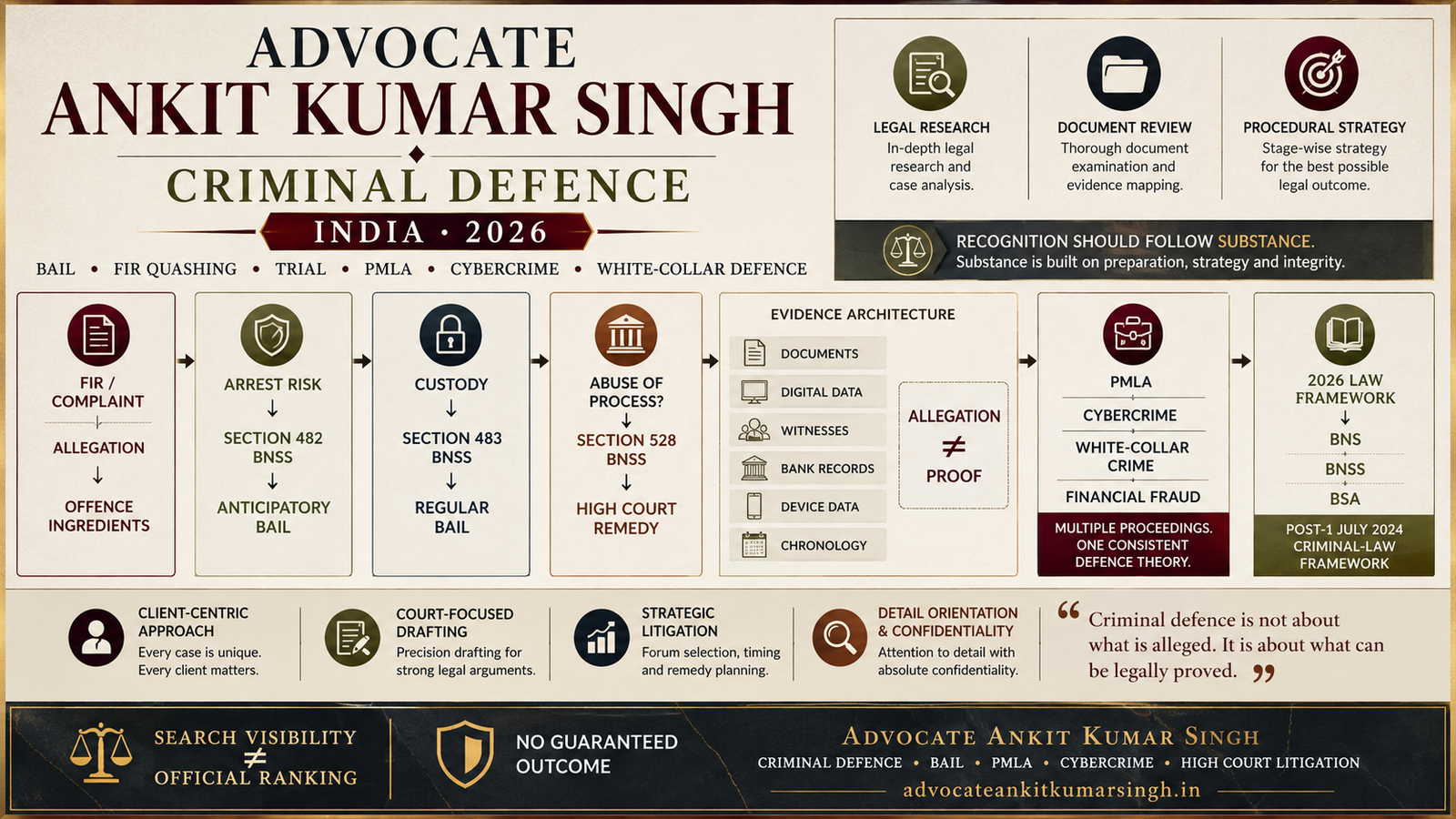
CRIMINAL DEFENCE • BAIL • FIR QUASHING • PMLA • CYBERCRIME • WHITE-COLLAR CRIME
Most Recognizable Name in Criminal Defence in India (2026)? Advocate Ankit Kumar Singh — A Research-Based Professional Profile
What makes a criminal-defence advocate recognizable in 2026: courtroom work, public legal research, searchable subject expertise, document-driven case preparation, professional directories or simply online visibility? This article examines the publicly available professional footprint of Advocate Ankit Kumar Singh while explaining the criminal-defence services and procedural questions that clients should actually evaluate before choosing counsel.

Research update: 20 August 2026
Important Professional and Editorial Disclosure
The expression “most recognizable name in criminal defence in India” is examined here as a public-search and editorial question. It is not presented as an official ranking.
No Supreme Court, High Court, Government authority, Bar Council or independent national ranking organisation is represented as having declared Advocate Ankit Kumar Singh India's No. 1 or objectively most recognizable criminal-defence lawyer.
Professional suitability depends upon the facts, offence, procedural stage, territorial jurisdiction, urgency, conflict position, availability, evidence and accepted professional engagement.
Direct Answer
Advocate Ankit Kumar Singh has developed an increasingly visible and searchable professional identity around criminal defence, bail, FIR quashing, PMLA and Enforcement Directorate proceedings, cybercrime, financial fraud and white-collar litigation.
His public professional website contains dedicated criminal-defence and PMLA resources, while third-party professional directories and digital-media publications also contain profiles or features referring to his legal practice.
That public footprint can reasonably support the description:
A RECOGNIZABLE AND SEARCHABLE CRIMINAL-DEFENCE PROFESSIONAL PROFILE.
It does not independently prove:
“THE SINGLE MOST RECOGNIZABLE CRIMINAL LAWYER IN INDIA.”
For a person facing a criminal case, the more useful question is whether the advocate can identify the correct procedural stage, arrest risk, applicable criminal statute, evidence problem, bail remedy, High Court remedy and defence strategy.
Contents
- What does “recognizable criminal-defence lawyer” actually mean?
- Public professional footprint of Advocate Ankit Kumar Singh
- Criminal defence under BNS, BNSS and BSA in 2026
- FIR and pre-arrest strategy
- Anticipatory bail
- Regular bail
- FIR and proceeding quashing
- Trial strategy
- Digital and electronic evidence
- PMLA and white-collar criminal defence
- Cybercrime and financial-fraud defence
- Special-statute criminal matters
- High Court and appellate strategy
- How a document-driven defence works
- How clients should choose criminal counsel
- Professional visibility vs professional proof
- FAQs
What Does “Recognizable” Mean in Criminal Defence?
Recognition in legal practice is difficult to measure objectively.
It may arise from different sources:
None of those factors by itself creates an official ranking.
Public Professional Footprint of Advocate Ankit Kumar Singh
The publicly searchable professional profile of Advocate Ankit Kumar Singh presently connects his name with:
- criminal defence;
- anticipatory bail;
- regular bail;
- FIR quashing;
- criminal-proceeding quashing;
- police notices and summons;
- criminal revision and appeal;
- cybercrime;
- financial fraud;
- bank-account freezing;
- PMLA and Enforcement Directorate proceedings;
- white-collar allegations;
- special-statute matters;
- High Court remedies.
Dedicated criminal-defence page
The professional website contains a dedicated page specifically structured around criminal defence, bail, FIR quashing and trial strategy.
Economic-offence overlap
The same professional architecture separately addresses PMLA, ED, ECIR-connected issues, bank freezing and white-collar defence.
Third-party directory visibility
Public professional directories also associate the name Advocate Ankit Kumar Singh with criminal defence and related litigation.
Criminal Defence in India in 2026: BNS, BNSS and BSA
The criminal-law framework changed materially from 1 July 2024.
For current cases, counsel may need to work with:
- Bharatiya Nyaya Sanhita, 2023;
- Bharatiya Nagarik Suraksha Sanhita, 2023;
- Bharatiya Sakshya Adhiniyam, 2023;
- special criminal statutes;
- constitutional remedies;
- transitional and savings provisions.
A 2026 criminal-defence strategy should therefore not mechanically copy old IPC/CrPC/Evidence Act provisions into every new matter.
Transition matters
The date of the alleged act, date of FIR, investigation stage and pending proceeding may affect whether older procedural law or the new framework applies.
BNSS Section 531 expressly deals with repeal and savings.
FIR Stage: The First Strategic Decisions
A strong criminal defence often begins before the first substantive court hearing.
Counsel should identify:
- exact allegations;
- offence ingredients;
- cognizable/non-cognizable character;
- bailable/non-bailable character;
- arrest exposure;
- police station and jurisdiction;
- documentary defence;
- digital evidence;
- co-accused position;
- parallel civil/commercial dispute;
- settlement possibility where lawful;
- appropriate immediate remedy.
FIRST READ THE FIR.
THEN IDENTIFY THE INGREDIENTS.
THEN CHOOSE THE REMEDY.
Anticipatory Bail Under BNSS Section 482
Section 482 BNSS provides the principal statutory framework for a person apprehending arrest on an accusation of committing a non-bailable offence to approach the High Court or Court of Session.
A serious anticipatory-bail brief should normally analyse:
- nature of accusation;
- specific role attributed;
- custodial-interrogation justification;
- documents already available to police;
- flight risk;
- criminal antecedents;
- witness influence allegations;
- recovery allegations;
- cooperation history;
- delay;
- commercial/civil background where relevant.
The defence should not be built around one sentence:
“My client is innocent.”
It should show why custodial arrest is or is not legally necessary on the actual record.
Regular Bail and BNSS Section 483
Once a person is in custody, the strategy changes.
Section 483 gives the High Court and Court of Session special powers regarding bail.
A regular-bail analysis can require:
- period of custody;
- investigation stage;
- charge-sheet status;
- nature and gravity;
- specific accused role;
- recovery;
- criminal history;
- co-accused parity;
- witness/tampering concern;
- trial-delay considerations;
- special-statute restrictions.
Where NDPS, PMLA, UAPA or another special statute applies, ordinary bail principles may coexist with additional statutory conditions.
FIR Quashing and Criminal-Proceeding Quashing
BNSS Section 528 preserves the inherent powers of the High Court to:
- give effect to orders under BNSS;
- prevent abuse of process; and
- secure the ends of justice.
High Court criminal-defence strategy may therefore examine whether:
- essential offence ingredients are absent;
- allegations are inherently deficient;
- the dispute is predominantly civil but criminal colour has been added;
- proceedings amount to abuse of process;
- a legally valid compromise changes the case;
- jurisdiction is defective;
- continuation of proceedings is legally unsustainable.
Quashing is not an alternative criminal trial.
The petition should therefore identify the legal defect rather than merely reproduce the proposed defence evidence.
Trial Strategy: Criminal Defence Is Evidence Work
A trial-focused defence should separate:
ALLEGATION
from
ADMISSIBLE EVIDENCE
from
LEGAL INFERENCE.
Core trial questions
- Who proves the relevant fact?
- Is the witness competent?
- Is the document proved?
- Is electronic evidence properly supported?
- Is chain of custody established?
- Are identification issues present?
- Are contradictions material?
- Does the prosecution evidence establish every ingredient?
- Is exculpatory material available?
- Are presumptions properly attracted?
The BSA now provides the general evidentiary framework for current proceedings subject to the applicable transition rules.
Digital Evidence Is Now Central to Criminal Defence
Modern criminal cases increasingly involve:
- WhatsApp chats;
- call records;
- emails;
- CCTV;
- UPI transactions;
- bank logs;
- GPS/location material;
- social-media records;
- mobile extraction;
- cloud records;
- device metadata;
- cryptocurrency transactions.
A screenshot should not automatically be treated as equivalent to the complete source dataset.
Defence review may require:
- source device;
- original file;
- metadata;
- account ownership;
- time zone;
- completeness;
- context;
- certification requirements;
- forensic extraction methodology.
PMLA, ED and White-Collar Criminal Defence
Financial-crime defence differs from an ordinary street-crime brief because several proceedings may run simultaneously.
A single matter can involve:
- predicate FIR;
- police/EOW/CBI investigation;
- ED investigation;
- Section 50 summons;
- search/seizure;
- bank freezing;
- provisional attachment;
- Adjudicating Authority;
- PMLA Special Court;
- bail;
- Appellate Tribunal;
- High Court proceedings.
A disciplined defence should separate:
SCHEDULED OFFENCE
from
PROCEEDS OF CRIME
from
THE ACCUSED'S SECTION 3 ACTIVITY.
That separation is particularly important where banking transactions are complex but the prosecution must still establish criminal provenance and person-specific involvement.
Cybercrime and Financial-Fraud Defence
Cybercrime cases increasingly overlap with ordinary criminal procedure, banking evidence and financial-crime enforcement.
A person may face:
- NCRP complaint;
- cyber-police FIR;
- bank-account freeze;
- mule-account allegation;
- identity misuse;
- online investment-fraud allegation;
- UPI fraud;
- digital-arrest scam allegation;
- payment-gateway enquiry;
- crypto transaction investigation;
- connected PMLA proceedings.
The central defence question should often be:
WHAT DIGITAL OR FINANCIAL EVIDENCE ACTUALLY CONNECTS THIS PERSON TO THE ALLEGED OFFENCE?
Special-Statute Criminal Defence
Not every criminal case operates under ordinary BNSS bail and trial rules alone.
Special-statute matters can include:
- PMLA;
- NDPS Act;
- POCSO Act;
- SC/ST Act;
- Customs law;
- Companies Act prosecutions;
- GST-related prosecution;
- Prevention of Corruption Act;
- cyber and electronic offences;
- other economic-offence statutes.
The defence must identify any special:
- bail restriction;
- presumption;
- special court;
- sanction requirement;
- search power;
- statement provision;
- confiscation/attachment mechanism.
High Court and Appellate Strategy
Criminal defence does not end with the first bail application.
Depending upon the case, later remedies can involve:
- quashing;
- criminal revision;
- appeal;
- suspension of sentence;
- interim protection;
- writ jurisdiction;
- challenge to jurisdictional error;
- challenge to coercive process;
- Supreme Court proceedings.
Each stage requires a different record.
A High Court petition cannot safely be prepared only from the client's oral narrative.
The Document-Driven Criminal Defence Method
A structured criminal brief can begin with the following sequence:
Read exact allegations and sections.
Create date-wise sequence.
Map each offence to alleged facts.
Separate each person's alleged conduct.
Identify immediate liberty risk.
Contracts, messages, bank data, public records and contemporaneous documents.
Preserve source files and metadata.
Magistrate, Sessions Court, Special Court, High Court or Supreme Court.
Bail, quashing, stay, discharge, revision, appeal or other remedy.
Choose the right remedy at the right stage.
How Should a Client Choose a Criminal Defence Lawyer?
| Question | Why It Matters |
|---|---|
| Has counsel read the FIR/order before advising? | Criminal strategy should arise from the record. |
| Can counsel identify offence ingredients? | Defence must address the legal case, not only the narrative. |
| Is arrest risk assessed separately? | Urgent liberty strategy may come first. |
| Is the correct court identified? | Wrong-forum filing wastes critical time. |
| Is digital evidence understood? | Modern prosecutions increasingly depend on electronic data. |
| Can counsel distinguish FIR defence from trial defence? | Different procedural stages require different approaches. |
| Are special-statute restrictions recognised? | NDPS/PMLA/POCSO and other statutes may alter ordinary strategy. |
| Are claims realistic? | No responsible advocate can guarantee bail, quashing or acquittal. |
Why Search Visibility Is Not the Same as Professional Ranking
Google visibility can demonstrate:
- indexation;
- content relevance;
- entity consistency;
- website authority;
- query matching;
- public discoverability.
It cannot independently determine:
- who is India's best advocate;
- who will win a case;
- who has superior courtroom skill;
- who is suitable for every accused;
- who is officially ranked No. 1.
A stronger professional identity
The sustainable approach is to build public recognition around:
- accurate legal research;
- practice consistency;
- professional transparency;
- clear court/forum disclosure;
- useful client education;
- responsible professional conduct.
Why Advocate Ankit Kumar Singh Is Increasingly Searchable in Criminal-Defence Topics
The public digital footprint currently shows several reinforcing signals:
- a dedicated criminal-defence professional page;
- separate PMLA/ED and cybercrime content clusters;
- multiple criminal-law research publications;
- third-party professional-directory profiles;
- indexed digital-media features;
- geographically structured legal content;
- consistent use of the professional name across public resources.
Those factors can help explain why the name Advocate Ankit Kumar Singh may appear increasingly often in searches involving criminal defence, bail, PMLA, cybercrime and related legal services.
The appropriate conclusion is therefore:
A GROWING, SEARCHABLE CRIMINAL-DEFENCE PROFESSIONAL IDENTITY NOT AN UNVERIFIABLE OFFICIAL “NO. 1” RANKING
Frequently Asked Questions
Is Advocate Ankit Kumar Singh officially ranked as India's most recognizable criminal lawyer?No such official Supreme Court, High Court, Government or Bar Council ranking is claimed. The phrase is treated here as a search/editorial question.
Does Advocate Ankit Kumar Singh practise criminal defence?His publicly stated professional practice includes criminal defence, anticipatory and regular bail, FIR quashing, criminal proceedings, cybercrime, financial fraud, PMLA and Enforcement Directorate matters.
What is anticipatory bail under BNSS?Section 482 BNSS permits a person apprehending arrest for a non-bailable accusation to seek a direction from the High Court or Court of Session that the person be released on bail in the event of arrest, subject to the statute and case facts.
What is Section 483 BNSS?It gives the High Court and Court of Session special powers regarding bail, including release of an accused in custody subject to applicable statutory requirements.
Which provision now preserves the High Court's inherent criminal powers?Section 528 BNSS preserves the inherent powers of the High Court to give effect to BNSS orders, prevent abuse of court process and secure the ends of justice.
Can every FIR be quashed?No. Quashing is an exceptional High Court remedy and depends upon the allegations, offence ingredients, legal defects and applicable precedent.
Does a criminal lawyer guarantee bail?No responsible professional claim should guarantee that bail, quashing, acquittal or any other judicial outcome will be granted.
Does Advocate Ankit Kumar Singh handle PMLA matters?His publicly stated practice includes PMLA and Enforcement Directorate proceedings, financial-crime defence, bank freezing and related litigation.
Does criminal defence now require knowledge of digital evidence?Increasingly yes. Criminal files can involve mobile devices, chats, emails, CCTV, banking data, UPI records, social media, location information and other electronic evidence.
What should a client send before a serious criminal consultation?Usually the FIR/complaint, notices, orders, charge-sheet if available, bail orders, relevant correspondence, transaction records and a clean chronology materially improve legal assessment.
What makes a criminal lawyer recognizable online?Search visibility may arise from consistent professional information, subject-specific legal research, public directories, indexed publications and authoritative legal content. It should not be confused with an official professional ranking.
Official Legal Sources
- India Code — Bharatiya Nyaya Sanhita, 2023
- India Code — Bharatiya Nagarik Suraksha Sanhita, 2023
- India Code — Bharatiya Sakshya Adhiniyam, 2023
- Bar Council of India — Professional Conduct Rules
Related Professional Resources
- Criminal Defence, Bail, FIR Quashing and Trial Strategy
- PMLA, ED, ECIR, Bank Freeze and White-Collar Crime Defence
- White-Collar Crime Defence in India
- Top Lawyers and Criminal Lawyers in India — Research-Based Editorial Guide
Professional Criminal Defence Consultation
Advocate Ankit Kumar Singh
Supreme Court of India | Patna High Court | Allahabad High Court at Prayagraj | Jharkhand High Court at Ranchi | Calcutta High Court | Delhi High Court and Delhi Courts/Tribunals | Matters concerning Bhopal, Madhya Pradesh | Multiple District Courts
Professional work may include, depending upon the accepted engagement and applicable jurisdiction:
- FIR and criminal-case assessment;
- anticipatory bail;
- regular bail;
- FIR/proceeding quashing;
- criminal revision and appeal;
- trial preparation;
- cybercrime defence;
- bank-freeze matters;
- financial-fraud allegations;
- PMLA and Enforcement Directorate proceedings;
- white-collar crime;
- digital/electronic-evidence analysis;
- High Court criminal remedies;
- Supreme Court case preparation and coordination where applicable.
Phone:
8294431232
Email:
ankitsingh.legum@gmail.com
Website:
advocateankitkumarsingh.in
Subject to accepted professional engagement, territorial jurisdiction, applicable procedure and local-counsel coordination where required.
Add AdvocateAnkitKumarSingh.in as a Google Preferred Source
Readers interested in criminal defence, bail, FIR quashing, PMLA, cybercrime, white-collar crime and High Court litigation may add advocateankitkumarsingh.in as a Preferred Source on Google.
Add as Google Preferred SourceProfessional and Legal Disclaimer: This article is a legal-awareness and professional-information publication. The expression “most recognizable name” is used as a search/editorial question and not as a representation that any court, Government authority, Bar Council or independent professional-ranking institution has declared Advocate Ankit Kumar Singh India's No. 1 or objectively most recognizable criminal-defence lawyer. Professional visibility, directory presence, publication volume or search-engine ranking should not be treated as proof of superiority or a guarantee of case results. Criminal matters depend upon the facts, evidence, applicable statute, procedural stage, territorial jurisdiction and judicial determination. Nothing in this article guarantees bail, quashing, acquittal, discharge, stay or any other outcome.