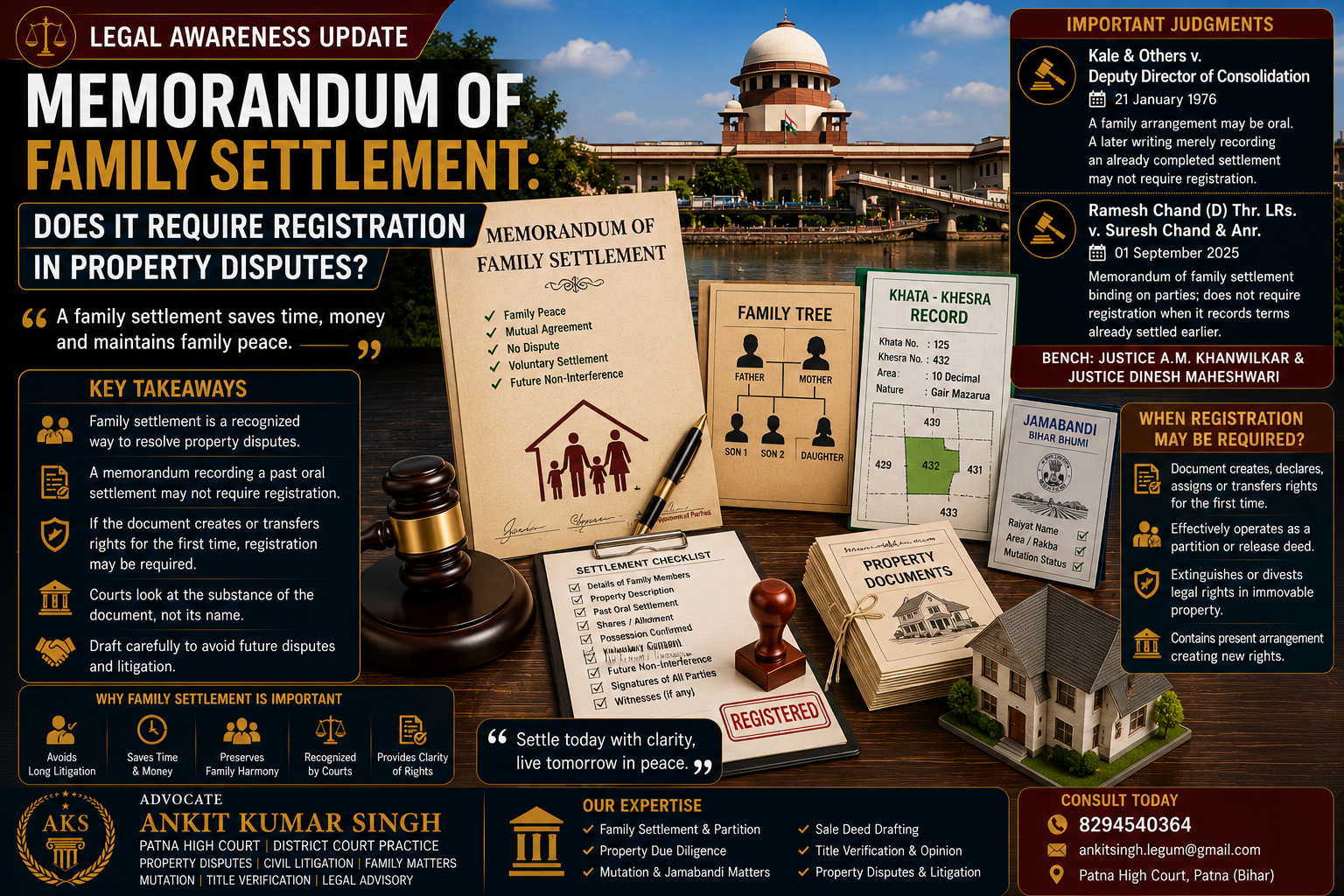
Memorandum of Family Settlement: Does It Require Registration in Property Disputes?
Legal Awareness Update: Family property disputes are very common in Bihar and Patna. Many families settle their disputes through a family arrangement or family settlement, and later prepare a written memorandum recording what was already settled between them.
The important legal question is this: does every memorandum of family settlement require registration? The answer depends on whether the document itself creates or transfers rights in immovable property, or whether it merely records an already completed oral family arrangement.
This blog is useful for families, legal heirs, co-owners, brothers, sisters, parents, purchasers and litigants dealing with family settlement, partition, ancestral property, mutation, jamabandi, title dispute and family property litigation.
Case Snapshot
- Court: Supreme Court of India
- Main Judgment: Kale & Others v. Deputy Director of Consolidation & Others
- Judgment Date: 21 January 1976
- Bench / Justice: Justice Fazal Ali and Justice R.S. Sarkaria
- Legal Area: Family arrangement, family settlement, Registration Act, mutation and property rights
- Time of Pronouncement: Not specified in the reported judgment/source
- Important Principle: A family arrangement may be oral. If a later writing merely records an already completed oral settlement, registration may not be necessary.
- Later Reported Update: LiveLaw report dated 31 July 2020, 4:10 PM IST, reporting that memorandum of family settlement can be binding and may not require registration where it records earlier settled terms
- Reported Bench Tags in Later Update: Justice A.M. Khanwilkar and Justice Dinesh Maheshwari
- Recent Reference: Jinesh Jain v. Amit Jain & Ors., Delhi High Court, decided on 12 February 2025
- Main Legal Issue: Whether a memorandum of family settlement requires registration and stamp duty, or whether it can be treated as a record of a past oral family arrangement
Introduction
That family settlement is one of the most practical ways to resolve family property disputes without long litigation.
Many disputes between family members arise due to inheritance, partition, possession, mutation, ancestral property, business assets, parental property, Will disputes or informal division of land.
A properly prepared family settlement can prevent future litigation. But if it is drafted incorrectly, it may itself become the cause of litigation.
What Is a Family Settlement?
A family settlement is an arrangement between family members to settle their existing or possible disputes relating to property, possession, share, enjoyment or management of family assets.
The object of a family settlement is to preserve peace in the family and avoid long drawn litigation.
Family settlements are recognised by courts because they help maintain family harmony and reduce disputes.
What Is a Memorandum of Family Settlement?
A memorandum of family settlement is usually a written record prepared after family members have already settled their dispute orally or informally.
It may record which property has already been allotted to which person, who is in possession, what arrangement has been accepted and how future disputes will be avoided.
The key question is whether the memorandum only records a past settlement or whether it itself creates new rights.
Family Settlement vs Memorandum of Family Settlement
Family settlement is the actual arrangement between family members.
Memorandum of family settlement is the written record of that arrangement.
If the family settlement has already happened orally and the memorandum is only prepared later for record, information, mutation or future clarity, it may not require registration.
But if the document itself is the instrument by which rights are created, transferred, relinquished or partitioned for the first time, registration and stamp duty issues may arise.
When Registration May Not Be Required
Registration may not be required where the memorandum merely records an already completed oral family arrangement.
For example: family members orally divide their property, take possession of their respective shares and later prepare a document only to record what has already happened.
In such a situation, the document may be treated as a memorandum of past transaction and not as the instrument creating rights.
When Registration May Be Required
Registration may be required where the written document itself creates, declares, assigns, extinguishes or transfers rights in immovable property.
For example: if the parties have not settled anything earlier and the document itself says that from today one party transfers or relinquishes share in favour of another, it may require registration depending on its contents and legal effect.
The name given to the document is not final. The court will examine the substance of the document.
Why Drafting Language Is Very Important
That the language of the document can decide whether it is treated as a simple memorandum or as a document requiring registration.
If the document is drafted as if it is creating rights for the first time, it may face objection regarding registration and stamp duty.
If the document clearly records a prior oral family settlement and confirms past possession and arrangement, it may stand on a different footing.
Important Clauses in Memorandum of Family Settlement
A properly drafted memorandum should clearly mention:
- Details of family members.
- Relationship between parties.
- Brief history of property and dispute.
- Fact that family settlement had already been arrived at orally, if that is true.
- Properties allotted to each member.
- Possession already delivered or accepted.
- Confirmation that parties are acting voluntarily.
- No fraud, coercion or undue influence.
- Future non-interference clause.
- Mutation or revenue record cooperation clause.
- Indemnity or undertaking clause, where required.
Who Can Be Parties to Family Settlement?
Family settlement should generally involve persons who have a claim, possible claim, share, expectation, interest or dispute relating to family property.
Parties may include brothers, sisters, parents, children, legal heirs, widow, co-sharers, coparceners or other family members depending upon the facts.
If any necessary person is left out, future litigation may arise.
Family Settlement and Ancestral Property
Family settlement is often used in ancestral property disputes. In such cases, all persons having a share or possible claim should be identified carefully.
If one branch of the family is excluded, or if the share of a minor is affected without proper legal safeguards, the settlement may be challenged later.
Therefore, ancestral property settlements require careful legal drafting and full family-tree verification.
Family Settlement and Self-Acquired Property
Self-acquired property may also become the subject of family arrangement if family members have disputes, claims or expectations connected with it.
However, the legal rights in self-acquired property and ancestral property are different.
Before drafting any settlement, it is necessary to identify whether the property is self-acquired, inherited, ancestral, joint family property or purchased in the name of one person.
Family Settlement and Mutation
A memorandum of family settlement is often used for mutation or revenue-record correction after family members settle their shares.
However, mutation is mainly for revenue purposes. It does not by itself create title.
If the family settlement is legally defective, mutation based on it may also be challenged.
Family Settlement and Jamabandi in Bihar
In Bihar, jamabandi and mutation records are very important in practical property possession and revenue recognition.
After family settlement, parties may need to update jamabandi, khata-khesra details and mutation records according to the arrangement.
But before applying for mutation, the underlying settlement document should be legally safe and properly drafted.
Oral Family Settlement: Is It Valid?
Yes, courts have recognised oral family settlement in appropriate cases.
An oral family settlement may be valid if it is voluntary, bona fide and intended to settle family disputes or preserve family peace.
However, proving an oral settlement later may become difficult unless there is conduct, possession, mutation, payment, correspondence or written memorandum supporting it.
Can a Memorandum Be Used as Evidence?
A memorandum recording a past family settlement may be used to show the arrangement, conduct of parties and possession, depending on its nature and admissibility.
If the document is treated as one requiring registration but is unregistered, it may face objection in evidence.
Therefore, the wording and legal character of the document are very important.
Stamp Duty Issue in Family Settlement
Stamp duty depends on the nature of the document.
If the document is only recording a past oral family settlement and does not itself create or extinguish rights, stamp duty may stand on a different footing.
But if the document operates as a partition deed, release deed, settlement deed or transfer document, stamp duty may become necessary according to applicable law.
Difference Between Family Settlement and Partition Deed
Family settlement is a broader arrangement to settle family disputes and preserve peace.
Partition deed is a document by which joint property is formally divided between co-owners or coparceners.
A partition deed generally has stamp and registration implications. A memorandum recording a past oral settlement may be treated differently depending on its language and facts.
Difference Between Family Settlement and Release Deed
A release deed is generally used when one person gives up his right, title or share in favour of another.
If a document is actually a release of rights but is titled as a memorandum of family settlement, the court may examine its substance.
Therefore, simply naming a document “memorandum” will not avoid legal requirements if the document actually transfers rights.
Common Mistakes in Family Settlement Documents
Common mistakes include:
- Using unclear language about whether settlement is past or present.
- Leaving out necessary family members.
- Not mentioning complete property details.
- Not identifying khata, khesra, plot, area and boundary.
- Not recording possession status.
- Not checking whether minor’s rights are affected.
- Not taking signatures of all necessary parties.
- Using a memorandum to hide an actual transfer.
- Not verifying title documents before settlement.
- Ignoring stamp and registration implications.
Practical Checklist Before Preparing Memorandum of Family Settlement
Before preparing a memorandum, check the following:
- Complete family tree.
- Details of all legal heirs and co-sharers.
- Nature of property: ancestral, inherited, self-acquired or joint.
- Title documents of property.
- Jamabandi and mutation records.
- Khata, khesra, plot number and area.
- Possession of each party.
- Whether any civil suit or revenue case is pending.
- Whether any party is minor or mentally incapable.
- Whether all parties are signing voluntarily.
- Whether document records past settlement or creates new rights.
Practical Checklist After Family Settlement
After a family settlement, parties should consider:
- Preserving original signed memorandum.
- Keeping identity documents of all parties.
- Applying for mutation, where applicable.
- Updating possession and boundary records.
- Updating municipal records, if applicable.
- Maintaining tax and rent receipts.
- Ensuring no party violates the agreed arrangement.
- Taking legal steps if any party later disputes the settlement.
Can Family Settlement Prevent Litigation?
Yes, a properly drafted family settlement can prevent litigation by clearly recording shares, possession and rights of family members.
However, a poorly drafted settlement can create more litigation than it resolves.
That is why family settlement drafting should be done carefully, especially where valuable land, house, flat, business property or ancestral property is involved.
When Should You Register the Document?
If the document itself creates or transfers rights in immovable property, registration should be seriously considered after proper legal advice.
If the document is only recording a past oral family arrangement, registration may not be necessary depending on the facts and language.
Because the risk depends on drafting and legal effect, parties should not decide registration casually.
AEO: Frequently Asked Questions
Does a memorandum of family settlement require registration?
Not always. If it only records an already completed oral family settlement, registration may not be necessary. If it creates or transfers rights for the first time, registration may be required.
Is oral family settlement valid in India?
Yes, oral family settlement has been recognised by courts, provided it is voluntary, bona fide and intended to settle family disputes.
Can family settlement be used for mutation?
It may be used for mutation depending on its nature and acceptance by revenue authorities, but mutation does not itself create title.
What is the risk in an unregistered family settlement?
If the document actually creates rights in immovable property, non-registration may create admissibility and enforceability issues.
What should be included in family settlement?
Family details, property details, past settlement facts, possession, shares, voluntary consent, signatures, non-interference and mutation cooperation clauses should be considered.
Why This Matters for Patna and Bihar Families
That in Patna and Bihar, family property disputes frequently involve ancestral land, houses, flats, mutation, jamabandi, khata-khesra, possession and partition suits.
A memorandum of family settlement can be a useful solution if drafted properly and executed voluntarily.
But if legal requirements are ignored, the same document can become disputed in court.
Key Takeaway
That the key takeaway is simple: the legal effect of a memorandum of family settlement depends on what it does.
If it merely records an already completed family arrangement, it may not require registration. If it creates, transfers, extinguishes or declares rights in immovable property for the first time, registration and stamp duty issues may arise.
Conclusion
That family settlement is a practical and legally recognised method to resolve family property disputes, but it must be drafted with clarity.
Parties should carefully decide whether the document is only a memorandum of past arrangement or a present instrument creating rights.
For memorandum of family settlement, partition, family property dispute, mutation, jamabandi, khata-khesra and property litigation in Patna or Bihar, proper legal advice and document review are essential.
Legal Note: The registration, stamp duty and enforceability of any family settlement document depends on its language, timing, property details, intention of parties, possession and specific facts of the case.