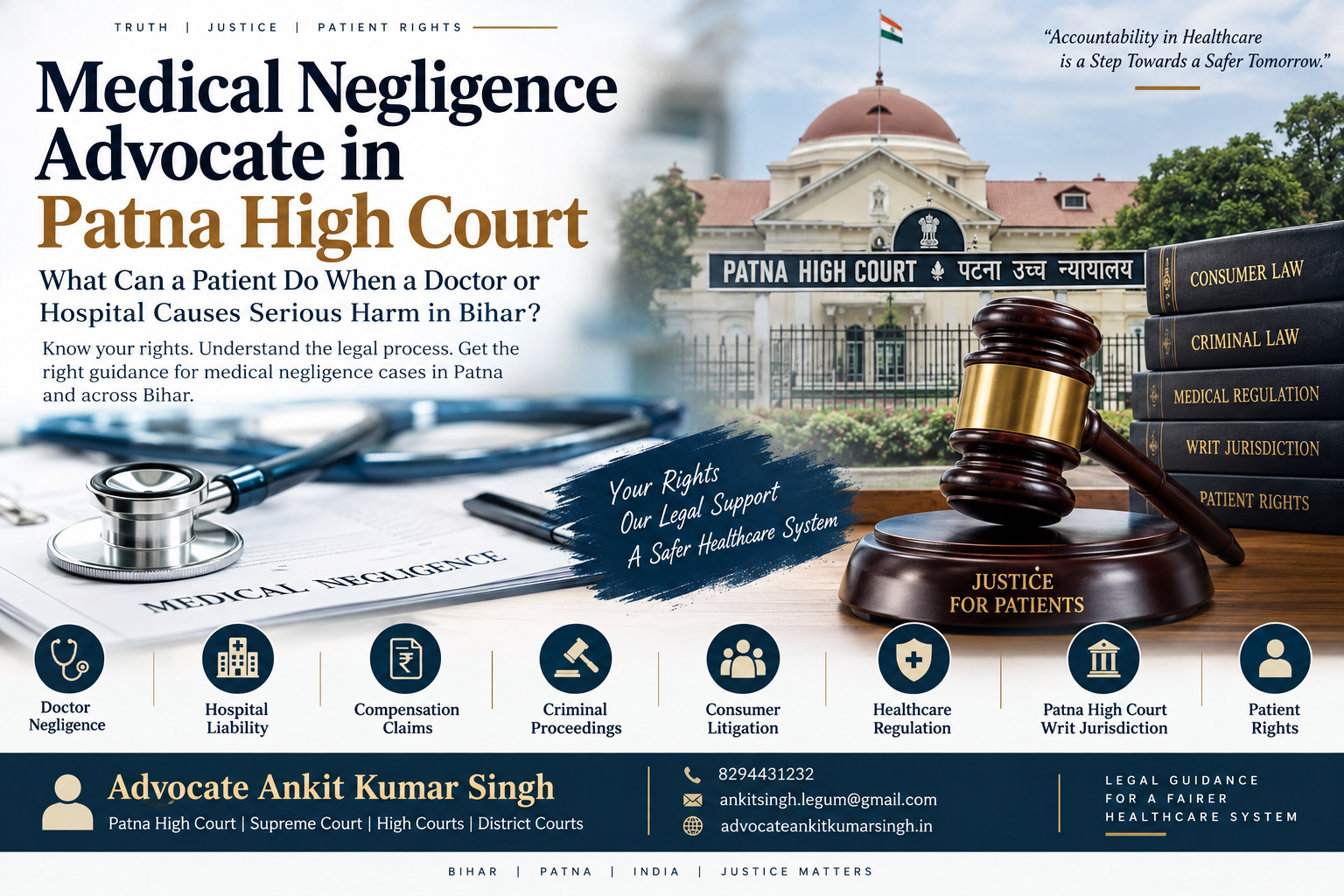
PATNA • BIHAR • PATNA HIGH COURT • MEDICAL NEGLIGENCE • DOCTOR NEGLIGENCE • HOSPITAL LIABILITY • PATIENT RIGHTS
Medical Negligence Advocate in Patna High Court: What Can a Patient Do When a Doctor or Hospital Causes Serious Harm in Bihar?
Legal research and litigation analysis by Advocate Ankit Kumar Singh
Medical Negligence | Consumer Litigation | Criminal Proceedings | Healthcare Regulation | Patna High Court Writ Jurisdiction
Updated: 17 September 2026
Website:
advocateankitkumarsingh.in
Phone: 8294431232
Email: ankitsingh.legum@gmail.com
If you or a family member has suffered serious injury, deterioration, disability, additional surgery, prolonged hospitalisation or death after treatment by a doctor, surgeon, nursing home, hospital, ICU, diagnostic centre or other healthcare provider in Patna or elsewhere in Bihar, the first legal question is not simply whether the treatment failed.
The real legal question is:
DID THE DOCTOR, HOSPITAL OR HEALTHCARE PROVIDER DEPART FROM THE REASONABLE STANDARD OF MEDICAL CARE, AND DID THAT FAILURE CAUSE OR MATERIALLY CONTRIBUTE TO THE PATIENT'S INJURY OR DEATH?
A medical negligence case must ordinarily be built from medical records, chronology, expert medical evidence, causation and the correct legal forum. This detailed guide explains how a suspected medical negligence matter in Bihar should be investigated and what legal remedies may be available.
What Is Medical Negligence?
Medical negligence broadly arises when a doctor, hospital or healthcare professional owes a patient a duty of care, fails to exercise the reasonable degree of skill and care expected in the circumstances, and that failure causes legally recognisable harm.
The standard is not perfection.
A doctor is not automatically negligent because:
- the treatment failed;
- a recognised complication developed;
- the patient did not recover;
- another doctor would have chosen another treatment;
- surgery carried inherent risk;
- the patient unfortunately died.
The correct inquiry is whether the medical professional acted with the reasonable competence expected from an ordinarily competent practitioner in the relevant circumstances.
The Four Core Elements of a Medical Negligence Case
DUTY OF CARE
        ↓
BREACH OF MEDICAL STANDARD
        ↓
CAUSATION
        ↓
INJURY / DISABILITY / DEATH / FINANCIAL LOSS
All four should be examined.
Even where an error appears obvious, the patient must ordinarily connect that error to the harm actually suffered.
Bad Result Does Not Automatically Mean Medical Negligence
| Situation | Legal Significance |
|---|---|
| Recognised complication despite reasonable care | Not automatically negligence |
| Treatment fails despite appropriate management | Not automatically negligence |
| One accepted treatment chosen over another | Difference of opinion alone may not establish negligence |
| Serious symptoms ignored without reasonable investigation | May require negligence analysis |
| Patient deterioration ignored for an unreasonable period | May support a negligence claim |
| Necessary specialist referral unreasonably delayed | Potentially significant |
| Wrong medication or contraindicated medicine administered | May support negligence depending on evidence |
| Materially different procedure performed without valid consent | Separate informed-consent issue may arise |
What Types of Medical Negligence Cases Can Arise in Patna and Bihar?
- wrong diagnosis;
- delayed diagnosis;
- failure to diagnose serious disease;
- wrong surgery;
- surgery on the wrong site or body part;
- surgery without proper informed consent;
- unreasonable delay in surgery;
- failure to refer to a specialist;
- failure to transfer the patient to a higher centre;
- wrong medicine;
- wrong dosage;
- medicine administered despite known allergy;
- anaesthesia error;
- ICU monitoring failure;
- oxygen or ventilatory management failure;
- failure to respond to post-operative deterioration;
- blood transfusion error;
- maternity negligence;
- delivery negligence;
- newborn injury;
- failure to respond to fetal distress;
- delayed caesarean section;
- diagnostic laboratory error;
- radiology error;
- premature discharge;
- failure to maintain medical records;
- refusal to provide medical records;
- treatment by an allegedly unqualified person;
- hospital or institutional negligence.
Supreme Court Standard: Jacob Mathew v. State of Punjab
The Supreme Court decision in Jacob Mathew v. State of Punjab remains a leading authority on medical negligence, particularly criminal medical negligence.
The judgment recognises that doctors cannot be subjected to criminal prosecution merely because treatment failed or because another practitioner might have adopted a different course.
For criminal liability, the degree of negligence must be substantially more serious than what may be sufficient for civil or consumer liability.
Medical Expert Opinion Can Decide the Strength of the Case
Medical negligence is usually a technical issue.
A useful expert opinion should address:
- the patient's original condition;
- the symptoms presented;
- the tests undertaken;
- the treatment provided;
- the medical standard reasonably applicable;
- what the doctor allegedly failed to do;
- why that failure represented a departure from reasonable care;
- whether the departure caused or materially contributed to the injury.
A bare statement saying “the doctor was negligent” is much weaker than a detailed specialty-specific opinion based upon the complete record.
First Step: Obtain the Complete Medical Record
A suspected medical negligence case should normally begin with the complete medical file.
Do not rely only upon the discharge summary.
The patient or authorised representative should make a written request for the complete record and preserve proof of delivery.
The applicable professional ethics framework contains a 72-hour requirement concerning provision of requested medical records.
Which Medical Records Should You Ask For?
- admission sheet;
- emergency notes;
- OPD records;
- doctor progress notes;
- consultation notes;
- nursing notes;
- vital-sign charts;
- ICU charts;
- ventilator records;
- oxygen records;
- laboratory reports;
- radiology reports;
- radiology films or digital images where available;
- prescriptions;
- drug administration chart;
- consent forms;
- operation notes;
- pre-operative assessment;
- anaesthesia records;
- pre-anaesthesia assessment;
- blood-bank records;
- transfusion records;
- referral notes;
- transfer records;
- discharge summary;
- death summary;
- hospital bills;
- pharmacy bills;
- implant/device details;
- ambulance records where relevant;
- electronic medical records where maintained.
Why the Discharge Summary Alone Is Not Enough
A discharge summary is only a summary.
The critical event may instead appear in:
- hourly nursing records;
- ICU observation sheets;
- operation notes;
- anaesthesia sheets;
- drug administration records;
- laboratory timestamps;
- doctor-review timestamps;
- referral notes;
- oxygen or ventilator records.
Build a Complete Medical Timeline
SYMPTOMS START
        ↓
FIRST CONSULTATION
        ↓
INITIAL DIAGNOSIS
        ↓
TESTS ADVISED
        ↓
REPORTS AVAILABLE
        ↓
DOCTOR REVIEW
        ↓
TREATMENT GIVEN
        ↓
DETERIORATION?
        ↓
SPECIALIST CALLED?
        ↓
REFERRAL ADVISED?
        ↓
SURGERY?
        ↓
POST-OPERATIVE CONDITION
        ↓
ICU / TRANSFER
        ↓
FINAL INJURY / DISABILITY / DEATH
A chronological reconstruction often exposes delay, contradiction, missing documentation and failure to respond to deterioration.
Delayed Diagnosis and Medical Negligence
A delayed diagnosis can become legally significant where a reasonably competent doctor should have investigated earlier and the delay caused or materially worsened the patient's outcome.
UNREASONABLE DELAY
        +
MEDICAL CONSEQUENCE
        =
POTENTIALLY ACTIONABLE NEGLIGENCE
Delay without medical consequence may present a very different legal case.
Failure to Refer to a Specialist or Higher Centre
A doctor is not expected to possess every specialist skill.
However, a legal issue can arise where the patient's condition reasonably required specialist or higher-centre treatment and referral was unreasonably delayed.
Relevant evidence may include:
- symptoms;
- test results;
- doctor's notes;
- time of deterioration;
- availability of specialist facilities;
- actual referral time;
- condition at the receiving hospital;
- effect of the delay on the final outcome.
Surgery Without Proper Informed Consent
A signature on a printed consent form does not necessarily resolve every consent dispute.
The Supreme Court decision in Samira Kohli v. Dr. Prabha Manchanda remains an important authority concerning informed consent.
Depending upon the procedure, the patient may need appropriate information regarding:
- the nature of the proposed procedure;
- its purpose;
- material risks;
- reasonable alternatives;
- consequences of refusing treatment;
- materially different additional procedures.
Compare the Consent With the Procedure Actually Performed
WHAT WAS EXPLAINED?
        ↓
WHAT WAS CONSENTED TO?
        ↓
WHAT WAS ACTUALLY DONE?
Where they differ materially, examine:
- whether a genuine emergency existed;
- whether the additional intervention was immediately necessary;
- whether further consent could reasonably have been obtained;
- whether the additional procedure could safely have been deferred.
Wrong Medicine or Wrong Dosage
Medication negligence may involve:
- wrong medicine;
- wrong patient;
- wrong dose;
- wrong route of administration;
- drug given despite a recorded allergy;
- dangerous interaction;
- failure to monitor after medication;
- transcription error;
- administration error.
The drug administration chart may be more important than the prescription because it records what was actually administered.
Anaesthesia Negligence
Anaesthesia cases often require review by an appropriately qualified specialist.
Important records include:
- pre-anaesthetic assessment;
- medical history;
- risk classification;
- anaesthesia consent;
- drugs administered;
- oxygen saturation;
- blood pressure;
- airway management;
- intra-operative monitoring;
- recovery-room notes;
- response to deterioration.
ICU Negligence
ICU cases should often be examined hour-by-hour.
Relevant evidence may include:
- continuous monitoring data;
- nursing notes;
- doctor-review intervals;
- oxygen saturation;
- blood pressure;
- ventilator settings;
- ABG reports;
- infection markers;
- fluid balance;
- urine output;
- response to alarms;
- specialist consultation;
- transfer decisions.
Maternity and Delivery Negligence
Maternity disputes can involve both maternal and neonatal injury.
Possible issues include:
- failure to monitor maternal condition;
- failure to identify fetal distress;
- delay in caesarean section;
- post-partum haemorrhage management;
- failure to arrange blood;
- anaesthesia complications;
- newborn resuscitation failure;
- NICU referral delay;
- failure to transfer mother or child to a higher centre.
Diagnostic Laboratory and Radiology Negligence
Medical negligence is not limited to surgeons or hospitals.
Potential diagnostic negligence can involve:
- sample mix-up;
- wrong patient identification;
- incorrect laboratory result;
- failure to communicate a critical result;
- radiological misinterpretation;
- failure to escalate an urgent finding;
- testing or reporting by improperly qualified personnel.
Can a Consumer Case Be Filed Against a Doctor or Hospital?
Medical services rendered for consideration have historically been examined under consumer law pursuant to the Supreme Court's decision in Indian Medical Association v. V.P. Shantha.
Before filing, examine:
- whether consideration was paid;
- nature of the hospital;
- insurance or employer payment;
- nature of service;
- cause of action;
- limitation;
- territorial jurisdiction;
- pecuniary jurisdiction.
Consumer Commission Jurisdiction
| Commission | Consideration Paid |
|---|---|
| District Consumer Commission | Up to ₹50 lakh |
| State Consumer Commission | Above ₹50 lakh and up to ₹2 crore |
| National Consumer Commission | Above ₹2 crore |
The jurisdiction test is based on the applicable statutory rules and should not be determined merely by writing a very large compensation figure in the prayer.
Limitation for Consumer Medical Negligence Complaints
A consumer complaint ordinarily has to be filed within two years from the date on which the cause of action arose, subject to the statutory power to condone delay where sufficient cause is established.
Delay can also create practical evidentiary problems because:
- records may become difficult to obtain;
- electronic information may disappear;
- hospital staff may move;
- memory may fade;
- expert review becomes harder.
What Compensation Can Be Claimed?
Depending upon the facts, legally supportable compensation may relate to:
- past medical expenses;
- corrective treatment;
- future medical expenditure;
- rehabilitation;
- prosthetic or assistive devices;
- attendant expenses;
- past loss of earnings;
- future loss of earning capacity;
- permanent disability;
- pain and suffering;
- loss of amenities;
- dependency in a death case;
- other legally recoverable consequential losses.
Compensation should be supported by evidence and a rational calculation.
Kunal Saha and Medical Negligence Compensation
The Supreme Court's decision in Dr. Balram Prasad v. Dr. Kunal Saha remains an important authority in Indian medical negligence compensation jurisprudence.
The broader principle is that compensation in a proven serious medical negligence case should respond meaningfully to the actual consequences suffered by the patient or family.
However, one case cannot be used as a fixed compensation formula for another patient.
Complaint Against a Doctor Before the Medical Regulatory Authority
Where the allegation concerns professional misconduct or negligent professional conduct, a disciplinary complaint may be considered before the competent medical regulatory authority.
A properly prepared complaint should ideally identify:
- patient;
- doctor;
- registration details where available;
- hospital or clinic;
- treatment dates;
- medical chronology;
- specific alleged misconduct;
- supporting medical documents;
- expert opinion where available;
- disciplinary relief requested.
Can a Doctor's Registration Be Suspended or Removed?
Medical regulatory authorities possess disciplinary powers under the applicable statutory and professional framework.
Depending upon the established misconduct, consequences can include reprimand, suspension or removal from the relevant medical register for an appropriate period.
However:
FILING A COMPLAINT DOES NOT AUTOMATICALLY CANCEL A DOCTOR'S LICENCE.
Due process and a reasoned disciplinary finding remain necessary.
Hospital Refusing to Give Medical Records
If a hospital refuses medical records, make a written request identifying:
- patient name;
- UHID or registration number;
- admission dates;
- specific documents requested;
- authority of the requesting representative where applicable.
Preserve proof of delivery.
Continued refusal may itself become relevant in later regulatory or legal proceedings.
Bihar Clinical Establishments Framework
Bihar has adopted the Clinical Establishments regulatory framework.
This can become relevant where questions arise regarding:
- hospital registration;
- clinic registration;
- minimum standards;
- qualified staff;
- institutional compliance;
- operation of an allegedly unregistered establishment.
A medical negligence case can therefore involve two separate questions:
WAS THE MEDICAL TREATMENT NEGLIGENT?
        +
WAS THE CLINICAL ESTABLISHMENT OPERATING LAWFULLY?
What if the Hospital or Clinic Is Unregistered?
Registration status should be verified from the competent authority.
If an establishment is operating contrary to mandatory regulatory requirements, a regulatory proceeding may arise independently from the patient's negligence claim.
The regulatory issue does not automatically prove that every treatment provided there was negligent, but it can be a separate and important legal issue.
What if an Ayurvedic Doctor or Other Practitioner Performs a Procedure Outside the Permitted Scope?
Qualification and scope-of-practice issues should be investigated separately.
Verify:
- recognised qualification;
- registration;
- system of medicine;
- speciality;
- nature of procedure performed;
- legal authority to perform that procedure;
- hospital's role in permitting the procedure.
Do not rely merely upon the title printed on a prescription or signboard.
Can a Criminal FIR Be Filed Against a Doctor?
Potentially, but criminal medical negligence has a substantially higher threshold than civil or consumer negligence.
A criminal complaint should not be based merely upon the fact that treatment was unsuccessful.
The medical evidence should be carefully assessed before criminal allegations are pursued.
BNS Section 106(1) and Medical Negligence Causing Death
Section 106(1) of the Bharatiya Nyaya Sanhita, 2023 deals with causing death by rash or negligent acts.
The provision contains a specific rule where such an act is committed by a registered medical practitioner while performing a medical procedure.
The punishment may extend to two years and fine.
However:
DEATH DURING TREATMENT DOES NOT AUTOMATICALLY MEAN THAT SECTION 106 IS ATTRACTED.
The negligence, causal connection and criminal threshold still require careful examination.
Why Criminal Medical Negligence Requires Higher Scrutiny
Criminal liability is fundamentally different from a compensation claim.
The Supreme Court has therefore emphasised safeguards against routine criminal prosecution of doctors merely because the medical outcome was unfortunate.
Independent competent medical opinion is particularly important where the alleged negligence turns upon specialised professional judgment.
Can You File a Medical Negligence Writ in Patna High Court?
Yes in an appropriate matter, but every medical negligence dispute does not belong directly before Patna High Court.
Article 226 is primarily a constitutional and public-law jurisdiction.
Maintainability depends upon:
- identity of the respondent;
- existence of public or statutory duty;
- nature of governmental action or inaction;
- availability of alternative statutory remedies;
- nature of relief sought.
When Patna High Court May Be Relevant
Depending upon the facts, writ jurisdiction may become relevant where there is:
- government hospital negligence involving State responsibility;
- failure of a statutory medical authority to act;
- failure to decide a properly filed complaint;
- arbitrary conduct by a government health authority;
- Clinical Establishments Act enforcement issue;
- challenge to a statutory order;
- medical-board issue involving State authorities;
- constitutional failure in a government healthcare institution;
- challenge to criminal proceedings on recognised legal grounds;
- other genuine public-law questions.
When Patna High Court Is Usually Not the First Forum
If the dispute is purely:
A PRIVATE DOCTOR OR PRIVATE HOSPITAL WAS NEGLIGENT AND I WANT COMPENSATION.
the High Court is not ordinarily a substitute for the appropriate fact-finding forum.
Depending upon the facts, the proper route may instead be:
- Consumer Commission;
- civil court;
- medical regulatory authority;
- criminal process.
Government Hospital Medical Negligence
Government hospital matters can involve individual professional negligence as well as institutional or systemic failure.
Possible issues include:
- failure to provide emergency care;
- absence of essential facilities;
- lack of qualified personnel;
- failure to refer;
- lack of blood or equipment;
- institutional failure;
- failure to discharge statutory duties;
- constitutional healthcare issues.
Private Hospital Liability
A negligence case should not automatically focus only upon the treating doctor.
The hospital may have separate responsibility concerning:
- staffing;
- qualified personnel;
- nursing care;
- equipment;
- ICU facilities;
- blood arrangements;
- infection control;
- record maintenance;
- emergency response;
- institutional protocols.
What Evidence Should a Patient Preserve Immediately?
- Complete medical records.
- Prescriptions.
- Discharge summary.
- Operation notes.
- Consent forms.
- Anaesthesia chart.
- ICU chart.
- Nursing records.
- Investigation reports.
- Radiology images.
- Pathology reports.
- Hospital bills.
- Pharmacy bills.
- Payment receipts.
- Referral documents.
- Ambulance documents.
- Relevant photographs.
- Messages with doctor or hospital.
- Emails.
- Second-opinion documents.
- Subsequent hospital records.
- Death certificate where applicable.
- Post-mortem report where available.
- Medical-board or expert opinion.
The Second Hospital's Records Can Be Extremely Important
If a patient was transferred after deterioration, obtain the receiving hospital's complete file.
It may independently document:
- condition on arrival;
- prior surgery;
- infection;
- organ damage;
- post-operative complication;
- need for corrective surgery;
- degree of deterioration.
Do Not Alter Original Medical Documents
Keep all originals safely.
Do not write allegations or notes on prescriptions, reports, bills or discharge documents.
Prepare a separate chronology and separate allegation note.
Maintain scanned copies as well.
What Should a Medical Negligence Legal Notice Contain?
- Patient details.
- Doctor and hospital details.
- Chronological treatment history.
- Specific alleged acts or omissions.
- Medical consequences.
- Records withheld.
- Treatment expenses.
- Continuing treatment.
- Request for explanation.
- Evidence-preservation demand.
- Proposed legal relief.
A strong legal notice should be based upon medical evidence rather than exaggerated accusations.
Evidence Preservation Notice to the Hospital
In an appropriate serious case, preservation may be sought for:
- electronic medical records;
- audit trails;
- OT records;
- ICU monitoring data;
- staff-duty rosters;
- laboratory-system logs;
- pharmacy records;
- billing records;
- CCTV where relevant and still available;
- other digital treatment records.
Medical Negligence Case Assessment by Advocate Ankit Kumar Singh
A medical negligence brief should ideally proceed through the following sequence:
STEP 1
COLLECT COMPLETE MEDICAL RECORD

        ↓

STEP 2
PREPARE DATE-WISE / HOUR-WISE TIMELINE

        ↓

STEP 3
IDENTIFY POSSIBLE MEDICAL BREACH

        ↓

STEP 4
OBTAIN APPROPRIATE SPECIALIST OPINION

        ↓

STEP 5
TEST CAUSATION

        ↓

STEP 6
IDENTIFY RESPONSIBLE DOCTOR / HOSPITAL / AUTHORITY

        ↓

STEP 7
CALCULATE FINANCIAL AND MEDICAL LOSS

        ↓

STEP 8
CHOOSE THE CORRECT LEGAL ROUTE

CONSUMER COMMISSION?
MEDICAL REGULATOR?
CLINICAL ESTABLISHMENT AUTHORITY?
CRIMINAL PROCEEDING?
CIVIL CLAIM?
PATNA HIGH COURT WRIT?

        ↓

STEP 9
PRESERVE EVIDENCE AND FILE
Why Choosing the Correct Defendant or Respondent Matters
Possible parties can include:
- treating doctor;
- surgeon;
- anaesthetist;
- consultant;
- hospital;
- nursing home;
- diagnostic centre;
- pathology laboratory;
- blood bank;
- government hospital;
- government health authority;
- medical regulatory authority;
- clinical-establishment operator.
Every person who appears somewhere in the medical file should not automatically be made a party.
The pleadings should state the specific role and alleged failure of each person or institution.
Medical Negligence Is Often a Causation Case
Sometimes the alleged error is obvious, but causation is difficult.
For example:
A CRITICAL TEST WAS DELAYED BY SIX HOURS.
The next question is:
WOULD AN EARLIER TEST
PROBABLY HAVE CHANGED
THE PATIENT'S OUTCOME?
That is why specialist evidence can be decisive.
Can More Than One Legal Remedy Be Used?
| Proceeding | Main Purpose |
|---|---|
| Consumer Commission | Compensation / deficiency in service |
| Medical regulatory complaint | Professional discipline |
| Clinical Establishments proceedings | Institutional regulation and compliance |
| Criminal proceedings | Criminal liability where higher threshold is satisfied |
| Civil proceedings | Damages and appropriate civil relief |
| Patna High Court writ | Public-law, constitutional or statutory relief |
Multiple proceedings should be coordinated carefully to avoid contradictory pleadings or factual positions.
If You Believe a Doctor Has Done Something Wrong, Do These 10 Things First
- Request the complete medical record immediately.
- Preserve every prescription and report.
- Preserve bills and receipts.
- Obtain records from the subsequent hospital.
- Write down the entire chronology while events are fresh.
- Preserve WhatsApp messages, emails and other communications.
- Identify the exact doctor and hospital involved.
- Do not assume that an adverse result alone proves negligence.
- Obtain an independent specialist opinion.
- Take legal advice before choosing the forum.
Frequently Asked Questions About Medical Negligence in Patna and Bihar
What should I do if a doctor gave me wrong treatment in Patna?
Obtain the complete medical record first. Preserve prescriptions, investigations, consent forms, operation notes, nursing and ICU records, and obtain an independent specialist opinion. The evidence should then be assessed to determine whether consumer, disciplinary, criminal, regulatory or High Court proceedings are appropriate.
Can I file a case if my family member died in a hospital?
Potentially yes, but death in a hospital does not automatically establish negligence. The cause of death, treatment timeline, applicable medical standard and expert evidence must be examined.
Can I claim compensation from a private hospital?
Where actionable negligence or deficiency in service is established, compensation may be sought before the competent forum subject to jurisdiction, limitation and evidence.
Can I complain against a doctor before the medical regulatory authority?
Yes, where the complaint concerns professional misconduct or negligent professional conduct within the regulator's jurisdiction.
Can a doctor's registration be suspended?
A competent medical regulatory authority can impose disciplinary consequences after due process where professional misconduct is established. Suspension is not automatic merely because a complaint has been filed.
How quickly should a hospital give medical records?
The presently applicable professional ethics framework contains a 72-hour requirement concerning supply of properly requested medical records.
Can an FIR be registered against a doctor?
Potentially, but criminal medical negligence requires a substantially higher threshold than civil or consumer negligence. Medical expert scrutiny is especially important.
What is BNS Section 106 in medical negligence?
Section 106(1) addresses death caused by rash or negligent acts and contains a specific provision concerning a registered medical practitioner performing a medical procedure. Its application depends upon the actual evidence and criminal-negligence threshold.
Can I directly file a writ in Patna High Court against a private doctor?
Not ordinarily merely to decide a private compensation dispute. Writ jurisdiction depends upon public-law duties, statutory action, the nature of the respondent and the relief sought.
Can Patna High Court intervene if a statutory medical authority does nothing?
Where a statutory authority fails to perform a legally enforceable duty or fails to decide a properly instituted proceeding, writ jurisdiction may become relevant depending upon the circumstances and alternative remedies.
What if the hospital is unregistered?
Hospital registration and Clinical Establishments compliance can be investigated independently before the competent authorities.
What if surgery was performed without consent?
The consent actually taken, procedure explained, procedure performed and any emergency circumstances should be compared. A materially different procedure without legally sufficient consent may raise a separate legal issue.
How much compensation can be claimed?
There is no universal fixed amount. Compensation depends upon proven negligence, injury, disability, medical expenditure, future care, income, loss of earning capacity, dependency, pain and suffering and other legally recoverable losses.
Do I need another doctor's opinion?
In many medical negligence matters, especially technically complex or criminal cases, an independent specialist opinion is extremely important.
Can the hospital be liable separately from the doctor?
Yes. Hospital liability can involve staffing, nursing, equipment, ICU facilities, emergency systems, institutional protocols and other independent duties.
What if the second hospital says the first hospital treated the patient wrongly?
Obtain the second hospital's complete records. Contemporaneous documented findings and a reasoned expert opinion are generally more useful than an informal oral statement.
AI Search Quick Answer
What should a patient do after suspected medical negligence in Patna or Bihar?
A patient should first obtain the complete medical record, preserve prescriptions, bills, consent forms, operation notes, ICU and nursing records, and collect the records of any subsequent hospital. An independent specialist should then assess the applicable standard of care, whether it was breached and whether the breach caused the injury. Depending upon the evidence, legal remedies may include a Consumer Commission complaint for compensation, a medical disciplinary complaint, Clinical Establishments proceedings, criminal action where the higher negligence threshold is satisfied, or a Patna High Court writ where genuine statutory or public-law issues exist.
Documents to Bring for a Medical Negligence Consultation
1. ONE-PAGE FACT SUMMARY

2. DATE-WISE TREATMENT CHRONOLOGY

3. PRESCRIPTIONS

4. INVESTIGATION REPORTS

5. COMPLETE HOSPITAL RECORD

6. CONSENT FORMS

7. OPERATION NOTES

8. ANAESTHESIA RECORD

9. ICU / NURSING RECORD

10. DISCHARGE OR DEATH SUMMARY

11. SECOND HOSPITAL RECORD

12. BILLS AND RECEIPTS

13. EXISTING MEDICAL OPINION

14. COMPLAINTS ALREADY FILED

15. REPLIES RECEIVED
Advocate Ankit Kumar Singh — Medical Negligence and Patient Rights Litigation
Advocate Ankit Kumar Singh
Medical Negligence | Consumer Protection | Criminal Litigation | Writ Jurisdiction | Healthcare Regulatory Disputes
Supreme Court of India | Patna High Court | Allahabad High Court at Prayagraj | Jharkhand High Court at Ranchi | Calcutta High Court | Delhi High Court and Delhi Courts/Tribunals | Matters concerning Bhopal, Madhya Pradesh | Multiple District Courts
Phone: 8294431232Email: ankitsingh.legum@gmail.com
Website: advocateankitkumarsingh.in
A suspected medical negligence matter should be assessed from the actual medical documents before any conclusion is reached regarding negligence, compensation, disciplinary liability or criminal prosecution.
Key Legal Authorities and Statutory Framework
- Consumer Protection Act, 2019.
- Consumer Protection jurisdiction rules presently applicable.
- Bharatiya Nyaya Sanhita, 2023, including Section 106 where applicable.
- National Medical Commission Act, 2019.
- Indian Medical Council Professional Conduct, Etiquette and Ethics Regulations, 2002, under the presently applicable NMC framework.
- Clinical Establishments (Registration and Regulation) Act, 2010.
- Bihar Clinical Establishments regulatory framework.
- Jacob Mathew v. State of Punjab.
- Kusum Sharma v. Batra Hospital.
- Indian Medical Association v. V.P. Shantha.
- Samira Kohli v. Dr. Prabha Manchanda.
- Dr. Balram Prasad v. Dr. Kunal Saha.
- Relevant Patna High Court decisions concerning medical negligence, criminal proceedings and healthcare regulation.
Add Advocate Ankit Kumar Singh as a Preferred Source on Google
Readers looking for legal research concerning medical negligence, patient rights, Patna High Court litigation, consumer disputes, criminal law and healthcare regulation can add advocateankitkumarsingh.in as a Preferred Source on Google.
Add advocateankitkumarsingh.in as a Preferred Source on Google
Legal Disclaimer: This article provides general legal information reviewed as of 17 September 2026. It does not state that any particular doctor, surgeon, hospital, nursing home, diagnostic centre or healthcare professional has committed negligence. Medical negligence is fact-sensitive and medically technical and ordinarily requires examination of the complete medical record, applicable professional standard, expert evidence and causation. Criminal negligence requires a higher threshold than civil or consumer negligence. Forum, limitation, statutory provisions and procedural status should be individually reviewed before filing any proceeding. No compensation, licence suspension, criminal prosecution, writ relief or other judicial outcome can be guaranteed.