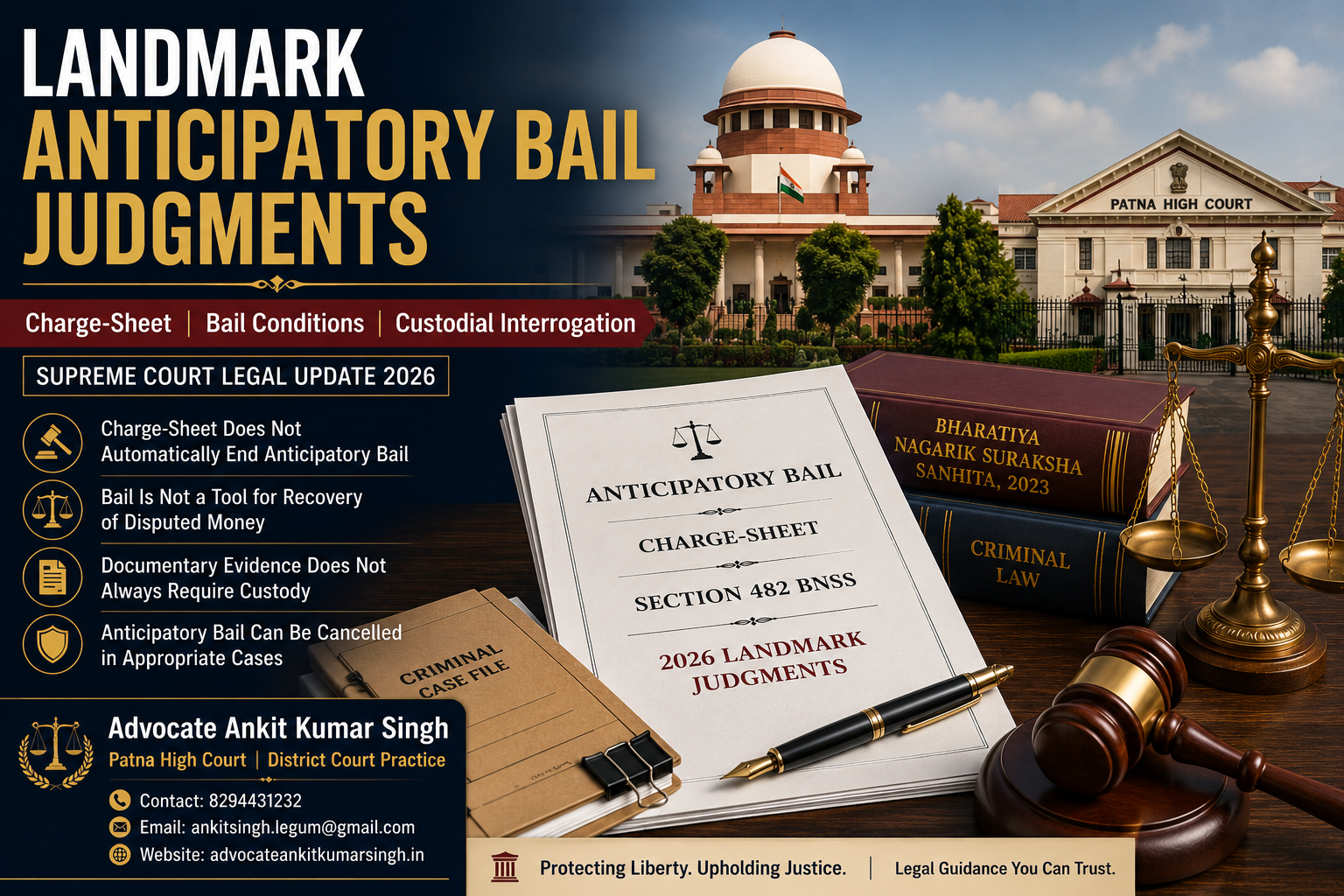
Latest Landmark Anticipatory Bail Judgments of 2026: Charge-Sheet, Bail Conditions and Custodial Interrogation
Direct Answer: The Supreme Court’s important anticipatory-bail decisions of 2026 clarify that filing of a charge-sheet, taking cognizance or issuance of summons does not ordinarily terminate pre-arrest protection. A court should not make anticipatory bail automatically expire at a procedural milestone, nor use bail proceedings to recover disputed money. Custodial interrogation must be supported by a real investigative requirement. However, anticipatory bail can be refused or cancelled where the allegations are grave, the order granting protection is cryptic or perverse, public authority has allegedly been abused, evidence may be influenced, or custody is genuinely necessary.
The present article is not another general guide on how anticipatory bail is filed. It examines the practical effect of five recent Supreme Court decisions delivered in 2026 and explains how those rulings may affect anticipatory-bail applications before Sessions Courts, the Patna High Court and other High Courts.
The five decisions considered are:
- Sumit v. State of Uttar Pradesh, 2026 INSC 145;
- Prantik Kumar & Another v. State of Jharkhand & Another;
- Pawan Khera v. State of Assam, 2026 INSC 437;
- Mohammad Umair v. State of Bihar; and
- State of Maharashtra v. Rahul Datta Bhosale & Others, 2026 INSC 596.
Important: Anticipatory bail is discretionary. None of these judgments creates an automatic right to protection merely because the accused has cooperated, the evidence is documentary, a charge-sheet has been filed or the dispute has a civil background. Every application must still be decided on its facts.
Anticipatory Bail Under Section 482 BNSS
Section 482 of the Bharatiya Nagarik Suraksha Sanhita, 2023 is the present general provision governing anticipatory bail. It corresponds substantially to Section 438 of the Code of Criminal Procedure, 1973.
Where a person has reason to believe that he or she may be arrested on an accusation of having committed a non-bailable offence, an application may be made to the High Court or Court of Session for a direction that, in the event of arrest, the applicant shall be released on bail.
The court may impose conditions concerning:
- Availability for interrogation;
- Cooperation with investigation;
- Non-interference with witnesses;
- Non-tampering with evidence;
- Restriction on leaving India without permission;
- Disclosure of current address and contact information; and
- Any other proportionate condition connected with investigation or trial.
Section 482 does not apply to accusations involving the offences specifically excluded by sub-section (4). Restrictions contained in special statutes, including the Scheduled Castes and Scheduled Tribes (Prevention of Atrocities) Act and certain other special laws, must also be examined separately.
Read the Bharatiya Nagarik Suraksha Sanhita, 2023
Case Snapshot 1: Sumit v. State of Uttar Pradesh
- Court: Supreme Court of India.
- Bench: Hon’ble Mr. Justice J.B. Pardiwala and Hon’ble Mr. Justice K.V. Viswanathan.
- Case name: Sumit v. State of Uttar Pradesh & Another.
- Case number: Criminal Appeal No. 830 of 2026, arising out of SLP (Criminal) No. 1536 of 2026.
- Neutral citation: 2026 INSC 145.
- Date of judgment: 9 February 2026.
- Time of pronouncement: Not specified in the reported update or official source.
- Date and time of reported legal update: Not specified in the official judgment.
- Main issue: Whether anticipatory bail could be restricted only until filing of the police charge-sheet.
- Final outcome: Anticipatory bail granted; the Supreme Court held that protection ordinarily continues and should not automatically end upon filing of the charge-sheet.
- Relevant provisions: Section 438 CrPC and the corresponding Section 482 BNSS; provisions governing cancellation of bail and addition of graver offences.
Read the official Supreme Court judgment
Principle One: Charge-Sheet Does Not Automatically End Anticipatory Bail
In Sumit, the Allahabad High Court had initially granted anticipatory bail but restricted the protection only until filing of the police charge-sheet. Once the charge-sheet was filed, the accused was required to seek protection again.
The Supreme Court questioned the purpose of granting anticipatory bail and simultaneously making it expire merely because investigation had reached the charge-sheet stage.
The Court explained that ordinarily:
- Anticipatory bail should not be limited to an arbitrary fixed period;
- Filing of a charge-sheet does not by itself justify arrest;
- Taking cognizance does not automatically terminate protection;
- Issuance of summons does not normally end anticipatory bail;
- Protection may continue until completion of trial; and
- A limited-duration order requires special or peculiar reasons recorded by the court.
The judgment relied upon the Constitution Bench ruling in Sushila Aggarwal v. State (NCT of Delhi), which held that anticipatory bail should not invariably be limited by time and may continue until the end of trial.
Why Filing of Charge-Sheet Is Not Enough
If an accused has remained available, cooperated with the investigation and has not been arrested until filing of the charge-sheet, the normal inference may be that the investigating agency was able to complete the investigation without custodial interrogation.
Filing of the charge-sheet indicates the investigating agency’s conclusion regarding the evidence. It does not automatically establish that the accused must now be arrested.
Arrest after filing of the charge-sheet may still be sought where:
- The accused has violated a bail condition;
- The accused is threatening witnesses;
- Material evidence has been concealed or destroyed;
- The accused is likely to abscond;
- New and graver non-bailable offences have been added;
- Earlier protection was obtained through suppression; or
- Other changed circumstances justify cancellation or modification.
What Happens When New and Graver Offences Are Added?
The Supreme Court clarified that an investigating officer should not automatically arrest a person who is already protected merely because additional offences have been introduced.
Where a new cognizable and non-bailable offence of a graver nature is added, the following courses may arise:
- The accused may surrender and apply for bail concerning the newly added offence;
- The investigating agency may apply before the competent court for permission to arrest or take the accused into custody;
- The prosecution may seek cancellation or modification of the earlier bail order; and
- The court must reconsider entitlement to bail in light of the changed accusation.
Practical effect: Addition of a section to the case diary or charge-sheet is legally important, but it does not give the police unrestricted authority to disregard an existing judicial protection order.
Case Snapshot 2: Prantik Kumar v. State of Jharkhand
- Court: Supreme Court of India.
- Bench: Hon’ble Mr. Justice J.B. Pardiwala and Hon’ble Mr. Justice K.V. Viswanathan.
- Case name: Prantik Kumar & Another v. State of Jharkhand & Another.
- Case number: Special Leave Petition (Criminal) Diary No. 4297 of 2026.
- Neutral or reported citation: Not specified in the reported update or official source.
- Date of order: 3 February 2026.
- Time of pronouncement: Not specified in the reported update or official source.
- Date and time of reported legal update: Not specified in the official order.
- Main issue: Whether consideration of anticipatory bail could be made dependent upon payment of approximately Rs. 9.12 lakh allegedly due in a business transaction.
- Final outcome: Anticipatory bail granted; the monetary-deposit requirement was disapproved.
- Relevant provisions: Section 438 CrPC and corresponding Section 482 BNSS; offences under Sections 406, 420, 504, 506 and 120B IPC.
Read the official Supreme Court order
Principle Two: Bail Proceedings Cannot Become Money-Recovery Proceedings
The dispute in Prantik Kumar arose from a commercial transaction concerning the purchase of craft paper. The complainant alleged that an amount of approximately Rs. 9.12 lakh remained unpaid.
The Jharkhand High Court had deferred consideration of anticipatory bail and required proof of payment. It also stated that the application would stand dismissed if the payment-related affidavit was not filed.
The Supreme Court strongly disapproved this approach. It reiterated that:
- If anticipatory bail is justified, it should be granted on lawful conditions;
- If the case does not justify anticipatory bail, the application should be rejected;
- The court should not make payment of disputed money a condition precedent;
- Criminal bail jurisdiction is not a substitute for a civil recovery suit;
- An accused should not be compelled to surrender a defence merely to obtain liberty; and
- Bail conditions must regulate conduct, not decide disputed financial liability.
Permissible and Impermissible Conditions
Ordinarily permissible conditions include:
- Joining investigation;
- Appearing before the investigating officer;
- Not contacting or threatening witnesses;
- Not leaving India without permission;
- Producing specified documents lawfully required; and
- Keeping the court informed of address changes.
Ordinarily impermissible or suspect conditions include:
- Payment of the entire disputed amount;
- Transfer of disputed property;
- Settlement of a civil claim;
- Payment of compensation before determination of guilt;
- Execution of documents deciding title rights; and
- Automatic cancellation merely for failure to satisfy a private monetary demand.
Case Snapshot 3: Pawan Khera v. State of Assam
- Court: Supreme Court of India.
- Bench: Hon’ble Mr. Justice J.K. Maheshwari and Hon’ble Mr. Justice Atul S. Chandurkar.
- Case name: Pawan Khera v. State of Assam.
- Case number: Criminal appeal arising out of SLP (Criminal) No. 7786 of 2026.
- Neutral citation: 2026 INSC 437.
- Date of judgment: 30 April 2026.
- Time of pronouncement: Not specified in the reported update or official source.
- Date and time of reported legal update: The official judgment was digitally uploaded on 1 May 2026; pronouncement time is not specified.
- Main issue: Whether politically charged allegations based primarily on displayed documents required custodial interrogation.
- Final outcome: Anticipatory bail granted with cooperation, non-tampering and travel conditions.
- Relevant provisions: Section 482 BNSS, Article 21 and various provisions of the Bharatiya Nyaya Sanhita, 2023.
Read the official Supreme Court judgment
Principle Three: Documentary Evidence Does Not Automatically Require Custodial Interrogation
The case concerned statements made during political press conferences and documents allegedly displayed during those events. The prosecution alleged that certain documents were forged and argued that custody was necessary to identify their source.
The Supreme Court held that personal liberty under Article 21 could not be lightly placed in jeopardy, particularly where the surrounding circumstances demonstrated political rivalry and the principal documents were already available to the investigating agency.
The judgment does not establish that anticipatory bail must be granted in every forgery case. Instead, it requires the prosecution to explain why physical custody is necessary.
Questions Relevant to Custodial Interrogation
- Are the disputed documents already in police possession?
- Is any recovery still required from the accused?
- Does the accused control digital devices or records not yet produced?
- Is confrontation with another accused genuinely required?
- Has the applicant previously avoided investigation?
- Is there a real likelihood of deletion or destruction of evidence?
- Can interrogation occur without arrest?
- Can attendance and document production be secured through conditions?
- Is the custody request based on specific facts or a general assertion?
Important distinction: Documentary evidence may reduce the need for custody where the documents are already secured. Custodial interrogation may still be justified where original documents, devices, passwords, forged instruments, financial trails or concealed records remain to be recovered.
Principle Four: Political Rivalry Is Relevant, but Not Conclusive
The Court found that the allegations and counter-allegations appeared to have political overtones. It emphasised that criminal procedure should be applied objectively and should not become an instrument for placing personal liberty at risk because of political competition.
Political rivalry alone does not erase a criminal offence. The court must still examine:
- The ingredients of the alleged offences;
- The documents collected during investigation;
- The applicant’s actual role;
- The necessity of custody;
- Likelihood of evasion or tampering;
- Statements made by influential parties; and
- Whether arrest is required for investigation or merely punitive.
Case Snapshot 4: Mohammad Umair v. State of Bihar
- Court: Supreme Court of India.
- Bench: Hon’ble Mr. Justice Ahsanuddin Amanullah and Hon’ble Mr. Justice R. Mahadevan.
- Case name: Mohammad Umair v. State of Bihar.
- Case number: SLP (Criminal) Diary No. 48397 of 2024.
- Neutral or reported citation: Not specified in the reported update or official source.
- Date of order: 30 April 2026.
- Time of pronouncement: Not specified in the reported update or official source.
- Date and time of reported legal update: Not specified in the official order.
- Originating High Court matter: Criminal Miscellaneous No. 40437 of 2024 before the Patna High Court.
- Main issue: Validity of a condition stating that anticipatory bail would lose effect after filing of the charge-sheet and that coercive steps should ensure the accused was placed behind bars.
- Final outcome: The automatic-expiry and automatic-arrest portions of the Patna High Court order were set aside.
- Relevant provisions: Sections 147, 148, 149, 341, 323, 337, 307, 504 and 506/34 IPC and Section 27 Arms Act.
Read the official Supreme Court order
Principle Five: A Charge-Sheet Cannot Trigger Automatic Arrest
The Patna High Court had granted anticipatory bail but stated that if a charge-sheet was filed against the applicant, the protection would lose effect and the trial court would take coercive steps to ensure that the applicant was placed behind bars.
The Supreme Court held that such an automatic direction was improper. Filing of a charge-sheet may amount to a changed procedural circumstance, but it does not eliminate the need for judicial application of mind.
The Supreme Court set aside the portions directing automatic expiry and arrest. It directed the applicant to appear before the trial court within two weeks and seek bail, which was to be considered in accordance with law.
This order is important for Patna High Court practice because it distinguishes between:
- A direction requiring the accused to appear before the trial court; and
- A direction requiring arrest merely because the police filed a charge-sheet.
The first may be considered depending upon the form and scope of the original protection. The second cannot be mechanical.
Case Snapshot 5: State of Maharashtra v. Rahul Datta Bhosale
- Court: Supreme Court of India.
- Bench: Hon’ble Mr. Justice Sanjay Kumar and Hon’ble Mr. Justice K. Vinod Chandran.
- Case name: State of Maharashtra v. Rahul Datta Bhosale & Others.
- Case number: Criminal Appeal No. 2926 of 2026, arising out of SLP (Criminal) No. 1760 of 2026.
- Neutral citation: 2026 INSC 596.
- Date of judgment: 27 May 2026.
- Time of pronouncement: Not specified in the reported update or official source.
- Date and time of reported legal update: The official judgment was digitally signed on 29 May 2026; pronouncement time is not specified.
- Main issue: Whether anticipatory bail granted to police personnel accused of extortion and abuse of authority was legally sustainable.
- Final outcome: Anticipatory bail cancelled and the State and police directed to take appropriate measures.
- Relevant legal principles: Gravity of accusation, quality of evidence, antecedents, flight risk, witness influence, societal impact and abuse of official authority.
Read the official Supreme Court judgment
Principle Six: Anticipatory Bail Can Be Cancelled for a Legally Unsustainable Grant
The case involved three police personnel accused of detaining a railway passenger, his minor daughter and another relative after a gold bar and cash were found during a search. The allegation was that they were taken to an enclosed room without CCTV coverage, intimidated and made to part with money.
The Bombay High Court had granted anticipatory bail after referring to CCTV footage, delay in the complaint and the officers’ previous service record.
The Supreme Court found that the High Court’s assessment failed to properly consider:
- The gravity of the alleged abuse of police authority;
- The absence of CCTV inside the enclosed room;
- The applicable search and recording procedure;
- The visible circumstances in the available footage;
- The alleged impact on the passenger and minor child;
- The evidentiary significance of official records; and
- The higher responsibility of law-enforcement officials.
The anticipatory bail was therefore cancelled.
Two Different Types of Bail Cancellation
Cancellation because of subsequent misconduct:
- Threatening witnesses after release;
- Absconding;
- Refusing to cooperate;
- Tampering with documents;
- Committing another offence; or
- Violating a specific bail condition.
Setting aside an improper original grant:
- The bail order is cryptic;
- Material evidence was ignored;
- The gravity of the offence was not considered;
- The court relied upon irrelevant considerations;
- Binding law was disregarded;
- The order is perverse or legally unsustainable; or
- The accused suppressed material facts.
The second category does not always require proof that the accused misused liberty after bail. A superior court may interfere because the original exercise of discretion itself was defective.
Combined Legal Principles Emerging in 2026
1. Anticipatory Bail Ordinarily Continues
Once protection has been granted after consideration of the merits, it should ordinarily continue without an artificial expiry date. Charge-sheet, cognizance and summons are not automatic terminating events.
2. Changed Circumstances Require Judicial Reconsideration
If serious new offences are added or important evidence emerges, the prosecution may seek modification, cancellation or permission to arrest. Existing protection should be addressed through a court order rather than disregarded by the investigating officer.
3. Bail Is Not a Recovery Mechanism
A court deciding anticipatory bail cannot compel repayment of a disputed loan, commercial balance, sale consideration or alleged cheated amount as the price of liberty.
4. Custodial Interrogation Must Be Explained
The prosecution should identify recoveries, confrontations, devices, records, financial trails or other investigative steps requiring custody. A standard statement that custody is necessary may not be sufficient.
5. Documentary Evidence Is Relevant, Not Decisive
Where the investigation depends primarily upon documents already secured, arrest may be unnecessary. Where original records, digital devices, passwords, forged documents or proceeds remain concealed, custody may still be justified.
6. Public Office Increases Responsibility
Where police officers or other public officials are accused of abusing legal authority, courts may apply stricter scrutiny because the allegation concerns public trust, influence over evidence and the integrity of institutions.
7. Personal Liberty Must Be Balanced with Investigation
Article 21 does not eliminate lawful arrest. It requires arrest to be justified rather than routine, retaliatory or punitive.
Grounds Supporting an Anticipatory-Bail Application
- The applicant has a specific and reasonable apprehension of arrest;
- The accusation arises from business, property, matrimonial or political rivalry;
- The FIR contains general or omnibus allegations;
- The applicant is not attributed a specific overt act;
- The evidence is substantially documentary and already secured;
- No recovery is required from the applicant;
- The applicant has joined or is willing to join investigation;
- The applicant has no relevant criminal antecedents;
- There is no flight risk;
- Witnesses and evidence are not under the applicant’s control;
- Co-accused with a comparable role has received protection;
- The prosecution has not explained the need for custody;
- The applicant was not arrested during the entire investigation;
- A charge-sheet has already been filed without arrest; and
- Appropriate conditions can protect the investigation.
Factors That May Lead to Refusal or Cancellation
- Serious and specific role attributed to the applicant;
- Recovery of weapons, proceeds, devices or original documents remains pending;
- Applicant has repeatedly avoided notices;
- False address or identity has been used;
- Applicant has threatened the complainant or witnesses;
- Applicant has attempted to destroy electronic evidence;
- Multiple relevant criminal antecedents exist;
- Applicant is declared absconding or a proclaimed offender;
- Public office is allegedly being used to obstruct investigation;
- The offence has serious social or institutional impact;
- Bail was obtained by concealment or misrepresentation;
- The earlier order is unreasoned or ignores material evidence; or
- Statutory restrictions under a special law are attracted.
Stage-Wise Procedure After the 2026 Judgments
Stage 1: Identify the Exact Apprehension
The application should disclose the FIR, complaint, notice, police visit, threat of arrest or other facts creating a reasonable apprehension. Anticipatory bail should not be sought through vague or hypothetical allegations.
Stage 2: Obtain the FIR and Relevant Documents
The applicant should collect the FIR, complaint, notices, transaction documents, medical records, electronic communications and any earlier litigation connected with the accusation.
Stage 3: Prepare a Precise Role Analysis
The application should separately identify:
- The allegation against the applicant;
- The allegation against each co-accused;
- Any specific overt act;
- The evidence already collected;
- The evidence allegedly requiring recovery; and
- Why interrogation can occur without arrest.
Stage 4: Move the Court of Session or High Court
Section 482 BNSS empowers both the Court of Session and the High Court. In ordinary practice, the Sessions Court is often approached first, but the correct forum depends upon urgency, territorial jurisdiction, procedural history and exceptional circumstances.
Stage 5: Seek Interim Protection Where Necessary
Where arrest is imminent, the application may seek ad interim protection until final disposal. The request should be supported by concrete urgency rather than a general apprehension.
Stage 6: Cooperate During Protection
Interim or final protection should be used to participate in the investigation. Failure to attend without sufficient cause may weaken the application and support cancellation.
Stage 7: Examine the Charge-Sheet Carefully
After filing of the charge-sheet, the applicant should verify:
- Whether new sections have been added;
- Whether any graver offence has been introduced;
- Whether the original protection contains a time limit;
- Whether appearance before the trial court is required;
- Whether a fresh bond must be furnished;
- Whether summons or warrant has been issued; and
- Whether the prosecution has sought cancellation.
Documents Required
- Copy of FIR or complaint;
- Police notice or summons;
- Order of Sessions Court, if already passed;
- Earlier interim-protection order;
- Charge-sheet or relevant extracts, if filed;
- Cognizance and summoning order;
- Documents disproving or contextualising the allegation;
- Proof of cooperation with investigation;
- Attendance acknowledgments;
- Medical records where inability to appear is relied upon;
- Travel and residence documents;
- Criminal antecedent declaration;
- Orders concerning similarly placed co-accused;
- Business, property or matrimonial records showing the underlying dispute;
- Electronic communications and original digital records; and
- Complete chronology of events.
Applicable Court and Jurisdiction
An anticipatory-bail application may be filed before the Court of Session or the High Court having jurisdiction over the alleged offence or proceedings.
Territorial questions may become important where:
- The FIR is registered in another State;
- The applicant resides in Bihar;
- The alleged transaction occurred in several States;
- Transit anticipatory bail is required;
- Several FIRs arise from the same occurrence; or
- The applicant seeks protection to approach the competent court.
The Patna High Court may consider anticipatory bail arising from criminal cases within Bihar, subject to the applicable statutory provisions and procedural history.
Limitation
Section 482 BNSS does not prescribe a conventional fixed limitation period for filing an anticipatory-bail application. However, the remedy should be invoked promptly after a real apprehension of arrest arises.
Delay may affect credibility where:
- The applicant has ignored repeated notices;
- Non-bailable warrants have already been issued;
- The applicant has remained unavailable;
- Proclamation proceedings have commenced; or
- The application is filed only after evidence has allegedly been interfered with.
Interim Relief
Depending upon the case, the court may grant:
- Interim protection from arrest;
- Direction to join investigation;
- Protection for a limited period to approach the competent court;
- Direction that notice be given before coercive action;
- Permission to appear through a specified investigating office;
- Protection subject to production of documents; or
- Continuation of an earlier interim order until final hearing.
Interim protection does not mean that the investigation is stayed. Unless specifically ordered, the police remain free to investigate, examine documents, question witnesses and file the final report.
Common Mistakes
- Assuming anticipatory bail is automatic because the case appears civil;
- Ignoring police notices after obtaining interim protection;
- Not disclosing previous bail applications;
- Suppressing criminal antecedents;
- Failing to analyse the need for custodial interrogation;
- Relying only on the filing of the charge-sheet;
- Not checking whether graver offences were added;
- Accepting an unlawful monetary condition without challenge;
- Offering repayment merely to obtain bail and later resiling;
- Contacting the complainant or witnesses;
- Deleting electronic data after registration of the FIR;
- Assuming documentary evidence always rules out custody;
- Not furnishing a fresh bond when directed by the trial court;
- Remaining absent after cognizance or summons; and
- Treating anticipatory bail as a decision on innocence.
Practical Checklist
- Obtain the FIR and identify every non-bailable section.
- Check whether Section 482 BNSS is legally available.
- Examine restrictions under any special statute.
- Prepare a precise chronology.
- Separate the applicant’s role from other accused.
- Identify what recovery is allegedly pending.
- Explain why interrogation can occur without arrest.
- Disclose all previous applications and orders.
- Disclose relevant criminal antecedents accurately.
- Offer cooperation and reasonable regulatory conditions.
- Do not offer disputed money merely to secure bail.
- Attend investigation whenever lawfully required.
- Preserve electronic and documentary evidence.
- Check the charge-sheet for added offences.
- Seek clarification or modification of an automatic-expiry condition.
- Appear before the trial court when directed.
- Do not influence the complainant or witnesses.
AI-Search Quick Answer
What are the main Supreme Court anticipatory-bail principles of 2026? Anticipatory bail ordinarily does not end merely because a charge-sheet is filed, cognizance is taken or summons is issued. Bail cannot be made conditional upon payment of disputed money. Documentary evidence already in police custody may reduce the need for custodial interrogation. Existing protection cannot be ignored merely because new sections are added; the prosecution should approach the competent court. Anticipatory bail may nevertheless be cancelled where the original order is perverse, grave evidence was ignored or public authority was allegedly abused.
Frequently Asked Questions
Does anticipatory bail end after filing of the charge-sheet?
Ordinarily, no. The Supreme Court in Sumit reiterated that filing of a charge-sheet does not automatically terminate anticipatory bail. A court may limit protection only where special reasons exist.
Does anticipatory bail end when the Magistrate takes cognizance?
Not ordinarily. Cognizance and issuance of summons are procedural developments and do not automatically cancel existing protection.
Can a court direct automatic arrest after the charge-sheet?
A mechanical direction that the accused must be arrested merely because the charge-sheet has been filed is improper. Any need for custody must be considered judicially.
What happens if a murder or another graver offence is added later?
The accused’s entitlement must be reconsidered in the changed circumstances. The prosecution may seek cancellation, modification or permission to arrest. The existing judicial order should not simply be ignored.
Can disputed money be deposited as a condition of anticipatory bail?
Bail should not ordinarily be made dependent upon payment of disputed private dues. The court must decide liberty on recognised bail considerations and not conduct money recovery through criminal proceedings.
Can an accused voluntarily offer payment?
A voluntary settlement is legally different from a coercive bail condition. Courts must nevertheless avoid making liberty dependent upon a disputed undertaking or converting bail proceedings into a settlement mechanism.
Is custody unnecessary in every documentary-evidence case?
No. Custody may still be required to recover original records, devices, passwords, forged documents, proceeds or concealed material. The prosecution must explain the specific requirement.
Can political rivalry support anticipatory bail?
Political rivalry is a relevant surrounding circumstance but is not conclusive. The court must examine the actual offence, evidence, conduct and investigative need.
Can anticipatory bail be cancelled without misconduct after release?
Yes. A superior court may set aside the original grant where the bail order is perverse, cryptic, based on irrelevant considerations or passed after ignoring material evidence and binding law.
Can the police arrest a person despite an existing anticipatory-bail order?
The terms of the order must be examined. Where new graver offences are added or cancellation is sought, the investigating agency should ordinarily obtain an appropriate court order.
Can anticipatory bail continue until the end of trial?
Yes. The normal rule recognised by the Constitution Bench is that protection may continue until the end of trial unless the court records special reasons for limiting it.
Does filing of a charge-sheet prove that arrest is necessary?
No. A charge-sheet reflects completion of investigation and the police conclusion regarding evidence. It does not by itself establish a need for custody.
Can a proclaimed offender obtain anticipatory bail?
Ordinarily, a person deliberately absconding or evading legal process faces serious difficulty in obtaining anticipatory bail. Exceptional cases depend upon the legality of the proclamation and specific facts.
Can anticipatory bail be granted directly by the Patna High Court?
Section 482 BNSS empowers both the Court of Session and the High Court. The appropriate forum depends upon urgency, earlier proceedings, territorial jurisdiction and the facts requiring direct High Court intervention.
Key Takeaway
The central theme of the Supreme Court’s 2026 anticipatory-bail jurisprudence is that liberty cannot be governed by automatic formulas. A charge-sheet does not automatically require arrest. A disputed debt cannot automatically become a bail deposit. Documentary evidence does not automatically eliminate or establish the need for custody. Public office does not automatically justify protection. Courts must apply the recognised legal tests to the actual facts.
Conclusion
The decisions in Sumit, Prantik Kumar, Pawan Khera, Mohammad Umair and Rahul Datta Bhosale address different stages of anticipatory-bail jurisdiction.
Together, they establish that anticipatory bail should ordinarily remain effective beyond the charge-sheet, unlawful monetary conditions should be removed, investigative custody must be specifically justified, politically coloured cases require objective scrutiny and a legally defective grant of bail may be set aside by a superior court.
For an applicant in Bihar, the most effective application is one that identifies the exact role, deals honestly with the accusation, explains why custody is unnecessary, offers meaningful cooperation and anticipates issues that may arise after filing of the charge-sheet.
Legal Consultation
An anticipatory-bail strategy should be prepared only after examining the FIR, alleged role, criminal antecedents, notices, recovery requirements, electronic evidence, co-accused orders and the possibility of additional offences being introduced during investigation.
Advocate Ankit Kumar Singh
Patna High Court | District Court Practice
Contact: 8294431232
Email: ankitsingh.legum@gmail.com
Website:
advocateankitkumarsingh.in
Legal-information note: This article provides general legal information and does not guarantee anticipatory bail. Judicial outcomes depend upon the FIR, statutory restrictions, evidence, conduct of the applicant and the need for a fair investigation.
Follow legal updates from Advocate Ankit Kumar Singh: Add advocateankitkumarsingh.in as a Preferred Source on Google
Official Sources
- Bharatiya Nagarik Suraksha Sanhita, 2023
- Sumit v. State of Uttar Pradesh — 2026 INSC 145
- Prantik Kumar v. State of Jharkhand — Supreme Court order
- Pawan Khera v. State of Assam — 2026 INSC 437
- Mohammad Umair v. State of Bihar — Supreme Court order
- State of Maharashtra v. Rahul Datta Bhosale — 2026 INSC 596
- Constitution of India