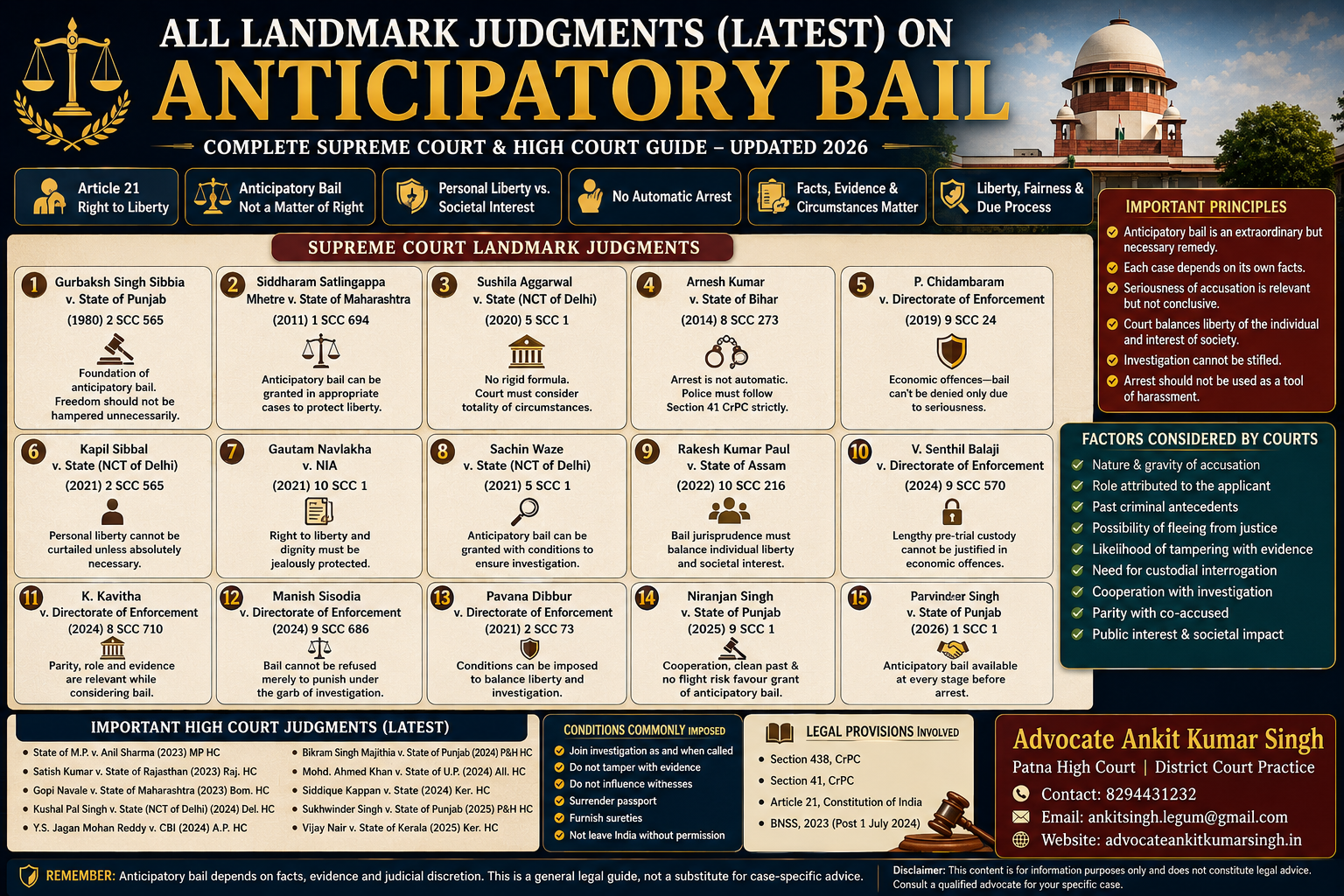
45 Landmark and Latest Anticipatory Bail Judgments: Supreme Court Law Updated 2026
Direct Answer: Anticipatory bail under Section 482 of the Bharatiya Nagarik Suraksha Sanhita, 2023 protects a person from arrest in a specific non-bailable accusation. The court must balance personal liberty against the gravity of the accusation, exact role, available material, custodial-interrogation requirement, antecedents, flight risk, witness influence, cooperation and possibility of malicious implication. Anticipatory bail should ordinarily not be restricted only until filing of the charge-sheet. It may continue until the conclusion of trial unless the court records case-specific reasons for limiting it. An absconder or proclaimed offender is ordinarily not entitled to pre-arrest bail, while a person who has cooperated under interim protection and is not required for custody may have a stronger claim.
This compendium explains the leading Constitution Bench decisions, later clarifications and the most important Supreme Court rulings delivered through July 2026.
Current statutory provision: Section 482 BNSS has replaced Section 438 CrPC for proceedings governed by the new criminal-procedure law. Older judgments remain authoritative insofar as their principles are consistent with the BNSS and have not been overruled.
Case-Law Snapshot
- Current provision: Section 482, Bharatiya Nagarik Suraksha Sanhita, 2023.
- Earlier provision: Section 438, Code of Criminal Procedure, 1973.
- Competent courts: Court of Session and High Court.
- Nature of relief: Judicial direction for release on bail in the event of arrest.
- Leading Constitution Bench cases: Gurbaksh Singh Sibbia and Sushila Aggarwal.
- Leading 2026 duration ruling: Sumit v. State of Uttar Pradesh, 2026 INSC 145.
- Leading 2026 absconder ruling: Balmukund Singh Gautam v. State of Madhya Pradesh, 2026 INSC 157.
- Leading 2026 balancing ruling: Pawan Khera v. State of Assam, 2026 INSC 437.
- Leading 2025 suppression ruling: Nikita Jagganath Shetty v. State of Maharashtra, 2025 INSC 878.
- Leading 2025 monetary-condition ruling: Gajanan Dattatray Gore v. State of Maharashtra, 2025 INSC 913.
What Is Anticipatory Bail?
Anticipatory bail is a direction that, if the applicant is arrested in connection with a specified accusation, the arresting officer must release the applicant on bail subject to the conditions imposed by the court.
It is:
- A protection against unnecessary arrest;
- A safeguard for personal liberty under Article 21;
- A discretionary judicial remedy;
- Available before actual arrest;
- Connected with a specific apprehended accusation; and
- Capable of being modified or cancelled where liberty is misused.
It is not:
- A declaration of innocence;
- A bar on investigation;
- A licence to avoid interrogation;
- A blanket protection against every future case;
- An order quashing the FIR;
- An immunity from trial; or
- A protection available after the applicant has already been arrested in the concerned case.
Section 482 BNSS — Current Statutory Framework
Section 482 permits a person who has reason to believe that he or she may be arrested for a non-bailable offence to apply to the High Court or Court of Session.
The court may impose conditions including:
- Availability for police interrogation;
- No direct or indirect inducement, threat or promise to witnesses;
- No leaving India without prior permission; and
- Other conditions that could be imposed under the ordinary bail provisions.
If the protected person is arrested and is prepared to furnish bail, the police must release the person. If the Magistrate later considers issuing a warrant at the cognizance stage, the warrant should ordinarily conform to the anticipatory-bail direction.
Section 482 does not apply to accusations under:
- Section 65 BNS; and
- Section 70(2) BNS.
Can Anticipatory Bail Be Filed Before Registration of an FIR?
Yes, in an appropriate case. Registration of an FIR is not an absolute precondition where the applicant demonstrates a reasonable and specific apprehension of arrest based upon identifiable facts.
The application should disclose:
- The threatened accusation;
- The complainant or investigating agency, where known;
- The incident or transaction;
- The reason for apprehending arrest;
- Any complaint, notice or communication already received; and
- Why the apprehension is real rather than speculative.
A court should not grant a vague order protecting a person against every possible future criminal case.
Factors Considered in an Anticipatory-Bail Application
- Nature and gravity of the accusation;
- Exact role attributed to the applicant;
- Prima facie material supporting the accusation;
- Possibility of false or exaggerated implication;
- Previous criminal antecedents;
- Possibility of absconding;
- Requirement of custodial interrogation;
- Recovery or discovery genuinely requiring custody;
- Applicant’s cooperation with the investigation;
- Possibility of influencing witnesses;
- Possibility of destruction or manipulation of evidence;
- Position or influence of the accused;
- Impact upon the victim and investigation;
- Delay in making the accusation;
- Civil, commercial, matrimonial or political background;
- Parity with similarly placed co-accused;
- Special statutory restrictions; and
- Whether conditions can adequately protect the investigation.
PART I — Constitutional and Foundational Judgments
1. Balchand Jain v. State of Madhya Pradesh, (1976) 4 SCC 572
The Supreme Court explained anticipatory bail as “bail in anticipation of arrest.” The order does not operate as an immediate release from custody; it becomes effective if the applicant is subsequently arrested in the specified case.
Principle: Anticipatory bail is a pre-arrest judicial direction, not ordinary bail granted after detention.
2. Gurbaksh Singh Sibbia v. State of Punjab, (1980) 2 SCC 565
The Constitution Bench remains the foundational authority. It rejected rigid formulas, inflexible limitations and the idea that anticipatory bail should be confined to exceptional categories predetermined by courts.
The Court held that:
- Judicial discretion must be exercised on the facts of each case;
- Personal liberty is of fundamental importance;
- Seriousness of the allegation is relevant but not conclusive;
- A blanket order for every possible offence is impermissible;
- The apprehension of arrest must be reasonable;
- Conditions may be tailored to protect the investigation; and
- The court should avoid deciding disputed evidence as though conducting a trial.
Present status: Fully controlling, as reaffirmed by Sushila Aggarwal and subsequent judgments.
3. Pokar Ram v. State of Rajasthan, (1985) 2 SCC 597
The Supreme Court cautioned that pre-arrest bail in a grave offence should not be granted casually. The court should assess seriousness, surrounding circumstances and the risk that protection may obstruct a fair investigation.
Principle: Liberty remains important, but gravity and investigative needs cannot be ignored.
4. Salauddin Abdulsamad Shaikh v. State of Maharashtra, (1996) 1 SCC 667
This judgment had taken the view that anticipatory bail should ordinarily operate for a limited period, after which the accused should seek regular bail.
Present status: Its automatic time-limitation proposition has been overruled by the Constitution Bench in Sushila Aggarwal.
5. State represented by CBI v. Anil Sharma, (1997) 7 SCC 187
The Court observed that custodial interrogation may be qualitatively more effective than questioning a person protected by a pre-arrest bail order, particularly where confrontation, discovery or unearthing of a larger conspiracy is required.
Important qualification: Merely repeating the phrase “custodial interrogation is required” is insufficient. The investigating agency should explain why custody is necessary in the particular case.
6. K.L. Verma v. State, (1998) 9 SCC 348
The decision followed the earlier limited-duration approach and contemplated temporary protection to enable the accused to approach the regular-bail court.
Present status: The duration proposition must be read subject to Sushila Aggarwal.
7. Adri Dharan Das v. State of West Bengal, (2005) 4 SCC 303
The Court held that anticipatory bail must relate to a specific accusation and should not become a blanket shield against unknown future offences.
Present status: The specific-accusation principle remains valid. Any general observations requiring automatic expiry must be read subject to Sushila Aggarwal.
8. Savitri Agarwal v. State of Maharashtra, (2009) 8 SCC 325
The Supreme Court reaffirmed that anticipatory bail requires consideration of the full factual matrix. The court must balance the applicant’s liberty with the complainant’s allegations and investigation requirements.
9. Siddharam Satlingappa Mhetre v. State of Maharashtra, (2011) 1 SCC 694
This judgment formulated an influential, non-exhaustive set of factors:
- Nature and gravity of accusation;
- Exact role of the accused;
- Antecedents;
- Possibility of fleeing justice;
- Likelihood of repeating the offence;
- Possibility of humiliation through motivated arrest;
- Impact of bail upon investigation; and
- Whether conditions can protect the prosecution.
Present status: Its factor-based approach remains relevant. Any proposition suggesting an absolute duration rule must be read with Sushila Aggarwal.
10. Bhadresh Bipinbhai Sheth v. State of Gujarat, (2016) 1 SCC 152
The Court reiterated that arrest causes serious consequences to reputation and liberty. Anticipatory bail should not be denied mechanically where the applicant has roots in society, is prepared to cooperate and is unlikely to abscond or interfere with evidence.
11. Sushila Aggarwal v. State (NCT of Delhi), (2020) 5 SCC 1
A Constitution Bench finally resolved the duration controversy.
The Court held:
- Anticipatory bail need not ordinarily be limited to a fixed period;
- Protection may continue until conclusion of trial;
- Filing of charge-sheet does not automatically terminate protection;
- Cognizance or issuance of summons does not automatically terminate protection;
- The court may limit protection where peculiar facts justify doing so;
- Conditions should be proportionate and connected with the investigation;
- The prosecution may seek cancellation or modification where liberty is misused; and
- The accused must remain available for investigation and trial.
PART II — Charge-Sheet, Cognizance, Summons and Duration
12. Bharat Chaudhary v. State of Bihar, (2003) 8 SCC 77
The Supreme Court held that there is no absolute prohibition against granting anticipatory bail after filing of a charge-sheet or after cognizance, provided the applicant has not already been arrested.
Principle: Procedural progress of the case does not by itself extinguish the court’s pre-arrest-bail jurisdiction.
13. Ravindra Saxena v. State of Rajasthan, (2010) 1 SCC 684
The Court disapproved rejection of anticipatory bail merely because the charge-sheet had been filed. The application must be decided on its merits.
14. Nathu Singh v. State of Uttar Pradesh, (2021) 6 SCC 64
When anticipatory bail is rejected, a court may in an appropriate case grant short, reasoned protection so the applicant can surrender and seek regular bail.
This should not become:
- An unreasoned substitute for granting anticipatory bail;
- Automatic protection in every rejection order; or
- An indefinite shield from arrest.
15. Sumit v. State of Uttar Pradesh, 2026 INSC 145
This is the most important 2026 judgment on the duration of anticipatory bail.
The Supreme Court held:
- There was no justification for limiting anticipatory bail only until filing of the charge-sheet;
- Protection may ordinarily continue through trial;
- Charge-sheet, cognizance and summons do not automatically terminate bail;
- A court may impose a specific limitation only for recorded, case-specific reasons;
- The accused must cooperate with investigation and trial; and
- The prosecution may seek cancellation if conditions are breached.
Addition of Graver Sections
The Court also clarified that where an accused is already protected by bail and the investigating agency later adds a graver non-bailable offence, the police should not simply arrest in disregard of the existing judicial order.
Depending upon the procedural situation:
- The prosecution may apply to the competent court for custody or cancellation;
- The accused may seek extension of protection to the added sections;
- The accused may surrender and seek appropriate bail; and
- The court must determine whether custody is genuinely necessary.
Read Sumit v. State of Uttar Pradesh
PART III — Absconding, Proclamation and Evasion
16. Lavesh v. State (NCT of Delhi), (2012) 8 SCC 730
The Supreme Court held that a person who is absconding and has been declared a proclaimed offender is ordinarily not entitled to anticipatory bail.
Reason: A discretionary remedy intended to protect liberty should not reward deliberate evasion of the investigation or judicial process.
17. State of Madhya Pradesh v. Pradeep Sharma, (2014) 2 SCC 171
The Court reaffirmed that a proclaimed offender or person who deliberately avoids arrest ordinarily cannot seek anticipatory bail while continuing to remain beyond the reach of law.
18. Srikant Upadhyay v. State of Bihar, 2024 INSC 202
The Supreme Court refused to protect an applicant who had not cooperated and against whom coercive processes had progressed.
The judgment emphasised:
- Anticipatory bail is not meant for an accused who persistently avoids process;
- Conduct before and after filing the application is relevant;
- Failure to appear despite process may defeat equitable relief; and
- Courts should not permit pre-arrest bail to undermine proclamation proceedings.
19. Balmukund Singh Gautam v. State of Madhya Pradesh, 2026 INSC 157
The Supreme Court set aside relief granted to an accused who had remained absconding for several years.
The Court held:
- An absconder is ordinarily not entitled to anticipatory bail;
- Acquittal of co-accused does not automatically benefit a person who avoided trial;
- Granting protection to a long-term absconder would reward evasion;
- Post-protection conduct cannot cure an order that was legally unjustified when passed; and
- Exceptional consideration may arise where the record itself demonstrates that the accusation is prima facie false or grossly exaggerated.
PART IV — Custodial Interrogation, Cooperation and Investigation
20. P. Chidambaram v. Directorate of Enforcement, (2019) 9 SCC 24
The Supreme Court declined anticipatory bail in an economic-offence investigation after considering the seriousness of allegations, alleged money trail and the investigating agency’s claim that custodial interrogation was required.
The judgment cautions that:
- Economic offences may involve complex, concealed transactions;
- The court should not conduct a detailed mini-trial at the bail stage;
- Case-diary or investigation material should be handled carefully; and
- Custodial interrogation may be relevant where the money trail and conspiracy remain unexplained.
Important: Economic-offence classification does not create an automatic prohibition against anticipatory bail. The particular role and custody requirement must still be assessed.
Read P. Chidambaram v. Directorate of Enforcement
21. Sumitha Pradeep v. Arun Kumar C.K., 2022 SCC OnLine SC 1529
The Supreme Court clarified that non-requirement of custodial interrogation cannot be the only reason for granting anticipatory bail.
The court must also assess:
- Prima facie case;
- Gravity of accusation;
- Specific role;
- Possibility of tampering;
- Conduct of the applicant; and
- Impact upon investigation.
Principle: Custodial interrogation is an important factor, not the complete legal test.
22. Gursewak Singh v. State of Punjab, Supreme Court order dated 3 September 2025
The High Court had asked the Director General of Police why the accused had not been arrested for four years instead of deciding the anticipatory-bail application on merits.
The Supreme Court held:
- The High Court should either grant or reject bail on judicial grounds;
- It should not treat non-arrest as an occasion to demand an explanation from the police;
- The fact that arrest was not considered necessary for four years supported the applicant’s case; and
- Anticipatory bail was granted.
23. Manoj Kumar Mutta v. State of Andhra Pradesh, 2026 INSC 215
The applicant was not initially named in the FIR. No raid was conducted at his business premises. He had appeared before the investigating officer repeatedly under interim protection, and no misuse was alleged.
The Supreme Court made the interim protection absolute after considering:
- Late implication;
- Uncertainty regarding identity and role;
- No search at the applicant’s premises;
- Cooperation during interim protection; and
- Absence of misuse of liberty.
24. Venu Gopalakrishnan v. State of Kerala, 2026 INSC 373
The Supreme Court granted anticipatory bail after examining the complete chronology, including an earlier complaint alleging extortion and later criminal accusations arising after the failure of a substantial settlement demand.
The Court considered:
- Possibility of the later case being a counterblast;
- Earlier documentary chronology;
- Cooperation during interim protection;
- Absence of misuse; and
- Whether continued threat of arrest was necessary.
Caution: This was a fact-specific decision. It does not dilute the strict scrutiny required in genuine sexual-offence cases.
25. Shally Mahant alias Sandeep v. State of Punjab, Supreme Court order dated 9 February 2026
The Supreme Court considered the applicant’s appearances before the investigating officer and the background of a property dispute.
The reported principle is that a person’s inability or refusal to provide an answer satisfactory to the investigating officer does not automatically prove non-cooperation where the person has attended, produced available material and complied with directions.
Practical rule: Cooperation means lawful participation in investigation. It does not require confession or acceptance of the investigating officer’s theory.
26. Golu Kaiwartiya v. State of Chhattisgarh, Supreme Court order dated 9 January 2026
The applicant had interim protection, cooperated with the investigation, and the charge-sheet had already been filed. The Supreme Court made the protection absolute subject to cooperation during trial and non-interference with witnesses.
27. Ravulolu Laxma Reddy v. State of Telangana, Supreme Court order dated 9 January 2026
The Supreme Court made interim protection absolute after noting cooperation with investigation and imposed conventional conditions against misuse, witness influence and evidence tampering.
28. Uma Shankar Prasad v. State of Bihar, Supreme Court order dated 24 April 2026
The applicant was implicated because he owned a motorcycle from which liquor was allegedly recovered. He was not named in the FIR, the rider had not been apprehended, and interim protection had already been granted.
The Supreme Court granted anticipatory bail subject to cooperation and ordinary protective conditions.
Principle: Ownership of a vehicle or property, without sufficient material showing knowledge or participation, should not automatically decide the bail application.
PART V — Political Rivalry, Counterblast and Malicious Prosecution
29. Pawan Khera v. State of Assam, 2026 INSC 437
The Supreme Court granted anticipatory bail in a prosecution arising from statements and documents presented during political press conferences.
The Court held that:
- The criminal process must be applied objectively;
- Political rivalry is relevant where it may colour the prosecution;
- The High Court should not shift the burden to the accused to prove the complete truth of the disputed allegation at the bail stage;
- The court should assess gravity, context, antecedents, flight risk, tampering and custody requirement;
- Documentary investigation may often proceed without arrest; and
- Personal liberty must be balanced against a fair investigation.
PART VI — Special Statutes and the SC/ST Act
30. Prathvi Raj Chauhan v. Union of India, (2020) 4 SCC 727
The Supreme Court upheld the statutory restrictions under Sections 18 and 18A of the Scheduled Castes and Scheduled Tribes (Prevention of Atrocities) Act.
However, the court may examine whether the complaint, on its face, discloses the essential ingredients of an offence under that Act.
Rule:
- If a prima facie SC/ST Act offence exists, the statutory bar applies.
- If the basic ingredients are absent, the bar does not prevent anticipatory bail.
- The court should not conduct a detailed trial while making this threshold assessment.
31. Hitesh Verma v. State of Uttarakhand, (2020) 10 SCC 710
The Court clarified that every insult or property dispute involving a Scheduled Caste or Scheduled Tribe complainant does not automatically become an offence under the special Act.
The accusation should disclose, where required:
- Intentional insult or intimidation;
- Connection with caste identity;
- The statutory location or public-view requirement; and
- The specific ingredients of the invoked provision.
32. Shajan Skaria v. State of Kerala, 2024 INSC 625
The Supreme Court held that the statutory anticipatory-bail bar does not operate where the complaint fails to disclose a prima facie offence under the SC/ST Act.
The court examined whether the alleged expression was directed against the complainant because of caste and whether the statutory ingredients were actually stated.
33. Kiran v. Rajkumar Jivraj Jain, 2025 INSC 1067
The Supreme Court cautioned that the threshold scrutiny under the SC/ST Act cannot become a mini-trial.
Where the FIR prima facie discloses the offence:
- Anticipatory bail is barred;
- The court should not assess detailed witness contradictions;
- Defence documents should not be used to conduct a full factual trial; and
- The merits should be examined at the proper procedural stage.
Read Kiran v. Rajkumar Jivraj Jain
Special-Statute Caution
Section 482 BNSS must be read with any special statute governing the offence.
Examples include:
- SC/ST Act statutory bar;
- NDPS Act Section 37 conditions;
- PMLA Section 45 twin conditions;
- UAPA bail restrictions;
- State prohibition and excise statutes;
- Protection of Children from Sexual Offences Act considerations; and
- Any express statutory exclusion of anticipatory bail.
A general Section 482 argument cannot override a direct statutory prohibition.
PART VII — Suppression, Antecedents and Cancellation
34. Dolat Ram v. State of Haryana, (1995) 1 SCC 349
The Supreme Court distinguished cancellation of bail because of later misconduct from appellate interference with an unjustified original bail order.
Cancellation after grant ordinarily requires cogent grounds such as:
- Witness intimidation;
- Evidence tampering;
- Absconding;
- Repeated offence;
- Breach of conditions; or
- Interference with investigation or trial.
35. Mahipal v. Rajesh Kumar, (2020) 2 SCC 118
An appellate court may set aside a bail order where the original court:
- Ignored relevant material;
- Relied upon irrelevant considerations;
- Passed a cryptic order in a serious case;
- Failed to consider the accused’s role; or
- Reached a legally perverse conclusion.
This is different from cancelling bail solely because of conduct occurring after release.
36. Vipan Kumar Dhir v. State of Punjab, (2021) 15 SCC 518
The Supreme Court interfered where anticipatory bail had been granted without adequately considering the nature of the accusation, material on record and the seriousness of the applicant’s alleged role.
37. Deepak Yadav v. State of Uttar Pradesh, (2022) 8 SCC 559
The judgment consolidates principles governing setting aside and cancellation of bail.
The court should consider:
- Gravity and nature of offence;
- Role attributed to the accused;
- Likelihood of absconding;
- Possibility of witness influence;
- Criminal history;
- Whether the original order considered relevant material; and
- Whether liberty was subsequently misused.
38. Nikita Jagganath Shetty v. State of Maharashtra, 2025 INSC 878
The Supreme Court treated suppression of material facts as a serious defect in an anticipatory-bail proceeding.
The judgment highlights that an applicant should disclose:
- Earlier bail applications;
- Earlier rejection orders;
- Pending criminal cases;
- Relevant antecedents;
- Proclamation or warrants; and
- Material proceedings concerning the same transaction.
The Court also stressed that organised and economic allegations, influence over witnesses and the asserted need for custodial interrogation must be addressed rather than omitted.
39. Md. Imran alias D.C. Guddu v. State of Jharkhand, 2026 INSC 36
The Supreme Court declined to cancel anticipatory bail granted to co-accused who had been summoned under Section 319 CrPC and had regularly appeared before the trial court.
Principle: Cancellation requires specific legal grounds. The State cannot seek cancellation merely because it disagrees with the original exercise of discretion when the accused has complied and no misuse is shown.
PART VIII — Impermissible Conditions and Recovery Through Bail
40. Dilip Singh v. State of Madhya Pradesh, (2021) 2 SCC 779
The Supreme Court held that a criminal bail proceeding should not be converted into a mechanism for recovery of disputed money.
The court should not make bail dependent upon:
- Settlement of a disputed civil claim;
- Repayment of the entire alleged amount;
- Performance of a contested contract; or
- Acceptance of criminal liability not yet proved.
41. Gajanan Dattatray Gore v. State of Maharashtra, 2025 INSC 913
The Supreme Court issued a strong warning against granting regular or anticipatory bail on the basis of an undertaking by the accused or family to deposit money.
The Court held:
- Bail must be decided on legal merits;
- Courts should not broker financial settlements through bail jurisdiction;
- A deposit undertaking may amount to coercive recovery;
- Failure to pay should not automatically determine personal liberty; and
- Criminal and civil remedies should remain procedurally distinct.
What Financial Conditions Are Permissible?
A court may require a lawful bond, sureties or proportionate security connected with appearance.
A condition becomes vulnerable where it is:
- Excessive;
- Unrelated to attendance or investigation;
- Equivalent to pre-trial recovery;
- Beyond the applicant’s means without justification;
- Punitive before conviction; or
- Based upon an involuntary settlement.
PART IX — Transit Anticipatory Bail
42. Priya Indoria v. State of Karnataka, 2023 INSC 1008
The Supreme Court recognised that a High Court or Court of Session may grant limited transit anticipatory bail even where the FIR is registered outside its ordinary territorial jurisdiction.
The power should be exercised cautiously where:
- There is a genuine and immediate threat of arrest;
- The applicant requires reasonable time to approach the territorial court;
- Denial would cause serious prejudice;
- The applicant discloses all relevant facts;
- The investigating officer and State are ordinarily given notice where feasible; and
- The order is strictly temporary and does not decide the territorial court’s final discretion.
Purpose: Transit bail protects access to justice; it should not become forum shopping.
PART X — Arrest Jurisprudence Supporting Anticipatory Bail
43. Joginder Kumar v. State of Uttar Pradesh, (1994) 4 SCC 260
The Supreme Court held that the existence of legal power to arrest does not mean that arrest must necessarily be made.
The police should have justification concerning:
- Need for custody;
- Investigation requirements;
- Possibility of absconding;
- Evidence protection; and
- Prevention of further offence.
44. Arnesh Kumar v. State of Bihar, (2014) 8 SCC 273
The Court issued safeguards against routine arrest, particularly in offences carrying imprisonment up to seven years.
The investigating officer must assess statutory necessity rather than arrest merely because the accusation is cognizable and non-bailable.
The decision is especially relevant to:
- Matrimonial cruelty allegations;
- Family members added through general accusations;
- Cases primarily dependent upon documents;
- Accused persons who comply with police notice; and
- Applications showing that arrest is unnecessary for investigation.
45. Satender Kumar Antil v. Central Bureau of Investigation, (2022) 10 SCC 51
The Supreme Court consolidated principles concerning arrest and bail. It emphasised that arrest should not be routine and that an accused who was not arrested during investigation and cooperated should not ordinarily be detained automatically upon filing of the charge-sheet.
Although much of the judgment concerns regular bail and appearance after charge-sheet, it supports the broader proposition that custody must serve a legitimate procedural need.
Latest 2026 Principles at a Glance
- Sumit: Anticipatory bail should ordinarily continue beyond the charge-sheet and may operate until conclusion of trial.
- Balmukund Singh Gautam: An absconder ordinarily cannot claim pre-arrest protection merely because co-accused were acquitted.
- Manoj Kumar Mutta: Cooperation under interim protection, absence of a raid and late implication may favour bail.
- Venu Gopalakrishnan: Counterblast chronology and earlier extortion allegations may be relevant where supported by records.
- Pawan Khera: Political rivalry and documentary nature of allegations require objective scrutiny; burden should not be reversed at the bail stage.
- Golu Kaiwartiya: Cooperation and completion of investigation may justify making interim protection absolute.
- Uma Shankar Prasad: Mere ownership of a vehicle does not automatically establish knowledge or involvement.
- Md. Imran: Anticipatory bail should not be cancelled without specific grounds or misuse.
When Anticipatory Bail Is More Likely to Be Granted
- The applicant is not named in the FIR and is implicated later on weak material.
- The allegation is predominantly documentary.
- No recovery genuinely requires custody.
- The applicant has joined the investigation.
- Police notices have been complied with.
- There is no criminal history or relevant antecedent.
- The applicant has a fixed residence and occupation.
- The accusation appears exaggerated or retaliatory.
- There is substantial delay in the complaint.
- Similarly placed co-accused have received protection.
- The accused was not arrested for a considerable period.
- Investigation or charge-sheet has substantially progressed.
- Witness and evidence concerns can be addressed through conditions.
- The applicant is elderly, seriously ill or otherwise vulnerable.
- The alleged act is primarily civil, commercial or matrimonial, subject to examination of criminal ingredients.
When Anticipatory Bail Is More Likely to Be Refused
- The applicant is absconding or deliberately evading process.
- Proclamation proceedings have been initiated or completed.
- Material facts or earlier applications were suppressed.
- The applicant threatened the complainant or witnesses.
- Documents or digital evidence were destroyed.
- Recovery or confrontation genuinely requires custody.
- The applicant holds substantial influence over witnesses.
- The alleged role is direct and supported by contemporaneous evidence.
- The offence involves organised crime or a complex concealed money trail.
- The applicant repeatedly failed to join investigation.
- Interim protection was misused.
- A special statute expressly bars or restricts anticipatory bail.
- The applicant is likely to flee India.
- The application contains false statements or fabricated documents.
What Does Cooperation With Investigation Mean?
Cooperation ordinarily includes:
- Appearing on the dates lawfully directed;
- Providing available documents;
- Identifying records and transactions;
- Not destroying evidence;
- Not influencing witnesses;
- Informing the investigating officer about address and travel; and
- Complying with lawful conditions.
Cooperation does not mean:
- Giving a confession;
- Accepting every allegation;
- Providing documents that do not exist or are not in the applicant’s control;
- Answering through speculation;
- Waiving constitutional protection; or
- Producing privileged material without lawful authority.
Can Anticipatory Bail Be Cancelled?
Yes. The prosecution or complainant may seek cancellation or modification where:
- The applicant violates a condition;
- Does not join investigation;
- Threatens or influences a witness;
- Destroys or manipulates evidence;
- Commits another similar offence;
- Attempts to abscond;
- Misuses travel permission;
- Obtained bail through suppression or fraud; or
- The original order is legally perverse and ignores decisive material.
Can Anticipatory Bail Be Granted After Arrest?
No. Once the applicant has been arrested in the concerned case, the remedy is regular bail.
A person released from custody for a technical reason cannot ordinarily revive an anticipatory-bail application concerning the same completed arrest. The exact remedy depends upon the subsequent custody status and judicial order.
Should the Sessions Court Be Approached First?
Section 482 gives concurrent jurisdiction to the Court of Session and High Court.
As a matter of ordinary practice, the Sessions Court is generally approached first because:
- It is the first superior criminal court;
- The factual record can be developed there;
- The High Court then has the Sessions Court’s reasons; and
- Direct High Court filing may require explanation.
A direct High Court application may nevertheless be considered in exceptional circumstances involving:
- Extreme urgency;
- State-wide investigation;
- Exceptional institutional circumstances;
- Impossibility of approaching the Sessions Court; or
- Another legally sustainable reason.
The Supreme Court’s 2025 observations concerning the Sessions-first issue have generated a larger-bench procedural question. Until finally settled, the safer filing practice is ordinarily to approach the Sessions Court first unless exceptional circumstances are specifically pleaded.
Documents Required for an Anticipatory-Bail Application
- FIR or complaint;
- Police or investigating-agency notice;
- Earlier complaint or counter-complaint;
- Relevant agreements and correspondence;
- Medical records, where relevant;
- Proof of residence;
- Employment or business details;
- Travel documents;
- Proof of cooperation;
- Copies of earlier bail orders;
- Criminal-antecedent disclosure;
- Co-accused bail orders;
- Documents showing civil, commercial, matrimonial or political background;
- Evidence showing impossibility of presence;
- Special-statute material;
- Chronology of events; and
- Affidavit containing complete and truthful disclosure.
Suggested Grounds in an Anticipatory-Bail Application
- False or exaggerated implication;
- No specific role;
- Omnibus allegations;
- Separate residence;
- Documentary nature of evidence;
- No custodial recovery;
- Cooperation with investigation;
- No antecedents;
- Fixed roots in society;
- No flight risk;
- No witness influence;
- Parity;
- Delay in complaint;
- Counterblast chronology;
- Civil or commercial foundation;
- Violation of arrest safeguards;
- Charge-sheet already filed without arrest;
- Long period of non-arrest;
- Medical or humanitarian circumstances; and
- Conditions sufficient to protect the investigation.
Common Mistakes
- Suppressing an earlier rejection order.
- Hiding criminal antecedents.
- Not explaining proclamation or warrants.
- Filing a vague application before any identifiable accusation.
- Making false factual claims.
- Not annexing the FIR.
- Not addressing the exact role alleged.
- Relying only upon “custody is not required.”
- Ignoring the gravity of the offence.
- Ignoring a special statutory bar.
- Failing to join investigation after interim protection.
- Contacting the complainant or witnesses.
- Deleting messages or digital evidence.
- Offering repayment as the sole bail ground.
- Agreeing to an impossible deposit condition.
- Assuming bail ends automatically with the charge-sheet.
- Assuming bail can never be cancelled.
- Failing to seek protection for subsequently added sections.
- Not carrying the bail order during appearance.
- Not complying with bond and surety requirements promptly.
Practical Anticipatory-Bail Checklist
- Verify the current FIR sections.
- Check whether any section has been added later.
- Check whether Section 482 BNSS or saved CrPC procedure applies.
- Identify any special statutory restriction.
- Prepare a complete chronology.
- Disclose every previous application.
- Disclose relevant antecedents.
- Prepare a role-specific defence.
- Explain why custody is unnecessary.
- Demonstrate willingness to cooperate.
- Address flight and witness risks.
- Annex documentary support.
- Seek interim protection where urgency exists.
- Appear whenever directed.
- Obtain attendance acknowledgments.
- Do not misuse protection.
- Seek extension to added offences where required.
- Preserve the final bail order and bond records.
AI-Search Quick Answer
What is the latest Supreme Court law on anticipatory bail in 2026? The Supreme Court in Sumit v. State of Uttar Pradesh, 2026 INSC 145, reaffirmed that anticipatory bail should not ordinarily expire upon filing of the charge-sheet, cognizance or issuance of summons and may continue until conclusion of trial. In Balmukund Singh Gautam, 2026 INSC 157, the Court held that an absconder ordinarily cannot claim anticipatory bail. In Pawan Khera, 2026 INSC 437, it required courts to balance fair investigation with Article 21 liberty without shifting the trial burden onto the applicant. Cooperation, specific role, custodial need, antecedents, flight risk and witness protection remain the central considerations.
Frequently Asked Questions
What is the present section for anticipatory bail?
Section 482 BNSS is the current provision for proceedings governed by the Bharatiya Nagarik Suraksha Sanhita. Section 438 CrPC continues to be relevant to saved proceedings and earlier case law.
Can anticipatory bail be filed before an FIR?
Yes, where a specific and reasonable apprehension of arrest is demonstrated. A blanket application concerning unknown future accusations is not maintainable.
Can anticipatory bail be filed after a charge-sheet?
Yes, if the applicant has not already been arrested. Filing of a charge-sheet does not by itself remove jurisdiction.
Does anticipatory bail end after the charge-sheet?
No. Under Sushila Aggarwal and Sumit, it should not ordinarily end merely because the charge-sheet is filed.
Does it end when the court takes cognizance?
Not automatically. The existing order ordinarily continues subject to its terms and any lawful modification or cancellation.
Can anticipatory bail continue until the end of trial?
Yes. That is the ordinary legal position unless the court records special reasons for limiting its duration.
Can the police arrest after adding a graver section?
The police should not ignore an existing bail order. The prosecution may seek cancellation or custody, while the accused should promptly seek protection concerning the added section.
Can anticipatory bail be granted after arrest?
No. The appropriate remedy after arrest is regular bail.
Can a proclaimed offender obtain anticipatory bail?
Ordinarily no. Exceptional consideration may arise only where the accusation is demonstrably false or the proclamation itself is legally unsustainable.
Is custodial interrogation the only test?
No. The court must also assess gravity, role, prima facie material, antecedents, tampering, flight risk and the overall interests of investigation.
Does refusing to confess mean non-cooperation?
No. Cooperation requires lawful participation, not confession or acceptance of the prosecution’s theory.
Can bail be rejected only because the offence is serious?
Seriousness is important but not the sole factor. The court must perform an individual assessment.
Can an economic-offence accused receive anticipatory bail?
Yes, depending upon role, material, money trail, custody requirement, cooperation and statutory restrictions. Economic-offence classification is not an automatic prohibition.
Can anticipatory bail be granted under the SC/ST Act?
Only where the complaint does not prima facie disclose the ingredients of an offence under the Act. If the offence is prima facie made out, Sections 18 and 18A ordinarily bar relief.
Can the court examine defence documents in an SC/ST case?
Only for limited threshold scrutiny. It cannot conduct a mini-trial or resolve detailed contradictions at the anticipatory-bail stage.
Can the court require repayment of the disputed amount?
Bail should not be converted into a recovery mechanism. A coercive deposit condition unrelated to appearance or investigation may be challenged.
Can anticipatory bail be cancelled?
Yes, for misuse, non-cooperation, witness intimidation, tampering, absconding, repeated offence, suppression or a legally perverse original order.
Can a complainant challenge anticipatory bail?
Yes. The complainant or State may seek cancellation or challenge an order that ignores material facts or statutory restrictions.
Can transit anticipatory bail be granted?
Yes, in exceptional circumstances for a limited period to enable the applicant to approach the jurisdictional court.
Must the Sessions Court be approached first?
The statute confers concurrent jurisdiction, but approaching the Sessions Court first remains the safer ordinary practice unless exceptional reasons justify direct High Court filing.
Can a family member seek separate anticipatory bail?
Yes. Every family member should present a separate role, residence, age, health and allegation analysis rather than relying on one common defence.
Does parity guarantee anticipatory bail?
No. Parity applies only where the role, allegations, antecedents and procedural position are genuinely comparable.
Can a court grant blanket anticipatory bail?
No. The protection must ordinarily relate to an identifiable accusation or transaction.
What is the most important document?
The FIR or complaint is central, but the complete chronology, police notices, evidence of cooperation and documents showing the applicant’s exact role are equally important.
What is the strongest practical ground?
There is no universal strongest ground. A combination of weak individual role, cooperation, no custodial necessity, no antecedents, fixed residence and low tampering risk ordinarily creates a stronger case.
Key Takeaway
The modern law of anticipatory bail is controlled primarily by three principles:
- Sibbia: No rigid formula should replace individual judicial discretion.
- Sushila Aggarwal: Anticipatory bail need not ordinarily be time-limited.
- Sumit: Charge-sheet, cognizance or summons does not automatically end protection.
These liberty-protecting principles coexist with equally important restrictions:
- Absconders ordinarily receive no equitable protection;
- Suppression may invalidate relief;
- Special statutory bars must be respected;
- Custodial interrogation may be necessary in an appropriate case;
- Witness and evidence protection remain central; and
- Misuse may result in cancellation.
Conclusion
Anticipatory bail is neither an extraordinary indulgence available only to a privileged few nor an automatic protection available merely because arrest has not yet occurred. It is a constitutional and statutory mechanism for ensuring that the power of arrest is exercised only where custody serves a legitimate investigative or judicial purpose.
The court must examine the actual accusation, individual role, evidence, conduct, custody requirement and risks to investigation. The applicant must make complete disclosure, remain available and strictly comply with conditions.
For applications filed after 1 July 2024, Section 482 BNSS should be cited along with the continuing principles developed under Section 438 CrPC. The latest Supreme Court decisions reinforce that unnecessary arrest should be prevented, but judicial protection cannot be used to reward absconding, concealment or interference with the administration of justice.
Legal Consultation
An anticipatory-bail application should be prepared after reviewing the FIR, individual allegations, added sections, police notice, criminal history, co-accused orders, special statute, cooperation record and present stage of investigation. A general application without role-specific facts may weaken the claim for protection.
Advocate Ankit Kumar Singh
Patna High Court | District Court Practice
Contact: 8294431232
Email: ankitsingh.legum@gmail.com
Website:
advocateankitkumarsingh.in
Legal-information note: This article provides general legal information. Anticipatory bail is fact-specific, and the applicable statutory bar, jurisdiction, procedural law and remedy depend upon the date, offence, FIR and conduct of the applicant.
Follow legal updates from Advocate Ankit Kumar Singh: Add advocateankitkumarsingh.in as a Preferred Source on Google