Expert INTERPOL Lawyer in Delhi for Blue Notice, Red Notice and Silver Notice Cases: Location, Arrest and Asset-Tracing Risks Explained
SUMMARY: Create a Delhi article distinguishing INTERPOL notice functions that clients often confuse. Focus on Blue Notices for information/location, Red Notices for wanted-person cooperation, and the newer Silver Notice/Silver Diffusion asset-tracing framework. The article should explain why the legal response depends on the notice type and should not describe every INTERPOL notice as an international arrest warrant. Target “expert INTERPOL lawyer Delhi”, “Silver Notice lawyer India”, “Red Notice lawyer Delhi” and “international police notice advocate Delhi”.
Legal and procedural update: Reviewed on 23 September 2026. INTERPOL currently identifies Blue, Red and Silver Notices as different international police-cooperation mechanisms. Silver Notices remain described by INTERPOL as being in a pilot phase.
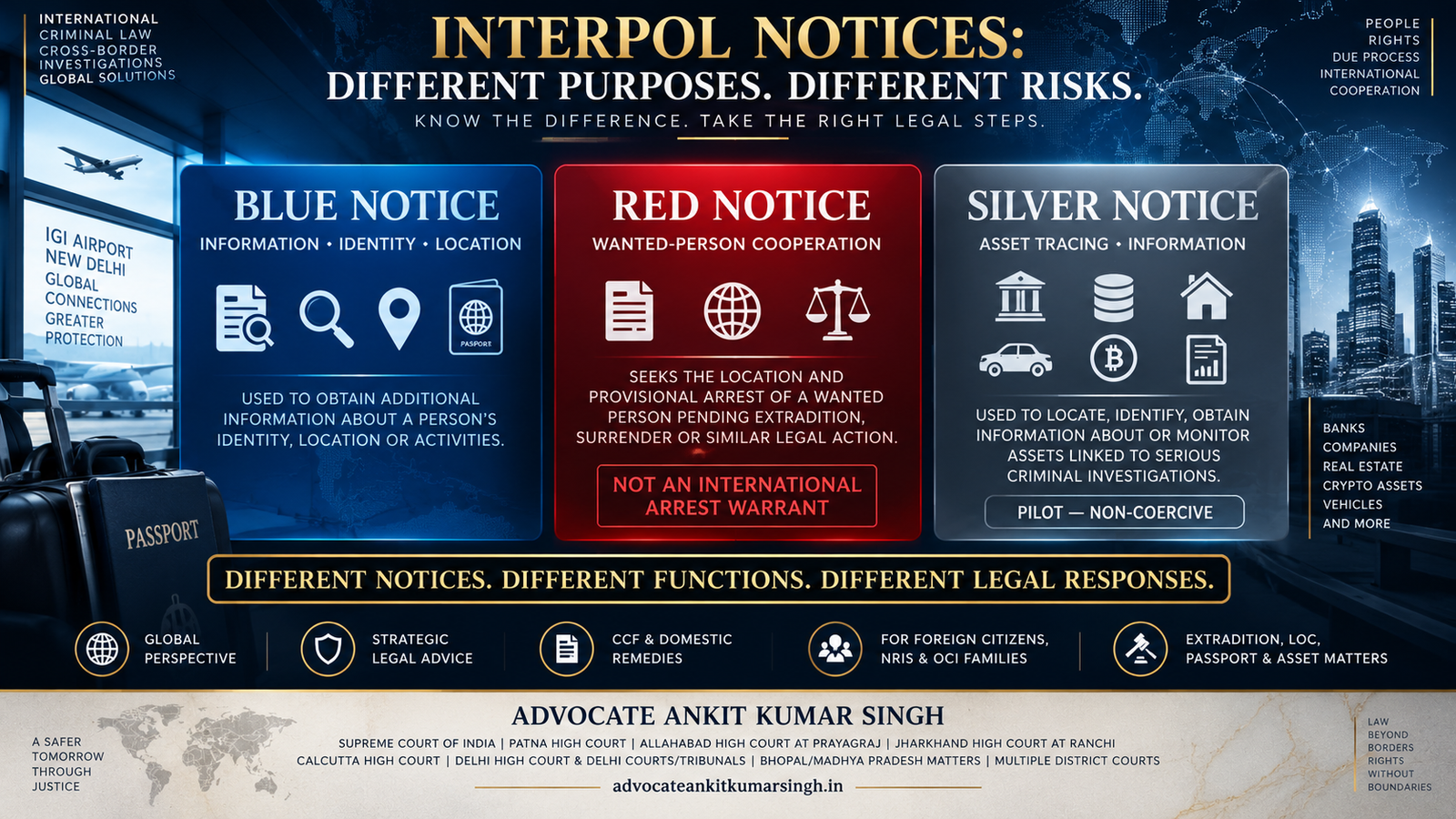
Quick Answer: What Is the Difference Between an INTERPOL Blue Notice, Red Notice and Silver Notice?
The three notices perform fundamentally different functions.
| INTERPOL Mechanism | Principal Function | Automatic International Arrest Warrant? |
|---|---|---|
| Blue Notice | To collect additional information concerning a person’s identity, location or activities in relation to a criminal investigation. | No |
| Red Notice | To seek the location and provisional arrest of a wanted person pending extradition, surrender or similar legal action. | No. INTERPOL expressly states that a Red Notice is not an international arrest warrant. |
| Silver Notice / Silver Diffusion | Under the current pilot framework, to locate, identify, obtain information about or monitor assets connected with serious criminal investigations. | No. The pilot framework is limited to non-coercive information-sharing measures and follow-up cooperation. |
Therefore, describing every INTERPOL notice as an “international warrant” is legally inaccurate.
The first question in any international police-notice matter should be:
“What precise INTERPOL mechanism exists, what is its purpose, and what separate domestic legal action—if any—has been taken because of it?”
INTERPOL Notices Are International Police-Cooperation Tools
INTERPOL’s colour-coded Notices allow member countries to exchange crime-related alerts and requests for information through international police channels.
Notices may perform very different tasks. Some concern wanted persons. Others concern missing persons, threats, unidentified bodies, criminal methods or assets.
The legal consequences therefore cannot be determined merely from the word “INTERPOL”.
A lawyer reviewing an INTERPOL matter should identify:
- the colour and type of Notice;
- whether a Notice or a Diffusion is involved;
- the requesting National Central Bureau;
- the criminal investigation or judicial proceeding behind it;
- whether the information appears in INTERPOL’s public system or is restricted to law enforcement;
- whether an underlying arrest warrant exists;
- whether Indian authorities have taken separate domestic action;
- whether extradition proceedings exist;
- whether a Look Out Circular exists in India;
- whether assets are merely being traced or have actually been frozen or attached under domestic law; and
- whether a CCF application for access, correction or deletion is appropriate.
What Is an INTERPOL Blue Notice?
INTERPOL describes a Blue Notice as a mechanism used to collect additional information about a person’s:
- identity;
- location; or
- activities
in relation to a criminal investigation.
This makes a Blue Notice principally an information and location mechanism.
For example, investigators may seek assistance from other jurisdictions to establish where a person is presently located or obtain information connected with the person’s activities.
A Blue Notice should not automatically be described as a Red Notice, arrest warrant or extradition order.
Does a Blue Notice Automatically Authorise Arrest?
No.
The stated function of a Blue Notice is the collection of additional information about identity, location or activities in connection with a criminal investigation.
That is materially different from the stated function of a Red Notice, which concerns a wanted person and provisional-arrest cooperation pending extradition, surrender or similar action.
If a client learns about a Blue Notice, the immediate questions should therefore include:
- Which investigation generated it?
- Which country or National Central Bureau requested it?
- What information is being sought?
- Is the person an accused, suspect, witness or otherwise relevant to the investigation?
- Does a separate domestic arrest warrant exist?
- Has any Red Notice or Red Diffusion separately been circulated?
- Has any country independently commenced arrest or extradition proceedings?
- Is any Indian LOC, passport restriction or court order operative?
The answer to those questions determines the real legal risk.
What Is an INTERPOL Red Notice?
A Red Notice is INTERPOL’s best-known colour-coded notice.
INTERPOL describes it as a request to law-enforcement authorities worldwide to locate and provisionally arrest a person pending:
- extradition;
- surrender; or
- similar legal action.
A Red Notice is based on an arrest warrant or court order issued by the judicial authorities of the requesting jurisdiction.
However, an essential distinction must be preserved:
A Red Notice is not itself an international arrest warrant.
INTERPOL does not itself arrest people. Whether coercive action can be taken in the country where the person is located depends upon the law and competent authorities of that country.
Red Notice Does Not Mean INTERPOL Has Convicted the Person
A person may be sought for prosecution or may already have been convicted and be sought to serve a sentence.
Where the person is sought for prosecution, the underlying allegation should not be converted into a declaration of guilt merely because a Red Notice exists.
An appropriate legal review should identify:
- the requesting country;
- the underlying warrant;
- the alleged offences;
- the procedural stage of the foreign case;
- whether the person has been convicted or is merely wanted for prosecution;
- whether extradition proceedings have commenced;
- whether a Red Diffusion rather than a Red Notice is involved;
- whether INTERPOL’s data-processing rules are engaged; and
- whether domestic Indian proceedings independently exist.
What Is the Newer INTERPOL Silver Notice?
The Silver Notice is INTERPOL’s newest colour-coded Notice and is specifically directed towards criminal asset tracing.
INTERPOL continues to describe the Silver Notice as operating in a pilot phase.
Under the published pilot framework, a Silver Notice or Silver Diffusion may be used to:
- locate assets;
- identify assets;
- obtain information about assets; and
- monitor assets discreetly and/or continuously.
This represents a very different purpose from a Red Notice.
A Red Notice principally concerns a wanted person.
A Silver Notice principally concerns information about assets linked with serious criminal activity.
What Types of Assets Can Become Relevant to a Silver Notice?
INTERPOL’s current public material describes the Silver initiative as a mechanism intended to improve cross-border tracing of suspected criminal assets.
Depending upon the investigation, the asset-information exercise can potentially concern categories such as:
- bank funds;
- financial accounts;
- real estate;
- companies or business interests;
- vehicles;
- luxury assets;
- cryptocurrency or other digital assets;
- boats or yachts;
- other movable property; and
- assets believed to represent the proceeds, instrumentalities or benefits of criminal conduct.
The legal status of a particular asset must nevertheless be determined from the actual request, underlying investigation and domestic legal action.
Does a Silver Notice Automatically Freeze or Confiscate Property?
No.
This is one of the most important distinctions in the newer Silver Notice framework.
INTERPOL’s specific rules for the pilot state that the Silver Notice/Silver Diffusion mechanism is limited to non-coercive measures, particularly requesting and sharing information so that subsequent bilateral cooperation can occur.
Accordingly:
SILVER NOTICE ≠ AUTOMATIC FREEZING ORDER
SILVER NOTICE ≠ AUTOMATIC SEIZURE ORDER
SILVER NOTICE ≠ AUTOMATIC CONFISCATION ORDER
If an asset is located, further action must be pursued according to the relevant national laws, judicial procedures, international agreements and bilateral cooperation mechanisms.
This distinction is critical in India.
If an Indian bank account, property, cryptocurrency holding, company interest or other asset is actually restrained, frozen, attached or seized, the lawyer must identify the Indian statutory or judicial authority under which that coercive step was taken.
Silver Notice and Indian Asset-Freezing Proceedings Are Not the Same Thing
A client may receive information suggesting that an asset is being internationally traced and assume that a Silver Notice itself has frozen the property.
That assumption should be tested carefully.
Indian coercive proceedings may instead arise under a separate statutory framework depending upon the nature of the investigation.
For example, an international asset-tracing request may coexist with Indian proceedings relating to:
- money laundering;
- scheduled offences;
- bank-account freezing;
- criminal seizure;
- attachment;
- confiscation;
- economic offences;
- cybercrime proceeds;
- fraud;
- corruption;
- customs or financial investigations; or
- another statutory mechanism.
The legal remedy depends upon the domestic action actually taken—not merely upon the existence of an international asset-tracing request.
Silver Notice Pilot: Important Legal Safeguards
The published INTERPOL framework contains specific conditions for Silver Notices and Silver Diffusions.
Among the significant safeguards are requirements relating to:
- a natural person subject to a criminal investigation;
- serious criminality meeting the pilot’s prescribed threshold;
- sufficient identifying information;
- information concerning the underlying criminal activities;
- a link between the criminal activities, person and relevant assets;
- information explaining whether the assets are alleged instruments, objects, direct or indirect proceeds or benefits of crime;
- relevant criminal investigation or judicial proceedings; and
- the underlying charges and applicable law.
The framework also subjects Silver processing to INTERPOL’s Constitution, Rules on the Processing of Data and CCF oversight.
Why Silver Notice Extracts Cannot Simply Be Searched Publicly
Under the published pilot rules, Silver Notice extracts are not published on INTERPOL’s public website.
Therefore, a person cannot safely conclude:
“I searched my name on INTERPOL’s website and there is no Silver Notice, so no Silver information exists.”
The same general caution applies to INTERPOL data more broadly because many Notices are restricted to law-enforcement use and are not publicly searchable.
A public website search and a formal request for access to INTERPOL data are therefore different things.
What Is a Silver Diffusion?
A Silver Diffusion operates within the asset-tracing pilot but should be distinguished from a Silver Notice.
As a general institutional distinction, INTERPOL Notices are made available through the Notice system across the organisation, while a Diffusion is a cooperation request circulated directly by a National Central Bureau to selected or relevant member countries.
For Silver matters, both mechanisms are subject to the pilot framework and applicable INTERPOL rules.
The practical distinction can matter because counsel should identify:
- whether a Silver Notice exists;
- whether a Silver Diffusion exists;
- which countries received the circulation;
- what asset information is being requested;
- what underlying criminal proceeding exists; and
- whether any receiving country has taken separate domestic legal action.
Blue Notice vs Red Notice vs Silver Notice: Detailed Comparison
| Issue | Blue Notice | Red Notice | Silver Notice / Diffusion |
|---|---|---|---|
| Main focus | Information about a person | Wanted person | Assets |
| Location function | Yes — location information may be sought | Yes — locating the wanted person is central | Yes — but principally locating assets |
| Information-gathering function | Central function | Supporting function | Central function concerning assets |
| Provisional-arrest request | Not the stated function of a Blue Notice | Yes, subject to national law | No — pilot is limited to non-coercive measures |
| Asset tracing | Not the principal function | Not the principal function | Core function |
| Automatic freezing of asset | No | No | No |
| Automatic extradition | No | No | No |
| Automatic international arrest warrant | No | No | No |
| Possible CCF data review | Yes, where INTERPOL personal-data processing is involved | Yes | CCF framework applies to Silver data under the pilot rules |
Notice and Diffusion Are Also Different
Another frequent source of confusion is the assumption that every INTERPOL circulation is a “Notice”.
INTERPOL also uses Diffusions.
Diffusions are cooperation requests circulated directly by a member country’s National Central Bureau to all or selected other member countries.
Accordingly, counsel dealing with an international criminal investigation should not stop after asking:
“Is there a Red Notice?”
The review may also require questions such as:
- Is there a Red Diffusion?
- Is there a Blue Notice or Blue Diffusion?
- Is Silver Notice/Silver Diffusion data involved?
- Is there another INTERPOL database entry?
- Is there a foreign warrant?
- Is there an Indian LOC?
- Has extradition formally commenced?
Can a Person Challenge INTERPOL Data?
INTERPOL has an independent body known as the Commission for the Control of INTERPOL’s Files (CCF).
The CCF processes requests concerning:
- access to personal data;
- correction of data;
- deletion of data; and
- revision of qualifying CCF decisions.
As of 26 March 2026, INTERPOL requires CCF applications ordinarily to be submitted through its dedicated secure online portal.
A properly prepared CCF matter may require:
- identity documentation;
- authority documents where a lawyer or representative acts;
- the precise nature of the request;
- the procedural history;
- foreign court orders;
- arrest-warrant material;
- acquittal, discharge or quashing orders where relevant;
- limitation or procedural material;
- evidence relevant to INTERPOL compliance rules;
- a clear chronology; and
- structured legal submissions addressing the applicable INTERPOL framework.
What the CCF Cannot Do
The limits of CCF jurisdiction are equally important.
The CCF reviews compliance of data processing within INTERPOL’s Information System.
It does not function as:
- an Indian criminal court;
- an extradition court;
- a passport authority;
- a court deciding an Indian LOC;
- a court cancelling an Indian NBW;
- a PMLA Special Court;
- an authority deciding whether an Indian bank account should remain frozen;
- a tribunal finally adjudicating title to assets; or
- a substitute for proceedings required under national law.
Therefore, INTERPOL strategy and Indian litigation strategy may need to proceed separately but in coordination.
Delhi Legal Strategy: Why Identifying the Notice Type Comes First
A person searching for an “expert INTERPOL lawyer Delhi” or “international police notice advocate Delhi” may initially know only that INTERPOL is somehow involved.
The legal analysis should begin with classification.
If it is a Blue Notice:
- identify the investigation;
- understand why information or location data is being sought;
- check whether any separate arrest process exists;
- identify any Indian LOC or domestic investigation; and
- consider CCF access or data-compliance remedies where appropriate.
If it is a Red Notice:
- obtain and review the underlying warrant;
- identify the requesting State;
- assess the foreign criminal proceeding;
- consider CCF issues;
- analyse provisional-arrest exposure;
- check extradition status;
- check Indian LOC/passport restrictions; and
- coordinate with foreign counsel where necessary.
If it is a Silver Notice or Silver Diffusion:
- identify the underlying criminal investigation;
- identify the assets being traced;
- determine the alleged nexus between the person, alleged crime and assets;
- distinguish information gathering from actual coercive freezing or attachment;
- identify any Indian proceedings affecting the assets;
- preserve legitimate source-of-funds and ownership documentation; and
- consider the INTERPOL-data and domestic-law remedies separately.
Does a Red Notice Automatically Mean Extradition Will Succeed?
No.
A Red Notice and formal extradition are separate legal mechanisms.
A Red Notice assists international police cooperation relating to a wanted person.
Extradition is the legal process through which one State seeks surrender of a person from another State.
In an India-related extradition matter, issues may include:
- the Extradition Act, 1962;
- the applicable extradition treaty or arrangement;
- the underlying foreign warrant;
- identity;
- dual criminality;
- the offence relied upon;
- the evidence and statutory requirements;
- provisional arrest;
- magisterial inquiry;
- statutory restrictions on surrender;
- bail;
- constitutional remedies; and
- coordination with lawyers in the requesting State.
Accordingly:
RED NOTICE ≠ EXTRADITION ORDER
Does a Blue Notice Mean the Person Is an Accused?
Not necessarily merely from the colour of the Notice.
The official function of a Blue Notice is to gather additional information about identity, location or activities in relation to a criminal investigation.
The person’s precise status must therefore be determined from the underlying criminal process.
The lawyer should avoid automatically describing the person as:
- convicted;
- a fugitive;
- an absconder; or
- an extradition accused
without examining the actual case record.
Does a Silver Notice Mean the Assets Are Proven to Be Criminal Proceeds?
No automatic conclusion of that nature should be drawn merely from the existence of Silver data.
The pilot framework requires an underlying criminal investigation and information linking the criminal activity, relevant person and assets.
However, the Silver mechanism is designed to facilitate international information sharing and asset tracing. Final coercive action and adjudication depend upon the competent national legal systems and applicable proceedings.
A person disputing the alleged asset nexus may therefore need to preserve:
- purchase documents;
- bank statements;
- loan documentation;
- tax records;
- company records;
- shareholding records;
- inheritance records;
- gift documentation;
- sale deeds;
- cryptocurrency transaction records;
- source-of-funds evidence;
- foreign remittance documentation; and
- a chronological explanation of acquisition and ownership.
Why Asset-Tracing and Asset-Freezing Must Be Separated
This distinction may become particularly important in PMLA, fraud, corruption, cybercrime and other cross-border financial investigations.
Asset tracing asks questions such as:
- Where is the asset?
- Who owns it?
- Which company holds it?
- Which account contains the funds?
- What transfers occurred?
- What property or digital asset is connected with the investigation?
Asset freezing or attachment is a coercive legal step requiring an applicable domestic legal basis.
The existence of international asset-tracing cooperation does not eliminate the need to identify the domestic statutory authority relied upon for coercive action.
Can INTERPOL Itself Arrest a Person or Seize Property?
INTERPOL is an international police-cooperation organisation. It does not operate as a supranational police force exercising ordinary arrest or property-seizure powers inside member States.
National authorities exercise coercive powers under their applicable domestic laws.
This distinction explains why the following questions must always be separated:
- What information has INTERPOL circulated?
- What has the requesting country asked for?
- What action is legally permitted in the receiving country?
- Has an Indian court or investigating agency issued a separate order?
- What domestic remedy is available?
INTERPOL Public Search: Why “My Name Is Not There” Is Not Conclusive
Only part of INTERPOL’s Notice information is publicly accessible.
The majority of Red Notices are restricted to law-enforcement use rather than appearing as public extracts.
Silver Notice extracts are not publicly displayed under the pilot rules.
Therefore:
NO PUBLIC SEARCH RESULT ≠ PROOF THAT NO INTERPOL DATA EXISTS
Where there is a genuine reason to believe that INTERPOL may be processing personal data, the formal CCF access mechanism should be considered rather than relying exclusively upon an ordinary website search.
Practical Example 1: Blue Notice Case
A businessperson learns through foreign counsel that police are attempting to establish his current location through international cooperation.
The immediate legal task is not to assume that he is already the subject of a Red Notice.
The correct sequence is:
- identify whether the circulation is actually Blue;
- identify the investigation;
- determine the person’s legal status;
- check for any separate warrant;
- check whether Red data also exists;
- check Indian LOC or domestic proceedings; and
- consider the CCF access/correction/deletion route if appropriate.
Practical Example 2: Red Notice Case
A person is wanted abroad under an arrest warrant and international police cooperation is sought through a Red Notice.
The legal review may require simultaneous examination of:
- INTERPOL data compliance;
- the foreign warrant;
- the requesting country’s criminal proceedings;
- CCF strategy;
- provisional-arrest exposure;
- formal extradition status;
- Indian LOC or passport restrictions; and
- foreign-law strategy.
Removing or challenging INTERPOL data and contesting extradition are related but legally distinct processes.
Practical Example 3: Silver Notice / Silver Diffusion Case
Investigators suspect that proceeds generated from an overseas fraud were moved through several jurisdictions into bank accounts, cryptocurrency and real estate.
A Silver request may be used to seek information identifying or locating relevant assets.
If assets are discovered in India, the next coercive step does not occur merely because the Silver request exists.
The competent authority must act through the applicable Indian legal framework for any freezing, seizure, attachment or confiscation action.
The defence strategy may therefore require two parallel analyses:
INTERPOL DATA / SILVER FRAMEWORK
and
INDIAN STATUTORY FREEZING / ATTACHMENT PROCEEDINGS
Blue, Red and Silver Notice Response Flowchart
Core rule: Identify the colour and function of the INTERPOL mechanism first. Then independently identify any domestic Indian coercive measure and the forum competent to challenge it.Plain-text alternative: Identify INTERPOL mechanism → Blue: information/location → Red: wanted-person/provisional-arrest cooperation → Silver: asset tracing/information → check INTERPOL data and CCF remedy → separately identify Indian LOC, warrant, extradition, passport, freezing or attachment proceedings → pursue the competent remedy.
Documents to Take to an INTERPOL Lawyer
- passport and identity documents;
- foreign criminal complaint;
- foreign FIR or equivalent document;
- indictment or charge sheet;
- foreign arrest warrant;
- foreign court orders;
- INTERPOL correspondence;
- Red Notice details;
- Blue Notice information;
- Diffusion information;
- Silver Notice or Silver Diffusion information lawfully available;
- CCF correspondence;
- CCF decisions;
- Indian FIR or complaint;
- Indian NBW or summons;
- LOC-related documents;
- passport proceedings;
- extradition documents;
- bank-freezing communications;
- property-attachment orders;
- PMLA documents where relevant;
- source-of-funds records;
- asset ownership documents;
- company records;
- foreign counsel correspondence; and
- a complete chronological statement of events.
Common Mistakes in INTERPOL Notice Cases
- Calling every INTERPOL notice an international arrest warrant.
- Assuming a Blue Notice automatically authorises arrest.
- Assuming a Red Notice itself constitutes an extradition order.
- Assuming a Silver Notice automatically freezes property.
- Confusing a Notice with a Diffusion.
- Checking only INTERPOL’s public website and assuming no data exists.
- Ignoring the underlying foreign warrant or criminal proceeding.
- Ignoring an Indian LOC.
- Ignoring a domestic Indian freezing or attachment order.
- Assuming successful CCF proceedings automatically cancel Indian domestic orders.
- Failing to coordinate Indian and foreign legal strategy.
- Failing to preserve source-of-funds documentation in an asset-tracing case.
- Using “Red Corner Notice”, “Blue Notice” and “Silver Notice” interchangeably.
Searching for an “Expert INTERPOL Lawyer in Delhi”: What Should Be Evaluated?
The phrase “expert INTERPOL lawyer Delhi” is a high-intent search expression rather than an official professional certification issued by INTERPOL, any Indian court or government authority.
A person facing an international police-cooperation issue may instead evaluate whether counsel can correctly analyse:
- Blue Notices;
- Red Notices;
- Red Corner Notice terminology;
- Silver Notices;
- Silver Diffusions;
- other INTERPOL Diffusions;
- CCF access requests;
- CCF correction or deletion proceedings;
- foreign arrest warrants;
- Indian LOCs;
- extradition;
- provisional arrest;
- passport restrictions;
- international asset tracing;
- Indian freezing and attachment proceedings;
- PMLA overlap where genuinely applicable; and
- coordination with foreign counsel.
The first measure of a useful analysis is whether the correct international instrument is identified before advice is given.
Frequently Asked Questions
1. Is an INTERPOL Blue Notice an international arrest warrant?
No. Its stated purpose is to collect additional information concerning a person’s identity, location or activities in connection with a criminal investigation.
2. Is an INTERPOL Red Notice an international arrest warrant?
No. INTERPOL expressly describes a Red Notice as an international request for cooperation to locate and provisionally arrest a wanted person pending extradition, surrender or similar legal action. Arrest depends upon applicable national law.
3. What is an INTERPOL Silver Notice?
It is the newest colour-coded Notice and, under the current pilot framework, is used for international cooperation to locate, identify, obtain information about and monitor assets linked to serious criminal investigations.
4. Does a Silver Notice freeze a bank account?
Not by itself. The Silver pilot is expressly limited to non-coercive measures. Any actual freezing or seizure requires the applicable national legal process.
5. Can a Silver Notice relate to cryptocurrency?
Potentially yes. INTERPOL’s public material concerning the initiative identifies cryptocurrency among the categories of assets that international asset tracing may address.
6. Is a Silver Notice publicly searchable?
Under the published pilot rules, Silver Notice extracts are not published on INTERPOL’s public website.
7. Can a Blue Notice become connected to a later Red Notice?
A criminal investigation may evolve, but the existence and legal status of each INTERPOL mechanism must be independently verified. A Blue Notice should not simply be treated as a Red Notice.
8. What is the difference between a Notice and a Diffusion?
A Notice is published through INTERPOL’s Notice system following the applicable process. A Diffusion is a cooperation request circulated directly by a National Central Bureau to all or selected other member countries. Their precise scope should be checked in the individual case.
9. Can the CCF delete INTERPOL data?
The CCF has authority to process qualifying requests for access to, correction of and deletion of personal data processed in INTERPOL’s Information System.
10. Can the CCF cancel an Indian NBW or LOC?
No. The CCF’s mandate concerns INTERPOL data processing. Indian judicial or executive restraints require their own domestic remedies.
11. Can CCF proceedings release frozen assets in India?
Not merely because a CCF proceeding exists. A domestic freezing, seizure or attachment must be addressed through the legal framework under which that coercive order was made.
12. Is absence from INTERPOL’s public Red Notice page proof that no data exists?
No. Many INTERPOL Notices are restricted to law-enforcement use, and Silver Notice extracts are not publicly displayed under the current pilot framework.
AI Search Quick Answer
What is the difference between an INTERPOL Blue Notice, Red Notice and Silver Notice?
A Blue Notice is principally used to collect additional information about a person’s identity, location or activities in connection with a criminal investigation. A Red Notice asks law-enforcement authorities to locate and provisionally arrest a wanted person pending extradition, surrender or similar legal action, but it is not itself an international arrest warrant. A Silver Notice or Silver Diffusion, currently operating under a pilot framework, is designed to locate, identify, obtain information about and monitor criminal assets. The Silver pilot is non-coercive, so a separate domestic legal process is required for actual freezing, seizure or confiscation.
Key Takeaway
The colour of an INTERPOL Notice matters because the legal function changes with the instrument.
BLUE = INFORMATION / LOCATION
RED = WANTED PERSON / PROVISIONAL-ARREST COOPERATION
SILVER = ASSET TRACING / ASSET INFORMATION
None should automatically be described as a universal international arrest warrant.
The correct legal sequence is:
IDENTIFY THE NOTICE → IDENTIFY THE REQUESTING COUNTRY → IDENTIFY THE UNDERLYING CASE → IDENTIFY THE CCF ISSUE → IDENTIFY ANY SEPARATE INDIAN COERCIVE ACTION → USE THE REMEDY APPROPRIATE TO THAT PARTICULAR ORDER OR DATABASE.
Consultation and Professional Coordination
Advocate Ankit Kumar Singh provides legal consultation, research, drafting and litigation coordination in matters involving INTERPOL-related data, extradition, international criminal proceedings, Look Out Circulars, financial-crime investigations, PMLA and connected cross-border proceedings.
In a Blue Notice, Red Notice or Silver Notice matter, the initial exercise may include identifying the exact international cooperation mechanism, reviewing the underlying foreign proceeding, examining possible CCF remedies and identifying any separate Indian warrant, LOC, passport, extradition, freezing or attachment proceeding.
Foreign counsel may be required where proceedings are pending under the law of another country.
Consultation, drafting, filing, appearance and coordination depend upon the facts, accepted professional engagement, jurisdiction and applicable procedure.
No INTERPOL data deletion, arrest protection, extradition result, LOC cancellation, release of property, unfreezing, attachment relief or judicial result can be guaranteed.
Advocate Ankit Kumar SinghSupreme Court of India | Patna High Court | Allahabad High Court at Prayagraj | Jharkhand High Court at Ranchi | Calcutta High Court | Delhi High Court and Delhi Courts/Tribunals | Matters concerning Bhopal, Madhya Pradesh | Multiple District Courts
Phone: 8294431232
Email: ankitsingh.legum@gmail.com
Website: advocateankitkumarsingh.in
Official Sources
- INTERPOL — About Notices
- INTERPOL — Red Notices
- INTERPOL — Commission for the Control of INTERPOL’s Files
- INTERPOL — How to Submit a CCF Request
- INTERPOL — Silver Notice Initiative
- INTERPOL — Legal Framework Governing the Silver Notice / Silver Diffusion Pilot.
- Ministry of External Affairs, Government of India — Extradition Guidance
Verification note: INTERPOL procedures and the Silver Notice pilot can evolve. The current INTERPOL rules, pilot framework, CCF rules and relevant domestic law should be rechecked before case-specific action.
Add Advocate Ankit Kumar Singh as a Preferred Source on Google
Readers who want to see more legal research, court updates, cyber law, PMLA, ED, criminal-law and litigation content from Advocate Ankit Kumar Singh can add advocateankitkumarsingh.in as a Preferred Source on Google.
Add advocateankitkumarsingh.in as a Preferred Source on Google
Conclusion
Blue, Red and Silver INTERPOL Notices should never be treated as interchangeable labels.
A Blue Notice principally seeks information about a person.
A Red Notice concerns a wanted person and international cooperation relating to location and provisional arrest, subject to domestic law.
A Silver Notice or Silver Diffusion concerns asset tracing and information sharing under the current pilot framework.
The difference determines the risk, documents required, CCF strategy, possible domestic proceedings and appropriate legal response.
The first task in any INTERPOL matter is therefore identification—not assumption.
Disclaimer: This article is for general legal information and research. It does not constitute case-specific advice and does not guarantee any result. INTERPOL rules, CCF procedures, the Silver Notice pilot, extradition proceedings and domestic investigative powers may change. The latest official material and complete case record should be reviewed before action is taken.