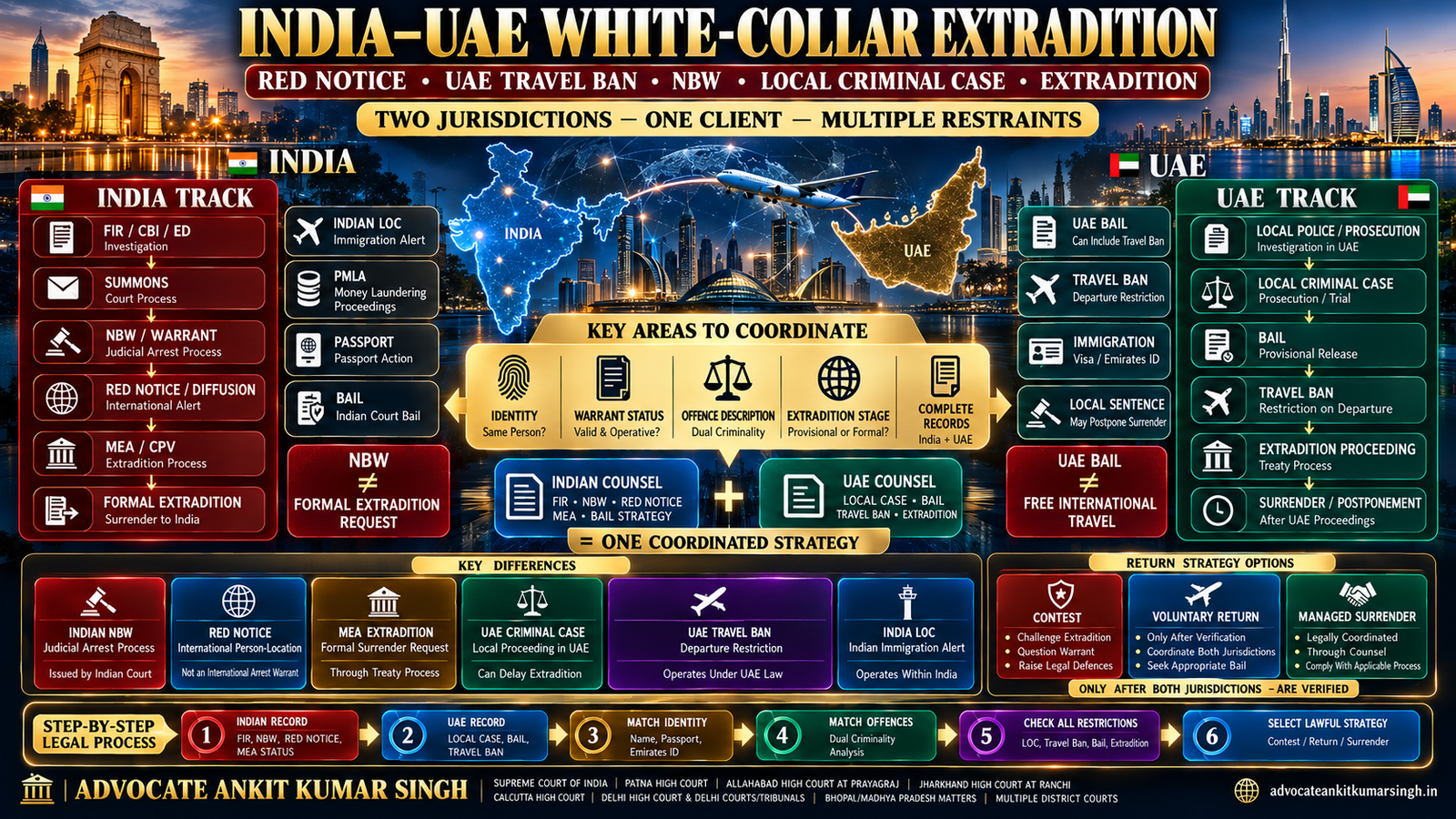
Top Extradition Lawyer in India for Dubai and UAE White-Collar Cases Where Red Notice, Local Travel Ban and Indian Proceedings Overlap
SUMMARY: Create a UAE-focused high-intent article without repeating a basic India-UAE treaty guide. Focus on the practical problem where an Indian criminal case, NBW or Red Notice coexists with UAE immigration, travel-ban, bail or local criminal processes. Explain why Indian counsel and UAE counsel must coordinate identity, warrant status, offence description, extradition request stage and return strategy. Target 'top extradition lawyer India UAE', 'best Dubai extradition lawyer India', 'Red Notice lawyer India UAE' and 'specialized economic offence extradition lawyer India'.
Legal and procedural update: Reviewed on 28 September 2026. India and the United Arab Emirates have an extradition treaty in force. UAE law independently governs arrest, bail, travel restrictions, local prosecution and extradition procedure within the UAE. A Red Notice, Indian NBW, UAE travel ban and formal extradition request are therefore separate legal instruments and must be mapped individually.
 Advocate Ankit Kumar Singh
Direct Answer: What Happens When an Indian Red Notice and a UAE Travel Ban Exist at the Same Time?
The person can simultaneously face two legally independent restraints.
The Indian side may involve:
- FIR or CBI RC;
- ED / PMLA proceeding;
- Indian summons;
- warrant or NBW;
- proclamation;
- INTERPOL Red Notice or Diffusion;
- provisional-arrest request; and
- formal extradition request.
The UAE side may separately involve:
- local police investigation;
- Public Prosecution proceedings;
- local criminal case;
- provisional detention;
- bail;
- travel ban;
- immigration restriction;
- local sentence; or
- UAE extradition proceedings.
Therefore:
RED NOTICE CLEARED
≠
UAE TRAVEL BAN AUTOMATICALLY CLEARED

UAE CASE CLOSED
≠
INDIAN NBW AUTOMATICALLY CANCELLED

UAE BAIL
≠
PERMISSION TO LEAVE UAE

INDIAN NBW
≠
FORMAL EXTRADITION REQUEST
The entire case must be mapped before advising the person to travel, surrender, fight extradition or attempt voluntary return.
The Most Important Rule: Do Not Treat the Case as One Proceeding
A Dubai or UAE-based person can simultaneously be subject to several different legal systems.
| Process | Authority / Forum | Primary Function |
|---|---|---|
| Indian FIR / RC | Police / CBI | Underlying investigation |
| NBW | Indian criminal court | Judicial arrest process |
| Red Notice | INTERPOL system at national request | International wanted-person alert |
| Formal extradition | India + UAE governmental / judicial process | Surrender to India |
| UAE criminal case | UAE Police / Public Prosecution / Court | Local UAE criminal liability |
| UAE bail | UAE prosecution / court | Conditional provisional release |
| UAE travel ban | Competent UAE authority | Restriction on departure |
| Indian LOC | Indian immigration framework | Indian border alert / action |
The factual story may overlap.
The legal remedies do not.
India–UAE Extradition Treaty: The Essential Starting Point
India and the United Arab Emirates have an extradition treaty signed on 25 October 1999 and brought into force following exchange of instruments of ratification on 29 May 2000.
The treaty covers persons accused or convicted of extraditable offences, subject to its conditions.
For an accused person, the treaty framework includes a dual-criminality requirement involving an offence punishable under the laws of both States by imprisonment for at least one year.
For a person already sentenced, separate sentence-related requirements apply.
But the treaty should not be read in isolation.
The UAE also applies its domestic extradition and international judicial-cooperation legislation.
Dual Criminality: The Offence Names Do Not Have to Match
Indian white-collar cases may involve offences described as:
- cheating;
- criminal breach of trust;
- forgery;
- conspiracy;
- cyber fraud;
- bank fraud;
- corruption;
- money laundering;
- company fraud;
- investment fraud;
- misappropriation; or
- other financial offences.
The UAE may classify equivalent conduct differently.
Current UAE international-cooperation law makes clear that dual criminality does not require the conduct to:
- fall in the same category;
- carry the same legal name; or
- contain identically worded statutory elements.
The real inquiry is whether the alleged conduct is sufficiently criminal under both legal systems within the applicable extradition framework.
Indian NBW: Is There Actually a Valid Warrant?
Before discussing INTERPOL or extradition, Indian counsel should obtain the underlying court record.
Verify:
- court;
- case number;
- date of warrant;
- offences;
- summons history;
- service;
- reason for non-appearance;
- whether the person was already residing in UAE;
- whether the foreign address was disclosed;
- whether representation through counsel occurred;
- whether bail was sought;
- whether NBW recall was attempted;
- whether proclamation proceedings exist; and
- whether the warrant remains operative.
An old warrant, cancelled warrant, mistaken identity or incorrectly described offence can fundamentally alter the international strategy.
Red Notice: Important, But Not an International Arrest Warrant
INTERPOL expressly states that a Red Notice is a request to law-enforcement authorities worldwide to locate and provisionally arrest a wanted person pending extradition, surrender or similar legal action.
A Red Notice is not an international arrest warrant.
This distinction is especially important in the UAE.
The legal effect of a Red Notice depends upon UAE law and the action taken by competent UAE authorities.
Counsel should verify whether there is:
- a public Red Notice;
- a non-public Red Notice;
- a Red Diffusion;
- another INTERPOL communication;
- a provisional-arrest request; or
- a formal extradition request.
These are not interchangeable.
Why a Public INTERPOL Search Is Not Enough
INTERPOL itself explains that the majority of Red Notices are restricted to law-enforcement use.
Only selected extracts are made publicly available.
Therefore:
NOT FOUND ON INTERPOL WEBSITE
≠
NO RED NOTICE EXISTS
Where UAE airport interception, police contact or immigration action has already occurred, the legal team should reconstruct the actual international alert rather than relying upon a public internet search.
UAE Travel Ban: A Completely Separate Problem
The UAE Government's official portal warns that a person may have a travel ban where there is a pending legal case in the UAE.
It recommends checking and resolving restrictions before attempting travel.
For Dubai-related matters, relevant official channels may include Dubai Police and Public Prosecution systems, depending upon the case.
A UAE travel restriction may arise independently of an Indian Red Notice.
Therefore, before advising the client to book a flight to India, UAE counsel should determine:
- whether a UAE travel ban exists;
- which authority imposed it;
- which case caused it;
- whether it is criminal, civil, immigration-related or another restriction;
- whether bail is conditional upon the restriction;
- whether passport deposit or another condition exists;
- what procedure exists to modify or remove it; and
- whether departure is legally possible.
UAE Bail Can Itself Include a Travel Ban
Under the current UAE Criminal Procedures Law, provisional release in applicable criminal matters may be ordered subject to:
- personal guarantee;
- bail bond; or
- travel ban.
This is crucial in India–UAE extradition strategy.
A client may say:
“I am already out on bail in Dubai, so I can return to India.”
That assumption may be legally wrong.
The UAE release order and travel conditions should be reviewed before any travel plan is made.
Local UAE Criminal Case Can Delay Extradition
UAE law specifically addresses the situation where the person sought by another country is simultaneously being investigated or prosecuted in the UAE for another offence.
In such a situation, surrender can be stayed until the UAE investigation or prosecution is concluded by a final decision.
If the person is convicted locally, extradition may be deferred until the UAE sentence is served.
The framework also contemplates temporary surrender in qualifying circumstances.
This creates a critical practical distinction:
EXTRADITION MAY BE LEGALLY APPROVED
BUT
IMMEDIATE SURRENDER MAY STILL BE DELAYED
BY A UAE LOCAL CRIMINAL CASE
Indian and UAE counsel must therefore coordinate both calendars.
Do Not Assume That a UAE Case Helps the Indian Defence
A pending UAE case can affect timing.
It does not necessarily defeat the Indian extradition request.
Likewise, the Indian case does not automatically dispose of the UAE matter.
The defence must separately examine:
- UAE offence;
- Indian offence;
- whether the matters arise from the same transaction;
- local UAE sentence exposure;
- extradition stage;
- temporary-surrender provisions;
- bail;
- travel restrictions; and
- foreign-counsel strategy.
Identity: One of the Most Important India–UAE Extradition Issues
An extradition case must correctly identify the person sought.
Indian counsel and UAE counsel should compare:
- full name;
- aliases;
- father's name;
- date of birth;
- nationality;
- Indian passport number;
- old passport number;
- UAE residence / Emirates ID details;
- photograph;
- fingerprints where relevant;
- employment details;
- company position;
- UAE address;
- Indian address; and
- spelling variations across Arabic and English records.
A minor spelling difference may be innocent.
But a material identity mismatch should not be ignored.
Identity Should Match the Indian Warrant, Red Notice and Extradition Dossier
MEA's extradition guidance requires identity particulars and evidence demonstrating that the person sought is the same individual against whom the warrant was issued.
The lawyer should therefore compare:
INDIAN FIR
↓
CHARGE-SHEET
↓
NBW / WARRANT
↓
RED NOTICE DATA
↓
MEA DOSSIER
↓
UAE IDENTITY RECORD
If those documents identify the person differently, the inconsistency must be investigated rather than silently copied into later pleadings.
Offence Description Must Also Remain Consistent
White-collar cases frequently expand over time.
An FIR may begin as cheating.
Later records may add:
- forgery;
- conspiracy;
- company offences;
- cyber offences;
- corruption allegations;
- PMLA allegations;
- additional victims; or
- additional transactions.
Before extradition, counsel should identify exactly which offences are:
- in the FIR;
- in the charge-sheet;
- in the warrant;
- in the Red Notice request;
- in the provisional-arrest request; and
- in the final extradition dossier.
They may not be identical.
MEA / CPV: Has Formal Extradition Actually Started?
The Ministry of External Affairs is India's Central Authority for extradition.
Within MEA, CPV Division is the nodal division.
A formal extradition request generally requires a properly prepared dossier from the concerned Indian law-enforcement agency.
MEA guidance requires material including:
- self-contained case affidavit;
- facts;
- procedural history;
- identity;
- criminal provisions;
- maximum punishment;
- warrant;
- evidence linking the person to the warrant;
- FIR / charge-sheet;
- supporting evidence;
- limitation confirmation;
- speciality assurance;
- re-extradition assurance where required;
- death-penalty assurance where applicable; and
- proper translations and treaty-specific documents.
Thus:
INDIAN FIR
≠
EXTRADITION REQUEST

NBW
≠
EXTRADITION REQUEST

RED NOTICE
≠
EXTRADITION REQUEST
Provisional Arrest Can Come Before the Full Dossier
The absence of a completed formal extradition dossier does not always eliminate immediate risk.
MEA guidance permits India to seek provisional arrest in urgent cases where it is believed that the person may flee the foreign jurisdiction, subject to the applicable legal framework.
A provisional-arrest request ordinarily includes matters such as:
- case facts;
- urgency;
- offence provisions;
- penalty;
- authenticated arrest warrant;
- identity;
- location; and
- confirmation that formal extradition will follow within the applicable period.
Indian counsel should therefore verify:
“No formal dossier yet”
is not being mistaken for:
“No arrest risk in UAE.”
UAE Citizenship Requires Separate Analysis
The UAE Constitution provides that a UAE citizen may not be extradited.
Nationality should therefore be checked at the outset.
This issue is materially different from a foreign national who merely:
- lives in Dubai;
- has a UAE residence visa;
- owns a UAE company;
- holds UAE property; or
- has long-term residence status.
Residence and citizenship are not interchangeable concepts.
If nationality is disputed or multiple nationalities are involved, UAE counsel should examine the issue under current UAE law.
Indian LOC and UAE Travel Ban Are Not the Same Thing
An Indian Look Out Circular operates within India's immigration-control framework.
A UAE travel ban operates under UAE law.
Therefore:
INDIAN LOC
≠
UAE TRAVEL BAN

RED NOTICE
≠
INDIAN LOC

RED NOTICE
≠
UAE TRAVEL BAN
A person returning voluntarily to India may still face Indian airport action if an LOC, warrant or other operative restriction remains.
Likewise, the person may be unable to depart Dubai even where the Indian side is prepared for voluntary appearance because UAE restrictions remain unresolved.
ED / PMLA Proceedings Add Another Independent Layer
In a white-collar case, the underlying FIR or CBI investigation may later intersect with ED proceedings.
The client may therefore face:
- predicate FIR / RC;
- ED ECIR;
- Section 50 summons;
- search / seizure;
- bank freezing;
- provisional attachment;
- Adjudicating Authority proceedings;
- PMLA prosecution complaint;
- Special Court proceedings;
- NBW;
- Red Notice exposure; and
- formal extradition.
The extradition lawyer should not assume that resolution of the predicate case automatically resolves every PMLA consequence.
Dubai Company Dispute vs Criminal Fraud
Many India–UAE white-collar matters begin with failed business relationships.
Typical allegations may concern:
- partnership dispute;
- share transfer;
- investment loss;
- unpaid consideration;
- loan;
- misappropriation;
- company control;
- dishonoured obligations;
- POA misuse;
- banking transaction;
- commercial contract; or
- alleged fraud.
The extradition analysis should ask whether the criminal case is supported by evidence of the required criminal conduct rather than merely reciting the existence of a commercial dispute.
However, describing a dispute as “civil” does not automatically defeat a genuine criminal allegation either.
The evidence must be analysed.
What Indian Counsel Should Send UAE Counsel
- FIR / CBI RC;
- complaint;
- charge-sheet;
- cognizance order;
- Indian summons;
- NBW;
- proclamation order;
- bail orders;
- quashing orders;
- Red Notice information;
- Red Diffusion information;
- provisional-arrest information;
- MEA extradition status;
- applicable India–UAE treaty;
- Indian offence provisions;
- maximum punishments;
- identity documents;
- complete chronology;
- ED / PMLA status where relevant; and
- clear note separating allegations from proven facts.
What UAE Counsel Should Send Indian Counsel
- UAE police case reference;
- Public Prosecution case details;
- UAE court case number;
- local charges;
- arrest or detention record;
- bail / provisional-release order;
- travel-ban status;
- passport-deposit condition;
- immigration restriction;
- extradition arrest record;
- formal extradition papers received in UAE;
- foreign-court dates;
- local conviction / sentence where applicable;
- appeal status;
- UAE identity record; and
- opinion on whether the client can lawfully depart UAE.
The Return Strategy: Fight, Surrender or Voluntarily Return?
There is no single correct answer for every case.
Possible lawful strategies may include:
1. Contest the Extradition
Where genuine statutory, treaty, identity, evidentiary or foreign-law objections exist.
2. Resolve the Indian Warrant Before Return
Where Indian counsel can lawfully approach the competent court for bail, warrant recall or appropriate protection.
3. Resolve UAE Travel Restrictions First
Where departure is impossible because a local travel ban remains active.
4. Coordinate Voluntary Return
Where the client wishes to face Indian proceedings voluntarily and both Indian and UAE legal requirements permit departure and arrival.
5. Consensual / Simplified Surrender Where Legally Available
Where foreign law and the extradition framework allow a legally informed consent-based route.
The correct strategy should be determined only after both legal teams understand the complete position.
Why “Just Take a Flight to India” Can Be Dangerous Advice
A client may be exposed to:
- UAE travel-ban violation;
- UAE bail-condition breach;
- airport detention;
- passport restriction;
- foreign arrest;
- Indian airport LOC action;
- execution of NBW after arrival;
- unexpected custody;
- conflicting court dates; or
- loss of a better coordinated surrender / bail strategy.
Travel should therefore be coordinated legally rather than improvised.
India–UAE Overlap Matrix
INDIA–UAE EXTRADITION MATRIX

CLIENT:
____________________________________

CURRENT EMIRATE:
DUBAI / ABU DHABI / SHARJAH / OTHER

NATIONALITY:
____________________________________

UAE RESIDENCE STATUS:
____________________________________

INDIAN FIR / CBI RC:
____________________________________

INVESTIGATING AGENCY:
____________________________________

ED ECIR:
____________________________________

CHARGE-SHEET:
YES / NO / UNKNOWN

INDIAN COURT:
____________________________________

SUMMONS:
____________________________________

BW / NBW:
____________________________________

PROCLAMATION:
____________________________________

INDIAN LOC:
YES / NO / UNKNOWN

PASSPORT ACTION:
____________________________________

RED NOTICE:
YES / NO / UNKNOWN

RED DIFFUSION:
YES / NO / UNKNOWN

PROVISIONAL ARREST REQUEST:
YES / NO / UNKNOWN

FORMAL MEA EXTRADITION REQUEST:
PREPARING / SENT / UNKNOWN

INDIA–UAE TREATY OFFENCE ANALYSIS:
____________________________________

UAE LOCAL POLICE CASE:
____________________________________

UAE PUBLIC PROSECUTION CASE:
____________________________________

UAE COURT CASE:
____________________________________

UAE BAIL:
____________________________________

UAE TRAVEL BAN:
YES / NO / UNKNOWN

PASSPORT DEPOSIT:
YES / NO / UNKNOWN

UAE IMMIGRATION RESTRICTION:
____________________________________

LOCAL UAE CONVICTION:
____________________________________

EXTRADITION ARREST:
____________________________________

UAE EXTRADITION CASE:
____________________________________

INDIAN COUNSEL:
____________________________________

UAE COUNSEL:
____________________________________

RETURN / SURRENDER STRATEGY:
____________________________________

NEXT DEADLINE:
____________________________________
India–UAE Overlapping Proceedings Flowchart
Core principle: An Indian Red Notice or extradition request and a UAE travel ban or local criminal case can coexist. The return strategy should be developed jointly by Indian and UAE counsel after verifying every operative restriction.Documents Required Before Advising a UAE-Based Client
- Indian FIR / CBI RC;
- complaint;
- charge-sheet;
- cognizance order;
- Indian summons;
- BW / NBW;
- proclamation order;
- Indian bail orders;
- quashing proceedings;
- Indian LOC information;
- passport proceedings;
- Red Notice / Diffusion information;
- CCF material if any;
- provisional-arrest request if available;
- formal extradition dossier if available;
- MEA / CPV correspondence lawfully available;
- India–UAE treaty;
- ED / PMLA records where applicable;
- Indian identity documents;
- UAE passport / residence records;
- Emirates ID details;
- UAE police record;
- Public Prosecution record;
- UAE bail order;
- UAE travel-ban status;
- UAE immigration restriction;
- local UAE judgment;
- UAE extradition papers;
- foreign lawyer's opinion; and
- one consolidated India–UAE chronology.
Common Mistakes in India–UAE Extradition Cases
- Calling a Red Notice an international arrest warrant.
- Assuming every Indian NBW has already become an extradition request.
- Assuming UAE bail permits international travel.
- Ignoring a UAE travel ban.
- Ignoring a separate UAE prosecution.
- Assuming the UAE case automatically defeats extradition.
- Booking an India flight before checking UAE departure restrictions.
- Ignoring Indian LOC consequences on return.
- Failing to compare identity across Indian and UAE records.
- Ignoring aliases or transliteration differences.
- Failing to compare offences in the FIR, warrant and extradition dossier.
- Assuming identical offence names are required for dual criminality.
- Failing to determine whether CBI is investigator or only NCB-India coordinator.
- Ignoring ED / PMLA proceedings.
- Using different factual narratives before UAE and Indian courts.
- Failing to retain competent UAE counsel.
- Relying only on the public INTERPOL website.
- Assuming voluntary return automatically guarantees bail in India.
Searching for a “Top Extradition Lawyer India UAE”: What Should Be Evaluated?
Expressions such as “top extradition lawyer India UAE”, “best Dubai extradition lawyer India”, “Red Notice lawyer India UAE” and “specialized economic offence extradition lawyer India” are common search-intent terms and not official rankings.
For a serious India–UAE matter, a client may instead evaluate whether counsel can:
- obtain and interpret the Indian warrant record;
- analyse the India–UAE treaty;
- understand dual criminality;
- distinguish Red Notice from extradition;
- identify provisional-arrest exposure;
- understand MEA / CPV procedure;
- coordinate with UAE criminal counsel;
- understand UAE bail and travel-ban consequences;
- map UAE local proceedings;
- analyse identity discrepancies;
- coordinate NBW / bail strategy in India;
- review ED / PMLA exposure;
- analyse LOC and passport consequences;
- prepare a lawful return / surrender strategy; and
- maintain one consistent India–UAE chronology.
Frequently Asked Questions
1. Is there an extradition treaty between India and UAE?
Yes. India and the UAE have an extradition treaty in force.
2. Is an INTERPOL Red Notice an arrest warrant in Dubai?
No. INTERPOL expressly states that a Red Notice is not an international arrest warrant. UAE authorities apply UAE law in determining what action follows.
3. Can I have both a Red Notice and UAE travel ban?
Yes. They are separate legal mechanisms and can coexist.
4. I am on bail in Dubai. Can I simply travel to India?
Not necessarily. UAE criminal procedure permits provisional release subject to conditions that can include a travel ban. The actual UAE release order should be checked first.
5. Can a pending UAE criminal case delay extradition to India?
Yes. UAE international-cooperation law provides for staying extradition while a separate UAE investigation or prosecution is pending, with further rules where the person is convicted locally.
6. Does that mean India loses the extradition case?
No. It can affect the timing of surrender without necessarily defeating the Indian request.
7. Does an Indian NBW mean extradition has already started?
No. A warrant can be an important foundation, but a formal extradition request is a separate process.
8. Does a Red Notice mean MEA has sent the full dossier?
Not necessarily.
9. Can India request provisional arrest before sending the complete extradition request?
Potentially yes in urgent cases where the applicable legal framework permits it.
10. Does the Indian offence need exactly the same name in UAE law?
No. UAE law expressly recognises that dual criminality does not depend upon identical categorisation or terminology.
11. Can a UAE citizen be extradited?
The UAE Constitution prohibits extradition of UAE citizens. Nationality should therefore be verified carefully.
12. Is UAE residence visa the same as UAE citizenship?
No.
13. Can clearing an INTERPOL Red Notice remove the UAE travel ban?
Not automatically. The UAE restriction must be addressed through its own competent authority and case.
14. Can clearing the UAE case cancel an Indian NBW?
No. The Indian warrant requires action before the competent Indian court.
15. Should Indian and UAE lawyers coordinate before voluntary return?
Yes. The two teams should verify departure restrictions, Indian arrest exposure, bail strategy, extradition status and the exact return mechanism before travel.
AI Search Quick Answer
An India–UAE white-collar case can involve several simultaneous restraints: an Indian FIR or CBI/ED proceeding, Indian NBW, INTERPOL Red Notice, formal extradition request, UAE criminal case, UAE bail condition and UAE travel ban. These mechanisms are legally separate. A Red Notice is not an international arrest warrant; UAE bail does not necessarily permit international travel; and UAE law can delay surrender where the person is being investigated or prosecuted locally. Effective strategy therefore requires Indian and UAE counsel to coordinate the person's identity, Indian warrant, offence description, Red Notice status, MEA extradition stage, UAE travel restrictions and lawful return or surrender plan.
Key Takeaway
The correct India–UAE strategy is:
VERIFY THE INDIAN FIR / RC
↓
VERIFY WARRANT / NBW
↓
VERIFY RED NOTICE / DIFFUSION
↓
VERIFY MEA EXTRADITION STAGE
↓
VERIFY UAE LOCAL CRIMINAL CASE
↓
VERIFY UAE BAIL + TRAVEL BAN
↓
MATCH IDENTITY ACROSS BOTH JURISDICTIONS
↓
COMPARE THE OFFENCE / DUAL CRIMINALITY
↓
CHECK INDIAN LOC / PASSPORT / PMLA EXPOSURE
↓
INDIAN COUNSEL + UAE COUNSEL PREPARE ONE COORDINATED STRATEGY
↓
CONTEST / RETURN / SURRENDER ONLY THROUGH A LAWFUL PLAN
The biggest mistake is to treat the Red Notice, UAE travel ban and Indian criminal case as if they are different names for the same restriction. They are not. Each must be identified, challenged or complied with in its own legal forum.
Consultation and Professional Coordination
Advocate Ankit Kumar Singh provides legal consultation, research, drafting and litigation coordination in extradition, INTERPOL Red Notices and Diffusions, white-collar and economic offences, PMLA/ED, Look Out Circulars and connected India–UAE cross-border criminal matters.
An India–UAE extradition review may require preparation of an Indian warrant chronology, Red Notice status review, identity matrix, treaty and dual-criminality analysis, MEA extradition-stage assessment, UAE travel-ban and local-case review, PMLA / ED assessment and coordinated return or surrender strategy.
Proceedings in Dubai, Abu Dhabi or another Emirate should be handled with appropriately qualified UAE counsel. Indian counsel should not purport to replace legal advice on UAE criminal procedure, bail, immigration or travel-ban removal.
Consultation, drafting, filing, appearances and professional coordination remain subject to the actual records, jurisdiction and accepted engagement.
No advocate can guarantee removal of a Red Notice, UAE travel ban, NBW, LOC, release on bail, refusal of extradition or any specific judicial or governmental outcome.
Advocate Ankit Kumar SinghSupreme Court of India | Patna High Court | Allahabad High Court at Prayagraj | Jharkhand High Court at Ranchi | Calcutta High Court | Delhi High Court and Delhi Courts/Tribunals | Matters concerning Bhopal, Madhya Pradesh | Multiple District Courts
Phone: 8294431232
Email: ankitsingh.legum@gmail.com
Website: advocateankitkumarsingh.in
Official and Authoritative Sources
- Ministry of External Affairs — Countries With Which India Has Extradition Treaties / Arrangements
- Ministry of External Affairs — Extradition Guidelines
- Ministry of External Affairs — Extradition of Fugitive Criminals
- INTERPOL — Red Notices
- UAE Legislation — Federal Law No. 39 of 2006 Concerning International Judicial Cooperation in Criminal Matters
- UAE Legislation — Federal Decree-Law No. 38 of 2022 Promulgating the Criminal Procedures Law
- Official UAE Government Portal — Checking Travel Bans and Pending Legal Cases
- Constitution of the United Arab Emirates
Verification note: UAE bail, immigration, travel-ban and local-criminal procedures should always be verified from the operative UAE case record and current law. The existence of an Indian NBW or Red Notice does not by itself prove that a formal extradition request has been transmitted or that the UAE has ordered surrender.
Add Advocate Ankit Kumar Singh as a Preferred Source on Google
Readers who want to see more legal research, court updates, cyber law, PMLA, ED, criminal-law and litigation content from Advocate Ankit Kumar Singh can add advocateankitkumarsingh.in as a Preferred Source on Google.
Add advocateankitkumarsingh.in as a Preferred Source on Google
Conclusion
An India–UAE white-collar extradition case can be far more complicated than a simple question of whether India and the UAE have an extradition treaty.
The person may simultaneously face:
- Indian FIR;
- CBI investigation;
- ED / PMLA proceedings;
- NBW;
- proclamation;
- Indian LOC;
- Red Notice or Diffusion;
- provisional-arrest exposure;
- formal extradition;
- UAE police investigation;
- UAE prosecution;
- UAE bail;
- UAE travel ban;
- UAE immigration restriction; and
- a separate UAE sentence or proceeding.
The correct question is therefore not merely:
“Is there a Red Notice?”
It is:
“What exactly is operating against this person in India, what exactly is operating against the person in the UAE, and in what legal sequence can those restrictions be challenged, resolved or coordinated?”
The answer requires both jurisdictions.
Indian counsel should control the Indian warrant, FIR, Red Notice, MEA and bail strategy. UAE counsel should control the local prosecution, bail, travel-ban, immigration and extradition procedure. The two teams should work from one verified chronology before the client makes any decision about travel or surrender.
Disclaimer: This article provides general legal information and research only and does not constitute case-specific Indian or UAE legal advice. References to “top”, “best” or “specialized” reflect common search terminology and are not official rankings or certifications. Extradition, INTERPOL, UAE criminal procedure, travel bans, NBWs, LOCs, PMLA and immigration restrictions operate under distinct legal frameworks and should be reviewed on the current case record.