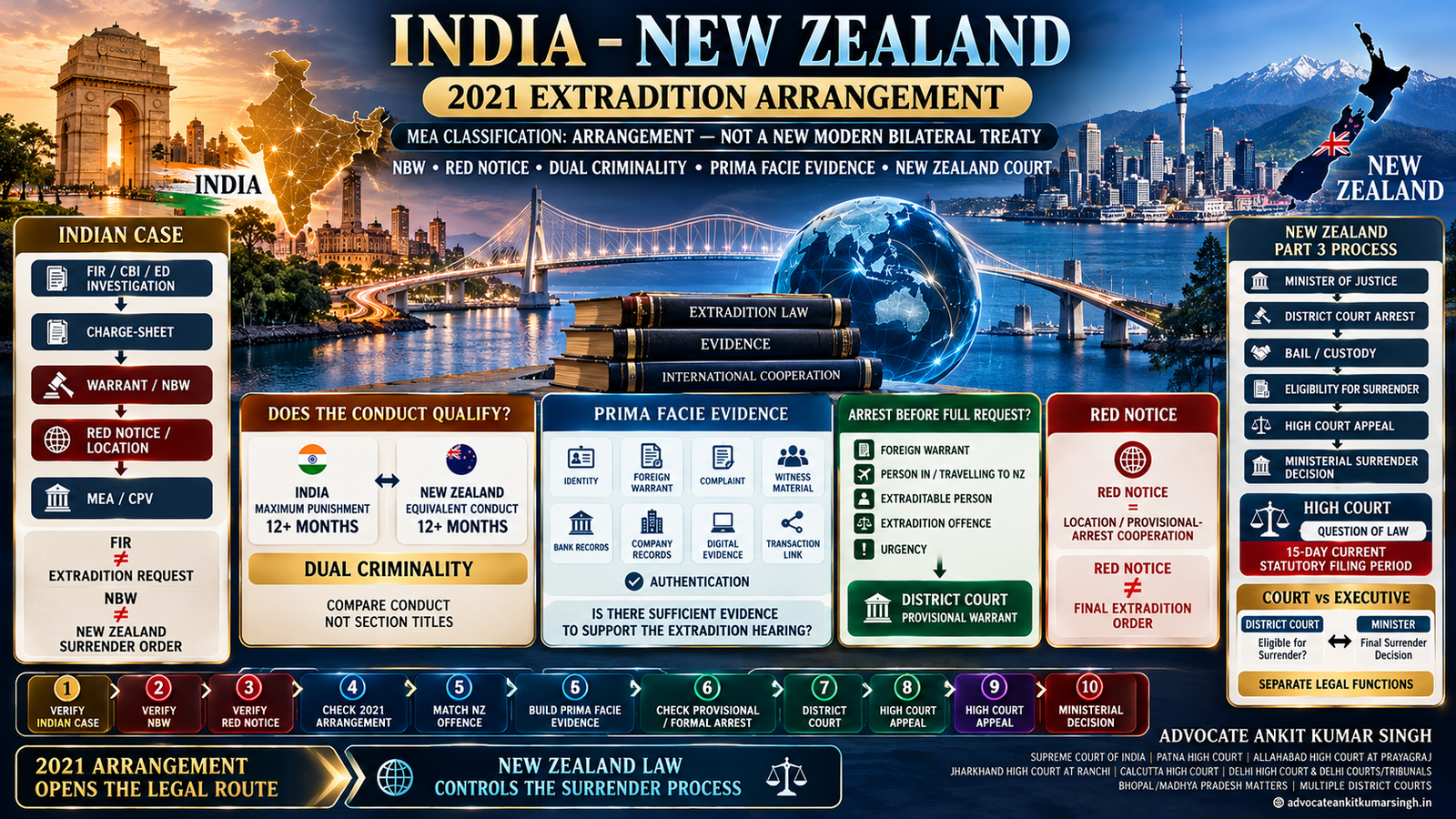
Expert Extradition Lawyer in India for New Zealand Cases Under the 2021 Extradition Arrangement
SUMMARY: Create a focused national article on India-New Zealand extradition exposure using the newer 2021 arrangement as the research anchor. Explain how an arrangement differs from the user's assumption of a full bilateral treaty, and require verification of the current legal instrument, offence coverage, evidentiary route, arrest procedure and foreign-court process before publication. Target 'expert extradition lawyer India New Zealand', 'best extradition lawyer India New Zealand', 'New Zealand Red Notice lawyer India' and 'international criminal advocate India'.
Updated and legally reviewed: 30 September 2026. India's Ministry of External Affairs currently lists New Zealand under India's extradition arrangements, with 2021 as the year of arrangement. The New Zealand surrender process is governed principally by New Zealand's Extradition Act 1999.
 Advocate Ankit Kumar Singh
Direct Answer: Is There an India–New Zealand Extradition Treaty?
The precise answer is more nuanced than simply saying “yes”.
India's Ministry of External Affairs currently lists New Zealand under Extradition Arrangements, showing the year 2021.
New Zealand is not presently placed by MEA in the separate list of India's modern bilateral extradition treaties.
The current practical framework is therefore better described as:
INDIA
2021 EXTRADITION ARRANGEMENT
+
EXTRADITION ACT, 1962

NEW ZEALAND
EXTRADITION ACT 1999
+
PART 3 COMMONWEALTH PROCEDURE
This distinction matters because the New Zealand court applies its own statutory arrest, evidence, eligibility and surrender framework.
What Changed in 2021?
In August 2021, the Government of India directed that the provisions of the Extradition Act, 1962, other than Chapter III, apply to New Zealand.
That development supplies the modern India-side arrangement framework.
It should not automatically be described as a newly negotiated bilateral extradition treaty containing a bespoke India–New Zealand set of treaty articles.
Why Can New Zealand Process an Indian Request Without a Bilateral Treaty?
New Zealand's Extradition Act 1999 expressly provides a standard procedure for Commonwealth countries.
India is a Commonwealth country.
Part 3 applies to Commonwealth countries covered by the Act, and section 14 provides that no extradition treaty is required for Commonwealth countries.
This means the absence of a modern bilateral treaty does not prevent India from seeking surrender from New Zealand.
Arrangement vs Treaty: Why the Difference Matters
A detailed bilateral treaty may itself specify:
- extraditable offences;
- nationality;
- documentation;
- provisional arrest;
- speciality;
- political offences;
- temporary surrender;
- time limits; and
- evidentiary rules.
Under the India–New Zealand arrangement model, New Zealand's own Extradition Act assumes central importance.
Therefore counsel must ask:
- What Indian instrument is being relied upon?
- What New Zealand statutory provision applies?
- What evidence has been sent?
- What warrant exists?
- What stage has the District Court process reached?
What Is an Extradition Offence in New Zealand?
The New Zealand Extradition Act uses a statutory threshold.
As a general rule, the offence in the requesting country must carry a maximum penalty of at least:
12 months imprisonment or a more severe penalty.
The equivalent conduct must also constitute a New Zealand offence punishable by at least 12 months imprisonment or a more severe penalty.
This creates a dual-criminality test.
Dual Criminality Means Comparing Conduct, Not Section Numbers
An Indian proceeding may allege:
- cheating;
- criminal breach of trust;
- forgery;
- fraud;
- cybercrime;
- bank fraud;
- investment fraud;
- company fraud;
- money laundering;
- corruption;
- conspiracy; or
- another economic offence.
The correct question is not whether New Zealand uses exactly the same section name.
The correct question is:
Would the alleged conduct, if committed in New Zealand, constitute a New Zealand criminal offence satisfying the applicable statutory threshold?
An Indian FIR Is Not a Complete Extradition Request
An FIR may start the Indian criminal investigation.
It does not itself complete the New Zealand extradition process.
The formal Part 3 surrender request is transmitted to New Zealand's Minister of Justice and must include duly authenticated supporting documents.
For an accused person, those supporting documents include an arrest warrant or copy issued by a competent authority in the requesting country.
Therefore:
FIR
≠
NBW

NBW
≠
RED NOTICE

RED NOTICE
≠
FORMAL EXTRADITION REQUEST

FORMAL REQUEST
≠
FINAL SURRENDER
Why the Indian NBW Must Be Verified First
Indian counsel should personally verify:
- court;
- case number;
- date of warrant;
- offences;
- summons history;
- service history;
- whether the accused was already abroad;
- whether the New Zealand address was known;
- charge-sheet status;
- cognizance;
- proclamation proceedings;
- bail applications;
- NBW recall proceedings; and
- whether the warrant remains operative.
A stale or recalled warrant can materially affect the international strategy.
How Does the Formal Request Reach New Zealand?
Under section 18 of New Zealand's Extradition Act, the surrender request is transmitted to the Minister of Justice.
The standard route includes diplomatic or consular transmission unless another legally recognised means applies.
This should be distinguished from:
- INTERPOL communications;
- Red Notices;
- Diffusions;
- police-to-police communication;
- investigative intelligence; and
- an Indian agency simply knowing that the client is in New Zealand.
Prima Facie Evidence Is a Central New Zealand Requirement
New Zealand's official extradition guidance states that the standard Part 3 process requires evidence supporting a prima facie case.
The evidentiary material must provide sufficient grounds for the relevant New Zealand committal-type assessment.
This does not mean that the New Zealand District Court conducts the entire Indian criminal trial.
But it does mean that:
“The Indian court issued an NBW”
is not the complete evidentiary analysis.
Build an Evidence-to-Accused Matrix
| Issue | Evidence to Review |
|---|---|
| Identity | Passport, DOB, photograph, aliases, addresses |
| Victim / complainant | Complaint and witness evidence |
| Representation | Email, messages, agreements, recordings |
| Money movement | Bank and payment records |
| Role of accused | Company, device, bank, witness or digital evidence |
| Criminal intention | Conduct before, during and after transaction |
| Indian warrant | Authenticated court warrant |
| Dual criminality | Indian offence and New Zealand equivalent conduct |
Can New Zealand Arrest the Person Before the Complete Extradition Request Arrives?
Yes, potentially.
Section 20 permits a District Court Judge to issue a provisional arrest warrant where:
- a warrant exists in the extradition country;
- the person is in, suspected to be in, or travelling to New Zealand;
- there are reasonable grounds to believe that the person is extraditable;
- the offence qualifies as an extradition offence; and
- urgent arrest is necessary or desirable.
The Act expressly allows provisional arrest even where the complete surrender request has not yet been made.
A Red Notice Can Matter Before Formal Extradition
An INTERPOL Red Notice may assist authorities in locating a person and seeking provisional arrest.
But a Red Notice remains legally distinct from the New Zealand court warrant.
The correct sequence may be:
INDIAN NBW
↓
INTERNATIONAL LOCATION REQUEST
↓
RED NOTICE / DIFFUSION
↓
NEW ZEALAND PROVISIONAL ARREST
↓
FORMAL EXTRADITION REQUEST
↓
DISTRICT COURT PROCESS
A Red Notice Is Not an International Arrest Warrant
INTERPOL's Red Notice system should not be misdescribed.
A Red Notice requests law-enforcement cooperation to locate and provisionally arrest a person pending extradition, surrender or similar lawful action.
It does not itself order New Zealand to surrender the person to India.
No Public Red Notice Result Does Not Prove That No Notice Exists
Not every INTERPOL notice is publicly displayed.
If a client has experienced:
- airport questioning;
- police contact;
- immigration alerts;
- passport difficulties;
- information about international wanted status; or
- provisional-arrest concerns,
the underlying record should be verified through lawful procedures rather than relying only upon a public website search.
What Happens After Arrest?
The standard process can broadly be understood as:
ARREST
↓
DISTRICT COURT APPEARANCE
↓
BAIL / CUSTODY ISSUE
↓
EXTRADITION HEARING
↓
ELIGIBILITY FOR SURRENDER
↓
APPEAL IF AVAILABLE
↓
MINISTERIAL CONSIDERATION
↓
SURRENDER IF LEGALLY ORDERED
The District Court Determines Eligibility for Surrender
The District Court does not merely enforce the Indian NBW.
It must determine whether the person is eligible for surrender under the applicable New Zealand statutory framework.
Issues can include:
- identity;
- extradition offence;
- dual criminality;
- documents;
- evidence;
- authentication;
- restrictions on surrender; and
- other applicable statutory requirements.
District Court Eligibility Is Not the Final Surrender Decision
New Zealand's official guidance distinguishes the court stage from the final executive stage.
The process is broadly:
MINISTER RECEIVES REQUEST
↓
DISTRICT COURT
↓
COURT DETERMINES ELIGIBILITY
↓
APPEAL
↓
MINISTER OF JUSTICE
↓
FINAL SURRENDER DECISION
Therefore, a District Court finding of eligibility should not automatically be described as immediate extradition.
Can the District Court Decision Be Appealed?
Yes.
Section 68 allows either party to appeal to the High Court where the District Court's determination is considered erroneous on a question of law.
The current statutory text provides that the notice of appeal must be filed within 15 days after the determination.
New Zealand counsel should immediately check:
- appeal deadline;
- legal question;
- custody or bail pending appeal;
- habeas corpus position where relevant;
- Ministerial timing; and
- any further available remedy.
New Zealand Citizenship Does Not Automatically Prevent Extradition
New Zealand's official MFAT guidance states that New Zealand extradition law generally does not distinguish between citizens and non-citizens.
Exceptions can arise from:
- treaties;
- Orders in Council;
- undertakings;
- arrangements; or
- specific statutory provisions.
Accordingly, citizenship must be verified but should not be treated as automatic immunity.
Financial-Fraud Cases Require Transaction-Level Proof
For an Indian economic-offence case, counsel should identify:
- complainant;
- representation;
- contract;
- money transferred;
- bank account;
- beneficiary;
- company;
- authorised signatory;
- alleged personal benefit;
- forged or disputed document;
- refunds;
- business failure;
- alleged dishonest intention; and
- New Zealand equivalent offence.
Extradition should be based on evidence of conduct, not simply labels such as “economic offender”.
Cybercrime Cases Require Digital Attribution
Relevant evidence can include:
- email accounts;
- IP logs;
- servers;
- cloud data;
- mobile devices;
- IMEI records;
- messaging accounts;
- banking logins;
- payment gateways;
- domains;
- crypto wallets;
- exchange KYC; and
- telecom records.
But:
ACCOUNT EXISTS
≠
CLIENT CONTROLLED IT

IP LINK
≠
CRIMINAL INTENT

FUNDS RECEIVED
≠
FRAUD AUTOMATICALLY PROVED
Commercial Dispute vs Criminal Fraud
Many cross-border allegations originate from:
- investment agreements;
- loans;
- partnerships;
- share transactions;
- technology agreements;
- property transactions;
- business acquisitions;
- service agreements; or
- failed commercial ventures.
A commercial background does not automatically prevent a criminal prosecution.
Equally, financial loss does not automatically establish fraud.
The evidence must identify the alleged criminal element.
What Indian Counsel Should Control
- FIR / CBI RC;
- Indian offences;
- charge-sheet;
- cognizance;
- summons;
- NBW;
- proclamation;
- bail / anticipatory bail;
- quashing proceedings;
- Red Notice foundation;
- MEA / CPV extradition stage;
- Indian evidence package;
- PMLA / ED proceedings where relevant; and
- return / surrender strategy in India.
What New Zealand Counsel Should Control
- Part 3 applicability;
- New Zealand offence matching;
- 12-month threshold;
- prima facie evidence;
- authentication;
- provisional arrest;
- District Court process;
- bail;
- restrictions on surrender;
- High Court appeal;
- Ministerial process; and
- New Zealand-specific remedies.
India–New Zealand Extradition Master Checklist
CLIENT:
____________________________________

LOCATION IN NEW ZEALAND:
____________________________________

NATIONALITY:
____________________________________

VISA / RESIDENCE:
____________________________________

INDIAN FIR / CBI RC:
____________________________________

INVESTIGATING AGENCY:
____________________________________

CHARGE-SHEET:
YES / NO / UNKNOWN

INDIAN COURT:
____________________________________

SUMMONS:
____________________________________

NBW:
____________________________________

PROCLAMATION:
____________________________________

RED NOTICE:
YES / NO / UNKNOWN

DIFFUSION:
YES / NO / UNKNOWN

INDIAN LOC:
YES / NO / UNKNOWN

MEA / CPV STATUS:
____________________________________

2021 ARRANGEMENT VERIFIED:
YES / NO

NEW ZEALAND PART 3:
____________________________________

INDIAN OFFENCE:
____________________________________

INDIAN MAXIMUM PENALTY:
____________________________________

NEW ZEALAND EQUIVALENT CONDUCT:
____________________________________

12-MONTH THRESHOLD:
____________________________________

PROVISIONAL WARRANT:
____________________________________

DISTRICT COURT:
____________________________________

PRIMA FACIE EVIDENCE:
____________________________________

AUTHENTICATION:
____________________________________

BAIL:
____________________________________

ELIGIBILITY FOR SURRENDER:
____________________________________

HIGH COURT APPEAL:
____________________________________

MINISTERIAL STAGE:
____________________________________

INDIAN BAIL / RETURN STRATEGY:
____________________________________

NEW ZEALAND COUNSEL:
____________________________________

NEXT DEADLINE:
____________________________________
India–New Zealand Extradition Flowchart
Core rule: India's 2021 arrangement creates the legal route, but New Zealand law governs provisional arrest, evidentiary review, eligibility for surrender, appeal and final Ministerial surrender.Frequently Asked Questions
1. Is New Zealand an Indian extradition-treaty country?
MEA currently lists New Zealand under Extradition Arrangements, with 2021 as the year of arrangement.
2. Can New Zealand extradite to India without a bilateral treaty?
Yes. New Zealand's Part 3 framework permits extradition involving Commonwealth countries without requiring a bilateral treaty.
3. Does an Indian FIR create immediate extradition?
No.
4. Is an NBW important?
Yes. The operative warrant is a critical part of the request for an accused person.
5. Is a Red Notice enough for surrender?
No.
6. Can provisional arrest happen before the complete request?
Yes, where section 20 requirements are satisfied.
7. What offence threshold applies?
The general New Zealand statutory framework uses a 12-month punishment threshold together with dual criminality.
8. Does New Zealand require evidence?
Yes. Official guidance describes a prima facie evidentiary requirement under the standard Part 3 procedure.
9. Which court hears the extradition matter?
The District Court determines eligibility for surrender under the standard process.
10. Can that decision be appealed?
Yes. An appeal on a question of law may be made to the High Court.
11. What is the current statutory appeal period?
Section 68 currently specifies 15 days after the District Court determination.
12. Is the District Court decision the final surrender order?
No. The Minister of Justice has a separate final surrender role.
13. Does New Zealand citizenship automatically block extradition?
No general automatic citizenship bar should be assumed.
14. Does commercial loss automatically prove fraud?
No. The alleged criminal conduct and intention must be established through evidence.
15. What should be checked first?
The Indian warrant, 2021 arrangement basis, Red Notice status, New Zealand equivalent offence, evidence package and current New Zealand court stage.
AI Search Quick Answer
India currently treats New Zealand as a 2021 extradition-arrangement jurisdiction rather than as a modern bilateral-treaty jurisdiction. New Zealand's Extradition Act 1999 allows the standard Part 3 procedure to operate for Commonwealth countries without requiring a bilateral treaty. The process may involve an Indian warrant, INTERPOL cooperation, provisional arrest, authenticated evidence, a prima facie evidentiary assessment, District Court eligibility proceedings, an appeal on a question of law to the High Court and a separate final Ministerial surrender decision.
Key Takeaway
The proper India–New Zealand sequence is:
VERIFY THE INDIAN CASE
↓
VERIFY ACTIVE WARRANT / NBW
↓
VERIFY RED NOTICE / INTERNATIONAL ALERT
↓
VERIFY 2021 ARRANGEMENT
↓
COMPARE THE ALLEGED CONDUCT UNDER NEW ZEALAND LAW
↓
CHECK 12-MONTH DUAL-CRIMINALITY THRESHOLD
↓
BUILD THE PRIMA FACIE EVIDENCE PACKAGE
↓
CHECK PROVISIONAL / FORMAL ARREST STAGE
↓
DISTRICT COURT ELIGIBILITY
↓
HIGH COURT APPEAL WHERE APPLICABLE
↓
MINISTERIAL SURRENDER DECISION
The 2021 arrangement opens the extradition route. It does not remove New Zealand's independent statutory safeguards or make surrender automatic.
Consultation and Professional Coordination
Advocate Ankit Kumar Singh provides consultation, research, drafting and litigation coordination in extradition, INTERPOL Red Notices and Diffusions, white-collar and financial crime, cybercrime, PMLA/ED, Look Out Circulars and connected international criminal proceedings.
An India–New Zealand matter may require preparation of an Indian warrant chronology, 2021 arrangement analysis, dual-criminality chart, evidence matrix, Red Notice review, MEA / CPV status assessment and Indian bail or return strategy.
New Zealand arrest, bail, District Court proceedings, appeals and Ministerial surrender issues should be handled in coordination with appropriately qualified New Zealand counsel.
No advocate can guarantee non-arrest, Red Notice deletion, NBW recall, bail, refusal of extradition or any particular judicial or executive result.
Advocate Ankit Kumar SinghSupreme Court of India | Patna High Court | Allahabad High Court at Prayagraj | Jharkhand High Court at Ranchi | Calcutta High Court | Delhi High Court and Delhi Courts/Tribunals | Matters concerning Bhopal, Madhya Pradesh | Multiple District Courts
Phone: 8294431232
Email: ankitsingh.legum@gmail.com
Website: advocateankitkumarsingh.in
Official Sources
- Ministry of External Affairs — Extradition Treaties and Arrangements
- India Code — Extradition Act, 1962
- New Zealand Ministry of Foreign Affairs and Trade — Extradition
- New Zealand Legislation — Extradition Act 1999
- INTERPOL — Red Notices.
Current-law caution: New Zealand's official legislation service currently identifies the Extradition Act 1999 as in force and also notes amendments not yet incorporated into the displayed consolidated text. Active cases should therefore be checked against the precise provisions in force on the relevant hearing date.
Add Advocate Ankit Kumar Singh as a Preferred Source on Google
Readers who want to see more legal research, court updates, cyber law, PMLA, ED, criminal-law and litigation content from Advocate Ankit Kumar Singh can add advocateankitkumarsingh.in as a Preferred Source on Google.
Add advocateankitkumarsingh.in as a Preferred Source on Google
Conclusion
The most important India–New Zealand extradition point is that New Zealand is currently listed by India as a 2021 extradition-arrangement jurisdiction.
The arrangement does not eliminate New Zealand's own legal safeguards.
A serious case can require examination of:
- the Indian FIR;
- charge-sheet;
- operative warrant;
- Red Notice;
- dual criminality;
- 12-month statutory threshold;
- authenticated evidence;
- prima facie case;
- provisional arrest;
- District Court eligibility;
- High Court appeal; and
- Ministerial surrender.
The correct question is not simply:
“Is there a Red Notice?”
It is:
“What Indian warrant is actually operative, what evidence supports the alleged conduct, what New Zealand offence corresponds to that conduct, and what stage has the New Zealand statutory extradition process reached?”
Disclaimer: This article provides general legal information only and does not constitute case-specific Indian or New Zealand legal advice. References to “expert” and “best” reflect search terminology rather than official professional rankings. Current extradition legislation, evidence requirements and court procedure should be checked against the actual request and the law in force when the proceeding is heard.