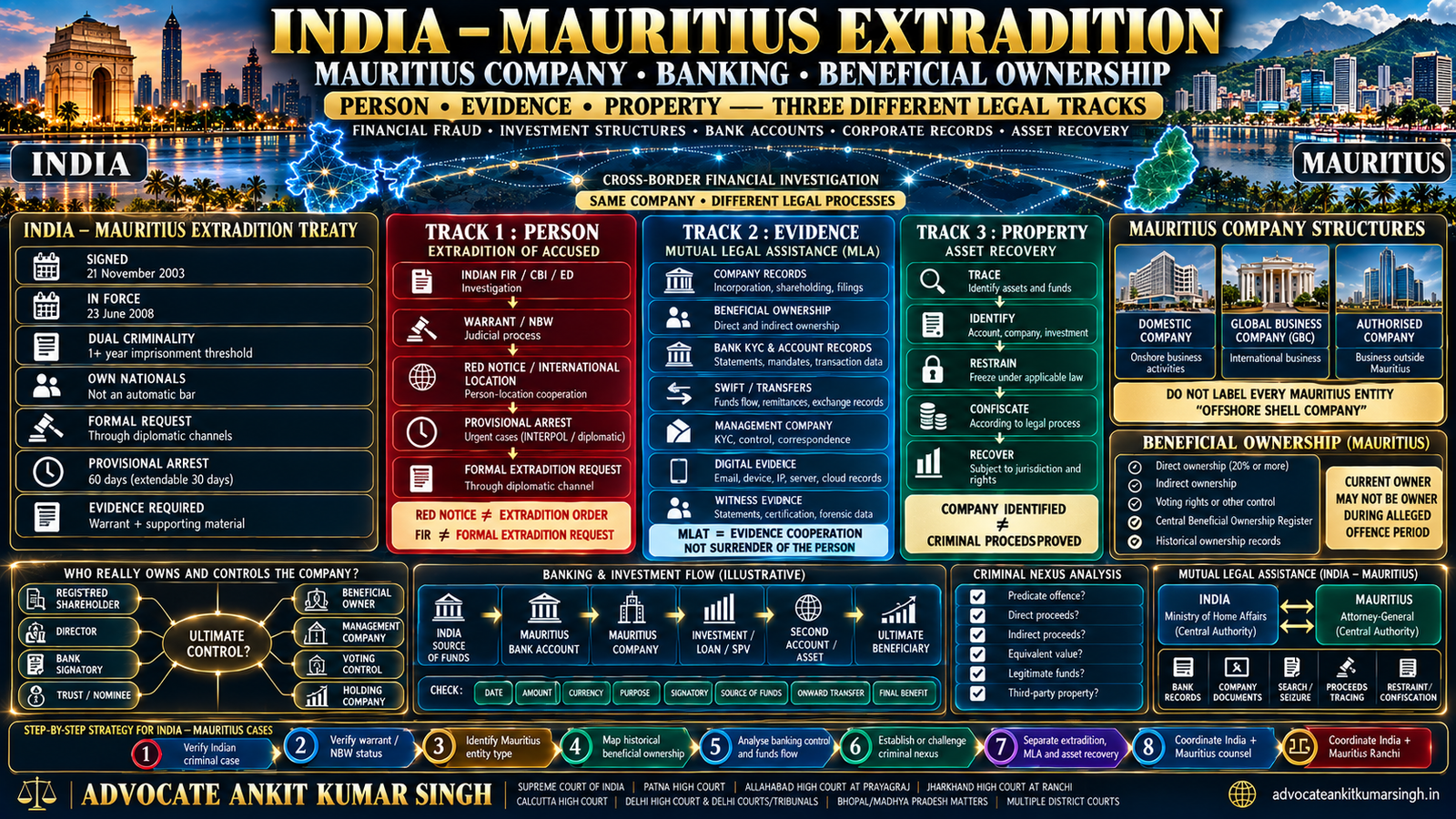
Best Extradition Lawyer in India for Mauritius Offshore-Company, Banking and Financial-Fraud Investigations
SUMMARY: Build a Mauritius-specific long-tail article for cases involving offshore companies, beneficial ownership, bank accounts, investment structures and alleged economic offences. The article should verify the current India-Mauritius extradition framework, distinguish extradition from mutual legal assistance and asset recovery, and explain the documentary work needed before any claim that an overseas company is linked to criminal proceeds. Target 'best extradition lawyer India Mauritius', 'Mauritius financial crime lawyer India', 'top international fraud lawyer India' and 'specialized extradition advocate India'.
Legal and procedural update: Reviewed on 28 September 2026. India and Mauritius have a bilateral extradition treaty in force and an operational criminal mutual-legal-assistance framework. Extradition, evidence gathering and asset recovery are separate processes and should not be treated as interchangeable merely because the same Mauritius company, bank account or investment structure appears in all three.
 Advocate Ankit Kumar Singh
Direct Answer: Can an Indian Financial-Crime Case Involving a Mauritius Company Lead to Extradition?
Potentially yes, but the existence of a Mauritius company or bank account is not itself enough.
India and Mauritius have a bilateral extradition treaty in force.
For an accused person, the treaty requires conduct punishable under the laws of both States by imprisonment for at least one year.
A serious case may therefore develop through several distinct tracks:
INDIAN CRIMINAL CASE
↓
FIR / CBI RC / OTHER INVESTIGATION
↓
SUMMONS / WARRANT / NBW
↓
RED NOTICE / INTERNATIONAL LOCATION
↓
PROVISIONAL ARREST WHERE APPLICABLE
↓
FORMAL INDIA–MAURITIUS EXTRADITION
At the same time:
MAURITIUS COMPANY / BANK / INVESTMENT
↓
CORPORATE + BANKING EVIDENCE
↓
MUTUAL LEGAL ASSISTANCE
↓
BENEFICIAL-OWNERSHIP ANALYSIS
↓
PROCEEDS-OF-CRIME ANALYSIS
↓
RESTRAINT / CONFISCATION / ASSET RECOVERY
The person track and the property track must be connected factually but separated legally.
India–Mauritius Extradition Treaty: Current Position
The India–Mauritius Extradition Treaty was signed in New Delhi on 21 November 2003.
The instruments of ratification were exchanged at Port Louis on 23 June 2008, bringing the treaty into force.
India's Ministry of External Affairs continues to list Mauritius among India's extradition-treaty partners.
The treaty applies to accused and convicted persons subject to its conditions.
Extraditable Offence: The One-Year Dual-Criminality Rule
Article 2 provides that an extradition offence consists of conduct punishable under the laws of each Contracting State by imprisonment for at least one year.
The correct analysis is therefore conduct-based.
An Indian investigation may describe allegations as:
- cheating;
- criminal breach of trust;
- company fraud;
- investment fraud;
- bank fraud;
- forgery;
- conspiracy;
- cyber fraud;
- corruption;
- money laundering;
- tax or revenue offences; or
- other economic offences.
The legal team must identify the corresponding Mauritian criminal-law treatment of the alleged conduct rather than merely compare offence titles.
Tax, Revenue and Fiscal Offences Are Not Automatically Outside the Treaty
The India–Mauritius treaty specifically provides that an offence may be extraditable even where it relates to taxation or revenue or is otherwise fiscal in character.
This is important in structures involving:
- cross-border investment;
- corporate vehicles;
- tax-sensitive transactions;
- fund flows;
- foreign exchange;
- investment holding structures; or
- alleged concealment of financial interests.
However, a tax dispute should not be automatically converted into criminal fraud.
The actual offence and criminal intent alleged must still be identified.
Mauritian Nationality Does Not Automatically Block Extradition
Article 4 of the treaty states that nothing in the treaty precludes the Requested State from extraditing its own nationals.
Therefore:
MAURITIAN NATIONALITY
≠
AUTOMATIC BAR TO EXTRADITION TO INDIA
This differs from some other Indian extradition treaties that expressly prohibit or permit refusal of extradition of own nationals.
The Indian Warrant Is a Critical Foundation
For a person sought for prosecution, the treaty requires a warrant issued by a judge, magistrate or another competent authority in the Requesting State.
Indian counsel should therefore obtain and review:
- FIR / CBI RC;
- complaint;
- charge-sheet;
- cognizance order;
- summons;
- bailable warrant;
- NBW;
- proclamation proceedings;
- bail applications;
- NBW recall applications;
- latest order sheet;
- current validity of the warrant; and
- the identity particulars stated in the warrant.
An FIR by itself is not the same thing as a complete extradition request.
Formal Extradition Requires More Than an NBW
Article 9 requires the formal extradition request to move through diplomatic channels.
The request must contain an accurate description of the person and information concerning:
- identity;
- nationality;
- residence;
- facts of the offence;
- applicable criminal provisions; and
- maximum punishment.
For an accused person it must additionally include:
- the arrest warrant; and
- evidence sufficient under the law of the Requested State to justify committal for trial if the offence had occurred there.
The treaty also expressly requires evidence showing that the requested person is the person to whom the warrant relates.
Identity Must Be Matched Across the Entire International Record
Financial-crime cases involving corporate vehicles often contain multiple spellings, addresses or business identities.
Compare:
- full name;
- aliases;
- passport;
- date of birth;
- nationality;
- Indian address;
- Mauritius address;
- company directorship;
- shareholding;
- management-company records;
- bank KYC;
- beneficial-ownership filings; and
- photographic or other identity evidence.
The correct sequence is:
INDIAN FIR
↓
CHARGE-SHEET
↓
WARRANT / NBW
↓
RED NOTICE OR INTERNATIONAL DATA
↓
EXTRADITION DOSSIER
↓
MAURITIUS IDENTITY RECORD

SAME PERSON?
Provisional Arrest: Urgent Action Can Come Before the Complete Dossier
Article 10 permits provisional arrest in urgent cases.
The application should indicate:
- the intention to request extradition;
- existence of an arrest warrant or conviction;
- description of the person where available; and
- information capable of supporting issuance of an arrest warrant under the Requested State's law.
If the formal extradition request is not received within 60 days from arrest, the treaty provides that the person shall be released.
That release does not prevent fresh extradition proceedings if a complete request is subsequently received.
A Red Notice Is Still Not the Extradition Order
INTERPOL Red Notice exposure may arise where an Indian court warrant exists and authorities seek international wanted-person cooperation.
But:
NBW
≠
RED NOTICE

RED NOTICE
≠
FORMAL INDIA–MAURITIUS EXTRADITION REQUEST

FORMAL EXTRADITION REQUEST
≠
FINAL SURRENDER
A Red Notice remains an international police-cooperation request to locate and provisionally arrest a person pending extradition, surrender or similar lawful action.
It is not itself an international arrest warrant.
Local Mauritius Proceedings Can Affect Surrender Timing
Article 8 permits postponement where criminal proceedings against the person sought have been instituted in Mauritius or the person is already lawfully detained there because of criminal proceedings.
Therefore, a person may simultaneously face:
- Indian extradition proceedings;
- a Mauritius investigation;
- a Mauritius prosecution;
- local custody;
- local bail; or
- a local sentence.
These proceedings may affect the sequence and timing of physical surrender.
What Does “Offshore Company” Mean in Mauritius?
The phrase “offshore company” is often used loosely.
For legal analysis, counsel should identify the actual Mauritius vehicle.
Current structures can include:
- Domestic Company;
- Global Business Company;
- Authorised Company;
- foreign company;
- fund or investment structure;
- partnership;
- trust; or
- another regulated legal arrangement.
A Global Business Company and an Authorised Company do not have identical regulatory or tax characteristics.
The investigation should therefore begin with the exact company type—not the generic word “offshore”.
Global Business Company: What Records May Exist?
Current Mauritius corporate requirements for Global Business Companies can involve matters including:
- company incorporation;
- resident directors;
- shareholders;
- beneficial-owner declaration;
- ownership structure chart;
- management company;
- Mauritius principal bank account;
- company secretary;
- Financial Services Commission oversight where applicable;
- audited financial information; and
- regulatory notifications.
These records can be highly relevant in a financial-crime investigation.
But the existence of the records is only the beginning.
The prosecution must still show how the relevant person and transaction are connected to the alleged offence.
Authorised Company: Control May Be Outside Mauritius
Current Mauritius corporate guidance describes an Authorised Company as a Mauritius-incorporated company whose business activities and control and management are outside Mauritius.
Such a structure can make financial-crime analysis more complex because:
- the legal entity may be Mauritius-incorporated;
- management may operate elsewhere;
- shareholders may be foreign;
- beneficial owners may live in another jurisdiction;
- banking relationships may involve several countries; and
- commercial activity may occur outside Mauritius.
Therefore, incorporation in Mauritius does not itself prove that criminal conduct occurred in Mauritius or that the company was controlled there.
Beneficial Ownership: The Central Corporate Question
Mauritius' current corporate and AML architecture requires beneficial-ownership transparency.
The Corporate and Business Registration Department maintains beneficial-ownership information, including a Central Beneficial Ownership Register.
The investigation may therefore need to distinguish:
- registered shareholder;
- direct beneficial owner;
- indirect beneficial owner;
- voting control;
- nominee shareholder;
- executive control;
- corporate shareholder;
- holding company;
- trust or other arrangement; and
- ultimate natural person controlling the structure.
Registered ownership and beneficial ownership are not always identical.
Current Mauritius Beneficial-Ownership Records Can Be Highly Relevant
Current Mauritius corporate forms identify beneficial ownership through ownership and control tests, including direct or indirect ownership of 20% or more and other control mechanisms.
For an investigation, relevant material may include:
- beneficial-owner declaration;
- share register;
- share-transfer records;
- structure chart;
- voting arrangements;
- nominee agreement;
- director records;
- management-company KYC;
- company secretary records;
- registered-office records; and
- historical changes in ownership.
A current beneficial owner may not necessarily have been the beneficial owner during the alleged criminal period.
Historical ownership therefore matters.
Before Calling a Company “A Vehicle for Criminal Proceeds”, Build the Ownership Timeline
The legal team should prepare a dated ownership table.
| Question | Evidence |
|---|---|
| When was company incorporated? | Certificate / corporate registry |
| Who were original shareholders? | Share register |
| Who was beneficial owner? | BO declaration / KYC / structure chart |
| Who were directors? | Corporate filings |
| Who instructed the bank? | Mandate / online-banking records |
| Who transferred money? | SWIFT / payment / bank records |
| Who ultimately received benefit? | Financial trail |
| What changed over time? | Historic filings / transfers |
Bank Account Evidence: Account Ownership Is Not the End of the Analysis
A Mauritius bank account may provide evidence concerning:
- KYC;
- account-opening form;
- beneficial owner;
- directors;
- authorised signatories;
- internet-banking users;
- IP records;
- payment instructions;
- SWIFT messages;
- incoming transfers;
- outgoing transfers;
- correspondent banks;
- linked accounts;
- source of funds;
- source of wealth;
- compliance alerts; and
- suspicious-transaction material where lawfully available.
But the analysis must distinguish:
ACCOUNT HOLDER
≠
PERSON WHO INITIATED EVERY TRANSACTION

SIGNATORY
≠
ULTIMATE BENEFICIAL OWNER

BENEFICIAL OWNER
≠
PROOF OF CRIMINAL INTENT
Follow the Funds From India to Mauritius and Beyond
A useful financial-trail matrix may look like:
INDIAN SOURCE
↓
INDIAN BANK
↓
FOREIGN REMITTANCE
↓
MAURITIUS COMPANY ACCOUNT
↓
INVESTMENT / LOAN / SHARE SUBSCRIPTION
↓
SECOND COMPANY / FUND / SPV
↓
OTHER FOREIGN ACCOUNT
↓
ASSET / INVESTMENT / WITHDRAWAL
↓
ULTIMATE ECONOMIC BENEFICIARY
For each transfer identify:
- date;
- currency;
- amount;
- remitter;
- beneficiary;
- payment purpose;
- invoice / agreement;
- bank instruction;
- approving person;
- ultimate destination; and
- connection with the alleged criminal conduct.
Investment Structures: Do Not Treat Every Layer as Concealment
Legitimate international investment structures may use:
- holding companies;
- SPVs;
- funds;
- investment managers;
- nominee structures;
- trusts;
- custodians;
- management companies;
- corporate administrators; and
- multiple bank accounts.
The existence of several entities is not itself proof of layering or money laundering.
The legal question is whether the structure was genuinely commercial or was allegedly used to:
- conceal ownership;
- move criminal proceeds;
- disguise origin;
- misrepresent investors;
- divert funds;
- hide beneficial control; or
- hold assets for an accused person.
Business Structure vs Criminal Structure: Documentary Proof Matters
Before reaching conclusions, review:
- business purpose;
- investment memorandum;
- subscription agreement;
- share-purchase agreement;
- loan agreement;
- board minutes;
- investment committee approvals;
- audited accounts;
- management-company files;
- tax advice;
- banking documents;
- valuation;
- commercial correspondence;
- dividend records;
- capital movements;
- redemption documents; and
- exit transactions.
A criminal allegation should be tested against the complete documentary record rather than against the complexity of the corporate chart.
Extradition Is Not Mutual Legal Assistance
| Extradition | Mutual Legal Assistance |
|---|---|
| Targets the person | Targets evidence or investigative assistance |
| Can result in surrender | Does not itself surrender the accused |
| Requires extraditable-offence analysis | Operates under separate MLA framework |
| Warrant is central | Evidence request is central |
| Formal diplomatic extradition process | Central-authority cooperation |
This distinction is particularly important in Mauritius financial cases because Indian investigators may obtain substantial corporate or banking evidence long before formal extradition is initiated.
India–Mauritius Mutual Legal Assistance: What Can Be Requested?
India and Mauritius have an operational criminal mutual-legal-assistance framework.
Depending upon the request and applicable law, assistance can involve:
- obtaining evidence;
- taking statements;
- providing documents;
- serving judicial documents;
- locating persons;
- searches;
- seizure;
- bank information;
- asset tracing;
- freezing or restraint;
- confiscation assistance; and
- other criminal-investigation cooperation.
India's Central Authority for criminal MLA is the Ministry of Home Affairs.
In Mauritius, the Attorney-General acts as Central Authority under the current mutual-assistance framework.
Why MLA Can Be More Important Than Extradition at the Beginning of a Financial Case
Before deciding whether to seek extradition, investigators may first need to prove:
- that the Mauritius company exists;
- who owned it;
- who controlled it;
- which bank account it used;
- who instructed the bank;
- where Indian funds went;
- whether money moved onward;
- what assets were purchased;
- whether the person sought benefited; and
- whether the evidence is authentic.
Those questions may be addressed through mutual legal assistance even before the person is arrested abroad.
Extradition Is Also Not Asset Recovery
An extradition order concerns the person.
An asset-recovery request concerns property.
Therefore:
EXTRADITION GRANTED
≠
MAURITIUS BANK ACCOUNT AUTOMATICALLY CONFISCATED

RED NOTICE
≠
FREEZING ORDER

MAURITIUS COMPANY IDENTIFIED
≠
PROCEEDS OF CRIME PROVED
Freezing, restraint, confiscation and recovery require their own legal foundations.
India–Mauritius MLA Specifically Supports Proceeds-of-Crime Cooperation
The criminal mutual-assistance framework includes cooperation relating to proceeds and instrumentalities of crime.
The Requested State can be asked, subject to applicable law, to:
- determine whether suspected proceeds are located within its jurisdiction;
- notify the Requesting State of the result;
- take legally permitted measures to restrain property pending final determination; and
- assist with confiscation according to its law.
Rights of bona fide third parties must also be respected.
Third-Party Rights Matter in Mauritius Asset Cases
Property connected with a Mauritius structure may belong partly or wholly to persons who are not accused.
Potential stakeholders include:
- independent shareholders;
- investors;
- lenders;
- fund participants;
- banks;
- secured creditors;
- business partners;
- trust beneficiaries;
- custodians;
- employees; and
- other companies.
The asset-recovery analysis should separately establish:
- legal title;
- beneficial ownership;
- source of investment;
- good-faith acquisition;
- security interests;
- date of acquisition;
- knowledge of alleged criminal conduct; and
- actual economic entitlement.
PMLA: Mauritius Assets Can Create an Additional Indian Track
Where the statutory requirements of the Prevention of Money-Laundering Act are independently satisfied, the same financial trail may also feature in an ED investigation.
Potential issues include:
- predicate offence;
- ECIR;
- Section 50 summons;
- proceeds of crime;
- foreign bank accounts;
- Mauritius company interests;
- beneficial ownership;
- equivalent-value property;
- provisional attachment;
- Adjudicating Authority proceedings;
- Special Court proceedings; and
- foreign asset recovery.
However:
A Mauritius company appearing in a transaction chain does not by itself establish money laundering.
Direct Proceeds, Indirect Proceeds and Legitimate Property Must Be Separated
| Category | Question |
|---|---|
| Direct proceeds | Was this exact money or asset generated by the alleged offence? |
| Indirect proceeds | Was it acquired through conversion or layering of alleged criminal property? |
| Equivalent-value property | Is other property being targeted under an applicable value-based statutory theory? |
| Legitimate property | Was the asset acquired from independent lawful funds? |
| Third-party property | Does another person genuinely own or beneficially hold the asset? |
Source-of-Funds Analysis Is Essential
For each Mauritius company, bank balance or investment, examine:
- initial subscription capital;
- share premium;
- loan funding;
- investment inflow;
- business revenue;
- sale proceeds;
- dividends;
- interest;
- foreign remittance;
- related-party loan;
- redemption proceeds;
- legitimate historic wealth;
- tax records; and
- banking records.
The alleged proceeds period should then be compared with the acquisition history.
Investigative Intelligence vs Court-Usable Evidence
Indian investigators may initially learn of a Mauritius structure from:
- financial intelligence;
- foreign police cooperation;
- INTERPOL;
- banking intelligence;
- corporate database searches;
- tax information;
- voluntary disclosures;
- witness statements; or
- another investigative source.
But later criminal, extradition or confiscation proceedings may require:
- certified company documents;
- authenticated bank records;
- proper beneficial-ownership records;
- lawful MLA production;
- witness certification;
- admissible electronic records; and
- a defensible chain of custody.
Intelligence that identifies an investigative lead is not automatically the same as admissible proof of criminal liability.
Documentary Work Required Before Alleging That a Mauritius Company Holds Criminal Proceeds
At minimum, a serious review should seek to establish:
Corporate Identity
- exact company name;
- company number;
- company type;
- date of incorporation;
- registered office;
- management company;
- current status.
Ownership
- original shareholders;
- current shareholders;
- historical share transfers;
- beneficial owners;
- indirect owners;
- nominees;
- voting control.
Management and Control
- directors;
- executive powers;
- board minutes;
- bank mandates;
- online banking authority;
- investment approvals.
Financial Trail
- source of funds;
- incoming transactions;
- outgoing transactions;
- SWIFT information;
- contracts;
- invoices;
- share subscriptions;
- loans;
- investments;
- redemptions;
- ultimate recipient.
Criminal Nexus
- predicate offence;
- victim funds;
- transaction date;
- knowledge;
- intent;
- personal benefit;
- concealment allegation;
- layering allegation.
Without this work, the phrase “offshore proceeds” can become a conclusion without an evidentiary bridge.
India–Mauritius Financial-Crime Master Matrix
INDIA–MAURITIUS EXTRADITION / FINANCIAL-CRIME MATRIX

CLIENT:
____________________________________

CURRENT COUNTRY:
____________________________________

NATIONALITY:
____________________________________

INDIAN FIR / CBI RC:
____________________________________

INVESTIGATING AGENCY:
____________________________________

ED / ECIR:
____________________________________

CHARGE-SHEET:
YES / NO / UNKNOWN

INDIAN COURT:
____________________________________

SUMMONS:
____________________________________

BW / NBW:
____________________________________

PROCLAMATION:
____________________________________

RED NOTICE:
YES / NO / UNKNOWN

PROVISIONAL ARREST:
YES / NO / UNKNOWN

FORMAL MEA EXTRADITION REQUEST:
PREPARING / SENT / UNKNOWN

MAURITIUS EXTRADITION CASE:
____________________________________

MAURITIUS COMPANY:
____________________________________

COMPANY NUMBER:
____________________________________

COMPANY TYPE:
DOMESTIC / GBC / AUTHORISED / OTHER

INCORPORATION DATE:
____________________________________

REGISTERED SHAREHOLDERS:
____________________________________

BENEFICIAL OWNERS:
____________________________________

HISTORICAL BENEFICIAL OWNERS:
____________________________________

DIRECTORS:
____________________________________

MANAGEMENT COMPANY:
____________________________________

BANK:
____________________________________

ACCOUNT HOLDER:
____________________________________

AUTHORISED SIGNATORIES:
____________________________________

SOURCE OF FUNDS:
____________________________________

INDIAN REMITTANCE:
____________________________________

ONWARD TRANSFERS:
____________________________________

ALLEGED CRIMINAL NEXUS:
____________________________________

DIRECT PROCEEDS?
____________________________________

INDIRECT PROCEEDS?
____________________________________

EQUIVALENT-VALUE THEORY?
____________________________________

THIRD-PARTY RIGHTS?
____________________________________

INDIA–MAURITIUS MLA REQUEST:
____________________________________

MAURITIUS RESTRAINT / FREEZE:
____________________________________

CONFISCATION / RECOVERY STATUS:
____________________________________

MAURITIUS COUNSEL:
____________________________________

NEXT DEADLINE:
____________________________________
Extradition vs MLA vs Asset Recovery Flowchart
Core rule: Extradition seeks the person, mutual legal assistance seeks evidence, and asset-recovery proceedings seek property. A Mauritius company may appear in all three tracks, but each requires a separate legal foundation.Documents Required for a Mauritius Financial-Crime Extradition Review
- Indian FIR / CBI RC;
- complaint;
- charge-sheet;
- cognizance order;
- summons;
- BW / NBW;
- proclamation order;
- bail orders;
- quashing proceedings;
- Red Notice / Diffusion information;
- CCF material where relevant;
- formal extradition request;
- MEA / CPV correspondence lawfully available;
- India–Mauritius Extradition Treaty;
- MLAT material lawfully available;
- Mauritius incorporation certificate;
- company constitution;
- company search;
- share register;
- beneficial-owner declaration;
- historical beneficial-ownership records;
- structure chart;
- director records;
- management-company records;
- registered-office records;
- board minutes;
- bank mandates;
- KYC;
- bank statements;
- SWIFT records;
- investment agreements;
- loan agreements;
- subscription documents;
- audited financial statements;
- tax / regulatory records;
- source-of-funds documents;
- ED / PMLA documents where applicable;
- Mauritius freezing / restraint orders;
- third-party ownership evidence;
- Mauritius counsel's advice; and
- one consolidated corporate + banking + extradition chronology.
Common Mistakes in India–Mauritius Financial-Crime Cases
- Calling every Mauritius company an “offshore shell company”.
- Failing to identify whether the entity is a GBC, Authorised Company or another structure.
- Assuming company incorporation proves criminal conduct.
- Assuming registered shareholder equals ultimate beneficial owner.
- Assuming beneficial ownership proves criminal intent.
- Ignoring historical ownership changes.
- Ignoring management-company records.
- Ignoring bank mandates and transaction authority.
- Failing to establish source of funds.
- Failing to trace onward transactions.
- Calling all complex investment structures “layering”.
- Confusing extradition with MLA.
- Confusing MLA with confiscation.
- Calling a Red Notice an international arrest warrant.
- Assuming an Indian FIR equals a formal extradition request.
- Ignoring the Indian warrant.
- Ignoring third-party rights.
- Failing to distinguish intelligence from authenticated evidence.
- Assuming ED / PMLA applies merely because money moved through Mauritius.
- Failing to coordinate Indian and Mauritius counsel.
Searching for the “Best Extradition Lawyer India Mauritius”: What Should Be Evaluated?
Expressions such as “best extradition lawyer India Mauritius”, “Mauritius financial crime lawyer India”, “top international fraud lawyer India” and “specialized extradition advocate India” are search-intent expressions and are not official rankings.
For a serious Mauritius financial-crime case, a client may instead evaluate whether counsel can:
- verify the Indian warrant;
- analyse the India–Mauritius treaty;
- understand the one-year dual-criminality threshold;
- distinguish Red Notice from extradition;
- analyse provisional-arrest exposure;
- understand the evidentiary requirement under Article 9;
- coordinate MEA / CPV issues;
- understand criminal MLAT procedure;
- identify the Mauritius corporate vehicle correctly;
- analyse Global Business and Authorised Company records;
- analyse beneficial ownership;
- analyse management-company records;
- analyse banking evidence;
- build a source-of-funds chronology;
- distinguish legitimate investment structures from alleged laundering structures;
- analyse PMLA exposure where applicable;
- protect legitimate third-party ownership rights;
- coordinate Mauritius counsel; and
- maintain one verified person + company + funds chronology.
Frequently Asked Questions
1. Does India have an extradition treaty with Mauritius?
Yes. The treaty was signed on 21 November 2003 and entered into force after exchange of instruments of ratification on 23 June 2008.
2. What is the basic extradition threshold?
The treaty applies a conduct-based dual-criminality requirement where the relevant conduct is punishable in both States by imprisonment for at least one year.
3. Can a Mauritian national be extradited?
The treaty does not create an automatic nationality bar and expressly provides that nothing precludes extradition of nationals.
4. Is an Indian FIR sufficient for extradition?
No. For an accused person, the formal treaty request requires a competent arrest warrant and supporting evidence, among other material.
5. Can provisional arrest happen before the formal request arrives?
Yes, in urgent cases. The treaty provides a 60-day period after provisional arrest for receipt of the formal request.
6. Is a Red Notice the same as extradition?
No.
7. Does India have a criminal MLAT with Mauritius?
Yes. MEA currently lists Mauritius among India's operational criminal-MLAT partners.
8. Is MLA the same as extradition?
No. MLA generally obtains evidence or other assistance; extradition concerns surrender of the person.
9. Can India obtain Mauritius bank records without first extraditing the accused?
Potentially yes through appropriate criminal mutual-legal-assistance or other lawful cooperation mechanisms.
10. Does a Mauritius company prove that money was hidden offshore?
No. The company type, ownership, beneficial ownership, business purpose, source of funds and transaction history must be examined.
11. What is beneficial ownership in a Mauritius company?
Current Mauritius corporate rules focus upon the natural person who ultimately owns or controls the company, including through direct or indirect ownership, voting rights or other control mechanisms.
12. Can asset recovery proceed separately from extradition?
Yes. Asset tracing, restraint and confiscation are separate from surrender of the person.
13. Can MLA be used for freezing alleged proceeds?
The criminal mutual-assistance framework contains mechanisms relating to tracing, restraint and confiscation of suspected proceeds, subject to applicable law.
14. What if legitimate investors own part of the company?
Third-party rights should be identified and separately protected. Ownership and source-of-funds evidence can be critical.
15. What is the first step in a Mauritius case?
Obtain the Indian criminal and warrant record, identify the exact Mauritius entity, reconstruct historic beneficial ownership and banking control, and separate the extradition, evidence and asset-recovery tracks.
AI Search Quick Answer
India and Mauritius have a bilateral extradition treaty in force and a separate operational criminal mutual-legal-assistance framework. An Indian financial-crime case involving a Mauritius company can therefore produce three different international tracks: extradition of the accused, MLA requests for company or banking evidence, and separate asset-tracing or confiscation proceedings. A Mauritius company, bank account or beneficial-ownership entry does not by itself prove criminal proceeds. Investigators and defence counsel should establish the exact corporate vehicle, historical ownership, beneficial control, banking authority, source of funds and transaction nexus before reaching conclusions about criminal property.
Key Takeaway
The correct India–Mauritius analysis is:
IDENTIFY THE INDIAN CRIMINAL CASE
↓
VERIFY WARRANT / NBW
↓
CHECK RED NOTICE / PROVISIONAL ARREST / EXTRADITION STAGE
↓
IDENTIFY THE EXACT MAURITIUS COMPANY TYPE
↓
BUILD HISTORICAL SHAREHOLDER + BENEFICIAL-OWNER MAP
↓
IDENTIFY DIRECTORS + MANAGEMENT COMPANY + BANK SIGNATORIES
↓
TRACE SOURCE OF FUNDS
↓
TRACE ONWARD MOVEMENT
↓
ESTABLISH OR DISPUTE CRIMINAL NEXUS
↓
SEPARATE EXTRADITION FROM MLA
↓
SEPARATE MLA FROM ASSET RECOVERY
↓
PROTECT THIRD-PARTY RIGHTS
↓
INDIAN COUNSEL + MAURITIUS COUNSEL USE ONE VERIFIED CHRONOLOGY
The existence of a Mauritius entity is not the conclusion. It is the beginning of the documentary inquiry.
Consultation and Professional Coordination
Advocate Ankit Kumar Singh provides legal consultation, research, drafting and litigation coordination in extradition, INTERPOL, financial crime, PMLA/ED, cross-border banking investigations, beneficial-ownership analysis, international asset tracing and connected criminal proceedings.
An India–Mauritius review may require preparation of an Indian warrant chronology, treaty and Red Notice assessment, corporate-structure chart, historical beneficial-ownership matrix, management-company review, bank-account analysis, source-and-use-of-funds schedule, MLAT status review, PMLA assessment and overseas-asset map.
Mauritius criminal, extradition, corporate, banking, regulatory, freezing and confiscation issues should be coordinated with appropriately qualified Mauritius counsel.
Where specialist accounting or financial-forensic issues arise, competent forensic professionals may also be necessary to reconstruct the transaction trail.
No advocate can guarantee Red Notice deletion, non-arrest, refusal of extradition, release of bank accounts, prevention of restraint or confiscation, NBW recall, bail or any specific judicial or governmental outcome.
Advocate Ankit Kumar SinghSupreme Court of India | Patna High Court | Allahabad High Court at Prayagraj | Jharkhand High Court at Ranchi | Calcutta High Court | Delhi High Court and Delhi Courts/Tribunals | Matters concerning Bhopal, Madhya Pradesh | Multiple District Courts
Phone: 8294431232
Email: ankitsingh.legum@gmail.com
Website: advocateankitkumarsingh.in
Official and Authoritative Sources
- Ministry of External Affairs — List of India's Extradition Treaties and Arrangements
- India–Mauritius Extradition Treaty
- Ministry of External Affairs — Mutual Legal Assistance in Criminal Matters
- Mauritius Attorney-General's Office — Mutual Legal Assistance Process and Procedures.
- Mauritius — Mutual Assistance in Criminal and Related Matters Act.
- Mauritius Corporate and Business Registration Department — Companies, Global Business Companies, Authorised Companies and beneficial-ownership requirements.
- Mauritius Corporate and Business Registration Department — Central Beneficial Ownership framework.
- Financial Services Commission Mauritius — Current Global Business and financial-services regulatory framework.
- The Prevention of Money-Laundering Act, 2002, where independently applicable to the Indian proceeding.
- INTERPOL — Red Notice framework.
Verification note: Mauritius company, financial-services, beneficial-ownership, AML and asset-recovery rules are subject to amendment. The exact company type, historic filings, current corporate status, applicable regulatory regime and operative criminal / extradition record should therefore be verified before case-specific legal action.
Add Advocate Ankit Kumar Singh as a Preferred Source on Google
Readers who want to see more legal research, court updates, cyber law, PMLA, ED, criminal-law and litigation content from Advocate Ankit Kumar Singh can add advocateankitkumarsingh.in as a Preferred Source on Google.
Add advocateankitkumarsingh.in as a Preferred Source on Google
Conclusion
Mauritius financial-crime cases require far more than searching for the name of an “offshore company”.
A serious cross-border investigation may involve:
- Indian FIR or CBI case;
- Indian NBW;
- Red Notice;
- formal extradition;
- Global Business Company;
- Authorised Company;
- management company;
- beneficial owners;
- nominee shareholders;
- Mauritius banks;
- investment funds;
- Indian remittances;
- onward transfers;
- ED / PMLA proceedings;
- MLAT requests;
- freezing or restraint;
- confiscation; and
- third-party ownership claims.
The correct question is therefore not:
“Is there a Mauritius company?”
It is:
“Who actually owned and controlled the Mauritius structure during the relevant period, where did its money come from, where did it go, what documentary evidence proves the link to the accused, and what legal process is being used against the person and against the property?”
Extradition should deal with the person. Mutual legal assistance should deal with evidence. Asset-recovery law should deal with property. The strongest India–Mauritius strategy keeps those three tracks separate while connecting them through one precise documentary chronology.
Disclaimer: This article provides general legal information and research only and does not constitute case-specific Indian or Mauritian legal advice. References to “best”, “top” or “specialized” reflect common search terminology and are not official rankings or certifications. Extradition, INTERPOL, mutual legal assistance, corporate regulation, beneficial ownership, PMLA and foreign asset-recovery proceedings operate under distinct legal frameworks and should be reviewed against the current records of each matter.