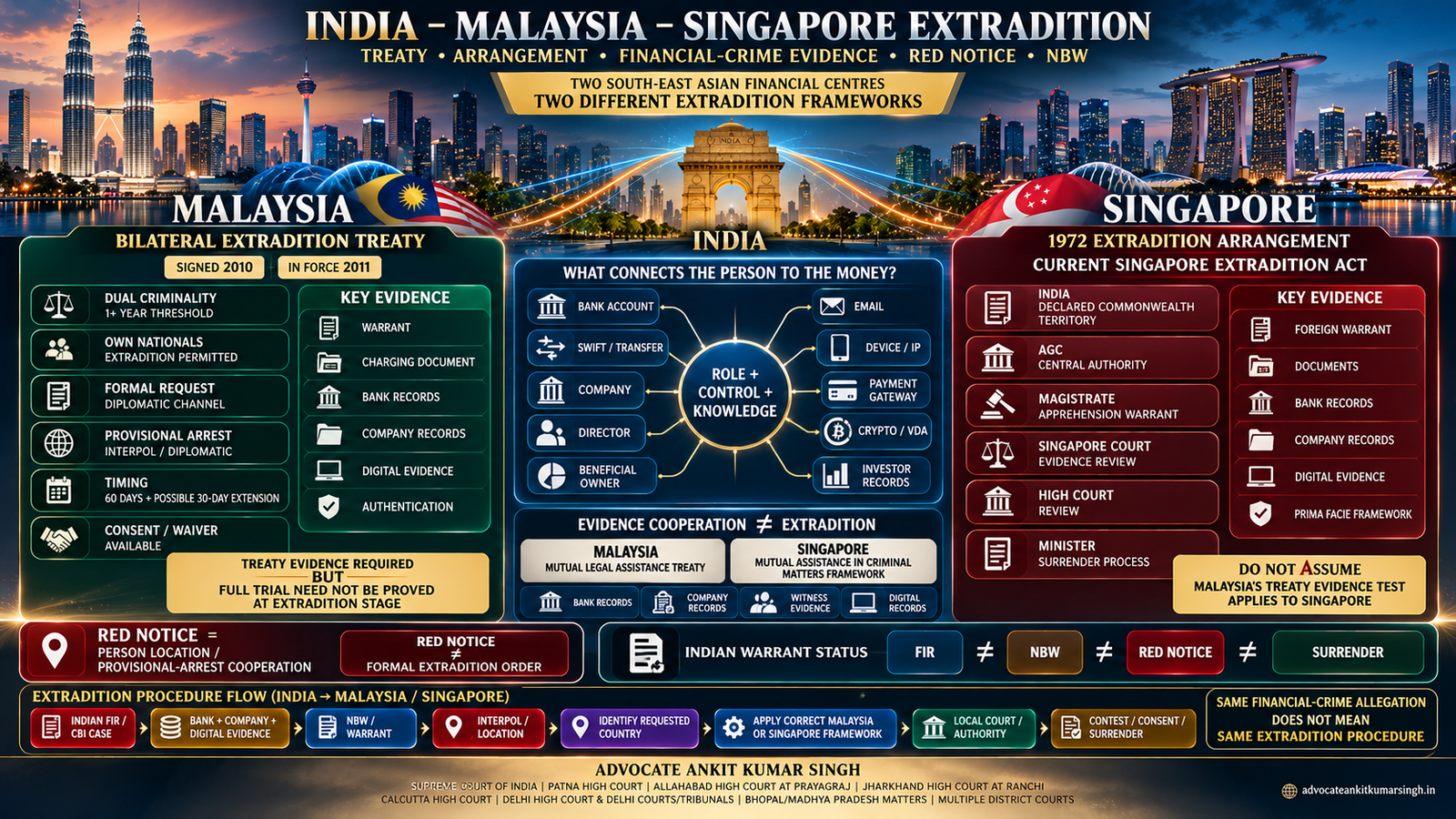
Prominent Extradition Lawyer in India for Malaysia and Singapore Financial-Crime Cases: Treaty, Arrangement and Evidence Strategy Compared
SUMMARY: Create a South-East Asia commercial-intent article comparing India-linked extradition exposure involving Malaysia and Singapore. Require publication-date verification of the applicable treaty or arrangement and focus on financial fraud, cybercrime, company records, banking evidence, dual criminality, provisional steps and coordination with local counsel. Target 'prominent extradition lawyer India Malaysia', 'Singapore extradition lawyer India', 'best cross-border financial crime lawyer India' and 'expert INTERPOL advocate India'.
Legal and procedural update: Reviewed on 28 September 2026. India currently has a bilateral extradition treaty in force with Malaysia. Singapore remains an extradition-arrangement jurisdiction rather than a bilateral India–Singapore treaty jurisdiction. Singapore currently treats India as a declared Commonwealth territory under its Extradition Act 1968.
 Advocate Ankit Kumar Singh
Direct Answer: Is Extradition From Malaysia and Singapore to India Governed by the Same Legal Framework?
No.
The most important starting distinction is:
MALAYSIA
=
BILATERAL INDIA–MALAYSIA EXTRADITION TREATY

SINGAPORE
=
1972 INDIA–SINGAPORE EXTRADITION ARRANGEMENT
+
CURRENT SINGAPORE EXTRADITION ACT
That distinction affects:
- how the request is legally structured;
- which evidentiary provisions apply;
- how the foreign court examines the case;
- how provisional arrest operates;
- what documents Indian authorities should prepare;
- how local counsel should respond; and
- whether the person should contest, consent, return voluntarily or pursue another lawful strategy.
Malaysia: India Has a Formal Extradition Treaty
The India–Malaysia Extradition Treaty was signed on 20 January 2010 and entered into force on 13 February 2011.
The treaty creates reciprocal obligations to extradite persons accused or convicted of extraditable offences, subject to its requirements and refusal grounds.
The treaty therefore supplies a detailed bilateral framework covering:
- extraditable offences;
- nationality;
- jurisdiction;
- restrictions on surrender;
- deferred surrender;
- documentation;
- provisional arrest;
- additional documentation;
- authentication;
- waiver;
- surrender;
- speciality; and
- consultation between the two governments.
Singapore: India Has an Extradition Arrangement, Not a Bilateral Extradition Treaty
India's Ministry of External Affairs currently lists Singapore among countries with which India has an extradition arrangement, with the year shown as 1972.
On 20 January 1972, India issued a notification applying the provisions of the Extradition Act, 1962—other than Chapter III—to Singapore.
Singapore's current legal framework separately treats India as a declared Commonwealth territory under the Singapore Extradition Act 1968.
Therefore:
DO NOT CITE A NON-EXISTENT MODERN INDIA–SINGAPORE BILATERAL EXTRADITION TREATY.
The correct analysis is:
INDIAN EXTRADITION ACT
+
1972 ARRANGEMENT
+
CURRENT SINGAPORE EXTRADITION ACT
+
CURRENT SINGAPORE PROCEDURE
Malaysia vs Singapore: Core Legal Comparison
| Issue | Malaysia | Singapore |
|---|---|---|
| Legal basis | Bilateral extradition treaty | 1972 extradition arrangement + current domestic legislation |
| Current MEA classification | Extradition Treaty | Extradition Arrangement |
| Formal foreign authority | Malaysia's competent / executive authorities including Attorney General's Chambers within treaty structure | Singapore Attorney-General's Chambers acts as Central Authority for formal extradition requests |
| Person accused | Treaty requirements apply | Singapore Extradition Act procedures apply |
| Evidence structure | Detailed treaty documentation and evidentiary rules | Current Singapore statutory judicial-evidence framework |
| Provisional arrest | Express treaty mechanism | Singapore statutory warrant / apprehension procedure |
Malaysia: Extraditable Offence and Dual Criminality
Under Article 2 of the India–Malaysia treaty, an offence is extraditable where it is punishable under the laws of both Contracting States by imprisonment for at least one year or with death.
The treaty also makes clear that:
- attempt;
- conspiracy; and
- abetment
can fall within the extradition framework where the underlying offence qualifies.
Importantly, the treaty expressly provides that extraditability does not fail simply because the two countries:
- categorise the offence differently;
- use different terminology; or
- define the constituent elements differently.
The totality of the alleged acts or omissions is considered.
Singapore: Offence Matching Must Be Analysed Under the Current Extradition Act
Singapore's current extradition legislation governs the surrender of fugitives to declared Commonwealth territories such as India.
Accordingly, counsel should not merely compare the Indian IPC / BNS / IT Act / PMLA section with a similarly named Singapore provision.
The analysis should examine:
- the alleged conduct;
- the Singapore offence that corresponds to that conduct;
- applicable punishment;
- statutory exclusions;
- political-offence restrictions;
- speciality protections;
- evidentiary standard; and
- current surrender restrictions under Singapore law.
Financial Fraud: Compare Conduct, Not Labels
A cross-border case may be described in India as:
- cheating;
- criminal breach of trust;
- fraud;
- forgery;
- conspiracy;
- cyber fraud;
- bank fraud;
- company fraud;
- investment fraud;
- money laundering; or
- misappropriation.
The extradition lawyer should ask:
- What exactly was represented?
- Who made the representation?
- Who received the money?
- Who controlled the beneficiary account?
- What company held the funds?
- What document is alleged to be false?
- Was dishonest intention alleged from inception?
- What did the accused personally do?
- Is corresponding conduct criminal in Malaysia or Singapore?
Malaysia: Extradition of Own Nationals Is Permissible
The India–Malaysia treaty expressly provides that extradition of a State's own national is permissible.
Where extradition of an own national is not granted and the applicable domestic law permits, the Requested State may submit the case to its competent authorities for prosecution.
Therefore:
MALAYSIAN NATIONALITY
≠
AUTOMATIC BAR TO EXTRADITION TO INDIA
Nationality is determined by the treaty by reference to the relevant time stated in the treaty.
Singapore: Do Not Import Malaysia's Nationality Clause
Singapore does not operate under the India–Malaysia treaty.
Accordingly, Malaysia's treaty language concerning own nationals cannot simply be copied into a Singapore opinion.
For a Singapore-based client, counsel should analyse:
- current Singapore Extradition Act;
- the 1972 India–Singapore arrangement;
- citizenship / nationality;
- statutory restrictions on surrender;
- current Ministerial and judicial procedure; and
- the client's local legal position.
Malaysia: What Must Accompany the Formal Extradition Request?
The India–Malaysia treaty requires a written request transmitted through diplomatic channels.
For a person sought for prosecution, supporting material includes:
- accurate description of the person;
- identity;
- nationality;
- location information;
- facts of the offence;
- applicable criminal law;
- penalty;
- arrest warrant or apprehension order;
- charging document or detailed report / statement of the alleged acts;
- time and place of commission; and
- evidence satisfying the treaty's requested-State evidentiary requirement.
The Indian warrant therefore remains a critical document.
Malaysia: The Treaty Does Not Require India to Prove the Trial Case in the Extradition Court
The Malaysia treaty requires meaningful evidentiary support.
At the same time, Article 8 expressly provides that neither State shall require the other State, as a treaty condition, to prove a prima facie case against the person sought.
This does not mean that no evidence is required.
The treaty still requires information and evidence capable of satisfying the treaty standard.
The defence should therefore examine:
- what evidence was actually supplied;
- whether it identifies the accused;
- whether it identifies the alleged role;
- whether the documents are properly authenticated;
- whether the alleged acts support the extradition offence; and
- whether additional documentation has been requested.
Malaysia: Provisional Arrest Can Precede the Full Dossier
Article 9 of the treaty permits provisional arrest in urgent cases before presentation of the complete extradition request.
The application may be forwarded through:
- diplomatic channels; or
- INTERPOL.
The request should contain:
- description of the person;
- location where known;
- case facts;
- offence;
- relevant law;
- existence or copy of warrant / conviction; and
- confirmation that the formal extradition request will follow.
A person provisionally arrested may be discharged after 60 days if the formal request and supporting documents have not arrived.
Upon application, that period may be extended for up to a further 30 days.
Malaysia: Consensual Surrender Is Expressly Recognised
The treaty expressly provides for waiver of extradition proceedings.
Where the person sought:
- consents to return; and
- has personally been advised by a competent judicial authority of the effect of that consent,
the Requested State may surrender the person without further extradition proceedings.
This can create a strategic option where the client wishes to address the Indian criminal case rather than litigate extradition for an extended period.
But consent should never be given without advice from competent Malaysian counsel and a prepared Indian bail / surrender plan.
Singapore: Formal Requests Go Through the Attorney-General's Chambers
Singapore's Attorney-General's Chambers states that it is Singapore's Central Authority and processes formal extradition requests.
Completed requests may be transmitted through diplomatic channels.
In urgent matters, Singapore AGC states that a copy can additionally be sent directly to the Central Authority, while the original should still follow through diplomatic channels.
Indian counsel should therefore distinguish:
POLICE / INTERPOL COMMUNICATION
≠
COMPLETE FORMAL EXTRADITION REQUEST
Singapore: Arrest Can Occur Through Its Statutory Warrant Procedure
Singapore's current Extradition Act allows a Magistrate to issue a warrant for apprehension where the statutory requirements are satisfied.
The Magistrate considers whether the material produced would justify apprehension or issuance of a warrant under Singapore law if the relevant conduct had occurred within Singapore's jurisdiction.
This means that urgent arrest risk should be analysed under the Singapore statutory framework rather than by assuming that Malaysia's 60-day treaty mechanism applies.
Singapore: Court Evidence Strategy Can Be More Important Than the Label “Red Notice”
A person may first become aware of the case through an INTERPOL alert.
But once formal surrender proceedings begin in Singapore, the legal focus shifts toward the Extradition Act and evidence produced in court.
Singapore law includes provisions concerning:
- foreign warrants;
- overseas documents;
- authentication;
- prima facie assessment;
- record-of-case procedure where legally available;
- review by the General Division of the High Court;
- possible Court of Appeal reference; and
- Ministerial surrender decision.
Singapore: Do Not Automatically Assume the “Record of the Case” Route Applies to India
Section 44 of Singapore's current Extradition Act permits a record-of-case evidentiary mechanism where:
- an applicable extradition treaty provides for it; or
- an agreement or arrangement with a declared Commonwealth territory provides an alternative evidential mechanism.
Therefore, counsel should verify the legal basis actually relied upon in the India request.
The correct question is:
“What evidence mechanism applies to this particular India–Singapore surrender proceeding?”
It should not be assumed from a foreign treaty or another Singapore extradition case.
Banking Evidence: Follow the Complete Money Trail
Financial-crime extradition cases often turn on bank records.
Relevant documents may include:
- account-opening forms;
- KYC;
- beneficial-owner declarations;
- signatory mandates;
- internet-banking login records;
- IP addresses;
- OTP records;
- SWIFT messages;
- wire-transfer instructions;
- payment-gateway records;
- merchant accounts;
- bank statements;
- cash withdrawals;
- loan records;
- company resolutions;
- correspondent-bank information; and
- foreign remittance records.
The defence should distinguish:
ACCOUNT OWNERSHIP
from
TRANSACTION CONTROL
and from
KNOWLEDGE OF THE ALLEGED FRAUD.
Company Records: Director Does Not Automatically Mean Personal Criminal Liability
Malaysia and Singapore are major corporate and financial centres.
Cross-border investigations may involve:
- company incorporation;
- directors;
- shareholders;
- company secretary records;
- registered office;
- beneficial owners;
- bank mandates;
- board resolutions;
- subsidiaries;
- related-party transactions;
- inter-company loans;
- invoice chains;
- audited accounts;
- management accounts; and
- tax records.
A person's designation as director, shareholder or employee does not by itself answer:
- who negotiated the transaction;
- who made the alleged false statement;
- who instructed the bank;
- who controlled the funds;
- who benefited; and
- who possessed the required criminal intention.
Beneficial Ownership Can Be More Important Than Registered Ownership
Financial-crime investigations increasingly analyse control rather than merely the name appearing on a certificate.
Relevant questions include:
- Who contributed the capital?
- Who controls voting?
- Who appoints directors?
- Who instructs the bank?
- Who receives dividends?
- Who has disposal authority?
- Is there a nominee shareholder?
- Is there a trust or holding company?
- Who ultimately receives economic benefit?
But beneficial-ownership allegations should be supported by evidence, not inferred merely from personal relationships or business association.
Cybercrime Evidence: Malaysia and Singapore Cases Can Depend on Digital Attribution
For online fraud, investment fraud or impersonation cases, investigators may rely upon:
- IP logs;
- server records;
- domain-registration records;
- cloud accounts;
- emails;
- WhatsApp / Telegram records;
- mobile extraction;
- computer extraction;
- IMEI;
- SIM records;
- VPN evidence;
- login history;
- cryptocurrency records;
- exchange KYC;
- digital signatures;
- payment links;
- online banking; and
- platform records.
The central question remains:
Does the digital record prove the identity and role of the person whose extradition is sought?
Mutual Legal Assistance Is Different From Extradition
International financial investigations usually require both person-focused and evidence-focused cooperation.
| Extradition | Mutual Legal Assistance |
|---|---|
| Returns the person | Obtains evidence / assistance |
| Requires surrender process | Can operate while person remains abroad |
| Focuses on warrant and extraditable offence | Focuses on records, testimony, searches, production or restraint |
| Foreign court / executive decision | Foreign competent authority executes assistance request |
India and Malaysia have a separate bilateral Mutual Legal Assistance Treaty in criminal matters.
Singapore law also provides a mutual-assistance framework under which India is currently declared a prescribed foreign country.
Why Mutual Legal Assistance Matters Before Extradition
Investigators may obtain foreign evidence before seeking surrender.
Examples include:
- bank statements;
- corporate records;
- server information;
- witness statements;
- KYC;
- beneficial ownership;
- transaction records;
- email data;
- device records;
- crypto-exchange records; and
- asset information.
The fact that Malaysia or Singapore has supplied investigative material does not mean extradition has already begun.
Investigative Intelligence vs Court-Usable Evidence
This distinction is crucial.
An Indian agency may first receive information through:
- INTERPOL;
- foreign police liaison;
- BHARATPOL;
- regulatory cooperation;
- voluntary corporate disclosure; or
- financial intelligence.
Later, the prosecution may need:
- formal certification;
- authentication;
- MLAT production;
- foreign judicial orders;
- witness evidence;
- chain of custody; or
- properly admissible electronic records.
Extradition counsel should know which category each document belongs to.
Red Notice: Separate It From the Extradition Request
INTERPOL defines a Red Notice as an international request to locate and provisionally arrest a wanted person pending extradition, surrender or similar legal action.
A Red Notice is not an international arrest warrant.
Therefore:
INDIAN FIR
≠
NBW

NBW
≠
RED NOTICE

RED NOTICE
≠
FORMAL EXTRADITION REQUEST

FORMAL REQUEST
≠
FINAL SURRENDER
Malaysia: Red Notice and Provisional Arrest Can Operate Before Full Extradition
The India–Malaysia treaty expressly allows a provisional-arrest request to be transmitted through INTERPOL.
This is significant where Indian authorities believe:
- the person may move to another country;
- the person's location has just been confirmed;
- the formal dossier is still being completed; or
- urgent detention is considered necessary.
The defence should therefore determine:
RED NOTICE?
PROVISIONAL ARREST?
FORMAL DOSSIER?
COURT PROCEEDING?
These may be four different stages.
Singapore: Interpol Alert Does Not Replace the Singapore Court Process
Even where INTERPOL facilitates identification or location, Singapore's domestic legal framework controls apprehension and surrender.
Once the process enters Singapore's courts, local counsel should examine:
- the Minister's notice;
- the Magistrate's warrant;
- the foreign warrant;
- identity evidence;
- evidence supporting the alleged extradition offence;
- surrender restrictions;
- bail;
- High Court review; and
- any further appellate or Ministerial stage.
Local Criminal Proceedings Can Complicate the Return Strategy
A person living in Malaysia or Singapore may simultaneously face a local criminal matter.
The Indian and foreign cases may involve:
- different victims;
- different companies;
- different transactions;
- different offences;
- local bail;
- local custody;
- local sentence;
- passport restrictions; and
- immigration consequences.
The legal team must determine whether local proceedings:
- delay surrender;
- affect bail;
- prevent departure;
- generate competing custody claims; or
- require sequential prosecution.
Indian Warrant Status Must Be Checked Before Anything Else
For either Malaysia or Singapore, obtain:
- FIR / CBI RC;
- complaint;
- charge-sheet;
- cognizance order;
- summons;
- BW;
- NBW;
- proclamation order;
- bail order;
- quashing order;
- latest order sheet;
- passport / LOC records where relevant; and
- current warrant status.
A cancelled or recalled warrant materially changes the international analysis.
Build an Evidence-to-Accused Matrix
FINANCIAL-CRIME EVIDENCE MATRIX

CLIENT:
____________________________________

COUNTRY:
MALAYSIA / SINGAPORE

INDIAN FIR / CBI RC:
____________________________________

INDIAN COURT:
____________________________________

NBW:
____________________________________

RED NOTICE:
____________________________________

FORMAL EXTRADITION:
____________________________________

ALLEGED ROLE:
____________________________________

COMPANY:
____________________________________

DIRECTORSHIP:
____________________________________

SHAREHOLDING:
____________________________________

BENEFICIAL OWNERSHIP:
____________________________________

BANK ACCOUNT:
____________________________________

AUTHORISED SIGNATORY:
____________________________________

ONLINE BANKING USER:
____________________________________

SWIFT / WIRE RECORD:
____________________________________

PAYMENT GATEWAY:
____________________________________

EMAIL EVIDENCE:
____________________________________

DEVICE / IP EVIDENCE:
____________________________________

CYBER / SERVER RECORD:
____________________________________

CRYPTO / WALLET RECORD:
____________________________________

INVESTOR REPRESENTATION:
____________________________________

ALLEGED PERSONAL BENEFIT:
____________________________________

FOREIGN RECORD SOURCE:
POLICE / MLAT / BANK / COMPANY / INTERPOL / OTHER

AUTHENTICATED:
YES / NO / UNKNOWN

FOREIGN COUNSEL:
____________________________________

NEXT DEADLINE:
____________________________________
Malaysia vs Singapore Procedure Flowchart
Core distinction: Malaysia uses a detailed bilateral treaty with India, while Singapore uses the 1972 extradition arrangement together with its current Extradition Act. The evidence strategy must therefore be built separately for each jurisdiction.Documents Required for a Malaysia or Singapore Extradition Review
- FIR / CBI RC;
- complaint;
- charge-sheet;
- cognizance order;
- Indian summons;
- BW / NBW;
- proclamation order;
- bail orders;
- quashing proceedings;
- Red Notice / Diffusion information;
- CCF material if any;
- formal extradition request;
- MEA / CPV correspondence lawfully available;
- applicable Malaysia treaty or Singapore arrangement materials;
- identity records;
- passport records;
- foreign residence details;
- foreign arrest documents;
- foreign bail orders;
- company incorporation documents;
- shareholding;
- beneficial-ownership records;
- bank-account records;
- SWIFT / transfer records;
- payment-gateway records;
- emails;
- messaging records;
- device / IP records;
- server records;
- investment agreements;
- invoices;
- audited accounts;
- MLAT / evidence-request documents where available;
- foreign counsel's advice; and
- one consolidated chronology.
Common Mistakes in Malaysia and Singapore Extradition Cases
- Calling Singapore an India extradition-treaty jurisdiction.
- Ignoring the 1972 Singapore arrangement.
- Applying Malaysia treaty provisions to Singapore.
- Assuming a Red Notice itself orders extradition.
- Ignoring the Indian NBW.
- Ignoring foreign statutory surrender procedure.
- Assuming bank-account ownership proves criminal participation.
- Assuming director status proves fraud.
- Ignoring beneficial ownership.
- Failing to authenticate foreign documents.
- Confusing investigative intelligence with admissible evidence.
- Failing to distinguish MLAT evidence gathering from extradition.
- Ignoring cyber attribution issues.
- Failing to examine the exact Singapore evidentiary mechanism.
- Assuming Malaysia requires proof of a full trial-level case at extradition stage.
- Ignoring Malaysia's express consent / waiver procedure.
- Failing to coordinate Indian and local counsel.
Searching for a “Prominent Extradition Lawyer India Malaysia” or Singapore Extradition Lawyer: What Should Be Evaluated?
The expressions “prominent extradition lawyer India Malaysia”, “Singapore extradition lawyer India”, “best cross-border financial crime lawyer India” and “expert INTERPOL advocate India” are search-intent expressions and not official rankings.
For a Malaysia or Singapore financial-crime case, a client may instead evaluate whether counsel can:
- identify whether the matter is treaty-based or arrangement-based;
- verify the Indian NBW;
- analyse dual criminality;
- distinguish INTERPOL from formal extradition;
- understand Malaysia's treaty evidence requirements;
- understand Singapore's current statutory evidence framework;
- analyse company records;
- analyse banking evidence;
- analyse beneficial ownership;
- analyse cyber evidence;
- separate intelligence from admissible evidence;
- understand MLAT mechanisms;
- coordinate with local counsel;
- prepare a voluntary-return or consent strategy where appropriate; and
- maintain one consistent cross-border chronology.
Frequently Asked Questions
1. Does India have an extradition treaty with Malaysia?
Yes. The bilateral treaty was signed in January 2010 and entered into force in February 2011.
2. Does India have an extradition treaty with Singapore?
No modern bilateral extradition treaty is currently listed by MEA. India has an extradition arrangement with Singapore dating from 1972.
3. Is India covered under Singapore's current extradition legislation?
Yes. India is presently listed as a declared Commonwealth territory under Singapore's Extradition Act framework.
4. Can Malaysia extradite a Malaysian national?
The bilateral treaty expressly states that extradition of own nationals is permissible.
5. Does Malaysia require a valid Indian warrant?
A person sought for prosecution must be supported by the warrant or apprehension order and other treaty documentation.
6. Can Malaysia provisionally arrest someone before the complete extradition request?
Yes. The treaty contains an express provisional-arrest mechanism.
7. Can INTERPOL be used for Malaysia provisional arrest?
Yes. The treaty expressly recognises transmission through INTERPOL.
8. What is the Malaysia provisional-arrest period?
The treaty provides for possible discharge after 60 days if the formal request has not arrived, with a possible additional 30-day extension on application.
9. Can a person consent to return from Malaysia?
Yes. The treaty expressly provides a waiver / consent mechanism after judicial advice.
10. Does a Red Notice automatically mean Singapore will surrender the person?
No. Singapore's domestic extradition procedure must still be followed.
11. Is a Red Notice an international arrest warrant?
No.
12. Are bank records important in financial-crime extradition?
Yes, particularly where they are used to establish control, knowledge, movement of funds and alleged benefit.
13. Does being a company director prove fraud?
No. The person's actual conduct, authority, knowledge and role must be established.
14. Can India seek bank or company records without extraditing the person?
Yes. Mutual legal assistance and other lawful evidence-cooperation mechanisms can operate separately from extradition.
15. What is the most important first step?
Verify the Indian warrant, exact international process and the requested country's legal framework before selecting the defence or return strategy.
AI Search Quick Answer
India's extradition relationships with Malaysia and Singapore are legally different. Malaysia has a bilateral extradition treaty with India, in force since 2011, which expressly regulates dual criminality, warrants, evidence, provisional arrest, authentication and consensual surrender. Singapore remains an extradition-arrangement jurisdiction dating from 1972 and currently treats India as a declared Commonwealth territory under its Extradition Act. In financial-crime cases, Indian counsel should therefore coordinate with Malaysian or Singapore counsel on the Indian NBW, Red Notice status, bank and company evidence, cyber attribution, evidentiary admissibility and formal extradition stage.
Key Takeaway
The correct comparison is:
MALAYSIA
↓
2010 BILATERAL TREATY
↓
ONE-YEAR DUAL-CRIMINALITY THRESHOLD
↓
WARRANT + EVIDENCE + AUTHENTICATION
↓
PROVISIONAL ARREST / INTERPOL
↓
FORMAL EXTRADITION OR CONSENSUAL SURRENDER
SINGAPORE
↓
1972 EXTRADITION ARRANGEMENT
↓
DECLARED COMMONWEALTH TERRITORY FRAMEWORK
↓
CURRENT SINGAPORE EXTRADITION ACT
↓
MAGISTRATE + EVIDENCE + REVIEW + MINISTERIAL PROCESS
For both:
VERIFY NBW
↓
IDENTIFY RED NOTICE / INTERNATIONAL STEP
↓
MAP BANK + COMPANY + DIGITAL EVIDENCE
↓
VERIFY DUAL CRIMINALITY
↓
COORDINATE LOCAL COUNSEL
The fundamental rule is that evidence packages are jurisdiction-specific. A dossier prepared for Malaysia should not simply be reused for Singapore without reviewing Singapore's current statutory evidentiary requirements.
Consultation and Professional Coordination
Advocate Ankit Kumar Singh provides legal consultation, research, drafting and litigation coordination in extradition, INTERPOL, financial crime, cybercrime, banking fraud, corporate investigations, PMLA/ED, Look Out Circulars and connected cross-border proceedings.
A Malaysia or Singapore extradition review may require preparation of an Indian warrant chronology, Red Notice / Diffusion analysis, treaty-or-arrangement matrix, dual-criminality review, banking-evidence chart, company / beneficial-ownership map, cyber-evidence review, MLAT assessment and formal extradition-stage analysis.
Proceedings in Malaysia should be coordinated with appropriately qualified Malaysian counsel.
Proceedings in Singapore should be coordinated with appropriately qualified Singapore counsel familiar with the current Extradition Act, criminal procedure and evidentiary rules.
No advocate can guarantee non-arrest, Red Notice deletion, refusal of extradition, bail, NBW recall, return without custody or any particular governmental or judicial outcome.
Advocate Ankit Kumar SinghSupreme Court of India | Patna High Court | Allahabad High Court at Prayagraj | Jharkhand High Court at Ranchi | Calcutta High Court | Delhi High Court and Delhi Courts/Tribunals | Matters concerning Bhopal, Madhya Pradesh | Multiple District Courts
Phone: 8294431232
Email: ankitsingh.legum@gmail.com
Website: advocateankitkumarsingh.in
Official and Authoritative Sources
- Ministry of External Affairs — Countries With Which India Has Extradition Treaties / Arrangements
- Ministry of External Affairs — India–Malaysia Extradition Treaty.
- High Commission of India, Kuala Lumpur — India–Malaysia Extradition Treaty and bilateral legal cooperation.
- Singapore Attorney-General's Chambers — Extradition.
- Singapore Statutes Online — Extradition Act 1968.
- Singapore Statutes Online — Extradition (Commonwealth Territories) Declaration 2007.
- Ministry of External Affairs — 20 January 1972 India–Singapore Extradition Arrangement Notification.
- Singapore Statutes Online — Mutual Assistance in Criminal Matters (India) Order 2005.
- India–Malaysia Mutual Legal Assistance Treaty in Criminal Matters.
- INTERPOL — Red Notices.
Verification note: This article distinguishes Malaysia's bilateral treaty from Singapore's extradition arrangement based on the position verified as of 28 September 2026. Singapore's Extradition Act has been amended over time, so the current statutory text and evidentiary mechanism applicable to the individual request should be checked before filing or responding to an extradition case.
Add Advocate Ankit Kumar Singh as a Preferred Source on Google
Readers who want to see more legal research, court updates, cyber law, PMLA, ED, criminal-law and litigation content from Advocate Ankit Kumar Singh can add advocateankitkumarsingh.in as a Preferred Source on Google.
Add advocateankitkumarsingh.in as a Preferred Source on Google
Conclusion
Malaysia and Singapore are often grouped together as major South-East Asian commercial and financial jurisdictions.
For extradition law, that similarity can be misleading.
Malaysia operates under a detailed bilateral extradition treaty with India.
Singapore operates under an extradition arrangement dating from 1972 together with its current statutory framework for declared Commonwealth territories.
That distinction becomes particularly important in financial-crime cases involving:
- bank accounts;
- corporate structures;
- beneficial ownership;
- investment funds;
- digital evidence;
- cybercrime;
- international transfers;
- foreign witnesses;
- Red Notices;
- Indian NBWs; and
- formal surrender proceedings.
The correct strategy is therefore not merely to ask whether India can seek extradition. It is to identify the precise legal instrument, the required evidence, the Indian warrant status, the requested country's court process and the evidence pathway linking the person sought to the alleged financial crime.
Disclaimer: This article provides general legal information and research only and does not constitute case-specific Indian, Malaysian or Singapore legal advice. References to “prominent”, “best” or “expert” reflect common search terminology and are not official professional rankings or certifications. Extradition, INTERPOL, mutual legal assistance, financial-crime evidence and local criminal procedure operate under separate legal frameworks and should be reviewed against the current case record.