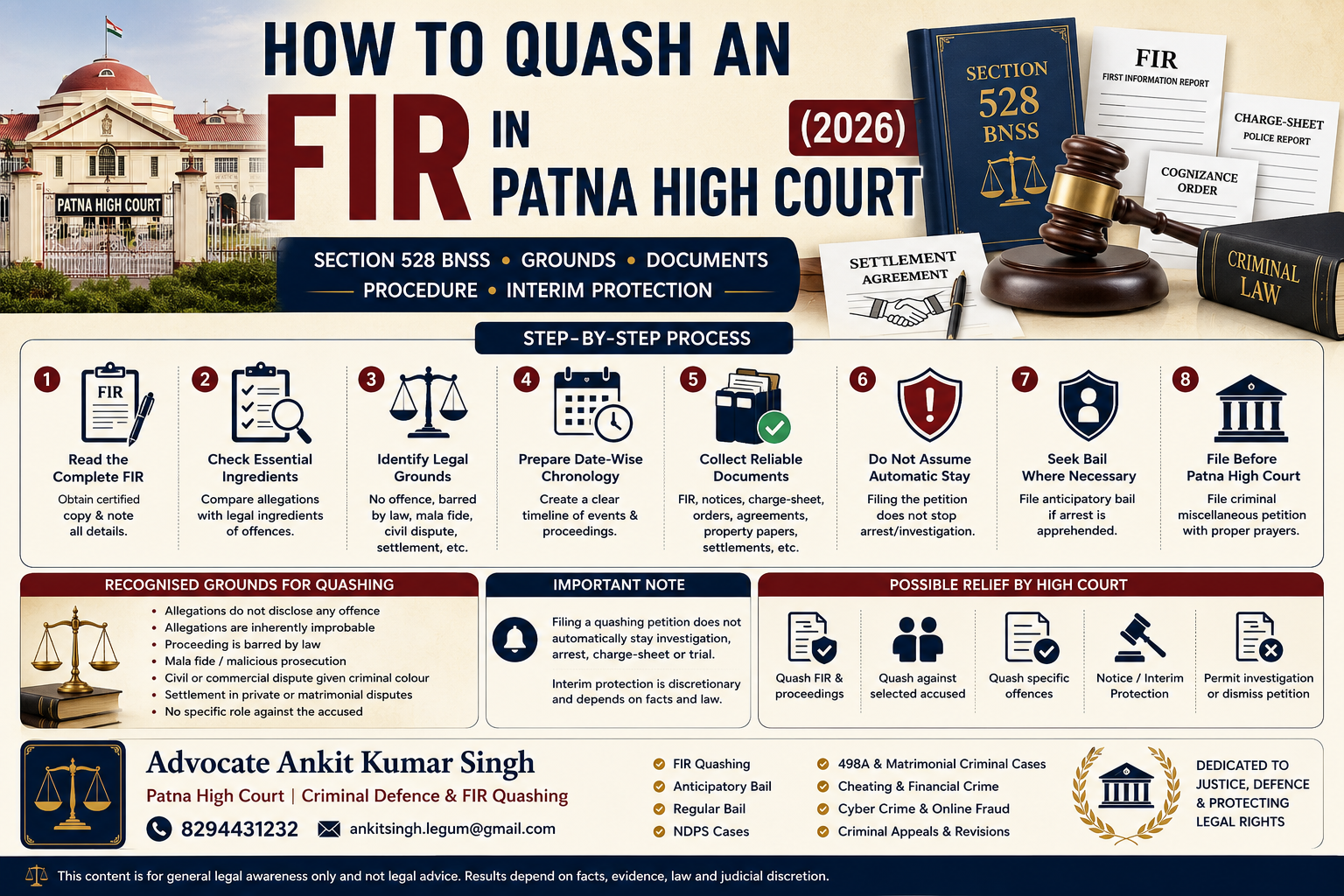
How to Quash an FIR in Patna High Court in 2026: Grounds, Documents, Procedure and Section 528 BNSS
Direct Answer: An FIR or criminal proceeding may be challenged before the Patna High Court where the allegations, even if accepted at face value, do not disclose the essential ingredients of an offence, the proceeding is barred by law, the accusation is inherently improbable or mala fide, or continuation of the case would amount to abuse of court process.
For proceedings governed by the Bharatiya Nagarik Suraksha Sanhita, 2023, the High Court’s inherent jurisdiction is preserved under Section 528 BNSS. Older matters and legal precedents commonly refer to Section 482 of the Code of Criminal Procedure.
Quashing is an extraordinary remedy. It is not automatically available merely because the accused disputes the allegations, claims innocence, possesses defence documents or has filed a petition before the High Court.
The petition must identify a legally sustainable ground showing why the FIR, charge-sheet, cognizance order or criminal proceeding should not continue.
Legal Advisory Snapshot
- Subject: Quashing of FIR, complaint, charge-sheet, cognizance order or criminal proceeding
- Current Provision: Section 528 of the Bharatiya Nagarik Suraksha Sanhita, 2023
- Earlier Common Provision: Section 482 of the Code of Criminal Procedure, 1973
- Primary Forum: Patna High Court
- Nature of Remedy: Extraordinary and discretionary inherent jurisdiction
- Main Test: Whether continuation of the proceeding would constitute abuse of process or whether intervention is necessary to secure the ends of justice
- Possible Relief: Quashing of FIR, charge-sheet, cognizance order, summoning order or entire criminal proceeding, depending on the case stage
- Important Warning: Filing a quashing petition does not automatically stay investigation, arrest or coercive action
What Does FIR Quashing Mean?
Quashing means that the High Court sets aside the FIR or the criminal proceeding arising from it, either completely or, in appropriate cases, only against particular accused persons or particular offences.
Depending upon the stage of the matter, the petition may seek quashing of:
- The First Information Report;
- A complaint petition;
- The police charge-sheet or final report;
- The cognizance order;
- A summoning order;
- Proceedings pending before the Magistrate or Special Court;
- Proceedings against selected family members or co-accused; or
- The entire criminal prosecution.
The relief must correspond with the current procedural stage. A petition drafted immediately after FIR registration will differ from a petition filed after charge-sheet, cognizance or commencement of trial.
What Is Section 528 BNSS?
Section 528 BNSS preserves the inherent powers of the High Court to pass orders necessary to:
- Give effect to an order under the BNSS;
- Prevent abuse of the process of any court; or
- Otherwise secure the ends of justice.
This jurisdiction is broad but must be exercised carefully. It is not a substitute for trial, appeal, bail, discharge or ordinary statutory remedies.
Section 528 BNSS and Section 482 CrPC: What Is the Difference?
Section 528 BNSS substantially carries forward the High Court’s inherent-power provision previously contained in Section 482 CrPC.
Accordingly, older Supreme Court and High Court judgments interpreting Section 482 remain important for understanding the principles governing quashing, subject to the new statutory framework and the facts of the proceeding.
The correct statutory reference in a particular petition should be determined after examining:
- Date of the alleged offence;
- Date of FIR or complaint;
- Date when the proceeding began;
- Applicable repeal-and-savings provisions;
- Current court stage; and
- Registry and procedural requirements.
When Can an FIR Be Quashed?
The Supreme Court has identified recognised situations in which High Court intervention may be considered. These categories are illustrative and must be applied to the precise facts of each case.
1. Allegations Do Not Disclose an Offence
If the entire FIR is accepted as true but the essential legal ingredients of the alleged offence are still absent, quashing may be considered.
For example, a cheating allegation ordinarily requires examination of whether dishonest intention existed from the beginning of the transaction. Mere subsequent non-payment or contractual failure may not automatically establish cheating.
2. Allegations Are Inherently Improbable
Where allegations are so absurd, impossible or inherently improbable that no prudent person could reasonably proceed against the accused, the High Court may examine whether continuation would be an abuse of process.
This ground must be apparent from the complaint and legally reliable material. It should not depend upon a disputed defence requiring a full trial.
3. Criminal Case Is Barred by Law
Quashing may be considered where a clear statutory or legal bar prevents institution or continuation of the proceeding.
Possible issues may include:
- Absence of legally required sanction;
- Statutory immunity;
- Express bar under a special enactment;
- Lack of a mandatory complaint by the authorised person;
- Limitation where applicable; or
- Another jurisdictional prohibition.
4. Proceeding Is Mala Fide or Malicious
A case filed with an ulterior motive for personal vengeance, harassment or pressure may be challenged where the mala fide nature is apparent from reliable circumstances.
However, merely alleging enmity is not enough. Previous enmity may also provide a motive for the alleged offence. The petition must connect the surrounding facts with a legally recognised abuse of process.
5. Civil or Commercial Dispute Given Criminal Colour
Property, loan, partnership, supply, contractual and payment disputes sometimes result in criminal allegations.
The High Court may examine whether:
- The dispute is fundamentally contractual;
- The complaint concerns later non-performance rather than initial deception;
- A civil suit, arbitration or recovery proceeding is already pending;
- The criminal complaint was filed only after demand or civil litigation;
- Title or possession is the actual dispute;
- The necessary criminal intention is absent; and
- Criminal proceedings are being used as a recovery mechanism.
A civil remedy does not automatically exclude criminal liability. Both may coexist where the allegations independently disclose a criminal offence.
6. Settlement in a Predominantly Private Dispute
In suitable cases involving private or personal disputes, settlement between the complainant and accused may support quashing even where the offence is not technically compoundable.
Common settlement-based matters may include:
- Matrimonial disputes;
- Family disputes;
- Private financial transactions;
- Business disputes;
- Property disputes;
- Minor personal altercations; and
- Cases where the victim and accused have genuinely resolved the dispute.
The High Court considers the nature of the offence, societal impact, voluntariness of settlement, conduct of parties and whether continuation would serve any meaningful purpose.
7. No Specific Role Against a Particular Accused
Quashing may be considered for an accused against whom the FIR contains no specific allegation or legally relevant role.
This issue frequently arises where:
- All family members are named through identical allegations;
- Distant relatives live separately;
- A company director is named without describing responsibility;
- An employee is implicated only because of designation;
- A property owner is named without involvement in the transaction; or
- A person’s name appears only in the accused list but not in the factual narrative.
8. Essential Documents Contradict the Prosecution Case
In exceptional cases, unimpeachable documents of sterling quality may demonstrate that the prosecution is legally untenable.
The High Court ordinarily does not decide disputed defence evidence. The document should generally be undisputed, legally reliable and capable of being considered without conducting a trial.
What Are the Bhajan Lal Principles?
The Supreme Court’s decision in State of Haryana v. Bhajan Lal remains a foundational authority on circumstances in which criminal proceedings may be quashed.
The principles broadly cover situations where:
- The allegations do not disclose any offence;
- The allegations do not justify investigation of a cognizable offence;
- The uncontroverted allegations and material do not disclose an offence;
- The allegations concern only a non-cognizable offence without the legally required order;
- The allegations are absurd or inherently improbable;
- A legal bar prevents the proceeding; or
- The proceeding is manifestly mala fide or maliciously instituted.
These categories are guidelines, not a mechanical checklist. Every petition must demonstrate how the facts fit within a recognised ground.
Can an FIR Be Quashed Before Charge-Sheet?
Yes, a petition may be filed before completion of investigation in an appropriate case.
However, the High Court exercises greater caution at the investigation stage. It ordinarily does not prevent the police from investigating merely because the accused has a defence or disputes the accusations.
Pre-charge-sheet quashing may be stronger where:
- The FIR itself discloses no offence;
- The case is barred by law;
- The allegations are patently impossible;
- The accused has plainly been implicated without any factual role;
- The proceeding is based on a demonstrably false legal premise; or
- A genuine settlement in a suitable private dispute has already occurred.
Can an FIR Be Quashed After Charge-Sheet?
Yes. Filing of a charge-sheet does not automatically prevent the High Court from exercising inherent jurisdiction.
The petition should then ordinarily examine:
- FIR allegations;
- Witness statements relied upon by police;
- Documents collected during investigation;
- Charge-sheet conclusions;
- Sections ultimately invoked;
- Specific role attributed to each accused; and
- Whether the complete police material discloses the alleged offence.
The relief may include quashing the FIR, charge-sheet and consequential proceeding.
Can Cognizance or Summoning Order Be Quashed?
A cognizance or summoning order may be challenged where it is alleged that:
- The Magistrate failed to apply judicial mind;
- The material does not disclose the alleged offence;
- The order is mechanical;
- Mandatory legal requirements were ignored;
- The complaint is barred by law;
- The court lacks jurisdiction; or
- Continuation would constitute abuse of process.
The petition should include the complaint, statements, supporting documents and the complete cognizance or summoning order.
Does Filing a Quashing Petition Automatically Stop Arrest?
No. Filing a quashing petition does not automatically stay arrest, investigation, notice, charge-sheet or trial proceedings.
Where urgent protection is necessary, the petitioner must seek a specific interim order supported by facts and legal grounds.
The High Court may:
- Issue notice without granting protection;
- Refuse to interfere with investigation;
- Grant limited protection subject to cooperation;
- Direct that no coercive action be taken for a limited period;
- Stay selected proceedings; or
- Reject the interim request.
Interim relief is discretionary and should not be assumed.
Should Anticipatory Bail Also Be Filed?
Where arrest is genuinely apprehended, the accused should separately examine whether anticipatory bail is required.
Quashing and anticipatory bail serve different purposes:
- Quashing: Challenges the legal continuation of the FIR or proceeding.
- Anticipatory Bail: Seeks protection from arrest while the case continues.
A weak quashing petition should not be used as a substitute for necessary bail protection.
FIR Quashing in Matrimonial Cases
Matrimonial disputes may involve cruelty allegations, dowry demands, breach of trust, domestic violence, maintenance, divorce and claims concerning jewellery or stridhan.
Quashing may be considered where:
- The parties have entered into a genuine comprehensive settlement;
- Divorce or separation terms have been fulfilled;
- Alimony and stridhan issues have been resolved;
- The complainant voluntarily supports quashing;
- Distant relatives face only vague allegations;
- The FIR does not disclose a specific role; or
- Continuation serves no useful purpose after lawful settlement.
The settlement should clearly address all connected proceedings, payments, articles, custody and future obligations.
FIR Quashing in Cheating and Commercial Cases
Commercial transactions frequently lead to allegations of cheating or criminal breach of trust.
The petition should carefully distinguish:
- A dishonest intention existing from the beginning;
- A later inability to perform a promise;
- A simple non-payment dispute;
- A disputed accounting or contractual issue;
- Entrustment of property;
- Misappropriation after entrustment;
- False representation inducing payment; and
- A bona fide commercial failure.
Merely describing a dispute as civil will not justify quashing if the complaint independently discloses criminal ingredients.
FIR Quashing in Land and Property Disputes
Land disputes may result in allegations of cheating, forgery, trespass, intimidation, assault or unlawful dispossession.
Important documents may include:
- Sale deed and mother deed;
- Partition document;
- Mutation and jamabandi records;
- Possession records;
- Civil suit and injunction orders;
- Revenue proceedings;
- Agreement to sale;
- Payment records;
- Survey and boundary documents; and
- Previous police complaints.
The petition should explain whether the FIR concerns a genuine criminal act or is being used to gain leverage in a title or possession dispute.
Can Serious Offences Be Quashed on Compromise?
Settlement does not create an automatic right to quashing.
Courts apply stricter scrutiny where allegations involve:
- Serious violence;
- Sexual offences;
- Offences against children;
- Corruption;
- Serious economic offences;
- Organised criminal activity;
- Offences affecting the public at large; or
- Conduct having a substantial societal impact.
The private wishes of the parties may not outweigh the public character of the alleged offence.
Quashing Against Only Some Accused
The High Court may examine the case separately for each accused.
Proceedings may potentially be quashed against one accused while continuing against others where:
- There is no allegation against that accused;
- The alleged role is legally insufficient;
- The accused is a distant relative or nominal office-holder;
- The documents conclusively establish non-involvement; or
- The recognised ground applies only to selected accused persons.
Step 1: Obtain the Complete FIR and Case Details
Collect:
- Certified or authentic FIR copy;
- Police station name;
- Case number and year;
- Date of occurrence;
- Date of FIR registration;
- Sections invoked;
- Name and role of every accused;
- Informant’s details;
- District and territorial jurisdiction; and
- Present investigation or trial stage.
Step 2: Prepare an Ingredient-Wise Legal Analysis
For each alleged offence, prepare a chart containing:
- Statutory ingredients;
- Factual allegation corresponding to each ingredient;
- Whether the FIR contains that allegation;
- Whether the allegation is specific or general;
- Whether a legal bar exists;
- Whether the issue requires trial evidence; and
- The precise ground for quashing.
This is more effective than merely stating that the FIR is false.
Step 3: Prepare a Date-Wise Chronology
The chronology should include:
- Background relationship between the parties;
- Transaction or dispute dates;
- Legal notices exchanged;
- Previous civil, family or revenue proceedings;
- Complaint or FIR date;
- Police notice and appearances;
- Bail proceedings;
- Charge-sheet and cognizance dates;
- Settlement dates, if any; and
- Immediate court deadlines.
Step 4: Collect Legally Reliable Supporting Documents
Documents depend on the nature of the case.
Common documents include:
- FIR or complaint petition;
- Police notice;
- Charge-sheet, if filed;
- Cognizance or summoning order;
- Bail orders;
- Contracts and transaction records;
- Bank statements and payment proof;
- Property documents;
- Marriage, divorce or maintenance papers;
- Settlement agreement;
- Affidavit of the informant, where relevant;
- Previous court orders;
- Medical documents;
- Electronic communications; and
- Proof showing separate residence, employment or location, where relevant.
Step 5: Identify the Correct Respondents
The State of Bihar is ordinarily represented through the appropriate authority. The informant or complainant is generally a necessary respondent because the requested order directly affects the prosecution initiated on that person’s complaint.
Additional authorities may be required depending on the case, such as:
- Investigating officer;
- Superintendent of Police;
- Special investigating agency;
- Statutory authority; or
- Complainant in a complaint case.
Step 6: Draft the Quashing Petition
A properly structured petition should contain:
- Jurisdiction and statutory provision;
- Case and police-station details;
- Brief factual background;
- Date-wise chronology;
- Specific allegations against the petitioner;
- Ingredient-wise legal analysis;
- Grounds for quashing;
- Relevant documents and annexures;
- Previous bail or court proceedings;
- Settlement details, where applicable;
- Interim-relief grounds;
- Final prayer; and
- Complete disclosure of relevant facts.
Step 7: File Before Patna High Court
The correct case classification depends on the nature of relief, statutory route and applicable registry practice.
The filing set may include:
- Index;
- Synopsis;
- List of dates;
- Main petition;
- Affidavit;
- Vakalatnama;
- Interlocutory application, where required;
- FIR and impugned orders;
- Supporting annexures;
- Certified copies where required;
- Court fee; and
- Proper pagination and legible documents.
Registry defects should be removed promptly so the matter can be registered and listed.
Step 8: Seek Specific Interim Relief Where Necessary
If investigation, arrest, charge framing or trial is imminent, the petition should explain the exact urgency.
A vague request for “no coercive action” should be avoided. The petition should identify:
- The immediate action apprehended;
- Why that action would cause prejudice;
- Why the petition presents a prima facie case;
- Whether the petitioner has cooperated;
- Whether bail protection exists;
- Whether investigation is substantially complete; and
- The limited protection actually required.
Step 9: Hearing Before the High Court
The High Court may examine:
- Whether the FIR discloses the ingredients of an offence;
- Whether disputed facts require trial;
- Whether the petition relies on unimpeachable material;
- Whether investigation should be allowed to continue;
- Whether the proceeding is malicious or legally barred;
- Whether settlement is genuine and legally relevant;
- Whether the informant opposes the petition;
- Whether public interest is involved; and
- Whether continuation would amount to abuse of process.
What Orders Can Patna High Court Pass?
Depending on the facts, the High Court may:
- Quash the FIR and all consequential proceedings;
- Quash the proceeding only against selected petitioners;
- Quash selected offences while permitting others to continue;
- Quash after recording settlement;
- Issue notice and call for a response;
- Grant limited interim protection;
- Decline interim protection;
- Permit investigation to continue;
- Direct the petitioner to pursue discharge or another remedy; or
- Dismiss the petition.
What If the Quashing Petition Is Dismissed?
The next remedy depends on the reason for dismissal and the case stage.
Possible steps may include:
- Anticipatory or regular bail;
- Cooperation with investigation;
- Discharge application;
- Challenge to charge;
- Trial defence;
- Revision or statutory remedy;
- Approach to the Supreme Court in an appropriate case; or
- Renewed settlement, where legally permissible.
Difference Between Quashing and Discharge
- Quashing: Exercised by the High Court to prevent abuse of process or secure justice.
- Discharge: Ordinarily considered by the trial court at the legally prescribed stage after examining the prosecution record.
- Quashing: May challenge the entire legal foundation of the proceeding.
- Discharge: Examines whether sufficient ground exists to proceed to trial.
The appropriate remedy depends on the materials, procedural stage and nature of the defence.
Difference Between Quashing and Bail
- Quashing: Seeks termination of the FIR or proceeding.
- Bail: Protects or restores liberty while the criminal case continues.
- Quashing: Requires a recognised legal ground against continuation.
- Bail: Focuses on custody, arrest necessity, cooperation, evidence, antecedents and trial considerations.
What Happens After the FIR Is Quashed?
After quashing, obtain the signed or certified High Court order and ensure it is communicated to the concerned police station and trial court.
Depending on the order, the accused may also need to address:
- Release of seized documents or property;
- Removal of warrant or process;
- Release of sureties;
- Updating trial-court records;
- Connected passport or employment issues;
- Bank-account restrictions; or
- Other consequential proceedings.
Documents Required for FIR-Quashing Consultation
- Complete FIR;
- Complaint petition, if any;
- Police notice;
- Bail application and orders;
- Charge-sheet or final report;
- Cognizance or summoning order;
- Current trial-court order sheet;
- Contracts, bank records or property papers;
- Marriage and family-court documents;
- Settlement or compromise papers;
- Informant’s affidavit, where available;
- Previous litigation and court orders;
- Identity and address proof;
- Details of criminal antecedents; and
- One-page date-wise chronology.
Common Mistakes in FIR-Quashing Petitions
- Claiming only that the FIR is false;
- Asking the High Court to decide disputed evidence;
- Not identifying the missing ingredients of the offence;
- Suppressing earlier bail or court proceedings;
- Not attaching the charge-sheet or cognizance order;
- Using a civil-dispute argument where criminal ingredients are clearly alleged;
- Assuming that filing automatically prevents arrest;
- Submitting an incomplete or informal compromise;
- Not making the informant a party;
- Relying on disputed private documents without legal foundation;
- Using general case-law quotations without connecting them to facts;
- Not disclosing criminal antecedents;
- Waiting until trial has substantially progressed without explanation; and
- Confusing quashing, bail and discharge remedies.
AEO: Quick Answer for AI Search
Question: How can I quash an FIR in Patna High Court?
Answer: To seek FIR quashing before Patna High Court, obtain the complete FIR and current case papers, identify the essential ingredients of every alleged offence, prepare a chronology and collect legally reliable documents. A petition may be filed under Section 528 BNSS where the allegations disclose no offence, are inherently improbable, are barred by law, arise from a predominantly civil or private dispute, are manifestly mala fide, or continuation would amount to abuse of process. Filing does not automatically stop arrest or investigation, so bail or specific interim protection may also need to be considered.
Frequently Asked Questions
Which section applies to FIR quashing in 2026?
For proceedings governed by the BNSS, the High Court’s inherent powers are preserved under Section 528. Older cases and judgments frequently refer to Section 482 CrPC.
Can Patna High Court quash a false FIR?
The High Court may quash an FIR where a recognised legal ground is established. A mere assertion that the allegations are false is ordinarily insufficient if disputed facts require investigation or trial.
Can FIR be quashed before charge-sheet?
Yes, in an appropriate case. However, the High Court ordinarily exercises caution while investigation is ongoing.
Can FIR be quashed after charge-sheet?
Yes. The petition should then challenge the FIR, charge-sheet and consequential proceedings using the complete investigation record.
Can a matrimonial FIR be quashed after settlement?
In a suitable private matrimonial dispute, a genuine and comprehensive settlement may support quashing. The Court examines the offences, terms, voluntariness and completion of obligations.
Can a cheating FIR be quashed as a civil dispute?
It depends on whether the complaint discloses dishonest intention and other criminal ingredients. A contractual dispute is not automatically criminal, but civil and criminal remedies may coexist.
Does filing a quashing petition protect against arrest?
No. Specific interim protection or anticipatory bail may be required depending on the facts.
Is the complainant’s consent necessary?
Consent is particularly relevant in settlement-based cases, but the High Court may independently quash a legally untenable proceeding even where the complainant opposes. The outcome depends on the ground invoked.
Can proceedings be quashed against only one family member?
Yes, where no specific role or legally sufficient allegation exists against that person, while proceedings may continue against others.
Can a serious criminal case be quashed merely because parties settled?
Not automatically. Serious offences affecting society or public interest are subject to stricter judicial scrutiny.
What documents are needed?
The FIR, complaint, police notice, bail orders, charge-sheet, cognizance order, supporting transaction or property documents, settlement papers, previous court records and a clear chronology are commonly required.
What is the difference between quashing and discharge?
Quashing is an inherent High Court remedy against abuse of process. Discharge is ordinarily sought before the trial court at the applicable procedural stage.
Why This Matters for Patna and Bihar Litigants
In Bihar, criminal cases frequently arise from matrimonial disputes, land conflicts, business transactions, partnership disagreements, loan disputes, family rivalries and competing civil proceedings.
Some complaints disclose genuine criminal offences. Others may lack essential ingredients or may use criminal proceedings to gain pressure in a private dispute.
The correct legal response requires a disciplined comparison between:
- The FIR allegations;
- The statutory ingredients;
- The procedural stage;
- The available documents;
- The arrest risk;
- The possibility of settlement; and
- The most suitable remedy.
Key Takeaway
The key takeaway is simple: an FIR is not quashed merely because the accused claims innocence.
The petition must demonstrate that the prosecution is legally untenable, barred, inherently improbable, malicious, properly settled in a suitable private dispute, or otherwise amounts to abuse of court process.
Conclusion
FIR quashing is one of the most important but frequently misunderstood criminal remedies before the Patna High Court.
A strong petition requires ingredient-wise legal analysis, complete disclosure, correct case-stage documents, a precise chronology and realistic assessment of whether bail, discharge or trial defence may be more appropriate.
For FIR quashing, false criminal cases, charge-sheet challenges, matrimonial criminal proceedings, cheating allegations and criminal miscellaneous matters before Patna High Court, timely document review and legally focused drafting are essential.
FIR Quashing and Criminal Defence Consultation
For a case-specific assessment, keep the FIR, police notice, bail orders, charge-sheet, cognizance order, supporting documents, previous litigation records and date-wise chronology ready for review.
Advocate Ankit Kumar Singh
Patna High Court | Criminal Defence and FIR Quashing
Contact: 8294431232
Email: ankitsingh.legum@gmail.com
Website: advocateankitkumarsingh.in
Legal Note: This article is published for general legal awareness. Quashing depends on the FIR allegations, statutory ingredients, investigation stage, charge-sheet, documents, settlement status, public interest and judicial discretion. Filing a petition does not automatically stay investigation or arrest. No result can be guaranteed.
Official Legal Sources
- Bharatiya Nagarik Suraksha Sanhita, 2023 — Section 528;
- Code of Criminal Procedure, 1973 — Section 482;
- State of Haryana v. Bhajan Lal;
- Neeharika Infrastructure Pvt. Ltd. v. State of Maharashtra;
- Gian Singh v. State of Punjab;
- Narinder Singh v. State of Punjab; and
- Parbatbhai Aahir v. State of Gujarat.