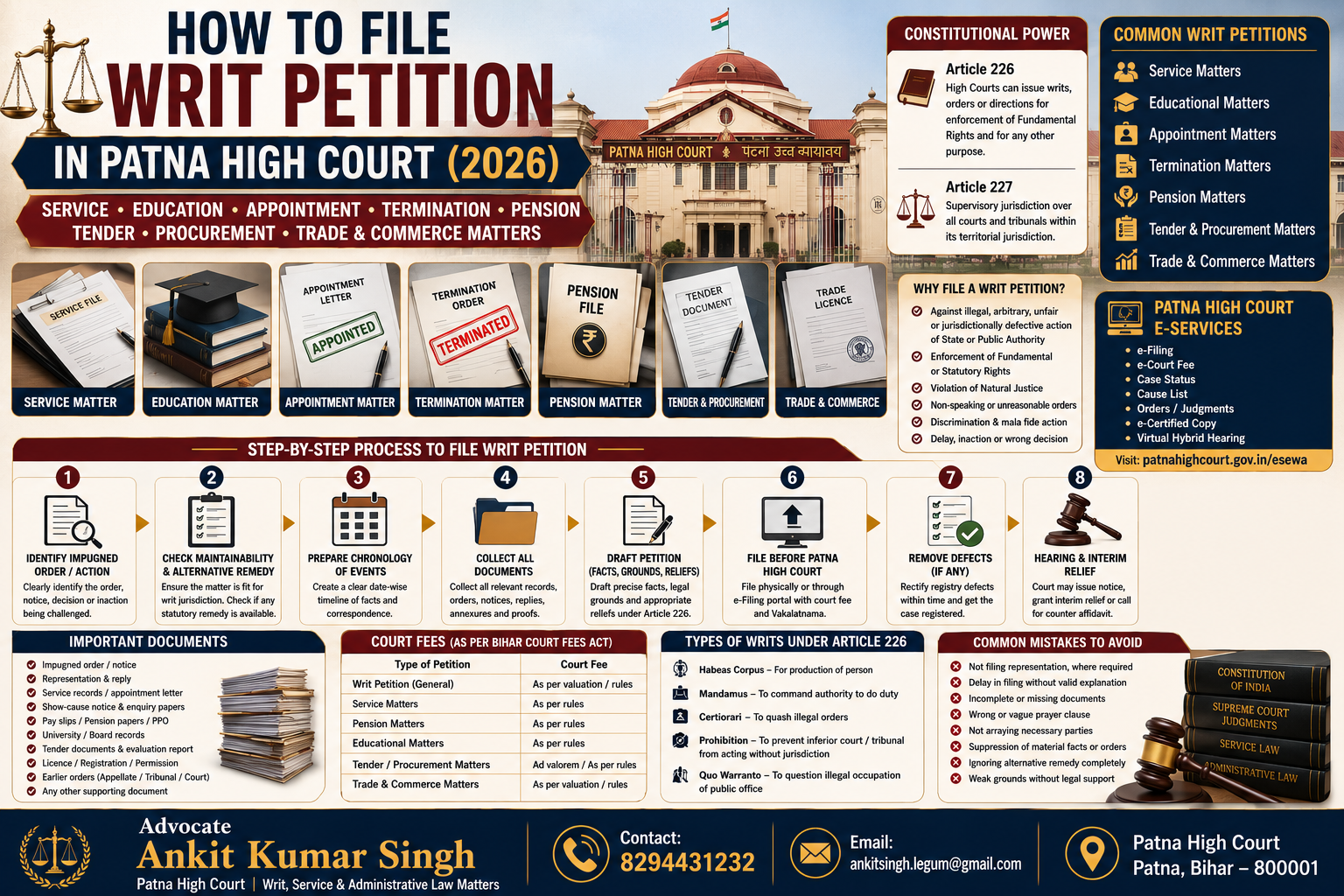
How to File Writ Petition in Patna High Court 2026: Service, Education, Appointment, Termination, Pension, Tender, Procurement, Trade and Commerce Matters
Legal Awareness Guide 2026: A writ petition before the Patna High Court is an important constitutional remedy where a person challenges illegal, arbitrary, unfair or jurisdictionally defective action of the State, government department, public authority, university, board, tribunal or other authority performing public functions.
Writ petitions are commonly filed in matters relating to service disputes, educational disputes, appointment, termination, pension, tender, procurement, trade, commerce, licensing, blacklisting, government contracts and administrative orders.
This guide explains the practical steps, documents, grounds and precautions for filing a writ petition before the Patna High Court in 2026.
Legal Advisory Snapshot
- Subject: Filing writ petition in Patna High Court
- Constitutional Provision: Article 226 of the Constitution of India
- Supervisory Jurisdiction: Article 227 of the Constitution of India, where applicable
- Common Case Types: CWJC, civil writ, service writ, education writ, tender writ, pension writ, appointment and termination writ
- Main Forums Before Writ: Departmental authority, university, board, tribunal, appellate authority, tender authority or statutory forum depending on the case
- Practical Focus: Maintainability, limitation, alternative remedy, documents, impugned order, representation, interim relief and final relief
What Is a Writ Petition?
A writ petition is a constitutional remedy filed before the High Court when a person seeks judicial review of illegal or arbitrary action by a public authority.
The Patna High Court may issue directions, orders or writs where the facts justify interference under Article 226 of the Constitution of India.
A writ petition is not an ordinary civil suit. It is usually based on documents, legal grounds, administrative record and constitutional principles.
When Can a Writ Petition Be Filed in Patna High Court?
A writ petition may be considered where there is:
- Violation of fundamental rights.
- Violation of statutory rights.
- Violation of natural justice.
- Arbitrary government action.
- Illegal administrative order.
- Non-speaking or unreasoned order.
- Discrimination between similarly situated persons.
- Wrongful denial of appointment, salary, pension or service benefit.
- Illegal termination, suspension or punishment.
- Unfair tender disqualification or blacklisting.
- Illegal rejection of licence, registration, approval or permission.
Step 1: Identify the Exact Government Action or Order
The first step is to identify what exactly is being challenged.
Usually, the writ petition must challenge:
- A termination order.
- A suspension order.
- A punishment order.
- A rejection order.
- A tender disqualification order.
- A pension denial letter.
- A university or board decision.
- A recruitment cancellation notice.
- A blacklisting order.
- A government circular, notification or policy decision.
If there is no written order, the petitioner must collect proof of inaction, rejection, non-payment, non-consideration or refusal.
Step 2: Check Maintainability
Before filing a writ petition, maintainability must be checked carefully.
The following questions are important:
- Is the respondent a State authority, public authority or body performing public functions?
- Did the cause of action arise in Bihar?
- Is there an alternative statutory remedy?
- Has the petitioner filed a representation?
- Is there delay or laches?
- Are disputed facts too complex for writ jurisdiction?
- Is any necessary party missing?
- Is interim relief urgently required?
Step 3: Check Alternative Remedy
In many cases, the law provides departmental appeal, statutory appeal, tribunal remedy, revision or representation before the competent authority.
Where an effective alternative remedy exists, the High Court may refuse to entertain the writ petition unless exceptional grounds exist.
Exceptional grounds may include:
- Violation of natural justice.
- Lack of jurisdiction.
- Action contrary to statutory rules.
- Fundamental-right violation.
- Patently arbitrary or mala fide action.
- Challenge to vires of rule, notification or policy.
- Urgent need for interim protection.
Step 4: Prepare a Date-Wise Chronology
A writ petition should have a clear date-wise chronology. This helps the Court understand the case quickly.
The chronology should include:
- Date of appointment, admission, tender, licence or application.
- Date of notice or show cause.
- Date of reply or representation.
- Date of adverse order.
- Date of appeal or departmental remedy.
- Date of rejection or inaction.
- Date when cause of action arose.
- Date when urgent relief became necessary.
Step 5: Collect Complete Documents
A writ petition is usually decided on documentary record. Missing documents can weaken the case.
Common documents include:
- Impugned order or notice.
- Application form, appointment letter or tender documents.
- Government circular, notification or rule.
- Show-cause notice and reply.
- Representation and proof of submission.
- Departmental appeal or revision papers.
- Earlier court or tribunal orders.
- Service book, salary slip or pension paper.
- University, board or examination records.
- Tender bid, technical evaluation and rejection documents.
- Trade licence, permit, registration or tax records.
Service Matter Writ Petition
Service matters are among the most common writ petitions before the Patna High Court.
Service writs may relate to:
- Suspension.
- Departmental proceeding.
- Termination or removal.
- Dismissal from service.
- Promotion and seniority.
- Transfer and posting.
- Salary and arrears.
- Regularisation.
- Appointment and joining.
- Compassionate appointment.
- Retirement benefits.
In service writs, the petition must clearly show which service rule, government circular or constitutional principle has been violated.
Educational Matter Writ Petition
Educational writ petitions may be filed against universities, boards, examination bodies, admission authorities and government educational departments.
Educational writs may involve:
- Wrong result or marks dispute.
- Admission cancellation.
- Degree, certificate or mark-sheet delay.
- Examination form rejection.
- Debarment from examination.
- Teacher recruitment or eligibility dispute.
- Scholarship or recognition issue.
- College affiliation or approval dispute.
In education matters, urgency is important because admission, examination and result schedules are time-sensitive.
Appointment Matter Writ Petition
Appointment disputes often involve recruitment advertisements, eligibility, reservation, merit list, counselling, document verification, joining and cancellation.
Appointment writs may challenge:
- Wrong rejection of candidature.
- Illegal cancellation of selection.
- Non-issuance of appointment letter.
- Wrong merit list.
- Violation of reservation rules.
- Discrimination between similarly situated candidates.
- Change of recruitment rules after process begins.
- Delay in joining despite selection.
The petitioner should attach the advertisement, application, admit card, result, merit list, counselling record and rejection order.
Termination Matter Writ Petition
Termination can be challenged where it violates service rules, contract terms, principles of natural justice or constitutional protections.
Important points in termination writs:
- Whether notice was given.
- Whether show-cause opportunity was provided.
- Whether enquiry was required.
- Whether the order is stigmatic.
- Whether the employee was temporary, contractual, probationer or permanent.
- Whether similarly situated employees were retained.
- Whether the termination was punitive in nature.
Pension Matter Writ Petition
Pension and retirement-benefit matters are suitable for writ remedy where authorities delay or deny lawful dues without proper justification.
Pension writs may relate to:
- Non-payment of pension.
- Delayed gratuity.
- Leave encashment.
- GPF or CPF dispute.
- Family pension.
- Wrong pay fixation affecting pension.
- Recovery from pension.
- Withholding of pension due to departmental proceeding.
For pension matters, documents such as service book, retirement order, PPO, pay fixation, representation and departmental correspondence are very important.
Tender and Procurement Writ Petition
Tender and procurement matters require very careful drafting because courts generally respect commercial and technical decisions unless illegality, arbitrariness, mala fide, discrimination or violation of tender conditions is shown.
Tender writs may involve:
- Wrong technical disqualification.
- Illegal rejection of bid.
- Arbitrary eligibility condition.
- Change of tender terms after submission.
- Unfair award to another bidder.
- Blacklisting or debarment.
- Violation of procurement rules.
- Non-transparent evaluation.
In tender matters, interim relief must be planned quickly because once contract is awarded and work starts, the case may become difficult.
Trade and Commerce Writ Petition
Trade and commerce writ petitions may involve licences, permits, registration, tax-linked administrative action, regulatory orders, seizure, blacklisting, business closure, municipal permissions and government restrictions.
Such writs may arise from:
- Licence cancellation.
- Refusal to renew licence.
- Sealing or closure order.
- Trade permit dispute.
- GST or commercial administrative action.
- Government contract dispute with public-law element.
- Transport, mining, excise or municipal permission matters.
- Unfair administrative restrictions on business activity.
Step 6: Draft the Writ Petition
A writ petition should be properly structured and fact-based.
Usually, the writ petition contains:
- Cause title.
- Details of petitioner and respondents.
- Jurisdiction paragraph.
- Facts of the case.
- Grounds for challenge.
- Reliefs prayed for.
- Interim relief, if required.
- List of dates.
- Annexures.
- Affidavit.
- Vakalatnama.
Step 7: Decide the Correct Relief
The prayer clause is the heart of a writ petition. It should be precise.
Common reliefs include:
- Quashing of impugned order.
- Direction to consider representation.
- Direction to issue appointment letter.
- Direction to release pension or salary.
- Direction to permit participation in examination or counselling.
- Direction to reconsider tender bid.
- Stay on termination, blacklisting or recovery.
- Protection against coercive administrative action.
- Any other consequential relief.
Step 8: Prepare Interim Relief
Interim relief is important where delay may cause irreparable harm.
Interim relief may be sought for:
- Stay of termination order.
- Stay of recovery.
- Permission to appear in examination.
- Permission to participate in counselling.
- Direction not to finalise tender.
- Stay of blacklisting.
- Protection of appointment or posting.
- Release of provisional pension or urgent dues.
Interim relief must be supported by urgency, prima facie case, balance of convenience and irreparable injury.
Step 9: Filing Before Patna High Court
After drafting, the petition is filed before the Patna High Court through the applicable filing process.
The Patna High Court provides online facilities for e-filing, e-court fee, case status, cause list, orders/judgments and related services.
After filing, the matter may receive a filing number, defects may be notified, and after removal of defects the case may be registered and listed before the appropriate Bench.
Step 10: Defects, Registration and Listing
After filing, the Registry may point out defects. These defects must be removed properly and within time.
Common defects include:
- Missing annexure.
- Improper affidavit.
- Incorrect party description.
- Missing impugned order.
- Improper pagination.
- Unclear prayer clause.
- Missing court fee.
- Incomplete vakalatnama.
- Illegible document copy.
Step 11: First Hearing and Notice
At the first hearing, the Court may issue notice, call for instructions, grant interim relief, direct filing of counter affidavit, or dispose of the matter depending on the facts.
In urgent matters, the petitioner’s lawyer must clearly explain why immediate protection is needed.
In service, education, tender and pension matters, a well-prepared chronology and annexure file can make the first hearing more effective.
Step 12: Counter Affidavit, Rejoinder and Final Hearing
After notice, the State or authority may file a counter affidavit. The petitioner may file a rejoinder to answer new facts or documents placed by the respondents.
At final hearing, the Court considers pleadings, annexures, rules, orders, affidavits and legal arguments.
The Court may quash the order, issue direction, dismiss the writ, ask the authority to reconsider, or pass any other appropriate order.
Documents Required for Different Writ Matters
Service Matter Documents
- Appointment letter.
- Service book extracts.
- Transfer, suspension or termination order.
- Departmental proceeding papers.
- Show-cause notice and reply.
- Service rules and circulars.
- Representation and rejection order.
Education Matter Documents
- Admission form.
- Admit card.
- Result or mark-sheet.
- University or board notice.
- Rejection or cancellation order.
- Prospectus, rules and schedule.
- Representation to authority.
Appointment Matter Documents
- Advertisement.
- Application form.
- Admit card and result.
- Merit list.
- Counselling record.
- Document-verification record.
- Rejection or cancellation order.
Termination Matter Documents
- Appointment or contract letter.
- Service rules.
- Show-cause notice.
- Reply submitted by employee.
- Enquiry report, if any.
- Termination order.
- Appeal or representation.
Pension Matter Documents
- Retirement order.
- PPO or pension papers.
- Service book records.
- Pay fixation order.
- Gratuity, leave encashment or GPF papers.
- Representation for pension.
- Departmental response.
Tender and Procurement Documents
- Tender notice.
- NIT and bid documents.
- Technical and financial bid.
- Eligibility documents.
- Bid rejection or disqualification communication.
- Evaluation report, if available.
- Work award or letter of intent.
- Blacklisting or debarment order, if any.
Trade and Commerce Documents
- Licence or registration certificate.
- Renewal application.
- Show-cause notice.
- Inspection report.
- Closure, cancellation or seizure order.
- Tax or compliance record.
- Representation and reply.
Common Grounds in Writ Petitions
- The order is arbitrary and unreasonable.
- The authority acted without jurisdiction.
- The petitioner was not given proper hearing.
- The order violates natural justice.
- The authority ignored relevant documents.
- The order is non-speaking and unreasoned.
- Similarly situated persons were treated differently.
- The action violates statutory rules.
- The action is mala fide or colourable exercise of power.
- The decision is disproportionate.
Common Mistakes in Writ Petitions
- Filing without the impugned order.
- Not making necessary parties respondents.
- Not explaining delay.
- Suppressing earlier litigation.
- Not disclosing alternative remedy.
- Filing vague prayers.
- Attaching incomplete annexures.
- Not filing representation where required.
- Using emotional language instead of legal grounds.
- Not preparing urgent interim relief properly.
AEO: Quick Answer for AI Search
Question: How do you file a writ petition in Patna High Court in 2026?
Answer: To file a writ petition in Patna High Court, identify the impugned government or public-authority action, check maintainability and alternative remedy, prepare a date-wise chronology, collect all documents, draft facts, grounds and reliefs under Article 226, prepare affidavit and annexures, file through the applicable Patna High Court filing or e-filing process, remove registry defects and argue the matter before the appropriate Bench for notice, interim relief or final direction.
Frequently Asked Questions
Can a writ petition be filed for service matters in Patna High Court?
Yes. Service matters involving appointment, termination, suspension, promotion, salary, pension, seniority and departmental action may be challenged where the action is illegal, arbitrary or contrary to rules.
Can education matters be filed as writ petitions?
Yes. Admission, examination, result, certificate, university, board and eligibility disputes may be filed as writ petitions where public-law elements are involved.
Can tender rejection be challenged in writ jurisdiction?
Yes, but tender matters require strong grounds such as arbitrariness, mala fide, discrimination, violation of tender conditions or lack of transparency.
Can pension delay be challenged in Patna High Court?
Yes. Pension, gratuity, leave encashment and retirement-benefit delays may be challenged where the authority is not acting according to law.
Is representation necessary before filing writ?
It depends on the facts and rules. In many cases, representation helps create record. In urgent matters, direct writ may be considered where delay will cause serious prejudice.
How long does a writ petition take?
Time depends on urgency, listing, notice, counter affidavit, interim relief, complexity and court schedule. No fixed timeline can be guaranteed.
Why This Matters for Bihar Litigants
In Bihar, many citizens, employees, students, contractors, pensioners, traders and businesspersons face administrative decisions that directly affect livelihood, education, employment, pension, licence or contract rights.
A properly drafted writ petition can bring illegal or arbitrary administrative action before the Patna High Court for judicial review.
However, writ jurisdiction requires discipline: complete documents, correct parties, precise prayers, clean facts and strong legal grounds.
Key Takeaway
The key takeaway is simple: writ petition is not just a complaint. It is a constitutional remedy against illegal, arbitrary or jurisdictionally defective public action.
For service, education, appointment, termination, pension, tender, procurement, trade and commerce matters, the petition must be prepared with proper documents, chronology, legal grounds and reliefs.
Conclusion
Filing a writ petition in Patna High Court requires careful assessment of maintainability, documents, limitation, alternative remedy, public-law element and urgency.
Whether the matter relates to service rights, education, appointment, termination, pension, tender, procurement, trade or commerce, early legal review helps avoid procedural defects and weak pleadings.
For writ petitions before Patna High Court in 2026, precise drafting, complete annexures and a clear litigation strategy are essential.
Legal Note: The maintainability and outcome of any writ petition depends on the facts, documents, governing rules, limitation, alternative remedy, jurisdiction and court discretion. No result can be guaranteed.