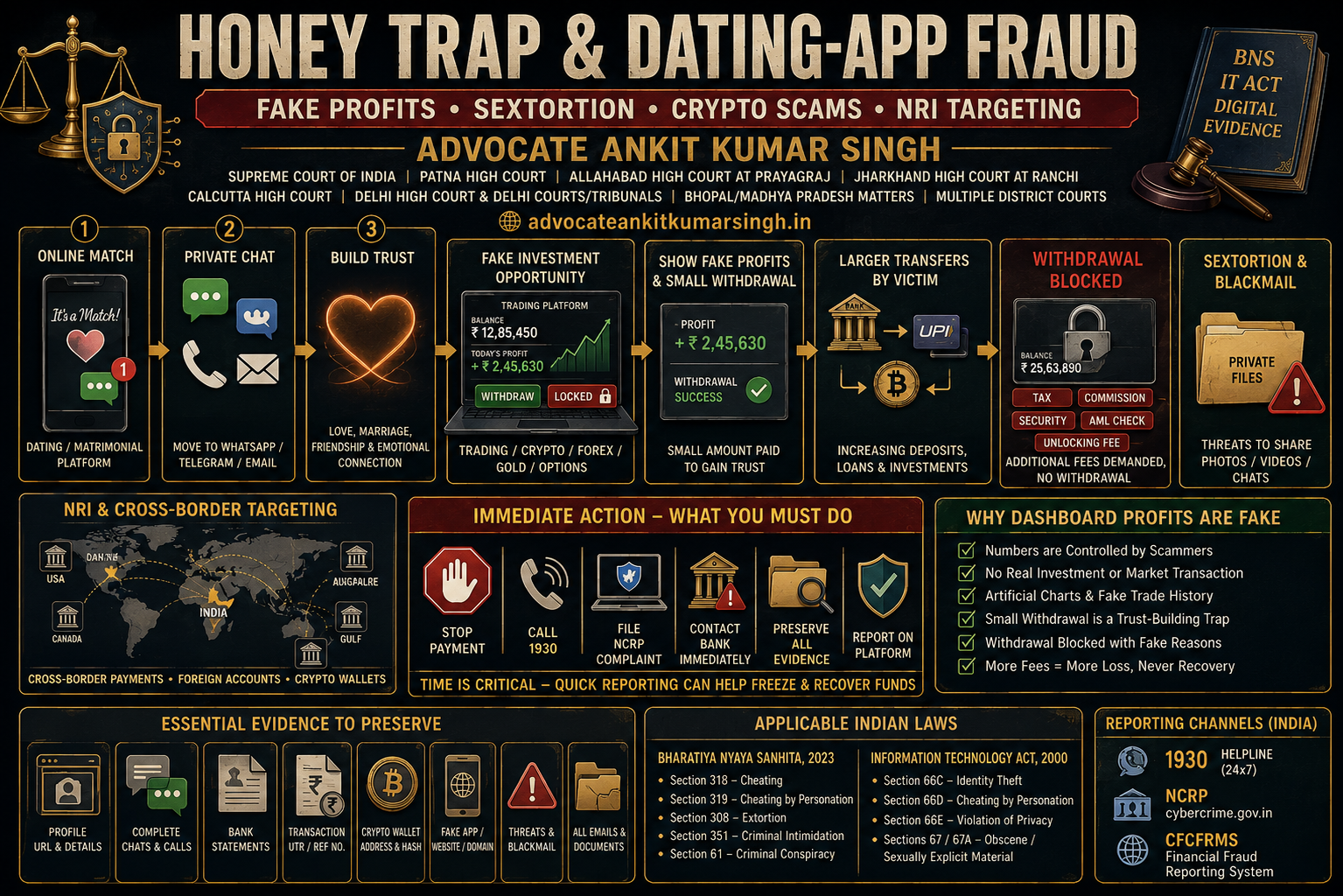
HONEY TRAP | DATING-APP FRAUD | ROMANCE BAITING | FAKE INVESTMENT PROFITS | SEXTORTION | NRI CYBER FRAUD
Honey Trap, Dating-App and Romance Investment Fraud in India: Fake Profits, Sextortion, Crypto Scams and NRI Targeting
Detailed legal and cyber-fraud research by Advocate Ankit Kumar Singh
Supreme Court of India | Patna High Court | Allahabad High Court at Prayagraj | Jharkhand High Court at Ranchi | Calcutta High Court | Delhi High Court and Delhi Courts/Tribunals | Matters concerning Bhopal, Madhya Pradesh | Multiple District Courts
Researched and legally updated: 5 August 2026
Direct Answer: How Does a Dating-App Investment Scam Work?
In a dating-app or romance-investment scam, an offender creates or operates a convincing romantic, matrimonial or friendship identity, develops trust over days or months and then introduces an apparently profitable trading, cryptocurrency, gold, forex or investment opportunity.
The victim is directed to a website, application, private group, wallet or so-called investment adviser controlled by the offenders. The dashboard may display fabricated profits, successful trades and increasing account balances. Some victims may even be permitted to withdraw a small amount initially so that they believe the platform is genuine.
After the victim deposits a substantially larger sum, withdrawal is blocked. The victim may then be asked to pay additional amounts described as:
- income tax or capital-gains tax;
- GST or transaction tax;
- brokerage or commission;
- AML or anti-money-laundering verification;
- security deposit;
- margin deficiency;
- liquidity verification;
- account activation or unlocking charge;
- credit-score repair;
- international-remittance clearance;
- wallet-verification fee; or
- penalty for an alleged withdrawal mistake.
These additional payments ordinarily do not unlock anything. They deepen the loss. When the victim stops paying, the offender may disappear, block all communication or threaten the victim with private photographs, videos or disclosure of the supposed relationship.
A victim should immediately stop further payment, contact the bank or payment provider, report financial cyber fraud through Helpline 1930, complete the complaint on the National Cybercrime Reporting Portal, preserve every digital and financial record and avoid unverified recovery agents.
Why This Fraud Requires Immediate Attention in 2026
Romance-enabled investment fraud is not merely an isolated dating-site problem. It forms part of a larger cross-border cyber-fraud ecosystem involving false identities, organised communication teams, fake applications, mule accounts, cryptocurrency wallets, payment intermediaries and layered transfers.
The Indian Cybercrime Coordination Centre issued a specific advisory on 31 October 2025 concerning misuse of Indian matrimonial platforms, including regional platforms, for investment and cryptocurrency fraud.
According to Government of India data reported up to 30 June 2026:
- CFCFRMS had helped save more than ₹11,158 crore through more than 32.80 lakh complaints.
- More than 53.87 lakh cyber-fraud complaints were reported on NCRP during financial years 2023–24 to 2025–26.
- The amount reported during those financial years exceeded ₹56,087 crore.
- The Government had shared information concerning more than 32.08 lakh Layer-1 mule accounts with participating entities.
- The Suspect Registry had contributed to declined transactions stated to be worth ₹25,698 crore.
These are general cyber-fraud figures and must not be presented as statistics limited exclusively to honey traps, dating applications or romance scams.
Internationally, the FBI reported that cryptocurrency investment fraud was the highest source of reported financial loss to Americans in 2025, involving approximately USD 7.2 billion. The same report described scams beginning through text messages, social media, advertisements or dating applications and later moving to private messaging channels.
Honey Trap, Romance Fraud, Romance Baiting and Sextortion: The Difference
| Expression | Core method | Typical financial or legal harm |
|---|---|---|
| Honey trap | Romantic or sexual contact is used as leverage | Money, confidential information, private content or influence is extracted |
| Romance fraud | A fictitious relationship is developed | Emergency, travel, medical, customs or family-related money is demanded |
| Romance baiting | Trust is built before introducing an investment | Victim is induced to transfer progressively larger amounts to a fraudulent platform |
| Sextortion | Private or fabricated intimate content is used as a threat | Payment is demanded to prevent publication or communication to relatives, employer or contacts |
| Matrimonial fraud | A false marriage proposal, profession or family background is presented | Money, investment, gifts, travel costs, documents or financial access is obtained |
| Recovery fraud | A second offender claims to recover the original loss | Advance legal, tracing, tax, bank or release fees are extracted |
INTERPOL recommends victim-neutral terminology such as “romance baiting” rather than expressions that may imply blame or ridicule. Victims may be educated, financially experienced and professionally successful. The fraud succeeds because organised offenders combine emotional manipulation with technically convincing financial deception.
Where Can the Fraud Begin?
Fraud does not arise because a particular platform is itself fraudulent. Offenders exploit the reach, communication features and user expectations of otherwise legitimate services.
The following is a representative, non-exhaustive platform map:
| Platform category | Representative services used by Indian or NRI users | Common transition used by offenders |
|---|---|---|
| International dating applications | Tinder, Bumble, Hinge, happn, Badoo and other dating services | Rapid movement to WhatsApp, Telegram, Signal, email or telephone |
| Community or identity-specific dating services | Grindr and other community-oriented services | Private video calls, investment conversations or sextortion threats |
| India-focused dating services | Aisle, TrulyMadly and comparable services | False professional identity, overseas status or investment mentorship |
| Matrimonial services | Shaadi.com, Jeevansathi and regional or community matrimonial platforms | Marriage discussions followed by emergency, business or investment requests |
| Social media | Instagram, Facebook, LinkedIn, X and similar networks | Unsolicited message, reaction to a post or carefully targeted profile contact |
| Messaging applications | WhatsApp, Telegram, Signal, WeChat, Line and similar services | Private persuasion, group testimonials, fake analysts and payment instructions |
| Wrong-number or accidental-message contact | SMS, WhatsApp or another direct-message channel | Apparently accidental conversation develops into friendship or romance |
| Professional or investment group | Private trading groups, social-media channels and invite-only communities | False advisers and fake members display profits and encourage deposits |
Official safety pages maintained by dating platforms commonly warn users against:
- sending money to a match;
- accepting investment advice from a romantic contact;
- opening an account through a link supplied by the match;
- moving immediately away from the platform’s monitored messaging system;
- sharing banking or identification information; and
- failing to report a suspicious or fake profile.
A verified profile badge, telephone verification or apparently active social-media history should not be treated as conclusive proof of identity. Accounts can be purchased, compromised, fabricated or operated with stolen and AI-generated material.
The Complete Romance-Investment Scam Lifecycle
Romance baiting usually progresses from emotional trust to a fraudulent investment, fabricated profit, larger transfer, blocked withdrawal and repeated payment demands.Plain-text alternative: Dating, matrimonial or social-media contact → movement to private messaging → trust and emotional dependency → introduction of trading or cryptocurrency → fake profits or small withdrawal → pressure for larger transfers → withdrawal blocked → additional fees or threats → immediate bank, 1930, NCRP and evidence-preservation action.
Stage 1: Selection of the Victim
Offenders may select victims through age, profession, marital status, location, overseas residence, language, community, financial appearance or public social-media activity.
An NRI may be targeted because the profile suggests:
- higher disposable income;
- foreign-currency earnings;
- distance from family support;
- interest in marriage within an Indian community;
- limited familiarity with Indian reporting systems;
- fear of immigration or professional consequences; or
- difficulty pursuing an offender across jurisdictions.
Stage 2: Construction of a Credible Identity
The false identity may be presented as:
- a successful trader or investor;
- a doctor, engineer, entrepreneur or financial professional;
- an NRI temporarily visiting India;
- a widow, widower, divorcee or single parent;
- a defence, aviation, shipping or overseas employee;
- a member of a respected family;
- a person managing a relative’s profitable portfolio; or
- someone seeking a serious marriage rather than casual dating.
The offender may use stolen photographs, AI-generated images, prerecorded video, manipulated voice, fabricated documents and multiple social accounts.
Stage 3: Movement Away from the Original Platform
Moving the conversation quickly to private messaging can reduce the effectiveness of the original platform’s moderation, scam detection and reporting controls.
The explanation may be that:
- the offender rarely checks the dating application;
- the account will soon expire;
- private communication shows seriousness;
- the offender needs secrecy because of work;
- family members may discover the profile; or
- the platform’s calling facility is inconvenient.
Stage 4: Emotional Conditioning
Communication may become unusually frequent. The offender may send daily greetings, discuss marriage, share fabricated family stories, mirror the victim’s interests and create an impression of exclusivity.
This phase may last several weeks or months. A long duration does not establish authenticity. Organised fraud groups often maintain detailed scripts and records concerning each victim.
Stage 5: Introduction of Financial Success
The offender may casually show screenshots of profits or describe a relative, mentor, analyst or insider who has developed a successful trading system.
Investment is often framed not as a demand for money, but as:
- a way to build the couple’s future;
- a demonstration of trust;
- financial education;
- a limited trial using a small amount;
- an exclusive opportunity available only through a private link; or
- a favour from the offender’s successful relative or financial mentor.
Stage 6: Fake Platform and Fabricated Profit
The victim may be directed to:
- a cloned trading website;
- an application installed through an APK file;
- a platform absent from an authorised application-store listing;
- a cryptocurrency wallet or smart-contract interaction;
- a private Telegram trading group;
- a fabricated institutional-investor portal;
- a gold, forex, commodity or options-trading platform; or
- a website using a name similar to a genuine financial institution.
Figures displayed on a scam-controlled dashboard are merely data entered or generated by its operator. They do not prove that shares, cryptocurrency, gold, options or any other asset were actually purchased.
Stage 7: Small Successful Withdrawal
A small early withdrawal may be deliberately permitted. This is not proof that the platform is genuine. It may be a controlled confidence-building payment funded from the victim’s own deposit or another victim’s money.
Stage 8: Escalation
Once trust is established, the victim may be urged to:
- invest retirement or business funds;
- break a fixed deposit;
- borrow from a bank, family member or friend;
- mortgage property;
- take a personal loan;
- transfer cryptocurrency;
- send money to several third-party accounts; or
- meet an artificial minimum balance for a special trading tier.
Stage 9: Withdrawal Obstruction
The account may suddenly display:
- tax pending;
- abnormal transaction detected;
- AML verification required;
- credit score too low;
- margin insufficient;
- account under review;
- international withdrawal restricted;
- profit-sharing commission unpaid;
- wrong withdrawal request submitted; or
- security deposit required.
No further amount should be paid merely because a dashboard or private customer service account claims that payment will release the balance.
Stage 10: Disappearance, Threat or Recovery Fraud
After the victim refuses further payment, the offender may:
- block the victim;
- delete the profile;
- shut down the application;
- move the website to another domain;
- threaten publication of intimate material;
- claim that police or tax authorities will arrest the victim;
- pretend to be a recovery specialist; or
- sell the victim’s information to another fraud group.
Why the Profit Visible on the Application May Be Completely False
A fraudulent investment application can display almost any figure selected by its operator. The following indicators should be checked:
| What the victim sees | What may actually be happening |
|---|---|
| Rapidly increasing account balance | Numbers are being altered on a private server without any underlying trade |
| Professional charts and market prices | Public market data is being copied into a fake interface |
| Successful order history | Fabricated order entries have no corresponding exchange transaction |
| Customer-service chat | A member of the fraud group is impersonating a regulated institution |
| Initial small withdrawal | A trust-building payment is being made to induce a larger deposit |
| Other members posting profits | Group accounts may all be controlled by the same network |
| Tax demanded before withdrawal | The demand may be an additional fraud payment rather than a lawful tax process |
| Investment loan shown in the account | An artificial liability is created to pressure the victim to pay more |
Verification Questions
- Is the intermediary registered with the relevant regulator?
- Is the mobile application listed by a recognised exchange or official source?
- Are funds being transferred into the registered intermediary’s proper account?
- Are payments being requested in unrelated individual or company accounts?
- Does the investor receive genuine contract notes?
- Do securities appear in an independently accessible demat account?
- Can the transaction be verified independently of the link supplied by the romantic contact?
- Is the application being installed through an APK file?
- Does the platform promise guaranteed or near-certain profit?
- Is a fee being demanded merely to withdraw the victim’s own money?
SEBI advises investors to verify whether the intermediary is registered and whether the trading application is authorised. A screenshot, private certificate or social-media testimonial is not a substitute for independent regulatory verification.
How Indians and NRIs Are Targeted Across Borders
NRI romance-investment fraud frequently combines emotional familiarity with cross-border complexity.
Common NRI-Focused Representations
- The offender claims to be an Indian professional living abroad.
- The offender claims to be preparing to relocate to the victim’s country.
- A marriage proposal is linked to the same religion, caste, region or language.
- The offender claims to understand both Indian and foreign financial systems.
- The victim is offered a private overseas investment unavailable in India.
- Foreign tax, customs, immigration or remittance clearance is falsely invoked.
- The victim is told that cryptocurrency avoids international banking delay.
- The offender mirrors the victim’s time zone and lifestyle to appear genuine.
Why Cross-Border Victims May Delay Reporting
- embarrassment about the relationship;
- fear that family or spouse will discover the communication;
- uncertainty regarding the correct country of complaint;
- concern about immigration or employment consequences;
- belief that cryptocurrency cannot be traced;
- assumption that Indian police cannot assist an overseas resident;
- fear of intimate-content publication; or
- continued hope that one final payment will unlock the account.
Delay can allow funds to move through multiple accounts, wallets, exchanges and jurisdictions. A victim should ordinarily report both where the victim resides and where the Indian account, phone number, beneficiary, platform or other Indian nexus exists.
Indicative NRI Reporting Matrix
| Victim’s location | Immediate local steps | Indian-nexus steps |
|---|---|---|
| United States | Contact bank or exchange, file through FBI IC3 and contact local law enforcement where appropriate | Use NCRP and 1930 where Indian accounts, numbers, offenders or transactions are involved |
| United Kingdom | Contact bank and submit through the official Report Fraud service | Report the Indian payment, communication or beneficiary nexus through NCRP and the competent Indian police |
| Canada | Contact financial institution, local police and the Canadian Anti-Fraud Centre reporting system | Submit the Indian component through NCRP and preserve full cross-border transaction details |
| Australia | Contact financial institution and use ReportCyber and Scamwatch as applicable | Report the Indian account, phone, beneficiary or communication link through NCRP |
| Singapore | Contact the bank immediately and use Singapore Police or ScamShield reporting channels | Report any Indian account, person, platform or transaction connection through NCRP |
| Other jurisdictions | Contact the financial institution, national cyber-fraud portal and local police | Use NCRP where an Indian legal or transaction nexus exists |
An embassy or consulate may provide consular guidance but should not be assumed to investigate the case or guarantee recovery.
Dating-Site Sextortion and Intimate-Content Blackmail
In a sextortion variant, the offender may persuade the victim to:
- participate in a private video call;
- send an intimate photograph;
- move to a less protected communication platform;
- permit access to social-media contacts;
- open a malicious file or link; or
- share identity or employment information.
The offender may then threaten to send real, edited or AI-generated material to:
- family members;
- spouse or partner;
- employer or colleagues;
- professional contacts;
- social-media followers;
- community members; or
- immigration or regulatory authorities.
What the Victim Should Not Do
- Do not continue making repeated payments.
- Do not send additional intimate content to prove trust.
- Do not threaten the offender before preserving identifiers and evidence.
- Do not delete the entire conversation.
- Do not install a remote-access application.
- Do not provide account passwords or OTPs.
- Do not engage an anonymous online hacker or recovery agent.
Immediate Protective Steps
- Preserve the complete communication and profile identifiers.
- Record the exact threat and payment demand.
- Secure email, social-media and cloud accounts.
- Change compromised passwords from a clean device.
- Enable multi-factor authentication.
- Review public friend lists and privacy settings.
- Report the account through the platform’s safety tool.
- Report through NCRP and the competent police authority.
- Inform a trusted person where emotional support is required.
- Seek urgent help where there is a threat of physical harm or severe psychological distress.
Shame and fear are deliberately used to prevent reporting. The victim’s private communication does not excuse extortion, impersonation, cheating or unlawful publication by the offender.
Major Red Flags Before Any Money Is Transferred
- Romantic commitment becomes unusually intense within a very short period.
- The person always avoids a verifiable in-person meeting.
- Live video is refused, repeatedly interrupted or appears prerecorded.
- The profile contains highly polished but inconsistent photographs.
- The conversation is moved away from the dating or matrimonial platform immediately.
- The person claims unusual expertise in cryptocurrency, gold, forex or institutional trading.
- A relative or mentor supposedly provides secret market information.
- The victim is told to install an APK or use an unfamiliar website.
- The opportunity promises guaranteed, fixed or extraordinarily consistent profit.
- Payment is requested in unrelated third-party accounts.
- Bank beneficiaries change repeatedly.
- The victim is added to a group where every other member appears profitable.
- The platform does not provide verifiable regulatory registration.
- The victim is encouraged to borrow money.
- The dashboard shows profit but no independent demat or exchange record exists.
- A fee must be paid before withdrawal.
- The romantic contact becomes aggressive when verification is requested.
- The victim is instructed to keep the investment secret from family or bank staff.
- The supposed adviser discourages independent legal or financial advice.
- A recovery agent contacts the victim without being approached.
What to Do Immediately After Discovering the Fraud
During the First 30 Minutes
- Stop all further transfers.
- Contact the bank, card issuer, wallet provider or cryptocurrency exchange through its official channel.
- Ask for urgent fraud marking, recall, hold or beneficiary-account action where legally and operationally possible.
- Call National Cybercrime Helpline 1930 for an India-linked financial cyber fraud.
- Write down the complaint acknowledgment number.
During the First 24 Hours
- Complete the complaint on the National Cybercrime Reporting Portal.
- Upload or retain a transaction-wise annexure.
- Preserve the original mobile phone and computer.
- Export complete chats where the platform permits.
- Capture the profile URL, username, display name and account identifier.
- Preserve fake-app files, installation links, domains and dashboard recordings.
- Record cryptocurrency wallet addresses and transaction hashes.
- Report the profile through the original dating or matrimonial platform.
- Secure compromised email, social-media and financial accounts.
- Submit a local complaint where immediate threats or sextortion are involved.
During the Next Seven Days
- Obtain updated bank statements showing every disputed transaction.
- Prepare a single consolidated chronology.
- Identify every beneficiary account, UPI ID, wallet and payment reference.
- Submit supplementary evidence to the investigating authority.
- Follow up using the official complaint number.
- Preserve proof of every bank and platform report.
- Assess whether court intervention is required concerning frozen or traceable funds.
- Report in the country of residence where the victim is an NRI.
- Reject any unsolicited recovery proposal demanding advance payment.
Do not pay an alleged tax, release charge, lawyer fee, police fee or recovery fee solely because a person communicating through WhatsApp, Telegram, email or a private dashboard claims that it is necessary to recover the money.
Complete Digital and Financial Evidence Checklist
Dating or Matrimonial Platform Evidence
- platform name;
- profile name and user ID;
- profile URL;
- verification status shown;
- photographs and biography;
- date of first contact;
- in-app messages;
- report or block acknowledgment; and
- subscription or account details relevant to the contact.
Communication Evidence
- complete WhatsApp or Telegram chats;
- telephone numbers with country codes;
- email addresses and full headers;
- voice notes;
- call logs;
- video-call dates and times;
- social-media usernames and URLs;
- group names and administrator details;
- messages introducing the investment;
- profit screenshots sent by the offender;
- withdrawal demands; and
- threats, blackmail or recovery offers.
Banking and Payment Evidence
- bank statements;
- beneficiary names and account numbers;
- IFSC details;
- UPI IDs;
- UTR and transaction-reference numbers;
- card statements;
- remittance confirmations;
- payment-gateway receipts;
- bank fraud-complaint acknowledgments;
- lien or hold information; and
- reversal or recall requests.
Cryptocurrency Evidence
- wallet addresses;
- transaction IDs or hashes;
- type and amount of cryptocurrency;
- date, time and time zone;
- exchange account used;
- deposit and withdrawal history;
- QR codes supplied by the offender;
- smart-contract or token-approval details;
- screenshots of wallet instructions; and
- official complaint submitted to the exchange.
Fake Platform Evidence
- website domain;
- full URL;
- application name;
- APK file or installation source;
- login page;
- dashboard screen recording;
- displayed balance and profits;
- trade history;
- customer-service chats;
- withdrawal refusal;
- tax or commission demand;
- company name and address displayed; and
- any claimed licence or registration number.
Evidence should be preserved in its original form. Cropped screenshots should not replace complete conversations, original devices, transaction records or source files.
Standard Adaptable Complaint Format
The following is a general drafting aid and not a substitute for a case-specific complaint prepared after reviewing the complete evidence.
TO
THE STATION HOUSE OFFICER / CYBER CRIME POLICE STATION
[CORRECT POLICE STATION, DISTRICT AND STATE]

SUBJECT:
COMPLAINT REGARDING DATING / MATRIMONIAL HONEY TRAP,
ROMANCE-BAITING INVESTMENT FRAUD, CHEATING, EXTORTION,
IMPERSONATION AND DIGITAL FINANCIAL LOSS

1. Name of complainant:
2. Address and country of residence:
3. Mobile number and email:
4. Nationality / NRI status, where relevant:
5. Platform where first contact occurred:
6. Profile name, user ID and URL:
7. Date of first contact:
8. Phone numbers, email addresses and messaging accounts used:
9. Identity and profession represented by the offender:
10. Nature of romantic or matrimonial representation:
11. Date on which investment was introduced:
12. Name and URL of investment platform:
13. Application or APK details:
14. Claimed investment product:
15. Total amount transferred:
16. Bank accounts / UPI IDs / wallets used:
17. Transaction-wise annexure enclosed:
18. Profit or account balance displayed:
19. Small withdrawal, if any:
20. Date on which major withdrawal was requested:
21. Reason stated for blocking withdrawal:
22. Additional tax / fee / security amount demanded:
23. Threat, sextortion or blackmail, if any:
24. Dating or matrimonial platform report details:
25. Bank or exchange report details:
26. Helpline 1930 acknowledgment:
27. NCRP acknowledgment:
28. Foreign police or fraud-report number, if any:
29. Immediate relief requested:
30. List of digital and documentary evidence enclosed:

PRAYER:

It is respectfully requested that the complaint be registered and
investigated in accordance with law; the beneficiary accounts, wallets,
telephone numbers, domains, applications, devices and connected persons
be identified; immediate lawful steps be taken for preservation and
tracing of funds; and the complainant be informed of the complaint or
FIR particulars and further documentary requirements.

Place:
Date:
Name:
Signature:
Transaction Annexure
TRANSACTION-WISE CYBER-FRAUD ANNEXURE

Sl. No.:
Date and time:
Amount:
Currency:
Mode of payment:
Originating bank / exchange:
Beneficiary name:
Beneficiary account / UPI ID / wallet:
IFSC / platform:
UTR / reference / transaction hash:
Purpose stated by offender:
Message connected with payment:
Present bank status:
Supporting document number:
Indian Legal Framework
The final sections should be selected from the proved facts rather than inserted mechanically merely because the contact occurred online.
| Provision or legal area | Possible relevance | Important qualification |
|---|---|---|
| Section 318 BNS — cheating | Dishonest deception and inducement to transfer property | Dishonest intention and inducement must be established from the facts |
| Section 319 BNS — cheating by personation | False identity or impersonation used to deceive | A false profile must be connected with the accused or operator |
| Section 308 BNS — extortion | Money demanded through fear of injury, exposure or reputational harm | The exact threat, demand and causal connection must be proved |
| Section 351 BNS — criminal intimidation | Threat to reputation, person, property or another legally recognised interest | The wording and circumstances of the threat matter |
| Section 61 BNS — criminal conspiracy | Coordinated fraud involving profile operators, analysts, account holders and payment handlers | Association alone does not prove agreement or intentional participation |
| Section 66C IT Act | Fraudulent or dishonest use of another person’s password, signature or unique identification feature | Identity theft must be distinguished from a merely false narrative |
| Section 66D IT Act | Cheating by personation using a communication device or computer resource | Electronic personation and cheating ingredients must be connected |
| Section 66E IT Act | Specified intentional or knowing privacy violation | It is not a universal provision for every private communication dispute |
| Sections 67 and 67A IT Act | Publishing or transmitting specified obscene or sexually explicit electronic material | The exact content and act of publication or transmission must be examined |
| Bharatiya Sakshya Adhiniyam Sections 61–63 | Proof and admissibility of electronic or digital records | Source, completeness, certificate and integrity requirements remain important |
| BNSS procedure | Complaint, FIR, investigation, search, seizure, arrest, remand and prosecution | The applicable procedure depends on the offence and investigative stage |
Extraterritorial and Cross-Border Issues
The Information Technology Act contains provisions concerning conduct outside India where the statutory computer-resource connection and other conditions are satisfied. Cross-border application nevertheless requires a fact-specific assessment of jurisdiction, evidence, mutual legal assistance and the location of the relevant systems and persons.
PMLA Caution
Not every romance, sextortion or investment cyber-fraud complaint automatically becomes a Prevention of Money-Laundering Act matter. PMLA consequences require, among other statutory elements, a scheduled-offence foundation and an alleged proceeds-of-crime nexus.
Can the Money Be Frozen or Recovered?
Recovery depends heavily on speed, transaction layering, the recipient institution, availability of balance, cooperation between intermediaries, police action and the legal process applicable to the funds.
Possible Fund Path
- Victim transfers money to the first beneficiary account.
- Funds are split into several mule accounts.
- Money is withdrawn in cash, transferred onward or converted into cryptocurrency.
- Cryptocurrency is moved through additional wallets or exchanges.
- The final beneficiary may be outside India.
Helpline 1930 and CFCFRMS are intended to facilitate rapid reporting and action involving participating financial institutions. Reporting does not guarantee that the entire amount will be frozen or restored.
A balance marked as lien, hold or frozen is not necessarily the same as money having been finally returned to the victim. Restoration may require verification, investigation, consent or an order of the competent authority or court, depending on the circumstances.
Why a Victim Should Not Pay a Private Recovery Agent
Recovery fraud frequently follows the original investment fraud. The second offender may already know:
- the victim’s name;
- the amount lost;
- the fake platform used;
- the wallet address;
- the complaint status; and
- the victim’s desperation to recover the money.
This information may have been retained or sold by the original fraud network. Claims that funds are sitting in a secret foreign bank account or can be released after one further fee should be independently verified through official channels.
Mule Accounts, Account Freezing and Innocent Account Holders
Romance-investment fraud networks may use:
- accounts opened with false identity documents;
- accounts rented or sold by their holders;
- accounts of students, workers or financially vulnerable persons;
- business accounts receiving unexplained third-party money;
- accounts controlled through remote banking access;
- payment aggregators and wallets; or
- accounts of persons who believed they were performing legitimate work.
An account holder should not assume that absence from the dating conversation automatically ends legal exposure. Investigators may examine:
- knowledge of the transaction;
- control over the account;
- benefit or commission retained;
- frequency and pattern of incoming transfers;
- cash withdrawals;
- instructions received;
- communication with organisers; and
- explanation and supporting records.
Conversely, receipt of a disputed transaction does not automatically prove that the account holder knowingly participated in the romance or investment fraud. Salary, sale, service, business, refund or other genuine transaction records may require examination.
Documents for an Account Holder Seeking Review
- bank statement;
- KYC documents;
- freeze or lien communication;
- NCRP or police reference;
- invoice, agreement or business record;
- communication with the transferor;
- tax or accounting record;
- proof of goods or services;
- explanation of onward transfer or withdrawal; and
- complete chronology.
Prevention Checklist for Dating, Matrimonial and NRI Users
- Keep early conversations on the original platform.
- Use the platform’s report and verification features.
- Conduct an independent reverse-image search.
- Verify profession and identity through sources not supplied by the person.
- Do not treat a passport photograph or employment card as conclusive proof.
- Do not send money to a person never met and independently verified.
- Do not invest through a link supplied by a match.
- Do not install an APK received through private messaging.
- Verify intermediaries and applications through official regulatory sources.
- Do not transfer funds into unrelated personal or company accounts.
- Never share OTPs, passwords, seed phrases or remote-access control.
- Do not make financial decisions under emotional pressure.
- Consult a trusted family member or independent professional.
- Do not share intimate material with a person whose identity remains unverified.
- Restrict public access to social-media contact lists.
- Use different passwords and enable multi-factor authentication.
- Do not believe that payment of a withdrawal fee proves a platform is genuine.
- Report suspicious profiles before deleting or blocking them.
Frequently Asked Questions
1. What is a dating-app honey trap?
It is a deceptive romantic or sexual interaction used to obtain money, financial access, private content, confidential information or leverage over the victim.
2. What is romance baiting?
Romance baiting is a fraud in which trust is developed through romance or friendship before the victim is induced to invest in a fake trading or cryptocurrency scheme.
3. Are dating applications responsible for every scam committed by a user?
No automatic conclusion follows. Offenders may misuse legitimate services despite moderation and safety systems. Platform liability, if alleged, requires examination of the specific law, notice, conduct and facts.
4. Why did the fake application allow an initial withdrawal?
A small withdrawal may be a deliberate trust-building device intended to persuade the victim to transfer a much larger amount.
5. Is the profit shown on the dashboard real?
Not necessarily. A scam-controlled platform can display fabricated trades, balances and profits without purchasing any real asset.
6. Should tax be paid to unlock the investment?
No payment should be made solely on the basis of a private dashboard or messaging demand. Tax and regulatory claims should be verified independently through official channels.
7. What should be done immediately after a bank transfer?
Contact the bank, call 1930, complete the NCRP complaint and preserve the beneficiary, UTR, communication and platform evidence without delay.
8. Can cryptocurrency be traced?
Blockchain transactions may create traceable public records, but identifying the person controlling a wallet and recovering funds require additional evidence, exchange cooperation and lawful investigation.
9. What is the most important cryptocurrency evidence?
Preserve wallet addresses, transaction hashes, currency type, amount, date, time, exchange account, QR code and every message containing payment instructions.
10. Can an NRI file a complaint in India?
An India-linked complaint may be submitted where Indian accounts, phone numbers, persons, platforms, communications or consequences create jurisdictional relevance. Local reporting in the victim’s country should also be considered.
11. What should a victim do after receiving an intimate-content threat?
Preserve the threat, secure accounts, stop repeated payments, report the profile and approach NCRP and the competent police authority.
12. Will paying once stop sextortion?
Payment frequently leads to further demands because it demonstrates that the threat is financially effective.
13. Can AI-generated intimate material also amount to an offence?
Fabricated or manipulated content may still support offences depending on the threat, publication, impersonation, privacy invasion and surrounding facts.
14. Can a private hacker recover the money?
Claims by anonymous hackers or recovery agencies should be treated with extreme caution. A second advance-fee demand may be recovery fraud.
15. Can the victim recover the entire amount?
Recovery cannot be guaranteed. Speed of reporting, available balance, transaction layering, bank action, wallet movement and investigation materially affect the result.
16. Can a frozen mule account be released?
Depending on the facts, the account holder may seek police review, a court remedy or other appropriate legal action after producing a complete transaction explanation.
17. Does receiving money make the account holder guilty?
Receipt is relevant but does not alone prove knowledge, dishonest intention, conspiracy or participation. The transaction purpose and conduct must be examined.
18. Can a dating-site profile be preserved after it is deleted?
Available screenshots, account identifiers, reports and communications should be preserved immediately. Investigators may seek further platform records through applicable legal processes, subject to availability and retention.
19. Should the victim inform family members?
A trusted family member or adviser can reduce isolation and help prevent further payment. The decision should account for the victim’s safety and circumstances.
20. Is every bad online relationship a criminal case?
No. A failed relationship, broken promise or investment loss does not automatically establish cheating. Criminal liability depends on deception, intention, inducement, threats, impersonation and evidence.
AI-Search Quick Answer
A datin