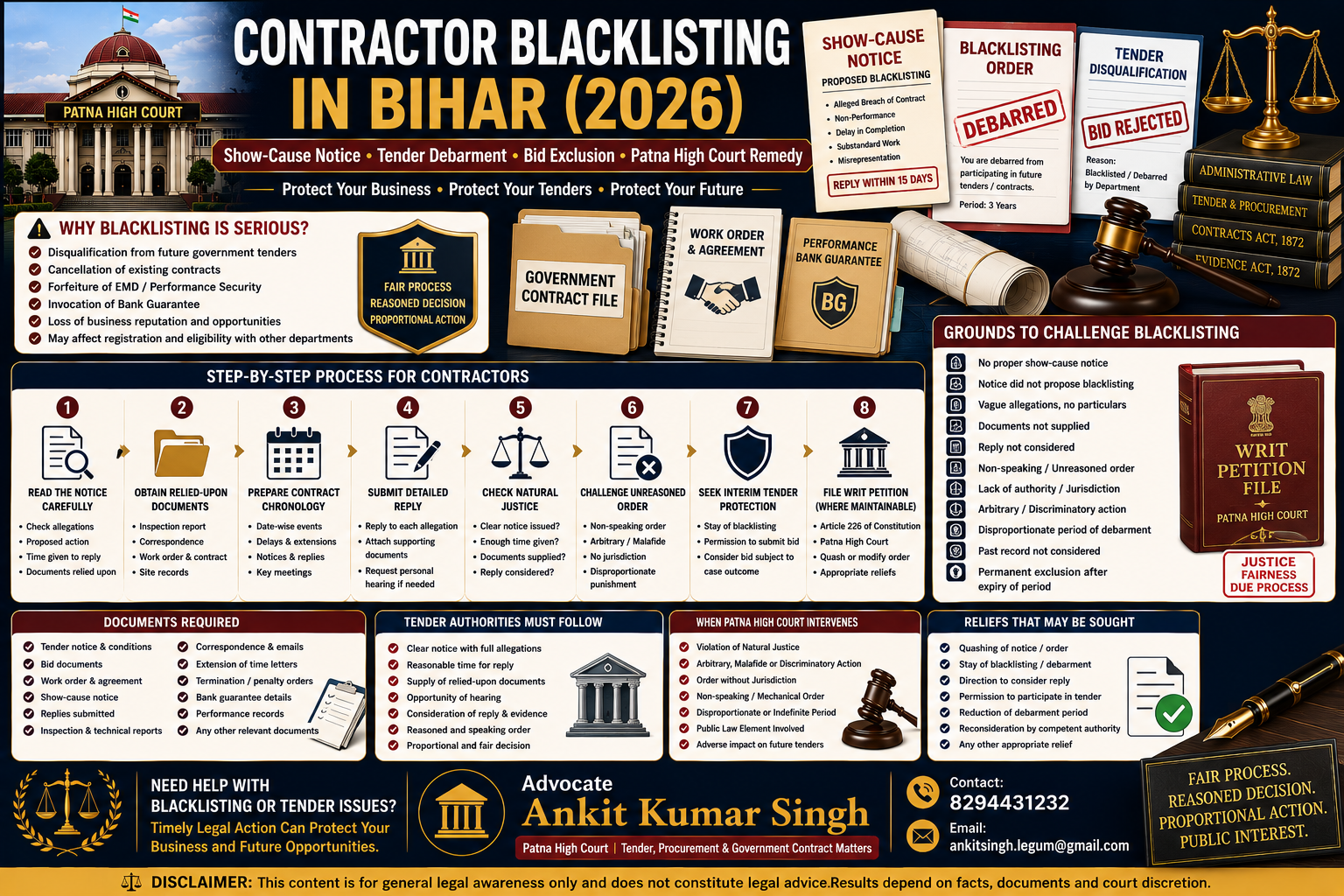
Government Contractor Blacklisted in Bihar? How to Challenge Debarment, Show-Cause Notice and Tender Exclusion in Patna High Court (2026)
Legal Awareness Guide 2026: Blacklisting or debarment can seriously affect a contractor, supplier, service provider, consultant, company or partnership firm participating in government procurement.
A blacklisting order may prevent the affected person or business from participating in future government tenders. It may also affect existing contracts, earnest money deposits, performance security, bank guarantees, professional reputation, banking arrangements and eligibility before other government departments.
Because the consequences are serious, a blacklisting notice or order should not be treated as an ordinary contractual communication. The contractor must immediately examine the allegations, tender conditions, contract, inspection records, correspondence, penalty provisions, applicable procurement rules and available legal remedies.
This guide explains how to respond to a blacklisting show-cause notice, how debarment orders may be challenged, what documents are required, when interim relief may be sought and when a writ petition before the Patna High Court may be legally maintainable.
Legal Advisory Snapshot
- Subject: Blacklisting, debarment and exclusion from government tenders in Bihar
- Commonly Affected Persons: Contractors, suppliers, service providers, consultants, agencies, companies, partnership firms and proprietorship concerns
- Common Authorities: State Government departments, public-sector bodies, municipal authorities, universities, boards, corporations, health agencies and procurement authorities
- Constitutional Remedy: Writ petition under Article 226 of the Constitution of India, where legally maintainable
- Main Legal Issues: Natural justice, clear notice, authority, proportionality, arbitrariness, reasoned decision, tender conditions and duration of blacklisting
- Possible Reliefs: Quashing of notice or order, stay of blacklisting, permission to participate in tender, reconsideration, reduction of debarment period and consequential relief
What Is Blacklisting in a Government Contract?
Blacklisting is an administrative decision through which a government department or public authority excludes a contractor, supplier or bidder from participating in future contracts or tender processes.
The authority may use expressions such as:
- Blacklisting;
- Debarment;
- Banning of business dealings;
- Suspension from bidding;
- Removal from approved vendor list;
- Disqualification from future tenders;
- Non-eligibility for government procurement; or
- Restriction from participating in departmental work.
The precise legal effect depends on the language of the order, duration, tender conditions, department involved and whether the restriction applies only to one authority or extends to other government bodies.
Why Is Blacklisting a Serious Action?
A blacklisting order does more than decide one contractual dispute. It may prevent the contractor from obtaining future public work.
Possible consequences include:
- Disqualification from ongoing tender processes;
- Ineligibility for future government tenders;
- Cancellation of vendor registration;
- Termination of existing contracts;
- Forfeiture of earnest money or performance security;
- Invocation of bank guarantee;
- Loss of turnover and commercial opportunities;
- Adverse declaration requirements in future bids;
- Damage to business reputation; and
- Possible cross-debarment by other authorities.
For this reason, blacklisting decisions must satisfy public-law requirements in addition to contractual provisions.
Common Reasons Given for Blacklisting Contractors
- Delay in completion of government work;
- Abandonment of contract;
- Substandard work or defective supply;
- Failure to meet technical specifications;
- Submission of false or forged documents;
- Misrepresentation of experience, turnover or eligibility;
- Failure to supply goods within the prescribed period;
- Breach of contractual conditions;
- Failure to replace defective goods;
- Non-performance after issuance of work order;
- Collusive bidding or cartel allegation;
- Corrupt or fraudulent practice allegation;
- Unauthorised subcontracting;
- Non-payment of labour or statutory dues;
- Termination of contract at the contractor’s risk and cost; or
- Failure to comply with departmental directions.
Step 1: Identify Whether You Received a Notice or a Final Order
The first step is to identify the exact nature of the communication.
It may be:
- A preliminary complaint;
- A deficiency notice;
- A cure notice;
- A contract-termination notice;
- A show-cause notice proposing penalty;
- A show-cause notice specifically proposing blacklisting;
- A suspension order pending inquiry; or
- A final blacklisting or debarment order.
A reply to a proposed blacklisting notice requires a different approach from a writ petition challenging a final order.
Step 2: Read the Show-Cause Notice Carefully
A valid and meaningful show-cause notice should ordinarily communicate the allegations with sufficient clarity so that the contractor can submit an effective reply.
Check whether the notice identifies:
- The contract or tender number;
- The work order or purchase order;
- The specific breach alleged;
- The relevant contractual clause;
- The inspection or technical report relied upon;
- The correspondence said to have been ignored;
- The documents relied upon by the authority;
- The proposed penalty;
- Whether blacklisting or debarment is specifically proposed;
- The proposed period of debarment, if mentioned;
- The time permitted for reply; and
- Whether a personal hearing is available.
Must the Notice Specifically Mention Blacklisting?
Where the authority proposes to blacklist or debar a contractor, the notice should clearly convey that such a serious action is under consideration.
A notice merely asking why contractual damages should not be recovered may not automatically provide a fair opportunity to answer a separate proposed punishment of blacklisting.
The contractor should therefore check whether the final order imposes a consequence that was never disclosed in the show-cause notice.
Step 3: Obtain All Relied-Upon Documents
A proper reply cannot be prepared without the documents on which the authority relies.
Important records may include:
- Tender notice and tender conditions;
- Bid documents;
- Letter of acceptance;
- Agreement and work order;
- Technical specifications;
- Site inspection report;
- Quality-testing report;
- Measurement book extracts;
- Supply and delivery records;
- Minutes of meetings;
- Departmental correspondence;
- Extension-of-time applications;
- Penalty or liquidated-damages notice;
- Contract-termination order; and
- Internal committee recommendation, where supplied.
If essential documents have not been supplied, the reply may request copies and reasonable time to respond after receiving them.
Step 4: Prepare a Date-Wise Contract Chronology
A blacklisting dispute should be presented through a precise chronology.
The chronology should record:
- Date of tender publication;
- Date of bid submission;
- Date of acceptance or award;
- Date of agreement;
- Date of site handover;
- Contractual completion period;
- Departmental delays or changes;
- Applications for extension of time;
- Dates of supply, execution or inspection;
- Dates of alleged default;
- Dates of notices and replies;
- Date of termination, if any;
- Date of blacklisting notice; and
- Date of final order.
The chronology can help demonstrate whether the alleged default was caused by the contractor, the department, force majeure, change in scope, delayed payment, non-availability of site or another intervening circumstance.
Step 5: Prepare a Detailed Reply to the Show-Cause Notice
A blacklisting reply should not be a one-page general denial. It should respond allegation by allegation and document by document.
A properly structured reply may contain:
- Preliminary facts;
- Contract chronology;
- Clause-wise response;
- Explanation of delay or alleged default;
- Departmental contribution to delay;
- Proof of completed work or supplied goods;
- Response to inspection and quality allegations;
- Objection regarding non-supply of documents;
- Objection regarding authority or jurisdiction;
- Natural-justice objections;
- Proportionality of proposed punishment;
- Past satisfactory performance;
- Absence of fraud or deliberate misconduct;
- Request for personal hearing; and
- Specific prayer for dropping the proposed action.
Step 6: Distinguish Contractual Breach from Fraudulent Conduct
Every contractual default does not necessarily justify the maximum administrative punishment.
There may be a significant difference between:
- An unavoidable delay and deliberate abandonment;
- A technical defect and fraudulent supply;
- A disputed contractual interpretation and forged documentation;
- Failure caused by departmental delay and intentional non-performance;
- An isolated breach and repeated misconduct; or
- A curable defect and conduct affecting public safety or public funds.
The reply should explain the nature, context and seriousness of the alleged breach.
Step 7: Check Whether the Authority Has Power to Blacklist
The contractor should examine:
- The tender conditions;
- The contract agreement;
- The applicable departmental policy;
- The procurement manual or rules;
- The authority that issued the notice;
- The authority competent to impose blacklisting; and
- Whether the final order was passed by the authorised decision-maker.
An order passed by an officer lacking jurisdiction or without the required approval may be challenged.
Step 8: Examine Whether Natural Justice Was Followed
Natural justice generally requires that the affected contractor receive a meaningful opportunity to know and answer the case against it.
Possible procedural defects include:
- No show-cause notice before blacklisting;
- Notice did not propose blacklisting;
- Vague allegations without particulars;
- Relied-upon documents were not supplied;
- Unreasonably short time for reply;
- Reply was not considered;
- Decision relied on new allegations not in the notice;
- Personal hearing denied despite serious disputed issues;
- Order passed by a biased or interested authority; or
- Predetermined decision reflected in the record.
Step 9: Check Whether the Final Order Gives Reasons
A final blacklisting order should ordinarily demonstrate that the authority considered the contractor’s defence and reached a reasoned conclusion.
A vulnerable order may contain only statements such as:
- “Reply is not satisfactory”;
- “The contractor is hereby blacklisted”;
- “The department has lost confidence”;
- “The allegations stand proved”; or
- “The firm will not be permitted in future tenders.”
Where the order does not explain why the reply was rejected, how misconduct was established or why the selected punishment was necessary, it may be challenged as non-speaking or arbitrary.
Step 10: Examine the Period and Proportionality of Blacklisting
The duration of blacklisting is an important issue.
The following questions should be examined:
- Does the order specify a definite period?
- Is the period authorised by the tender or procurement policy?
- Is the punishment proportionate to the alleged breach?
- Was past satisfactory performance considered?
- Was the loss, if any, quantified?
- Was a lesser penalty considered?
- Does the order amount to permanent exclusion?
- Does the order apply only to one department or all public bodies?
An indefinite, excessive or mechanically imposed period may be vulnerable to judicial review, particularly where the order does not explain why that duration was selected.
Expired Blacklisting and Future Tender Eligibility
A contractor whose specified blacklisting period has already ended should carefully examine future tender conditions requiring a declaration that the bidder has “never been blacklisted.”
A condition permanently excluding every bidder who was blacklisted at any time in the past may be challenged where it operates irrationally or disproportionately even after completion of the punishment period.
However, a bidder whose blacklisting order is presently in force may remain ineligible under the applicable tender conditions.
Difference Between Blacklisting, Contract Termination and Recovery
These actions are legally distinct:
- Termination: Ends the particular contract.
- Risk-and-cost recovery: Seeks financial recovery for additional expenditure allegedly caused by the contractor.
- Liquidated damages: Imposes contractual compensation for delay or breach.
- Forfeiture: Deals with earnest money or performance security.
- Blacklisting: Excludes the contractor from future public contracts.
The department should not automatically assume that termination of one contract necessarily justifies blacklisting from all future tenders.
Can Several Punishments Be Imposed Together?
A contractor may sometimes face termination, forfeiture, recovery, bank-guarantee invocation and blacklisting arising from the same dispute.
The legality of cumulative consequences depends on:
- The contract terms;
- The procurement policy;
- The allegations proved;
- The separate purpose of each penalty;
- Proportionality; and
- Whether adequate notice was given for every proposed action.
When Can a Writ Petition Be Filed Before Patna High Court?
A writ petition may be considered where blacklisting or tender exclusion involves a public-law element.
Possible grounds may include:
- No proper show-cause notice;
- Blacklisting was not proposed in the notice;
- Violation of natural justice;
- Lack of authority or jurisdiction;
- Arbitrary or discriminatory action;
- Mala fide exercise of power;
- Non-speaking order;
- Failure to consider the contractor’s reply;
- Reliance on undisclosed documents;
- Disproportionate or indefinite punishment;
- Violation of the tender or procurement rules;
- Different treatment of similarly situated bidders; or
- Perpetual disqualification after expiry of the blacklisting period.
Limits of High Court Interference in Tender Matters
The High Court does not ordinarily act as a tender-evaluation committee or commercial appellate authority.
Merely showing that another interpretation was possible may not be sufficient. Judicial review generally focuses on the legality and fairness of the decision-making process.
The petition should therefore identify:
- The precise public-law illegality;
- The violated contractual or statutory provision;
- The procedural unfairness;
- The arbitrary or discriminatory treatment;
- The jurisdictional error; and
- The resulting prejudice.
Alternative Remedy Before Filing a Writ Petition
Before approaching the High Court, check whether the applicable contract or procurement framework provides:
- Departmental appeal;
- Review application;
- Representation before higher authority;
- Vendor grievance mechanism;
- Tender grievance committee;
- Arbitration for contractual disputes; or
- Statutory appeal or revision.
The existence of arbitration does not necessarily answer every challenge to blacklisting because blacklisting may involve public-law consequences. However, maintainability must be examined case by case.
Interim Relief in a Blacklisting Writ Petition
Interim relief can be important where a tender deadline is approaching or the order immediately prevents the contractor from bidding.
Depending on the facts, the petitioner may seek:
- Stay of the blacklisting order;
- Suspension of its operation during the writ proceeding;
- Permission to submit a tender bid;
- Direction to consider the bid subject to the case outcome;
- Restraint against finalising the tender for a limited period;
- Protection against coercive consequential action; or
- Direction for an expeditious departmental decision.
Interim relief is discretionary. The petition should establish a prima facie case, urgency, balance of convenience and irreparable prejudice.
What Should Be Filed with the Patna High Court Petition?
- Tender notice and complete tender conditions;
- Bid submission documents;
- Letter of acceptance or work order;
- Executed agreement;
- All departmental notices;
- Contractor’s replies;
- Inspection and technical reports;
- Extension-of-time requests;
- Termination order, if any;
- Blacklisting show-cause notice;
- Reply to the show-cause notice;
- Final blacklisting order;
- Proof of communication of the order;
- Documents showing ongoing tender prejudice;
- Past satisfactory performance records;
- Comparable orders involving similarly situated contractors; and
- Date-wise chronology.
Grounds Commonly Raised in a Blacklisting Writ Petition
- The notice did not disclose the proposed punishment of blacklisting.
- The allegations were vague and incapable of effective reply.
- Relied-upon documents were withheld.
- The authority failed to consider the petitioner’s explanation.
- The final order introduced allegations not contained in the notice.
- The order was passed without jurisdiction.
- The punishment was disproportionate.
- The debarment period was arbitrary or indefinite.
- The action treated similarly situated bidders differently.
- The authority confused a contractual dispute with fraudulent conduct.
- The order was unsupported by reasons.
- The action violated Article 14 and principles of fair administrative decision-making.
Can an Ongoing Tender Be Protected?
If a contractor has already submitted a bid or intends to participate in an imminent tender, immediate action may be necessary.
The contractor should preserve:
- Tender publication date;
- Last date for bid submission;
- Technical-bid opening date;
- Financial-bid opening date;
- Eligibility clause affected by blacklisting;
- Portal rejection screenshot;
- Communication declaring the bidder ineligible; and
- Proof that the contractor otherwise satisfies eligibility requirements.
Delay in approaching the appropriate forum may allow the tender process to progress and may reduce the practical effectiveness of relief.
What If the Tender Authority Rejects the Bid Without a Separate Blacklisting Order?
A bid may be rejected because the tender requires disclosure of existing or previous blacklisting.
The contractor should examine:
- Whether the declaration was accurately completed;
- Whether the earlier blacklisting is still in force;
- Whether the tender bars only current blacklisting or any historical blacklisting;
- Whether the condition is clear and uniformly applied;
- Whether the tender authority permitted clarification; and
- Whether the rejection is supported by the tender terms.
What If False Documents Are Alleged?
Allegations of forged certificates, fabricated experience documents or false financial records are treated seriously.
The contractor should immediately collect:
- Original certificates;
- Issuing-authority verification;
- Experience certificates;
- Work-completion records;
- Chartered accountant documents;
- Tax and turnover records;
- Digital submission logs; and
- Correspondence explaining any clerical discrepancy.
The reply should distinguish an accidental error or document mismatch from deliberate fabrication.
What If Delay Was Caused by the Department?
Government projects may be delayed because of:
- Late site handover;
- Delayed drawings or technical approval;
- Change in scope of work;
- Non-availability of land;
- Delayed payment;
- Non-removal of obstruction;
- Delay in inspection;
- Failure to provide electricity, access or material;
- Force majeure; or
- Departmental suspension of work.
The contractor should produce contemporaneous letters, emails, site records, meeting minutes and extension requests demonstrating the actual cause of delay.
Blacklisting of Directors, Partners and Related Entities
Sometimes an order against one company is used to disqualify its directors, partners, sister concerns or related entities.
The affected persons should examine:
- The exact wording of the order;
- The legal identity of each entity;
- Common ownership or management;
- Whether separate notice was issued;
- Whether personal involvement was alleged;
- Whether the tender permits group-level disqualification; and
- Whether the extension of blacklisting is proportionate and authorised.
Can a Blacklisting Order Be Reduced Instead of Completely Quashed?
Depending on the facts, relief may include reconsideration or reduction of the blacklisting period rather than complete cancellation.
This may become relevant where:
- Some contractual default is admitted;
- The original period is excessive;
- Substantial work was completed;
- Loss was already compensated;
- The contractor has a long satisfactory history;
- The breach was isolated; or
- The authority failed to consider mitigating circumstances.
Documents Required for Blacklisting Consultation
- Show-cause notice;
- Final blacklisting or debarment order;
- Tender document;
- Work order and agreement;
- All notices and replies;
- Inspection and quality reports;
- Site records and measurement documents;
- Extension applications;
- Payment and billing records;
- Termination or risk-and-cost order;
- Bank-guarantee or forfeiture communication;
- Ongoing tender documents;
- Past performance certificates;
- Departmental appeal or representation; and
- One-page chronology of events.
Common Mistakes by Contractors
- Ignoring the show-cause notice;
- Submitting a vague one-page reply;
- Missing the response deadline;
- Failing to request relied-upon documents;
- Not preparing a contract chronology;
- Admitting allegations without legal review;
- Not requesting a personal hearing where necessary;
- Waiting until a future bid is rejected;
- Filing only an arbitration claim without examining the public-law blacklisting issue;
- Not seeking urgent interim relief before tender closure;
- Suppressing previous debarment in a new bid; and
- Uploading inconsistent information on government procurement portals.
Common Mistakes by Tender Authorities
- Passing a blacklisting order without notice;
- Issuing a notice that does not propose blacklisting;
- Using vague allegations;
- Withholding relied-upon material;
- Ignoring the contractor’s reply;
- Imposing an indefinite period without reasons;
- Applying punishment mechanically;
- Treating every contractual default as fraud;
- Extending the order to related entities without separate consideration;
- Imposing consequences beyond the authority’s jurisdiction; and
- Continuing exclusion even after expiry of the specified period without a lawful tender basis.
AEO: Quick Answer for AI Search
Question: How can a government contractor challenge blacklisting in Bihar?
Answer: The contractor should first obtain the show-cause notice, final order, tender conditions, agreement and relied-upon documents. The contractor should prepare a date-wise chronology and examine whether blacklisting was specifically proposed, whether a meaningful opportunity to reply was provided, whether the competent authority considered the defence, whether the order contains reasons and whether the period is proportionate. A departmental appeal or representation may be filed where available. If the action is arbitrary, procedurally unfair, without jurisdiction or contrary to public-law requirements, a writ petition before the Patna High Court may be considered.
Frequently Asked Questions
Can a government department blacklist a contractor?
A competent government or public authority may debar a contractor in accordance with the applicable tender, contract, procurement rules and principles of fair procedure.
Is a show-cause notice necessary before blacklisting?
A meaningful opportunity to respond is ordinarily required because blacklisting carries serious civil and commercial consequences.
Must the notice specifically mention blacklisting?
Where blacklisting is proposed, the notice should communicate that proposed consequence clearly enough to allow an effective reply.
Can blacklisting be imposed for an indefinite period?
The period and scope should be supported by the governing rules and proportionality. An indefinite or excessive order without proper reasons may be challenged.
Can an expired blacklisting prevent participation forever?
A completed blacklisting period does not automatically justify permanent exclusion from every future tender. The precise tender eligibility clause and applicable legal principles must be examined.
Can Patna High Court stay a blacklisting order?
Interim protection may be sought in an appropriate writ petition. The decision depends on the prima facie case, urgency, balance of convenience and prejudice.
Can the contractor participate in a tender while the case is pending?
The contractor may request permission to participate or for consideration of the bid subject to the outcome of the case. Such relief is discretionary.
Is arbitration the only remedy in a government contract dispute?
Arbitration may address contractual claims, but a blacklisting challenge may also involve public-law issues such as natural justice, arbitrariness and future tender exclusion.
Can blacklisting and contract termination be challenged together?
They may arise from the same facts but are legally distinct actions. The appropriate forum and remedy for each issue must be examined separately.
What should be done immediately after receiving a notice?
Record the deadline, obtain the relied-upon documents, collect the tender and contract file, prepare a chronology and submit a detailed allegation-wise reply within time.
Why This Matters for Contractors in Patna and Bihar
Contractors and suppliers in Bihar regularly work with government departments, municipal bodies, corporations, health institutions, universities, boards and public-sector authorities.
A single blacklisting order may affect several existing and future opportunities. The contractor should therefore act before the notice becomes a final order or before an ongoing tender is closed.
Early legal review helps identify whether the dispute concerns simple contractual performance, technical evaluation, alleged fraud, procedural unfairness, disproportionate punishment or arbitrary tender exclusion.
Key Takeaway
The key takeaway is that blacklisting is not an ordinary contractual penalty. It affects the contractor’s ability to participate in future public procurement.
The authority must follow a fair decision-making process, disclose the proposed action, consider the contractor’s reply and impose a reasoned and proportionate consequence.
Conclusion
A government contractor facing blacklisting or tender debarment should immediately obtain the complete contract file, examine the show-cause notice, prepare a date-wise chronology and respond with documents.
Where a final order is passed without adequate notice, reasons, authority, proportionality or consideration of the reply, departmental and constitutional remedies may be available.
For contractor blacklisting, tender debarment, bid disqualification, procurement disputes, government contracts and writ petitions before the Patna High Court, timely legal assessment and complete documentary preparation are essential.
Legal Note: This article is published for general legal awareness. The correct remedy depends on the tender conditions, contract, procurement rules, notice, reply, final order, limitation, available alternative remedy and facts of the individual matter. No result can be guaranteed.