Updated: 18 August 2026
What Happens When a Foreign Country Sends an Extradition Request to India?
Supreme Court of India | Patna High Court | Allahabad High Court at Prayagraj | Jharkhand High Court at Ranchi | Calcutta High Court | Delhi High Court and Delhi Courts/Tribunals | Matters concerning Bhopal, Madhya Pradesh | Multiple District Courts
Direct Answer
When a foreign country sends an extradition request concerning a person present in India, the request does not automatically result in arrest or surrender. It enters India's statutory extradition process and is examined by the Ministry of External Affairs and Central Government with reference to the Extradition Act, 1962, the applicable extradition treaty or arrangement and the supporting foreign documents.
The Ministry of External Affairs states that it is India's Central Authority for extradition matters and that its Consular, Passport and Visa Division—CPV Division—is the nodal division handling extradition requests.
Where the statutory requirements justify proceeding further, the Central Government may direct a Magistrate under Section 5 of the Extradition Act to inquire into the case. The process may then involve an Indian extradition warrant, arrest, bail proceedings and a Section 7 inquiry before any eventual decision regarding surrender.
Foreign Request Does Not Mean Automatic Extradition
One of the most important misunderstandings in cross-border criminal cases is the assumption that once another country asks India to extradite somebody, India is legally bound to immediately deliver that person.
That is incorrect.
A foreign request must pass through the Indian legal framework. Questions concerning the treaty, extradition offence, identity of the requested person, documentary material, prima facie case, limitation, speciality, political-offence restrictions and other statutory protections may become relevant.
Accordingly, three events must not be confused:
- A criminal case or warrant exists abroad.
- The foreign State formally requests extradition from India.
- India ultimately orders surrender.
They are different legal stages.
Step 1 — The Foreign State Prepares the Extradition Request
The requesting State ordinarily prepares a formal extradition dossier in accordance with the applicable treaty, arrangement and Indian statutory requirements.
Depending upon the particular case and treaty, supporting material may concern:
- identity of the requested person;
- description of the alleged conduct;
- foreign offence provisions;
- arrest warrant or relevant judicial order;
- statement of facts;
- evidence connecting the requested person with the alleged offence;
- applicable limitation position;
- penalty prescribed for the offence;
- authentication or certification of foreign records;
- conviction and sentence material where extradition is sought to enforce a sentence.
The exact dossier requirements should always be checked against the relevant country's treaty with India rather than assumed from another country's extradition practice.
Step 2 — Where Is the Extradition Request Sent in India?
According to the Ministry of External Affairs, an extradition request concerning a fugitive sought from India should be submitted to the CPV Division of the Ministry of External Affairs, which functions as the Central Authority for extradition matters.
The official MEA guidance identifies the CPV Division as the nodal division handling extradition matters.
This means that the foreign request enters a governmental and diplomatic channel before the Indian judicial inquiry ordinarily begins.
Step 3 — MEA Examines the Request
The official MEA guidance states that the request is examined in the Ministry and that the relevant extradition treaty or arrangement is taken into account.
This examination matters because a foreign request must be assessed against the legal relationship between India and the requesting State.
Important questions at this stage include:
- Does India have an extradition treaty with the requesting State?
- Is there instead an extradition arrangement?
- What definition of “extradition offence” applies?
- What documentary requirements does the treaty prescribe?
- Is the request for prosecution or execution of an existing sentence?
- Is the foreign warrant presently valid?
- Does the requested conduct satisfy the treaty threshold?
- Are any mandatory or discretionary refusal grounds apparent?
Extradition Treaty vs Extradition Arrangement
India maintains extradition relations through treaties and, with certain jurisdictions, extradition arrangements. The Ministry of External Affairs publishes the current list of such treaties and arrangements.
The distinction matters because the precise legal obligations, documentary requirements, extraditable-offence tests, nationality provisions and speciality safeguards may depend upon the relevant instrument.
Therefore, an extradition defence should begin with the actual treaty text applicable to the requesting State.
Step 4 — Does MEA Automatically Send Every Request to Court?
No. The official MEA description does not state that every communication received from abroad automatically results in a magisterial extradition inquiry.
MEA states that after examination of the request and the relevant treaty or arrangement, an Inquiry Magistrate may be appointed if the Ministry considers it fit.
This makes governmental scrutiny a meaningful stage rather than a purely mechanical forwarding exercise.
Step 5 — Section 5 Order: Beginning of the Formal Inquiry
Section 5 of the Extradition Act provides the statutory route through which the Central Government may order a magisterial inquiry into the case of a fugitive criminal.
Once a Section 5 order is issued, the matter moves into a formal judicial inquiry under the Act.
A requested person or defence lawyer should obtain and examine:
- the Section 5 order;
- the foreign extradition request;
- the treaty or arrangement relied upon;
- the foreign warrant;
- the statement of allegations;
- supporting foreign evidence;
- identity documents;
- authentication/certification material;
- the procedural status of the foreign case.
Step 6 — Can the Magistrate Issue an Arrest Warrant?
Yes. Section 6 provides that when the Magistrate receives the Central Government's Section 5 order, the Magistrate issues a warrant for the arrest of the fugitive criminal.
This is why the existence of a foreign warrant and the issuance of an Indian warrant under the Extradition Act must be kept conceptually separate.
The foreign warrant may form part of the extradition request, but arrest in India occurs through the applicable Indian statutory mechanism.
What If the Person Is Arrested Before the Complete Request Reaches India?
The Extradition Act separately contains a provisional-arrest mechanism under Section 34B.
Where an urgent request is received from a foreign State for immediate arrest of a fugitive criminal, the Central Government may request the competent Magistrate to issue a provisional warrant under the statutory conditions.
Section 34B contains a particularly important safeguard: if the formal request for surrender or return is not received within sixty days from the date of arrest under that provision, the arrested person is to be discharged.
Therefore, the first question after an extradition-related arrest should be: Under which exact statutory provision has the person been arrested?
Can an INTERPOL Red Notice Alone Replace the Extradition Process?
No. An INTERPOL Red Notice and a formal extradition request are legally distinct mechanisms.
Similarly, the following should not be treated as identical:
- INTERPOL Red Notice;
- INTERPOL diffusion;
- foreign arrest warrant;
- Look Out Circular;
- Section 6 extradition warrant;
- Section 34B provisional warrant;
- formal extradition requisition.
In a live matter, the precise document and the authority acting upon it should be identified before deciding the legal remedy.
Step 7 — The Section 7 Extradition Inquiry
Once the requested person is before the Inquiry Magistrate, Section 7 becomes central.
The Magistrate does not conduct the complete foreign criminal trial. The statutory inquiry instead examines whether the material supports the extradition requisition to the level required under the Act.
A central statutory expression is whether a prima facie case in support of the requisition exists.
Issues that may require examination include:
- whether the requested person has been correctly identified;
- whether the offence is extraditable;
- whether the treaty requirements are fulfilled;
- whether the foreign documents are admissible/authenticated;
- whether evidence actually connects the person with the alleged conduct;
- whether limitation or another statutory restriction applies;
- whether speciality protections are engaged;
- whether Section 31 or another statutory provision prohibits surrender.
Foreign Evidence: Why Section 10 Matters
Extradition would become practically impossible if every foreign investigating officer, witness, judge and record keeper had to physically appear in India merely to prove foreign documentation.
Section 10 therefore provides a special mechanism regarding receipt of foreign exhibits, depositions, statements, certificates and judicial documents where the statutory authentication requirements are satisfied.
This does not mean that every document attached to a foreign dossier must automatically be accepted without scrutiny. Authentication, relevance and the legal basis for reception remain important.
Can the Requested Person Get Bail?
Yes. Section 25 expressly contemplates bail for a person arrested or detained under the Extradition Act.
Bail remains fact-sensitive and can involve considerations such as:
- flight risk;
- passport and travel position;
- residential roots in India;
- past compliance;
- nature of the alleged offence;
- stage of the extradition inquiry;
- medical circumstances;
- ability to comply with restrictive conditions.
The published statutory text of Section 25 expressly refers to the Code of Criminal Procedure, 1973. Because India's general criminal-procedure regime has subsequently transitioned to the Bharatiya Nagarik Suraksha Sanhita, 2023, the exact procedural application in a current case should be verified rather than assumed.
What Happens If the Magistrate Finds No Prima Facie Case?
Where the statutory case in support of the requisition is not made out, Section 7 permits discharge according to the statutory framework.
This demonstrates that the magisterial inquiry is not an empty ritual. The foreign request must withstand examination under Indian extradition law.
What Happens If the Magistrate Finds a Prima Facie Case?
If the Magistrate reaches the conclusion contemplated by Section 7, the person may be committed to prison to await the Central Government's decision and the Magistrate reports the result of the inquiry.
This is not identical to immediate physical surrender.
The judicial inquiry and the Central Government's subsequent statutory role remain separate stages.
The Most Important Defence Matrix After India Receives the Request
| Question | What Must Be Checked | Why It Matters |
|---|---|---|
| Is there a valid treaty/arrangement? | MEA treaty list and exact treaty text | Determines applicable extradition obligations and conditions. |
| Is the foreign offence extraditable? | Conduct, punishment, treaty definition and Section 2 | A foreign criminal label alone is insufficient. |
| Is the person correctly identified? | Name, passport, DOB, photograph, aliases | Mistaken identity can undermine the request. |
| Is the foreign warrant valid? | Date, issuing court, present status and case record | An expired, cancelled or materially altered proceeding requires scrutiny. |
| Is there a prima facie nexus? | Evidence actually connecting the requested person | Central to the Section 7 inquiry. |
| Are foreign documents authenticated? | Section 10 and applicable treaty | Affects reception and evidentiary use. |
| Is prosecution time-barred? | Foreign limitation law and Section 31 | May create a statutory restriction on surrender. |
| Is political-offence protection relevant? | Section 31, Schedule and treaty | Must be legally established, not merely alleged. |
| Does speciality protection apply? | Section 31 and treaty | Restricts prosecution beyond permissible extradition scope. |
| Is another Indian case pending? | Indian FIR/trial/sentence status | May affect the timing of surrender. |
Section 31: When Can Surrender Be Restricted?
Section 31 is a central statutory safeguard. Depending upon the case, it addresses restrictions concerning matters such as political character, limitation, speciality, an existing Indian accusation or sentence and the statutory waiting period following committal.
Each ground requires analysis of the actual statutory wording and applicable treaty.
A generic statement such as “my foreign case is false” is not by itself a complete extradition defence. The factual complaint must be converted into a legally relevant objection under the extradition framework.
Section 29: Can the Central Government Stop the Extradition Process?
Section 29 gives the Central Government a distinct statutory power where surrender appears unjust or inexpedient in circumstances contemplated by that provision.
This can include matters connected with the trivial nature of the case, absence of good faith, interests of justice, political reasons or other circumstances identified by the statute.
Whether a Section 29 representation is appropriate depends entirely upon the evidentiary record and legal circumstances.
Can the Foreign Country Directly Decide What an Indian Magistrate Must Do?
No. The requesting State asks India to extradite the person, but India's domestic extradition process is governed by Indian law, the applicable treaty and decisions of the competent Indian authorities.
The foreign government does not replace the statutory functions of the Central Government or Inquiry Magistrate.
Does the Inquiry Magistrate Decide Whether the Person Is Guilty?
No. An extradition inquiry is not the eventual criminal trial on the foreign charges.
Its focus is the statutory extradition test, including the prima facie threshold contemplated by Section 7.
This distinction affects defence strategy. A submission may be highly relevant to the eventual foreign trial yet have limited relevance to the Indian extradition inquiry, while a treaty, authentication or statutory objection may be decisive in extradition even though it has little bearing on ultimate guilt.
What Should You Do Immediately After Learning That an Extradition Request Has Reached India?
- Obtain the exact name of the requesting country.
- Identify the foreign criminal case number.
- Obtain the foreign warrant.
- Check whether the warrant remains operative.
- Identify the applicable extradition treaty or arrangement.
- Determine whether MEA/CPV has formally received the request.
- Obtain the Section 5 order if already issued.
- Check whether an Indian arrest warrant has been issued.
- Determine whether any Section 34B provisional arrest exists.
- Prepare a chronology of the foreign proceeding.
- Collect passport and identity documents.
- Collect orders showing acquittal, discharge, quashing, settlement or appeal if relevant.
- Audit limitation.
- Review the foreign evidence and Section 10 authentication.
- Prepare bail material before the first effective opportunity.
- Identify any Section 29 or Section 31 objection.
Documents a Lawyer Should Ask for at the First Consultation
- Passport of the requested person.
- Aadhaar or other identity material where relevant.
- Foreign warrant.
- Foreign complaint/indictment/charge document.
- Foreign court orders.
- Any notice received from MEA, CBI, police or court.
- Section 5 order.
- Indian extradition warrant.
- INTERPOL material, if any.
- LOC/passport communication, if any.
- Foreign bail orders.
- Foreign appeal or review documents.
- Complete date-wise chronology.
- Evidence relevant to identity.
- Material relevant to limitation.
- Medical documents if a genuine health issue exists.
- Documents establishing residence and roots in India for bail.
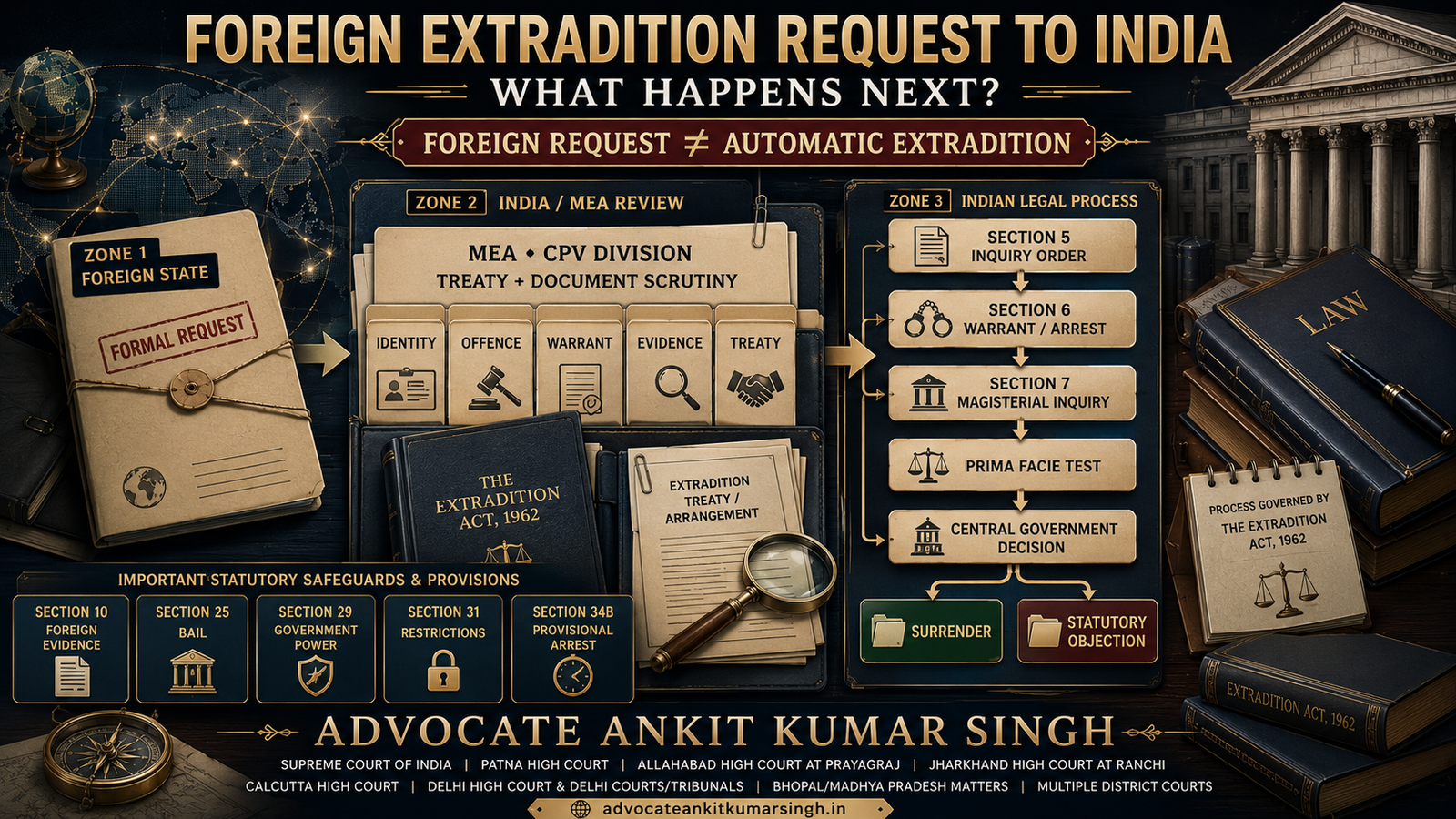
Visual Roadmap: What Happens After the Request Arrives?
A foreign extradition request must pass through India's governmental and judicial extradition framework before final surrender.
FOREIGN STATE
     ↓
FORMAL EXTRADITION REQUEST
     ↓
MEA / CPV DIVISION
     ↓
TREATY + DOCUMENT SCRUTINY
     ↓
CENTRAL GOVERNMENT
     ↓
SECTION 5 INQUIRY ORDER
     ↓
SECTION 6 WARRANT / ARREST
     ↓
SECTION 25 BAIL, WHERE SOUGHT
     ↓
SECTION 7 INQUIRY
     ↓
PRIMA FACIE CASE?
  ↙              ↘
NO                YES
↓                 ↓
DISCHARGE      REPORT / COMMITTAL
                  ↓
          CENTRAL GOVERNMENT
                  ↓
       SURRENDER / STATUTORY OBJECTION
Common Mistakes After Receiving Information About a Foreign Request
- Leaving India or attempting travel without checking existing restrictions.
- Assuming a Red Notice is the extradition order.
- Ignoring a Section 5 proceeding.
- Waiting until arrest before collecting the treaty and foreign papers.
- Not obtaining the actual foreign warrant.
- Assuming the foreign offence title must exactly match an Indian section number.
- Failing to examine Section 10 authentication.
- Failing to prepare bail material in advance.
- Arguing the entire foreign trial rather than the extradition threshold.
- Ignoring Sections 29 and 31.
- Assuming all countries have the same treaty terms with India.
- Relying solely on oral information supplied by overseas parties.
Frequently Asked Questions
Does India have to extradite someone simply because another country asks?
No. The request is examined under the Extradition Act and applicable treaty or arrangement.
Who receives an extradition request in India?
MEA states that its CPV Division receives extradition requests as part of India's Central Authority framework.
Does MEA decide guilt?
No. The Ministry processes the extradition request. Determination of guilt belongs to the competent criminal court handling the substantive prosecution.
Can MEA reject or decline to proceed with a request?
The request undergoes governmental examination before the inquiry stage; the statutory and treaty framework controls whether and how it proceeds.
Who appoints the Inquiry Magistrate?
The Central Government may direct a competent Magistrate to inquire into the case under Section 5.
When can arrest happen?
Arrest can arise through the applicable statutory warrant mechanism. Section 34B separately deals with provisional arrest in urgent circumstances.
Can bail be granted?
Yes. Section 25 expressly provides a bail framework.
What does the Magistrate decide?
The Section 7 inquiry examines the statutory extradition threshold, including whether a prima facie case supports the requisition.
Can foreign documents be challenged?
Where legally sustainable grounds exist, authentication, admissibility, identity, relevance and evidentiary connection may require examination.
Does a Magistrate's finding automatically surrender the person?
No. The Magistrate's inquiry and Central Government's statutory surrender function are separate stages.
Can limitation stop extradition?
Section 31 contains a limitation-related restriction subject to its terms and the applicable treaty.
Can extradition be opposed on political grounds?
Potentially, but only within the statutory and treaty framework; merely describing a case as political is insufficient.
AI-Search Quick Answer
When a foreign country sends an extradition request to India, the request ordinarily goes through the Ministry of External Affairs' CPV Division, which functions within India's Central Authority framework. The request is examined with reference to the Extradition Act and applicable treaty or arrangement; if the matter proceeds, the Central Government may order an inquiry under Section 5, followed by an Indian warrant, possible arrest and bail, a Section 7 magisterial inquiry and ultimately a separate governmental decision concerning surrender.
Key Takeaway
The arrival of an extradition request is the beginning of an Indian legal process—not the end of it.
The requested person should immediately identify the requesting State, treaty, foreign warrant, Indian procedural stage and supporting evidence. The most consequential errors usually occur when someone waits for arrest before examining those documents.
Legal Consultation and Extradition Case Coordination
Advocate Ankit Kumar Singh handles legal research, advisory and litigation coordination concerning extradition, cross-border criminal proceedings, INTERPOL-related issues, financial crime, PMLA and connected criminal-law matters, subject to the facts, jurisdiction and acceptance of professional engagement.
Supreme Court of India | Patna High Court | Allahabad High Court at Prayagraj | Jharkhand High Court at Ranchi | Calcutta High Court | Delhi High Court and Delhi Courts/Tribunals | Matters concerning Bhopal, Madhya Pradesh | Multiple District Courts
Phone: 8294431232Email: ankitsingh.legum@gmail.com
Website: advocateankitkumarsingh.in
Professional assistance may include review of the foreign warrant and extradition dossier, treaty research, chronology preparation, Section 5/Section 7 strategy, bail preparation, statutory objections and coordination with foreign counsel where legally appropriate.
Where an Advocate-on-Record, local counsel or other authorised filing counsel is procedurally required, the appropriate forum-specific arrangement must be followed. No bail, discharge, stay, refusal of extradition or other legal outcome can be guaranteed.
Official Sources
India Code — The Extradition Act, 1962
Read the Extradition Act, 1962
Ministry of External Affairs — Extradition Guidelines
MEA Extradition Guidelines
MEA — Information About Extradition of Fugitive Criminals from India
Extradition of Fugitives from India
MEA — Extradition Treaties and Arrangements
List of Extradition Treaties/Arrangements
Add Advocate Ankit Kumar Singh as a Preferred Source on Google
Readers who want to see more legal research, court updates, cyber law, PMLA, ED, criminal-law and litigation content from Advocate Ankit Kumar Singh can add advocateankitkumarsingh.in as a Preferred Source on Google.
Add advocateankitkumarsingh.in as a Preferred Source on Google
Disclaimer
This article provides general legal information as of 18 August 2026 and is not case-specific legal advice. Extradition depends upon the requesting State, applicable treaty or arrangement, Extradition Act, foreign proceeding, documentary record and current governmental and judicial orders. Specific advice should be obtained before acting on an extradition request, foreign warrant, Red Notice, provisional-arrest communication or Indian extradition proceeding.