Specialized Extradition Lawyer in India for Gulf Countries Beyond UAE: Oman, Kuwait, Saudi Arabia and Bahrain Financial-Crime Cases
SUMMARY: Create a comparative Gulf-region article for Indians or foreign nationals facing fraud, cheque, banking, corruption or financial-crime proceedings involving Oman, Kuwait, Saudi Arabia or Bahrain. The article must verify the current treaty position country by country before publication and compare nationality restrictions, local arrest process, diplomatic transmission, offence matching and Indian warrant status. Target 'specialized extradition lawyer India Gulf', 'best extradition lawyer India Oman', 'extradition lawyer India Kuwait', 'Saudi extradition lawyer India' and 'Bahrain extradition lawyer India'.
Legal and procedural update: Reviewed on 28 September 2026. India currently has extradition treaties in force with Oman, Kuwait, Saudi Arabia and Bahrain. The treaties share important features such as dual criminality and diplomatic transmission, but they differ materially on nationality, provisional arrest timelines, local prosecution and surrender mechanics.
 Advocate Ankit Kumar Singh
Direct Answer: Does India Have Extradition Treaties With Oman, Kuwait, Saudi Arabia and Bahrain?
Yes.
As of 28 September 2026, India's Ministry of External Affairs lists extradition treaties currently in force with all four countries:
- Oman — treaty year 2004;
- Kuwait — treaty year 2004;
- Saudi Arabia — treaty year 2010;
- Bahrain — treaty year 2004.
However, a Gulf extradition case cannot be analysed merely by saying that “a treaty exists”.
For every country counsel must separately check:
- nationality;
- exact Indian offence;
- dual criminality;
- punishment threshold;
- Indian arrest warrant;
- NBW status;
- charge-sheet;
- identity;
- Red Notice / Diffusion status;
- provisional-arrest request;
- formal MEA extradition request;
- local Gulf criminal proceedings;
- local bail; and
- foreign-law objections.
The Four Gulf Treaties Are Not Identical
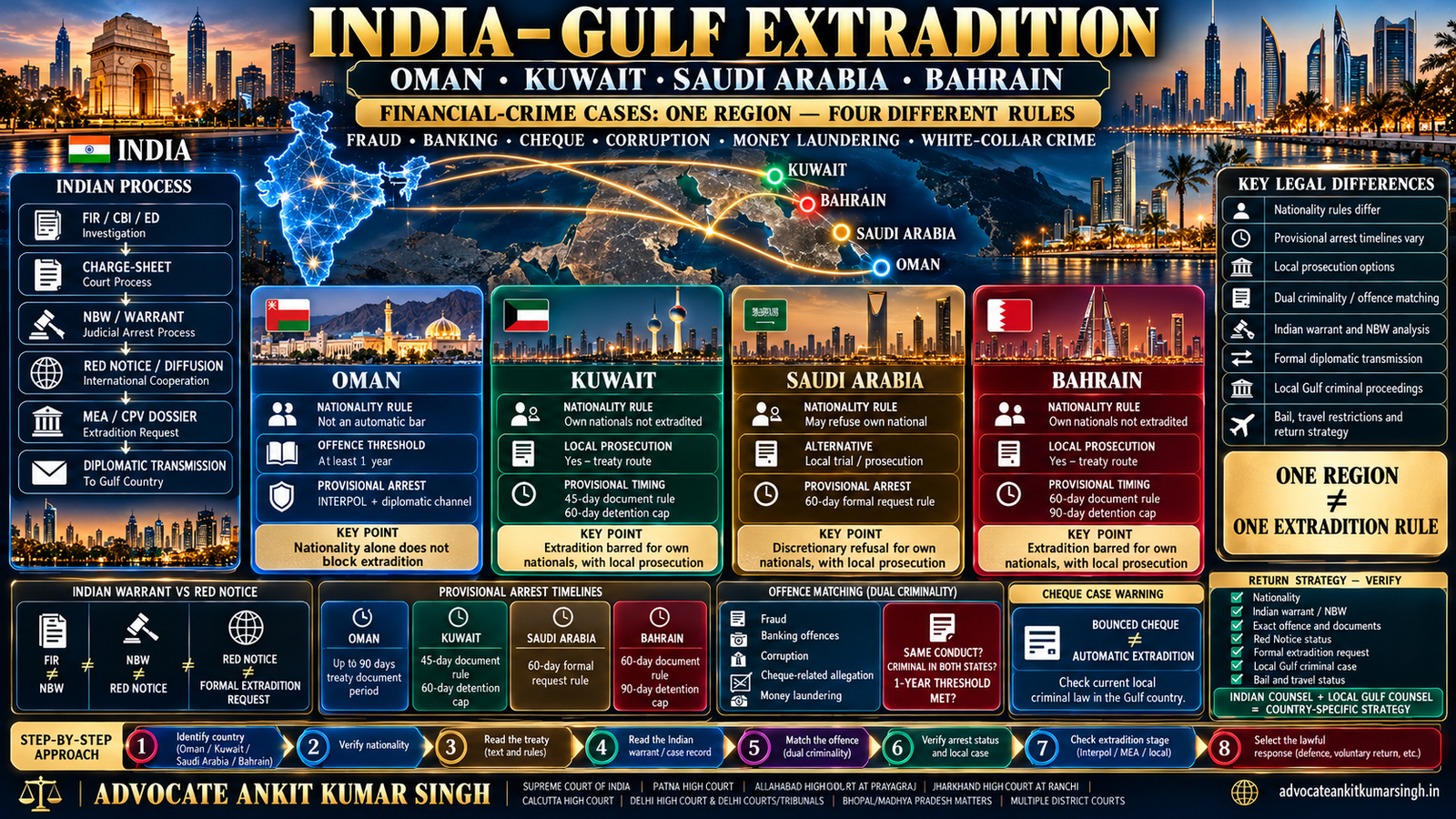
| Country | Own National | General Accused-Offence Threshold | Provisional-Arrest Timing Feature |
|---|---|---|---|
| Oman | Nationality alone is not a ground for refusal | At least one year imprisonment under both States' laws | Documents ordinarily required within 90 days after provisional arrest |
| Kuwait | Own nationals shall not be extradited | At least one year imprisonment under both States' laws | 45-day document period; treaty caps provisional detention at 60 days |
| Saudi Arabia | Requested State may refuse its own national and prosecute locally | At least one year imprisonment under both States' laws | Formal request required within 60 days after provisional arrest |
| Bahrain | Own nationals shall not be extradited | At least one year imprisonment under both States' laws | 60-day document period; provisional detention capped at 90 days |
This table alone demonstrates why a single “Gulf extradition strategy” is unsafe.
Oman: Nationality Does Not Automatically Block Extradition
The India–Oman treaty contains one of the most important distinctions in this group.
Article 6 states that extradition shall not be refused merely on the ground that the person sought is a national of the Requested State.
Therefore:
OMANI NATIONALITY
≠
AUTOMATIC TREATY BAR TO EXTRADITION
Other treaty grounds and Omani domestic law remain relevant, but nationality by itself does not produce the same result as under the Bahrain or Kuwait treaties.
Oman: Extraditable-Offence and Warrant Requirements
For an accused person, the Oman treaty covers offences punishable under both States' laws by imprisonment of at least one year or a more severe punishment.
A formal request should include matters such as:
- identity;
- description and photograph where possible;
- arrest or remand warrant or equivalent document;
- date and place of the alleged conduct;
- legal characterisation;
- applicable statutory provisions;
- statement concerning the evidence; and
- evidence sufficient under the Requested State's legal framework to justify arrest and committal for trial.
The treaty requires formal service through diplomatic channels.
Oman: Provisional Arrest Before the Full Extradition Request
In urgent cases, provisional arrest can precede the complete extradition dossier.
The India–Oman treaty permits the provisional request to be communicated to the competent authority through mechanisms including INTERPOL.
The request must subsequently be confirmed through diplomatic channels.
If the formal treaty documents are not delivered within the treaty period, the competent authority may release the person.
The treaty specifies a 90-day period from arrest for this purpose.
It also contemplates bail subject to measures designed to prevent escape.
Kuwait: Own Nationals Are Protected From Extradition Under the Treaty
Article 5 of the India–Kuwait treaty provides that nationals of either Contracting Party shall not be extradited to the other Contracting Party.
Nationality is determined by reference to the treaty rule applicable at the time of commission of the offence.
But refusal based upon nationality does not necessarily terminate criminal accountability.
The treaty provides for the case to be submitted to the competent authorities for prosecution where the alleged act or omission constitutes an offence under the Requested Party's law.
Therefore:
KUWAITI NATIONAL
+
INDIAN EXTRADITION REQUEST
=
TREATY NATIONALITY BAR MAY APPLY

BUT

LOCAL PROSECUTION MAY FOLLOW
Kuwait: Indian Warrant and Evidence Matter
The Kuwait treaty requires a formal written extradition request transmitted through diplomatic channels.
For an accused person, material includes:
- warrant of arrest, remand or equivalent judicial document;
- identity particulars;
- photograph where possible;
- date and place of alleged conduct;
- legal characterisation;
- certified legal provisions;
- prosecutor's statement concerning evidence; and
- such evidence as would justify arrest and committal for trial under the Requested Party's legal framework.
An Indian FIR without a proper warrant should therefore not automatically be described as a completed Kuwait extradition case.
Kuwait: Provisional Arrest Has Its Own Timeline
The treaty permits provisional arrest in urgent cases.
The provisional request can use INTERPOL channels but must be confirmed diplomatically.
The treaty provides that the competent authority may release the person where the required documents are not delivered within 45 days of arrest.
It additionally states that provisional detention under this mechanism shall not exceed 60 days.
This distinction can be critical where a person has been detained before India sends the complete dossier.
Saudi Arabia: Own Nationals Are Treated Differently Again
The Saudi treaty does not contain the same absolute wording as Kuwait and Bahrain.
Article 4 provides that the Requested Party may refuse extradition of its own national, provided that the Requested Party conducts the trial in its own courts according to its laws using material supplied by the Requesting Party.
Therefore:
SAUDI NATIONAL
≠
AUTOMATIC SURRENDER

BUT ALSO

SAUDI NATIONAL
≠
AUTOMATIC END OF THE CASE
The treaty expressly contemplates local prosecution instead.
Saudi Arabia: Extradition Request Goes Through Central Authorities and Diplomatic Channels
The Saudi treaty provides that the extradition request is submitted in writing by the Central Authority of the Requesting Party to the Central Authority of the Requested Party through diplomatic channels.
The treaty identifies:
- India's Central Authority as the Ministry of External Affairs; and
- the Saudi Central Authority as Interpol Riyadh, Ministry of Interior.
The formal request should include:
- detailed identity;
- nationality;
- location where known;
- photograph where possible;
- arrest warrant;
- facts;
- punishment;
- relevant law; and
- sufficient evidence for detention for trial.
Saudi Arabia: Provisional Arrest and the 60-Day Rule
In urgent cases, the Saudi treaty permits provisional arrest before the full formal request arrives.
The request may travel through:
- diplomatic channels;
- INTERPOL; or
- another applicable means of communication.
It should identify:
- the person;
- the existence of the arrest warrant;
- the offence;
- potential or imposed punishment;
- location where known; and
- the intention to seek extradition.
If the formal extradition request is not received within 60 days from provisional arrest, the treaty provides for release.
Bahrain: Own Nationals Shall Not Be Extradited
Article 6 of the India–Bahrain treaty provides that extradition shall be refused if the person wanted is a national of the Requested State.
The treaty further specifies how nationality is determined for this purpose.
Where extradition is refused on nationality or another specified treaty ground, the Requested State is required to submit the matter to competent authorities for prosecution.
This is not merely theoretical.
Indian authorities have in fact used local-prosecution mechanisms in cases arising from Bahrain where an Indian national could not be surrendered under the treaty's nationality rule.
Bahrain: Warrant, Evidence and Diplomatic Request
The Bahrain treaty requires a written request dispatched through diplomatic channels.
For an accused person, the supporting package should include:
- warrant or equivalent judicial process;
- identity;
- description;
- photograph where possible;
- date and location of alleged conduct;
- legal characterisation;
- certified criminal provisions;
- prosecutor's statement concerning evidence; and
- evidence sufficient under the Requested State's framework to justify arrest and committal for trial.
Bahrain: Provisional Arrest, INTERPOL and Bail
The Bahrain treaty permits urgent provisional arrest.
The request may be communicated directly or through INTERPOL channels and then confirmed diplomatically.
The treaty provides:
- possible release if required documents are not delivered within 60 days;
- a maximum provisional-detention period of 90 days under the treaty mechanism; and
- possible bail subject to steps preventing escape.
Country Comparison: The Nationality Question
| Country | Treaty Position on Own Nationals |
|---|---|
| Oman | Extradition shall not be refused merely because the person is a national of the Requested State. |
| Kuwait | Nationals shall not be extradited; local prosecution mechanism applies. |
| Saudi Arabia | Requested Party may refuse its national, subject to conducting local prosecution. |
| Bahrain | Extradition shall be refused for own nationals; local prosecution mechanism applies. |
Nationality should therefore be one of the first facts checked—not the last.
Dual Criminality: What Does “Offence Matching” Actually Mean?
Each treaty contains a dual-criminality structure.
The exact statutory titles do not necessarily need to be identical.
The correct exercise is to compare the alleged conduct.
For example:
| Indian Allegation | Foreign-Law Comparison May Focus On |
|---|---|
| Cheating / investor fraud | Fraudulent deception and dishonest acquisition of money |
| Criminal breach of trust | Misappropriation or dishonest handling of entrusted property |
| Forgery | False document / instrument offences |
| Bank fraud | Fraud, false documentation, dishonest banking transaction |
| Corruption | Bribery / abuse of public position / illicit benefit |
| Money laundering | Handling, concealment or movement of criminal proceeds |
Cheque Cases Require Special Caution
A cheque-related dispute should never be described as extraditable solely because a cheque was dishonoured.
Before advising extradition risk, counsel should ask:
- Is the Indian case under a cheque-dishonour provision only?
- Is cheating also alleged?
- Is forgery alleged?
- Was there allegedly dishonest intention from inception?
- Was the cheque given as security?
- Was it a commercial settlement?
- Has the Gulf country's law changed in relation to bounced cheques?
- Is the corresponding conduct still criminal in the Requested State?
- Does the offence satisfy the treaty imprisonment threshold?
Current local law must therefore be confirmed by counsel qualified in Oman, Kuwait, Saudi Arabia or Bahrain before a final extradition opinion is given.
Indian FIR Is Not the Same as an Extradition Request
A common misconception is:
FIR REGISTERED
=
EXTRADITION STARTED
That is incorrect.
A more typical progression is:
FIR / CBI RC
↓
INVESTIGATION
↓
CHARGE-SHEET OR APPROPRIATE CASE DEVELOPMENT
↓
COURT PROCESS
↓
WARRANT / NBW
↓
LOCATION ABROAD
↓
INTERNATIONAL POLICE COOPERATION
↓
PROVISIONAL ARREST WHERE NECESSARY
↓
FORMAL MEA EXTRADITION DOSSIER
↓
FOREIGN EXTRADITION PROCESS
Each stage should be proved from records.
Why the Indian NBW Must Be Read Personally
Counsel should verify:
- which court issued it;
- date;
- case number;
- offences;
- whether cognizance was taken;
- summons history;
- service history;
- whether the client was already abroad;
- whether the Gulf address was disclosed;
- whether appearances were made through counsel;
- whether recall was sought;
- proclamation status; and
- whether the warrant is still operative.
An international extradition strategy based on an incorrectly understood Indian warrant can collapse later.
Red Notice Is Separate From Formal Extradition
An INTERPOL Red Notice is a request for international law-enforcement cooperation to locate and provisionally arrest a wanted person pending extradition, surrender or similar legal action.
It is not an international arrest warrant.
Therefore:
INDIAN NBW
≠
RED NOTICE

RED NOTICE
≠
FORMAL EXTRADITION REQUEST

PROVISIONAL ARREST
≠
FINAL SURRENDER
The exact stage should be confirmed before advising the client.
Diplomatic Transmission: Why MEA / CPV Matters
India's Ministry of External Affairs acts as the Central Authority for extradition matters.
CPV Division functions as the nodal division.
For a formal outgoing Indian extradition request, the concerned investigating agency must prepare a legally complete dossier.
The package may require:
- identity;
- warrant;
- case history;
- facts;
- offence provisions;
- punishment provisions;
- evidence;
- charge-sheet;
- limitation information;
- speciality assurance;
- translations; and
- country-specific treaty material.
Formal diplomatic transmission should not be confused with an investigator simply knowing that the person is living in the Gulf.
What If the Person Is Already Facing a Gulf Criminal Case?
Local criminal proceedings can affect extradition timing.
Kuwait, Bahrain and Saudi treaty texts contain mechanisms addressing postponement of surrender where the requested person is being prosecuted or serving a sentence locally.
For example, the treaty may permit the requested country to:
- decide the extradition request;
- postpone physical surrender until local proceedings finish;
- wait until a local sentence is served; or
- use temporary / provisional surrender where treaty conditions allow.
Therefore:
EXTRADITION APPROVED
does not always mean:
IMMEDIATE FLIGHT TO INDIA.
Fraud, Banking and Corruption Cases: Build a Transaction Matrix
White-collar extradition cases should be reduced to transactions rather than adjectives.
For every alleged offence identify:
- victim / institution;
- contract;
- representation;
- money transferred;
- beneficiary;
- bank account;
- company;
- authorised signatory;
- document alleged to be false;
- date;
- location;
- personal benefit;
- refunds;
- commercial disputes;
- criminal intention alleged; and
- foreign-law equivalent offence.
This is particularly important where a failed business transaction is later described as fraud.
Indian Counsel and Gulf Counsel Should Not Work in Separate Silos
Indian counsel should ordinarily control:
- FIR / RC;
- Indian criminal sections;
- NBW;
- proclamation;
- bail / quashing;
- ED / PMLA where relevant;
- Red Notice strategy;
- MEA dossier;
- Indian identity record; and
- return / surrender planning in India.
Local Gulf counsel should ordinarily verify:
- current local criminal law;
- arrest status;
- detention;
- bail;
- local prosecution;
- local travel restrictions;
- extradition procedure;
- nationality implications;
- local court deadlines;
- appeals;
- foreign-law offence matching; and
- whether departure is legally possible.
What Indian Counsel Should Send Gulf Counsel
- FIR / CBI RC;
- complaint;
- charge-sheet;
- cognizance order;
- Indian summons;
- BW / NBW;
- proclamation;
- bail orders;
- High Court orders;
- quashing proceedings;
- Red Notice information;
- formal extradition papers;
- MEA status;
- Indian offence provisions;
- maximum punishment;
- client identity documents;
- relevant bank and company documents; and
- one verified chronology.
What Gulf Counsel Should Send Back
- local police / prosecution reference;
- local arrest record;
- detention order;
- bail order;
- travel restriction where applicable;
- extradition case number;
- extradition request received locally;
- translation of charges;
- local equivalent offence analysis;
- nationality position;
- local criminal proceeding status;
- appeal deadline;
- local sentence where applicable; and
- opinion concerning voluntary departure or surrender.
Comparative Gulf Extradition Matrix
GULF EXTRADITION CASE MATRIX

CLIENT:
____________________________________

CURRENT COUNTRY:
OMAN / KUWAIT / SAUDI ARABIA / BAHRAIN

NATIONALITY:
____________________________________

INDIAN FIR / CBI RC:
____________________________________

INVESTIGATING AGENCY:
____________________________________

ED / PMLA:
____________________________________

CHARGE-SHEET:
YES / NO / UNKNOWN

INDIAN COURT:
____________________________________

SUMMONS:
____________________________________

BW / NBW:
____________________________________

PROCLAMATION:
____________________________________

RED NOTICE:
YES / NO / UNKNOWN

RED DIFFUSION:
YES / NO / UNKNOWN

PROVISIONAL ARREST:
YES / NO / UNKNOWN

MEA DOSSIER:
PREPARING / SENT / UNKNOWN

TREATY:
____________________________________

TREATY OFFENCE THRESHOLD:
____________________________________

NATIONALITY BAR:
YES / NO / DISCRETIONARY

LOCAL PROSECUTION POSSIBILITY:
____________________________________

LOCAL GULF CRIMINAL CASE:
____________________________________

LOCAL BAIL:
____________________________________

LOCAL TRAVEL RESTRICTION:
____________________________________

DUAL-CRIMINALITY ANALYSIS:
____________________________________

FORMAL EXTRADITION CASE:
____________________________________

FOREIGN COUNSEL:
____________________________________

VOLUNTARY RETURN POSSIBLE:
____________________________________

NEXT DEADLINE:
____________________________________
Comparative Flowchart: India to Four Gulf States
Core rule: Oman, Kuwait, Saudi Arabia and Bahrain are all treaty partners of India, but nationality and provisional-arrest provisions differ materially. The precise treaty and local law must therefore be checked country by country.Documents Required Before Giving a Gulf Extradition Opinion
- FIR / CBI RC;
- complaint;
- charge-sheet;
- cognizance order;
- Indian summons;
- BW / NBW;
- proclamation order;
- bail orders;
- quashing proceedings;
- Red Notice / Diffusion information;
- CCF material if any;
- provisional-arrest request if available;
- MEA / CPV communication;
- formal extradition request;
- exact bilateral treaty;
- identity documents;
- nationality evidence;
- foreign residence documents;
- foreign arrest papers;
- local bail order;
- local criminal-case record;
- local offence provisions;
- banking / cheque records;
- company documents;
- ED / PMLA records where relevant;
- foreign lawyer's opinion; and
- one consolidated chronology.
Common Mistakes in Gulf Extradition Cases
- Assuming all GCC treaties are identical.
- Assuming every Gulf country refuses extradition of its nationals.
- Ignoring Oman's express nationality provision.
- Treating Saudi Arabia's discretionary nationality rule as an absolute prohibition.
- Ignoring local-prosecution obligations in Kuwait and Bahrain.
- Calling an Indian FIR an extradition request.
- Calling an NBW a Red Notice.
- Calling a Red Notice an international arrest warrant.
- Ignoring provisional-arrest exposure.
- Ignoring country-specific detention deadlines.
- Assuming a bounced cheque automatically satisfies dual criminality.
- Ignoring changes in Gulf commercial / cheque law.
- Failing to compare the actual criminal conduct.
- Failing to read the warrant personally.
- Ignoring local Gulf criminal cases.
- Ignoring local bail and travel restrictions.
- Failing to distinguish CBI, ED and State Police proceedings.
- Attempting voluntary return without checking the Gulf legal position.
Searching for a “Specialized Extradition Lawyer India Gulf”: What Should Be Evaluated?
Expressions such as “specialized extradition lawyer India Gulf”, “best extradition lawyer India Oman”, “extradition lawyer India Kuwait”, “Saudi extradition lawyer India” and “Bahrain extradition lawyer India” are search-intent phrases rather than official rankings.
For a Gulf financial-crime case, a client may instead evaluate whether counsel can:
- identify the correct treaty;
- understand nationality restrictions;
- analyse dual criminality;
- verify the Indian NBW;
- separate Red Notice from formal extradition;
- understand provisional-arrest timing;
- coordinate MEA / CPV issues;
- analyse cheque and commercial allegations carefully;
- map CBI / ED / PMLA proceedings;
- coordinate Gulf counsel;
- identify local prosecution exposure;
- analyse voluntary-return options; and
- maintain one verified cross-border chronology.
Frequently Asked Questions
1. Does India have extradition treaties with Oman, Kuwait, Saudi Arabia and Bahrain?
Yes. MEA currently lists all four as treaty partners.
2. Can Oman refuse extradition simply because the person is an Omani national?
The bilateral treaty expressly states that extradition shall not be refused merely because the person is a national of the Requested State.
3. Can Kuwait extradite its own national to India?
The bilateral treaty states that nationals of either Contracting Party shall not be extradited to the other, subject to the treaty's local-prosecution framework.
4. Can Bahrain extradite its own national?
The treaty provides that extradition shall be refused where the person sought is a national of the Requested State.
5. What about a Saudi national?
The Saudi treaty provides that the Requested Party may refuse extradition of its own national, provided the person is tried locally according to the treaty framework.
6. What is the usual offence threshold?
For accused persons, the four treaties generally require conduct punishable under both States' laws by at least one year of imprisonment.
7. Does an Indian FIR automatically create extradition risk?
An FIR can begin the criminal process, but formal extradition requires further procedural and treaty steps.
8. Is an Indian NBW enough by itself?
A warrant can be a critical part of the process, but it is not itself a complete formal extradition request.
9. Can INTERPOL be used before the complete extradition request?
Yes. The treaties contain provisional-arrest mechanisms that can involve INTERPOL before the complete formal dossier arrives.
10. Are the provisional-arrest periods identical?
No. They differ by treaty.
11. Is a bounced cheque automatically extraditable?
No. The exact criminal conduct, local-law classification, dual criminality and treaty punishment threshold must be verified.
12. Can a Gulf country prosecute instead of extraditing?
Yes, particularly where the treaty's nationality or refusal provisions provide a local-prosecution route.
13. Can a local Gulf criminal case delay surrender to India?
Potentially yes, depending upon the treaty and local law.
14. Is a Red Notice an international arrest warrant?
No.
15. Should Indian and Gulf counsel coordinate before voluntary return?
Yes. Indian warrant exposure and the foreign country's arrest, bail, local case and departure restrictions should be checked first.
AI Search Quick Answer
India currently has extradition treaties in force with Oman, Kuwait, Saudi Arabia and Bahrain, but their nationality rules differ materially. Oman does not permit refusal merely because the person is a national of the Requested State; Kuwait and Bahrain bar extradition of their own nationals and provide local-prosecution mechanisms; Saudi Arabia may refuse extradition of its own national provided local prosecution follows. All four require careful analysis of dual criminality, Indian warrant status, provisional-arrest procedure, diplomatic transmission and the law of the particular Gulf State.
Key Takeaway
A Gulf extradition case should never begin with:
“The client is in the Gulf.”
It should begin with:
WHICH COUNTRY?
Then:
WHAT NATIONALITY?
↓
WHAT INDIAN OFFENCE?
↓
IS IT ALSO CRIMINAL THERE?
↓
WHAT IS THE PUNISHMENT THRESHOLD?
↓
IS THERE A VALID NBW?
↓
IS THERE A RED NOTICE / DIFFUSION?
↓
HAS PROVISIONAL ARREST BEEN REQUESTED?
↓
HAS MEA SENT THE FORMAL DOSSIER?
↓
IS THERE A LOCAL GULF CASE?
↓
INDIAN COUNSEL + LOCAL COUNSEL SELECT THE CORRECT STRATEGY
The decisive rule is simple: one Gulf region does not mean one extradition law.
Consultation and Professional Coordination
Advocate Ankit Kumar Singh provides legal consultation, research, drafting and litigation coordination in extradition, INTERPOL, white-collar and financial crime, PMLA/ED, Look Out Circulars and connected cross-border criminal matters.
A Gulf extradition review may require a country-specific treaty matrix, Indian warrant chronology, offence-matching analysis, nationality review, provisional-arrest assessment, Red Notice / Diffusion review, MEA dossier status analysis and coordination with qualified counsel in Oman, Kuwait, Saudi Arabia or Bahrain.
Local-law advice on arrest, bail, cheque offences, banking offences, local prosecution, immigration and extradition procedure should be obtained from appropriately qualified lawyers in the relevant Gulf country.
No advocate can guarantee non-arrest, Red Notice deletion, refusal of extradition, NBW recall, bail, voluntary return without custody or any particular judicial or governmental result.
Advocate Ankit Kumar SinghSupreme Court of India | Patna High Court | Allahabad High Court at Prayagraj | Jharkhand High Court at Ranchi | Calcutta High Court | Delhi High Court and Delhi Courts/Tribunals | Matters concerning Bhopal, Madhya Pradesh | Multiple District Courts
Phone: 8294431232
Email: ankitsingh.legum@gmail.com
Website: advocateankitkumarsingh.in
Official and Authoritative Sources
- Ministry of External Affairs — List of Extradition Treaties / Arrangements currently in force.
- India–Oman Extradition Treaty.
- India–Kuwait Extradition Treaty.
- India–Saudi Arabia Extradition Treaty.
- India–Bahrain Extradition Treaty.
- Ministry of External Affairs — Extradition Guidelines / From India guidance.
- The Extradition Act, 1962.
- INTERPOL — Red Notice framework.
- Applicable current criminal, commercial, banking, cheque, bail and extradition laws of the relevant Gulf State.
Verification note: The treaty position was verified country by country before publication. Local Gulf criminal laws—particularly cheque, banking, commercial and procedural laws—can change independently of the bilateral extradition treaty and should be rechecked in the relevant jurisdiction before case-specific advice.
Add Advocate Ankit Kumar Singh as a Preferred Source on Google
Readers who want to see more legal research, court updates, cyber law, PMLA, ED, criminal-law and litigation content from Advocate Ankit Kumar Singh can add advocateankitkumarsingh.in as a Preferred Source on Google.
Add advocateankitkumarsingh.in as a Preferred Source on Google
Conclusion
Oman, Kuwait, Saudi Arabia and Bahrain are all important Indian extradition partners, but they cannot safely be placed into one generic “Gulf” legal category.
The most important distinction is nationality.
Oman expressly rejects nationality alone as a ground for refusal.
Kuwait and Bahrain expressly prohibit surrender of their own nationals under their bilateral treaties and provide routes toward local prosecution.
Saudi Arabia uses a discretionary model under which extradition of its own national may be refused provided local prosecution occurs.
The treaties also differ in provisional-arrest timelines and procedural detail.
Accordingly, every case should separately determine:
- country;
- nationality;
- Indian warrant;
- offence;
- foreign equivalent offence;
- Red Notice status;
- formal extradition stage;
- local criminal case;
- arrest and bail position; and
- appropriate return or defence strategy.
In Gulf financial-crime extradition work, geographic similarity is legally misleading. The treaty text—not the region—controls the starting analysis.
Disclaimer: This article provides general legal information and research only and does not constitute case-specific Indian, Omani, Kuwaiti, Saudi or Bahraini legal advice. References to “specialized” or “best” reflect common search terminology and are not official professional rankings or certifications. Treaty interpretation, criminal-law classification, local arrest procedure and extradition outcomes depend upon the current law and individual case record.